Tag: B’Tselem

  • The verdict of history: How political calculations betrayed Gaza

    Spread the love

    This work by Middle East Monitor is licensed under a Creative Commons Attribution-NonCommercial-ShareAlike 4.0 International License. 

    Palestinians inspect the damage following the Israeli attacks on a health facility belonging to the United Nations Relief and Works Agency for Palestine Refugees in the Near East (UNRWA) in the Sheikh Ridan neighborhood of Gaza City, Gaza on August 6, 2025. [Dawoud Abo Alkas – Anadolu Agency]

    The Israeli human rights organization B’Tselem released a comprehensive report on 27 July describing the Israeli war on Gaza as genocide. However, the delay in publishing such an indictment is troubling and adds to an existing problem of politically motivated decision-making processes that have, in their own right, prolonged the ongoing Israeli war crimes.

    The report accused Israel of committing genocide, a conclusion reached after a detailed analysis of the military campaign’s intent, the systematic destruction of civilian life, and the government-engineered famine. This finding is significant because it adds to the massive body of legal and testimonial evidence affirming the Palestinian position that Israel’s actions in Gaza constitute a genocide.

    Moreover, the fact that B’Tselem is an Israeli organization is doubly important. It represents an insider’s indictment of the horrific massacres and the government-engineered famine in the Strip, directly challenging the baseless argument that accusing Israel of genocide is an act of antisemitism.

    Western media were particularly interested in this report, despite the fact that numerous first-hand Palestinian reports and investigations are often ignored or downplayed. This double standard continues to feed into a chronic media problem in its perception of Palestine and Israel.

    Claims by Palestinians of Israeli war crimes have historically been ignored by mainstream media or academia. Whether the Zionist militia’s massacre of Tantura in 1948, the actual number of Palestinians and Lebanese killed in the massacres of Sabra and Shatila in Lebanon in 1982, or the events resulting in the Jenin massacre in the West Bank in 2002, the media has frequently ignored the Palestinian account. It often gains a degree of validation only if it is backed by Israeli or Western voices.

    The latest B’Tselem report is no exception. But another question must be asked: why did it take nearly two years for B’Tselem to reach such an obvious conclusion? Israeli rights groups, in particular, have far greater access to the conduct of the Israeli army, the statements of politicians, and Hebrew media coverage than any other entity. Such a conclusion, therefore, should have been reached in a matter of two months, not two years.

    This kind of intentional delay has so far defined the position of many international institutions, organisations, and individuals whose moral authority would have helped Palestinians establish the facts of the genocide globally much earlier.

    For example, despite the ICJ’s historic ruling on 26 January 2024, that determined that there are plausible grounds for South Africa’s accusation of Israel of committing genocide, the court is still unable, or unwilling, to produce a conclusive ruling. A definitive ruling would have been a significant pressure card on Israel to end its mass killing in Gaza. 

    READ: Over 14,800 patients in Gaza still in urgent need of medical treatment: WHO

    Instead, for now, the ICJ expects Israel to investigate itself, a most unrealistic expectation at a time when Israeli Prime Minister Benjamin Netanyahu promises his extremist ministers that Israel will encourage the ethnic cleansing of Gaza.

    The same indictment of intentional and politicised delays can be attributed to the International Criminal Court. While it issued arrest warrants for Netanyahu and his former defense minister on November 21, 2024, no concrete action has been taken. Instead, it is the Chief Prosecutor of the court, Karim Khan, who finds himself attacked by the US government and media for having the courage to follow through on the investigation.

    Individuals, too, especially those who have been associated with ‘revolutionary’ politics, the likes of Congresswoman Alexandria Ocasio-Cortez and Senator Bernie Sanders, among others, have been reluctant to act. On 22 March 2024, Ocasio-Cortez refused to use the term genocide in Gaza, going as far as claiming that, while she saw an “unfolding genocide,” she was not yet ready to use the term herself.

    Sanders, on the other hand, who has spoken out repeatedly and strongly against Netanyahu, describing him in an interview with CNN on 31 July as a “disgusting liar,” has had repeated moral lapses since the start of the war. When the term genocide was used by many, far less ‘radical’ politicians, Sanders doubled down during a lecture at a university in Ireland. He said that the word genocide “makes him queasy,” and he urged people to be “careful about it”.

    These are not simply lost opportunities or instances of moral equivocation. They have had a profound and direct impact on Israel’s behavior. The timely intervention of governments, international institutions, high courts, media, and human rights groups would have fundamentally changed the dynamics of the war. Such collective pressure could have forced Israel and its allies to end the war, potentially saving thousands of lives.

    Delays born of political calculation and fear of retribution have given Israel the critical space it needed to carry out its genocide. Israel is actively exploiting this lack of legal and moral clarity to persist in its mass slaughter of Palestinians.

    This must change. The Palestinian perspective, their suffering, and their truths must be respected and honored without needing validation from Israeli or other sources. The Palestinian voice and their rights must be truly centered, not as an academic cliché or political jargon, but as an undeniable, everyday reality.

    As for those who have delayed their verdict regarding the Israeli genocide, no rationale can possibly absolve them. They will be judged by history and by the desperate pleas of Gaza’s mothers and fathers, who tried and failed to save their children from the Israeli killing machine and the world’s collective silence or inaction.

    OPINION: Critical mass achieved: Why the world can no longer ignore Palestine

    This work by Middle East Monitor is licensed under a Creative Commons Attribution-NonCommercial-ShareAlike 4.0 International License. 

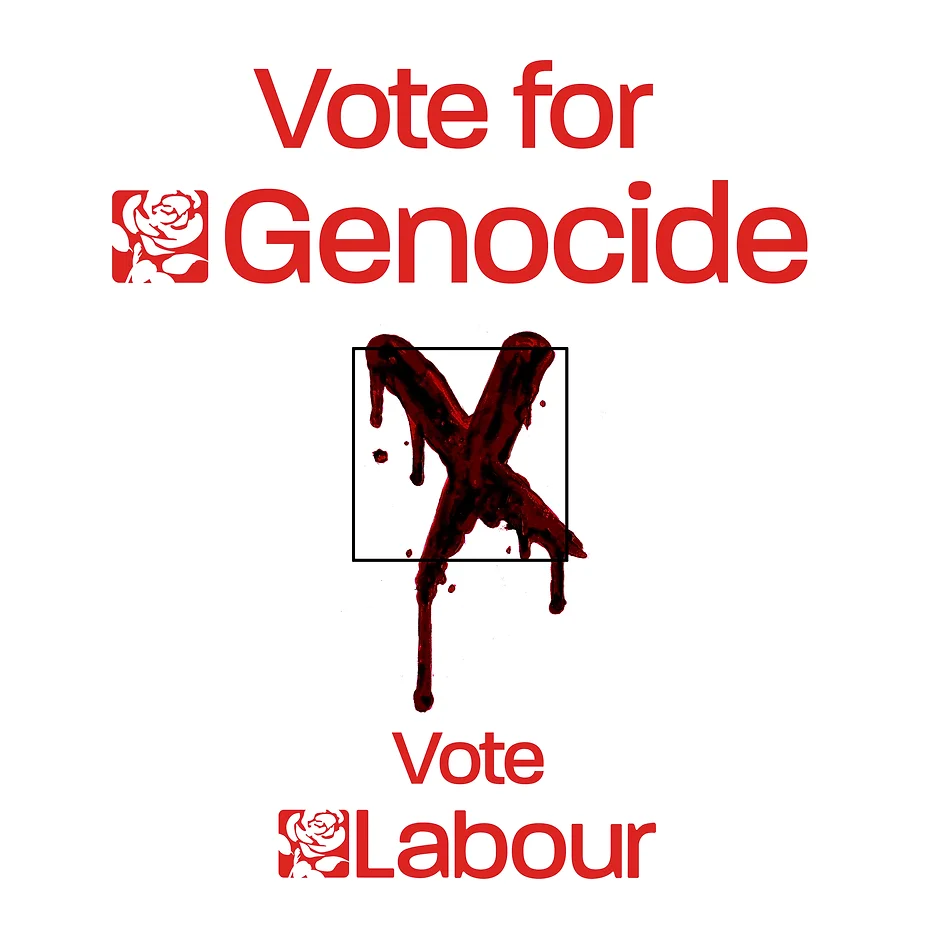
    Keir Starmer objects to criticism of the IDF. He asks how could anyone object to them starving people to death, forced marches like the Nazis did, bombing Gaza's hospitals and universities,mass-murdering journalists, healthworkers and starving people queuing for food, killing and raping prisoners and murdering children. He calls for people to stop obstructing his genocide for Israel.
    Keir Starmer objects to criticism of the IDF. He asks how could anyone object to them starving people to death, forced marches like the Nazis did, bombing Gaza’s hospitals and universities,mass-murdering journalists, healthworkers and starving people queuing for food, killing and raping prisoners and murdering children. He calls for people to stop obstructing his genocide for Israel.
    Vote Labour for Genocide.
    Vote Labour for Genocide.
  • Israeli Rights Group Leader Tells UN It’s Clear Netanyahu ‘Does Not Want’ a Hostage Deal

    Spread the love

    Original article by Jake Johnson republished from Common Dreams under a CC licence.

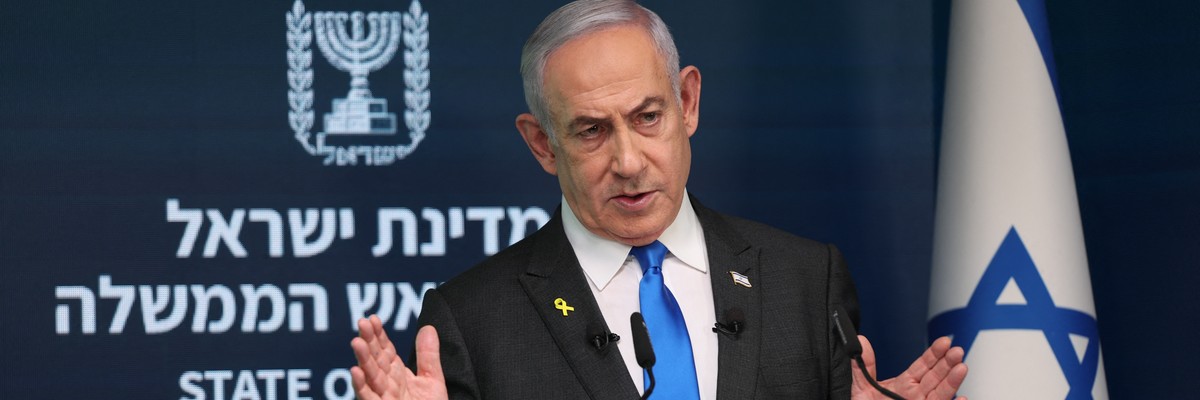
    Israeli Prime Minister Benjamin Netanyahu speaks at a press conference in Jerusalem on September 4, 2024. (Photo: Abir Sultan/Pool/AFP via Getty Images)

    Israel’s far-right government is “cynically exploiting our collective trauma” to “violently advance its project of cementing Israel’s control” over Palestinian land, said B’Tselem CEO Yuli Novak.

    The head of a leading Israeli human rights organization told the United Nations Security Council on Wednesday that Israel’s far-right government, led by Prime Minister Benjamin Netanyahu, obviously “does not want” to reach a hostage-release and cease-fire agreement with Hamas.

    Yuli Novak, the CEO of B’Tselem, said in an address to the U.N. body that the Netanyahu government is “cynically exploiting our collective trauma” in the wake of the October 7 Hamas-led attack to “violently advance its project of cementing Israel’s control” over Palestinian land.

    “To do that, it is waging war on the entire Palestinian people, committing war crimes almost daily,” said Novak. “In Gaza, this has taken the form of expulsion, starvation, killing, and destruction on an unprecedented scale.”

    Watch Novak’s full speech:

    Novak’s remarks came days after Israelis poured into the streets en masse over the weekend following their government’s announcement that Israel Defense Forces (IDF) soldiers recovered the bodies of six hostages in Gaza, heightening outrage over Netanyahu’s obstruction of cease-fire talks.

    In a speech on Monday, Netanyahu doubled down on his new hardline demands that have dampened hopes of a deal to end Israel’s U.S.-backed assault on Gaza and free the more than 60 living hostages still in captivity in the besieged Palestinian enclave.

    Hamas has rejected the prime minister’s demand that any deal include indefinite Israeli military control of the Philadelphi Corridor—a narrow strip of land along Gaza’s border with Egypt—leaving cease-fire talks at a standstill as the war on Gaza nears the 11-month mark.

    Gershon Baskin, a longtime Israeli hostage negotiator who has engaged in back-channel talks with Hamas since the October 7 attack, told Democracy Now! on Wednesday that the Philadelphi Corridor demand “is a made-up issue by Netanyahu to create… a new excuse for Israel to remain in Gaza.”

    “It’s very clear that Netanyahu doesn’t want to end the war,” Baskin said.

    In a social media post earlier this week, Baskin accused Netanyahu of “sacrificing the hostages on an altar of his own personal political survival.”

    The view that Netanyahu is deliberately sabotaging hostage-release talks is hardly fringe: As Jacobin‘s Branko Marcetic observed Wednesday, that assessment has become commonplace across Israeli society, including inside Netanyahu’s government.

    Marcetic cited recent reports from dozens of mainstream Israeli and U.S. media outlets casting Netanyahu—who faces corruption charges in his country—as the primary obstacle to a cease-fire agreement.

    One unnamed Israeli official, identified as a senior member of the country’s government, told the Israeli newspaper Haaretz over the weekend that the blood of hostages “is on [Netanyahu’s] hands.”

    “He knew the hostages are living on borrowed time, that the sand in their hourglass was running out,” said the senior official, referring to the six hostages who, according to the Israeli Ministry of Health, were shot at close range sometime around last Thursday.

    “He knew there were orders to kill them if there’d be rescue attempts. He understood the significance of his orders and acted in cold blood and cruelly,” the Israeli official continued. “They all knew he is corrupted, a narcissist, a coward, but his lack of humanity was fully revealed in all its ugliness in recent months.”

    Original article by Jake Johnson republished from Common Dreams under a CC licence.

  • Israeli Leaders Demand Probe of IDF Rape Video—To Find Out Who Leaked It

    Spread the love

    Original article by BRETT WILKINS republished from Common Dreams under Creative Commons (CC BY-NC-ND 3.0). 

    Israeli Finance Minister Bezalel Smotrich speaks during a rally in Sderot, Israel on October 26, 2022. (Photo: Gil Cohen-Magen/AFP via Getty Images)

    “This is what Israelis rioted to protect, what the Knesset debated—the right to rape Palestinians,” said one critic.

    While human rights groups called for an investigation of a leaked recording apparently showing Israel Defense Forces reservists gang-raping a Palestinian detainee at the Sde Teiman military base and detention center, Israeli leaders including Finance Minister Bezalel Smotrich on Wednesday also furiously demanded a probe of the video—not to seek justice for the victim, but rather to find and punish whoever leaked it.

    Smotrich took to social media Wednesday to call for “an immediate criminal investigation to locate the leakers of the trending video that was intended to harm the reservists and that caused tremendous damage to Israel in the world, and to exhaust the full severity of the law against them.”

    Israeli media on Tuesday aired footage in which Israel Defense Forces (IDF) reservists are seen attacking a Palestinian man at Sde Teiman while trying to hide their actions with shields.

    According to Israeli media reports, the victim was hospitalized with a severe anal injury, ruptured bowel, broken ribs, and lung damage.

    Nine alleged assailants—who include members of Force 100, the military unit tasked with guarding Sde Teiman prisoners—were arrested last week in connection with the attack. A mob of far-right Israelis including senior government officials subsequently stormed two military bases in an attempt to free the suspects.

    While many Israelis condemned the alleged rape, others rallied around the accused reservists. Smotrich described them as “heroic warriors.” National Security Minister Itamar Ben-Gvir called them “our best heroes.”

    Far-right Israeli lawmaker Zvi Sukkot—who took part in last week’s riot—joined Smotrich in demanding an investigation of the video leak.

    “Leaking and disclosure of investigative materials is a criminal offense that harms the proper legal process, the rule of law, public trust, and the principle of justice,” he said Wednesday.

    Israeli media reported Wednesday that two of the accused reservists lied on polygraph tests when asked if they had sodomized the prisoner.

    Numerous Israelis continued to express support for the accused rapists. Israel Today political reporter Yehuda Schlesinger said Wednesday on a popular morning show that “I don’t give a rat’s ass what they do to Hamas man.”

    “First of all, they deserve it,” Schlesinger said of the abuse at Sde Teiman and other Israeli military prisons. “It’s great revenge that we need to give them.”

    “It’s just a shame that we don’t do it in an institutionalized way, as part of regulations for torture of prisoners,” he added, “because then the next guys who think about doing another October 7 will say, ‘Do you see what they’re doing to [us] in Israel?’”

    Etan Nechin, the New York correspondent for the Israeli newspaper Haaretz, accused the media of being the “main culprit” that “has normalized the most extreme voices, letting genocidal brutes, racists, and messianic zealots into Israeli’s TV sets.”

    Some American media critics drew attention to the scant coverage of abuse at Sde Teiman in the U.S. corporate media.

    “U.S. taxpayers continue to support this military and its torture camps,” Palestinian American author and political analyst Yousef Munayyer wrote on social media. “How is this not front-page news?”

    In the United States—which supports Israel’s war on Gaza with billions of dollars in military aid and diplomatic cover—State Department Spokesperson Matthew Miller said during a Wednesday press conference that “there ought to be zero tolerance for sexual abuse, rape of any detainee. Period.”

    “It is appropriate that the IDF in this case, has announced an investigation, has arrested a number of people who are alleged to have been involved, and I won’t speak to the outcome of that investigation, but it ought to proceed swiftly,” Miller added.

    Critics noted the IDF’s chronic failures to credibly investigate its alleged crimes. The Israeli rights group Yesh Din said in late 2022 that less than 1% of Israeli soldiers accused of harming Palestinians in the occupied West Bank and Gaza were indicted over the previous five years.

    The Israeli Supreme Court on Wednesday took up a petition by rights groups seeking to close Sde Teiman, where widespread—and sometimes deadly—torture has been reported. Last month, Israel’s High Court issued a conditional order seeking to shut down the prison in response to the flood of reports of torture there.

    Former prisoners including children and Israeli whistleblowers at Sde Teiman—often called “Israel’s Guantánamo Bay”—have described rampant torture and abuse at the facility, which is used to imprison Palestinians captured in the Gaza Strip. According to their testimonies, prisoners have been raped, electrocuted, mauled by dogs, burned with cigarettes, severely beaten, starved, and subjected to 24-hour shackling sometimes leading to amputations.

    The Israeli human rights group B’Tselem said this week that at least 60 Palestinians have died in Israeli custody since October.

    More than 1,100 Israelis and others died during the Hamas-led attack on October 7, during which more than 240 other people were kidnapped. Israel’s response—which is the subject of an International Court of Justice genocide case—has left more than 142,000 Palestinians dead, maimed, or missing, according to local and international officials.

    Smotrich suggested earlier this week that it is “moral and justified” to starve 2 million Palestinians to death. So far, at least dozens, mostly children, have died from malnutrition, dehydration, and lack of medical care in Gaza amid Israel’s crippling assault and siege.

    Original article by BRETT WILKINS republished from Common Dreams under Creative Commons (CC BY-NC-ND 3.0). 

  • ‘Horror Is Growing By the Minute,’ Says Rights Group, as Israel Starves Gaza

    Spread the love

    Original article by JULIA CONLEY republished from Common Dreams under Creative Commons (CC BY-NC-ND 3.0). 

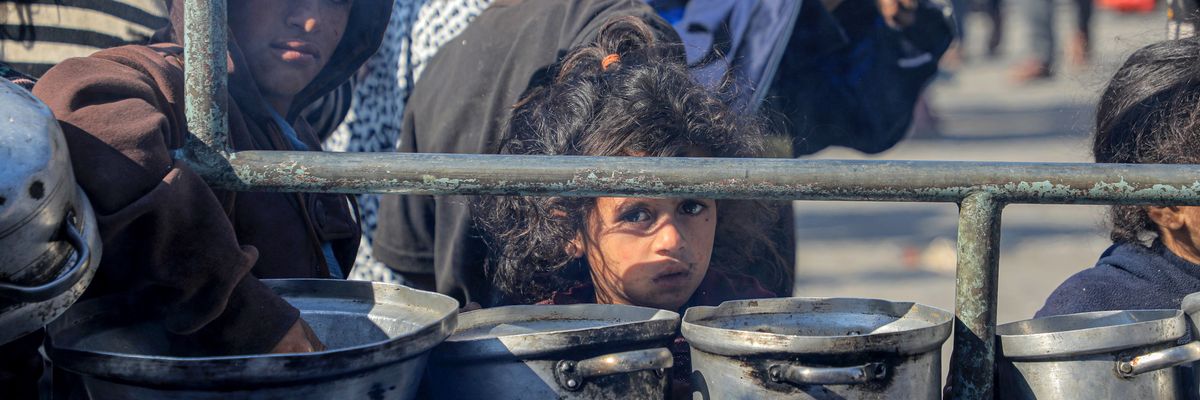
    Children wait for food relief in the southern Gaza Strip city of Rafah on December 31, 2023. (Photo: Rizek Abdeljawad/Xinhua via Getty Images)

    “If current conditions persist,” said Israeli group B’Tselem, “there is significant risk that famine will be declared throughout the entire Gaza Strip within six months.”

    The Israeli government “can, if it chooses to,” save more than 2 million people who are starving in Gaza by ending its blockade on aid, an Israel-based human rights group emphasized in a report on Monday, condemning the country for continuing to allow just a fraction of the food needed in the enclave through border crossings as it relentlessly bombs civilian targets.

    “Everyone in Gaza is going hungry,” said B’Tselem in the dispatch, bluntly titled, “Israel Is Starving Gaza.”

    The organization pointed to a recent analysis by the Integrated Food Security Phase Classification Famine Review Committee from late last month, which found that about 93% of Gaza’s over 2 million people were suffering from “acute food insecurity” at Phase 3, while more than 15%—378,000 people—were already at the most dire classification, Phase 5, with “extreme food shortages, hunger, and exhaustion.”

    By February 7, the entire population of Gaza is expected to reach Phase 3, and “if current conditions persist,” said B’Tselem, “there is significant risk that famine will be declared throughout the entire Gaza Strip within six months.”

    “Such a declaration is made when 20% of households read Phase 5, when 30% of children suffer from extreme malnutrition, and when two adults or four children out of 10,000 die of hunger every day,” said the group.

    Before Israel began its U.S.-backed bombardment of Gaza in retaliation for Hamas’ October 7 attack, about 80% of Gaza residents relied on humanitarian aid to survive.

    Israel’s destruction of cultivated fields, bakeries, food warehouses, and factories has meant that residents now wholly depend on food supplies from outside Gaza.

    That aid is still available, B’Tselem stressed, but cannot reach people because “Israel is deliberately denying the entry of enough food to meet the population’s needs.”

    About 500 aid trucks entered Gaza daily before the assault began, but only about 120 trucks are allowed through just two crossings—Rafah and Kerem Shalom—on a daily basis.

    The Rafah crossing is a designed for passenger vehicles rather than “massive commercial transports,” and the recent opening of the Kerem Shalom crossing was “merely a token addition that has failed to alleviate the hardship,” said B’Tselem.

    “The little food that does get in is very difficult to distribute due to constant bombings, destroyed roads, frequent communications blackouts, and shelters overflowing with hundreds of thousands of [internally displaced people] crowding into smaller and smaller areas,” said the group.

    Israel’s continued blockade has resulted in “children begging for food, people waiting in long lines for paltry handouts, and hungry residents charging at aid trucks,” B’Tselem added. “The horror is growing by the minute, and the danger of famine is real.”

    Martin Griffiths, undersecretary-general for humanitarian affairs and emergency relief coordinator at the United Nations, said late last week that Israel’s air and ground assault on Gaza has rendered the enclave “uninhabitable.”

    “A public health disaster is unfolding,” said Griffiths. “Infectious diseases are spreading in overcrowded shelters as sewers spill over. Some 180 Palestinian women are giving birth daily amidst this chaos. People are facing the highest levels of food insecurity ever recorded. Famine is around the corner.”

    “For children in particular, the past 12 weeks have been traumatic: No food. No water. No school,” he added. “Nothing but the terrifying sounds of war, day in and day out.”

    Last month, Human Rights Watch accused Israel of using starvation as a “method of warfare”—a war crime according to international humanitarian law.

    “Changing this policy is not just a moral obligation,” said B’Tselem. “Allowing food into the Gaza Strip is not an act of kindness but a positive obligation under international humanitarian law: Starvation as a method of warfare is prohibited, and when a civilian population lacks what it needs to survive, parties to the conflict have a positive obligation to allow rapid and unimpeded passage of humanitarian aid—including food.”

    “These two rules are considered customary law,” added the group, “and violating them constitutes a war crime under the Rome Statute of the International Criminal Court.”

    Original article by JULIA CONLEY republished from Common Dreams under Creative Commons (CC BY-NC-ND 3.0). 

  • Human Rights Group Slams Israeli Occupation for Holding Over 1,100 Palestinians Without Trial

    Spread the love

    https://daysofpalestine.ps/human-rights-group-slams-israeli-occupation-for-holding-over-1100-palestinians-without-trial/

    The Israeli use of administrative detention, a controversial practice that allows the Israeli occupation to hold suspects without trial for months or even years, has reached its highest level since 2003, according to a report by an Israeli human rights group, B’Tselem.

    B’Tselem said that as of November 2021, there were 1,128 Palestinians in administrative detention, including 10 minors and two women. The group said this was the largest number of such detainees since the end of the second intifada, or Palestinian uprising, in 2003.

    The group accused the Israeli occupation of using administrative detention as a “tool of oppression” and a “means of collective punishment” against Palestinians, especially those involved in political or social activism. It said that most of the detainees were held based on secret evidence that they and their lawyers could not challenge in court.

    …

    https://daysofpalestine.ps/human-rights-group-slams-israeli-occupation-for-holding-over-1100-palestinians-without-trial/