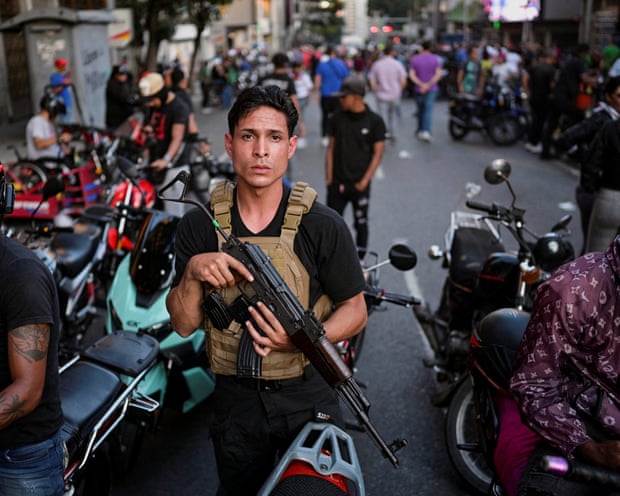
A member of the militia group known as “Colectivos” takes part in a march calling for release of Venezuela’s President Nicolas Maduro, after he and his wife Cilia Flores were captured following U.S. strikes on Venezuela, in Caracas, Venezuela. Photograph: Gaby Oráa/Reuters
“Uncertainty,” said Griselda Guzmán, a 68-year-old pensioner, fighting back tears as she lined up outside a grocery store with her husband to stock up on supplies in case the coming days brought yet more drama.
“Anger,” said Sauriany, a 23-year-old administrative worker from Venezuela’s state-owned electricity company as she queued outside a supermarket on the other side of town with her 24-year-old partner, Leandro.
Leandro voiced shock as the couple waited in a 100-person queue to buy flour, milk and butter alongside a quartet of nuns. “W ho could have imagined that his would happen? That right at the start of the year they’d bomb our country while everyone was asleep?” he asked.
“If I thought it would improve the country I’d welcome it,” Leandro added, as shoppers were allowed into the overcrowded supermarket in small groups. “But I don’t believe this will happen. If they wanted peace, this isn’t the way to achieve it.”
Similarly confused sentiments could be heard all over Caracas on Sunday as its 3 million citizens came to terms with the traumatic nocturnal blitz on their city – a move the governments of Spain, Brazil, Chile, Colombia, Mexico and Uruguay warned set “an extremely dangerous precedent for peace and regional security”.
“It’s all so distressing,” said Gabriel Vásquez, a 29-year-old video-maker, recalling how he had been woken by the sound of a “gigantic” explosion at about 2am on Saturday and how his community in central Caracas was plunged into darkness as aircraft circled overhead.
“I thought that any time my house could get bombed too,” said Vásquez, whose neighbourhood was still in the dark on Sunday. “We have no water, no electricity, no phone reception – nothing,” he complained.
Interior minister and PSUV leader Diosdado Cabello flanked by party militants in a mass demonstration in Caracas on November 25, 2025. Photo: Francisco Trias
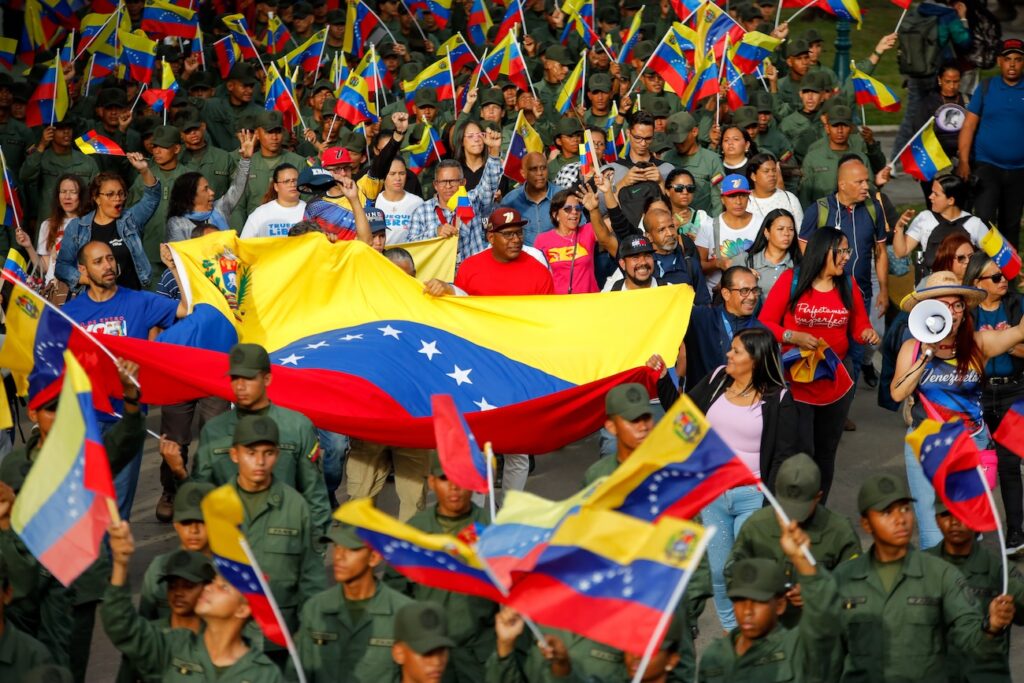
Demonstrators marched through central Caracas and demanded an end to military threats against Venezuela. For his part, Trump is keeping the lines of communication open with Caracas while increasing pressure on Chavista leaders.
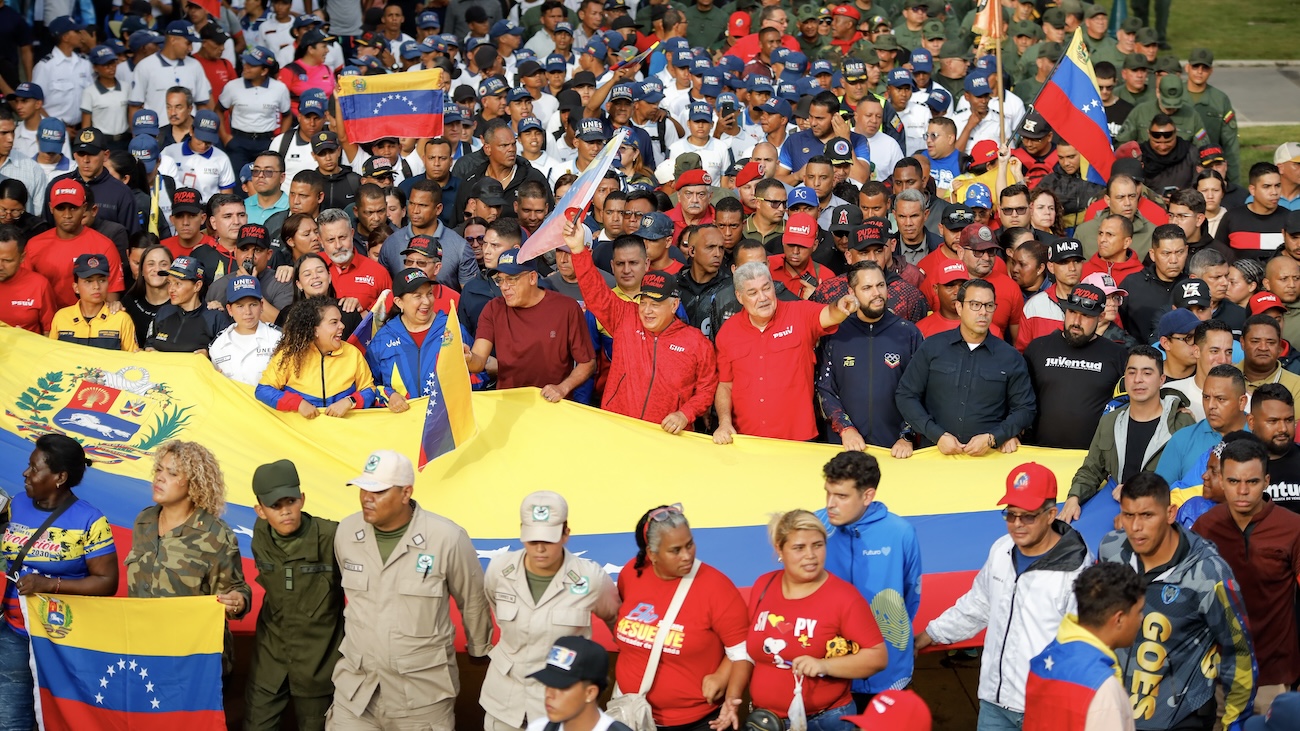
On November 25, tens of thousands of Venezuelans marched to defend national sovereignty. The event, dubbed the “Great Civic-Military, Police March for our National Flag and the Sword of Bolívar”, brought together various groups of military personnel, police, and civilians who demanded an end to Washington’s pressure on the Caribbean country.
Since August, the Pentagon has deployed its troops in the Caribbean Sea to, according to the Trump administration, stop the entry of drugs which allegedly come out of Venezuela. At the same time, they have declared the Cartel de los Soles an international terrorist organization and identified the Venezuelan government leadership as part of that organization.
However, Caracas has categorically rejected the accusations, which, according to Chavismo, are a crude and false attempt to pave the way for the overthrow of President Nicolás Maduro and establish a puppet government allied with the demands and needs of the United States, which would be after Venezuela’s mineral and oil reserves, the largest in the world.
Tuesday’s demonstration took place in the center of Caracas, the country’s capital, and sought to showcase and strengthen the mass popular defense of Venezuela’s sovereignty in the face of possible US military intervention. “Bolívar is more alive than ever among us, the anti-imperialist Bolívar, the genius Bolívar…” said PSUV secretary and Interior Minister Diosdado Cabello.
For several weeks, Chavismo has been preparing for a possible scenario in which it must face an invasion by the world’s largest military power. To this end, it has carried out coordination exercises between the organized bases of Chavismo, the National Bolivarian Militia, and the army and police.
In this regard, Defense Minister Vladimir Padrino emphasized that Washington’s recent actions are intended to cause fear and intimidate the Venezuelan people: “Bombers, ships, destroyers, submarines, all equipped with guided missiles; fighter planes approaching the coast, trying to intimidate a people.” Despite this, he affirmed that Venezuelan forces are ready to respond to any scenario.
During the mobilization, Maduro told attendees: “Venezuela faces a decisive moment for its existence… There is no excuse for anyone, whether civilian, politician, military, or police, to make excuses. Failure is not an option! Our homeland demands our utmost effort and sacrifice.”
Thousands participated in a mass mobilization in the center of Caracas on November 25, 2025. Photo: Francisco Trias
Trump’s ambiguity
For its part, the Trump administration continues to maintain an ambiguous stance on the situation in Venezuela. On the one hand, it has ordered the Cartel de los Soles to be declared a terrorist organization, which, according to Washington’s official line, makes Maduro the leader of a terrorist group.
However, Trump is aware of the enormous political damage that an attack on Venezuela could cause his administration. Perhaps that is why he is not ruling out the possibility of forcing Maduro out through hard diplomacy, namely through the pressure his troops are exerting on Venezuela’s borders in the Caribbean Sea.
On November 25, Trump said: “If we can save lives, if we can do things the nice way, that’s fine… [But] if we have to do it the hard way, that’s fine too.”
Many have seen the upcoming visit to the Dominican Republic by Pete Hegseth, the US Secretary of War, as a new maneuver to strengthen their military positions. Dominican President Luis Abinader, an ally of Washington, reported that the purpose of the visit is to strengthen the joint fight against drug trafficking in the region, which can be interpreted as an alliance in preparation for a war scenario in the Caribbean Sea.
Similarly, the Chief of Staff of the United States, Dan Caine, has been touring the Caribbean. Caine is one of the architects of Operation Southern Spear, the US Southern Command (SOUTHCOM) mission launched on November 13, 2025 by US Secretary of War Pete Hegseth to “removes narco-terrorists from our Hemisphere, and secures our Homeland from the drugs that are killing our people.” Presumably, though it is not clarified, the operation is a continuation of the military deployment and pressure campaign that began in August which has seen 15,000 soldiers stationed in the Caribbean and the launching of attacks on dozens of boats, resulting in the extrajudicial killings of over 80 people in international waters who, according to Washington, were carrying drugs in their boats, although several human rights organizations have strongly questioned these claims.
For his part, Albert Ramdin, the Secretary General of the Organization of American States, has called for a halt to a possible attack on Venezuela, despite his critical stance against the Chavista government: “We do not want any war in our hemisphere. Peace is, ultimately, what everyone in this hemisphere wants. No one wins in a war.”
Donald Fuhrump says that Amerikkka doesn’t bother with crimes or charges anymore, not being 100% Amerikkkan and opposing his real estate intentions is enough.Elon Musk urges you to be a Fascist like him, says that you can ignore facts and reality then.
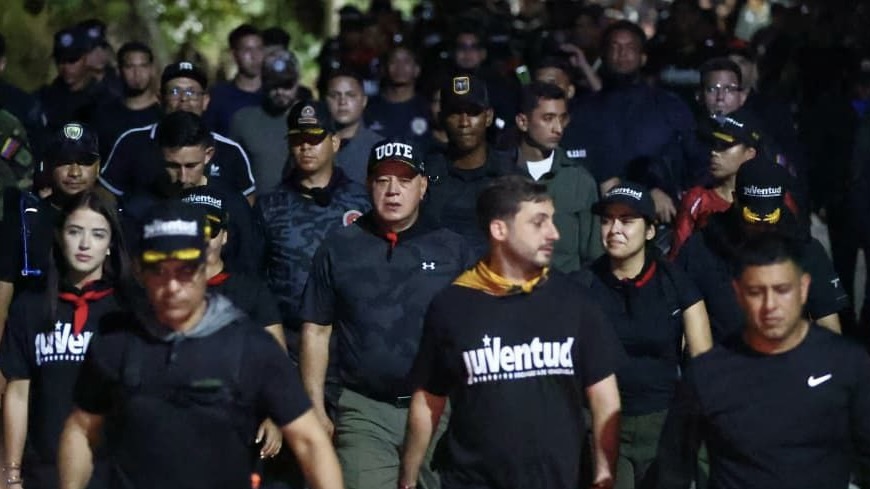
Youth of the PSUV carried out a week of training, culminating in a 10k night march led by Diosdado Cabello. Photo: Con el Mazo Dando
As the US escalates its threats against Venezuela, youth of the PSUV engaged in a week-long “Basic Revolutionary Resistance Training”
The youth wing of the United Socialist Party of Venezuela (PSUV) carried out “Basic Revolutionary Resistance Training” over the past week in the Venezuelan state La Guaira. On the evening of August 28, the youth participated in a 10 kilometer night march led by Secretary General of PSUV, Diosdado Cabello.
The training took place amid rising tensions between Washington and Caracas. The situation flared up when the administration of US President Donald Trump reiterated accusations that the Venezuelan government plays a major role in drug trafficking, increasing the bounty on the head of President Nicolás Maduro, and at the same time deploying troops to the Caribbean to support the US “war on drugs”.
“The socialist youth, with its morale and rebelliousness, is ready for the defense of the Homeland and the construction of the future,” said Cabello who also serves in the administration of the Bolivarian Republic.
The Chavista leader expressed that these trainings seek to build a combative youth in view of recent events that increased pressures on the South American country: “Chávez dreamed it and we are making it a reality, a combatant corps of the youth of the United Socialist Party of Venezuela.”
The activities are taking place after Venezuelan President Nicolás Maduro, called on all branches of the Armed Forces, including the militia, and the PSUV to be on high alert and prepared for a potential US attack.
Meanwhile, the military enlistment days organized by Chavismo continue to advance throughout Venezuela. According to Venezuelan authorities, “thousands of people have responded to the government’s call to join the ranks of the national defense.”
Vice President Delcy Rodríguez said in this regard: ‘’The workers are highly conscious of what it means to defend our homeland; today we heed the call of President Nicolás Maduro to defend our nation…We are ready to defend the social happiness of our people, to defend the future, to defend Venezuela’s right to exploit and develop its productive capacities.”
The United States continues to reinforce military and diplomatic positions.
On August 14, US Secretary of State Marco Rubio announced the deployment of several military vessels in the southern Caribbean Sea after declaring that Maduro is the alleged leader of the so-called Cartel de los Soles.
This organization has already been designated as a terrorist organization by Washington, which many analysts have seen as a tactic to attack Venezuela and thus overthrow the Chavista government.
In addition, several US allies in South America, Ecuador, Paraguay and Argentina, have also declared the Cartel de los Soles as an international terrorist organization, which can be interpreted as a form of alignment behind Washington’s geopolitical pretensions.
However, other countries in the region such as Colombia and Mexico, led by progressive presidents Gustavo Petro and Claudia Sheinbaum respectively, have expressed that they will not support a military intervention on Latin American soil as they consider that it goes against the principle of non-intervention that characterizes the foreign policy of several countries in the region.
“We will never be in favor of intervention by a foreign country.”
🇲🇽In her daily morning press conference, Mexican President Claudia Sheinbaum responded to a question by a journalist about a possible US military intervention in Venezuela. pic.twitter.com/XJ3DUJCmJF
Washington continues to reinforce its military positions in the Caribbean, specifically in Curacao and Guyana, countries that have granted permission to the US military to dock in their coasts.
Meanwhile, US Secretary of State Marco Rubio, has begun a tour of Latin America and the Caribbean to seek greater support for the Trump administration’s position on Venezuela and to rally more support for his regional strategy. Mexico and Ecuador will be part of Rubio’s tour.
Donald Fuhrump says that Amerikkka doesn’t bother with crimes or charges anymore, not being 100% Amerikkkan and opposing his real estate intentions is enough.Elon Musk urges you to be a Fascist like him, says that you can ignore facts and reality then.