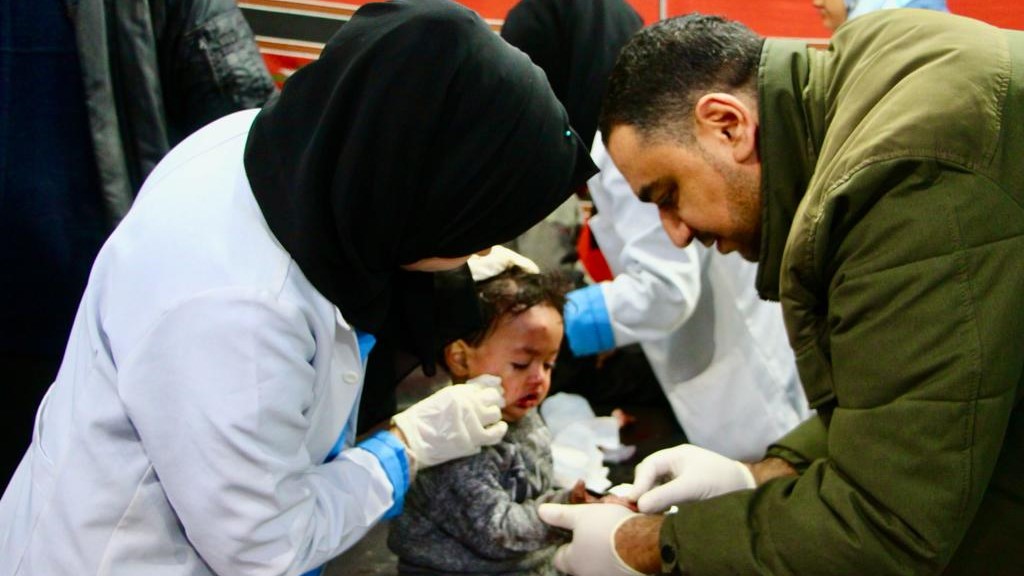
Children in Gaza are becoming increasingly hungry and unhealthy as the destruction of healthcare infrastructure exacerbates the spread of infectious diseases
The health of children in Gaza is deteriorating rapidly. Between June and October 2024, Nasser Medical Complex treated 300 children daily for infectious diseases like diarrhea, respiratory issues, and skin infections. These numbers are compounded by Israeli attacks on hospitals, obstruction of humanitarian aid, and the dire living conditions faced by more than one million forcibly displaced Palestinians preparing for winter in makeshift shelters.
The situation is equally critical regarding hunger and related conditions among children. Since the beginning of the year, nearly 33,000 children have been admitted for acute malnutrition. Health workers have also reported a rise in cases of nutritional edema, a condition that causes swelling due to a lack of protein intake. For over a year, children in the Gaza Strip have struggled to access adequate nutrition because of Israel’s blockades.
Child health experts have repeatedly warned about the long-term consequences of hunger for generations growing up in Palestine. Now, they caution that “there are clear signs of a rapidly worsening nutritional situation across Gaza, with two-thirds of the children admitted for outpatient treatment of acute malnutrition since the beginning of 2024 recorded in the past five months alone.”
Many child health services have been damaged or destroyed by Israeli attacks, leaving families reliant on sparse healthcare facilities still providing support. Doctors Without Borders (MSF) recently reported that, as a result, many mothers are forced to undertake dangerous journeys on foot to access healthcare for their infants. These journeys, MSF stated, expose both mothers and children to potential attacks and “put them [ill children] at high risk of health complications.”
“Even after receiving treatment, newborns and children return to unsanitary living conditions, which in turn leads to a deterioration of their health conditions and ability to heal properly,” MSF said. “My son doesn’t laugh, doesn’t play, doesn’t drink milk. He sleeps all the time,” a forcibly displaced mother shared with MSF.
Poor hygiene conditions, resulting from Israeli bombardment of water and sanitation infrastructure, are set to worsen further as the rainy season progresses. Thousands of tents have already been destroyed by heavy rains in recent days. Humanitarian agencies expect that heavy rainfall and rising sea tides will make sewage accumulation worse, fueling the spread of disease.
Meanwhile, Israeli attacks on healthcare facilities and other civilian infrastructure in Gaza continue. Kamal Adwan Hospital in northern Gaza is still being targeted, including by quadcopters, resulting in damage to essential medical equipment and critical injuries to more healthcare personnel. Among the injured is the hospital’s director, Hussam Abu Safiya.
Israeli authorities are still trying to justify the attacks by alleging the presence of Palestinian resistance groups in the hospitals they are attacking, despite not providing any proof. However, UN human rights experts emphasize that even if such claims were true, “Israeli forces are still bound by their obligations under international humanitarian law.”
“The manner in which this Israeli operation [the attack on Kamal Adwan] has been conducted is raising concerns about the likelihood that northern Gaza will be emptied of Palestinians through death and displacement,” the UN Human Rights Office in Palestine stated.
People’s Health Dispatchis a fortnightly bulletin published by thePeople’s Health Movementand Peoples Dispatch. For more articles and subscriptions to People’s Health Dispatch, clickhere.
dizzy: Israel’s genocides should be regarded as a joint enterprise involving the United States, United Kingdom and Israel.
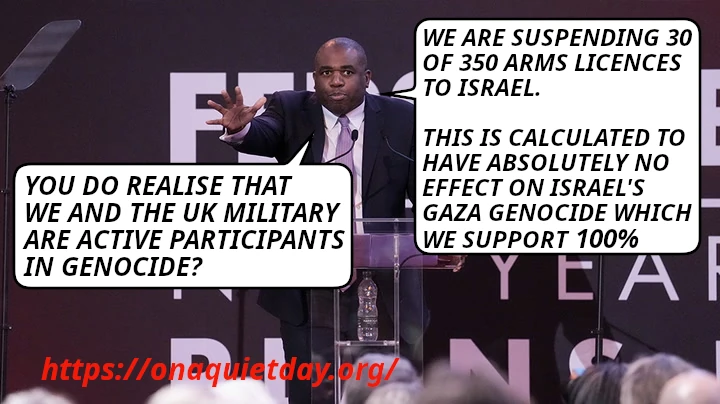
Genocide denier and Current UK Prime Minister Keir Starmer is quoted that he supports Zionism without qualification. He also confirms that UK air force support has been essential in Israel’s mass-murdering genocide. Includes URLs https://www.declassifieduk.org/keir-starmers-100-spy-flights-over-gaza-in-support-of-israel/ and https://youtu.be/O74hZCKKdpAGenocide denying UK Foreign Secretary David Lammy says that UK is suspending 30 of 350 arms licences to Israel. He also confirms the UK government’s support for Israel’s Gaza genocide and the UK government and military’s active participation in genocide.
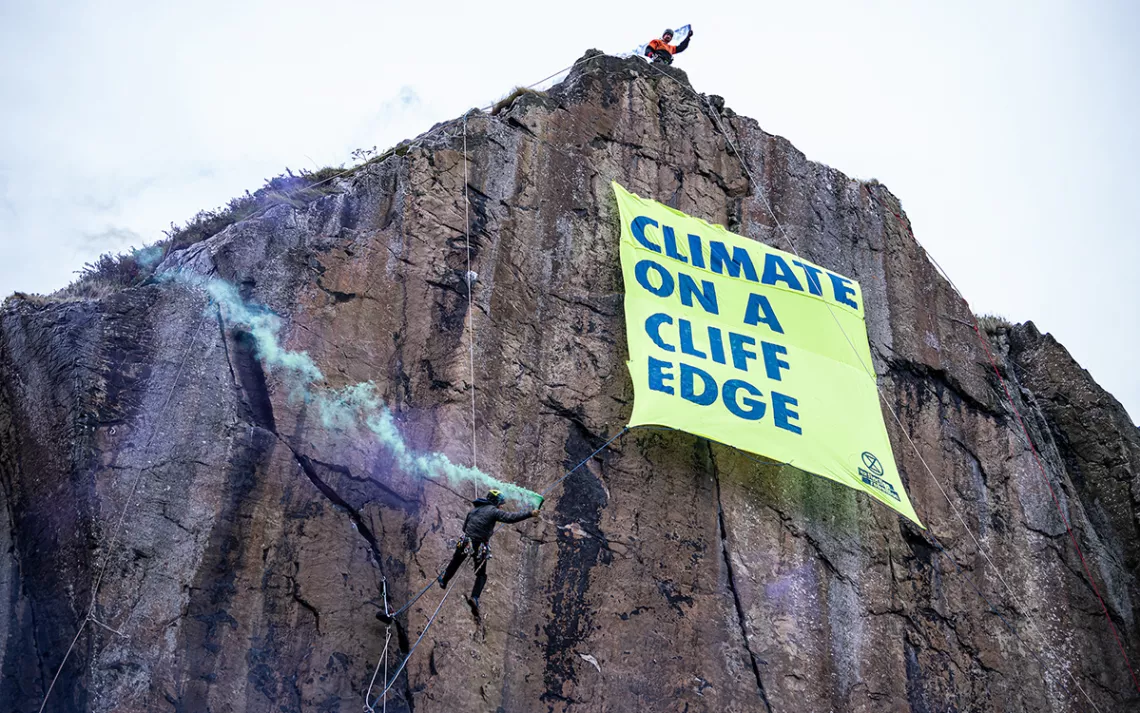
Experienced climbers scale a rock face near the historic Dumbarton castle in Glasgow, releasing a banner that reads “Climate on a Cliff Edge.” One activist, dressed as a globe, symbolically looms near the edge, while another plays the bagpipes on the shores below. | Photo courtesy of Extinction Rebellion and Mark Richards
Without action on climate crisis, far greater numbers will also experience floods, wildfires and droughts, according to report
Eight times as many children around the world will be exposed to extreme heatwaves in the 2050s, and three times as many will face river floods compared with the 2000s if current trends continue, according to the UN.
Nearly twice as many children are also expected to face wildfires, with many more living through droughts and tropical cyclones, according to the annual state of the world’s children report.
…
The report, released on Wednesday, World Children’s Day, forecasts how the climate crisis, demographic shifts (sub-Saharan Africa and south Asia are projected to have the largest child populations in the 2050s) and breakthrough technologies will affect children’s lives in the future.
The report said technologies such as artificial intelligence (AI) will bring benefits and risks to children, who are already interacting with AI embedded in apps, games and learning software. The digital divide remains stark, however. In 2024, almost 95% of people in high-income countries are connected to the internet, compared with about 25% in low-income countries.
“Children are experiencing a myriad of crises, from climate shocks to online dangers, and these are set to intensify in the years to come,” said Catherine Russell, Unicef’s executive director. “The decisions world leaders make today – or fail to make – define the world children will inherit … Decades of progress, particularly for girls, are under threat.”
Much of the emphasis of the report is on the impact of the climate crisis on children, nearly half of whom (approximately 1 billion) live in countries that face a high risk of environmental disasters. Even before they take their first breath, children’s brains, lungs and immune systems are susceptible to pollution, disease and extreme weather. As they grow, their education, nutrition, safety, security and mental health are shaped by the climate and environment.
Greenpeace activists display a billboard during a protest outside Shell headquarters on July 27, 2023 in London. (Photo: Handout/Chris J. Ratcliffe for Greenpeace via Getty Images)
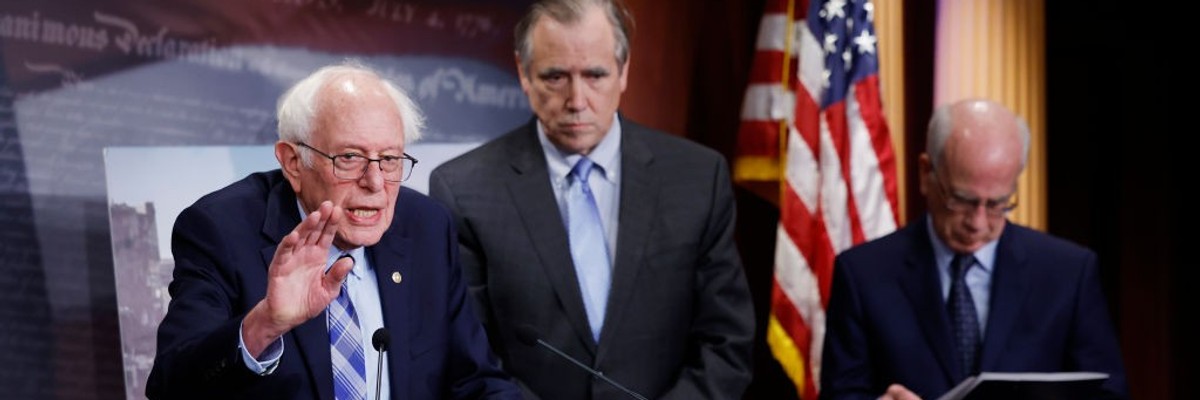
U.S. Sen. Bernie Sanders (I-Vt.), joined by Sen. Jeff Merkley (D-Ore.) and Sen. Peter Welch (D-Vt.), speaks at a news conference on November 19, 2024 in Washington, D.C. (Photo: Kevin Dietsch/Getty Images)
“The United States government is currently in violation of the law, and every member of the U.S. Senate who believes in the rule of law should vote for these resolutions,” said Sen. Bernie Sanders.
A group of U.S. senators led by Bernie Sanders of Vermont held a press conference Tuesday urging their colleagues to support resolutions that would block the sale of tank rounds, bomb kits, and other weaponry to the Israeli government, which has repeatedly used such arms to commit horrific war crimes in the Gaza Strip over the past 13 months.
“The truth of the matter is, from a legal perspective, these resolutions are not complicated; they’re cut and dry,” said Sanders (I-Vt.), who introduced the joint resolutions of disapproval in September alongside several other members of the Senate Democratic caucus.
“The United States government is currently in violation of the law, and every member of the U.S. Senate who believes in the rule of law should vote for these resolutions,” Sanders continued, pointing to U.S. statutes prohibiting the sale of weaponry to countries violating internationally recognized human rights or obstructing American humanitarian aid.
Sanders was joined at Tuesday’s press conference by Sens. Peter Welch (D-Vt.), Jeff Merkley (D-Ore.), and Chris Van Hollen (D-Md.), each of whom made their case to fellow senators ahead of a scheduled floor vote on Wednesday.
“What’s unfolding before our very eyes right now is mass starvation and the spread of disease,” said Welch. “Is the United States and its foreign policy… forced to be blind to the suffering before our very eyes?”
Surrounding the senators as they spoke were photographs of destruction and emaciated children in Gaza, where most of the population is displaced and crowded into small segments of the enclave as Israeli bombs rain down and famine takes hold.
Watch the full press conference:
The resolutions will hit the floor for a vote Wednesday with the backing of a broad coalition that includes Jewish Voice for Peace Action, the Council on American-Islamic Relations, J Street, the Service Employees International Union (SEIU), Oxfam, and other organizations and activists.
“For over a year, the Biden administration has funded the Israeli government’s brutal genocide of Palestinians in Gaza, despite overwhelming opposition from across the country,” said Beth Miller, political director of Jewish Voice for Peace Action, which said it has driven more than 56,200 letters and more than 20,790 phone calls to senators imploring them to support the measures.
“These joint resolutions of disapproval are one of the last chances that Senate Democrats have before Republicans take control in January to uphold human rights, honor the will of the American people, and stand on the right side of history by blocking weapons to the Israeli military,” Miller added.
“It is time to tell the Netanyahu government that they cannot use U.S. taxpayer dollars and American weapons in violation of U.S. and international law, and in violation of our moral values.”
Since the October 2023 Hamas-led attack on Israel, the U.S. has supplied its ally with more than 50,000 tons of weaponry and approved billions of dollars in additional arms and military equipment to be delivered in years to come. U.S. military support has helped Israel carry out a large-scale military assault on Gaza, killing more than 43,000 people so far—a majority of them women and children.
To sustain the flow of American weapons, the Biden administration has contradicted the findings of its own experts and outside analysts by declaring publicly that it has not found Israel to be illegally blocking U.S. humanitarian aid in the Gaza Strip. Meanwhile, aid groups on the ground say humanitarian assistance has plummeted to an all-time low in recent weeks, with an average of just 37 aid trucks entering Gaza per day in October.
During Tuesday’s press conference, Sanders said the “most important point to be made” ahead of Wednesday’s vote is that “the United States of America is complicit in these atrocities.”
“That complicity must end, and that is what these resolutions are about,” said Sanders. “It is time to tell the Netanyahu government that they cannot use U.S. taxpayer dollars and American weapons in violation of U.S. and international law, and in violation of our moral values.”
This post has been updated to correct when Sen. Bernie Sanders introduced the resolutions.
An extra 260,000 children are on the breadline since before the Covid pandemic. Photograph: Orlando Britain/Alamy
Exclusive: Study finds almost quarter of UK population living in poverty, reaching the highest level this century
More than one in three children and a quarter of adults are living in poverty in the UK as deprivation levels rise to the highest in the 21st century, according to a landmark report.
The study by the Social Metrics Commission (SMC), which uses measures recently adopted by the UK government, found the cost of living crisis had plunged 2 million more people into severe hardship since 2019.
In total, more than 16 million people are defined as living in poverty, or 24% of the UK population – the highest since comparable records began in 2000.
Children accounted for the biggest rise of any social group falling into poverty, the report found, with an extra 260,000 on the breadline since before the Covid pandemic, meaning a record 36%, or 5.2 million children, were in deprivation.
It is likely to reignite calls for Labour to scrap the two-child benefit cap as, of those 5.2 million children, more than half (55%) lived in families with three or more children. About one in four of the children in poverty lived in a single-child household, with the same proportion in a two-child family.
Keir Starmer says pensioners can freeze to death and poor children can starve and be condemned to failure and misery all their lives.Zionist Keir ‘Kid Starver’ Starmer. Image thanks to The Skwawkbox.
Protestors hold a banner outside Canterbury Crown Court to demonstrate against the conviction and sentencing of teenager Ibrahim Bah in February 2024 | Andrew Aitchison/In pictures/Getty Images. All rights reserved
Governments are locking teenagers up in a bid to catch smugglers – and failing vulnerable kids in the process
In December 2022, an inflatable dingy carrying dozens of people across the English Channel capsized. At least four people died. Ibrahima Bah, a teenager from Senegal, was identified by authorities as steering the dinghy and was arrested.
One of the people who died was Ibrahima’s friend. Neither of the friends had money, so Ibrahima initially agreed to steer the boat in exchange for their passage. He tried to back out when he saw the condition of the boat, but the adults organising the passage forced him to continue.
In February 2024, Bah was sentenced to almost ten years in prison for manslaughter by four counts of gross negligence, and for violating immigration rules. Despite Bah saving other passengers’ lives on the journey, mainstream headlines slammed him as a guilty ‘boat pilot’ and described him, wrongly, as an adult man.
Bah is one of dozens of children who have been charged for immigration offences across the UK and Europe. Most of those children are Black teenage boys travelling alone. Most of them were seeking safety and protection.
Accused children and their lawyers have spoken to openDemocracy from Greece, Italy and the UK about these huge miscarriages of justice.
They tell a story of racist and outdated age assessments, a lack of access to legal support and translators, bureaucratic mistakes, biased prosecutors and a fundamental lack of support.
“A dark place”
When he arrived in the UK, Bah didn’t know exactly how old he was. He was given an age assessment and declared to be over 18. Only later did a birth certificate emerge, showing that he was a minor. The courts rejected it and relied on the age assessment instead.
“I think Ibrahima struggles to understand, as do we, how he can possibly be held accountable for those people’s deaths,” says Maddie Harris of Humans for Rights Network, an organisation supporting people subjected to hostile border regimes.
Since June 2022, Humans for Rights Network has identified at least 23 minors prosecuted as adults for immigration offences. All of them are Black Africans, the majority Sudanese or South Sudanese.
“The reality of the child’s experience versus what they are accused of – they’re just not the same thing at all,” said Harris.
Most if not all children travelling irregularly go through a lot on their way to the UK. For more and more children, part of their transit now also includes getting coerced into steering the boats by those arranging the passage, often through violence, threats, or because they cannot afford the fare. Once they’re in the UK, they struggle to understand how the legal system can then paint them as criminals.
“They told me, ‘you are under arrest because you arrived in the UK without a visa,’” said Ameen (a pseudonym), one of those prosecuted children. “A couple of minutes later, they said, ‘you have to go to prison for a couple of days, and then you will go to court.’”
The next three days in the police station were the “darkest days” of his life, Ameen said. “One room, with nothing. A dark place. Nobody talks to you, nobody answers you. Stress. Words are not enough to explain those days. They were bad days, the worst that I have ever had in my life.”
Ameen went on to spend six months in an adult prison.
UK age assessments are “highly subjective”
Child asylum seekers get caught up in this system because of the way authorities determine their ages.
“When people arrive, they have the opportunity to state their age, usually by putting their finger on a number on a piece of paper,” said Vicky Taylor, a researcher at Oxford University and lead author of the 2024 report No Such Thing as Justice Here.
If a child is recognised as under 18, they are put in the care of the local authority. If they say they are a minor but are suspected of being older, they are subjected to further assessment.
“These initial inquiries have been shown to be unreliable,” said Taylor. “People are often in a confused state, having just landed in the UK after a long, dangerous and traumatic journey. They are not offered legal advice, interpreting or support.”
Age assessments tend to have three stages, according to Taylor. First, the young person is asked to recount their own personal timeline – when they left their home country, for instance, or the last birthday they can remember.
“Obviously it can be difficult [to assess] when people are from cultures in which birthdays are not celebrated or marked in the same way,” said Taylor. “Trauma also greatly affects young people’s ability to tell their story in a way that is legible to authorities.”
The second check is physical appearance. Assessors look at the potential child to see if they have beard lines, or to check how hairy their hands are, or how far back their hair line is. These are racialised markers, said Taylor.
Third, a person’s demeanour is assessed – how they engage with officials, react to questioning, and how they carry themselves.
All these checks “are highly subjective,” said Taylor, “and very difficult to ascertain within a ten-to-40-minute assessment.” Children travelling alone, as well as those who have been through difficult and traumatic experiences, are also less likely to present in ways that are obviously child-like.
It’s estimated that over 1,300 children were wrongly assessed as adults by the Home Office from January 2022 to June 2023
Many children who went through this process say they did not understand what they were asked. And for those who came away with a new age assigned to them, the number was often arbitrary.
Age assessments have been widely criticised by rights groups and researchers. An inquiry by the Independent Chief Inspector of Borders and Immigration between 2021 and 2022 described age assessments as “perfunctory” and noted that concerns had been raised at various times about the process.
“[Children’s] experiences include not being provided with the correct interpreter, being called liars and facing inappropriate comments about their physical appearance,” said Labour MP Andrew Western in the House of Commons. “This is unacceptable, and the reason it is so worrying is that the stakes are so high.”
Earlier this year, Refugee Council, Humans for Rights Network and the Helen Bamber Foundation reported that over 1,300 children had been wrongly assessed as adults by the Home Office from January 2022 to June 2023. The charities reported that children as young as 14 were forced to share rooms with unrelated adults, with no safeguards in place, and that children felt “unsafe, scared, and traumatised” by their experiences.
According to Harris, these figures are likely to be an undercount, since not all local authorities responded to requests for information, and some children continue to be prosecuted as adults.
“It’s a sort of conveyor belt,” said Harris. “They continue to prosecute children without adequately resolving their ages.”
Children branded as ‘traffickers’ in Italy
This is not just a problem in the UK. Italy is also taking child migrants to court, said Cinzia Pecoraro, a lawyer in Sicily. Similarly to Britain, outdated and racialised age markers are partly to blame.
Some of the methods Italian authorities use to measure people’s ages date back to the 1950s. One method uses X-rays to examine bone structure, based on samples of an Anglo-Saxon population. Its margin of error is between six months and two years, according to Pecoraro.
The moment I was arrested as a trafficker I was worried, because they accused me of something I didn’t do
Pecoraro represented one child from West Africa who was identified as steering the dinghy he arrived in.
“The moment I was arrested as a trafficker I was worried, because they accused me of something I didn’t do,” said Ola (a pseudonym) over text message.
Ola was originally identified as underage, but the Italian authorities intervened and subjected him to a flawed age assessment. He was moved to adult prison as a result.
“I felt sick, because they gave me an age that is not my age,” Ola said. “I felt it was racism.”
Ola spent a year in adult prison until Pecoraro was assigned to his case. “I realised that this was a child,” she said. “It was obvious.” She eventually got hold of a birth certificate, and after multiple delays his case was sent back to a minors’ court.
Ola is an adult now and the case is still pending. Despite being tried as a minor, he still faces serious consequences for allegedly steering the dinghy. “It’s been nine years,” Ola said. “Let’s hope to finish it soon so I can feel calm, because every moment I think about it.”
Pecoraro is confident Ola will be acquitted, but said he is lucky she was assigned to his case. She has a lot of experience defending minors in his position. “You need a proper defence,” she said. “Without it, they get convicted.”
These convictions are not happening in a political vacuum. The government of Georgia Meloni – who rose to power on the back of anti-immigrant rhetoric – has aggressively sought to reduce numbers of people arriving in Italy.
More and more people have been criminalised for the crime of ‘facilitation’ across the EU, allowed under the soon-to-be-expanded Facilitation Directive. And in Italy, Pecoraro says prosecutors seemed determined to continue.
“It’s common knowledge these journeys do not have a formal crew or driver. They are only passengers, forced to steer the boat,” she said. “This is [well] known, but prosecutors don’t want to surrender.”
Kids caught up in Greece’s hostile system
Thousands of people are likewise in prison in Greece for the crime of ‘facilitation’, with at least one or two people arrested per dinghy arriving. As a result, racialised people serving time for ‘smuggling’ related offences comprise the second largest prison population in the whole of Greece.
Sometimes just being seen by authorities at the rear of a boat is enough for a person to be identified as ‘driving’. Kani (a pseudonym), a young person from an African country, was 19 when he arrived in Greece. He was arrested after being falsely identified for driving the dinghy.
M. E., now 16, is awaiting trial and faces a possible 4,670-year sentence for ‘smuggling’
“I didn’t touch the steering wheel, and I have no idea about driving or anything else,” wrote Kani in a text message. “They took me to prison after that. I had no idea why they took me in the first place. I didn’t even realise that the matter was this serious. I didn’t understand anything. I said to myself, ‘what is happening’? I was literally terrified.”
In 2023, H. E.*, an Egyptian fisherman, was sentenced to 280 years in prison for piloting a dinghy from Libya to Crete. Unable to pay for himself and his teenage son, he had agreed to steer. His son, M. E.*, now 16, is awaiting his own trial and faces a possible 4,670-year sentence for ‘smuggling’.
In reality, M. E. won’t serve a sentence of this length – even if he could live that long. Maria Flouraki, the teenager’s lawyer, said he’ll likely be released before a decade is up. While Greek courts regularly hand out decades or even centuries-long sentences for smuggling cases, sentences are generally capped at 20-25 years, with options for early release.
The crime of ‘facilitation’ – legalese for smuggling – comes from the 2002 EU Facilitation Directive, and is interpreted very widely by Greek authorities. In this case, the child providing his father support while he steered the boat – helping pass out food and water, for instance – was enough to make him legally complicit.
Flouraki said M. E. could not understand why he was accused of being a smuggler. “He was just a kid following his father. He had no other option.”
She is hopeful he will be acquitted once in front of a judge, as is generally the case for minors. Flouraki’s client is not being prosecuted as an adult, but children are sometimes identified and charged as adults.
Dimitris Choulis is a lawyer on the Greek island of Samos. Many of the minors he works with have spent months in adult prison before being released. “To be honest, it’s always been like this,” said Choulis.
One of Choulis’s clients is a child currently locked up in an adult prison. Choulis says he has the birth certificate, and hopes it will help him to get his client out of adult prison and into the minors’ system soon.
Choulis does not believe Greece is deliberately trying to criminalise children. Rather, he thinks that children are getting caught up in a system beset with structural failures. But, he said, such problems could be avoided if the system gave children more time and support.
“They don’t give them the opportunity, and these [children] don’t know what they have to say,” said Choulis. “They are [hearing] a strange language, in a strange country, and they’re in handcuffs. They don’t know what to say, and they haven’t seen a lawyer.”
Whether children are locked up because of embedded racism in age assessments, overzealous prosecutors or bureaucratic errors, the result is the same.
Children are paying the price because the UK and EU governments are more intent on securing their borders than safeguarding the rights of people seeking asylum, said Vicky Taylor. “States are willing to override their obligations to children because they’re preoccupied with the performance of security.”
*Full names have been withheld to protect their identities