Factcheck: Nine false or misleading myths about North Sea oil and gas

Spread the love

Original article by Daisy Dunne, Josh Gabbatiss, Molly Lempriere & Simon Evans republished from Carbon Brief.

Credit: Joe Goodman

The Iran war has triggered another fossil-fuel energy crisis, with surging global prices and increasing concerns over energy security.

In the UK, many newspapers, opposition politicians and other public figures have used the crisis to argue in favour of issuing more licences for oil and gas drilling in the North Sea.

These arguments have also been amplified in AI-generated posts on social media, shared by fake accounts that usually post anti-immigrant and anti-Muslim content.

However, many of these arguments rest on false or misleading claims about the impact that further drilling could have on the UK’s bills, energy security, emissions and tax revenue.

The North Sea is a “mature basin” where production has been falling for decades, because most of the oil and gas it once contained has already been extracted.

While it would be possible to slow the rate of decline in oil and gas output from the North Sea, the quantities that would be economic to extract are disputed.

Overall, the transition to clean-energy supplies is expected to be far more effective at boosting UK energy security and reducing reliance on imports.

Moreover, the climate-change arguments for limiting fossil-fuel production, which have been made by scientists, the UN secretary general and even the Pope, remain as valid as ever.

Below, Carbon Brief factchecks some of the most common claims about North Sea oil and gas.

FALSE: ‘Reopening the North Sea would lower bills’

Many right-leaning newspapers and commentators have falsely argued that opening up new oil and gas fields in the North Sea would lower energy bills in the UK.

There is no evidence to support such claims. Indeed, numerous experts have explained that new drilling would make no difference to bills in the UK. 

For example, the Daily Express carried fact-free assertions from the hard-right, climate-sceptic Reform party on its frontpage under the headline: “Get drilling to stop bills soaring.” Despite the UK not using oil to generate power, it claimed:

“Open[ing] up the UK’s biggest oil field [would] stop power bills soaring.”

At the beginning of March, US president Donald Trump told the Sun that his advice to UK prime minister Keir Starmer would be: 

“Open up the North Sea. Immediately. Your energy prices are through the roof.”

In the Daily Telegraph, an “energy consultant” called Kathryn Porter, who has authored “papers” for climate-sceptic lobbyists, listed why she thinks more drilling could cut energy bills under the headline: “Reopening the North Sea would lower bills.”

On Twitter, Reform said the Labour and Conservative governments had “failed the British people” by “refusing to drill in the North Sea”. It added that more drilling would make “Britain energy independent once again” and “bring down bills”. 

Contrary to these claims, numerous experts have said that further drilling in the North Sea would do nothing to cut bills, because UK energy prices are set on international markets.

In 2022, the Climate Change Committee (CCC) wrote that increased UK extraction was not expected to “materially affect global oil or gas prices, as the UK energy market is highly connected to international markets and the potential supply [is] relatively small”.

It added that, even if all proven UK reserves and resources of gas from new fields were extracted, this would only meet about 1% of European demand each year up to 2050.

Jack Sharples, senior research fellow at the Oxford Institute for Energy Studies (OEIS), tells Carbon Brief that “you’re not going to bring prices down versus the current level, because you’re not going to be able to produce very much more [from the North Sea]”.

The Labour government has made similar arguments, saying in a “factsheet” on the Iran crisis that the UK is a “price-taker…not [a] price-maker”. It said:

“Future exploration in the North Sea is too marginal to make a difference to the overall supply in an international market…New licences to explore new fields wouldn’t make any difference to the prices set by international markets and paid by UK billpayers.”

Even shadow energy secretary Claire Coutinho, who has advocated strongly for further drilling, admitted in 2023 that new licenses “wouldn’t necessarily bring energy bills down”.

The North Sea is a “mature basin”, with around 90% of what it contained “already drained dry”. Most of what is produced for the basin is now oil, around 80% of which is exported.

In addition, oil and gas reserves are owned by private companies once licences are issued and the fuel is sold at international rates. Therefore, whether it is produced in the North Sea or elsewhere, its price is driven by the global market.

Moreover, the limited quantity of gas left in the ageing North Sea basin would do little to impact international markets and, thus, little to impact international prices.

https://www.youtube.com/embed/cfoXB1i9riI?feature=oembedClimate YouTuber Simon Clark discusses whether more North Sea oil and gas drilling could lower energy bills in the UK.

Recent analysis by the Smith School at the University of Oxford found that, even if the UK maximised North Sea oil and gas and used all revenues from the sector to subsidise lower energy bills, the impact would be limited. Under this unlikely scenario household bills could fall between £16 and £82 per year, or 1-4.6% a year. 

The fact that further oil and gas production in the North Sea would have a limited impact on energy bills has been noted repeatedly, even by those in favour of drilling in the North Sea.

For example, in a separate comment piece in the Daily Telegraph calling on the UK to “max out on both renewables and North Sea oil and gas”, world economy editor Ambrose Evans Pritchard wrote: 

“Reopening the North Sea would not make any difference to the current crisis, nor any difference to gas and petrol prices in the UK, since the volumes are too small to shift the traded global market.”

As such, the UK Energy Research Centre (UKERC) explained in a recent note:

“Squeezing additional oil and gas production from the UK may be technically possible, but it will have [a] negligible impact on the UK cost of living”.

Back to top

MISLEADING: ‘Energy from the North Sea generates a lot less CO2’

Many North Sea advocates argue that drilling more in the basin would mean lower carbon dioxide (CO2) emissions, due to the high emissions from imported fossil fuels.

This is a line often used by the oil-and-gas industry, with the trade body Offshore Energies UK (OEUK) stating that “LNG cargoes…are four times more carbon intensive than homegrown gas”.

Additionally, it is an argument that is sometimes used by commentators who – in other circumstances – would not be making the case for low-carbon policies. 

For example, in a Mail on Sunday column, the climate-sceptic journalist Andrew Neil wrote that “giving the North Sea a new lease of life” would:

“Even lower carbon emissions (because piping in energy from the North Sea generates a lot less CO2 than importing it).”

Conservative shadow energy secretary, Claire Coutinho, has also used this approach to question the government’s supposed opposition to North Sea drilling, writing in the Daily Telegraph:

“Doing so in the name of climate change when our own gas has four times fewer emissions than the LNG we’ll need to import instead? Unforgivable.”

The claim that UK gas from the North Sea produces “a lot less CO2” – and particularly the commonly cited “four times fewer emissions” figure used by Coutinho and OEUK – is misleading.

It references the fact that imported LNG has higher overall emissions than North Sea gas, due to the energy-intensive processes needed to liquify, transport and regasify it. 

However, as the chart below shows, the vast majority of emissions from gas result from burning it to produce energy. 

When CO2 from gas combustion is taken into account, North Sea gas emissions are not four times lower than LNG emissions, but 15% lower.

Emissions (grams of CO2 per kilowatt hour) from North Sea gas v LNG imports.
Emissions (grams of CO2 per kilowatt hour) from North Sea gas v LNG imports. Source: Carbon Brief analysis

The UK is reliant on LNG imports from a handful of countries, notably the US and Qatar. However, at present these imports make up only around 15% of the UK’s gas. 

Of the remaining gas used in the UK, roughly half is produced domestically and the rest comes via pipeline from Norway. Norwegian pipeline gas has even lower emissions than UK supplies.

More broadly, analysis by the Climate Change Committee in 2022 found that, despite the small “emissions advantage” of UK domestic production replacing imports, this could be wiped out if increased UK production led to more fossil-fuel production overall.

Back to top

FALSE: ‘Britain is a resource-rich nation that has chosen dependency’

One frequent false claim is that the UK has “chosen” to become reliant on fossil-fuel imports, as a result of policy decisions made by successive governments.

In fact, import dependency has primarily increased because most of the oil and gas in the North Sea has already been used up. It is a “mature basin” with falling output.

In the Daily Telegraph for example, Diana Furchtgott-Roth, former climate director at the Heritage Foundation, a US-based climate-sceptic lobby group, stated that the UK has “chosen dependency”. She wrote:

“[The UK] is not a resource-poor nation forced to depend on foreign suppliers. It is a resource-rich nation that has chosen dependency through planning rules, regulatory obstruction and a net-zero framework that treats domestic oil and gas production as a moral failing rather than a strategic necessity.”

It is true that the UK has become increasingly reliant on fossil-fuel imports. The country was a net energy exporter in 2000, but, by 2010, was dependent on imports for 30% of its energy supplies. On the same metric, the UK’s net import dependency reached 44% in 2024.

This is largely because UK fossil-fuel production peaked decades ago. Gas production in the North Sea fell by 74% between 2000 and 2025, while oil output fell by 75%.

Gas production is set to fall to 99% below 2025 levels by 2050 and oil is set to fall 94%, according to the government’s North Sea Transition Authority (NSTA). Even with further drilling, the NSTA expects gas output to fall by 97% and oil by 91%, as shown below.

North Sea oil (right) and gas production (right), million tonnes of oil equivalent, under the baseline NSTA projection or with further drilling.
North Sea oil (right) and gas production (right), million tonnes of oil equivalent, under the baseline NSTA projection or with further drilling. Source: NSTA.

Production has been in an inexorable decline for decades despite strongly supportive government policy through most of the period, including tax breaks and new licensing.

Contrary to the narrative that rising import dependency has been a policy choice, the main reason why production is falling is that the North Sea is a “mature basin”. In other words, most of the oil and gas it once contained has already been extracted and burned.

Simon Evans on Bluesky: Apropos of nothing in particular

According to the thinktank Energy and Climate Intelligence Unit (ECIU), around 90% of the oil and gas that is likely to be produced from the North Sea has already been burned.

A related argument, aired on Sky News in mid-March 2026, is that the NSTA projections have been revised downwards over time, as a result of government policy. The idea is that there is more oil and gas available, but the government has “chosen” to ignore it.

Yet for gas, there is little difference between the NSTA projections published before and after the government’s 2024 election win and its decision to ban new licensing, as shown below.

Past and projected North Sea gas output, million tonnes of oil equivalent
Past and projected North Sea gas output, million tonnes of oil equivalent, under the NSTA baseline or with new drilling. Left: 2023 projection. Right: 2026 projection. Source: NSTA.

While the NSTA projections for oil have shifted more noticeably between 2023 and 2026, this largely relates to output from existing fields, rather than the potential from new drilling.

There are a variety of other reasons why the NSTA projections have changed, notably including the economic viability of North Sea production.

Until the recent Iran war, UK oil prices had been declining steadily since the highs seen in the wake of Russia’s invasion of Ukraine in 2022.

This will have eroded the economics of North Sea production, particularly as the cost of extraction has gone up by roughly 40% since 2019.

A final claim relating to government policy choices is that the UK has, in the words of a recent Sun editorial, become “heavily dependent on imported energy because of unreliable wind and solar, and the government’s obsession with net-zero”.

This makes no sense – it is the opposite of the truth. Wind and solar generated more than 100 terawatt hours (TWh) of electricity in the UK last year, meeting a third of total demand.

Carbon Brief analysis shows that generating the same electricity from gas would have required around 200TWh of fuel, equivalent to three-quarters of UK imports of liquified natural gas (LNG).

In other words, without its fleet of what the Sun calls “unreliable wind and solar”, the UK would have needed to nearly double its LNG imports.

Back to top

FALSE: North Sea is ‘best way to protect us from volatility and provide energy security’

The effective closure of the Strait of Hormuz has triggered the worst energy crisis since the 1970s and has reignited debate over how best to ensure the UK’s energy security.

Many politicians, newspaper editorials and comment articles have argued that getting more oil and gas out from under the North Sea would cut UK fossil-fuel imports and boost energy security.

Some have gone so far as to argue that the North Sea is the “best way” or “the” answer to ensuring UK energy security. This is clearly false. So too is the idea – promoted by the hard-right, climate-sceptic Reform party – that the UK could become “energy independent” by expanding North Sea production.

For example, Conservative leader Kemi Badenoch wrote a comment piece for the Sunday Telegraph under the headline: “Drilling the North Sea is the answer to the energy crisis.”

Meanwhile, Enrique Cornejo, energy policy director at North Sea industry trade association Offshore Energies UK (OEUK), told the Times:

“Current events demonstrate that the best way to protect us from volatility and provide energy security is to maximise our homegrown energy resources.”

The potential for extra oil and gas output is disputed, but not even the North Sea oil and gas industry claims that it could reverse the decades-long decline in production.

Analysis by the National Energy System Operator (NESO) shows that the transition to clean energy would boost UK energy security by significantly reducing fossil-fuel imports. In contrast, it says that imports would rise if the UK boosts domestic oil and gas production but fails to decarbonise.

The UK has been increasingly reliant on energy imports since 2003. This is because UK oil and gas production from the North Sea has fallen by roughly three-quarters since 2000. (See: FALSE: “Britain is a resource-rich nation that has chosen dependency.”)

The UK’s reliance on fossil-fuel imports is set to increase even further, as North Sea production continues to decline. The NSTA says oil output will fall to 94% below 2025 levels by 2050 – or 91% with new drilling. For gas, the figures are 99% and 97%, respectively.

OEUK and other advocates for the oil and gas sector dispute these figures, claiming that higher production would be possible if there are changes in government policy.

For example, a report commissioned by OEUK put forward a “high case” for North Sea production over the coming decades, predicated on what it calls “significant changes to tax, licensing and regulatory approvals”. Notably, this still showed steep declines in output.

North Sea oil and gas production under an industry-backed “high case”, thousands of barrels of oil equivalent per day.
North Sea oil and gas production under an industry-backed “high case”, thousands of barrels of oil equivalent per day. Credit: Westwood Energy.

The OEUK-commissioned report also looked at an even more optimistic “no constraints” case for higher North Sea. However, the report authors, consultancy Westwood Energy, described this as “beyond realistic assumptions”. It said:

“The ‘no constraints’ case is considered to be beyond realistic assumptions given the current regulatory and fiscal conditions and investor sentiment. For this case to be realised, major industry change would be required.”

Similarly, OEUK has published a scenario for North Sea gas production that it calls “upside potential”, in which output is held close to current levels for the next decade.

It has used these scenarios to argue that the decline in North Sea gas output is “not inevitable”. However, the details behind these claims are opaque.

The “upside potential” scenario is based on what OEUK describes as “data provided by OEUK members” and it assumes that the government immediately scraps the “energy profits levy” (EPL, known as the windfall tax, see below).

OEUK claims that this scenario is “not speculative” and that it “clearly demonstrate[s] that the decline in potential supply indicated by NSTA forecasts is the result of policy choices”.

On this point, it is worth reiterating that the NSTA forecasts for gas barely changed in response to the election of the current government in 2024, as illustrated above.

Ultimately, while it is clear that most of the oil and gas that was once under the North Sea has already been burned, significant resources do remain.

The key question is how much of this remaining oil and gas is both technically and economically recoverable under current policies and prices – and if policies were changed.

OEIS’s Jack Sharples tells Carbon Brief that the North Sea is a “very mature basin” and that “nobody’s talking about increased production versus current levels”. He continues:

“Even if licences were to be made available for further exploration and production, that would result in a little bit of extra supply over the next 12 months, let’s say, but obviously not a huge amount…We’re just talking about slowing down the rate of decline.”

Sharples adds that, nevertheless, he thinks it is “worth maximising whatever we can produce in the North Sea”.

Recent Carbon Brief analysis found that expanding clean-energy supplies would have a larger impact on UK gas imports than an increase in North Sea drilling, as shown below.

(This analysis was based on NSTA projections of possible extra North Sea gas output, which amounted to 16TWh in 2030. If the OEUK “upside potential” scenario could be realised, the extra gas would amount to further 108TWh, equivalent to around 90 LNG tankers.)

The number of LNG tanker deliveries of gas that could be avoided in 2030, either due to clean technologies replacing the gas or by additional North Sea supplies replacing the imports
The number of LNG tanker deliveries of gas that could be avoided in 2030, either due to clean technologies replacing the gas or by additional North Sea supplies replacing the imports. See below for methodology. Sources: Carbon Brief analysis of data from the North Sea Transition Authority and the Department for Energy Security and Net Zero.

An additional aspect to this relates to timescales. It takes an estimated 28 years for new licenses to result in new oil and gas production, according to official figures.

The industry says fields that already have licenses, such as Rosebank and Jackdaw, could be developed more quickly, if they receive planning consent. The previous Conservative government had consented to these fields being developed, but this was overturned in the courts. The Labour government is in the process of considering whether to approve them.

(The new wind and solar projects from the latest renewable auction, which concluded in February 2026, are set to be operating by or around 2030.)

In a March 2026 note, the UK Energy Research Centre (UKERC) said that drilling for oil and gas “will not reduce bills or deliver energy security”. Instead, it said that “demand reduction should be a core focus of UK gas security”.

In the longer term, the National Energy System Operator (NESO) says that meeting the UK’s net-zero target would cut the country’s dependency on imported gas to 78% below current levels, whereas failing to decarbonise would see imports rising by a third as production falls.

At a recent parliamentary hearing, Miliband told MPs that this illustrated why “decarbonisation is essential for energy security”. He added that turning away from net-zero would leave the UK “really, really exposed”.

Octopus boss Greg Jackson said in a recent government press release: “Every solar panel, heat pump and battery cuts bills and boosts Britain’s energy independence.”

Back to top

MISLEADING: ‘The head honchos of the green lobby say we should drill’

Numerous media outlets have picked up on supportive comments from what the Daily Telegraph has called “net zero’s champions”, backing the use of North Sea oil and gas. 

Writing in the Daily Telegraph, shadow energy secretary Claire Coutinho said: 

“From the wind lobbyists at RenewableUK to the chair of Great British Energy (Miliband’s ‘clean energy’ propaganda outfit), the head honchos of the green lobby say we should drill.”

This point was similarly made in an editorial in the Sun, which stated that “Octopus energy chief Greg Jackson…and even the head of RenewableUK have called for North Sea reserves to be reopened urgently”.

These comments were in reference to a handful of specific interventions that, in reality, were far more nuanced than simply calling for more drilling. Indeed, some of the so-called “net-zero champions” have clarified that they are not calling for new licenses at all.

In the Daily Telegraph, Tara Singh, chief executive of RenewableUK, wrote that “it is entirely sensible to support continued domestic oil and gas production in the North Sea”.

Similarly, Jackson wrote in the Daily Telegraph that “we should use what’s available from the North Sea”.

The Daily Telegraph published news stories to accompany both of these articles with the headlines “wind industry chief urges Miliband to restart North Sea drilling” and “Miliband must reopen the North Sea, Octopus boss says”.

On LinkedIn, Juergen Maier, chair of the government’s publicly owned, clean-energy company Great British Energy, set out several arguments in favour of more North Sea production.

These included slowing job losses in the region, the lower carbon intensity of North Sea oil and gas compared with imports and extra production supporting tax revenues. 

His comments were picked up by the Financial Times and the Daily Telegraph, with the latter saying the comments from “Miliband’s clean-energy tsar” will “raise eyebrows”. 

However, neither Singh, Jackson nor Maier called for new oil and gas licences – and they stressed that North Sea oil and gas will not bring down energy bills. 

In fact, their position is similar to that of the UK government, which sees domestic fossil fuels playing an “important and valuable role” into the future.

Singh wrote: “Being serious about the UK’s important role in gas also means being honest about its limitations. The North Sea is a mature basin, not a limitless national asset.”

She added that politicians should not imply that more domestic drilling would bring down energy bills, as “it will not”. Instead, she wrote that new renewable generation offers “better value” for consumers, both when gas prices are normal and at “crisis levels”. (See: FALSE: “Reopening the North Sea would lower bills.”

Expanding on her piece on Twitter, Singh clarified “we don’t represent the [oil and gas] sector and we’re not arguing for or against new licences”, adding: 

“Before anyone gets too excited: I’m calling for a depoliticised conversation about energy in the UK – not an overhaul of policy to favour oil and gas.”

Tara Singh on X: To conclude

In his comment for the Daily Telegraph, Jackson added

“We’re kidding ourselves if we think this is a panacea – it’s 20 years since the North Sea could meet all our needs – we’ve depleted the most abundant reserves and the remainder will be less productive and more expensive. But it makes sense to use what we have whilst we’re so dependent on gas.”

His article, titled “My plan to safeguard Britain’s energy supplies”, only briefly mentioned the North Sea and stressed the importance of “reduc[ing] our dependency on gas”.

He continued to set out other potential steps for increasing energy security and bringing down bills, including building nuclear efficiently, cutting energy waste, reforming the electricity market, rolling out domestic renewable generation and breaking the link between gas and electricity that “lets global chaos dictate our prices”.

In a follow-up interview with Jackson in the Independent, which emphasised these alternatives, he added that the UK was “deluding” itself if it thinks it can “get enough out of the North Sea and in a market where the price is set internationally”. 

For his part, Maier clarified on LinkedIn that he was a supporter of a “ managed energy transition” making use of all available energy sources, but adding that this includes “the end game being mostly renewable energy generation”.

He also explicitly rejected the notion that more North Sea oil and gas would bring down bills, noting: “It doesn’t; indeed, energy costs are rising at this very moment because of fossil fuels.” Again, this mirrors the view expressed by government ministers.

Maier also subsequently pushed back against the media coverage of his original comments, writing in a follow-up post on LinkedIn that the claim he was pressuring Miliband over North Sea drilling was “wrong” and that he is “fully supportive of the government position”. He added: 

“I see this as consistent with an ‘all energy’ approach to the transition. That the end game is renewables and that we need to give supply chain companies enough time to transition. I have said this numerous times in many speeches and posts here.”

Back to top

FALSE: ‘The UK is the only country in the world banning new oil and gas licenses’

On LinkedIn, Conservative politician and shadow energy secretary Claire Coutinho claimed that the “UK is the only country in the world banning new oil and gas licenses”.

Her comment was made in response to a post about Denmark, which, in 2020, made a landmark decision to stop issuing new oil and gas licences and end all fossil-fuel extraction by 2050.

The post noted that Denmark is now considering “extending one or more production licenses” in the Danish North Sea, in response to the energy crisis.

However, as Coutinho surely knows, this is not the same as issuing new licences – and is more comparable to Labour’s move to allow some additional “tieback” drilling at existing fields, announced in 2025.

Denmark and the UK are not the only countries to end new oil and gas licences. Other nations to do so include IrelandFrancePortugal and Colombia.

In fact, there is an international coalition of nations that have pledged to end new oil and gas production, known as the Beyond Oil and Gas Alliance (BOGA).

This group is helping to convene the first meeting of nations that want to take immediate action to phase out fossil fuels, which is taking place in Santa Marta, Colombia, in April. Around 40-80 nations are expected to attend.

Carbon Brief understands that the UK will have a senior representative at the conference. 

Despite showing its support for BOGA, the UK is currently not a member. A senior official once told Carbon Brief that this is because the UK does not currently meet the required end date for stopping all fossil-fuel production.

Back to top

MISLEADING: ‘With new North Sea licences would come thousands of jobs’

Addressing parliament in March, Nigel Farage, the leader of the hard-right, climate-sceptic Reform UK party, claimed that with new North Sea oil and gas licences “would come thousands of jobs”, according to the Herald.

As noted above, the issuing of new exploration licences would only make a small difference to future production in a basin that is in irreversible decline.

Official statistics show the decline of the basin caused direct jobs in oil and gas production to fall by a third between 2014 and 2023. Indeed, according to the government, more than 70,000 jobs have been lost in the last decade alone.

This decline has occurred despite the previous Conservative government, which was in power from 2010-24, holding six new licensing rounds and issuing hundreds of new licences.

The Norwegian oil-and-gas company Equinor has claimed that, if approved, its large oil project, Rosebank, could create up to 1,600 jobs while at the height of its construction phase. (Rosebank has a licence, but has not yet obtained final consent from the government.)

However, analysis by the North Sea non-profit Uplift says that this figure is “inflated” and that the project would only create 255 jobs over its lifetime.

As part of its “North Sea future plan” announced in 2025, the current Labour government has pledged to establish the “North Sea jobs service” – a national employment programme offering support for oil and gas workers seeking new opportunities in clean energy, defence and advanced manufacturing.

However, campaigners have warned that the plan does not go far enough.

In 2023, the UK’s Climate Change Committee (CCC) published an analysis of how jobs might change as the country strives for its legally binding net-zero target.

Its review of available data suggested that the gradual phase-down of high-emitting sectors, such as oil and gas production, could lead to there being 8,000-75,000 workers “whose jobs cannot continue in their current form”. (It notes that the wide range is due to “much uncertainty in these estimates”.)

But it added that this would be outweighed by “extensive job creation”. It estimated that there could be between 135,000-725,000 new jobs created by the transition to net-zero, in sectors such as renewable energy generation, retrofitting and electric vehicles.

This job creation is not “guaranteed” and is dependent on the government implementing measures to support and upskill its workforce on the journey to net-zero, the CCC noted.

report published this week by the Renewable Energy Association, the UK’s largest renewables trade body, found that jobs in renewable energy in the UK now outstrip those in oil and gas.

According to the figures, there were 145,000 jobs in the renewable energy sector in 2025, compared with 115,000 in oil and gas.

Back to top

MISLEADING: North Sea drilling ‘would secure a rush of revenue into the Treasury’

One common argument in favour of more North Sea drilling is that the sector provides an important source of tax revenue for the government.

An editorial in the climate-sceptic Daily Telegraph claimed that “tapping” new North Sea oil and gas “would not resolve the problem of high energy prices”, but would “secure a rush of revenue into the Treasury and provide households and businesses struggling under current circumstances with a helping hand”.

The tax revenue argument is often made by North Sea proponents who try to position themselves as being even-handed and moderate, as illustrated in recent columns in the Guardian and Observer.

However, the idea that new projects would usher in significant revenue is highly misleading.

The Office of Budget Responsibility (OBR), the UK’s independent fiscal watchdog, in March forecast that total UK oil and gas revenues are expected to fall from £6bn in 2024-25 to just £0.1bn by 2030-31. (This is at baseline prices that do not consider the current energy crisis.)

Part of this decline comes from the expected end of the windfall tax, a levy first introduced by the Conservative government in 2022 in response to soaring oil-and-gas company profits fuelled by the end of Covid restrictions and Russia’s invasion of Ukraine. 

(Many proponents of North Sea oil and gas have repeatedly called for an end to the windfall tax, while also frequently talking up the tax benefits from oil-and-gas production.)

However, the downgraded OBR forecast also reflects the decline of production in the basin as resources dry up, a shrinking tax base and falling prices, says Daniel Jones, head of research, policy and legal at the campaign group Uplift. He tells Carbon Brief:

“Even the windfall receipts generated during a genuine price crisis are temporary and price-dependent. At normal prices, the basin contributes very little. The structural decline continues regardless of the spike.”

As old oil and gas assets reach the end of their lives, the companies behind them are able to access significant tax relief for decommissioning costs, “further reducing the net contribution to the public finances”, says Jones.

(In some years, this tax relief has meant that far from being a source of revenue, certain oil and gas companies have been paid money by the exchequer.)

In addition, new developments “tend to be smaller and more expensive than the fields they replace”, Jones says, leading to the government offering large tax deductions for exploration, drilling and construction costs from 2014 onwards. He continues:

“These deductions can wipe out any taxable profit for years, meaning the Treasury collects nothing until investment costs have been fully offset. By the time a new field generates net tax receipts, it may be well into its production life – if prices and production hold up long enough to get there at all.”

An analysis by Uplift and NGO WWF Norway in 2025 found that the Rosebank oil field currently seeking development consent from the government could, in a “base-case scenario”, lead to £258m in net losses for the UK, due to the reasons set out above.

Back to top

FALSE: Ed Miliband is an ‘anti-North Sea’ climate change ‘fanatic’

A huge amount of the criticism of the UK government’s position on North Sea oil and gas has been personally levelled at one man: Ed Miliband.

The energy secretary has been repeatedly labelled by opposition politicians and their media allies as “dangerous” and a “fanatic” with a “cult-like conviction”, because of his reported opposition to more drilling in the North Sea. 

Miliband’s Conservative counterpart, Claire Coutinho, wrote in the Daily Telegraph:

“As the world gets more dangerous, [Miliband’s] anti-North Sea fanaticism is making Britain weaker and poorer.”

As with much of the criticism aimed at Miliband in right-leaning media, these attacks are often highly personal. The Sun’s US editor-at-large, Harry Cole, referred to Miliband as a “Greta [Thunberg]-loving Marxist, who has never seen a market he doesn’t want to destroy”. 

In fact, Miliband is simply the energy minister in a government that has explicitly prioritised climate policies and transitioning away from fossil fuels.

Labour’s 2024 manifesto for the general election in which the party won an overwhelming victory and, hence, mandate stated:

“We will not issue new licences to explore new [North Sea] fields because they will not take a penny off bills, cannot make us energy secure and will only accelerate the worsening climate crisis.”

While the government has repeatedly ruled out new licences, it is considering approving several new projects at sites that have already received licences, but not consent to begin development.

It has also announced new “transitional energy certificates”, which will allow new oil and gas production at or near existing sites.

As for Miliband, his views are far more moderate than the “fanatical” ones portrayed by his detractors. 

The energy secretary has been clear that he expects the UK to continue producing oil and gas even as it transitions to net-zero, writing in a recent Observer article:

“As we build our clean-energy future, North Sea production continues to play an important and valuable role, which is why we are keeping existing oil and gasfields open for their lifetime.”

Arguing against more expansion, Miliband noted that the North Sea is a “maturing basin” and that “new exploration licences are simply too marginal to have a meaningful impact on levels of oil and gas production”.

Original article by Daisy Dunne, Josh Gabbatiss, Molly Lempriere & Simon Evans republished from Carbon Brief.

Continue ReadingFactcheck: Nine false or misleading myths about North Sea oil and gas

War on Iran shows that economies are vulnerable to oil shocks

Spread the love

Responding to the Climate Change Committee’s (CCC) finding that the cost of Net Zero is less than the cost of the 2022 Ukraine oil price shock, the Green Party has today said we need to transition to clean energy as quickly as possible to protect people and the economy from future oil shocks. 

Contrary to Reform UK’s unfounded claims about the cost of Net Zero, the CCC has today confirmed that the benefits of Net Zero outweigh the costs: “for every £1 spent there will be £2 to £4 in benefits” they conclude. 

Green party leader Zack Polanski (Green Party of England and Wales). Image: Bristol Green Party Creative Commons CC0 1.0 Universal Public Domain Dedication.

Green Party leader Zack Polanski said “Our dependency on fossil fuels is a strategic vulnerability for the UK – as evidenced by the war between Russia and Ukraine and the now the war on Iran. We need to make the transition to clean energy as fast as we can to protect people and our economy from the price shocks and instability that come when oil prices spike.” 

Green Party's Bristol Central MP Carla Denyer on BBC Question Time.
Green Party’s Bristol Central MP Carla Denyer on BBC Question Time.

Green Party MP Carla Denyer, who leads on energy security and net zero, said “This report makes a compelling case: that cutting carbon emissions makes sense for our economy, as well as for the safety of our climate.

“The numbers speak for themselves – investing in Net Zero pays dividends, avoiding the billions of pounds in climate damages that we would face as the cost of not acting, while also giving us warmer homes, cheaper bills, cleaner air and healthier lives for us and future generations.”

Nigel Farage urges you to ignore facts and reality and be a climate science denier like him and his Deputy Richard Tice. He says that Reform UK has received £Millions and £Millions from the fossil fuel industry to promote climate denial and destroy the planet.
Continue ReadingWar on Iran shows that economies are vulnerable to oil shocks

Reaching net zero by 2050 ‘cheaper for UK than one fossil fuel crisis’

Spread the love

https://www.theguardian.com/environment/2026/mar/11/reaching-net-zero-by-2050-cheaper-for-uk-than-one-fossil-fuel-crisis

The Ras Tanura oil refinery in Saudi Arabia. Eliminating the UK’s reliance on fossil fuels would be the most cost-effective option for the UK economy, the CCC said. Photograph: Ahmed Jadallah/Reuters

Climate change committee finds move to renewable energy would also bring health, economic and security benefits

Achieving the UK’s net zero target by 2050 will cost less than a single oil shock and bring health and economic benefits while insulating the country against future costs, the government’s climate advisers have forecast.

Eliminating the UK’s reliance on fossil fuels by adopting renewable energy and green technologies, such as electric vehicles and heat pumps, would be the best and most cost-effective option for the future economy, the Climate Change Committee (CCC) found.

Doing so would prevent the kind of shock that consumers are experiencing from the Iran war, which has sent the cost of oil and gas soaring to levels not seen since Russia’s invasion of Ukraine in 2022.

Reaching net zero would cost about £4bn a year, the CCC found, or close to £100bn by 2050, which was roughly equivalent to the energy-related costs of the fossil fuel shocks that followed Russia’s invasion of Ukraine.

The findings contradict widespread claims made by rightwing thinktanks and populist politicians including the Reform party that net zero would represent a crippling cost of £9tn to the UK’s economy. As well as exaggerating costs, these estimates failed to take into account the cost of paying for the fossil fuels needed for energy if we do not reach net zero.

Nigel Topping, chair of the CCC, said the real costs were not only manageable but offered protection against future fossil fuel supply crunches and against the impacts of the climate crisis. “In light of current world events, it’s more important than ever for the UK to move away from being reliant on volatile foreign fossil fuels, to clean, domestic, less wasteful energy,” he said.

Article continues at https://www.theguardian.com/environment/2026/mar/11/reaching-net-zero-by-2050-cheaper-for-uk-than-one-fossil-fuel-crisis

Nigel Farage urges you to ignore facts and reality and be a climate science denier like him and his Deputy Richard Tice. He says that Reform UK has received £Millions and £Millions from the fossil fuel industry to promote climate denial and destroy the planet.
Donald Trump urges you to be a Climate Science denier like him. He says that he makes millions and millions for destroying the planet, Burn, Baby, Burn and Flood, Baby, Flood.
Elon Musk urges you to be a Fascist like him, says that you can ignore facts and reality then.

Continue ReadingReaching net zero by 2050 ‘cheaper for UK than one fossil fuel crisis’

CCC: Reducing emissions 87% by 2040 would help ‘cut household costs by £1,400’

Spread the love

Original article by Simon Evans, Josh Gabbatiss, Molly Lempriere republished from Carbon Brief.

Teesside Offshore wind farm at Redcar, north east England. Credit: Islandstock / Alamy Stock Photo

The UK should cut its emissions to 87% below 1990 levels by 2040 under its seventh five-yearly “carbon budget”, according to official advice from the Climate Change Committee (CCC).

This target, which includes greenhouse gas emissions from international aviation and shipping, would keep the UK on track for reaching net-zero by 2050, the CCC says.

The committee says electrification is the key to decarbonising the UK economy, with most vehicles shifting to electric and most homes using heat pumps by the middle of the century.

It says there would be small, but vital roles for energy efficiency, behaviour change, carbon removal and technologies, such as carbon capture and storage.

It says reaching net-zero would require significant up-front investment, but would enhance energy security, cut operating costs and reduce bills, by cutting demand for imported fossil fuels.

In total, the CCC says the transition would have a net cost of around £108bn out to 2050, which is £4bn per year, or less than 0.2% of GDP. This is 73% lower than previously thought under its sixth carbon budget advice, published in 2020.

Moreover, the transition to net-zero would cut average household energy bills to £700 below today’s levels by 2050 and cut household motoring costs by a similar amount, the CCC says.

The government has until 30 June 2026 to legislate for the seventh carbon budget, which covers the period from 2038-2042.

Previous governments – whether Conservative or Labour – have always followed the CCC’s advice on the level of UK carbon budgets.

What is the ‘seventh carbon budget’?

The UK’s efforts to tackle global warming are governed by the 2008 Climate Change Act, which was legislated by a cross-party parliamentary consensus of 463 votes to five.

After being amended by the Conservative government in 2019, the long-term target of the act is to cut the UK’s emissions in 2050 to 100% below 1990 levels – usually referred to as “net-zero”.

(The Intergovernmental Panel on Climate Change (IPCC) has affirmed that reaching net-zero is the only way to stop global warming from getting worse – and that emissions would need to reach net-zero by 2050 globally to limit the rise in temperatures to 1.5C.)

In addition to the 2050 target, the Act sets a framework for five-yearly “carbon budgets”, which are “stepping stones” for the UK’s emissions along the pathway towards net-zero.

The UK met its first three carbon budgets, covering the 15 years from 2008-2022, and is currently at the mid-point of the fourth carbon budget period for 2023-2027.

Under the Act, the CCC is required to offer advice to government on the level of each carbon budget, 12 years in advance. In doing so, it must take into account a range of factors, including the latest scientific evidence, technological trends, the state of the economy and public finances.

Its advice on the seventh carbon budget, covering 2038-2042, is for the UK to cut its emissions to 87% below the 1990 baseline – equivalent to a three-quarters reduction on current levels.

Specifically, the CCC says emissions should fall from around 400m tonnes of carbon dioxide equivalent (MtCO2e) in 2023 to just 107MtCO2e on average across 2038-2042.

This is shown in the figure below, alongside previously legislated budgets and the UK’s international climate pledges for 2030 and 2035 under the Paris Agreement.

UK greenhouse gas emissions, including international aviation and shipping (IAS), MtCO2e.
UK greenhouse gas emissions, including international aviation and shipping (IAS), MtCO2e. Lines show historical emissions (black) and the CCC’s “balanced pathway” to reaching net-zero. Legislated carbon budgets levels are shown as grey steps. The first five budgets did not include IAS, but “headroom” was left to allow for these emissions (darker grey wedges). Source: CCC 2024 progress report

Note that the sixth and seventh budgets were set in line with the net-zero target, whereas previous budgets were set on a pathway to 80% by 2050, hence the step change.

These budgets also include emissions from international aviation and shipping, whereas previous ones had allowed “headroom” for these emissions. (The CCC notes that the government has yet to reflect this shift in legislation and calls for it to do so, when setting the seventh carbon budget.)

Now that the CCC has offered its advice, the government must pass legislation setting the level of the seventh carbon budget by no later than 30 June 2026.

Previous governments – whether Conservative or Labour – have always followed the advice of the committee. However, the government can choose not to do so, if it explains why.

This legislation is subject to the “affirmative procedure” in parliament, which can reject the government’s proposal. It must be debated and voted through by both houses of parliament.

Notably, the CCC backs a proposal by the former prime minister Rishi Sunak for the government to publish its plan for meeting the seventh carbon budget, before the target is voted on by parliament.

It suggests the government could publish a draft plan ahead of the votes in parliament. (The Climate Change Act requires the government’s final plan for meeting carbon budgets to be published “after” the carbon budget has been set.)

In line with its long-standing position, the CCC says the seventh carbon budget should be met via domestic action “without resorting to international [emissions] credits”.

Note that the CCC’s full methodology report will be published on 21 May 2025, alongside its advice to the devolved administrations of Northern Ireland, Scotland and Wales.

How could the UK cut emissions 87% by 2040?

The CCC says its recommended 87% emissions cut for the seventh carbon budget is “ambitious”, but remains “deliverable provided action is taken rapidly”.

In order to illustrate what it would take to reach this target, the CCC advice includes a “balanced pathway” that extends out to net-zero by 2050.

Speaking to a pre-launch press briefing, CCC chief executive Emma Pinchbeck, who took up the role last November, said this was designed to prove the 87% target was “feasible and deliverable”.

However, she stressed that the committee does not set policy and that it was up to the government to choose its preferred route. (See: What new climate policies does the CCC recommend?)

Still, the balanced pathway offers useful insight into how the UK could reach the 87% target by 2040 – and what the country would look like as a result.

To date, most of the reductions in UK greenhouse gas emissions have come in the power sector thanks to the expansion of renewable energy and the phase-out of coal-fired generation.

By 2040, however, this would need to change significantly, with emissions cuts taking place across every sector of the UK economy. (See: How would each sector need to change by 2040?)

Specifically, the UK would massively reduce emissions from surface transport (86%), building heat (72%), industry (78%) and the power sector (88%), historically the country’s largest polluters.

Notably however, these emissions reductions do not imply a reduction in industrial activity, said interim CCC chair Prof Piers Forster. He told a pre-launch press briefing:

“The country, in our pathway, does not deindustrialise, so we have just the same amount of industry as today…We do not want the story of decarbonisation to be one of deindustrialisation.”

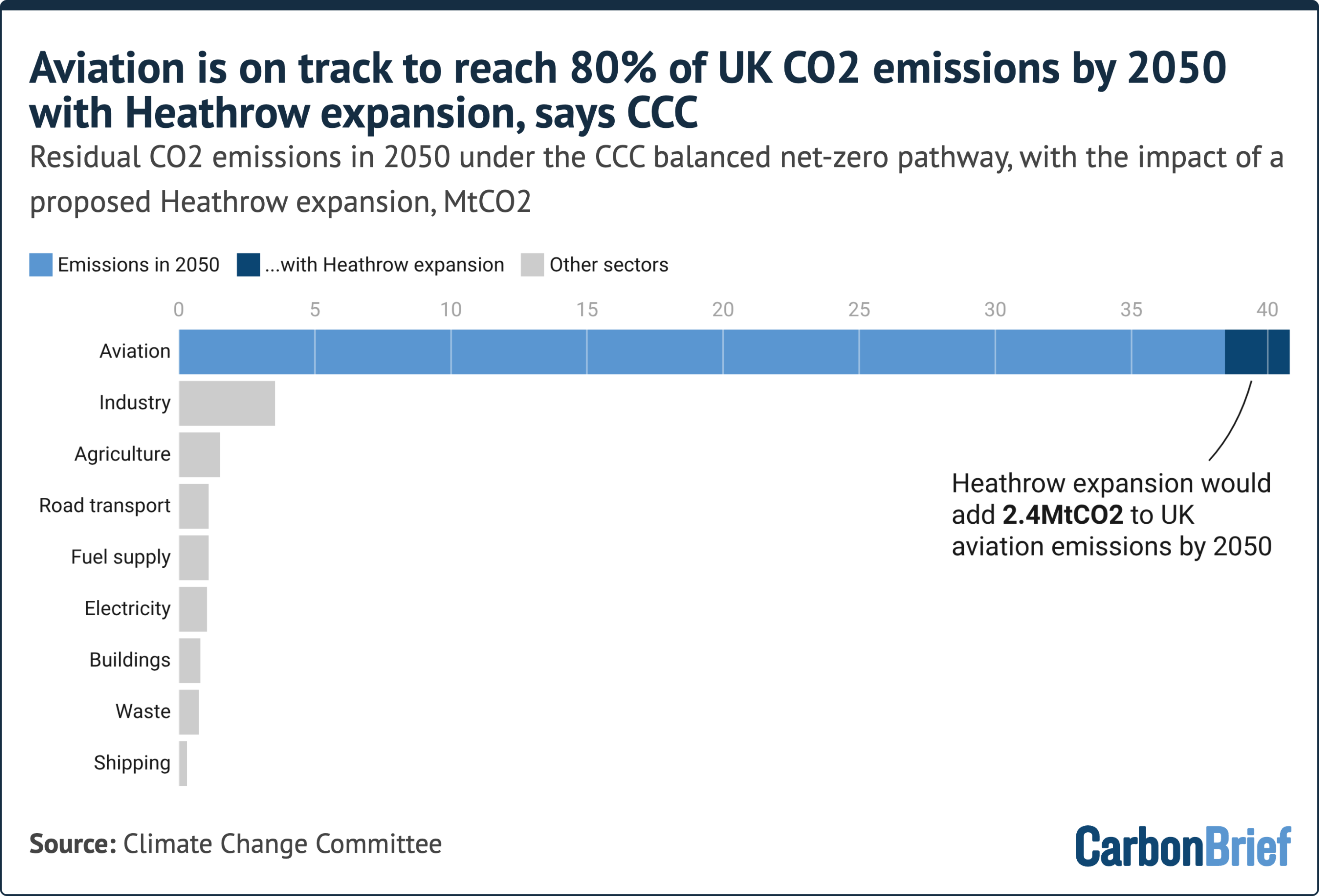
By 2040, aviation and agriculture would be the UK’s largest emitters, shown in the figure below. Even in 2050, these sectors would continue to have significant emissions.

Under the CCC’s net-zero pathway, natural carbon sinks in the land sector would balance out emissions from agriculture, while engineered carbon removals would balance aviation.

UK greenhouse gas emissions by sector, MtCO2e, showing the six largest emitters as of 2023
UK greenhouse gas emissions by sector, MtCO2e, showing the six largest emitters as of 2023 and changes to 2050 under the CCC’s balanced pathway. Source: Climate Change Committee.

While emissions cuts would be needed across the whole economy to meet the seventh carbon budget, the power sector would remain the lynchpin for wider progress. This is because electrification is now seen as the key solution for decarbonising the rest of the economy.

Whereas the sixth carbon budget advice hedged, offering five different routes towards net-zero, the CCC now offers a single balanced pathway built around clean power. The report says:

“In many key areas, the best way forward is now clear. Electrification and low-carbon electricity supply make up the largest share of emissions reductions in our pathway.”

This includes heat pumps in homes and businesses. The CCC says very clearly that there is “no role” for hydrogen heat.

In addition, the CCC now sees a far greater role for electrification of transport, including all HGVs, as well as in heavy industry.

Furthermore, the CCC points to important roles for energy efficiency, such as improved home insulation, and continued gradual changes in behaviour, such as reduced red meat consumption.

Where electrification is not possible, the CCC says other technologies will be needed. This includes bioenergy, synthetic fuels, such as hydrogen or methanol, and the continued use of small amounts of fossil fuels – in “limited circumstances” – with carbon capture and storage (CCS).

(The CCC says: “We cannot see a route to net-zero that does not include CCS.”)

The Sankey diagram below shows how the UK’s energy system looks today – and how it would need to change by 2050, if the seventh carbon budget and net-zero target are to be met.

On the left, each figure shows inputs of “primary energy” into the economy from low-carbon sources or fossil fuels. The central section shows the conversion of these fuels into final energy delivered to consumers, such as electricity or road fuel. The right-hand section shows the useful “energy services” that this final energy is able to provide, such as heat, light or motion (green).

Notably, the energy system would shift away from relying on fossil fuels (grey) towards a much greater use of electricity (blue). Technologies such as heat pumps and electric vehicles are far more efficient than boilers or combustion engines. As a result, the UK would get more useful energy (light blue) using far less primary energy, thanks to waste heat losses being halved (red).

Sankey diagram showing the UK energy system in 2025 and 2050 under the CCC’s balanced pathway. The electricity system is shown in blue, fossil fuels are grey, losses of waste heat are red and useful energy services light blue. Source: Climate Change Committee.

The huge reductions in fossil-fuel use and related increase in the overall efficiency of the UK system would yield significant economic benefits, the CCC explains, covered in the next section.

The CCC says that the shift to net-zero would cut oil imports tenfold from current levels by 2050 and cut gas imports by two-thirds over the same period.

What are the costs and benefits of net-zero?

The CCC’s advice comes against a backdrop of record global temperatures, with 2024 the first full year more than 1.5C hotter than pre-industrial times and escalating extreme weather impacts.

At the same time, there is growing hostility to climate action from large parts of the UK’s right-leaning media, as well as climate-sceptic, right-wing populist politicians, such as US president Donald Trump.

In addition, Russia’s 2021 invasion of Ukraine and the subsequent spike in fossil-fuel prices continue to cause geopolitical instability – and high energy bills.

The CCC presents the pathway towards net-zero as a solution to all of these problems.

It says reaching net-zero would not only end the UK’s contribution to climate change, but would also reduce high energy bills and energy insecurity caused by reliance on fossil-fuel imports.

Moreover, it says the up-front investment needed to reach net-zero is much smaller than thought in its previous 2020 advice, bringing the net cost down to just £108bn over 25 years (0.2% of GDP).

(All of the costings are presented in current prices relative to a counterfactual where the UK makes no further investments in the transition to net-zero. For example, households would buy combustion-engine cars instead of electric vehicles and gas boilers instead of heat pumps.)

The new 2025 estimate of the net cost of reaching net-zero by 2050 is shown by the red bars in the figure below, compared with the previous sixth carbon budget advice from 2020 (blue). The chart also shows the capital investments and operational savings that make up the net cost overall.

UK capital investment costs and operational savings under the CCC’s balanced pathway to net-zero, £bn, 2025-2050. Blue: sixth carbon budget advice from 2020. Red: seventh carbon budget advice from 2025. Source: Carbon Brief analysis of figures from the CCC.

Significantly, the new advice halves the CCC’s previous estimate published in 2020 of the capital investments needed to hit net-zero, from £1.3tn over 2025-2050 to £0.7tn. The earlier figure has been cited repeatedly by those attempting to undermine support for net-zero.

(Those attacking climate policy rarely mention the operational savings that would be delivered by investing in low-carbon technologies as a result of buying less oil and gas. Even under the earlier 2020 advice, the net cost of net-zero was £0.4tn, or around 0.6% of GDP.)

Notably, the large majority of the investment needed to reach net-zero would come from the private sector, according to the CCC, as long as the “right incentives” are in place.

It says that publicly funded outlays would need to range from £6-23bn per year out to 2035 and would never exceed 2% of government spending overall. Pinchbeck told a press briefing:

“We think 65-90% of the capital required is coming from the private sector…What the government needs to do is create the enabling environment to get that capital to move.”

There are several reasons for the fall in estimated net costs, with the largest contribution coming from the CCC assuming that EVs will be cheaper to buy than petrol equivalents within a few years.

This means that decarbonising the road transport sector would be cheaper than sticking with combustion engine cars, even before considering the considerable operational cost savings.

Another factor in the reduced cost is the more widespread use of electrification in heat, transport and industry, explains CCC chief analyst Dr James Richardson. He tells Carbon Brief that electrification in these areas “pushes out what looked like expensive but essential options”.

The figure below shows how the up-front investment needed for net-zero would deliver substantial operational cost savings from the 2040s under the CCC’s balanced pathway.

UK capital investment costs and operational savings under the CCC’s balanced pathway to net-zero by sector, £bn, 2025-2050. Source: CCC.

The figure shows that the largest capital cost would come in the buildings sector, where it expects the upfront cost of heat pumps could remain higher than gas boilers even in 2050.

As a result – and despite lower running costs, if electricity prices are cut in line with its advice – the CCC says the government would need to support households shifting to heat pumps.

In total, the CCC says that household energy bills for heat and power could fall to £700 below 2025 levels by 2050. In addition, it says that motoring bills would fall by another £700.

The advice considers distributional impacts for the first time, looking at how different types of households would be affected by the shift to net-zero. If the government reduces electricity costs then most types of households would see a cost saving. The exception to this would be homes unable to switch to heat pumps and using less efficient “resistive” heating instead.

In a pre-launch press briefing, Pinchbeck addressed those arguing against the transition:

“If you are an elected representative who is hostile to renewables, heat pumps, electric vehicles, what our numbers say is you are also hostile to your constituents saving £700 on their energy bill and [another] £700 on their fuel bill through making those changes.”

Beyond direct economic costs and benefits, the advice also considers “co-impacts” of the changes needed to meet climate goals. It says these co-impacts would include warmer and less damp homes, improved air quality, increased active travel and healthier diets.

These changes would deliver net benefits valued at £2.4-8.2bn by 2050, the CCC says. However, given the uncertainty around the monetary value of these impacts, they are not included in the overall benefit-cost analysis set out above.

What new climate policies does the CCC recommend?

The CCC says that achieving its recommended targets will rely on a “combination of markets, government support and choices by the public”.

It stresses that a “stable” and “consistent” set of climate policies would help to provide confidence to people and businesses during the net-zero transition. It adds that certain policies are also needed to “provide financial incentives, where necessary”.

Under the previous government, the committee repeatedly warned that the UK required more comprehensive climate policies. This shortfall was exacerbated by the Conservative leadership’s decision in 2023 to roll back some of its own net-zero policies.

The CCC has also warned that the Labour government, which was elected last year, must take urgent action to “make up lost ground”.

However, the committee’s new recommendations are less prescriptive about specific policies than its previous advice. (The last carbon budget advice, in 2020, was accompanied by an additional 209-page report titled: “Policies for the sixth carbon budget and net-zero.”)

Speaking to journalists at a press briefing, interim CCC chair Forster explained this new approach:

“We went back to the Climate Change Act and we did have a look at our core responsibility within that act – and that is to give government and parliament the very best non-partisan advice possible…It’s not up to us to make the policy, it’s up to government.”

Nevertheless, the new report still includes 43 “priority recommendations” for the government to support the delivery of the proposed seventh carbon budget. There are “seven core themes that underpin most of these recommendations”, which are:

  • “Making electricity cheaper”: Rebalancing prices to remove policy levies from electricity bills could incentivise people and businesses to choose low-carbon technologies, the CCC says.
  • “Removing barriers”: Processes and rules around planning, consenting and regulatory funding – including those covering grid infrastructure – “need to enable rapid deployment of low-carbon technologies”, according to the CCC.
  • “Providing certainty”: For technologies where markets have already “locked into a solution”, the committee says the government should introduce clear policies for phasing out old technologies and scaling up new ones.
  • “Supporting households to install low-carbon heating”: Government support is specifically needed to tackle the high up-front costs of heat-pump installations and other barriers such as “misconceptions”, the report states.
  • “Setting out how government will support businesses”: The CCC says businesses, including farmers, need clarity on how much government support they will receive and how much to rely on market mechanisms, such as the UK emissions trading scheme (ETS), to decarbonise.
  • “Enabling the growth of skilled workforces and supporting workers in the transition”: Government, businesses and affected communities should plan for changes in some industries, plus ensure that there is a workforce available to enable the net-zero transition, according to the CCC.
  • “Implementing an engagement strategy”: Finally, the committee stresses the importance of the government providing ”clear information to households and businesses”, including on the benefits of low-carbon choices.

There is some more specific guidance within these recommendations. This includes confirming that there will be no role for hydrogen in heating, no new properties connected to the gas grid from 2026 and no extended contracts for large biomass plants operating extensively beyond 2027.

CCC lead analyst Dr James Richardson tells Carbon Brief that such specificity reflects the committee’s certainty on some policies. He contrasts this with rebalancing electricity pricing, which the committee thinks is necessary, but could be achieved in a number of ways.

The report also calls for the government to publish its long-awaited land-use framework, which it is currently consulting on, as well as a common sustainability framework for biomass, which would support bioenergy with carbon capture and storage (BECCS).

More broadly, the CCC recommends that the government should produce a draft set of proposals and policies for delivering the seventh carbon budget. This would “aid parliamentary scrutiny in the setting of the budget level”, it says (See: What is the ‘seventh carbon budget’?).

It also says the government should introduce indicators to ensure emissions cuts are on track, as well as “contingency measures that could make up any shortfalls”.

Beyond emissions cuts, the CCC also calls for the government to strengthen the implementation of its third national adaptation plan, and introduce “clear objectives and measurable targets” across all departments.

How would each sector need to change by 2040?

The CCC lays out a detailed breakdown of how each sector in the UK economy could reduce its emissions in the coming years. 

This analysis aligns with its balanced pathway, which reduces overall emissions in line with the seventh carbon budget and, ultimately, achieves net-zero by 2050. 

The committee also details key metrics, from electric cars on the road to average meat consumption, and how they change on this trajectory.

Surface transport

Road and rail transport has been the sector with the highest emissions in the UK for a decade, currently accounting for around a quarter of the nation’s emissions. 

It is also the sector that would see the biggest dip in emissions in the CCC’s pathway – dropping by 86% from 103MtCO2e in 2023 to 15MtCO2e in 2040.

As the chart below shows, that drop is driven predominantly by the electrification of cars and vans. This accounts for 72% of the emissions savings out to 2040. 

Another 12% comes from zero-emission heavy-goods vehicles (HGVs) and 3% comes from other zero-emissions vehicles, such as buses and motorcycles. Most of these vehicles are also expected to be electric.

Sources of abatement in the “balanced pathway” for road and rail transport.
Sources of abatement in the “balanced pathway” for road and rail transport. Source: CCC.

In total, by 2040 some 80% of cars, 74% of vans and 63% of HGVs would be electric, under the CCC’s balanced pathway.

The uptake of electric vehicles modelled by the CCC is faster than the trajectory in the government’s legally binding zero-emission vehicle (ZEV) mandate. The committee says this is achievable, noting that “there has been strong early electric vehicle growth in the UK”.

In the CCC’s pathway, the electric-vehicle transition is “propelled by the falling cost of batteries”, which allows electric cars to match the purchase price of petrol and diesel cars by 2026-2028. 

The expansion of public charging points also plays an important role. The committee says there should also be efforts to make local public charging “more comparable to charging at home”.

The Labour government pledged to reintroduce the 2030 phaseout date for new petrol and diesel cars, which was delayed by Rishi Sunak’s Conservative government.

The CCC says the government should enact this pledge, as well as clarifying its position on similar phaseout dates for vans and HGVs with combustion engines.

Moreover, the committee says the government should consider including plug-in hybrid electric vehicles (PHEVs) in the phaseout. It says “ambitious targets” for the ZEV mandate would be needed beyond 2030, if PHEVs are not included in the ban.

The committee stresses that electric cars could also be included in a public information campaign to communicate their cost-saving potential. People have been “misinformed about battery longevity and electric vehicle lifecycle emissions”, the report says.

In addition, the committee says there is a need for a suite of policies, subsidies and regulatory mechanisms to scale up sales of electric vans and HGVs.

The CCC sees little or no role for hydrogen in any form of transport.

Another sizable chunk of emissions savings, amounting to 9% by 2040, comes from the replacement of 7% of car journeys with buses, walking and cycling. This is an “ambitious assumption” that the committee says is based on evidence from Germany and the Netherlands.

To achieve this shift, the committee says the government should “provide local authorities with long-term funding and powers”.

The CCC emphasises that many of the biggest benefits associated with net-zero will come from a switch to low-carbon forms of transport. For example, people will save money because electric cars are cheaper to run

However, this also applies to the £2.4-8.2bn annual “co-benefits” that will accrue across the economy by 2050. Most of these benefits, including better air quality, fewer road accidents and reduced congestion, result from a switch to electric cars or away from cars altogether.

Building heat

Heat pumps are going to drive the biggest reduction in heating emissions in the UK, while there is “no role” for hydrogen in the sector, according to the CCC. 

Residential buildings are currently the second highest emitting sector in the UK, accounting for 12% of emissions (52MtCO2e) in 2023. 

The largest source of emissions within the sector is fossil fuels for space heating and hot water, representing 96% of emissions. Of this, 80% comes from gas, while oil and liquefied petroleum gas make up another 12%. 

Emissions in the sector have gradually decreased since the early 2000s, driven by policies to improve the efficiency of heating technologies and invest in energy efficiency. A sharp decrease in emissions since 2021 has been caused by high gas prices and mild winters.

Under the CCC’s balanced pathway, emissions from residential heat would fall to 66% below 2023 levels by 2040. By the middle of the century, the sector could almost totally decarbonise. 

Building emissions fall faster in the 2030s in the seventh carbon budget advice than in the sixth carbon budget report, predominantly due to the use of “S-curves” for the pickup of heat pumps. 

Speaking to Carbon Brief, the CCC’s director of analysis Dr James Richardson says that, while the UK is behind other European countries in the installation of heat pumps, the advantage of being such a “laggard” is that it can learn from other markets, making the modelling “more precise”. 

While there will be a limited role for other electric-heating technologies, there is no role for hydrogen heating in residential buildings, the CCC says.

Speaking during a briefing, Richardson highlighted the weight of research showing that hydrogen heat would be expensive and challenging to roll out. He said: 

“Hydrogen is a limited resource. It’s quite costly to make and you need quite a lot of equipment that doesn’t already exist, so we can’t just magic it out of the air, as it were, and using it for heating is not a particularly efficient use of hydrogen.” 

The share of existing homes with low-carbon heating increases from 8% in 2023 to 68% in 2040 under the CCC’s balanced pathway, including the share of homes with a heat pump growing from sound 1% to 52% over the same time period. 

This would mean 75% of low-carbon heating systems installed by 2040 are heat pumps, with 94% of these being air-source heat pumps, the advice suggests.

In the CCC’s pathway, the rate of heat pump installations grows from 60,000 in 2023 to nearly 450,000 in 2030, and then 1.5m by 2035. While this represents a rapid increase, it falls short of the government’s target of 600,000 installations a year by 2028. 

Other forms of low-carbon heating systems expected to grow are: communal heat pumps (3% by 2040); low-carbon heat networks (9%); and direct electric heat (13%). 

In addition to getting rid of their boilers, most homes would also receive small energy efficiency improvements and 17% would see big efficiency improvements installed by 2050. 

Energy efficiency would be responsible for 10% of emissions reductions in 2040, according to the CCC.

The committee’s balanced pathway assumes all new homes would be built to be highly efficient and have low-carbon heating systems. These represent 14% of emissions reductions in 2040. 

Sources of abatement under the CCC’s balanced pathway within the building heating sector.
Sources of abatement under the CCC’s balanced pathway within the building heating sector. Source: CCC.

There are substantial upfront capital-cost requirements for lowering emissions within the residential sector, but energy efficiency measures and low-carbon heating systems have additional social benefits beyond long-term savings. The CCC estimates the co-benefits of its pathways at £650m by 2040. 

The transition represents an opportunity to reduce fuel poverty in the UK, it says, reducing the number of households in fuel poverty by 77% by 2050 compared to 2025.

To facilitate this transition, the CCC recommends electricity bills be made cheaper by removing levies and other policy costs, as well as decarbonising the electricity system. (See: Electricity below.) 

Additionally, the government should confirm that there will be no role for hydrogen in home heating, reinstate regulations that all heating systems installed by 2035 are low carbon and provide long-term funding for energy efficiency, amongst other policy moves.

Electricity

Emissions from the electricity sector have fallen by 81% since 1990, to 38MtCO2e in 2023, according to the CCC. 

The majority of this decrease has happened since 2012 due to the phase-out of coal – the UK’s last coal-fired power plant closed last year – and an increase in low-carbon generation. 

Between 2010 and 2023, the share of generation from wind and solar rose from 3% to 34%, helping to displace coal and gas, the CCC notes. The remaining emissions in the electricity sector are largely from unabated gas, which accounted for 30% of UK generation in 2023. 

Under the CCC’s balanced pathway, emissions from electricity supply fall by 88% to just 5MtCO2e in 2040. The committee notes that the sector can almost completely decarbonise by 2050. 

Over the next 25 years, demand for electricity is expected to more than double, from 274 terawatt hours (TWh) in 2023 to 692TWh in 2050. This is due to the increase in electric vehicles, heat pumps and other electric technologies to decarbonise other sectors. 

Renewable generation would make up 80% of generation in 2040. This would require the deployment of offshore wind – which would be the “backbone” of the system – to increase from around 1-2 gigawatts (GW) per year to 5.7GW per year out to 2030, before then maintaining a rate of 4GW per year, on average, out to the middle of the century.

Onshore wind would require an average deployment rate of 0.8GW per year, peaking at 1.9GW in 2030 – this is comparable to its historical peak of 1.8GW in 2017. Solar would need an average deployment rate of 3.4GW per year – below the historical peak seen in 2015 of 4.1GW. 

The CCC says there are several potential barriers to deployment, including planning, grid connections and supply-chain bottlenecks. 

The CCC expects “firm power” from nuclear and bioenergy with carbon capture and storage (BECCS) to make up 13% of generation in 2040. This would require an additional 5GW of nuclear capacity to be built, in addition to the Hinkley C new nuclear plant under construction in Somerset. 

“Dispatchable” generation from gas with CCS or hydrogen-fired turbines would make up the final 7% of the mix, but with a large capacity of 38GW by 2050. The electricity network would also need to be expanded “at pace” to ensure that the growing demand for electricity is enabled.

The electricity system of the future would include much more grid storage, the CCC says, with 35GW of short-duration batteries by 2050, more than a ten-fold increase on 2023 levels. A range of medium-duration technologies are also expected to be rolled out, with 7GW on the grid by 2050. 

Smart demand flexibility systems would need to be expanded and interconnectors to increase in capacity from around 10GW today to 28GW by 2050.

Together with storage, these would help manage grid security, with the CCC modelling a one-in-20 “adverse weather year” that includes wind droughts, to ensure the system would remain reliable.

The CCC states that these changes would allow the emissions intensity of electricity – its emissions per unit of generation – to fall by 95% by 2040 and 99% by 2050. 

The growth of cheap renewable energy would displace unabated gas generation, resulting in operational savings, the CCC says, as shown in the chart below. In order for the effect of this to be felt by consumers, policy costs should be rebalanced away from electricity bills, the CCC adds.

Cost and cost savings in the electricity supply sector in the CCC’s balanced pathway.
Cost and cost savings in the electricity supply sector in the CCC’s balanced pathway. Source CCC.

Despite the “significant investment” required to decarbonise and expand the electricity system under the CCC’s pathway, the underlying costs of electricity supply fall compared to the baseline. 

The shift provides a number of co-benefits as well, including industrial opportunities, increasing energy security by reducing reliance on volatile international prices and improving air quality. 

To meet the requirements of the balanced pathway, the CCC calls on the government to ensure the funding and auction design for the next contracts-for-difference subsidy auctions are sufficient.

It also calls for reform processes and rules around planning and consenting of new projects, as well as clarity around electricity market arrangement, amongst other actions.

Industry

By 2040, the CCC’s balanced pathway sees emissions from industry falling by 78% from 52MtCO2e in 20223, with industrial output remaining largely unchanged. 

It says that industry could almost completely decarbonise by 2050, with a large part of these reductions coming via electrification. 

Emissions from industry have fallen by 63% since 1990, due predominantly to a steep decline in UK production of emissions-intensive materials. 

A “structural shift” has seen lower-carbon, but higher-value industry outputs increase, such as pharmaceuticals and aerospace, allowing “gross value added” from the sector to grow by 26%, while energy consumption for each unit of output has fallen by 45% between 1998 and 2022. 

At the same time, however, steel production has fallen from 18Mt in 1990 to 6Mt in 2023 and cement from 15Mt to 8Mt.  

The closure of one of the UK’s last remaining blast furnaces, along with the expected closure of a second site, are expected to reduce emissions in the sector by at least another 8MtCO2e in 2024, the CCC says. It adds that the owners are planning to build electric arc furnaces at both sites, to maintain steel production with lower emissions.

Going forward, the largest share of emissions reduction for industry under the CCC’s balanced pathway is expected to come from electrification, representing 57% of savings in 2040. 

Sources of abatement within industry, under the CCC’s balanced pathway.
Sources of abatement within industry, under the CCC’s balanced pathway. Source: CCC.

The committee notes that there are already electrical alternatives to most types of fossil-fuelled heating used in industry, with many bringing “important advantages”, such as greater efficiency. 

In cases where electrification is not possible, the CCC envisages fuel switching to hydrogen, as well as a limited amount of bioenergy and carbon capture and storage (BECCS) being used to compensate for industrial process emissions that cannot be avoided.

CCS is expected to account for 17% of industrial emissions cuts 2040, helping to tackle those from industrial subsectors with a high level of process emissions or where switching away from fossil fuels is not practical. As such, it is only deployed in two industrial subsectors within the balanced pathway: chemicals, and cement and lime. 

The CCC has assumed that the capture rate of CCS technologies will be 90% until 2040, and 95% beyond that.

Hydrogen is expected to represent 7% of emissions reductions in 2040. In particular, it would play a “meaningful role” in decarbonising chemicals, glass and other minerals, iron and steel, as well as non-road mobile machinery.

Bioenergy is expected to reduce emissions by 5% by 2040. While many processes could, in theory, run on bioenergy, the CCC notes that it should be prioritised for subsectors that use CCS, particularly cement.

Combining bioenergy and CCS is expected to deliver 0.8 MtCO2e of CO2 removals by 2050.

Resource efficiency and energy efficiency are expected to represent 7% and 6% of emissions reductions in 2040, respectively. 

The CCC’s pathway between 2025 and 2050 increases sector costs compared to a baseline. But there are potential additional benefits, for example, electrification offers an opportunity for manufacturers to provide more demand management services to the national grid. 

It also notes that there is a potential competitive advantage for UK industry in decarbonising early, with low-carbon production expected to buck the wider trend of high-carbon goods demand falling. 

To support the decarbonisation of industry, the CCC recommends that the government make electricity cheaper relative to gas, speed up the grid connection process, maintain support for CCS and hydrogen, plus strengthen the UK Emissions Trading Scheme, amongst other measures.

Agriculture and land use

Agriculture accounted for 11% of emissions in 2022 (47.7MtCO2e), while net emissions from land use, land-use change and forests were 0.8MtCO2e. 

The CCC expects agricultural emissions to fall by 39% by 2040. Agricultural emissions will make up 27% of the UK’s emissions by 2040, making it the second-highest emitting sector at the time.

By 2050, the CCC’s pathway shows agricultural emissions falling to 26.4MtCO2e. 

Emissions in the sector start lower in the seventh carbon budget’s modelling than in the previous iteration and fall further by around 10Mt. This is due to several factors, including changes to the inventory and emerging trends within meat consumption.

Speaking to Carbon Brief, the CCC’s director of analysis Dr James Richardson says:  

“There is a trend in which red meat is losing ground within meat overall. And so we’ve reflected that trend in our assumptions that for any given amount of meat, less red meat within that reduces emissions. So that’s helping to bring down those agriculture numbers.”

In the CCC pathway, some land must be diverted from farmland to other uses, such as growing trees and restoring peatland. Lower livestock numbers free up 68% of this released land by 2040 and account for around a third of this sector’s emissions cuts.

The government should support this shift, including helping to reduce average meat consumption by 25% by 2040 and 35% by 2050 compared to 2019 levels, according to the CCC.

Other measures, such as cutting food waste and improving crop yields, are expected to release the remaining 32% of converted agricultural land. These only account for 2% of emissions cuts in 2040.

Soils and livestock measures are expected to reduce emissions by 14% in 2040 and decarbonising machinery by 21%, as shown in the chart below.

Sources of abatement within the agriculture and land use sectors, under the CCC’s balanced pathway.
Sources of abatement within the agriculture and land use sectors, under the CCC’s balanced pathway. Source: CCC.

Land-use emissions are now 10MtCO2e lower than 1990 levels and are expected to become a small carbon sink of 1.9MtCO2e in 2040.

The CCC pathway sees peatland restoration and management reducing emissions by 17% in 2040. Woodland creation and management also reduce emissions by 4%, rising to 15% by 2050. 

This follows the UK missing its tree-planting targets, failing to plant an area of forest nearly equivalent to the size of Birmingham, according to Carbon Brief analysis published last year.

Energy crops account for 7% of emissions reductions, with 0.7m hectares or almost 3% of UK land area allocated to three perennial crops – miscanthus, short-rotation coppice and short-rotation forestry by 2050. Agroforestry and hedgerows account for a 2% emissions reduction in 2040. 

Aviation

Aviation emissions drop by 17% to 29.5MtCO2e in 2040 in the CCC’s balanced pathway. By which point, aviation would have risen from sixth position to be the highest-emitting sector, due to its slow pace of decarbonisation.

As aviation has “no credible way to completely decarbonise”, roughly 60% of the engineered CO2 removals by 2050 may need to balance out its emissions, according to the CCC. (These removals primarily come from bioenergy with carbon capture and storage.)

A core message within the CCC’s report is that the aviation sector should “pay for [its] share” of removals, as well as the broader costs of decarbonising and addressing the non-CO2 effects of flights on global warming. These costs would be “reflected in the price of flying”.

This, in turn, would help to discourage growth in the sector, which would also help to curb emissions, the CCC says. Overall, limiting the number of flights accounts for more than half of the emissions savings out to 2040.

However, this is compared to a baseline scenario in which per-capita distance flown grows 53% above 2025 levels by 2040. In the CCC’s pathway, demand remains fairly steady for the next decade, then increases 16% from 2025 levels by 2040

The advice comes in the wake of the government recently supporting the expansion of Heathrow and, potentially, other airports.

The CCC’s latest pathway allows for greater growth in passenger numbers than previous advice – 402 million by 2050, rather than 365 million. It has also dropped a previous recommendation that there should be “no net increase” in airport capacity.

However, it stresses that government and industry “may need to take additional demand management measures”, if technologies do not expand sufficiently to reduce emissions.

Sustainable” aviation fuels (SAFs) account for 33% of emissions cuts by 2040 in the CCC’s pathway. This involves SAFs rising from meeting 1% of total demand today to 17%.

(The government and industry have emphasised their focus on SAFs, but many experts have doubts about how much they can be relied on to curb emissions.)

A further 13% of emissions savings in the CCC’s pathway come from efficiency improvements and, to a much lesser extent, the use of hybrid and zero-emission aircraft. The overall breakdown of emissions reductions is laid out in the chart below.

Sources of abatement in the “balanced pathway” for aviation.
Sources of abatement in the “balanced pathway” for aviation. Source: CCC.

However, the CCC says that, with SAFs and CO2 removal still in the early stages of development, there remains great uncertainty around how aviation will decarbonise. 

This means the final breakdown between these technologies and demand reduction could be very different. Therefore, it stresses that “all must be pursued” to ensure the UK meets its goals.

Finally, the CCC advises that the government should commit to monitoring and tackling the non-CO2 warming effects of aviation, as well as working with other countries to “go further” than the UN International Civil Aviation Organization (ICAO) to curb emissions from international flights.

Other sectors

The CCC’s balanced pathway also covers sectors that contribute smaller shares of UK emissions. 

The largest of these is fuel supply – primarily, oil and gas production, as well as hydrogen and bioenergy – which accounts for 7% of UK emissions. 

Even smaller shares come from waste and shipping, as well as fluorinated gases (F-gases), which are used in refrigeration, air conditioning, heat pumps and medical inhalers.

Here, Carbon Brief rounds up some of the key points and recommendations for these sectors:

  • Fossil-fuel supply emissions are expected to decline even without any new policies, as North Sea production dwindles and demand falls due to electrification. Oil and gas production would fall 68% by 2040 and 85% by 2050 under the balanced pathway.
  • The CCC says the government should provide incentives to encourage the electrification of oil and gas platforms and CCS use in refineries. It suggests “proactive transition plans” to help oil and gas workers find new employment.
  • “Low-regret” hydrogen infrastructure, such as networks and storage, should be “fast-tracked” so it is available from the 2030s, the committee says.
  • Bioenergy has an “important, but limited role in enabling decarbonisation”, met by increasing domestic supply of energy crops and fewer imports from overseas.
  • Shipping emissions drop by 62% by 2040 and – unlike aviation – the sector could almost completely decarbonise by 2050 through improved efficiencies and a switch to low-carbon fuels and electricity, according to the CCC.
  • Waste is one of the few sectors that is expected to continue emitting in 2050, due to hard-to-abate processes in wastewater, landfill methane emissions and uncaptured CO2 from energy from waste.
  • The CCC says the UK will need to introduce regulations to replace F-gases with less harmful alternatives. It says 2024 EU regulations provide a useful model for what needs to be achieved.

What does the CCC say about imported emissions?

The CCC notes that a significant share of the UK’s overall carbon footprint is associated with goods and services imported from overseas.

Specifically, it says that imported emissions – at 381MtCO2e in 2021 – are of a similar scale to those that take place within the UK’s borders, which were 423MtCO2e that year.

Contrary to widespread perception, however, the committee notes that these imported emissions have barely changed over the past four decades.

In other words, emissions cuts within the UK’s borders have not been wiped out by increasingly “offshored” emissions embedded in imports.

Moreover, the report shows that nearly a third of these imported emissions – some 29% – relate to trade with the EU, whereas only 12% come from China. Similarly, the largest sectors are food and forestry imports (21%), rather than manufactured goods.

Many commentators have tried to argue that the UK should set climate goals based on its overall emissions footprint, on a so-called consumption basis rather than a territorial one.

However, the CCC explains that emissions taking place overseas are not under the jurisdiction of the UK government. It adds that attempting to regulate emissions imported into the UK “could undermine the accountability of other countries for their territorial emissions…[given] ultimate responsibility for reducing emissions lies with the producer”.

In addition, it notes that statistics on consumption-based emissions are “inherently uncertain”, which would make them “problematic” as a basis for legally binding carbon targets.

Instead, the CCC proposes a non-legally binding “benchmark” on imported emissions, which would set out the government’s expectations for how emissions from imports should decline over time.

Original article by Simon Evans, Josh Gabbatiss, Molly Lempriere republished from Carbon Brief.

Continue ReadingCCC: Reducing emissions 87% by 2040 would help ‘cut household costs by £1,400’