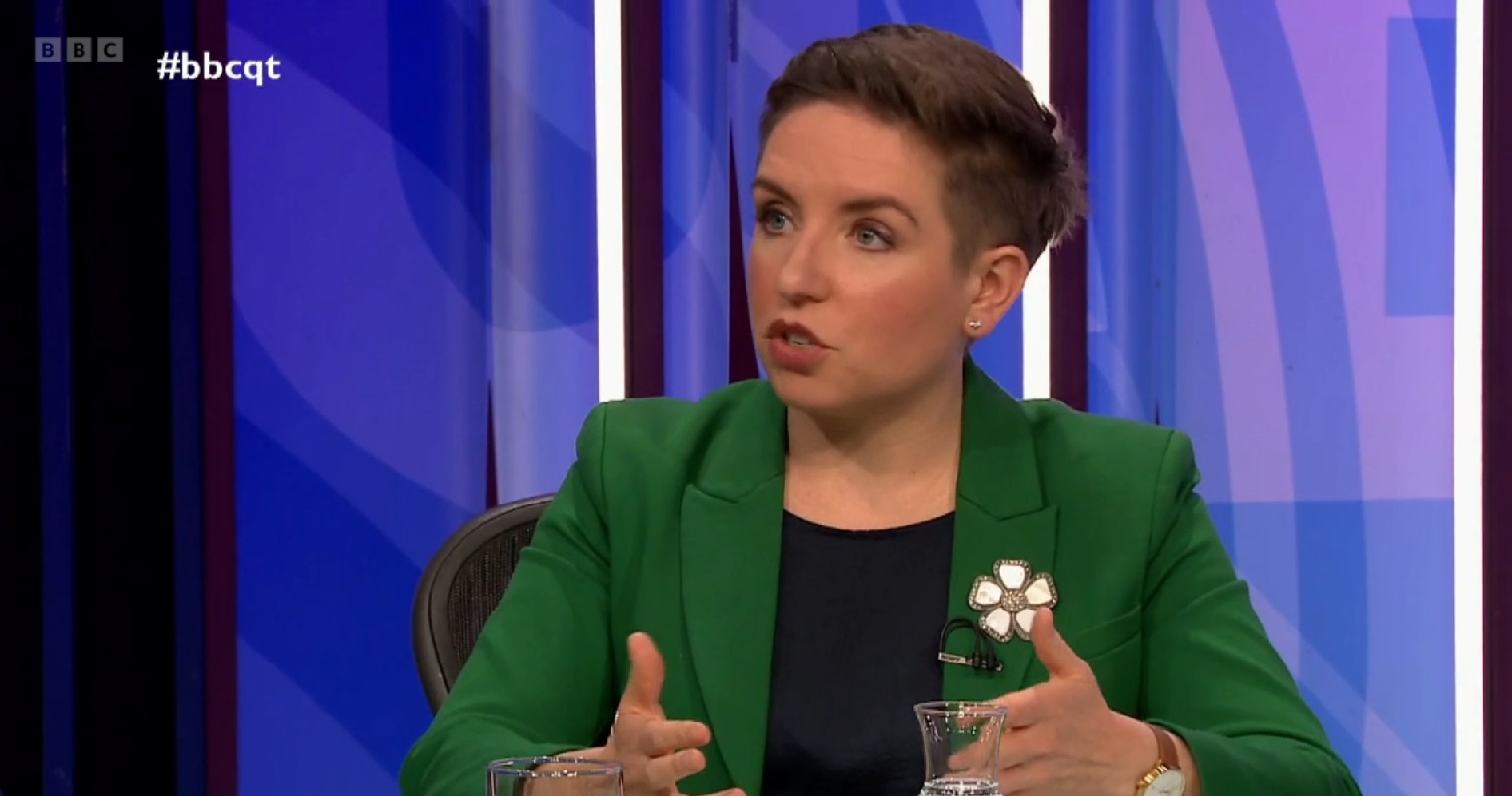
Image of Richard Tice, leader of Reform UK. BBC Question Time.
‘What makes you think you understand how climate change works better than all of the world’s scientific experts?’
The leader of Reform UK was dealt a humiliating hand on BBC Question Time after facing a backlash against his arguments on climate change and climate denial.
Richard Tice got owned by leader of the Green Party Carla Denyer during a lively exchange about what action needs to be taken to combat the climate crisis.
The leader of the right-wing populist party, who’s been known to make bizarre and inaccurate statements on climate science denial, instigated some eye rolls when he stated, “the climate has changed for millions and millions of years.. way before man-made CO2 emissions”.
He went on to face ridicule when questioned on his understanding of climate science and his lack of scientific background by Green Party leader and engineer by trade, Carla Denyer.
…
Image of the Green Party’s Carla Denyer on BBC Question Time.
The Green MP said: “The news has been full of pretty alarming evidence that climate change is not a concern that is going to come down the track sometime in the future, it’s here right now.
“And the best time that we could have brought in the policies to tackle this was of course decades ago. We’ve known about climate change my whole life. Successive governments in the UK and internationally largely failed to do that. So the second best time to do it is right now.”
She added: “I’m an engineer by background. I didn’t want to be a politician, I’m in this because I realised the people in power making the decisions were not making the right ones to tackle this crisis.”
The former prime minister attacks flagship climate deals and makes false claims about electric vehicles, Russia’s influence on energy policies, and net zero.
The new book by former Prime Minister Liz Truss urges the UK, U.S. and EU to drop their landmark climate change laws, spreads falsehoods about green policies, and fondly recalls an attempt to cancel a major climate conference.
Truss, who is the Conservative MP for South West Norfolk, resigned as prime minister in October 2022 after just 49 days in office.
Since leaving 10 Downing Street, Truss has attempted to expose the “deep state” forces that allegedly brought down her premiership, while advocating for “free market” ideas within the Conservative Party, helping to launch the Popular Conservatives group.
In her book, Ten Years to Save the West, which she is promoting widely this week, Truss writes that “the zealous drive to net zero”, the UK’s legally binding 2050 climate target, amounts to “unilateral economic disarmament” and is “a drag on economic growth”. She also claims that, while serving in the Treasury, she attempted to cancel the 2021 COP26 climate summit in Glasgow.
Truss writes: “We should abolish the Climate Change Act and instead adopt a new Climate Freedom Act that enables rather than dictates technology”. She adds that “the U.S. should reverse the Inflation Reduction Act, and the EU should abandon its equivalent measures”.
The Climate Change Act legalised the UK’s commitment to reducing carbon dioxide emissions by at least 80 percent by 2050 from 1990 levels. The Inflation Reduction Act is a $369 billion package of grants and subsidies by the U.S. government to spur green technology investment.
Scientists at the Intergovernmental Panel on Climate Change (IPCC) have said that without “immediate and deep emissions reductions across all sectors” limiting global heating to 1.5C is beyond reach.
Restricting global temperatures to this threshold – the target agreed by the UK as part of the 2015 Paris Agreement – would prevent the worst and most irreversible effects of climate change, including floods, droughts, heatwaves, and wildfires.
In the book, Truss also attacks climate advocates, writing that “the environmental movement is fundamentally driven by the radical left”, adding: “This ‘watermelon’ tendency is green on the outside, red on the inside – a modern rebranding of socialism. It features the same instincts of collectivism and authoritarianism.”
Truss writes that “we should cancel” the United Nations annual COP climate summit, and falsely claims that electric vehicles are worse for the environment than those powered by fossil fuels.
“In recent years, more radical forms of climate misinformation and disinformation have become mainstreamed”, said Jennie King, director of climate research and policy at the Institute of Strategic Dialogue think tank. “Such content continues to grow in virality and engagement online, but its impacts are vastly increased when platformed in the media or by politicians.”
King said “the normalisation of wild and outlandish claims”, with climate action “being framed through a conspiratorial, tribalist and anti-scientific lens”, can lead to “real-world harm”.
“When such ideas are conveyed from the very corridors of power, it sets a dangerous precedent”, she added.
The IPCC warned in 2022 that efforts to tackle climate change were being delayed by “rhetoric and misinformation that undermines climate science and disregards risk and urgency”.
Truss Claims ‘Couldn’t be Further from the Truth’
Truss’s book is published by Biteback Publishing, a company owned by former Conservative deputy chair and major party donor Michael Ashcroft.
The former prime minister dedicates a chapter to green policies, titled ‘A Hostile Environment’, apparently a play on the term used by the Conservative government about its anti-immigration policies.
Truss writes that current environmental policies should be scrapped in favour of a “free market” approach. On energy, she calls for more fossil fuel extraction, advocating a mix of “oil and gas as well as nuclear and renewables”, adding: “The use of North Sea oil and gas is crucial, so there needs to be investment in that too. There also should be fracking in the UK.”
Fracking for shale gas is a controversial practice that risks causing air, water, and noise pollution.
She fails to mention that oil and gas firms receive major subsidies and tax breaks from the government, which would logically be removed in a “free market” energy system. The UK government has given £20 billion more in support to fossil fuel producers than renewables companies since 2015.
Truss’s book also attacks the multilateral UN COP process, which has seen agreements on transitioning away from fossil fuels, and financial support for poorer countries suffering the worst effects of climate change.
Truss writes that “we should cancel the COP gravy train”. She claims that, in 2018, when she was chief secretary to the Treasury, she made “11th-hour attempts to ditch COP26”, the UN climate summit hosted by the UK in 2021, arguing that it was not a spending priority.
At COP26, nearly 200 countries agreed to ramp up efforts to cut emissions, also calling on wealthy countries to double their funding to poorer nations that have contributed the least to climate change. More than 40 countries also pledged to quit coal, the dirtiest fossil fuel and the world’s largest source of carbon dioxide emissions.
The book also spreads false claims about climate policies. Truss writes that “in the UK and Europe, Russia has funded anti-fracking campaigns”, a claim which is not supported by any evidence.
Truss claims that policies like “the switch from petrol to diesel in cars or the use of electric vehicles, have either harmed the environment in other ways or empowered our polluting adversaries elsewhere in the world”.
Colin Walker, head of transport at the Energy and Climate Intelligence Unit think tank, told DeSmog: “The notion that the switch to electric vehicles will have little discernible environmental impact, and make us dependent on imported gas and coal, couldn’t be further from the truth.
“The total lifetime CO2 emissions of an electric vehicle, from being built to being driven, are three times lower than a petrol vehicle – a figure that will only get higher as our grid becomes cleaner. And while older technologies like petrol cars and gas boilers rely on fossil fuels imported from abroad, EVs and heat pumps can be powered by electricity generated by British wind and solar farms.”
Truss also writes of “ludicrous claims that pursuing a net zero agenda … will boost the economy and drive growth”.
Walker added: “The UK’s net zero economy is now worth £74 billion, and grew by nine percent in 2023. The wider economy grew just 0.1 percent. Talking down the economic opportunities net zero has to offer the UK is at odds with a growth agenda when the U.S., EU and China are all competing for clean industries.”
Truss’s Climate Denial Ties
Truss has a long history of opposing climate policies. In the 2022 Conservative Party leadership contest, she attacked solar farms on agricultural land and, during her brief time in 10 Downing Street, she overturned the UK’s ban on fracking. (A policy reversed by her successor, Rishi Sunak.)
As DeSmog reported at the time, Truss’s leadership campaign received £30,000 from a pro-fracking lobby group, £10,000 from a climate denial activist, and £100,000 from the wife of a former BP oil executive. Truss received a further £5,000 from Lord Vinson, a Tory peer who has provided funding to the UK’s leading climate science denial group, the Global Warming Policy Foundation.
Since leaving office, Truss has received £250,000 in speaking fees, including £7,600 last April from the Heritage Foundation, a right-wing U.S. think tank that has long promoted climate science denial. Heritage President Kevin Roberts provides a long and glowing blurb for Truss’s book.
Earlier this year, Truss helped to launch the Popular Conservatives (PopCon), a new initiative run by Truss-ally Mark Littlewood, the former director general of the Institute of Economic Affairs, a think tank which received funding from oil major BP for at least 50 years.
At the PopCon launch, Truss attacked “net zero zealotry”, claiming voters “don’t like the net zero policies which are making energy more expensive”
The Institute of Economic Affairs has its headquarters on Lord North Street, Westminster. Credit: Des Blenkinsopp (CC BY-SA 2.0)
A senior figure at the influential Institute of Economic Affairs (IEA) think tank contributed to a new documentary that spread numerous myths about climate change.
Stephen Davies, an academic who has worked in educational outreach roles at the IEA since 2010, appeared several times in Climate The Movie: The Cold Truth – a new film directed by climate science denier Martin Durkin.
In the documentary, Davies claims that climate activists want to impose an “austere” life on ordinary people. “Behind all the talk about a climate emergency, climate crisis” is “an animus and hostility towards” working-class people, “their lifestyle, their beliefs and a desire to change it by force if necessary,” he says.
According to the website Skeptical Science, which debunks climate misinformation, Climate The Movie contains more than two dozen myths about climate change. The film suggests that we shouldn’t be worried about greenhouse gas emissions, because plants need carbon dioxide. “We’re in a CO2 famine,” one interviewee claims.
The UN’s Intergovernmental Panel on Climate Change (IPCC), the world’s foremost climate science body, has stated that carbon dioxide “is responsible for most of global warming” since the late 19th century, which has increased the “severity and frequency of weather and climate extremes, like heat waves, heavy rains, and drought”.
Climate The Movie producer Thomas Nelson told DeSmog that “I see the misguided fight against carbon dioxide as being as crazy as fighting against oxygen or water vapour, and I think scaring innocent children about this is deeply evil”.
The IEA said that “Steve firmly believes that climate change is happening and carbon emissions are having an impact. His view that climate policy imposes costs, particularly on working-class communities, is entirely mainstream. IEA publications and spokespeople have supported action on climate change, including carbon pricing.”
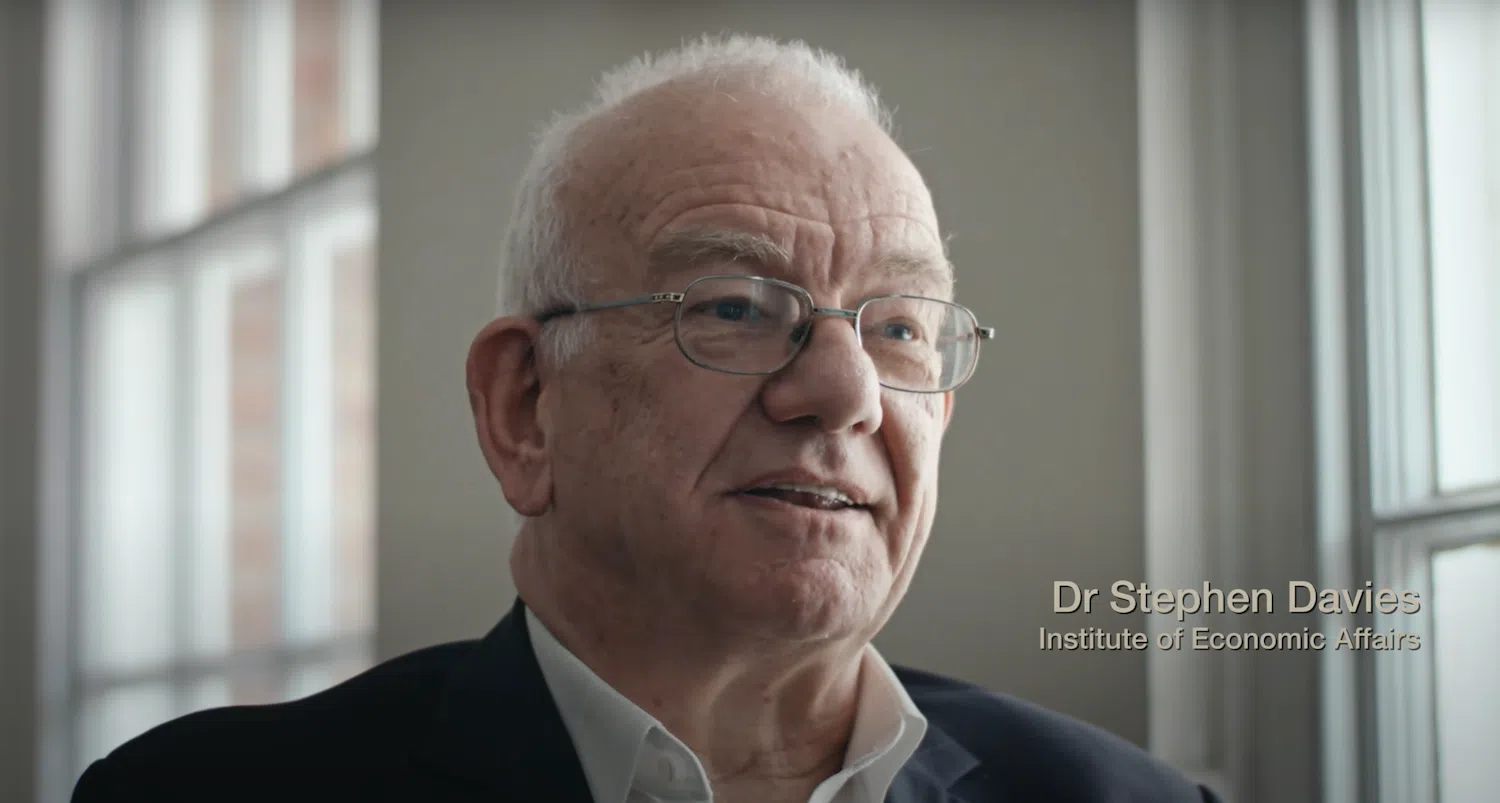
A screenshot of Stephen Davies of the Institute of Economic Affairs in Climate The Movie: The Cold Truth. Credit: Climate The Movie / YouTube
In 2018, Greenpeace’s investigative journalism unit Unearthed revealed that the IEA had received funding from oil major BP every year since 1967. In response to the story, an IEA spokeswoman said: “It is surely uncontroversial that the IEA’s principles coincide with the interests of our donors.”
The IEA also received a £21,000 grant from U.S. oil major ExxonMobil in 2005.
The IEA has extensive influence in politics and the media. It was pivotal to Liz Truss’s short-lived premiership as prime minister, and has boasted of its access to Conservative ministers and MPs. During the year ending March 2023, the IEA appeared in the media on 5,265 occasions, a figure 43 percent higher than its previous peak in 2019.
The group has also received donations from a number of philanthropic trusts accused of channelling funds from the fossil fuel industry and helping to support climate science denial groups. The IEA is a member of the Atlas Network – an international collaboration of “extreme” free market groups that have been accused of promoting the interests of fossil fuel companies and other large corporations.
It’s not known if the IEA has received funding from BP since 2018.
The IEA is a prominent supporter of the continued and extended use of fossil fuels. The group has advocated for the ban to be lifted on fracking for shale gas, calling it the “moral and economic choice”. The IEA has also said that a ban on new North Sea oil and gas would be “madness”, has criticised the windfall tax imposed on North Sea oil and gas firms, and said that the government’s commitment to “max out” the UK’s fossil fuel reserves is a “welcome step”.
The IEA is part of the Tufton Street network – a cluster of libertarian think tanks and pressure groups that are in favour of more fossil fuel extraction and are opposed to state-led climate action. These groups are characterised by a lack of transparency over their sources of funding. The IEA does not publicly declare the names of its donors.
“From Brexit to Trussonomics, the IEA has consistently peddled and promoted destructive and damaging policies,” Green Party MP Caroline Lucas told DeSmog. “Yet perhaps nothing will prove more dangerous long term than the stream of climate denialism and calls to delay action that have been pouring out of Tufton Street for many years.
“Clearly the IEA is now ramping up its climate culture war and the Conservative Party has been following suit. The cross-party consensus on climate action we used to have in Parliament is under strain like never before.”
The IEA and Stephen Davies were approached for comment.
Climate The Movie
During the documentary, Davies suggests that action to reduce greenhouse gas emissions is being used to limit the freedom of individuals. He claims that climate activists want to impose “a much more austere simple kind of lifestyle” on people “in which the consumption choices of the great bulk of the population are controlled or even prohibited.”
Davies adds that: “What you have here is a classic example of class hypocrisy and self-interest masquerading as public spirited concern. You could take these kinds of green socialist more seriously if they lived off grid, they cut their own consumption down to the minimum, they never flew. Instead you get constant talk about how human consumption is destroying the planet but the people making all this talk show absolutely no signs of reducing their own.”
The documentary also features an interview with Benny Peiser, the director of the Global Warming Policy Foundation (GWPF) – the UK’s leading climate science denial group. Peiser has previously claimed that it would be “extraordinary anyone should think there is a climate crisis”, while the GWPF has expressed the view that carbon dioxide has been mischaracterised as pollution, when in fact it is a “benefit to the planet”.
The film was favourably reviewed by commentator Toby Young in The Spectator magazine, who described it as “a phenomenon”. Young has previously said that he’s sceptical about the idea of human-caused climate change.
The IPCC has stated it is “unequivocal that human influence has warmed the atmosphere, ocean and land”, while scientists at NASA have found that the last 10 years were the hottest on record. Earth’s average surface temperature in 2023 was the warmest since records began in 1880.
The IPCC has also warned that false and misleading information “undermines climate science and disregards risk and urgency” of climate action.
The documentary also features Claire Fox, a member of the House of Lords who was nominated for a peerage by former prime minister Boris Johnson in 2020.
Fox used the documentary to claim that, by tackling climate change, people will be forced to pay more “to simply live the lives that they were leading”.
She suggests that supporters of climate action are trying to “take away what we consider to be not luxuries but necessities.”
The UK’s Climate Change Committee, which advises the government on measures to achieve net zero emissions by 2050, estimates that the combined policies will cost less than one percent of the country’s national output.
The Office for Budget Responsibility, the UK’s independent economic forecaster, has also said that “the costs of failing to get climate change under control would be much larger than those of bringing emissions down to net zero”.
Claire Fox and the GWPF were approached for comment.
A Charitable Cause?
The IEA is a registered charity, meaning that it receives generous tax breaks.
The group justifies this charitable status partly on the basis of its educational outreach programme, which aims to “equip tomorrow’s leaders with a deep understanding of free market economics”.
The IEA claims that: “Our aim is to change the climate of opinion in the long term and our work with students is a key part of this.”
In the year ending March 2023, the group claimed to have engaged with 3,500 students and 1,200 teachers via its seminars, internships and summer schools.
Formerly the IEA’s head of education and now a senior education fellow, Davies is a senior member of the group’s outreach programme. He is the first person listed in the IEA’s student speakers brochure, which advertises the IEA staff members who are available to speak at schools or universities.
The brochure also lists the IEA’s chief operating officer Andy Mayer, who has said that the government should “get rid of” its target of achieving net zero emissions by 2050, which he called a “very hard left, socialist, central-planning model”.
The non-profit Good Law Project recently made a complaint to the Charity Commission about the IEA, claiming that the libertarian group had breached charity rules. Namely, the Good Law Project claims that the IEA is in breach of rules stating that charities must avoid presenting “biased and selective information in support of a preconceived point of view”.
The Charity Commission rejected this complaint, stating that: “We have assessed the concerns raised and have not identified concerns that the charity is acting outside of its objects or the Commission’s published guidance.”
Good Law Project campaigns manager Hannah Greer told DeSmog: “It won’t be a surprise to anyone that the IEA is cementing its role as a major mouthpiece for climate change scepticism. It’s a huge scandal that the IEA is still allowed to peddle fringe views under the guise of being an ‘educational charity’ while benefiting from taxpayer subsidies.
“This has been allowed to happen because we have seen alarming and unambiguous regulatory failure from the Charity Commission – who have been presented with evidence of how the IEA is flouting charity law, but have chosen to look the other way.”
Al Gore, former vice president of the United States, speaks onstage at The New York Times Climate Forward Summit 2023 at The Times Center on September 21, 2023, in New York City. (Photo: Bennett Raglin/Getty Images for The New York Times)
“They are continuing to do similar things today to try to fool people and pull the wool over people’s eyes just in the name of greed,” the former vice president said.
In reflecting on nearly 50 years of climate advocacy, former Vice President Al Gore said that he had “underestimated” the greed of the fossil fuel industry.
The remarks came in an interview published in USA Today on Sunday. When asked if he had any regrets, Gore responded that he had “put every ounce of energy” he had into climate advocacy, but added:
“I was pretty slow to recognize how important the massive funding of anti-climate messaging was going on. I underestimated the power of greed in the fossil fuel industry, the shamelessness in putting out the lies.”
“They are continuing to do similar things today to try to fool people and pull the wool over people’s eyes just in the name of greed,” Gore continued.
“What’s at stake is so incredible.”
Gore, who tried to raise awareness about the climate crisis in the U.S. House of Representatives as early as 1981 and brought the issue to national attention in 2006’s documentary An Inconvenient Truth, has taken a harsher tone against oil, gas, and coal companies in recent months. In August 2023, he said that the “climate crisis is a fossil fuel crisis,” and in September, he implored the industry to “get out of the way.” In December, he lamented that the industry had “captured the COP process,” referring to the appointment of the United Arab Emirates national oil company CEO Sultan Ahmed Al Jaber to preside over the United Nations’ COP28 climate conference in that country.
In the USA Today interview, Gore also named the fossil fuel industry when asked about his greatest frustration.
“Well, that we haven’t made more progress,” Gore answered, “and that some of the fossil fuel companies have been shameless in providing, continuing to provide lavish funding for disinformation and misinformation.”
“What’s at stake is so incredible,” he added.
However, Gore told USA Today that he tried not to focus on his anger, but instead on continuing to raise awareness about the crisis and what can be done about it. And he remained hopeful that his grandchildren would live in a world in which people had come together and acted in time.
“We’ve got all the solutions we need right now to cut emissions in half before the end of this decade,” he said. “We’ve got a clear line of sight to how we can cut the other 50% of emissions by mid century.”
He also encouraged more people to get involved with the climate movement.
“I would say the greatest need is for more grassroots advocates because the most persuasive advocates are those in your own community,” he said.
This article by Sierra is published here as part of the global journalism collaboration Covering Climate Now.
LAST JULY, a small group of rabble-rousers boarded a trio of powerboats, banners and bullhorns in hand. They were headed for the massive floating construction site of an offshore wind farm 35 miles from the eastern tip of Long Island, New York. As the boats motored through the swells, the self-styled activists broke into a chorus of pleas for the wind farm construction to cease—chants likely intended less for the still-faraway workers than for the camera there to capture footage. “Hear this message: We’re here to save the whales!” called out a man in a black polo shirt. “If you were a fossil fuel project, you would have been shut down long ago.”
That apparent conservation activist was, in fact, an infamous climate change disinformation artist: Marc Morano, who’s done more than perhaps any other person to manufacture doubt about global warming. From his perch at Climate Depot, the blog he’s run since 2009, Morano has elevated fake climate experts, encouraged the harassment of real climate scientists, and promoted the myth of “global cooling.”
More recently, Morano has been talking about whales—specifically, the idea that the higher-than-usual number of dead ones washing ashore along the East Coast is the result of President Joe Biden’s push to develop 30 gigawatts of offshore wind power by the end of the decade. In fact, the spate of whale strandings began in January 2016, before most survey activity for ocean turbines had even begun. Federal agencies are still investigating “unusual mortality events” for three whale species, but regulators and academic researchers say there’s no evidence of a link to wind development. Since 2019, hundreds of gray whales have also washed up dead on the West Coast, where offshore wind development is only now getting underway. The clearest common factor is rising ocean temperatures, which are disrupting whales’ feeding and migration patterns. In other words, climate change. But no matter—video of Morano’s boat protest landed on Fox News and spread like a ripple through the social media groups that have sprouted to oppose offshore wind.
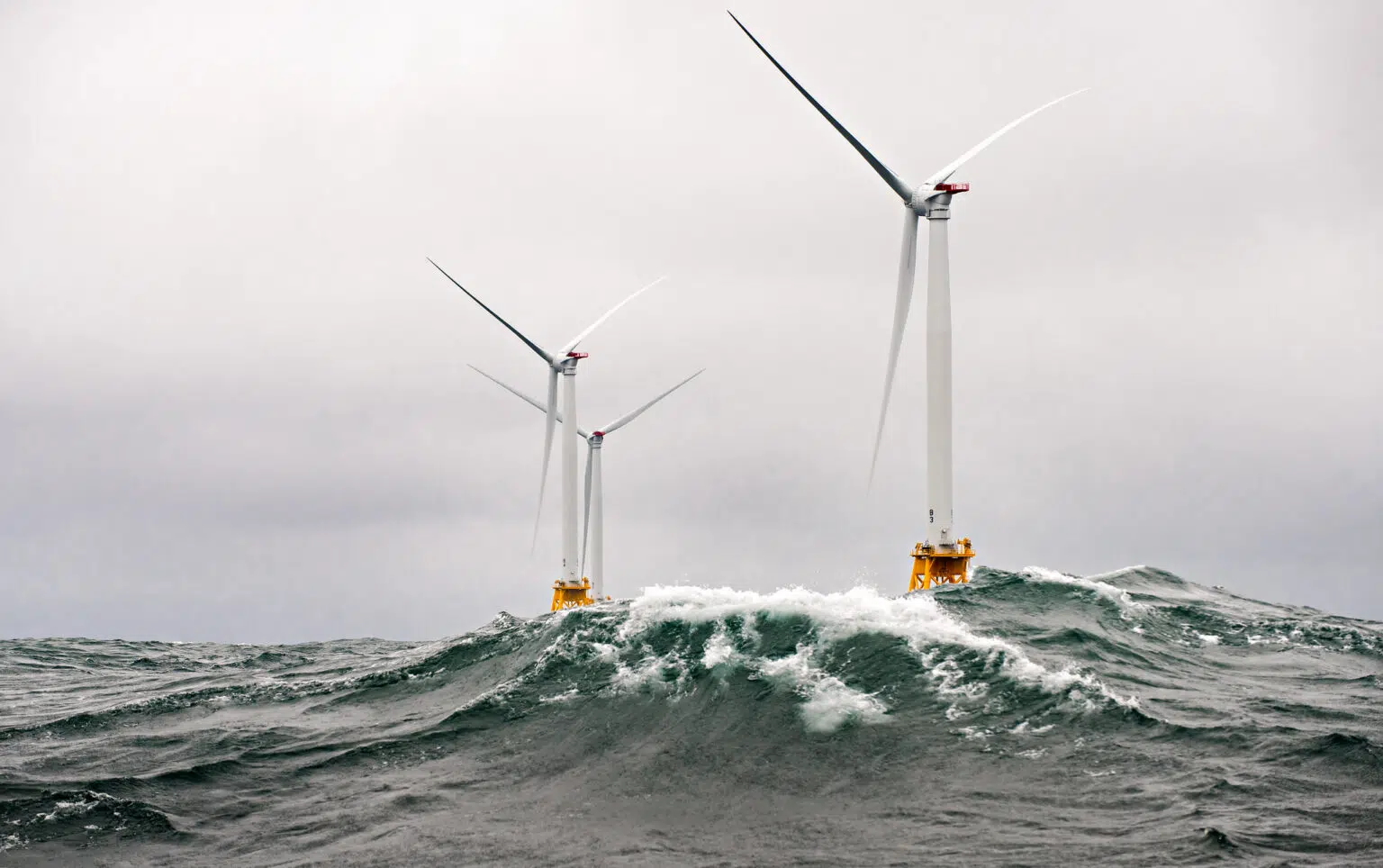
Morano and company’s mission failed, as construction continued on the 12 turbines that now compose one of the largest offshore wind farms built to date in the United States. In December, New York flipped the switch on South Fork Wind, which will deliver renewable power to some 70,000 homes in the state. But figures like Morano may be gaining ground in a larger mission: twisting public opinion against renewable energy in other would-be host communities.
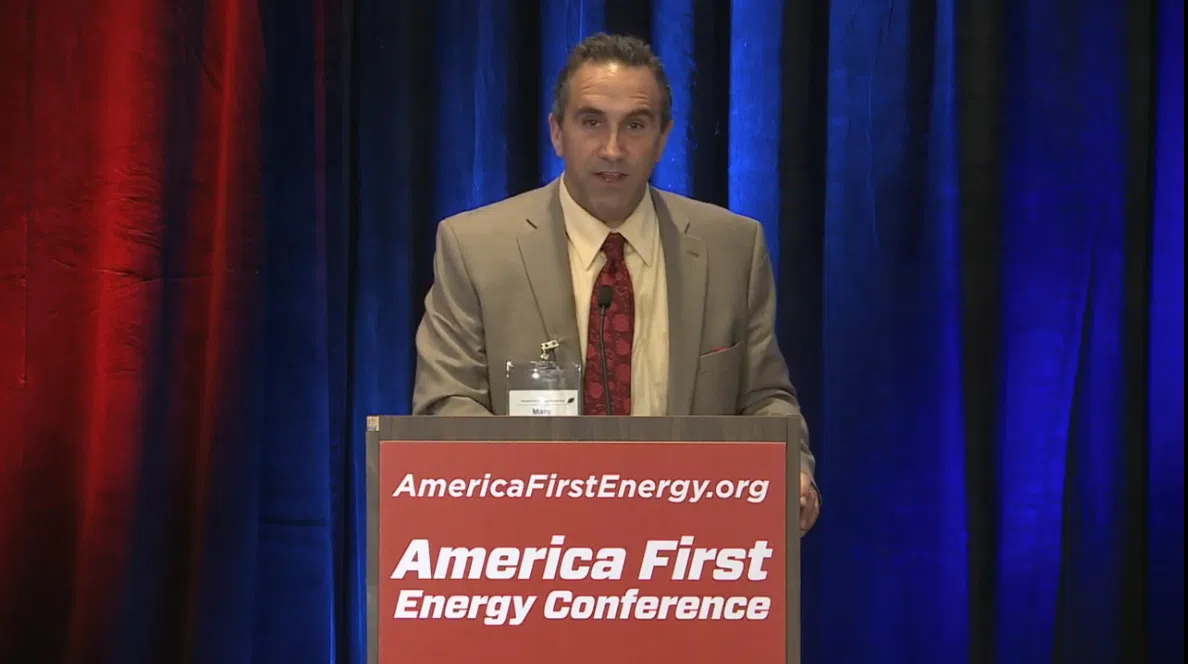
Marc Morano, a prominent climate change denier, spoke at the Heartland Institute’s “America First Energy Conference” in 2018. Credit: Heartland Institute via YouTube
Morano works at the Committee for a Constructive Tomorrow, part of a sprawling climate-denial machine assembled with funding from fossil fuel interests like ExxonMobil and the Charles Koch Foundation and dark-money groups like DonorsTrust. Between 1998 and 2014, ExxonMobil and its foundation gave more than half a million dollars to the committee, which did not respond to a request for comment. DonorsTrust gave the group nearly $8 million between 2008 and 2017, according to federal tax data. Today, as both the science and the tangible effects of a warming planet become irrefutable, it’s increasingly rare to encounter the kind of outright climate denial these groups pioneered. Instead, it’s being replaced by what misinformation experts call “climate delayism”—a coordinated campaign to undermine climate solutions.
For fossil fuel ideologues, sowing misinformation about wind and solar power is proving to be an effective stall tactic. Public opinion surveys show that renewable energy remains popular with a bipartisan majority of Americans; in a poll from The Washington Post and the University of Maryland, seven out of 10 people said they’d be comfortable with a wind farm in their own community. But in New Jersey—where Morano’s group has gone so far as to buy billboards reading “Save Whales Stop Windmills”—nearly half of all the state’s residents now believe that such a connection probably exists, according to an August poll from Monmouth University.
“There is absolutely zero evidence that any of the offshore wind activity has been involved in any of those strandings,” says Douglas Nowacek, a professor of marine conservation technology at Duke University. Claims that noise from offshore wind surveys are driving whales into harm’s way don’t hold water, according to Nowacek—and it bears noting that seismic surveys for oil and gas are far louder. Many of the dead whales have borne signs of ship strikes or entanglement in fishing gear.
Yet in lawsuits challenging offshore wind projects, opponents continue to routinely cite alleged threats to whales. Two separate groups of plaintiffs retained an attorney, David Hubbard, who also represents Morano’s group. (Citing attorney-client privilege, Hubbard declined to discuss the Committee for a Constructive Tomorrow.) Courts have rejected such challenges to date. But coupled with high interest rates and supply-chain disruptions, such lawsuits could delay the offshore wind sector’s development.
It’s not just offshore wind at risk either. In order for the Biden administration to hit its goal of a 100 percent clean power grid by 2035, the nation needs to rapidly increase the rate of new wind and solar power installations. Hard-won federal policies like the 2022 Inflation Reduction Act put that target within reach. But at the local level, challenges are mounting. A report from Columbia University’s Sabin Center for Climate Change Law identified nearly 230 local measures across 35 states that have been enacted to restrict renewable energy development. Matthew Eisenson, the report’s author, said these could amount to a “serious obstacle” to achieving US climate goals.
Many such measures bear the fingerprints of “wind warriors” who have reemerged in dozens of local fights to stymie the energy transition at key points. For more than a decade, climate deniers and fossil fuel interests have quietly cultivated ties with these activists, equipping them with talking points, legal muscle, model ordinances, and other tools to try to subvert renewable energy adoption. Now, from coastal hamlets in New York to rural farming towns in Ohio, residents supporting wind and solar in their communities are running up against the same barrier: a chorus of disinformation, much of it tied to, or even circulated directly by, fossil-fuel-backed groups waging an existential fight to preserve the status quo.
IN THEIR BOOKMerchants of Doubt, historians Naomi Oreskes and Erik M. Conway detail how Big Oil took a page from Big Tobacco’s playbook to stoke the embers of the climate-denial movement. The longer industry groups could “keep the controversy alive” by creating the appearance of scientific debate, the longer they could continue to stall regulations and rake in profits. Oreskes and Conway even spotted overlap in the operatives carrying out this strategy, as figures like tobacco lobbyist Steven Milloy made a seamless transition from denying the health impacts of secondhand smoke to smearing climate scientists. Today, Milloy can be found attacking renewable energy—such as in a bizarre 2023 tweet in which he claimed that “wind power made the trans-Atlantic slave trade possible.”
While slick public relations operatives were once the go-to for industry spin, today scrappy antagonists working through social media can be highly effective, according to Joshua Fergen, a sociologist who has studied how online groups opposing wind energy stoked local conflict over its development in Ohio. Deepening political polarization, fueled by social media, has helped transform renewable energy into a culture-war issue—and extended the reach of its most ardent opponents.
As both the science and the tangible effects of a warming planet become irrefutable, it’s increasingly rare to encounter outright climate denial. Instead, it’s being replaced by what misinformation experts call “climate delayism.”
Fergen emphasizes that valid concerns arise about how renewable developers engage communities and choose project locations. But browse the myriad local Facebook groups dedicated to opposing renewable energy and you’ll see a different set of themes repeat. Along with AI-generated images of whales washed ashore in front of wind turbines, there are memes of the Grim Reaper holding a turbine in place of a scythe. In 2021, a viral post blaming Texas’s deadly winter blackout on iced-over wind turbines used an image from Sweden—and originated from a prominent oil and gas consultant, as USA Today reported.
Certain names also pop up over and over—many of them tied to a 2012 anti-wind confab in Washington, DC. Fergen says that the seeds of today’s online wind wars were in a draft public relations strategy that circulated the same year; a leaked document outlined how wind warriors can “create so much confusion, so many opinions on this, that you don’t really want to step in it,” he says.
One of those names is John Droz. He is a retired real-estate investor who has been involved in an impressive array of local energy fights over the past 15 years. It was Droz who convened the 2012 meeting that brought together staff from groups like the American Legislative Exchange Council and the Committee for a Constructive Tomorrow with local wind opponents. Droz also edited the PR document that put forth tactics including a meme campaign, a “dummy business” to go into communities considering wind development, and youth science fairs “with preset parameters that cause students to steer away from wind.” The watchdog group Checks and Balances Project, which obtained documents from the conference, told The Guardian that it marked “the first time that local NIMBY anti-wind groups are coordinating and working with national fossil-fuel-funded advocacy groups to wreck the wind industry,” referring to “not in my backyard” anti-wind groups that proliferated during the mid-aughts.
Droz, who once worked at General Electric and describes himself as an “independent physicist,” has links to some of the key organs of the Right. He has been a guest speaker at the infamous climate-denial conferences hosted by the Heartland Institute. But Droz has achieved much of his impact through fastidious networking in communities with planned renewable energy projects. On his website, the Alliance for Wise Energy Decisions, he provides a menu of wind ordinance templates. The ordinances often focus on “setback” rules, which mandate how far wind turbines must be located from neighboring properties. In one strategy document, Droz explains that the point of setbacks should be to make them “so restrictive that the cost of the project becomes prohibitive and the developer leaves.”
Droz denies that his ordinances have had this effect; he also says that he does not keep track of how many have passed. But his name has turned up in the local meeting minutes of towns like Richland, New York, which enacted restrictive setbacks in 2018. In the nearby town of Worth, where dozens of residents turned out to try to stop the passage of a similar measure, documents filed with the state utility regulator show that the town board consulted Droz as an “independent wind expert.”
Many such local regulations act as de facto wind farm bans, according to Columbia University’s Eisenson. Local governments extend six-month moratoriums indefinitely, or set caps on the acreage renewables can occupy. “If you have a one-mile setback from roads, you essentially need to have a property that’s at least four square miles in order to have a single wind turbine,” Eisenson says.
Dave Anderson, a policy analyst at the pro-renewables Energy and Policy Institute, has watched figures like Droz reappear perennially. The upshot, he says, is that while local anti-renewable groups may not have been started by the fossil fuel industry, “very quickly, they began to coordinate and get a lot of their information from think tanks and front groups” for the industry.
For more than a decade, Anderson’s group has chronicled this kind of coordination in purportedly grassroots campaigns. That included a yearslong, nationwide assault on state renewable energy mandates led by the State Policy Network, a 50-state group of Koch-affiliated think tanks. Network members turned up to testify on behalf of cut-and-paste legislation rolling back the renewable requirements—sometimes citing debunked studies from other Koch-backed groups. In Ohio, which froze its requirements in 2014, conservative think tanks and utility lobbyists cultivated ties with local wind opponents to stage public meetings featuring a David and Goliath narrative about the invasion of “Big Wind.”
In August 2021, a press conference staged on the steps of the Massachusetts State House seemed to repeat the same formula. After two Nantucket residents announced plans to file suit against a planned offshore wind project, a man with a shock of white hair and a smart blue suit stepped forward. Homeowners fighting wind turbines “need help,” he said, which is why he had traveled from Delaware to announce a new coalition “pairing think tanks like ours from various states with beach community groups.”
The speaker was David Stevenson, a former DuPont executive and adviser to Donald Trump’s 2016 transition team. The think tank he was referring to is the Caesar Rodney Institute, the Delaware affiliate of the State Policy Network, where Stevenson works. At least five State Policy Network groups now work within the American Coalition for Ocean Protection, the new anti-wind umbrella group Stevenson announced. The coalition hadn’t received any Koch money to date, Stevenson told reporters at the statehouse press conference. He then added, “Not that we wouldn’t take it.”
Stevenson said in an email that the coalition has provided organizational but not financial support to local offshore-wind opponents. The dollar amount raised by the Caesar Rodney Institute for its Ocean Environment Legal Defense Fund is confidential, he said, “but it is substantial.”
A WOMAN DRESSED in a full-body whale costume sat in the front row of a school gymnasium in Rhode Island last March, holding a sign that read “Save Me.”
The event was an info session about planned offshore wind projects with a panel of experts including Timmons Roberts, a professor of environmental studies at Brown University. The woman, Mary Chalke, was one of the Nantucket homeowners from Stevenson’s press conference. Roberts had first encountered affiliated local wind opponents earlier that year, when they began publishing a series of over-the-top warnings. One said that just as chemical dispersants had intensified the environmental damage from the 2010 Gulf oil spill, so, too, could offshore wind prove to be a cure worse than the disease of climate change. “The claims were so unsupported by the evidence and so sensationalized, and they really seemed to be just playing on people’s fears,” Roberts says.
A few years ago, Roberts was part of a team that modeled possible pathways to decarbonization in Rhode Island and found that nearly two-thirds of its electricity could be supplied by offshore wind, the most viable option in the densely populated state. After watching wind misinformation mount, Roberts switched gears and, with his students, produced a report analyzing opponents’ tactics. The report found that while wind foes circulated voluminous studies, white papers, and regulatory comments that gave the impression of rigor, they relied on fake experts and cherry-picked or misrepresented data—mainstays of the larger climate-denial movement.
Take the evolution of the narrative that wind turbines are killing whales. Conservative tabloids in Britain began falsely reporting a link more than a decade ago, sometimes referencing findings from Scotland’s University of St. Andrews. In 2011, one of the university’s researchers protested when The Daily Telegraph cited his study linking naval exercises to whale strandings—in order to claim that wind farms “posed an even greater threat” to whales. The newspaper issued a correction, but the same claim, with the same citation, continued circulating nonetheless. In 2016, it was picked up by Paul Driessen, head of the Committee for a Constructive Tomorrow. Driessen’s blog post on whale deaths, citing the debunked article, is now marshaled as evidence by US opponents of offshore wind.
University of Rhode Island marine scientist Robert Kenney tried to correct the record in 2017, when a Daily Caller article linked the death of a humpback whale to the first US offshore wind farm. “Whales themselves are louder than turbines”—unlike ultraloud naval sonar—Kenney and a colleague explained in a published response. Plus, the Daily Caller piece had misstated the start of a series of humpback strandings to make the whales’ death rate appear three times as high. “The only thing in the whole article that was true was that there was a dead whale,” Kenney says.
Kenney’s research has tracked the decline of the critically endangered North Atlantic right whale. Since 2011, the whales’ deaths—largely from ship strikes and entanglements in fishing gear—have outpaced births. The most effective protections would involve stricter regulations on commercial fishing, according to Kenney. But, he says, “the fishing industry fights tooth and nail every step of the way.”
It’s suspicious, then, that the fishing industry is now one of the loudest voices decrying the supposed dangers that offshore wind poses to right whales. In 2021, six commercial fishing associations sued the Bureau of Ocean Energy Management, alleging that its approval of a wind farm off the coast of Nantucket violates the Marine Mammal Protection Act. The legal muscle behind the case was provided free of charge by the Texas Public Policy Foundation, a right-wing think tank. The group, which does not comment on its donors, has received at least $4 million from fossil fuel interests.
Amplified by fossil-fuel-backed groups and Fox News, the claims about whale deaths have derailed support for offshore wind in communities like Long Beach, New York, where many residents thought their community would welcome a proposed wind farm. Long Beach sits on a thin strip of land on the south shore of Long Island, an area devastated by 2012’s Superstorm Sandy. In the storm’s aftermath, the city came out in staunch opposition to a proposed liquefied natural gas terminal off its coastline. Residents packed public meetings and staged beachfront rallies. When then-governor Andrew Cuomo arrived in the city in 2015 to announce his veto of the gas project, a crowd of 200 people burst into applause.
During the past year, a vocal group of locals mounted a mirror-image campaign against a proposed offshore wind farm whose underwater cable would make landfall in Long Beach before carrying power to some 1 million New York homes. “I’m all for green energy, believe me. I recycle every little thing I can,” said one area resident at a public hearing before New York’s utility regulator last October. Then she continued, “I am vehemently opposed to this entire project. The whales washing up that never used to wash up before.”
Conservative think tanks and utility lobbyists cultivated ties with local wind opponents to stage public meetings featuring a David and Goliath narrative.
Wind opponents began showing up to nearly every city council meeting. “There weren’t that many of them, but they were very organized, and very loud,” says Ellen Gluck Feldman, an environmental planner who has lived in Long Beach for almost four decades. She watched in dismay as the city council came out in formal opposition to the project last summer, leaving its path forward uncertain.
Gluck Feldman had thought that renewable energy would be a relatively easy sell in a community intimately familiar with climate calamity. “We should be the first ones to step up and do it because of what happened with Sandy,” she says. “We should be the first ones to say yes, we’re on board. And instead, we said no. It just boggles the mind.”
IN MANY PARTS of the country, the tactics honed by anti-wind campaigners are now being deployed against solar.
In late November, residents of Knox County, Ohio, packed a 1,000-seat theater to enjoy snacks and free alcohol and learn about a solar project proposed for their area. The catered town hall was hosted by Knox Smart Development, an anonymously funded LLC incorporated less than three weeks earlier. The speakers included Steve Goreham, a policy adviser for the Heartland Institute whose latest book forecasts a “coming renewable energy failure.” Attendees were instructed on how they could voice their opposition to the state regulator now reviewing the solar project.
Kathy Gamble attended the town hall to pass out information on behalf of Knox County for Responsible Solar, a group she founded to support residents’ rights to use their land as they choose, including for renewable energy development. The solar scare tactics are straining local relationships to the breaking point, she says. “Landowners are afraid to admit that they have land in the project.”
A mostly rural area outside of Columbus, Knox County happens to be home to the Ariel Corporation, a major manufacturer of methane gas compressors. Gamble suspects that its CEO, Republican megadonor Karen Buchwald Wright, is behind the new anti-renewables group. Around the same time as the town hall, according to Gamble, residents began receiving copies of Goreham’s book with a handwritten note from Buchwald Wright. (Neither Knox Smart Development nor the Ariel Corporation responded to a request for comment.)
Gamble is unfazed by these tactics. The dark-money group in Knox County is just the latest of its kind to pop up in Ohio, where fossil fuel and utility companies have launched some of their most brazen attacks on renewable energy. Last year, the Empowerment Alliance, a separate group linked to Buchwald Wright that runs ads attacking wind and solar, successfully lobbied for state legislation categorizing methane gas as green energy. In 2019, Ohioans weathered a $9.5 million advertising blitz in favor of another disastrous energy law. The pressure campaign had been orchestrated by a front group for FirstEnergy, a bankrupt utility at the center of the state’s largest-ever corruption scandal. The utility company built a sprawling network of dark-money groups—and spent some $60 million on outright bribes—to grease the way for the state’s bailout of two aging nuclear plants. The 2019 legislation also gutted renewable energy standards and left taxpayers on the hook for ongoing coal subsidies benefiting FirstEnergy that will total nearly $2 billion by the end of this decade.
While the corruption at the heart of Ohio’s disastrous energy policy has been uncovered, the shadow it cast over the state’s climate future remains. Ohio utilities rank among the worst in the nation for the amount of electricity generated by renewables, and the state’s setback requirements for wind turbines are 10 times greater than those for oil and gas wells. Large-scale solar projects like the one in Knox County could provide a path forward—but only if they can make it through an approval process that’s increasingly stacked against renewables.
Three years ago, legislation cosponsored by Republican state representative Bill Seitz handed counties the power to veto renewable energy projects—and to proclaim themselves off-limits to wind and solar altogether. Communities lack any equivalent power to reject new fossil fuel projects. At least 10 counties in the state have since enacted such bans. And even in counties that haven’t passed such measures, the Ohio Power Siting Board has nonetheless begun rejecting new renewable projects, citing the presence of community opposition as evidence that they don’t adequately serve the public interest.
That’s a stark departure from precedent, according to Karin Nordstrom, an attorney for the nonprofit Ohio Environmental Council. In 2019, the board approved a controversial methane gas pipeline over the protest of communities in its path. Treating community opposition as a sufficient basis for denial appears to be a standard applied only to renewable energy, Nordstrom says. It’s “inappropriate” not to consider a project’s impact on climate change as part of the public interest.
Fossil fuel interests have a history of covert intervention in Ohio’s renewable energy siting. In one now-infamous example, coal producer Murray Energy was unmasked in 2018 as the money behind a yearslong lawsuit against a proposed Lake Erie wind farm. That was after an apparent front group for the coal industry—going by the name of Campaign for Affordable and Reliable Energy—tried unsuccessfully to intervene directly in several renewable energy siting cases. Murray Energy was also a major backer of the corruption-tainted 2019 nuclear and coal bailout.
Even after the astroturf anti-wind scheme was exposed in local media, an attorney for Murray Energy, John Stock, continued to represent groups fighting renewable energy projects until the coal company’s 2019 bankruptcy. At least two of Stock’s cases were then taken over by Jack Van Kley, a Columbus attorney who has since helped accelerate denials of renewable projects in Ohio. In the past four years, Van Kley has helped kill at least three other renewable energy projects, and he’s currently representing intervenors in four solar cases before the siting board. Last summer, The Plain Dealer spotted a reference to an “independent individual” chipping in $10,000 toward Van Kley’s fee in the meeting minutes of one of the townships he’s representing.
Van Kley said in an email that he has never represented or been paid by fossil fuel companies; his clients pay his fees. Other than the support they get from landowners who benefit financially, according to Van Kley, the projects “are almost universally opposed.”
In Madison County, Ohio, a solar proponent named John Boeckl has tried to counter that narrative. Boeckl researches photovoltaics for the nearby Wright-Patterson Air Force Base, and his land is a few hundred yards from the proposed site of the Oak Run Solar Project, which could become one of the largest solar projects built to date nationwide. With the help of Columbia Law School’s Sabin Center, Boeckl filed testimony on behalf of the project. He says that the objections he has heard from area residents boil down to scare tactics: “They’re taking away all our farmland, and we’re going to be eating soy.” The rhetoric echoes lines about the loss of farmland circulated by new fossil-fuel-linked groups like the Empowerment Alliance, as well as older ones like the Committee for a Constructive Tomorrow. In fact, Oak Run Solar could break new ground in agrovoltaics, the practice of co-locating crops and solar panels, which can increase some crop yields and reduce the amount of water needed for irrigation.
Local opponents have also raised concerns about the waste generated by solar panels; last year, researchers at the National Renewable Energy Laboratory and the Colorado School of Mines warned that such claims may be slowing solar deployment, even though decarbonization “represents a substantial reduction in mass and toxicity of waste.” At present, they found, as much toxic coal ash is generated globally in one month as solar panels are expected to produce in the next 35 years.
In the face of well-financed opposition, Gamble feels outgunned. “You can hardly turn on a computer in this area without seeing their ads,” she says. But she’ll keep having conversations with her neighbors, and she plans to make her opinions known at siting board meetings when hearings get underway this spring. “I plan to get up and say my piece there,” she says, no matter the size of the opposition. “I do know that I just plan to keep on doing what I do.”
This article was published in partnership with The American Prospect.