Overshooting 1.5°C: even temporary warming above globally agreed temperature limit could have permanent consequences

Spread the love
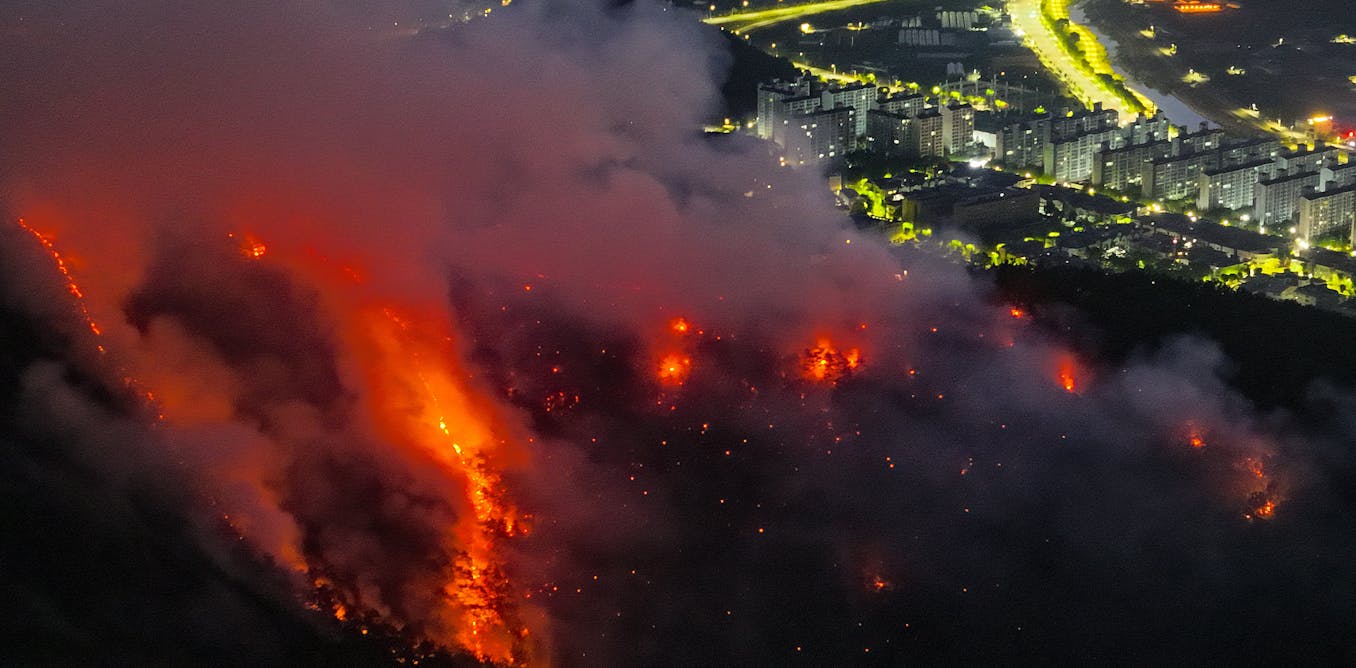
A wildfire raging near a residential area of Daegu, South Korea in April 2025. EPA-EFE/Yonhap

Paul Dodds, UCL

Earth’s surface temperature has been 1.5°C hotter than the pre-industrial average for 21 of the last 22 months.

The 2015 Paris agreement committed countries to keeping the global temperature increase “well below 2°C”, which is widely interpreted as an average of 1.5°C over a 30-year period. The Paris agreement has not yet failed, but recent high temperatures show how close the Earth is to crossing this critical threshold.

Climate scientists have, using computer simulations, modelled pathways for halting climate change at internationally agreed limits. However, in recent years, many of the pathways that have been published involve exceeding 1.5°C for a few decades and removing enough greenhouse gas from the atmosphere to return Earth’s average temperature below the threshold again. Scientists call this “a temporary overshoot”.

If human activities were to raise the global average temperature 1.6°C above the pre-industrial average, for example, then CO₂ removal, using methods ranging from habitat restoration to mechanically capturing CO₂ from the air, would be required to return warming to below 1.5°C by 2100.


Get your news from actual experts, straight to your inbox. Sign up to our daily newsletter to receive all The Conversation UK’s latest coverage of news and research, from politics and business to the arts and sciences.


Do we really understand the consequences of “temporarily” overshooting 1.5°C? And would it even be possible to lower temperatures again?

Faith that a temporary overshoot will be safe and practicable has justified a deliberate strategy of delaying emission cuts in the short term, some scientists warn. The dangers posed by remaining above the 1.5°C limit for a period of time have received little attention by researchers like me, who study climate change.

To learn more, the UK government commissioned me and a team of 36 other scientists to examine the possible impacts.

How nature will be affected

We examined a “delayed action” scenario, in which greenhouse gas emissions remain similar for the next 15 years due to continued fossil fuel burning but then fall rapidly over a period of 20 years.

We projected that this would cause the rise in Earth’s temperature to peak at 1.9°C in 2060, before falling to 1.5°C in 2100 as greenhouse gases are removed from the atmosphere. We compared this scenario with a baseline scenario in which the global temperature does not exceed 1.5°C of warming this century.

Our Earth system model suggested that Arctic temperatures would be up to 4°C higher in 2060 compared to the baseline scenario. Arctic Sea ice loss would be much higher. Even after the global average temperature was returned to 1.5°C above pre-industrial levels, in 2100, the Arctic would remain around 1.5°C warmer compared to the baseline scenario. This suggests there are long-term and potentially irreversible consequences for the climate in overshooting 1.5°C.

Comparative maps of global temperature increases in the middle of the century caused by overshooting 1.5°C, when compared to a pathway in which the global temperature does not exceed 1.5°C.
Temperature increases caused by overshooting 1.5°C are primarily felt in the Arctic and on land. Selena Zhang, Maria Russo, Luke Abraham and Alex Archibald.

As global warming approaches 2°C, warm-water corals, Arctic permafrost, Barents Sea ice and mountain glaciers could reach tipping points at which substantial and irreversible changes occur. Some scientists have concluded that the west Antarctic ice sheet may have already started melting irreversibly.

Our modelling showed that the risk of catastrophic wildfires is substantially higher during a temporary overshoot that culminates in 1.9°C of warming, particularly in regions already vulnerable to wildfires. Fires in California in early 2025 are an example of what is possible when the global temperature is higher.

Our analysis showed that the risk of species going extinct at 2°C of warming is double that at 1.5°C. Insects are most at risk because they are less able to move between regions in response to the changing climate than larger mammals and birds.

The impacts on society

Only armed conflict is considered by experts to have a greater impact on society than extreme weather. Forecasting how extreme weather will be affected by climate change is challenging. Scientists expect more intense storms, floods and droughts, but not necessarily in places that already regularly suffer these extremes.

In some places, moderate floods may reduce in size while larger, more extreme events occur more often and cause more damage. We are confident that the sea level would rise faster in a temporary overshoot scenario, and further increase the risk of flooding. We also expect more extreme floods and droughts, and for them to cause more damage to water and sanitation systems.

Floods and droughts will affect food production too. We found that impact studies have probably underestimated the crop damage that increases in extreme weather and water scarcity in key production areas during a temporary overshoot would cause.

We know that heatwaves become more frequent and intense as temperatures increase. More scarce food and water would increase the health risks of heat exposure beyond 1.5°C. It is particularly difficult to estimate the overall impact of overshooting this temperature limit when several impacts reinforce each other in this way.

In fact, most alarming of all is how uncertain much of our knowledge is.

For example, we have little confidence in estimates of how climate change will affect the economy. Some academics use models to predict how crops and other economic assets will be affected by climate change; others infer what will happen by projecting real-word economic losses to date into future warming scenarios. For 3°C of warming, estimates of the annual impact on GDP using models range from -5% to +3% each year, but up to -55% using the latter approach.

We have not managed to reconcile the differences between these methods. The highest estimates account for changes in extreme weather due to climate change, which are particularly difficult to determine.

We carried out an economic analysis using estimates of climate damage from both models and observed climate-related losses. We found that temporarily overshooting 1.5°C would reduce global GDP compared with not overshooting it, even if economic damages were lower than we expect. The economic consequences for the global economy could be profound.

So, what can we say for certain? First, that temporarily overshooting 1.5°C would be more costly to society and to the natural world than not overshooting it. Second, our projections are relatively conservative. It is likely that impacts would be worse, and possibly much worse, than we estimate.

Fundamentally, every increment of global temperature rise will worsen impacts on us and the rest of the natural world. We should aim to minimise global warming as much as possible, rather than focus on a particular target.


Don’t have time to read about climate change as much as you’d like?
Get a weekly roundup in your inbox instead. Every Wednesday, The Conversation’s environment editor writes Imagine, a short email that goes a little deeper into just one climate issue. Join the 45,000+ readers who’ve subscribed so far.


Paul Dodds, Professor of Energy Systems, UCL

This article is republished from The Conversation under a Creative Commons license. Read the original article.

Orcas comment on killer apes destroying the planet by continuing to burn fossil fuels.
Neo-Fascist Climate Science Denier Donald Trump says Burn, Baby, Burn.
Elon Musk urges you to be a Fascist like him, says that you can ignore facts and reality then.
Continue ReadingOvershooting 1.5°C: even temporary warming above globally agreed temperature limit could have permanent consequences

Critics Warn Trump ‘Flatly Illegal’ Firings at NOAA Will ‘Cost Lives’

Spread the love

Original article by Brett Wilkins republished from Common Dreams under Creative Commons (CC BY-NC-ND 3.0). 

U.S. Sen. Chris Van Hollen (D-Md.) speaks at Ritchie Coliseum on the campus of the University of Maryland on June 24, 2024 in College Park, Maryland. (Photo: Kevin Dietsch/Getty Images)

“Today’s mass layoffs of NOAA staff signals a grim new reality: one where career federal scientists will be recklessly discarded,” said one campaigner.

Critics on Thursday decried the Trump administration’s firing of National Oceanic and Atmospheric Administration staffers, part of Elon Musk’s Department of Government Efficiency’s plan to eviscerate the federal government.

Following the playbook of Project 2025, a blueprint for gutting the federal government, the Commerce Department this week fired hundreds of NOAA staffers, many of them specialized climate scientists and weather forecasters.

In addition to issuing weather watches and warnings, NOAA monitors and studies the planet’s climate.

We’re mobilizing scientists to protect NOAA and we need you too. Get involved:

Union of Concerned Scientists (@ucsusa.bsky.social) 2025-02-26T21:02:13.322Z

U.S. Sen. Chris Van Hollen’s (D-Md.) office said in a statement that the senator stressed that the firings “would be plainly unlawful and pointed to the Merit Service Protection Board’s decision yesterday that stayed the terminations of multiple federal employees on probationary status.”

“I take this opportunity to remind the department of its legal obligation to notify the Senate and House Committees on Appropriations regarding the large-scale termination of employees,” the senator added. Specifically, Section 505 of Title V, Division C of Public Law 118–42—a provision of the American Relief Act, 2025 (Public Law 118–158)—states, in part:

None of the funds provided under this act, or provided under previous appropriations acts to the agencies funded by this act that remain available for obligation or expenditure in fiscal year 2024… shall be available for obligation or expenditure through a reprogramming of funds that… reduces by 10% funding for any program, project, or activity, or numbers of personnel by 10%; or…results from any general savings, including savings from a reduction in personnel, which would result in a change in existing programs, projects, or activities as approved by Congress; unless the House and Senate Committees on Appropriations are notified 15 days in advance of such reprogramming of funds.

“Other agencies in my subcommittee’s jurisdiction have cited ‘ poor performance‘ to move forward with drastic layoffs,” Van Hollen added. “This has been exposed as a lie. Many terminated probationary employees have already come forward with evidence of recent glowing performance reviews, laying bare the flimsy pretext of these firings as gross misrepresentations of fact. The department must not become a purveyor of such lies and must comply with its legal obligations.”

Juan Declet-Barreto, senior social scientist for climate vulnerability in the Climate and Energy Program at Union of Concerned Scientists, said in a statement that “today’s mass layoffs of NOAA staff signals a grim new reality: one where career federal scientists will be recklessly discarded, and the lifesaving science they do will be significantly undermined.”

“When testifying under oath, Howard Lutnick assured congressional members that if confirmed as commerce secretary, NOAA wouldn’t be dismantled under his watch—a promise that was broken today,” Declet-Barreto added. “It seems either Lutnick willingly lied to Congress and the American people or that he has caved in record-breaking time to the destructive agenda of the Trump-Musk regime.”

Oceana U.S. vice president Beth Lowell said that “our oceans have become political carnage, but the real victims are hardworking Americans—the people you care about—and our future generations.”

“These are American jobs that warn us about severe weather, protect our most vulnerable marine life like whales and turtles, ensure abundant fisheries, and maintain a healthy ocean for those whose livelihoods depend on it,” Lowell added. “We’re calling on Congress to save NOAA from these disastrous cuts, while also protecting American jobs, communities, and the oceans.”

More than 2,000 scientists have signed a letter to members of Congress and the Commerce Secretary urging protection of NOAA.

Original article by Brett Wilkins republished from Common Dreams under Creative Commons (CC BY-NC-ND 3.0). 

Neo-Fascist Climate Science Denier Donald Trump says Burn, Baby, Burn.
Elon Musk urges you to be a Fascist like him, says that you can ignore facts and reality then.

Continue ReadingCritics Warn Trump ‘Flatly Illegal’ Firings at NOAA Will ‘Cost Lives’

Governments Must Tackle Climate Disinformation, Experts Urge

Spread the love

Original article by Joey Grostern republished from DeSmog.

Scientists and campaigners are calling on governments and tech companies to tackle climate disinformation. Credit: MauriceNorbert via Alamy

An open letter from climate scientists and campaigners warns of the dangers associated with false climate claims.

Governments around the world must take “immediate and decisive action” to tackle climate disinformation, scientists and campaign groups have urged as talks at the COP29 climate summit in Baku, Azerbaijan enter their fourth day. 

A coalition of 55 climate information integrity groups and 42 leading climate scientists and experts have signed an open letter urging countries to counter the risk of false and misleading claims that are wrecking efforts to slow climate change. 

It comes two days after UK Prime Minister Keir Starmer spoke at COP29 arguing that “there is no national security without climate security” – and a week after the election in the United States of Donald Trump, who has previously called climate change a “hoax”. 

The letter published today – signatories to which include Friends of the Earth, the Institute of Strategic Dialogue, and regional branches of Greenpeace and WWF – lists steps governments could take. 

These include adopting a universal definition of climate disinformation, such as the working definition proposed by the Climate Action Against Disinformation (CAAD) coalition, another signatory. 

According to the letter, the definition should cover anything that misrepresents scientific data or “falsely publicises” supposed solutions to climate change which in fact contribute to global warming, often referred to as “greenwashing”. 

Such a definition should cover “deceptive or misleading online behaviour” that undermines public understanding of climate change, the fact it is caused by human activity, and the need for urgent mitigation and adaptation action, the letter said. 

Signatories also urged governments to take action against organisations which give a platform to climate disinformation – including social media outlets, advertising technology providers, broadcasters, and publishing companies. 

“The spread of disinformation continues to undermine and delay our collective ability to act, jeopardising progress at crucial negotiations and the upcoming G20 Summit in Brazil”, the letter said.  

“Climate disinformation, waged by vested interests, undermines climate action and puts our collective future at risk. Our information ecosystem is being damaged, and those responsible must be held accountable.”

The letter ends by arguing that “by adopting these principles, governments can foster a healthier and safer online environment that supports informed decision-making and enables effective climate action.”

The world’s leading climate science group, the UN’s Intergovernmental Panel on Climate Change (IPCC), has warned that efforts to tackle climate change were being delayed by “rhetoric and misinformation that undermines climate science and disregards risk and urgency”.

“As disinformation continues to be an obstacle to vital climate action, the message from this open letter to decision makers globally is clear: protecting truth in the climate conversation is critical if we are to secure meaningful change”, said Max MacBride, Head of Counter-Disinformation at Roots Greenpeace, the NGO’s grassroots campaign initiative.

“At Roots, we see every day how climate disinformation stifles youth advocacy, and we join this call to hold governments and platforms accountable for enabling informed, equitable climate action”, he said.

Climate Disinformation Threats 

A CAAD report published earlier this week found that climate disinformation is widespread online, and is hobbling efforts to address climate change. 

The report said that social media platforms bear responsibility for allowing “super spreaders” to “pollute their platforms with debunked claims attacking renewable energy and electric vehicles”.

CAAD also found that fossil fuel companies were allowed to use digital advertising across Meta platforms to greenwash their reputations, by promoting false solutions or presenting fossil fuels as essential to the energy transition. 

A study published in February found that 14 percent of Americans don’t believe climate change is real – even as growing numbers of Americans say they are concerned about the climate.

“In the US, we’ve painfully experienced the role disinformation has played in thwarting disaster response and threats to the lives of responders”, Kate Cell, Senior Climate Campaign Manager at the Union of Concerned Scientists, told DeSmog.

“As climate-fueled disasters become more common around the world, governments can protect their residents by addressing the problem of climate disinformation systemically.” 

Another report released this week by the scrutiny NGO InfluenceMap found 2.500 cases of fossil fuel companies pushing arguments which contradict IPCC recommendations since COP28 last year. 

Thais Lazzeri, founder of educational group FALA, a signatory to the letter, told DeSmog: “The letter comes at a unique time for Brazil, which is hosting the G20 and the incoming COP30 Presidency. The alliance of so many Brazilian institutes and professionals shows the urgency for answers and the intersectoral power of this Brazilian network, willing to work together.”

She added: “At the opening of the Brazil space at CO29, Environment Minister, Marina Silva, said that denialism doesn’t fit. The Brazilian government can lead by example and guarantee information integrity policies and strategic, connected actions to change the game.”

DeSmog has previously reported on news media spreading false climate claims, with The Telegraph newspaper in the UK attacking climate solutions – a trend that has increasing since July’s general election. As revealed by DeSmog in 2023, one in three presenters on the right-wing broadcaster GB News had spread climate disinformation during the previous year. 

“It is much easier to pollute the waters of public discussion on climate change causes and consequences than it is to keep them clean and productive,” said Max Boykoff, signatory to the letter and professor of Environmental Studies at Boulder University in Colorado and founder of the Media Climate Change Observatory, a project which analyses mentions of climate change in news media.

“Therefore, more proactive, clear, accurate and effective communication efforts are consistently and repeatedly needed. That motivates this call for government action to curb disinformation about climate change.”

Original article by Joey Grostern republished from DeSmog.

Related: UK & Government Petitions: Run a public information campaign on the climate crisis

Continue ReadingGovernments Must Tackle Climate Disinformation, Experts Urge

What grief for a dying planet looks like: Climate scientists on the edge

Spread the love

https://www.aljazeera.com/features/2024/6/16/what-grief-for-a-dying-planet-looks-like-climate-scientists-on-the-edge-2

Environmental engineer Wolfgang Metzeler-Kick, centre, and energy engineer Richard Cluse, right, began a hunger strike in March in Berlin, Germany, under the motto “starving until you are honest” in a protest organised by Scientist Rebellion. The protesters seek acknowledgement from the German chancellor of the severity of the climate crisis [Sean Gallup/Getty Images]

Desperate climate scientists embrace civil disobedience and specialised therapy to deal with their growing anxiety over global warming.

“I was scared as hell. … I remember feeling very nervous.”

On April 6, 2022, Peter Kalmus, a climate scientist at NASA’s Jet Propulsion Laboratory, got a ride into downtown Los Angeles, where he was about to handcuff himself to the door of a JPMorgan Chase bank alongside three fellow scientists.

“There was a moment,” he says of the decision to engage in civil disobedience when he “realised that I just had to do it, to find that courage”.

He was joining more than 1,000 activists taking to the streets in nearly 30 countries across the globe under the slogan “1.5C is dead, climate revolution now!” – a campaign led by Scientist Rebellion, an activist group of scientists, academics and students committed to disruptive, nonviolent action to raise alarm over the global climate emergency.

“I was really scared,” Kalmus reiterates over a call, about how his colleagues, the police and, especially, his employer would respond. “I thought there was a very good chance that I’d get fired, which was probably my biggest concern.”

But by that point, he had exhausted all other avenues. For Kalmus, civil disobedience came as a culmination of decades of attempts to raise awareness of the climate emergency by other means. With what he sees as half the country being in denial of the urgency of the climate crisis, Kalmus says he didn’t know what else to do; this was the next logical step and one he admits has been the most effective.

Joining a global day of action in 2022 to ban private jets, Peter Kalmus and local activists chain the doors of a private airport in Charlotte, North Carolina, to underscore the disproportionately high impact the wealthy have in terms of carbon emissions [Courtesy of Will Dickson]

During a speech he delivered that day, which has gone viral around the world, Kalmus is visibly emotional, breaking down in tears as he tells the onlookers: “So I’m here because scientists are not being listened to. I’m willing to take a risk for this gorgeous planet – for my sons,” he gasps as he tries to control the tremor in his voice. “I’ve been trying to warn you for so many decades, and now we’re heading towards a f****** catastrophe.”

After a standoff with police and an eight-hour stint in jail, Kalmus was charged with misdemeanour trespassing, but the charges were later dropped. That first arrest felt exhilarating and freeing, he says, but the incident led to a months-long investigation by NASA’s ethics and human resources departments, and the resulting stress caused Kalmus’s diverticular disease to flare up. While he was stuck in a holding pattern awaiting the outcome of the inquiry, which ended in his favour (Kalmus is still employed by NASA and spoke to Al Jazeera in a private capacity), Kalmus felt like the institution was making a mistake by not supporting his activism “since climate activists are clearly on the right side of history”, he says.

Article continues at https://www.aljazeera.com/features/2024/6/16/what-grief-for-a-dying-planet-looks-like-climate-scientists-on-the-edge-2

Continue ReadingWhat grief for a dying planet looks like: Climate scientists on the edge