Environmental engineer Wolfgang Metzeler-Kick, centre, and energy engineer Richard Cluse, right, began a hunger strike in March in Berlin, Germany, under the motto “starving until you are honest” in a protest organised by Scientist Rebellion. The protesters seek acknowledgement from the German chancellor of the severity of the climate crisis [Sean Gallup/Getty Images]
Desperate climate scientists embrace civil disobedience and specialised therapy to deal with their growing anxiety over global warming.
“I was scared as hell. … I remember feeling very nervous.”
On April 6, 2022, Peter Kalmus, a climate scientist at NASA’s Jet Propulsion Laboratory, got a ride into downtown Los Angeles, where he was about to handcuff himself to the door of a JPMorgan Chase bank alongside three fellow scientists.
“There was a moment,” he says of the decision to engage in civil disobedience when he “realised that I just had to do it, to find that courage”.
He was joining more than 1,000 activists taking to the streets in nearly 30 countries across the globe under the slogan “1.5C is dead, climate revolution now!” – a campaign led by Scientist Rebellion, an activist group of scientists, academics and students committed to disruptive, nonviolent action to raise alarm over the global climate emergency.
“I was really scared,” Kalmus reiterates over a call, about how his colleagues, the police and, especially, his employer would respond. “I thought there was a very good chance that I’d get fired, which was probably my biggest concern.”
But by that point, he had exhausted all other avenues. For Kalmus, civil disobedience came as a culmination of decades of attempts to raise awareness of the climate emergency by other means. With what he sees as half the country being in denial of the urgency of the climate crisis, Kalmus says he didn’t know what else to do; this was the next logical step and one he admits has been the most effective.
Joining a global day of action in 2022 to ban private jets, Peter Kalmus and local activists chain the doors of a private airport in Charlotte, North Carolina, to underscore the disproportionately high impact the wealthy have in terms of carbon emissions [Courtesy of Will Dickson]
During a speech he delivered that day, which has gone viral around the world, Kalmus is visibly emotional, breaking down in tears as he tells the onlookers: “So I’m here because scientists are not being listened to. I’m willing to take a risk for this gorgeous planet – for my sons,” he gasps as he tries to control the tremor in his voice. “I’ve been trying to warn you for so many decades, and now we’re heading towards a f****** catastrophe.”
After a standoff with police and an eight-hour stint in jail, Kalmus was charged with misdemeanour trespassing, but the charges were later dropped. That first arrest felt exhilarating and freeing, he says, but the incident led to a months-long investigation by NASA’s ethics and human resources departments, and the resulting stress caused Kalmus’s diverticular disease to flare up. While he was stuck in a holding pattern awaiting the outcome of the inquiry, which ended in his favour (Kalmus is still employed by NASA and spoke to Al Jazeera in a private capacity), Kalmus felt like the institution was making a mistake by not supporting his activism “since climate activists are clearly on the right side of history”, he says.
Scientists engage in civil disobedience on the steps of the Congress of Deputies in Madrid, Spain on April 6, 2022. (Photo: Scientist Rebellion)
“I expect a semi-dystopian future with substantial pain and suffering for the people of the Global South,” one expert said.
Nearly 80% of top-level climate scientists expect that global temperatures will rise by at least 2.5°C by 2100, while only 6% thought the world would succeed in limiting global heating to 1.5°C above preindustrial levels, a survey published Wednesday by The Guardian revealed.
Nearly three-quarters blamed world leaders’ insufficient action on a lack of political will, while 60% said that corporate interests such as fossil fuel companies were interfering with progress.
“I expect a semi-dystopian future with substantial pain and suffering for the people of the Global South,” one South African scientist told The Guardian. “The world’s response to date is reprehensible—we live in an age of fools.”
“What blew me away was the level of personal anguish among the experts who have dedicated their lives to climate research.”
The survey was conducted by The Guardian‘s Damian Carrington, who reached out to every expert who had served as a senior author on an Intergovernmental Panel on Climate Change (IPCC) report since 2018. Out of 843 scientists whose contact information was available, 383 responded.
He then asked them how high they thought temperatures would rise by 2100: 77% predicted at least 2.5°C and nearly half predicted 3°C or more.
The key question was how high they thought global temperature will rise by 2100. Almost 80% of the respondents said at least 2.5C. Almost half said at least 3C. That is a catastrophic level of heating. Just 6% thought 1.5C would be achieved. 3/n pic.twitter.com/GHzRdLfNAk
“What blew me away was the level of personal anguish among the experts who have dedicated their lives to climate research,” Carrington wrote on social media. “Many used words like hopeless, broken, infuriated, scared, overwhelmed.”
The 1.5°C target was agreed to as the most ambitious goal of the Paris agreement of 2015, in which world leaders pledged to keep warming to “well below” 2°C. However, policies currently in place would put the world on track for 3°C, and unconditional commitments under the Paris agreement for 2.9°C.
The survey comes on the heels of the hottest year on record, which already saw a record-breaking Canadian wildfire season as well as extreme, widespread heatwaves and deadly floods. The firstfourmonths of 2024 have also been the hottest of their respective months on record, and the year has already seen the fourth global bleaching event for coral reefs.
“They can say they don’t care, but they can’t say they didn’t know.”
“I think we are headed for major societal disruption within the next five years,” Gretta Pecl of the University of Tasmania told The Guardian. “[Authorities] will be overwhelmed by extreme event after extreme event, food production will be disrupted. I could not feel greater despair over the future.”
Scientists said that governments and companies that profit from the burning of fossil fuels had prevented action. Many also blamed global inequality and the refusal of the wealthy world to step up, both in terms of reducing their own emissions and helping climate vulnerable nations adapt.
“The tacit calculus of decision-makers, particularly in the Anglosphere—U.S., Canada, U.K., Australia—but also Russia and the major fossil fuel producers in the Middle East, is driving us into a world in which the vulnerable will suffer, while the well-heeled will hope to stay safe above the waterline,” Stephen Humphreys at the London School of Economics said.
Despite their grim predictions, many of the scientists remained committed to researching and speaking out.
“We keep doing it because we have to do it, so [the powerful] cannot say that they didn’t know,” Ruth Cerezo-Mota, who works on climate modeling at the National Autonomous University of Mexico, told The Guardian. “We know what we’re talking about. They can say they don’t care, but they can’t say they didn’t know.”
Others found hope in the climate activism and awareness of younger generations, and in the finding that each extra tenth of a degree of warming avoided protects 140 million people from extreme temperatures.
“I regularly face moments of despair and guilt of not managing to make things change more rapidly, and these feelings have become even stronger since I became a father,” said Henri Waisman of France’s Institute for Sustainable Development and International Relations. “But, in these moments, two things help me: remembering how much progress has happened since I started to work on the topic in 2005 and that every tenth of a degree matters a lot—this means it is still useful to continue the fight.”
Peter Cox of the University of Exeter added: “Climate change will not suddenly become dangerous at 1.5°C—it already is. And it will not be ‘game over’ if we pass 2°C, which we might well do.”
“I’m not despairing, I’m not giving up. I’m pissed off and more determined to fight for a better world.”
Many of the scientists who still saw a hope of keeping 1.5°C alive pinned it on the speeding rollout and falling prices of climate-friendly technologies like renewable energy and electric vehicles. Also on Wednesday, energy think thank Ember reported that 30% of global electricity came from renewables in 2023 and predicted that the year would be the “pivot” after which power sector emissions would start to fall. Experts also said that abandoning fossil fuels has many side benefits such as cleaner air and better public health. Though even the more optimistic scientists were wary about the unpredictable nature of the climate crisis.
“I am convinced that we have all the solutions needed for a 1.5°C path and that we will implement them in the coming 20 years,” Henry Neufeldt of the United Nations’ Copenhagen Climate Center told The Guardian. “But I fear that our actions might come too late and we cross one or several tipping points.”
Several scientists gave recommendations for things that people could do to move the needle on climate. Humphreys suggested “civil disobedience” while one French scientist said people should “fight for a fairer world.”
“All of humanity needs to come together and cooperate—this is a monumental opportunity to put differences aside and work together,” Louis Verchot, based at the International Center for Tropical Agriculture in Colombia, told The Guardian. “Unfortunately climate change has become a political wedge issue… I wonder how deep the crisis needs to become before we all start rowing in the same direction.”
The publication of The Guardian‘s survey prompted other climate scientists to share their thoughts.
“As many of the scientists pointed out, the uncertainty in future temperature change is not a physical science question: It is a question of the decisions people choose to make,” Texas Tech University climate scientist Katharine Hayhoe wrote on social media. “We are not experts in that; And we have little reason to feel positive about those, since we have been warning of the risks for decades.”
Aaron Thierry, a graduate researcher at the Cardiff School of Social Sciences, pointed out that The Guardian‘s results were consistent with other surveys of scientific opinion, such as one published in Nature in the lead-up to COP26, in which 60% of IPCC scientists said they expected 3°C of warming or more by 2100.
2/n Today's findings are similar to those from a survey by @jefftollef for @Nature ahead of #COP26
James Dyke of the University of Exeter’s Global Systems Institute argued that there was room for scientists to share more negative thoughts without succumbing to or encouraging defeatism.
“I hear the argument that we must temper these messages because we don’t want people to despair and give up. But I’m not despairing, I’m not giving up. I’m pissed off and more determined to fight for a better world,” Dyke said on social media.
NASA climate scientist Peter Kalmus shared the article with a plea to “please start listening.”
“Elected and corporate ‘leaders’ continue to prioritize their personal power and wealth at the cost of irreversible loss of essentially everything, even as this irreversible loss comes more and more into focus. I see this as literally a form of insanity,” Kalmus wrote, adding that “capitalism tends to elevate the worst among us into the seats of power.”
However, he took issue with the idea that a future of unchecked climate change would be only “semi-dystopian.”
“We’re also at risk of losing any gradual bending toward progress, and equity, and compassion, and love,” Kalmus said. “All social and cultural struggles must recognize this deep intersection with the climate struggle.”
[dizzy: It is generally accepted by knowledgeable parties that 2.5C is “locked-in” in the sense that emissions already made will cause it. We need immediate reduction in climate heating gases by abandoning fossil fuels. Politicians worldwide are neglecting this necessary action and are indeed creating a worse situation by promoting fossil fuels through widespread and generous subsidies.]
14/5/24 I’m trying to verify the “locked-in” claim that I make above. It’s not particularly supported by this report.
If greenhouse gas emissions stopped but greenhouse gases stayed at a fixed level then there’d be another ~0.5-0.6°C of slow warming in the pipeline, but in reality CO₂ would fall due to natural carbon sinks once emissions stop and largely cancel out this warming.
Aerosols mask ~0.6°C of warming, but even in the unlikely scenario of their sudden elimination models show only ~0.2-0.4°C of extra warming by 2100 as a result. A gradual partial phase-out of aerosol emissions could limit this unmasking effect to ~0.1-0.2°C spread over time, and cuts in non-CO₂ greenhouse gases like methanes could entirely counteract aerosol removal, minimising its impact.
Overall this likely reduces “locked-in” warming from the climate lag and aerosols to a negligible amount on top of the current (2021) warming of ~1.2°C – in contrast to the extra ~1.4°C sometimes claimed – and any short-term warming from aerosol reductions can be reduced and compensated for by reducing other short-lived greenhouse gases like methane.
…
All of this is quite academic of course – politicians do not intend to address global warming and instead intend to continue trashing the planet.
30+ young people, scientists and supporters occupy Science Museum’s new climate gallery in protest over its sponsorship by coal-producing conglomerate Adani
Group announce plan to remain over weekend ahead of the opening to school groups next week
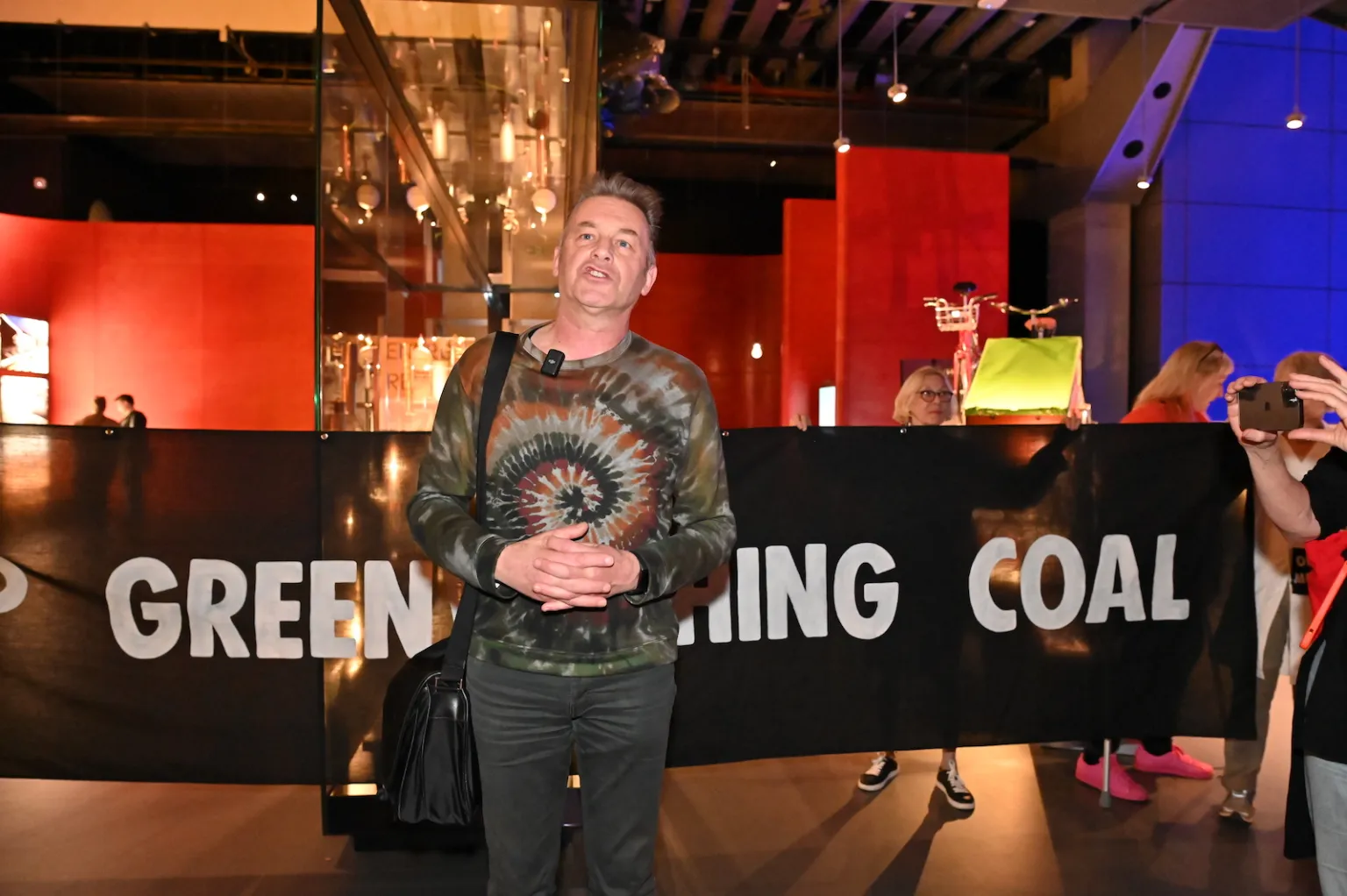
Naturalist Chris Packham says sponsorship deal is “beyond greenwash – it’s grotesque” and attends to support the protesters
Science Museum criticised over ties to conglomerate involved in manufacturing drones for the Israeli military amidst bombardment of Gaza and destructive coal mining operations in India and Australia opposed by Indigenous groups
This evening, more than 30 protesters led by young people from Youth Action for Climate Justice and members of Scientists for Extinction Rebellion have occupied the Science Museum’s new climate gallery, Energy Revolution, over its sponsorship by the coal giant and arms manufacturer, Adani. Naturalist and broadcaster Chris Packham joined the group as they began their protest, with scientists and young people now intending to remain in the museum over the weekend, with the first school visits to the gallery beginning on Monday.
Chris Packham, who famously claimed that peacefully breaking the law is the ethically responsible thing to do when it comes to protecting the planet, told the protesters: “For me science is the art of understanding truth and beauty and a lot of that beauty lies in the natural world. Science tells us that the fossil fuel industry is responsible for the accelerating destruction of our natural world. The Science Museum is a place to spark imagination, to provide answers but also to encourage us to ask questions. The question I’m asking today is a big one, “why on earth are we allowing a destructive industry to sponsor an educational exhibition whilst simultaneously setting fire to young peoples futures?” This is beyond greenwash – it’s grotesque. We urgently need an ‘Energy Revolution’ to steer us away from the course of planetary destruction on which we are heading. We need a rapid, just transition to renewables – that revolution means an end to coal, and starts with the young people and scientists occupying this space this evening. Science tells us the truth, and the truth is that we must change.”
Naturalist Chris Packham at the Science Museum occupation 12 April 2024. Image: Extinction Rebellion.
The Energy Revolution gallery opened to the public just a few weeks ago amidst protest, with over 150 people taking part in a day of creative action. A few days earlier, guests arriving for the private VIP launch were greeted by protesters as they arrived, as well as the museum throwing a lavish dinner for the Adani Group’s billionaire chairman, Gautam Adani, with the Adani Group’s logo plastered on screens around the room.
To coincide with today’s protest, activists have released a new video exposing the truth behind the misleading claims made by Gautam Adani during his speech at the opening of the gallery. While he discussed the energy transition from oil and gas, he neglected to mention coal, the industry from which the Adani Group derives 60% of its revenue. The Science Museum has attempted to defend its sponsorship deal by claiming it has only partnered with the Green Energy division, although evidence clearly shows that it is directly linked to Adani’s coal business and that the museum has maintained a relationship with the main Adani Group.
At 2pm on Saturday, the occupiers will invite members of the public to join them for an interactive assembly inside the gallery to discuss alternatives to toxic fossil fuel sponsorship at the Science Museum. The group plans to tell the public the truth about the gallery’s sponsor and the urgency of keeping fossil fuels in the ground for a liveable future. Throughout their occupation, the protesters are also constructing sculptures of fragments of coal as a poignant reminder of Adani’s core polluting business.
Ian McDermott, a Chemistry teacher who will no longer organise school trips to the museum, has said: “For decades I ran a couple of trips to the museum a year, but I just don’t think it’s in the students’ interests to engage with the greenwashing of the companies destroying their futures.”
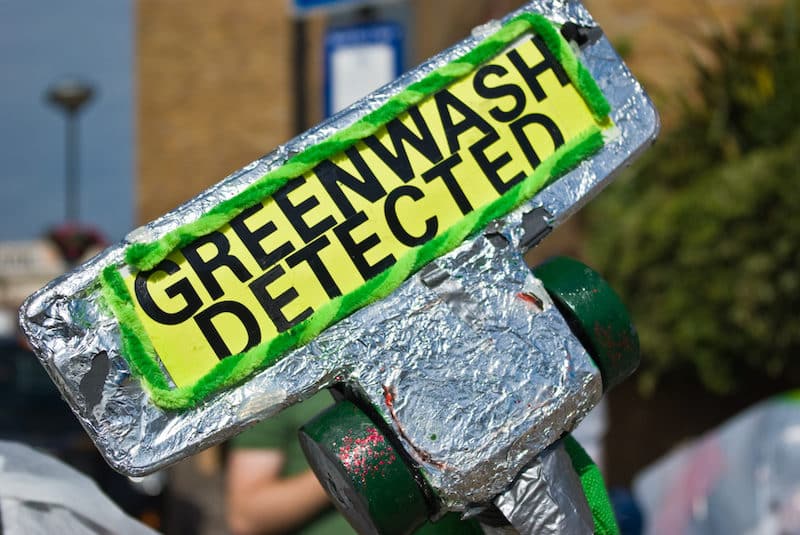
Protest placard reads Greenwash detected
Adani is the world’s largest private developer of new coal mines and coal-fired power plants, including Australia’s largest, the Carmichael Coal Mine built on Wangan and Jagalingou ancestral land. This ongoing investment in coal mining and power flies in the face of the scientific warning that most fossil fuel reserves cannot be burned and emitted if global warming increase is limited to 1.5°C, or even 2°C above pre industrial levels.
Anya, a young person occupying the gallery said: “To have a coal company sponsoring an exhibition on the future of energy is blatantly deceiving. Through this sponsorship deal, the Science Museum is helping Adani attach itself to the image of a positive and sustainable future when in reality it is a coal giant, weapons manufacturer and genocide supporter. It’s plain wrong for the Science Museum to be deceiving visitors, including young people like me, when it comes to the climate crisis.”
This is not the only instance of the museum welcoming fossil fuel companies to sponsor and influence its science education programmes and galleries. The Museum’s STEM Training Academy, which aims to support teachers in delivering science education, is sponsored by oil and gas giant BP, while the Museum’s interactive children’s gallery is named after Norwegian oil and gas company, Equinor.
Dr. Aaron Thierry, a scientist, who has researched climate impacts in the Arctic, is among those currently occupying the museum: “It’s not just Adani’s brand that the science museum is greenwashing, they’re also allowing the oil and gas giants BP and Equinor to sponsor their exhibits, disregarding the fact that these companies continue to expand fossil fuel production against the warnings of climate scientists. The latest science has shown we must leave the majority of fossil fuels unburned to prevent catastrophic changes to our climate. That an institution like the Science Museum is working with such rouge companies is a disgrace. The museum’s management needs to follow the example of Britain’s other leading cultural institutions and drop all ties to the fossil fuel industry.“
Scientists for Extinction Rebellion and Youth Action for Climate Justice (who have led this action) are members of Fossil Free Science Museum Coalition who are campaigning for the Science Museum to end its sponsorship by fossil fuel companies.
Youth Action for Climate Justice (formerly UKSCN London) is a radical youth organisation mobilising for climate justice. YACJ aims to create a new generation of young activists who are educated about society and the change we need, in order to work with other movements to change the system we live in. The group was previously part of Youth Strike for Climate Movement and coordinated the London youth climate strikes in 2019 and 2020, which brought thousands of young people to the streets of London. Instagram | Twitter
Other groups involved are: International Solidarity for Academic Freedom in India (InSAF India), India Labour Solidarity (UK), Students for Survival; and numerous Extinction Rebellion groups.
Getting to net zero emissions by mid-century is conventionally understood as humanity’s best hope for keeping Earth’s surface temperature (already 1.2°C above its pre-industrial level) from increasing well beyond 1.5°C – potentially reaching a point at which it could cause widespread societal breakdown.
At least one prominent climate scientist, however, disagrees.
James Hansen of Columbia University in the US published a paper with colleagues in November which claims temperatures are set to rise further and faster than the predictions of the Intergovernmental Panel on Climate Change (IPCC). In his view, the 1.5°C target is dead.
He also claims net zero is no longer sufficient to prevent warming of more than 2°C. To regain some control over Earth’s rising temperature, Hansen supports accelerating the retirement of fossil fuels, greater cooperation between major polluters that accommodates the needs of the developing world and, controversially, intervening in Earth’s “radiation balance” (the difference between incoming and outgoing light and heat) to cool the planet’s surface.
You can listen to more articles from The Conversation narrated by Noa.
There would probably be wide support for the first two prescriptions. But Hansen’s support for what amounts to the deliberate reduction of sunlight reaching Earth’s surface has brought into the open an idea that makes many uncomfortable.
Michael Mann from the University of Pennsylvania in the US and another titan of climate science, spoke for many when he dismissed solar radiation management as “potentially very dangerous” and a “desperate action” motivated by the “fallacy … that large-scale warming will be substantially greater than current-generation models project”.
Their positions are irreconcilable. So who is right – Hansen or Mann?
Earth’s radiation balance
First, an explanation.
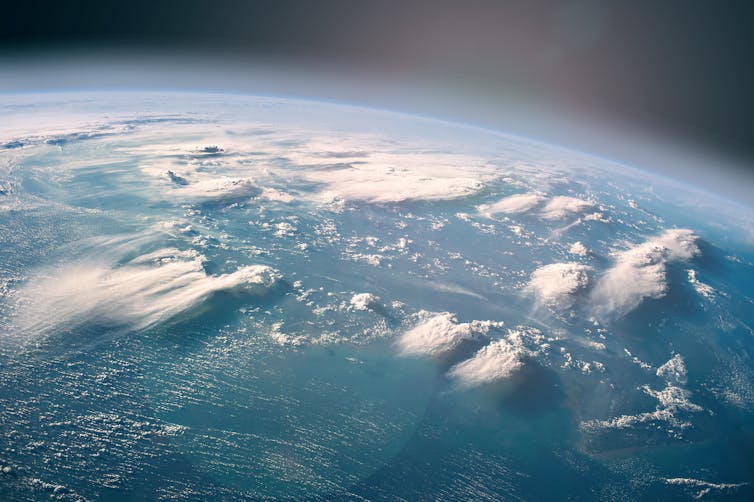
There are only two ways to reduce global warming. One is to increase the amount of heat radiated from Earth’s surface that escapes to space. The other is to increase the amount of sunlight reflected back to space before it lands on something – whether a particle in the atmosphere or something on Earth’s surface – and is converted to heat.
There are many ways to do both. Anything that reduces the amount of greenhouse gas in the atmosphere will let more heat escape to space (replacing fossil fuels with renewables, eating less meat and tilling the soil less for example). Anything that makes the planet brighter will reflect more sunlight to space (such as refreezing the Arctic, making clouds whiter or putting more reflective particles in the atmosphere).
But the key difference between the two, in terms of their impact on global warming, is their response time. That is, the time it takes for a change in the factors that allow more heat to escape or sunlight to be reflected to appear as a change in Earth’s surface temperature.
Intervening to speed up the loss of heat from Earth’s surface cools the planet slowly, over decades and longer. Intervening to increase the sunlight Earth reflects back to space cools the planet more or less immediately.
The essence of the dispute between Mann and Hansen is whether reducing greenhouse gases, by a combination of reducing new emissions and permanently removing past emissions from the atmosphere, is now enough on its own to prevent warming from reaching levels that threaten economic and social stability.
Mann says it is. Hansen says that, while doing these things remains essential, it is no longer sufficient and we must also make Earth more reflective.
When will warming end?
Mann aligns with IPCC orthodoxy when he says that emissions reaching net zero will result, within a decade or two, in Earth’s surface temperature stabilising at the level it has then reached.
In effect, there is no significant warming in the pipeline from past emissions. All future warming will be due to future emissions. This is the basis for the global policy imperative to get to net zero.
In his new paper, Hansen argues that if the atmospheric concentration of greenhouse gases remains close to its current level, the surface temperature will stabilise after several hundred years between 8°C and 10°C above the pre-industrial level.
Of this, at least 2°C will emerge by mid-century, and probably a further 3°C a century from now. A temperature increase of this magnitude would be catastrophic for life on Earth. Hansen adds that to avoid such an outcome, brightening Earth is now necessary to halt the warming in the pipeline from past emissions.
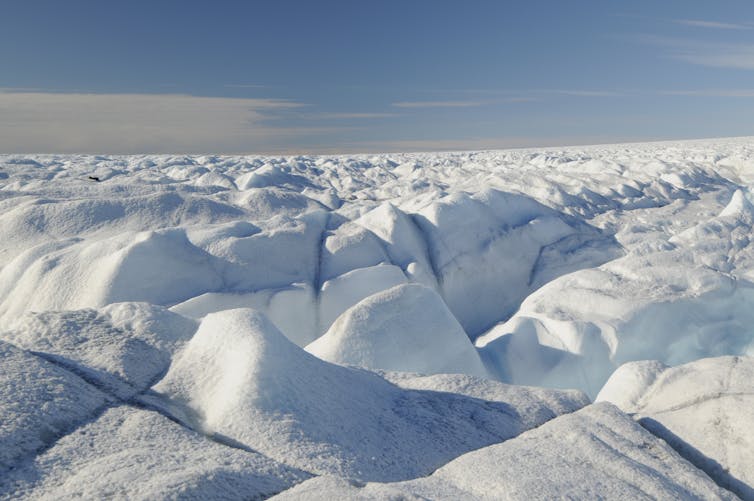
Bright surfaces, like ice sheets, reflect light to space. Tobetv/Shutterstock
But at the same time, we must also largely eliminate emissions if we are to stop recreating this problem in the future.
Still getting hotter…
We are scientists who study the feasibility and effectiveness of alternative responses to climate change, addressing both the engineering and political realities of enabling change at the scale and speed necessary.
We find Mann’s rebuttal of Hansen’s claims unconvincing. Crucially, Mann does not engage directly with Hansen’s analysis of new data covering the last 65 million years.
Hansen explains how the models used by IPCC scientists to assess future climate scenarios have significantly underestimated the warming effect of increased greenhouse gas emissions, the cooling effect of aerosols and how long the climate takes to respond to these changes.
Besides greenhouse gases, humanity also emits aerosols. These are tiny particles comprising a wide range of chemicals. Some, such as the sulphur dioxide emitted when coal and oil are burned, offset the warming from greenhouse gases by reflecting sunlight back to space.
Others, such as soot, have the opposite effect and add to warming. The cooling aerosols dominate by a large margin.
Hansen projects that in coming months, lower levels of aerosol pollution from shipping will cause warming of as much as 0.5°C more than IPCC models have predicted. This will take global warming close to 2°C as early as next year, although it is likely then to fall slightly as the present El Niño wanes.
Underpinning Hansen’s argument is his conviction that the climate is more sensitive to greenhouse gases than previously reported. The IPCC estimates that doubling atmospheric CO₂ raises Earth’s temperature by 3°C. Hansen calculates it to be 4.8°C.
This, and the much longer climate response time that Hansen calculates from the historical record, would have a significant impact on climate model projections.
Time for reflection
The differences between Mann and Hansen are significant for the global response to climate change.
Mann says that allowing emissions to reach net zero by mid-century is sufficient, while Hansen maintains that on its own it would be disastrous and that steps must now be taken in addition to brighten the planet.
Brightening Earth could also reverse the reductions in reflectivity already caused by climate change. Data indicates that from 1998 to 2017, Earth dimmed by about 0.5 watts per square metre, largely due to the loss of ice.
Given what’s at stake, we hope Mann and Hansen resolve these differences quickly to help the public and policymakers understand what it will take to minimise the likelihood of imminent massive and widespread ecosystem destruction and its disastrous effects on humanity.
While 1.5°C may be dead, there may still be time to prevent cascading system failures. But not if we continue to squabble over the nature and extent of the risks.
Don’t have time to read about climate change as much as you’d like?
Roger Hallam was involved in starting the climate activism groups Extinction Rebellion and Just Stop Oil. He is still involved with Just Stop Oil and often gets arrested and imprisoned. [22/3 Apologies had a typo calling Roger Roget]
I used to be a social science researcher at King’s College, London. The name of the game in that trade is to look at everything in context. So I will provide some context. There is overwhelming evidence that the climate science industry is structurally underestimating the realities we face. “Worst than expected” is the standard phrase of just about every article as new stats are published. A few years ago we were going to pass 1.5C around 2050 – now it is already happening. I remember reading reports that the Arctic will melt in the summer around 2100. Papers now predict 2035, if not before. AMOC – the ocean current that stops the 60 million people on these islands from starving to death – was going to collapse at some point next century. Now a recent paper tells us the odds are it will collapse by 2050. If you have not been paying attention, this will create a collapse of temperatures overnight of 3-8C across Europe. So don’t be surprised if it happens before your pension comes due.
I’m like you. I don’t like to believe things are true if they conflict with my baseline beliefs – like “we will muddle through”. But then it becomes more difficult when it actually comes true. Scientists have been telling us privately and then publicly for years that staying under 1.5C was bollocks – and now here we are. For two decades or more the best kept secret of the climate space has been that aerosols (pollution from burning fossil fuel emissions) have been holding down temperatures by .5C-1C. As we passed 1.8C last September the pretence started to collapse as scientists raged about each other on a dark corner of Twitter. It’s the start of the exposure of the world’s biggest cover up. That they knew we were fucked a decade or more ago. Not that the media is interested. Everyone is still in on the pretence, it seems.
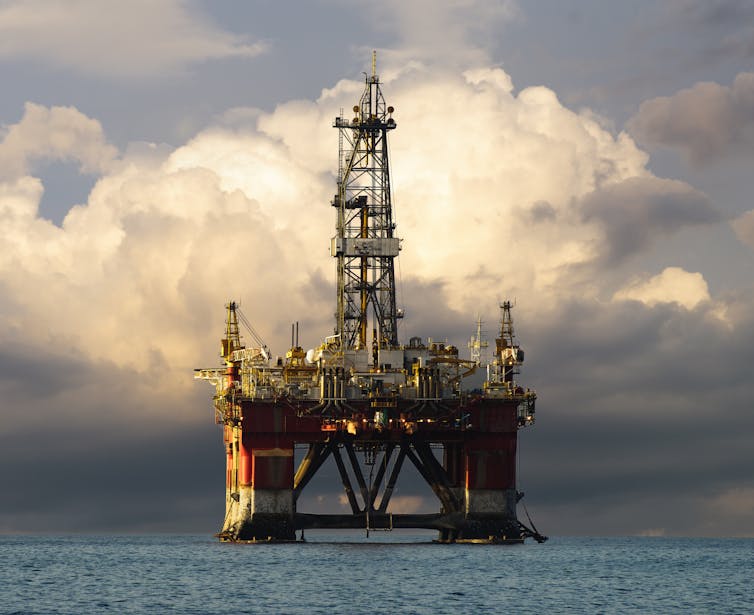
Climate scientists have been sounding the alarm for decades that this type of event will become more frequent as the world continues to warm. The major culprit behind this is the burning of fossil fuels. So it’s extremely concerning that the UK government has announced its intention to grant hundreds of licences for new North Sea oil and gas extraction.
Although burning fossil fuels to generate power and heat has enabled society to develop and flourish, we are now experiencing the unintended side effects. The carbon dioxide that has been added to the atmosphere is leading to a rise in global temperatures, causing heatwaves to become hotter and downpours more intense. The resulting large-scale disruption and suffering is becoming ever more visible.
This warming will continue, with worsening climatic consequences, until we reduce global carbon dioxide emissions to “net zero”. After that, we will still have to live and suffer in a warmer climate for generations. The collective choices we make now will matter in the future.
The small-scale, but high-profile, disruptions caused by Just Stop Oil protesters in the UK are extremely frustrating for many. But their single demand – for no licenses for new UK coal, oil and gas projects – is consistent with the science underpinning the international agreements that the UK has signed.
Temperatures are rising
Since the 1860s, the scientific community has understood that adding more carbon dioxide to the atmosphere would warm the climate. And as long ago as 1938, the burning of fossil fuels was linked to the observed rise in both carbon dioxide levels and global temperatures. Fast forward to now and global temperatures are warmer, and increasing faster, than at any point in human civilisation.
In response to the overwhelming scientific evidence, the UK and 193 other nations came together in 2015 to ratify the Paris agreement on climate change. One of the agreed goals is to limit global warming to well below 2°C, and even aim for 1.5°C, compared to the pre-industrial era.
However, the latest synthesis report from the Intergovernmental Panel on Climate Change, which all governments explicitly endorsed, paints a stark reality. If we burn all of the fossil fuels that we currently have access to, then global warming will exceed 1.5°C and may reach 2°C.
To avoid breaching the limits set out by the Paris agreement, some of the coal, oil and gas that we can already extract must remain unburnt. New fossil fuel extraction projects will make it even harder to stop further global warming.
Build up renewable infrastructure
There are other options. The UK government’s official advisers, the Climate Change Committee, have put forward a vision for UK power generation consistent with a net zero future. They say that the UK could provide all of its energy needs by 2050 through a combination of renewables, bioenergy, nuclear, hydrogen, storage and demand management, with some carbon capture and storage for fossil gas-based generation in the meantime.
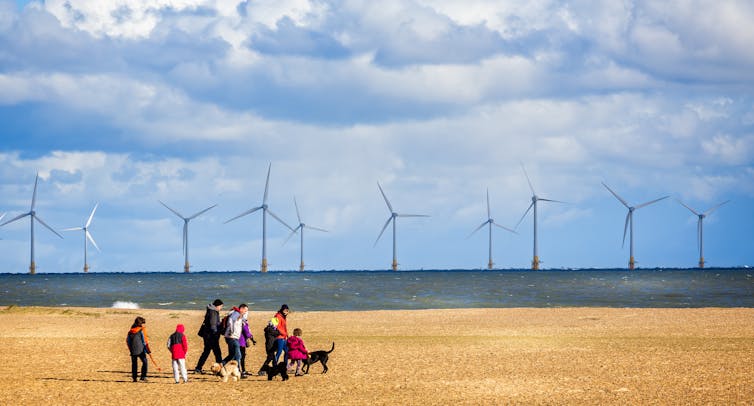
The UK can achieve energy security without causing additional global warming. Nigel Jarvis/Shutterstock
If the UK followed the example of China and rapidly increased its investments in renewable energy, then it could achieve energy security without causing additional global warming. China emits the most carbon dioxide of any country in the world. But it is installing more renewable energy generation than the rest of the world combined.
Rapidly reducing our reliance on fossil fuels, and not issuing new licenses to extract oil and gas, is the most effective way of minimising future climate-related disruptions. The sooner those with the power to shape our future recognise this, the better.
Don’t have time to read about climate change as much as you’d like?