After four months of global records being “obliterated”, temperatures in October have left climate scientists nearly certain that 2023 will be the hottest on record.
Scientists now say that 2023 is “virtually certain” to be the warmest year on record.
Data from the Copernicus Climate Change Service (C3S) reveals that this October was the warmest on record globally. As a whole, it was 1.7ºC above pre-industrial averages after four consecutive months of temperature records being broken.
In Europe, it was the fourth warmest October on record with temperatures 1.3ºC higher than the 1991 to 2020 average.
“October 2023 has seen exceptional temperature anomalies, following on from four months of global temperature records being obliterated,” says Samantha Burgess, deputy director of C3S, the European Union’s climate change agency.
Globally averaged surface air temperature anomalies relative to 1991–2020 for each October from 1940 to 2023. Data Source: ERA5.C3S/ECMWF
‘Climate change is the idiot socialist get-out-of-jail-free card,’ Peterson recently tweeted. Image: Gage Skidmore, Flickr, CC.
Fringe climate crisis deniers who claim that the earth is “cooling” and greenhouse emissions are good for “biological productivity” are getting exposed to millions more people than they normally would on YouTube thanks to conservative influencer Jordan Peterson.
That’s according to viewership data newly reviewed by DeSmog, which reveals a massive visibility boost for public figures who’ve been active in the climate denial movement for years but whose ideas — such as the claim that plants are growing much better due to increased carbon dioxide in the atmosphere — are now rarely taken seriously by most legacy media outlets.
They include climate crisis deniers like Judith Curry, Steven Koonin, Richard Lindzen, Alex Epstein and Bjorn Lomborg. Despite having either a modest YouTube presence or none at all, these figures have collectively garnered nearly five million views after being interviewed on Peterson’s channel, which has 7.31 million subscribers. The New York Times, by comparison, has 4.33 million YouTube subscribers.
This is especially worrying to climate scientists and disinformation experts because Peterson for years has been actively courting alienated males in their 20s and younger. Traditionally, people who are “doubtful” or “dismissive” of climate change have tended to skew older. Peterson is now planting doubt via his podcast and social media posts about the severity and urgency of global warming in the minds of younger generations.
“‘Climate change,’” he tweeted in June, is “the idiot socialist get-out-of-jail-free card.”
And he is now in the process of putting real political power behind the climate crisis denial movement. In late October and early November, a new group Peterson founded called the Alliance for Responsible Citizenship (ARC) will hold in London, England, its first ever meetings. It has on its advisory board Republican presidential candidate Vivek Ramaswamy, who during GOP debates in August said that “the climate change agenda is a hoax.”
ARC advisor Ramaswamy: ‘the climate change agenda is a hoax.’ Image: Gage Skidmore, Flickr, CC.
Advisors to the group include Lomborg, a Danish political scientist who earlier this year argued on Peterson’s podcast that “climate change is a real problem, but it’s not this catastrophic end of the world.” Lomborg didn’t respond to questions from DeSmog. Other advisors are Texas Republican congressmember Dan Crenshaw; Utah Republican Senator Mike Lee; former Australian prime minister Tony Abbott; and dozens of conservative policymakers, financiers, activists and journalists from the U.S., Canada, the U.K. and Australia.
The Alliance for Responsible Citizenship is being supported by founders and leaders of the Legatum Group, a Dubai-based investment firm behind The Legatum Institute, a pro-Brexit think tank in London with close ties to the U.K. Conservative Party. The Legatum Group is a leading investor in the rightwing British television network GB News. Read DeSmog’s in-depth report on ARC’s U.K. links here.
Experts argue this makes Peterson a key organizer at the global level for efforts to oppose and delay action on climate change. “I would say that Jordan Peterson has become a central cog in the denial machine,” Michael Mann, director of the Penn Center for Science, Sustainability and the Media at the University of Pennsylvania, told DeSmog.
“It’s concerning that he’s poisoning the minds of so many influenceable people with his pseudo-intellectual and pseudoscientific drivel, drivel that is being weaponized in the right-wing assault on science and reason,” Mann added, referring to Peterson’s frequent downplaying of climate risks, including the conservative influencer’s insistence that rising levels of carbon dioxide are good for the planet.
Spreading Denial, Making Money
Peterson’s influence depends to a significant degree on his gigantic YouTube following, which is larger than that of the liberal-leaning news network MSNBC. It also surpasses the following of The Daily Wire, a digital conservative outlet co-founded by Ben Shapiro that has a partnership with Peterson, which last year claimed a yearly revenue of $100 million.
Google, which owns YouTube, announced a policy in October 2021 prohibiting advertisements on content that “contradicts well-established scientific consensus around the existence and causes of climate change.” Elaborating on the policy in an email to DeSmog, a Google spokesperson wrote that “Debate or discussion of climate change topics is allowed, but when content crosses the line to climate change denial, we stop showing ads on those videos.”
Yet a Peterson interview from this year entitled “The Great Climate Con,” during which he framed rising greenhouse gas emissions as a positive for making the planet “green in the driest areas,” was accompanied by ads for Birch Gold and Masterworks. Climate scientists say that is a misleading argument because it doesn’t take into account the massively negative effects that intensified droughts, wildfires and heatwaves due to global warming have on plants and ecosystems.
“Debate or discussion of climate change topics is allowed, but when content crosses the line to climate change denial, we stop showing ads on those videos.”— Google spokesperson
“We’ve reviewed the videos,” the Google spokesperson wrote, “and did not take action on them.”
“What’s the point of having policies if you’re not going to enforce them?” Claire Atkin, co-founder of the anti-disinformation watchdog group Check My Ads, told DeSmog. “YouTube and its ecosystem of marketing tools allow Jordan Peterson to not only spread [misleading statements], but to make money off them.”
Peterson didn’t respond to questions from DeSmog about his current income nor his recent shift towards promoting climate crisis denial online.
‘Twisted Symbiotic Relationship’
One example of Peterson’s amplifying effect is his interview with Judith Curry, a former Georgia Institute of Technology climatologist who now does consulting work for clients including petroleum companies and natural gas traders. In testimony to Congress in 2015 she claimed incorrectly that recent data “calls into question the conclusion that humans are the dominant cause of recent climate change.”
While appearing on Peterson’s podcast earlier this year she argued that due to “natural variability” the planet could grow cooler over the next three decades rather than warmer, a position with no credible scientific basis, especially considering that July was the hottest month in recorded human history. Posted to YouTube, where Curry has no official channel, the interview garnered more than 960,000 views. She didn’t respond to questions from DeSmog.
Conservative author and fossil fuel activist Alex Epstein had a modest YouTube following of 15.2 thousand subscribers when he was interviewed by Peterson. “It’s out!” he tweeted after the video was posted. It now has over 1.04 million views, a significant boost considering that the vast majority of videos on his page have under 500 views.
“I think Jordan Peterson has become more interested in humanistic thinking about fossil fuels,” Epstein wrote in an email to DeSmog. “He has become even more convinced, thanks to my work and others, that the popular movement to rapidly eliminate fossil fuel use is based on invalid thinking methods, false assumptions, and anti-human values.”
During his interview with Peterson, Epstein claimed that “It’s kind of obvious if you have a warmer world with more CO2, it’s a more tropical world with more life. It’s a more green world in the life sense of green. And yet the green movement hates it.”
Peterson has echoed that statement frequently in his podcast, despite actual scientists saying that greening caused by rising greenhouse gases shouldn’t be celebrated. He claimed during his interview with Steven Koonin, author of a book on climate change science called Unsettled, that “since the year 2000 the world has greened by 15 percent … why the hell isn’t that good news?” That interview has since been viewed more than 1.1 million times. Koonin didn’t respond to a media request.
“Peterson—who doesn’t appear to know much at all about the science or politics of global warming—has become an influential promoter of illogical ideas,” Benjamin Franta, a senior research fellow in climate litigation at the Oxford Sustainable Law Programme, told DeSmog.
During an interview in 2022 on Joe Rogan’s podcast, for instance, Peterson argued that the climate is too complex a system to be modeled accurately, “and that’s a huge problem when you’re trying to model over 100 years because the errors compound just like interest.” “He sounds intelligent, but he’s completely wrong,” one climate scientist told the Guardian.
Though Peterson is among the most visible promoters of climate crisis denial, he’s also part of a wider digital network. Researchers with Climate Action Against Disinformation and the Center for Countering Digital Hate earlier this year found 200 videos on YouTube promoting delay or skepticism around measures to address the climate emergency, garnering nearly 74 million views altogether.
“[There’s] a twisted symbiotic relationship between these platforms and climate denial content,” Erika Seiber, a climate disinformation spokesperson at the nonprofit Friends of the Earth who is part of the disinfo coalition, told DeSmog. “YouTube runs ads on the content, incentivizing the creation of yet more misleading content, which allows deniers like Peterson to flourish and for their networks to grow.”
Enabled by Google and YouTube, climate crisis denial could be having real-world influence, disinformation experts say. A poll this summer suggested that 72 percent of U.S. Republican supporters think that the economy should be prioritized over addressing climate change, a 13 point increase from 2018, even as cities sweltered under record heat waves. Conservatives are opposing coastal wind turbines under the pretense of protecting whales. Republican Congressmembers in June passed bills protecting gas stoves in people’s homes.
“You can see how climate denial content from Peterson and others has informed policy discussions,” Seiber said. “It’s incredibly concerning.”
Campaigners say the lobbying tactics used to argue against tougher measures on emissions echo those of the 20th century tobacco industry
Airlines have been accused of using a “typical climate denialist” strategy after downplaying decades of scientific research on aviation emissions to block tougher regulations.
Campaigners said the lobbying tactics echoed those of the 20th century tobacco industry, which fought stricter measures by magnifying minor doubts on the health risks of smoking.
Documents obtained by openDemocracy show airlines and airports privately told the government there was too much uncertainty about the additional warming effects of flights to justify introducing new policies to tackle them.
But senior climate scientists contradicted the industry’s claims, saying the science is well established on what are known as aviation’s “non-CO2 effects”.
These are caused by emissions at high altitude of water, nitrous oxides, sulphur dioxide and particulate matter, with aircraft vapour trails, also known as contrails, a particular problem because they form clouds at high altitude that trap heat radiated from the Earth.
The Intergovernmental Panel on Climate Change estimated in a special report in 1999 that the total historic impact of aviation on the climate was two to four times greater than from its CO2 emissions alone.
Research in 2021 largely confirmed those findings and concluded aviation emissions were warming the climate at “approximately three times the rate of that associated with aviation CO2 emissions alone”. An EU study from 2020 also found non-CO2 emissions warm the planet about twice as much as CO2 emissions, but acknowledged there were “significant uncertainties”.
The Department for Transport considered regulating these non-CO2 impacts and asked for views on the issue in a consultation in 2021 on its proposed “Jet Zero strategy”.
Responses from airlines and airports, obtained under FOI by openDemocracy, reveal several used the same tactic of arguing the science was too uncertain to justify policies to address non-CO2 effects. Several recommended instead that the government should limit its action on the issue to funding further research into it.
‘A bit of a joke’
Airlines UK, a trade body that lobbies for airlines including British Airways (BA), easyJet and Virgin Atlantic, told the DfT that “the science around these [non-CO2 impacts] is not yet robust enough to form reduction targets”.
When asked during the Jet Zero consultation what could be done to tackle non-CO2 impacts, Ryanair said it was “too early to say until impact is better understood”.
Low-cost airline Wizz Air told the DfT: “There is too high a level of uncertainty of non-CO2 emission contribution to climate change for a policy to be formed.”
Airlines UK, Ryanair and Wizz – alongside others across the industry – called on the DfT to instead fund further research into the science of non-CO2 impacts.
The tactic appears to have worked, with the DfT announcing in the Jet Zero strategy last year that more work would be done with scientists and the industry to understand the issue.
The DfT did, however, say the government was “exploring whether and how non-CO2 impacts could be included in the scope of the UK ETS (emissions trading scheme)”.
Professor Piers Forster, an atmospheric physicist and member of the independent Climate Change Committee, told openDemocracy it was “completely wrong” for the aviation industry to claim the science on aviation’s non-CO2 effects was too uncertain to address them.
He said: “It’s a bit of a joke to say the effects are too uncertain to do anything about. We see their contrails and we’ve known for over 20 years that they are warming the planet. The industry should not hide behind uncertainty.”
He added that “the non-CO2 effects absolutely have to be accounted for in some way and action should be taken to reduce them”.
Milan Klöwer, a climate physicist at Massachusetts Institute of Technology, said airlines were adopting a “typical climate denialist strategy” by overstating the level of uncertainty about non-CO2 effects.
“Even in the best case they roughly double the effect of CO2 emissions on the climate,” he said.
He called on airlines to start accounting for their non CO2 effects and invest more in solutions, such as alternative fuels, which reduced those effects.
Rob Bryher, aviation campaigner at climate charity Possible, said: “These documents show that airlines cannot be trusted to decarbonise on their own. Demand management solutions like a frequent flyer levy, introducing fuel duty, carbon pricing, or management of airport capacity are going to be crucial.”
Matt Finch, UK policy manager of campaign group Transport & Environment, said: “Aviation’s non-CO2 impacts are somewhere between huge and absolutely massive. But the industry doesn’t want you to know that. Instead of confronting its environmental problems head-on, the industry copies the tobacco industry of the ’50s and the oil industry of the ’70s in casting doubt and disbelief around the science.”
BA said it was working with academics and experts on non-CO2 impacts of flying while Sustainable Aviation, an industry group that includes airlines, said it was committing to addressing them but reiterated more research was needed. Wizz Air said it was already addressing the impacts through a range of measures.
Some airlines ignore non-CO2 effects in schemes they support to help passengers calculate and offset the emissions of their flights.
BA’s emissions calculator states a one way flight from London Heathrow to New York emits 348kg CO2E (carbon dioxide equivalent) and charges £3.97 for offsetting.
Atmosfair, a German non-profit organisation which supports the decarbonisation of flying, calculates the same journey on a Boeing 777-200 – an aircraft type used by BA – emits 896kg and charges 21 euros (£18.37) for offsetting. Atmosfair’s emissions total comprises 308kg of CO2 emissions and 587 kg equivalent for “climate impact of contrails, ozone formation etc”.
While the DfT has so far failed to act on non-CO2 effects, they are mentioned in official advice to companies from the Department for Business Energy and Industrial Strategy on how to report their emissions.
It says: “Organisations should include the indirect effects of non-CO2 emissions when reporting air travel emissions to capture the full climate impact of their travel.”
A DfT spokesperson said: “Our Jet Zero Strategy confirmed our aim of addressing the non-CO2 impacts of aviation, by developing our understanding of their impact and possible solutions, and the UK is one of the leading countries working to address this issue.”
Sustainable Aviation Fuel
International Airlines Group (IAG), which owns BA, Vueling and Aer Lingus, told DfT’s Jet Zero consultation it could address non-CO2 emissions by supporting “sustainable aviation fuel” (SAF).
SAF is a jet fuel made from sources which the industry claims are sustainable, including cooking oil and animal fat. It performs in a similar way to kerosene but can produce up to 80% less CO2 depending on how it is made. It potentially also reduces contrails.
IAG told the Jet Zero consultation SAF was “the only viable solution for decarbonising medium and long haul flights”, which account for about 70% of global aviation emissions.
But further documents obtained by openDemocracy reveal IAG then lobbied the DfT to water down its SAF mandate.
In response to a separate consultation, IAG argued the SAF mandate should only cover flights within the UK or to the EU, and not the long haul flights on which British Airways makes most of its profits.
IAG also lobbied against a proposal to ban airlines from dodging the mandate by filling their tanks with cheap kerosene at overseas airports – a practice known as “tankering”.
A BBC Panorama investigation in 2019 revealed tankering by BA and other airlines was creating small financial savings but unnecessary carbon emissions.
IAG also argued against a proposal aimed at building demand for “power-to-liquid” jet fuel, which is produced by combining hydrogen made by renewable energy with carbon captured from the atmosphere.
Unlike other so-called sustainable jet fuels, power-to-liquid fuel does not involve a feedstock needed by other industries to decarbonise, such as used cooking oil or animal fat.
IAG called it “a very expensive pathway to directly decarbonise aviation”.
Sustainable Aviation, an industry group that includes airlines, said: “We are committed to addressing [non-CO2] impacts based on the scientific evidence, but further research is key to developing effective mitigation solutions, for example the use of sustainable aviation fuels (which contain lower contrail forming particulates), alongside steps such as optimising flight routes to avoid contrail formation.”
BA, IAG’s principal airline, said: “We are actively engaging with academics, experts within the industry and the government’s Jet Zero Council to take proactive steps to look into non-CO2 impact.”
Wizz Air said it was mitigating non-CO2 effects “through route optimisation and jet fuel improvements” and by using Airbus A321neo aircraft which reduced NOx emissions by 50%.
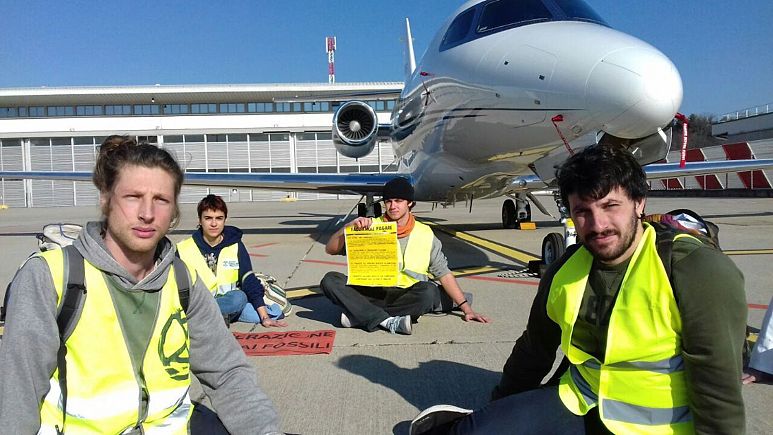
Climate scientists have blocked private jet terminals around the world today in protest of ‘luxury emissions’.
London Luton Airport, Schiphol Airport in Amsterdam and Bromma Airport in Stockholm are among those being disrupted by activists from Scientist Rebellion, Extinction Rebellion (XR) and Stay Grounded.
It follows actions against private jets in Brussels and Seville yesterday, and one in Los Angeles on 11 February, with more protests expected in the coming months.
“It is time to ban private jets and tax frequent flyers to the ground”, says NASA climate scientist Dr Peter Kalmus from Scientist Rebellion.
“We cannot allow the rich to sacrifice our present and future in the pursuit of their luxury lifestyles.”