Barclays’ $2bn coal loans expose ‘enormous loophole’ in its climate policy

Spread the love

Original article by Josephine Moulds republished from The Bureau of Investigative Journalism under a Creative Commons Attribution-NonCommercial-NoDerivs 3.0 Unported License.

Bank accused of ‘trying to have it both ways’ with coal policy that allows financing for huge polluters

Barclays helped raise nearly $2bn for companies running highly polluting coal-fired power plants in the US, exposing an “enormous loophole” in its climate policy.

As part of its strategy to reach net zero, the bank has committed to stop financing companies that make more than half their revenues from coal-fired power.

Last year, however, Barclays helped raise $1.7bn for coal-fired power companies that appear to exceed that threshold, the Bureau of Investigative Journalism and ITV News can reveal.

Among these deals were two $400m loans for Monongahela Power, which generates 95% of its electricity from burning coal at two huge plants in West Virginia. The company only sells electricity that it generates itself, suggesting that the vast majority of its revenues are from coal-fired power.

Barclays, however, said its policy only prohibits financing for companies that make more than 50% of revenues specifically from generating coal-fired power; and that TBIJ’s calculations did not account for these companies’ revenues from transmitting and distributing that power.

Barclays was Europe’s biggest lender to the coal power industry last yearAndrea Domeniconi / Alamy

Seth Feaster, an analyst at the Institute for Energy Economics and Financial Analysis (IEEFA) think tank, said: “The bank is trying to have it both ways: a public-facing coal policy that sounds like it will no longer support coal-heavy companies, but the technicality [regarding transmission and distribution revenue] has rendered that policy largely meaningless.

“The bank has created an enormous loophole that appears to allow it to largely continue doing business as usual with coal-friendly utilities.”

Natasha Landell-Mills, head of stewardship at the asset manager Sarasin & Partners, which holds Barclays debt, said the bank’s position appeared to be “somewhat disingenuous”.

“In the end, what matters is that coal-fired power falls in keeping with ensuring a safe climate. As investors, we would expect all related activities that enable coal-fired power to be captured and, if they are not, would hope to see the board urgently address this loophole.” She said this was not just a question of how Barclays is run and its reputation, but that continuing to fund high emitters was also financially risky for long-term investors.

The news comes amid a storm of protest against the bank, which was revealed in May to be Europe’s biggest funder of fossil fuels.

It is also Europe’s biggest lender to the coal power industry, taking part in $75bn worth of deals for companies active in the sector last year.

Bold pledges

Under pressure from its customers and investors, Barclays has made increasingly bold climate promises. It tightened its coal policy in 2022 and said financing the sector not only poses a threat to the planet but could represent a bad lending decision. Yet a number of companies it funded last year appear to be making most of their money from coal-fired power.

In addition to the Monongahela Power deals, Barclays helped raise $400m for Kentucky Utilities, which in 2022 generated almost three quarters of its electricity from burning coal. This suggests more than half its revenues were from coal-fired power.

Barclays also helped raise a $500m loan for Louisville Gas & Electric, which generated 83% of its power from coal in 2022. It makes some revenues from selling gas but calculations based on company and government data suggest its revenue share from coal was more than 50%.

Mill Creek power plant, a coal-fired stations owned by Louisville Gas and ElectricWilliam Alden / Creative Commons

Neither company appears to be transitioning to renewable power and their owner, PPL Corporation, said it expects they will use coal and natural gas as their predominant fuels “for the foreseeable future”.

Monongahela Power is investing millions to keep its two West Virginia plants running until 2035 and 2040, despite scientists warning that developed countries must end power generation from coal by 2030. The company aims to build 50MW of solar generation, but that represents less than 2% of its current coal-fired power capacity.

Barclays told TBIJ the deals complied with its policy “based on publicly disclosed information and our due diligence”. It said its policy does not have a loophole and that its methodology is robust. “An ambition to be net zero by 2050 does not require an immediate exit from financing coal,” the bank said. “Barclays is financing an energy sector in transition, providing finance to meet current energy needs and also financing the scaling of clean energy”.

PPL, which owns utilities in Kentucky, Rhode Island and Pennsylvania, said it had set a clear goal to achieve net-zero carbon emissions by 2050 and was transitioning to a cleaner energy mix across the group. It added that it had received approval from the authorities to retire 600MW of coal-fired power generation in Kentucky by 2027. This, however, represents less than 15% of its remaining coal capacity.

Monongahela Power did not respond to TBIJ’s request for comment.

Deadly coal plants

Coal-fired power plants are responsible for more than 40% of global CO2 emissions from energy. At Cop28 UN climate talks in Dubai last year, all countries agreed that accelerating the transition from coal to renewables was essential in order to avert catastrophic climate change.

Coal is also a major source of toxic air pollution. In the US alone, more than 3,800 people die from soot released by coal-fired power plants every year, according to a report by Sierra Club, a US NGO. While many European banks have distanced themselves from the industry, Barclays has retained strong links with US coal-fired power companies.

The boom in fracked gas and plunging cost of renewables has changed the landscape for power generation in the US. Seth Feaster at IEEFA said: “[Coal-fired power] companies are going to start struggling because they can’t sell their power in competitive environments.

“Investing in coal is very risky because most of [these coal plants] are losing money. They’re not going to be around for very long and if something breaks, they tend to shut down early because they can be very costly to repair.”

Bob Ward from the Grantham Research Institute on Climate Change said: “The coal industry in the United States is failing, it’s on its way out … there’s no excuse for propping up the American coal industry.” He described the distinction Barclays made between the generation, transmission and distribution of electricity from coal in its policy as “semantics”.

“What consumers and investors will be expecting is that Barclays are complying with the spirit of their declarations, and not just a technicality,” Ward said. “If you are generating most of your income from burning coal and then distributing the electricity results, then that’s the coal. That’s the coal industry. You’re damaging the climate. And that is what Barclays said they would stop.”

Last month, the organisers of the Wimbledon tennis championships faced calls to drop Barclays as a sponsor over its ties to fossil fuels and defence companies supplying Israel. Barclays addressed criticism of its defence funding, saying it trades in shares on behalf of clients. “Whilst we provide financial services to these companies, we are not making investments for Barclays.”

Live Nation also dropped the bank as a sponsor for various music festivals – including Download, Latitude and Isle of Wight – after protests from bands and fans.

Steff Wright, chairman of the Gusto Group, said his construction and manufacturing business is moving away from banking with Barclays. “As a company that’s working towards a green future, we need to look at our supply chain and who else is on that journey with us.

“We’d encourage all businesses to move away from them, to put pressure on them to rethink their strategy.”

Reporters: Josephine Moulds
Environment editor: Robert Soutar
Impact producer: Grace Murray
Deputy editors: Chrissie Giles and Katie Mark
Editor: Franz Wild
Production editor: Alex Hess
Fact checker: Somesh Jha

This reporting is funded by the Sunrise Project. None of our funders have any influence over our editorial decisions or output.

Original article by Josephine Moulds republished from The Bureau of Investigative Journalism under a Creative Commons Attribution-NonCommercial-NoDerivs 3.0 Unported License.

More from this project

Barclays’ billions of ‘sustainable’ finance for fossil fuel industry is greenwash, says investor

HSBC helped oil and gas industry raise $47bn despite net-zero pledge

How will new FCA greenwashing rule tackle banks’ dodgy climate claims?

Continue ReadingBarclays’ $2bn coal loans expose ‘enormous loophole’ in its climate policy

For decades, governments have subsidised fossil fuels. But why?

Spread the love
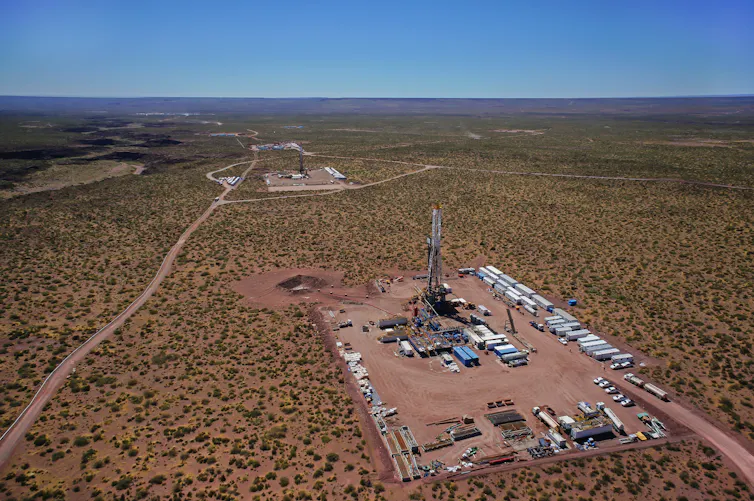
Sobrevolando Patagonia/Shutterstock

Bernard Njindan Iyke, La Trobe University

Even now, decades after we first began trying to avert the worst of global warming, more than 80% of the world’s total energy comes from fossil fuels.

You might think this would make fossil fuel production extremely profitable. But it’s not always the case. Much of the most accessible oil has already been extracted and burned. Many countries want to shore up domestic sources of fossil fuels to boost energy security. Energy price fluctuations and competition from new energy sources such as solar, wind and fossil gas have made it harder for some fossil fuel companies to make money, especially in coal.

This is where fossil fuel subsidies come in. Australia gave A$14.5 billion in subsidies to major fossil fuel producers and consumers in 2023–24 alone.

You might have wondered – why would some of the largest companies on Earth need subsidies? Here’s why.

LNG tanker
Australia’s surging liquefied natural gas industry has been boosted by government funding. KDS Photographics/Shutterstock

Private companies, public money

Globally, private companies dominate fossil fuel production, though fossil fuel-rich nations often have state-owned companies, such as Saudi Arabia’s Aramco and Russia’s Rosneft.

Why would governments give fossil fuel companies money? Many reasons. But the most important is that wealthy countries have historically needed huge volumes of fossil fuels for manufacturing, transport and power. Many countries have some sources of fossil fuels inside their borders, but only a few are self-sufficient. This has enabled fossil fuel giants such as Saudi Arabia to become wealthy beyond belief.

Many governments have used subsidies to boost their energy security and encourage local producers to seek out new sources of coal, gas and oil. These subsidies can make all the difference in making fossil fuel companies competitive internationally. For instance, Canada spent billions on subsidies to boost its oil sands and fracking projects.

Subsidies were essential in the United States’ fracking revolution. Novel approaches to extracting fossil gas and oil – boosted by major tax incentives – turned the US from a major importer of oil and gas into a net exporter by 2019.

You can see why the US did this. At a stroke, it went from being dependent on energy provided by foreign nations to being independent.

Once subsidies are in place, they become very hard to remove. Indonesia’s lavish fuel subsidies now account for 2% of the nation’s GDP. When the national government tried to walk these back, there were riots.

And there’s another reason, too. Fossil fuels are still playing an important role in boosting the economy in most nations. Subsidising them has long been seen as a way to maintain economic growth and stability.

Globally, these subsidies are estimated at a staggering $10.5 trillion each year.

This figure has grown sharply in recent years, after Russia’s invasion of Ukraine. As European nations tried to wean themselves off Russia’s gas, energy prices surged worldwide. In response, some countries introduced new subsidies to support businesses and consumers.

The top-line figure of $10.5 trillion includes two types of subsidy – explicit (meaning real dollars change hands) and implicit (for example, governments building roads and railways to encourage crude oil transport).

Explicit subsidies

Explicit fossil fuel subsidies are direct financial incentives from governments to fossil fuel producers and consumers. These incentives come in different forms, such as tax breaks, direct payments, grants and price controls. All of them aim to reduce the financial burden associated with fossil fuel production and use.

In Australia, explicit subsidies include fuel tax credits and exploration tax reductions. Fossil fuel companies can get subsidies to offset the losses they make during the years it takes to find and begin extracting new fossil fuels.

In the US, oil and gas companies benefit from the oil depletion allowance, which permits them to deduct a percentage of their gross income from oil and gas sales as an expense. They can also claim tax deductions for intangible drilling costs, such as the wages of workers and material needed to find new sources of oil and gas.

China, too, uses direct subsidies, discounted land-use fees, and preferential loans as explicit subsidies to boost coal production and consumption. The national government also supports fossil fuel consumption through direct payments to consumers.

coal miners China
China has used subsidies to encourage exploitation of its large coal resources. zhaoliang70/Shutterstock

Implicit subsidies

Implicit subsidies are often described as “imaginary”. That doesn’t mean they don’t exist, just that they’re not a direct transfer to directly paid to fossil fuel producers.

For instance, the cost of burning fossil fuels is borne by the global community and the natural world, in the form of climate change, damage to human health and other harms. Most fossil fuel companies don’t have to pay a cent for the pollution their products cause – so in effect, they are being granted an indirect subsidy.

Implicit incentives also include government investment in facilities such as transport networks, pipelines, oil refineries and port infrastructure, which will accelerate fossil fuel production and delivery. Think of the Middle Arm development in Darwin, funded by both the federal and territory government.

Why are these subsidies still being paid?

As the world grapples with a worsening climate crisis, fossil fuel subsidies are under great scrutiny.

It’s politically difficult to withdraw subsidies once given. This is why governments around the world have instead begun to give subsidies and tax incentives to green energy developers, including the enormous $500 billion Inflation Reduction Act in the US, the European Union’s Green Deal, and China’s massive subsidies of green technologies such as electric vehicles and solar panels.

The goal here is to make renewable energy and electrified transport steadily more affordable and competitive – just as fossil fuel subsidies did for oil, gas and coal.

Bernard Njindan Iyke, Lecturer in Finance, La Trobe University

This article is republished from The Conversation under a Creative Commons license. Read the original article.

Continue ReadingFor decades, governments have subsidised fossil fuels. But why?

Tory Leadership Contender Robert Jenrick’s Pro-Coal and Anti-Net Zero Record

Spread the love

Original article by Adam Barnett and Sam Bright republished from DeSmog.

The Conservative candidate has changed his tune on climate action, recently attacking Labour’s net zero policies and arguing for new fossil fuel extraction.

Former Conservative minister Robert Jenrick, who has today entered the race to lead the Tory party, has a growing record of attacks on climate action.

The MP for Newark – who saw a 23.9 percent swing against him in the general election, and served as secretary of state for immigration under former prime minister Rishi Sunak – has attacked what he calls “net zero zealotry”, and has labelled the UK’s net zero target “dangerous fantasy green politics unmoored from reality”. 

This is despite Jenrick having hailed the UK’s “world-leading commitment to net zero by 2050” as recently as 2020.

Jenrick has also called for the building of “new gas power stations” and supports new fossil fuel extraction, including North Sea oil and gas, and the opening of new coal mines. 

Jenrick’s campaign manager is Conservative MP Danny Kruger, a political reactionary who is also an advisor to climate denier Jordan Peterson’s Alliance for Responsible Citizenship (ARC).

His candidacy follows the Conservative Party losing a landslide election on 4 July against a Labour Party committed to climate action, during which the Tories supported new North Sea oil and gas extraction, and the delaying of key climate reforms.

Almost half of voters (49 percent) believe renewable energy would lower household bills, while only 14 percent say the same for more fossil fuels, according to polling by More in Common. 

This week saw what climate scientists believe could be the hottest day on record thanks to climate change. The world’s leading climate science group, the UN’s Intergovernmental Panel on Climate Change (IPCC), has said that there is “a brief and rapidly closing window of opportunity to secure a liveable and sustainable future for all”.

Attacks on Labour’s Climate Agenda

In his response to the announcement of Labour’s legislative agenda in the King’s Speech last week (19 July), Jenrick used an address in the House of Commons to launch an attack on the government’s climate policies, spreading familiar misinformation. 

Jenrick said that “despite being only responsible for one percent of global emissions, we find ourselves with a government pursuing for ideological reasons a net zero policy which is going to make it harder for our own consumers to afford their bills, [and] which is further going to erode our industrial base”.

Downplaying a country’s emissions is a “widely deployed” tactic used to delay international climate action, according to academics. Contrary to Jenrick’s claims, the UK’s cost of living crisis has been made worse by its dependence on fossil fuels, according to the International Monetary Fund (IMF).

And rather than “eroding our industrial base”, net zero policies are already creating new jobs and economic development. The UK’s net zero economy grew nine percent in 2023 to £74 billion – equivalent to 3.8 percent of the total UK economy, and supported more than 765,000 jobs, according to the Energy and Climate Intelligence Unit (ECIU). 

Jenrick also attacked Labour’s green investment vehicle, Great British Energy – launched today – as a quango “which serves no apparent purpose”, warned that new solar farms would “despoil our countryside”, and claimed that “200,000 jobs in the oil and gas sector have been put in danger”, using a widely debunked figure.

The chief advisor to the National Farmers Union (NFU) has said solar farms “do not in any way present a risk to the UK’s food security”, while NFU president Tom Bradshaw has attacked the claims made by Jenrick and others as “sensationalist”. 

On 11 July, when Labour announced its decision not to defend the new proposed coal mine in Cumbria in the High Court, Jenrick posted on X: “First the oil and gas industry, now coking coal for the steel industry. Less than a week in and jobs and economic growth are already being sacrificed on the altar of Labour’s net zero zealotry.”

In 2021, Jenrick decided not to challenge the planning application for the new mine – the UK’s first deep coal mine in more than 30 years, which would extract 2.8 million tonnes of coking coal a year, emitting an estimated 220 millions tonnes of greenhouse gases over its lifetime.

Net Zero U-Turn

Jenrick’s attacks on Labour’s green policies mirror his growing criticism of climate action – despite having previously celebrated the Conservatives Party’s support for net zero.

In February, Jenrick wrote an article for The Telegraph – a newspaper that regularly publishes attacks on climate science and net zero reforms – claiming that voters are sick of the “dishonesty” from politicians about “what net zero entails”. 

He said that the UK’s 2050 net zero ambition was decided upon in the summer of 2019, “while the country was occupied by Brexit debates”, and was “nodded through the Commons with fewer than 90 minutes of debate”.

At the time, Jenrick, who was Treasury minister, welcomed the adoption of the target. In 2020, while serving as communities secretary under Boris Johnson, Jenrick praised the UK’s “world-leading commitment to net zero by 2050”. Ahead of the 2019 general election, he said that voters should support the Conservatives on the basis that the UK was the “first advanced economy in the world to pass a net zero target”.

Yet, in the February 2024 Telegraph article, Jenrick wrote that it was obvious to him “at the time” that the costs associated with net zero “were likely to be astronomical.” The article went on to claim that “reaching net zero by 2050 requires us to overhaul the material foundations of our economy in just three decades”, and that the result “is a dangerous fantasy green politics unmoored from reality and that lacks the buy-in of the public”.

Jenrick’s campaign for Tory leader is being run by fellow Conservative MP Danny Kruger.

Kruger is the chair of the New Conservatives faction in Parliament – a group that advocates for more socially conservative, right-wing ideas within the Tory party, campaigning against “woke” culture, and immigration. 

It also appears that New Conservative press officer Sam Armstrong is serving as one of Jenrick’s campaign aides, although Armstrong neither confirmed nor denied his role when approached for comment. 

As DeSmog has revealed, the New Conservatives received £50,000 in December from the Legatum Institute, a free market think tank that formerly employed Kruger as a senior fellow. 

In May of this year, Jenrick gave a speech to the Legatum Institute’s ‘Free Market Roadshow’ event at the group’s London office, where he called for new fossil fuel plants. He said: “We are smothering our ability to build new nuclear power stations, to build new gas power stations, which we’ve got to have to have the base capacity that we need as a country, in this mesh of regulation.”

The Legatum Institute’s parent company is UAE-based investment firm Legatum Group, which co-owns the right-wing broadcaster GB News. The outlet frequently spreads climate denial, both via its presenters and guests.

Kruger is also on the advisory board of another Legatum project, the Alliance for Responsible Citizenship (ARC), alongside some of the world’s most high-profile climate science deniers. 

Jenrick has pledged to win back voters who have switched from the Tories to Reform UK, the right-wing populist party led by Nigel Farage, which is bankrolled by climate deniers and polluting interests, and campaigns to “scrap all of net zero”.

Polling from the Conservative Environment Network, a green caucus backed by dozens of Tory MPs, found that only two percent of voters who planned to switch from the Conservative to Reform saw climate change as the most important issue for them in July’s election.

Original article by Adam Barnett and Sam Bright republished from DeSmog.

Continue ReadingTory Leadership Contender Robert Jenrick’s Pro-Coal and Anti-Net Zero Record

Labour Ignores Coal Mine-Shaped Elephant in the Room

Spread the love

Original article by Tommy Greene republished from DeSmog

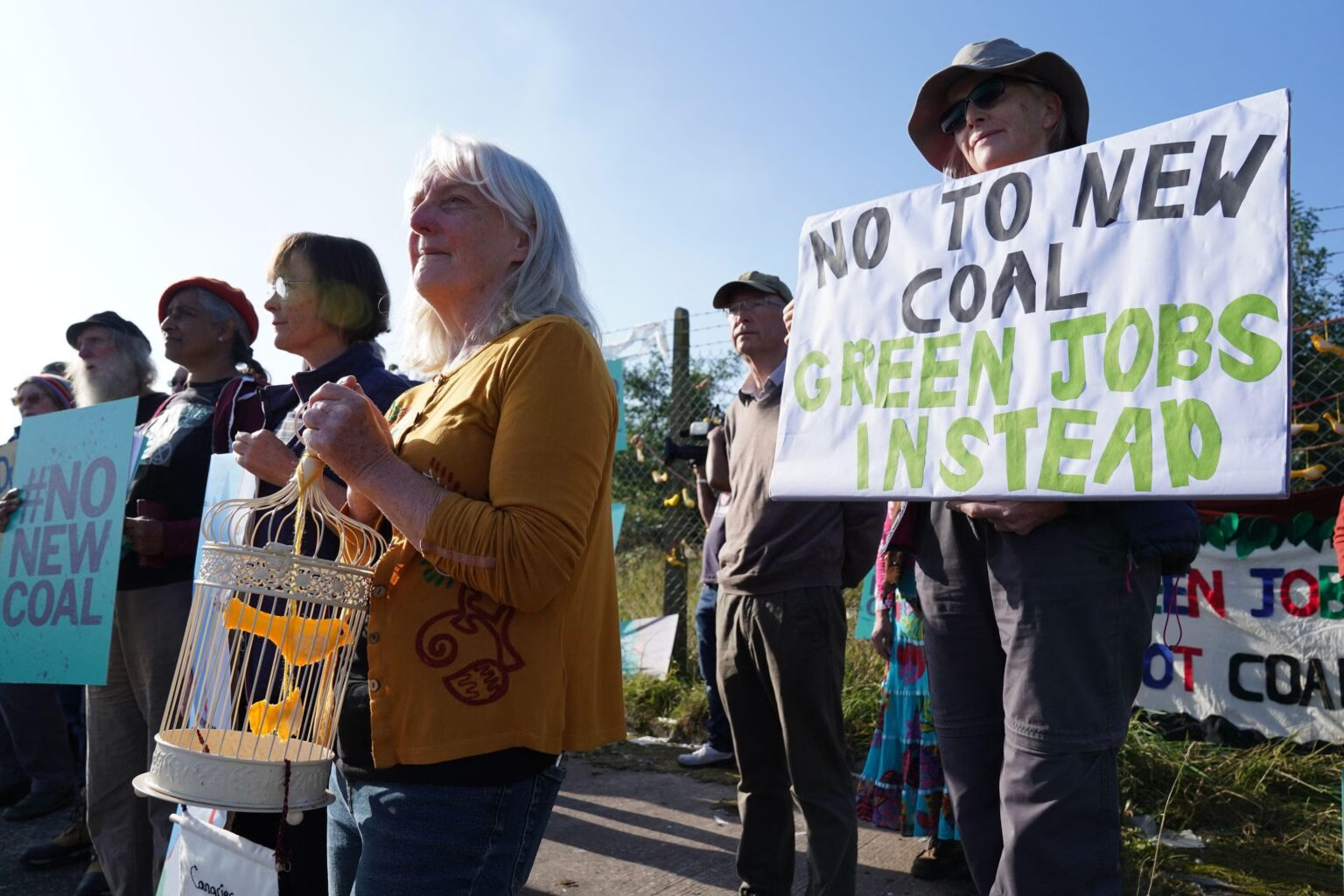
Demonstrators outside the proposed Woodhouse Colliery, south of Whitehaven, September 2021. Credit: PA Images / Alamy Stock Photo

Questions over compensation and employment could make it politically difficult for Labour to scrap the Whitehaven project, experts told DeSmog.

Labour has been urged to clarify its stance on the UK’s first deep coal mine in more than 30 years – as it fights an election campaign that has put clean energy at the fore.

The proposed mine in Whitehaven, Cumbria, would extract 2.8 million tonnes of coking coal a year from under the Irish sea to produce steel, emitting an estimated 220 millions tonnes of greenhouse gases over its lifetime.

The mine has become a political flashpoint in discussions over the UK’s commitment to reach net zero by 2050. In 2021, the International Energy Agency concluded that any new fossil fuel extraction was incompatible with global decarbonisation targets.

Ahead of a widely predicted victory at the 4 July election, Labour’s lack of clarity on the polluting mine poses awkward questions for a party that has based its manifesto on making Britain “a clean energy superpower”.

In the new manifesto, launched last week, Labour says it will not revoke existing oil and gas licences, but will also not grant any new licences. The party has explicitly ruled out issuing licences for new coal mines and says it will ban fracking for good.

The Woodhouse Colliery was granted planning permission by then Conservative levelling up secretary Michael Gove in December 2022, but has been plagued by controversy over its environmental impact and beset by legal delays.

So far, Labour has failed to address whether it would seek to overturn planning permission for the project, and has not responded to DeSmog’s requests for clarification.

In contrast, the party’s parliamentary candidate for the new Workington and Whitehaven constituency, where the mine would be built, has been vocal in his opposition.

Speaking to his local newspaper the News & Star last week, prospective MP Josh MacAlister said the mine was “a risky bet for new jobs”. “The easiest thing in the world would be to tell you the mine will solve our problems – but it won’t,” he said.

DeSmog understands that MacAlister has also addressed the issue at a number of local meetings, including to a mining heritage group in Whitehaven. 

According to a source, he told dozens of residents in November that the area was better off without the mine. However, he reportedly stopped short of clarifying whether he would oppose the national party if it backed the scheme’s development.

When approached by DeSmog for comment, MacAlister’s team referred DeSmog to his views expressed in the News & Star, adding that they were “consistent with what he has said since being selected”.

projection released by YouGov on 5 June shows that MacAlister is expected to win the seat in a landslide, with a predicted 53 percent of the vote to the Conservatives’ 25 percent.

Rebecca Willis, professor in energy and climate governance at the University of Lancaster, told DeSmog that “the mine has huge symbolic importance” both domestically and in terms of climate diplomacy.

“You can’t be a leading climate nation and provide consent for new coal mines,” she said. “Those two things are fundamentally incompatible.”

‘Non-Committal’

Despite Labour’s silence, MacAlister’s position appears to align with that of Ed Miliband, the party’s shadow climate change secretary.

Shortly after the mine was approved, Miliband co-authored an opinion piece for the News & Star with Cumberland’s council leader Mark Fryer. In the article, they argued that the mine would be “obsolete by the 2030s and 2040s at the latest, because of changes to the global steel industry which is rapidly moving towards clean steel production”.

Miliband reiterated this message at a March 2023 Cumberland Economic Summit event in west Cumbria.

Since then, the national Labour party has revealed little on its position.

Karl Conor, a former Labour councillor for Copeland, told DeSmog that given the controversies surrounding the scheme and the interest of the local community, MacAlister and Labour will be unable “to get through the campaign without having to nail their colours to the mast”.

In contrast to MacAlister, prospective Conservative MP Andrew Johnson has strongly backed the mine, telling the News & Star: “It offers the best prospect in years to create new jobs, attract significant investment into West Cumbria and help to deliver the upgrade to the coastal railway.

“If elected I will work tireless[ly] to fight for the mine to open and those jobs delivered”.

Claims by West Cumbria Mining that the project will create around 500 jobs have been strongly disputed.

Campaign group South Lakes Action on Climate Change (SLACC) group, which is bringing a legal challenge against the decision to greenlight the scheme, said that “no methodology” had been provided by the mining firm to support these claims.

A source in the new joint Cumberland authority told DeSmog they thought the local Conservative party would “try to make it [the local election campaign] about the mine”. 

“In the same way they made the Uxbridge by-election all about ULEZ [London’s Ultra Low Emission Zone], Sadiq Khan’s flagship policy, the Tories’ electoral strategy will be to make it about the mine,” they said. “… If I was in their position, it’s what I’d be doing.”

Compensation Conundrum

Any new administration looking to block the Cumbria coal mine may be hit with a compensation claim that runs into the tens of millions, according to a well-placed legal expert. 

Matthew McFeeley, a lawyer with Richard Buxton Solicitors, has been advising SLACC on its legal challenge. He told DeSmog that much will depend on the judicial review, which is scheduled to be heard on 16 July, less than a fortnight after the general election.

“If the court were to find that the planning permission had been unlawfully granted, then it would all have to go back to the secretary of state for a new decision,” McFeeley said.

In this scenario, he explained, a Labour administration could argue that the climate and environmental impacts of the project are too great, and refuse to grant permission.  

If campaigners can successfully argue the mine’s planning permission is unlawful, the company behind the coaling scheme – West Cumbria Mining (WCM) – would not be able to issue any kind of compensation claim.

However, if the next government decided to revoke planning permission without a legal ruling, the taxpayer would be legally obliged to pay compensation, McFeeley said. The amount would depend on an assessment of how much WCM stood to lose from the permission being revoked.

The legal challenge is one of a number of hurdles WCM has to jump over before it can begin work at the site. McFeeley also indicated that the compensation claim could run into the tens of millions, or higher.  “They’re investing their money at risk at this point,” he said.

WCM vacated its offices in west Cumbria on the eve of the 2021 public inquiry after the Singapore-based EMR Capital, one of the mine’s major financial backers, oversaw a “cost-saving” programme. The company has until the end of 2025 to get shovels in the ground.

Other hurdles also stand in the way of the mine’s construction – including approval of marine licences, habitat monitoring and a risk assessment.

Despite the many issues associated with the mine, Professor Willis, of the University of Lancaster, said that scrapping the plans may still prove awkward for an incoming government.

“There’s a timing issue for Labour here,” she said. “They’ve promised a lot in terms of green industrial policy through Great British Energy [Labour’s proposed state-owned energy company] and publicly-backed investment in green industries. But that will take a while to get going.

“So, at least over the next year, you’ll have the situation where they’ll be saying no to the mine but they’re not saying yes to anything else in the area. That’s quite difficult politically.

“Until the community actually sees a physical project with attached jobs being offered to them, they’re going to be pretty cynical about it.”

West Cumbria Mining did not respond to DeSmog’s request for comment.

Original article by Tommy Greene republished from DeSmog

Continue ReadingLabour Ignores Coal Mine-Shaped Elephant in the Room

Young people and scientists occupy new coal-sponsored Science Museum gallery, joined by broadcaster and wildlife campaigner Chris Packham

Spread the love

April 12, 2024 by Extinction Rebellion

  • 30+ young people, scientists and supporters occupy Science Museum’s new climate gallery in protest over its sponsorship by coal-producing conglomerate Adani
  • Group announce plan to remain over weekend ahead of the opening to school groups next week
  • Naturalist Chris Packham says sponsorship deal is “beyond greenwash – it’s grotesque” and attends to support the protesters
  • Science Museum criticised over ties to conglomerate involved in manufacturing drones for the Israeli military amidst bombardment of Gaza and destructive coal mining operations in India and Australia opposed by Indigenous groups

This evening, more than 30 protesters led by young people from Youth Action for Climate Justice and members of Scientists for Extinction Rebellion have occupied the Science Museum’s new climate gallery, Energy Revolution, over its sponsorship by the coal giant and arms manufacturer, Adani. Naturalist and broadcaster Chris Packham joined the group as they began their protest, with scientists and young people now intending to remain in the museum over the weekend, with the first school visits to the gallery beginning on Monday.

Chris Packham, who famously claimed that peacefully breaking the law is the ethically responsible thing to do when it comes to protecting the planet, told the protesters: “For me science is the art of understanding truth and beauty and a lot of that beauty lies in the natural world. Science tells us that the fossil fuel industry is responsible for the accelerating destruction of our natural world. The Science Museum is a place to spark imagination, to provide answers but also to encourage us to ask questions. The question I’m asking today is a big one, “why on earth are we allowing a destructive industry to sponsor an educational exhibition whilst simultaneously setting fire to young peoples futures?” This is beyond greenwash – it’s grotesque. We urgently need an ‘Energy Revolution’ to steer us away from the course of planetary destruction on which we are heading. We need a rapid, just transition to renewables – that revolution means an end to coal, and starts with the young people and scientists occupying this space this evening. Science tells us the truth, and the truth is that we must change.”

Naturalist Chris Packham at the Science Museum occupation 12 April 2024. Image: Extinction Rebellion.

The Energy Revolution gallery opened to the public just a few weeks ago amidst protest, with over 150 people taking part in a day of creative action. A few days earlier, guests arriving for the private VIP launch were greeted by protesters as they arrived, as well as the museum throwing a lavish dinner for the Adani Group’s billionaire chairman, Gautam Adani, with the Adani Group’s logo plastered on screens around the room. 

To coincide with today’s protest, activists have released a new video exposing the truth behind the misleading claims made by Gautam Adani during his speech at the opening of the gallery. While he discussed the energy transition from oil and gas, he neglected to mention coal, the industry from which the Adani Group derives 60% of its revenue. The Science Museum has attempted to defend its sponsorship deal by claiming it has only partnered with the Green Energy division, although evidence clearly shows that it is directly linked to Adani’s coal business and that the museum has maintained a relationship with the main Adani Group.

At 2pm on Saturday, the occupiers will invite members of the public to join them for an interactive assembly inside the gallery to discuss alternatives to toxic fossil fuel sponsorship at the Science Museum. The group plans to tell the public the truth about the gallery’s sponsor and the urgency of keeping fossil fuels in the ground for a liveable future. Throughout their occupation, the protesters are also constructing sculptures of fragments of coal as a poignant reminder of Adani’s core polluting business.

Since the announcement of Adani sponsorship of the gallery in 2021, the museum has faced a raft of opposition and protests, including the resignation of two trustees, and of former museum director Chris Rapley from the Advisory Board. The museum has also recently faced protests over Adani’s involvement in the ongoing genocide of Palestinians in Gaza via its partnership with Israeli arms firm Elbit Systems.

Ian McDermott, a Chemistry teacher who will no longer organise school trips to the museum, has said: “For decades I ran a couple of trips to the museum a year, but I just don’t think it’s in the students’ interests to engage with the greenwashing of the companies destroying their futures.”

Protest placard reads Greenwash detected

Adani is the world’s largest private developer of new coal mines and coal-fired power plants, including Australia’s largest, the Carmichael Coal Mine built on Wangan and Jagalingou ancestral land. This ongoing investment in coal mining and power flies in the face of the scientific warning that most fossil fuel reserves cannot be burned and emitted if global warming increase is limited to 1.5°C, or even 2°C above pre industrial levels.

Anya, a young person occupying the gallery said: “To have a coal company sponsoring an exhibition on the future of energy is blatantly deceiving. Through this sponsorship deal, the Science Museum is helping Adani attach itself to the image of a positive and sustainable future when in reality it is a coal giant, weapons manufacturer and genocide supporter. It’s plain wrong for the Science Museum to be deceiving visitors, including young people like me, when it comes to the climate crisis.”

This is not the only instance of the museum welcoming fossil fuel companies to sponsor and influence its science education programmes and galleries. The Museum’s STEM Training Academy, which aims to support teachers in delivering science education, is sponsored by oil and gas giant BP, while the Museum’s interactive children’s gallery is named after Norwegian oil and gas company, Equinor. 

Dr. Aaron Thierry, a scientist, who has researched climate impacts in the Arctic, is among those currently occupying the museum: “It’s not just Adani’s brand that the science museum is greenwashing, they’re also allowing the oil and gas giants BP and Equinor to sponsor their exhibits, disregarding the fact that these companies continue to expand fossil fuel production against the warnings of climate scientists. The latest science has shown we must leave the majority of fossil fuels unburned to prevent catastrophic changes to our climate. That an institution like the Science Museum is working with such rouge companies is a disgrace. The museum’s management needs to follow the example of Britain’s other leading cultural institutions and drop all ties to the fossil fuel industry.

Scientists for Extinction Rebellion and Youth Action for Climate Justice (who have led this action) are members of Fossil Free Science Museum Coalition who are campaigning for the Science Museum to end its sponsorship by fossil fuel companies.

Youth Action for Climate Justice (formerly UKSCN London) is a radical youth organisation mobilising for climate justice. YACJ aims to create a new generation of young activists who are educated about society and the change we need, in order to work with other movements to change the system we live in. The group was previously part of Youth Strike for Climate Movement and coordinated the London youth climate strikes in 2019 and 2020, which brought thousands of young people to the streets of London. Instagram | Twitter

Scientists for Extinction Rebellion are scientists who agree with Extinction Rebellion that it is time to take direct action to confront catastrophic climate and ecological breakdown. Instagram | Twitter

Other groups involved are: International Solidarity for Academic Freedom in India (InSAF India), India Labour Solidarity (UK), Students for Survival; and numerous Extinction Rebellion groups.

Continue ReadingYoung people and scientists occupy new coal-sponsored Science Museum gallery, joined by broadcaster and wildlife campaigner Chris Packham