‘Fossil Fuels Are Killing Us’: Scientists Publish Sweeping Review of Industry Harms

Spread the love

Original article by Jessica Corbett republished from Common Dreams under Creative Commons (CC BY-NC-ND 3.0).
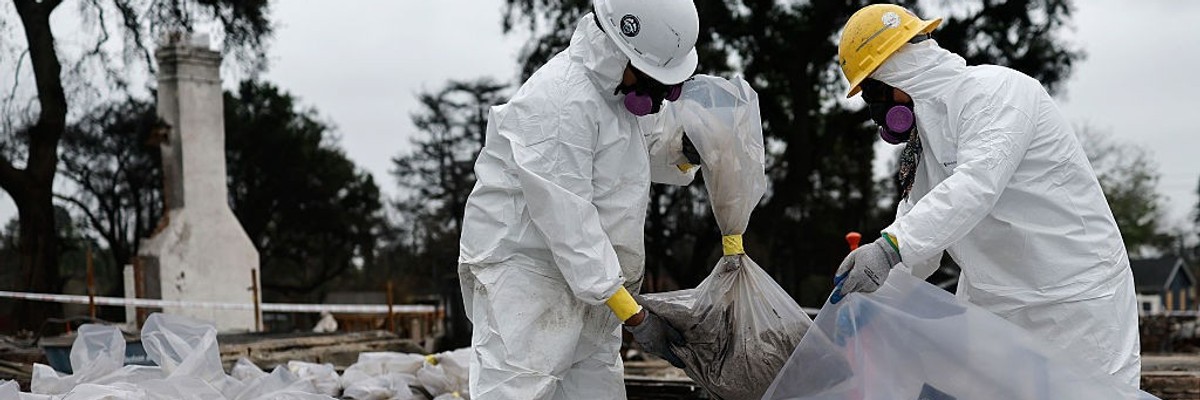
U.S. Army Corps of Engineers contractors in protective gear remove hazardous materials from a home destroyed in the Eaton Fire on March 26, 2025 in Altadena, California. (Photo: Mario Tama/Getty Images)

“We’ve got to work fast to end fossil fuel operations near our homes, schools, and hospitals and trade fossil fuel infrastructure for healthy, clean energy,” said one co-author.

“The evidence is clear that fossil fuels—and the fossil fuel industry and its enablers—are driving a multitude of interlinked crises that jeopardize the breadth and stability of life on Earth.”

That’s the first line of the abstract for an article published Monday by top scientists who reviewed “the vast scientific evidence showing that fossil fuels and the fossil fuel industry are the root cause of the climate crisis, harm public health, worsen environmental injustice, accelerate biodiversity extinction, and fuel the petrochemical pollution crisis.”

The new paper in the peer-reviewed journal Oxford Open Climate Change highlights the diverse impacts of “every stage of the fossil fuel life cycle” and stresses that the “industry has obscured and concealed this evidence through a decadeslong, multibillion-dollar disinformation campaign aimed at blocking action to phase out” its deadly products.

“The fossil fuel industry has spent decades misleading us about the harms of their products and working to prevent meaningful climate action,” said co-author Naomi Oreskes, professor of the history of science at Harvard University, in a statement. “Perversely, our governments continue to give out hundreds of billions of dollars in subsidies to this damaging industry. It is past time that stops.”

“The most polluted communities should be prioritized for clean energy investments and removal and cleanup of dirty fossil fuel infrastructure.”

While the researchers focused on the United States, “as the world’s largest oil and gas producer and dominant contributor to these fossil fuel crises,” their review—including proposed “science-and-justice-based solutions” for an economywide effort to “forge a path forward to sustaining life on Earth”—applies to the whole world, which is quickly heating up due to emissions from coal, gas, and oil.

The article features sections on the fossil fuel-driven climate crisis, public health harms, environmental injustice, biodiversity loss and extinction, petrochemical pollution, and industry disinformation. Each section lays out the “problem” and “solutions.”

The climate emergency section includes details such as “the production and combustion of oil, gas, and coal are responsible for nearly 90% of human-caused carbon dioxide (CO2) emissions and approximately 79% of total greenhouse gas emissions,” and “failures in political will to implement necessary climate action have made the 1.5°C benchmark nearly impossible to achieve without overshoot,” referring to a primary goal of the 2015 Paris agreement.
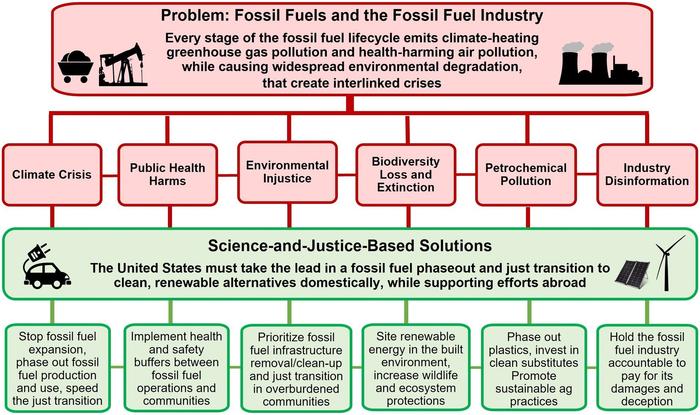
Although the current U.S. administration has demonstrated its alliance to the fossil fuel industry—including with President Donald Trump’s recent energy emergency declaration—the scientists still emphasized what’s possible in the country.

“In the USA, powerful policy levers are available to governments and civil society at the local, state, national, and international levels to phase out fossil fuels and transition to a clean, renewable energy economy,” they wrote. “These levers include regulation (e.g. applying and enforcing existing laws), legislation (e.g. polluters pay laws, fossil fuel subsidy reform, land use laws limiting drilling), and litigation (e.g. holding fossil fuel companies accountable, defending existing law).”

They also warned that “last-ditch efforts to prolong the fossil fuel industry are proliferating. These include counterproductive false solutions, like carbon capture and storage (CCS), which would perpetuate fossil fuel use while capturing only some of the resulting emissions, and hydrogen made from fossil fuels.”

The public health section notes that “air pollution from fossil fuel combustion accounts for 8.7 million (equaling 1 in 5) premature deaths per year worldwide and 350,000 premature deaths per year in the USA. In a single year, air pollution from oil and gas production in the USA resulted in 410,000 asthma exacerbations, 2,200 new cases of childhood asthma, and 7,500 premature deaths in 2016.”

Co-author David J.X. González, an assistant professor of environmental health sciences at the University of California, Berkeley, said Monday that “we’ve got to work fast to end fossil fuel operations near our homes, schools and hospitals and trade fossil fuel infrastructure for healthy, clean energy.”

“Oil, gas, and coal will continue to condemn us to more deaths, wildlife extinctions, and extreme weather disasters unless we make dirty fossil fuels a thing of the past.”

The paper points out that “climate change is increasing incidence of physical and mental health impacts and mortality through multiple pathways: worsening extreme events including heatwaves, severe storms, floods, droughts, and wildfires; shifting ranges of disease vectors; threats to food security; and displacement and forced migration, which restrict access to healthcare and other basic services.”

“These harms, though broadly felt, also disproportionately impact marginalized communities which are already disproportionately burdened by other socioenvironmental hazards, as well as susceptible populations including young children, people with certain disabilities, people experiencing homelessness, pregnant people, people with chronic diseases, and older adults,” the publication continues.

University of Montana associate professor of environmental studies Robin Saha, another co-author, said that “decades of discriminatory policies, such as redlining, have concentrated fossil fuel development in Black, Brown, Indigenous, and poor white communities, resulting in devastating consequences.”

“For far too long, these fenceline communities have been treated as sacrifice zones by greedy, callous industries,” Saha added. “The most polluted communities should be prioritized for clean energy investments and removal and cleanup of dirty fossil fuel infrastructure.”

The paper’s other co-authors are Robert Bullard of Texas Southern University, Boston University’s Jonathan J. Buonocore and Mary D. Willis, Trisia Farrelly of the Cawthron Institute, William Ripple of Oregon State University, and the Center for Biological Diversity’s Nathan Donley, John Fleming, and Shaye Wolf.

“The science can’t be any clearer that fossil fuels are killing us,” declared Wolf, the paper’s lead author and the center’s climate science director. “Oil, gas, and coal will continue to condemn us to more deaths, wildlife extinctions, and extreme weather disasters unless we make dirty fossil fuels a thing of the past. Clean, renewable energy is here, it’s affordable, and it will save millions of lives and trillions of dollars once we make it the centerpiece of our economy.”

Original article by Jessica Corbett republished from Common Dreams under Creative Commons (CC BY-NC-ND 3.0).

Orcas comment on killer apes destroying the planet by continuing to burn fossil fuels.
Continue Reading‘Fossil Fuels Are Killing Us’: Scientists Publish Sweeping Review of Industry Harms

‘Completely Delusional’: Trump Calls for Reinvigorating Domestic Use of US Coal

Spread the love

Original article by Eloise Goldsmith republished from Common Dreams under Creative Commons (CC BY-NC-ND 3.0). 

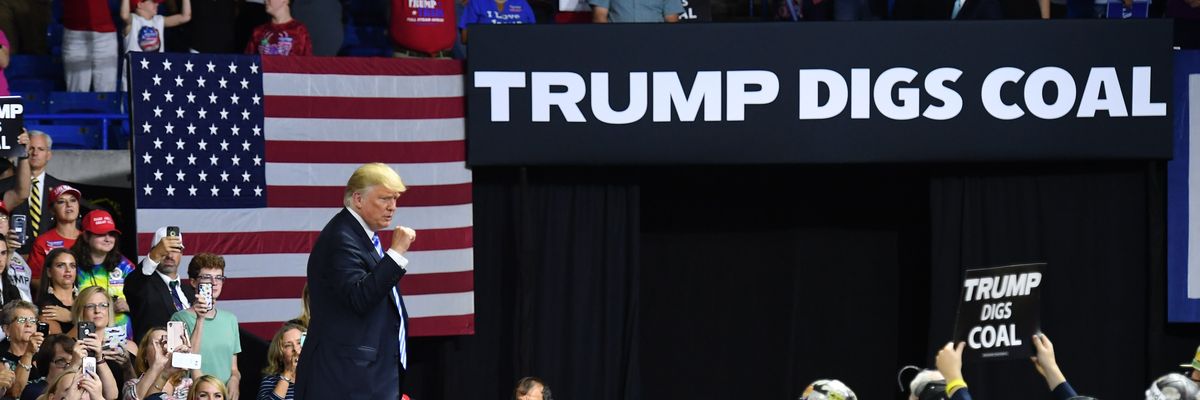
U.S. President Donald Trump salutes his supporters at a political rally at Charleston Civic Center in Charleston, West Virginia on August 21, 2018.
 (Photo: Mandel Ngan / AFP)

“Donald Trump is not concerned with Americans’ health or economic wellbeing. He is only concerned with helping out his billionaire buddies in the fossil fuel industry,” said one climate advocate.

After U.S. President Donald Trump declared on Truth Social on Monday night that he is ordering his administration “to immediately begin producing Energy with BEAUTIFUL, CLEAN COAL,” a leader at the grassroots environmental group Sierra Club quickly hit back, calling the move “completely delusional.”

Trump said he was announcing the move as a means to counter China’s economic edge. The announcement comes “after years of being held captive by Environmental Extremists, Lunatics, Radicals, and Thugs, allowing other Countries, in particular China, to gain tremendous Economic advantage over us by opening up hundreds of all Coal Fire Power Plants,” Trump wrote.

It was not immediately clear what Trump’s directive was referring to or how his announcement on social media would impact U.S. policy, according to Bloomberg.

“There is no such thing as clean coal. There is only coal that pollutes our air and water so severely that nearly half a million Americans have died prematurely from coal in the last two decades,” said Sierra Club director of climate policy Patrick Drupp in a statement Tuesday. “Donald Trump is not concerned with Americans’ health or economic wellbeing. He is only concerned with helping out his billionaire buddies in the fossil fuel industry.”

Trump’s cabinet includes a number figures who are friendly to the fossil fuel industry, such as Energy Secretary Chris Wright, who was a fracking industry CEO, and Interior Secretary Doug Burgum, a known ally of oil and gas companies.

On his first day in office, Trump declared a national energy emergency to ensure “an affordable and reliable domestic supply of energy,” called for expedited “permitting and leasing of energy and natural resource projects in Alaska,” and withdrew the United States from the the world’s main climate pact.

The U.S. is mulling using emergency authority to bring coal-fired plants back online and halt others from shutting, Burgum told Bloomberg Television in an interview last week.

“Under the national energy emergency, which President Trump has declared, we’ve got to keep every coal plant open,” Burgum said while at the energy sector gathering CERAWeek. “And if there had been units at a coal plant that have been shut down, we need to bring those back.”

Meanwhile, Environmental Protection Agency Administrator Lee Zeldin earlier this month announced a new effort to rollback a host of EPA regulations, including some that will impact coal producers.

The coal mining company Peabody Energy saw their stock rise 3.5% after Trump’s Monday post on social media about “clean coal,” according to Tuesday morning reporting from Schaeffer’s Investment Research.

As of 2023, coal accounted for 16.2% of U.S. electricity generation, according to the U.S. Energy Information Administration. That year, 21.4% came from renewables.

In its statement released on Tuesday, Sierra Club took issue with Trump’s assertion that investing in coal has provided an economic boost to other countries. “Trump refers to the ‘Economic advantage’ that burning coal has afforded other nations. In reality, renewable energy is quickly becoming more affordable and reliable than coal,” they wrote.

In 2023, the think tank Energy Innovation Policy & Technology released an analysis which found that 99% of coal plants are more expensive to run compared to replacing their generation capacity with either solar or wind power, when taking into account credits that were made available through the Inflation Reduction Act.

Original article by Eloise Goldsmith republished from Common Dreams under Creative Commons (CC BY-NC-ND 3.0). 

Neo-Fascist Climate Science Denier Donald Trump says Burn, Baby, Burn.
Elon Musk urges you to be a Fascist like him, says that you can ignore facts and reality then.
Continue Reading‘Completely Delusional’: Trump Calls for Reinvigorating Domestic Use of US Coal

Just 36 Companies Drove Half the World’s Climate-Altering Emissions in 2023: New Report

Spread the love

Original article by Sharon Kelly republished from DeSmog.

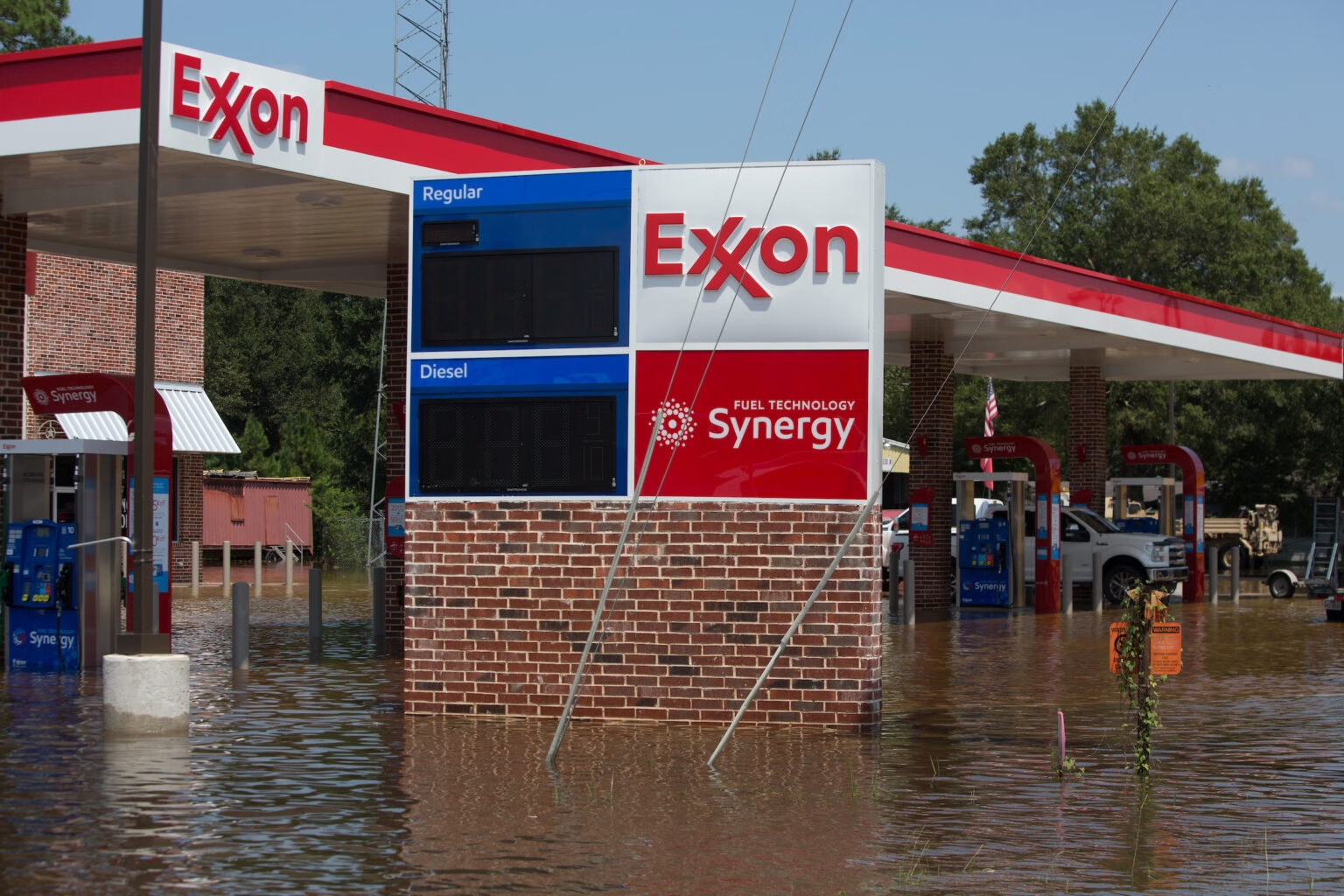
Hurricane Harvey, downgraded to a tropical storm when it hit Vidor, Texas, flooded an Exxon gas station, Sept. 1, 2017. Credit: ©Julie Dermansky

Companies and states most responsible for climate change are also those working hardest to prevent climate action, new Carbon Majors report finds.

Half of the world’s carbon dioxide emissions in 2023 came from just three dozen companies, according to a new report released today by the Carbon Majors project, with the list dominated by coal, cement, and oil producers.

Saudi Arabia’s Saudi Aramco, the year’s worst offender, drove 4.4 percent of the world’s carbon dioxide pollution alone in 2023, the report found.

Five publicly-traded oil companies — ExxonMobil, Chevron, Shell, TotalEnergies, and BP — combined to produce an additional 4.9 percent of the year’s global carbon dioxide emissions from fossil fuels, the report adds.

The Carbon Majors database builds on the innovative work published by researcher Richard Heede of the Climate Accountability Institute (CAI) begun in 2013. For the first time, instead of attributing the build-up of industrial carbon dioxide and methane emissions to each of the world’s nations, Heede managed to trace those emissions to 90 specific “carbon major” companies. Last year, the nonprofit think tank InfluenceMap collaborated with CAI to produce major updates to the database — and today’s report marks the first annual update to that report, incorporating global data from 2023.

The year’s top carbon polluters were a mix of investor-owned and state-owned or national companies — but they have one thing in common.

“They’re some of the most obstructive actors towards climate policy,” Emmett Connaire, a senior analyst at the Carbon Majors project and one of the authors of the report, told DeSmog.

“I think it kind of kills the argument from industry that they’re not responsible for their CO2 emissions because we need fossil fuels to grow,” Connaire said, “when they’re the most obstructive and trying to keep up the demand for their products in the face of the overwhelming scientific opinion.” 

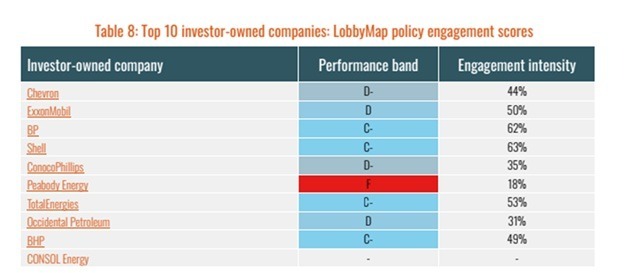
Eight of the nine public companies most responsible for carbon emissions in 2023 were “highly active or strategic” in their climate lobbying, the report notes. And their lobbying efforts took aim at regulating climate-altering pollution or sought to impede the energy transition.“ Of these 9 companies, 5 score a D or below, indicating unsupportive positions on climate policy,” the new report finds, citing data from InfluenceMap’s LobbyMap database, which grades companies based on their alignment with the Paris Agreement. “The remaining 4 score only slightly higher at C-.”

Top 10 investor-owned companies: LobbyMap engagement scores.
InfluenceMap gave climate policy lobbying scores to the top 10 investor-owned companies, all oil, gas, and coal firms. Credit: Carbon Majors 2025 report

None of the five top oil companies named in the report immediately responded to a request for comment from DeSmog.

Investor-owned companies aren’t the only ones actively fighting to prevent climate action, the Carbon Majors report notes.

“State-owned companies are even more oppositional to climate regulation globally according to LobbyMap research,” the report finds, listing Saudi Aramco, Russia’s Gazprom, Mexico’s Pemex, and China’s CHN Energy among the worst actors.

“The ‘Carbon Majors’ are keeping the world hooked on fossil fuels with no plans to slow production,” former United Nations climate chief and Paris Agreement architect Christiana Figueres said in a response accompanying the report. “While states drag their heels on their Paris Agreement commitments, state-owned companies are dominating global emissions — ignoring the desperate needs of their citizens.”

A sizable majority — 80 percent — of the year’s 20 worst offenders are state-owned, the report found.

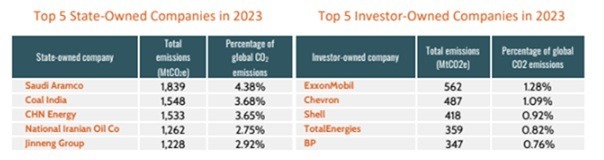
The 2025 Carbon Majors report compared the total CO2 emissions and percentage of total emissions for the top 5 state-owned (Saudi Aramco, Coal India, CHN Energy, National Iranian Oil, Jinneng Group) and top 5 investor-owned (ExxonMobil, Chevron, Shell, TotalEnergies, BP) companies in 2023
State-owned fossil fuel companies dominated global climate emissions in 2023, compared to public companies, the Carbon Majors report noted. Credit: Carbon Majors report 2025

Throughout history, responsibility for driving climate change is concentrated among a strikingly small number of corporations, the report suggests.

Two-thirds of all fossil fuel and cement emissions worldwide from 1750 through 2023 can be traced to just 181 entities, the report finds, adding that one-third of emissions came from just 26 companies.

These findings may have significant legal consequences. During 2024, New York state and Vermont both enacted “Climate Superfund” laws that aim to hold fossil fuel producers and oil refiners responsible for the damage done by their climate-altering products — and the Carbon Majors database is a proposed tool to assess companies’ relative liabilities, according to InfluenceMap. Its earlier findings have been cited in civil lawsuits brought by U.S. cities and counties against fossil fuel producers and an inquiry in the Philippines (which has seen some of the strongest typhoons in recorded history) into corporate responsibility for human rights violations.

The report approaches companies’ contributions to climate change based on production data —  meaning that it focuses on the companies that do the drilling and mining (which helps avoid double-counting, Connaire told DeSmog). Those production figures are self-reported by companies but are widely used by governments to assess taxes and by investors in public companies. That methodology means that, for example, natural gas pipeline companies and natural gas utilities aren’t included in the report’s rankings. 

Nonetheless, natural gas producers figure among the report’s list of all-time top polluters. That includes the former Chesapeake Energy, which first rose to prominence — and some notoriety — during the shale gas fracking boom only to implode into bankruptcy in 2020. Chesapeake later emerged from bankruptcy and has since merged into the newly formed Expand Energy.

As the Carbon Majors database traces emissions throughout history, it accounts for the effects of mergers and acquisitions in the tumultuous oil industry, known for its booms and busts. “For example, the multiple smaller companies into which the Standard Oil Trust was broken up have evolved to become some of the most recognizable companies in the database today,” the report notes. “Some are direct descendants of Standard Oil, like ExxonMobil, with both Exxon and Mobil as descendants separately, and Chevron. Others have resulted from mergers with descendants of Standard Oil, such as BP and ConocoPhillips.”

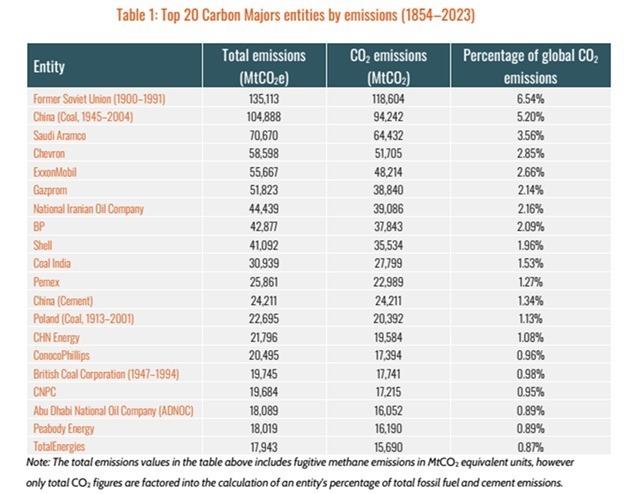
Top 20 carbon majors entities by emissions, from 1854-2023: Former Soviet Union (1900-1991), China (Coal, 1945-2004), Saudi Aramco, Chevron, ExxonMobil, Gazprom, National Iranian Oil Company, BP, Shell, Coal India, Pemex, China (Cement), Poland (Coal, 1913-2001), CHN Energy, ConocoPhillips, British Coal Corporation (1947-1994), CNPC, Abu Dhabi National Oil Company (ADNOC), Peabody Energy, TotalEnergies
The Carbon Majors database traces the historical cumulative emissions of the top individual entities, such as Chevron or the former Soviet Union, from 1854 through 2023. Credit: Carbon Majors report 2025

It also calls attention to the importance of coal pollution — not just historically, but also in 2023.

“In 2023, coal remained the largest source of emissions, contributing 41.1 percent of emissions in the database,” the new report finds, “continuing a steady increase since 2016.”

Emissions from the cement industry — also a major driver of carbon pollution — increased significantly in 2023, rising 6.5 percent year-over-year, which the Carbon Majors report noted was “the largest relative rise” found. “Four of the five companies with the greatest relative increases in emissions in 2023 were cement companies — Holcim Group, Heidelberg Materials, UltraTech Cement, and CRH — with cement emissions seeing the largest relative rise among the four commodity types.”

Cement producers aren’t the only ones, however. In fact, emissions from most of the top emitters rose in 2023, the Carbon Majors report found. 

“It is truly alarming that the largest fossil fuel companies continue to increase their emissions in the face of worsening natural disasters caused by climate change, disregarding scientific evidence that these emissions are harming us all,” said Tzeporah Berman, founder of the Fossil Fuel Non-Proliferation Treaty Initiative. “It is clearer than ever that dirty private companies, driven by profits and business as usual, will never choose to self-regulate. Governments around the world must use their power to end fossil fuel expansion and transition their economies before fossil fuel companies destroy the planet.”

Original article by Sharon Kelly republished from DeSmog.

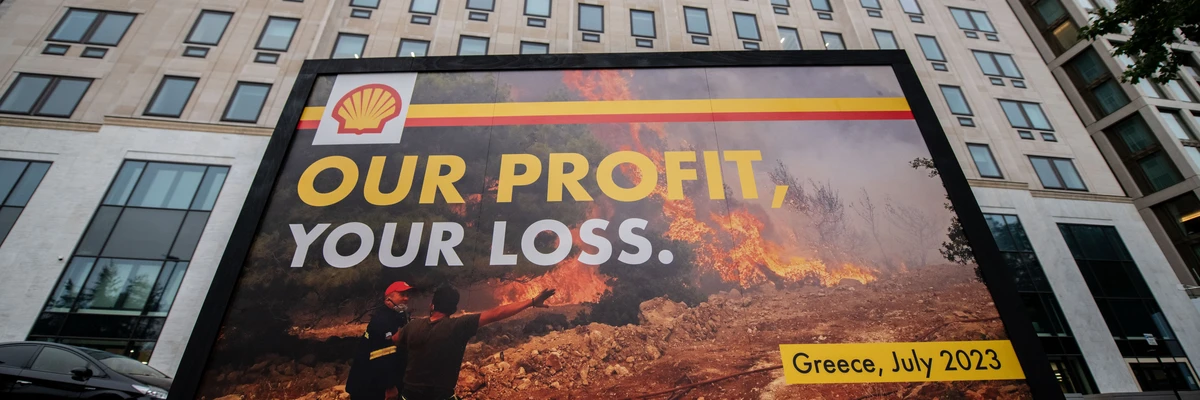
Greenpeace activists display a billboard during a protest outside Shell headquarters on July 27, 2023 in London.
Greenpeace activists display a billboard during a protest outside Shell headquarters on July 27, 2023 in London. (Photo: Handout/Chris J. Ratcliffe for Greenpeace via Getty Images)
Neo-Fascist Climate Science Denier Donald Trump says Burn, Baby, Burn.
Continue ReadingJust 36 Companies Drove Half the World’s Climate-Altering Emissions in 2023: New Report

Group That Calls CO2 ‘Essential’ Praises Trump Energy Secretary Pick Chris Wright

Spread the love

Original article by Geoff Dembicki republished from DeSmog

Climate denier Gregory Wrightstone (left) has nothing but praise for Trump’s energy secretary pick, Chris Wright (right). Credit: DeSmog

The head of the CO2 Coalition tells DeSmog that Wright agrees carbon dioxide is “not the demon molecule, it’s the miracle molecule.”

Donald Trump’s pick to lead the Department of Energy, Chris Wright, is receiving enthusiastic approval from a climate obstruction organization that argues global carbon dioxide emissions should be increasing because the gas is “essential for life.” 

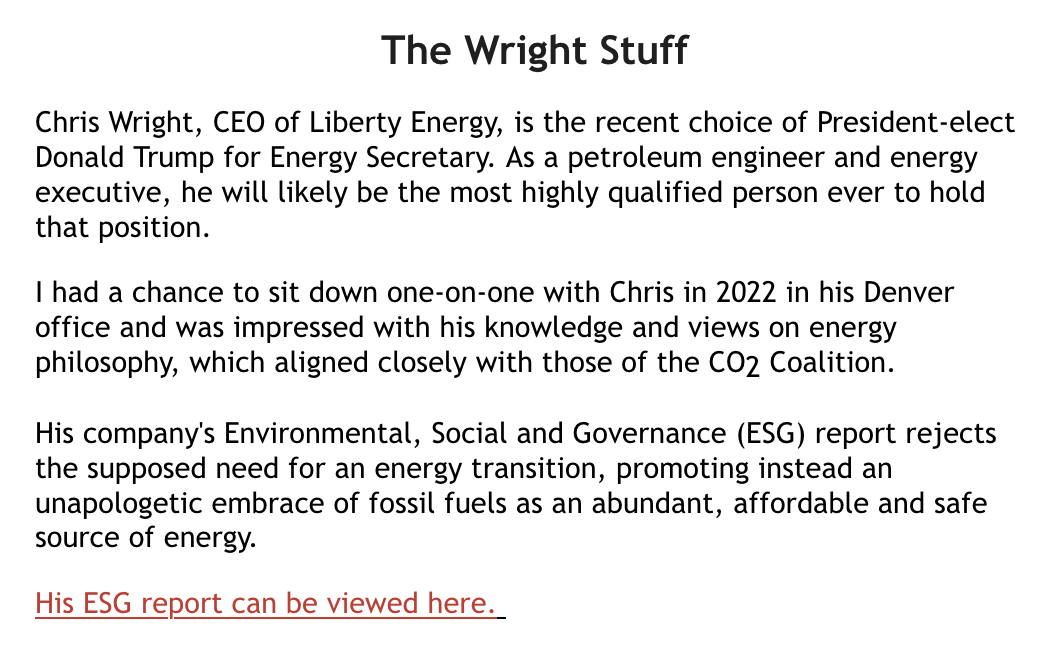
“I had a chance to sit down one-on-one with Chris in 2022 in his Denver office,” claimed Gregory Wrightstone, executive director of a group called the CO2 Coalition. For nearly a decade, the organization has publicly disputed the fundamentals of climate science while receiving donations from foundations linked to corporate backers, including the oil and gas billionaire Charles Koch

Wrightstone, who detailed the encounter with Wright in a recent newsletter, “was impressed with his knowledge and views on energy philosophy, which aligned closely with those of the CO2 Coalition.”

In a phone interview with DeSmog, Wrightstone elaborated on that alignment, explaining that “the main thing that he and I and the CO2 Coalition agree on is that increasing CO2 is a net benefit, it’s not the demon molecule, it’s the miracle molecule.”

Wright is currently the CEO of the fracking services company Liberty Energy and would bring no political or government experience to the role of energy secretary. Yet Wrightstone concluded that because Wright is “a petroleum engineer and energy executive, he will likely be the most highly qualified person ever to hold that position.” 

After Trump announced the nomination last week, some industry observers hailed the appointment as a sign of political moderation within the Republican cabinet, with the head of the Colorado Oil and Gas Association arguing that Wright is “a pragmatic problem solver” and “not a climate denier.”

Yet the full-throated praise that Wright is receiving from the likes of Wrightstone raises serious questions about whether the future energy secretary even thinks climate change is a problem worth addressing, said Connor Gibson, an independent research specialist who’s spent years tracking the CO2 Coalition and other groups that obstruct climate action including for Greenpeace USA. 

“The CO2 Coalition has been a persistent voice undermining the ABCs of climate change — that it’s happening, that it’s caused by human fossil fuel use, and that it’s going to be dangerous,” he told DeSmog. 

Wright didn’t respond to questions via his company Liberty Energy nor via the Trump-Vance transition team. 

Screenshot from CO2 Coalition emailed newsletter. Credit: CO2 Coalition

Backed by Koch

In email correspondence with DeSmog, Wrightstone explained how his meeting with the future nominee for energy secretary came about several years ago: “I was speaking at an event in Denver and set up a meeting in his office,” he wrote.

“We had a wide-ranging conversation, but I can’t recall any particular details,” he added during a phone interview. Yet Wright made a positive impression on the executive director of the CO2 Coalition. “The key takeaway is that he’s a big supporter of the continuing use of fossil fuels, including coal, oil, and natural gas,” Wrightstone said. 

According to Wrightstone, he and Wright’s views align on other key points, including the factually incorrect or dubious claims that “there is no man-made climate crisis,” “science is not consensus and consensus is not science,” “fossil fuels cannot be replaced by intermittent and unreliable solar and wind power,” and “history tells us that warmer periods have been beneficial, while cold periods have been horrific to humanity.”

These talking points have for years been disseminated by the CO2 Coalition, which was recently cited by Alberta’s United Conservative Party in a resolution that abandoned the oil-producing Canadian province’s net-zero targets and officially recognized “that CO2 is a foundational nutrient for all life on Earth.”

Gibson referred to the CO2 Coalition in a recent report he co-wrote along with Robert Brulle of Brown University as an “organization solely focused on disputing climate change science.”

During the first Trump administration, William Happer of the CO2 Coalition was appointed to the National Security Council but exited after only a year. White House advisors reportedly feared that his extreme views were a liability to Trump’s reelection. In 2017, Happer argued that the “demonization” of carbon dioxide “really differs little from the Nazi persecution of the Jews, the Soviet extermination of class enemies, or ISIL slaughter of infidels.”  

Nevertheless, the CO2 Coalition received more than $76,000 from foundations linked to the oil and gas billionaires Charles and David Koch during Trump’s first term, according to Gibson’s report. Greenpeace calculations show the group got $620,000 in Koch-related contributions between 2004 and 2015. 

“We have not received Koch Industries money since I’ve been here,” Wrightstone, who took over in 2021, said when asked about Koch contributions. 

Gibson argues that Wright, as a fossil fuel executive, is slightly more nuanced in expressing his views on climate change than his supporters at the CO2 Coalition. Wright acknowledges that human-caused global heating is real and potentially a problem while saying in a video posted to his LinkedIn last year that “there is no climate crisis.”

“It seems to me to be the calculated words of a CEO who recognizes that there is a potential liability of telling an outright lie to the public,” Gibson said. “Yet the effect of his comments is to leave people with the impression that climate change is not happening.”

Original article by Geoff Dembicki republished from DeSmog

Continue ReadingGroup That Calls CO2 ‘Essential’ Praises Trump Energy Secretary Pick Chris Wright

COP29 puts world on course for more extreme weather – and more deaths

Spread the love

Original article by Paul Rogers republished from Open Democracy under a Creative Commons Attribution-NonCommercial 4.0 International licence.

After a disappointing COP29, we should prepare for more extreme weather events like the floods that hit Valencia last month
 | David Ramos/Getty Images

Summit proves change won’t come until floods and wildfires are killing tens of thousands in rich Global North cities

While COP29 in Baku narrowly avoided collapsing, its results were bitterly disappointing for delegations from across the Global South, who ended up with barely a quarter of the annual $1.3trn of support they were seeking by 2035 to respond to climate breakdown.

Quite apart from other factors, more than 1,500 pro-carbon lobbyists worked hard to limit progress and ensure that burning oil, gas and coal at profit continues for as long as possible whatever the global consequences. After all, the world’s fossil fuel industries rake in around a trillion dollars in profits a year.

Meanwhile, more and more examples are emerging of accelerating climate breakdown. The flooding in Valencia is just one, but scarcely noticed in Europe is the thoroughly weird weather being experienced in the eastern United States.

This autumn there have been over five hundred wildfires in New Jersey alone, a 5,000-acre fire has been burning for a week on the New York-New Jersey border prompting a voluntary evacuation, and New York City’s Fire Department was called out to deal with 271 brush fires in the first two weeks of November alone.

As if timed for that and certainly released with COP29 in mind, Carbon Brief, a website covering the latest developments in climate science, climate policy and energy policy, has mapped every published study on ‘impossible’ weather events – record heatwaves or storms that would not have happened without the overall global climate changes.

The first such study came in 2004, the year after weeks of extreme heat hit Europe and killed 70,000 people across the continent over several months. That early example of an ‘impossible’ weather event kick-started a new field of research known as ‘extreme event attribution’, which looks at how climate change has influenced extreme weather.

There are now 600 studies of 750 such extreme events spanning the past 20 years – a tiny fraction of the total number of these kinds of events. Of these 750, Carbon Brief found that scientists and researchers had concluded that 74% were made more likely or more severe because of climate change.

This has added to the growing sense of urgency right across the climate science community coupled with a highly critical view of the whole COP process. Even before the dismaying summit in the Azerbaijani capital, both last year’s COP in Abu Dhabi and the year before in Egypt were notable for their lack of progress even as the urgency of preventing climate breakdown was becoming more and more obvious.

There are other risks to global security including nuclear weapons, pandemics, cyber warfare, AI misuse and the progressive destruction of biodiversity, but climate breakdown is different from all of these. It is not a future risk, it is a current happening, it is accelerating, and we now have very few years left to get on top of it. If we don’t then a worldwide catastrophe with many hundreds of millions dying and societal collapse will become increasingly likely.

Does it have to be like that?

As things stand, in terms of changing attitudes, developments in renewables, resistance of the fossil carbon industries and, of course, Donald Trump’s looming presidency in the US, a reasonable prognosis for the next decade has three elements.

First, the use of renewable energy resources does continue to increase but not at anything like the rate required, so net carbon emissions will continue to rise, not fall, for most of the next ten years. Second, resistance to decarbonisation will continue from many quarters, no doubt now including the White House. Finally, severe weather events will become both more common and more destructive.

Eventually, and it might take more than a decade, the disasters will be so great, including sudden weather events in rich cities in the Global North killing many tens of thousands of people, that public pressure across the world will force governments to respond. There will be no alternative to engage in truly transformative change.

But what that means is that the task ahead by then will be hugely greater than if the transformation starts much sooner, so timescales become crucial, especially what can speed up the process.

There is, though, one thing to remember at a time of widespread pessimism. If nations had got their act together 25 years ago after the Kyoto Protocols, were signed we would be in a far more favourable position worldwide than we are now. We are acting more than two decades late.

But climate breakdown is not happening as a slow, steady process of change, creeping up almost unawares. If that had been the case then with all the reasons not to act, especially the global fossil carbon lobby, we would have been in an even worse position now. Instead, it is happening at variable rates in two respects, some parts of the world – such as the polar regions – are warming up much faster than others and extreme weather events are happening much more often.

We are therefore getting a foretaste of what will affect everyone a few years before it does, and this gives us just a little more time to act. It means that the next ten years, and perhaps even the five years to 2030, will be the key time for us to come to terms with the transformation in society that is essential for global well-being. That is possible, just.

Original article by Paul Rogers republished from Open Democracy under a Creative Commons Attribution-NonCommercial 4.0 International licence.

Continue ReadingCOP29 puts world on course for more extreme weather – and more deaths