The Whole Truth Five (from left to right) Lucia Whittaker De Abreu, Cressida Gethin, Louise Lancaster, Daniel Shaw and Roger HallamPhoto: Just Stop Oil
SIXTEEN non-violent Just Stop Oil protesters handed draconian sentences since July have been granted an extraordinary mass hearing before the Court of Appeal next year, it was announced on Saturday.
The hearing on January 29 and 30 at the Royal Courts of Justice in London will examine four separate cases involving activists from the group. Key points of contention will include whether conscientious motivation should be considered a mitigating factor.
The outcome is anticipated to be a defining moment for protest rights in Britain.
The 16 include the “Whole Truth Five,” who organised a protest on the M25 calling for a halt to new oil and gas licences. Roger Hallam, Cressida Gethin, Louise Lancaster, Daniel Shaw, and Lucia Whittaker De Abreu received a combined total of 21 years for their action.
At the time, UN special rapporteur Michel Forst said the verdict marked a dark day for “anyone concerned with the exercise of their fundamental freedoms” in Britain.
…
Spokesman for the Free Political Prisoners campaign Lex Korte said: “A subset of judges have responded all too eagerly to the call from the disgraced Lord Walney, the arms and oil industry lobbyist, to jail peaceful climate campaigners for longer than if they’d committed serious crimes of sexual violence.
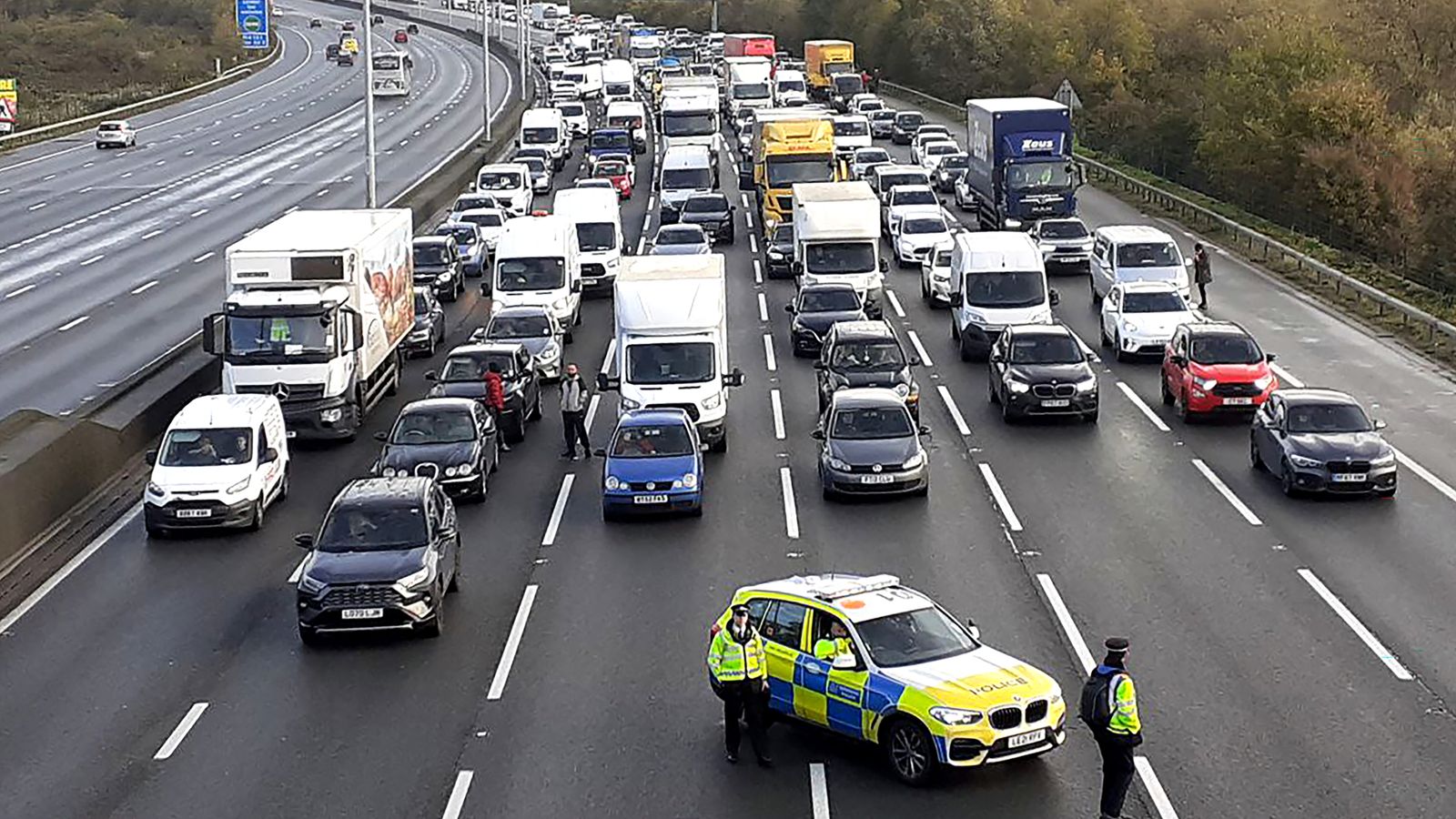
Delays on the M25 from a Just Stop Oil protest. Pic: Just Stop Oil/PA
Protesters now face up to two years in prison, but there has been international condemnation of the increasing severity of sentences for non-violent protest.
Five Just Stop Oil activists have just been jailed for up to two years after they climbed gantries over the M25 motorway and caused temporary gridlock.
For many of the 181,000 motorists the Highways Agency estimated were delayed in November 2022 by the coordinated four-day-long campaign of disruption, it may feel like justice served.
But there has been international condemnation of the increasing severity of sentences for non-violent protest.
“There can be no justification for the level of sentences that are being imposed,” says Raj Chada, a solicitor at Hodge Jones & Allen who represented one of the activists – a 77-year-old woman.
“These are sentences which have traditionally been reserved for violent offences. And in the UK, we’ve always said that no matter what the protest, even if it is disruptive, you get credit for it being non-violent,” said Mr Chada.
The latest sentences, of between two years and 20 months, follow those in July of jail terms between four and five years for Just Stop Oil campaigners who planned and recruited volunteers for the M25 protest.
“Today marks a very dark day for fundamental human rights in the UK,” wrote Michel Forst, the United Nations Special Rapporteur on Environmental Defenders, who attended their trial at Southwark Crown Court.
…
Lawyers representing some of the Just Stop Oil activists sentenced in both recent court cases said they would appeal the length of sentences.
The Court of Appeal has previously upheld judges decisions in protest cases, meaning the UK’s recent record on punishing environmental activists is likely to end up before the European Court of Human Rights.
When environmental defenders are tried in future they will be barred from giving evidence of climate impacts to the jury to explain their motives, writes Tim Crosland, director of climate justice charity Plan B Earth.
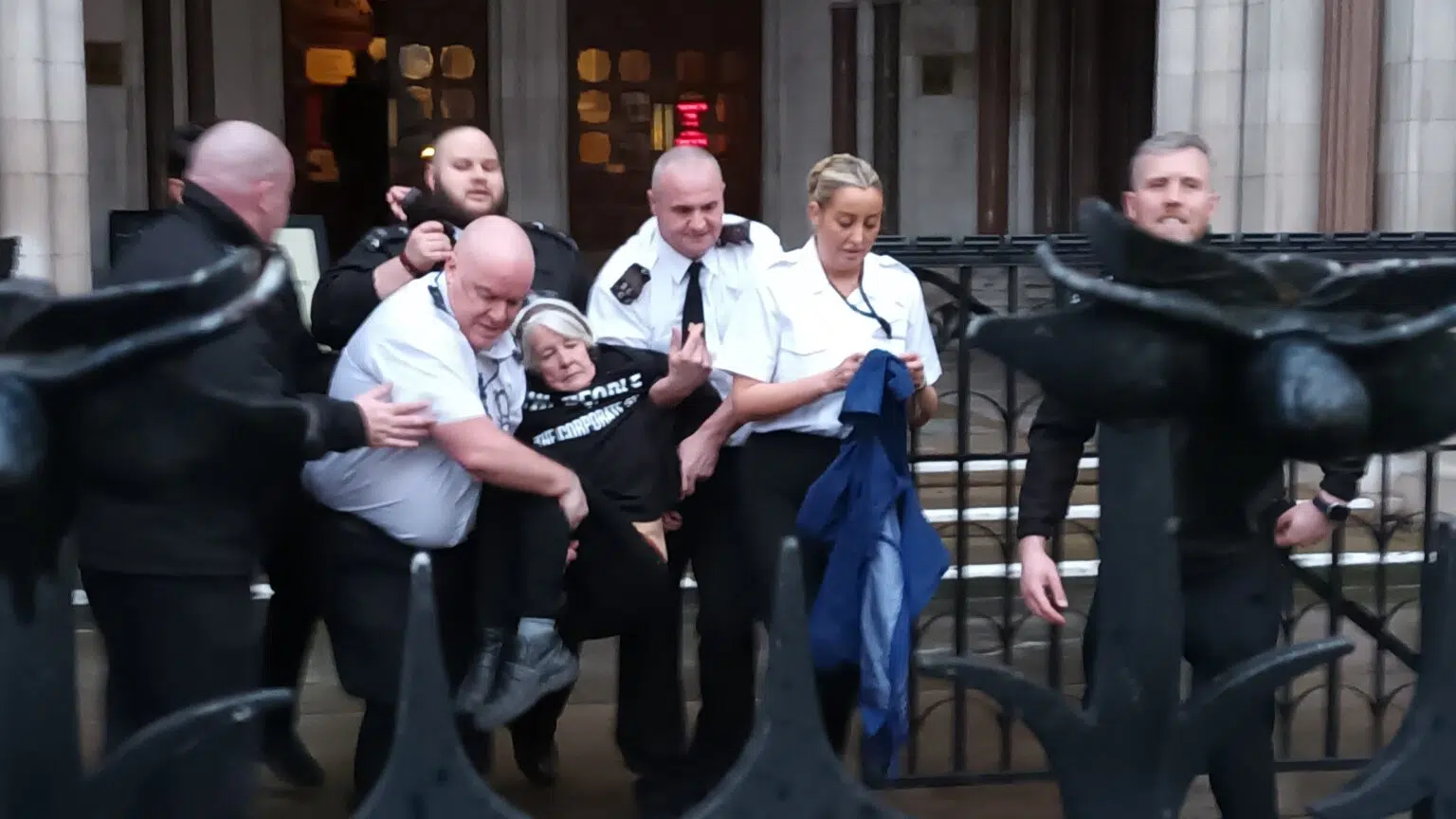
Environmental activist Trudi Warner is ejected from the Royal Courts of Justice on February 21. Credit: Defend Our Juries
The Court of Appeal this week delivered another blow to the rights of climate activists to defend themselves in court.
The case centred on a jury’s decision to acquit a group of activists last year after hearing evidence of the consequences of climate breakdown as part of the defence.
It was one of a number of “not guilty” verdicts in similar cases, which showed how seriously juries take such evidence – as long as they are allowed to hear it.
For the climate movement, It was a major boost to see that the public, in the form of juries, was on its side.
But on Monday, following an appeal by Attorney General Victoria Prentis, Lady Justice Carr delivered a ruling to the effect that the juries should not be allowed to hear that evidence in the future.
What this amounts to is that from now on, when environmental defenders are tried for criminal damage in the future, they will no longer be able to give climate impacts as evidence to explain their motives.
‘Show Trials’
This defence was one of the last available to activists in an increasingly hostile climate that has seen the UK, under Rishi Sunak’s administration, dish out some of the most punitive sentencing for peaceful protest in recent history.
The implications are grave. From now on, we will see jury trials turn into show trials, in which the defendants are banned from explaining to the jury their principled motivation for taking action.
Lady Justice Carr’s ruling was made even though the relevant legislation (the Criminal Damage Act of 1971) expressly provides for a jury to take into account the “circumstances” of environmentalists’ action.
The key question here is what counts as the “circumstances” of criminal damage, which is often the crime of which peaceful protestors stand accused. That might take the form of causing damage to property with graffiti, say by spray-painting #ShellKnows onto the oil company’s headquarters.
In this example, climate activists would argue they do this in order to hold those responsible for climate breakdown – and that the message serves to highlight the company’s decades-long knowledge and obfuscation of the impacts of fossil fuels on global heating.
The legal ‘logic’ of the new ruling is that “circumstances” refers to objective matters and therefore excludes a defendant’s beliefs. In the words of Lady Justice Carr, who read out the ruling of the court:
“The circumstances would not include the political or philosophical beliefs of the person causing the damage … Evidence from the defendant about the facts or effects of climate change would be inadmissible.”
The flaw in this logic is obvious. The climate crisis is not a matter of belief. It is a terrifying and objective reality. Not just according to scientists or the British parliament, but as evidenced by the well-documented destruction and mass loss of life that is already occurring across Europe and around the world.
Lady Justice Carr might try explaining that the climate crisis is all in their minds to the UK home-owners, whose properties are now uninsurable due to repeat flooding, or the mothers whose children’s bodies washed up on a Libyan shore after dams collapsed in the wake of heavy rains.
Sadly, this ruling, which is based on such obviously flawed reasoning, was widely predicted.
That’s because the ruling perpetuates an antagonism within the justice British system that has become impossible to ignore.
‘Embarrassment to the State’
On the one hand you have the juries, who represent our communities. They keep acquitting environmental defenders when they hear the full story.
And then you have some judges, paid by the state, who are taking increasingly bizarre measures to prevent the juries from giving not guilty verdicts (Judge Silas Reid has even banned the use of the words ‘climate change’ in court proceedings).
In February 2023, a jury acquitted campaigners who had splashed pink paint over Conservative and Labour Party HQs. In October, another acquitted a group who sprayed the Treasury with fake blood; and in November, yet another acquitted the HSBC 9, who broke windows to protest the bank’s £80 billion investments in fossil fuels since the Paris Agreement.
Such jury acquittals come as an embarrassment to the state. Since juries are composed of randomly selected members of the public, they expose a media-constructed fiction. The public doesn’t want the government to get tough on those taking measures against climate breakdown, they want it to take measures to stop climate breakdown.
As long as juries are allowed to hear evidence about a) the extreme danger of the climate crisis, b) the government’s systematic failure to follow the pathways that science dictates, and c) the efficacy of nonviolent direct action, it follows that those activists who are acting on the science are acquitted.
The British legal system, however, seems increasingly determined to prevent juries hearing the full facts. Judge Silas Reid has not only banned the words, he has sent people to prison simply for saying “climate change”.
At the end of February, almost as if he’d been tipped off on the Court of Appeal’s likely ruling, he used his office to cast doubt on the objective reality of the climate crisis:
“The circumstances of the damage do not include any climate crisis which may or may not exist in the world at the moment… Whether climate change is as dangerous as each of the defendants may clearly and honestly believe or is not, is irrelevant and does not form any part of the circumstances of the damage.”
But such oppressive rulings are backfiring. The public, as evidenced by jury acquittals, knows that the climate crisis is real and urgent. When courts suggest otherwise the legal system loses public support, undermining the social contract and the rule of law.
Last year hundreds of people demonstrated outside Crown Courts across England and Wales in solidarity with Trudi Warner, who was arrested for holding a sign outside court that explained the right of juries to acquit a defendant as a matter of conscience. Many actively invited the Attorney General to prosecute them for contempt of court.
In February, more than a hundred members of the public staged a ‘peaceful makeover’ of the Royal Courts of Justice, conducting a lawful assembly into the courts’ erosion of democratic freedoms, until they were forcefully ejected by court security.
For as long as judges believe they can rule away our collective desire to live and to protect those we love, the situation will only escalate.
Tim Crosland is a former government lawyer and director of the climate justice charity Plan B.Earth.
dizzy: The climate crisis is of course a matter of established fact. 2023 is the warmest year ever, climate records are getting broken monthly, they’ll be getting broken daily again in the summer. Capitalism has destroyed the climate and intends to destroy it more, fossil fool companies are pursuing more oil and gas extraction ignoring the established fact that it’s destroying the climate – so that rich cnuts get richer. Courts are supposedly independent, impartial and separate from the state instead of clearly part of it.
7.30am Equinox update: It’s a totally irrational denial of reality mirroring Rishi Sunak UK government’s own legislating that black is white, up is down, in is out. There’s a psychological term – reaction formation – that applies. The problem is that judges are meant to make wise, considered decisions and here they are instead behaving totally irrationally.
Image of InBedWithBigOil by Not Here To Be Liked + Hex Prints from Just Stop Oil’s You May Find Yourself… art auction. Featuring Rishi Sunak, Fossil Fuels and Rupert Murdoch.
CAMPAIGNERS have won permission to appeal against the building of Sizewell C nuclear power station in Suffolk because the government did not ensure there was a sufficient water supply to meet its demands.
The Court of Appeal overturned a refusal by the High Court to grant a judicial review into the decision by Kwasi Kwarteng, the then-business secretary, to give the station on the Suffolk coast the go-ahead.
The case was brought by the Together Against Sizewell C (Tasc) campaign group.
Tasc’s case included an argument that because of the power station’s need for huge quantities of water for its cooling system, the development should include a desalination plant to avoid endangering local domestic water supplies.
Court of Appeal judge Lord Justice Coulson said that given that Mr Kwarteng gave permission for the power station against the advice of the planning authority, and because of Tasc’s arguments about the need for a water supply, the appeal had “a real prospect of success.”