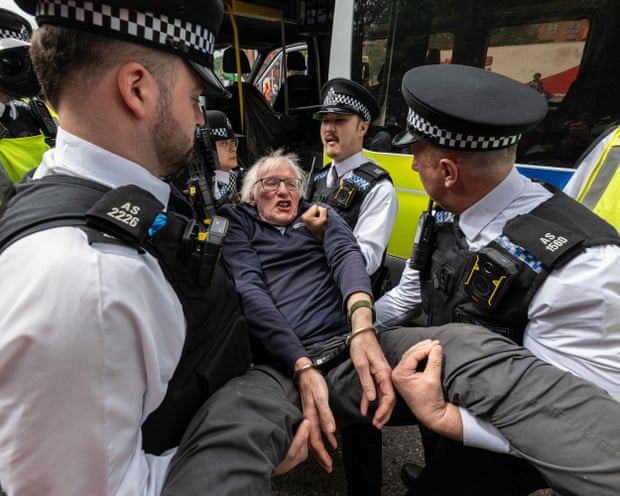
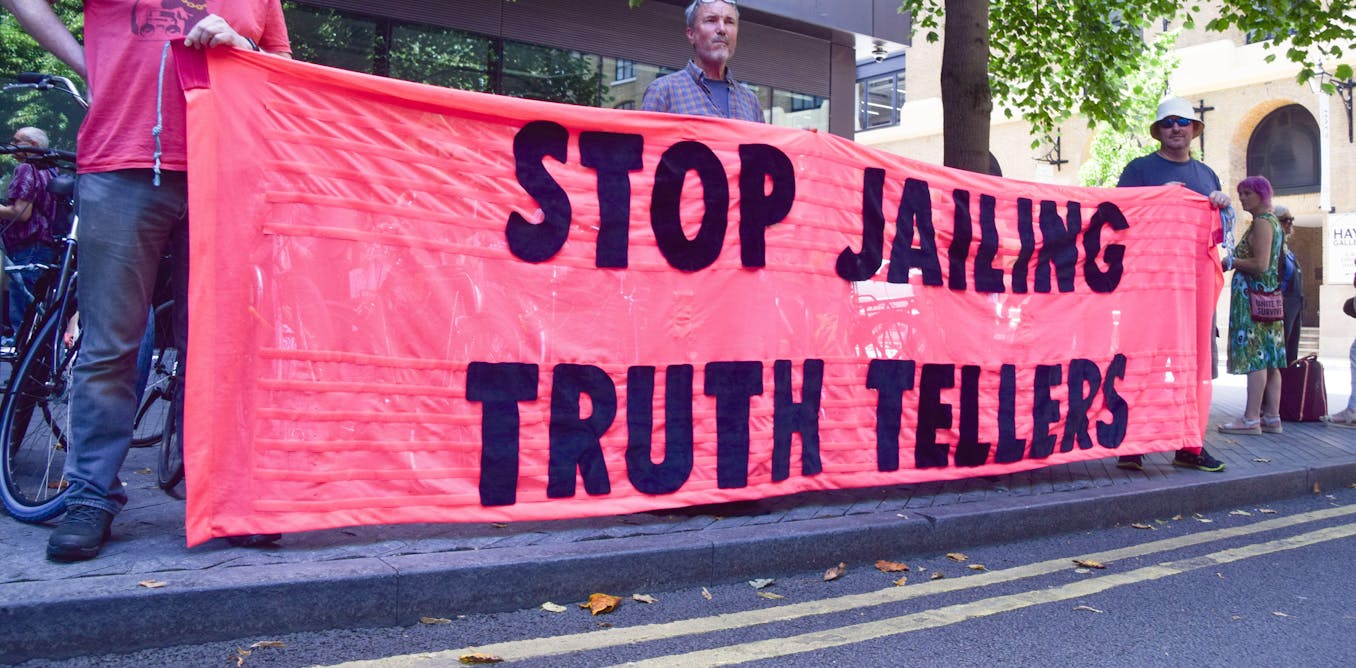
A man is arrested during a protest in support of Palestine Action. Photograph: Guy Smallman/Getty Images
Judges overturn decision of high court that government proscription of group under Terrorism Act was wrong
The high court was wrong to rule that the ban on Palestine Action under anti-terrorism laws was unlawful, the court of appeal has concluded.
A five-strong panel, including the two most senior judges in England and Wales, overturned February’s decision of the lower court that the proscription of the direct action group, the first to be banned under the Terrorism Act, was wrong.
The court of appeal’s decision will come as a relief to the government whose ban attracted widespread condemnation as well as a civil disobedience campaign defying proscription, during which more than 3,000 people have been arrested.
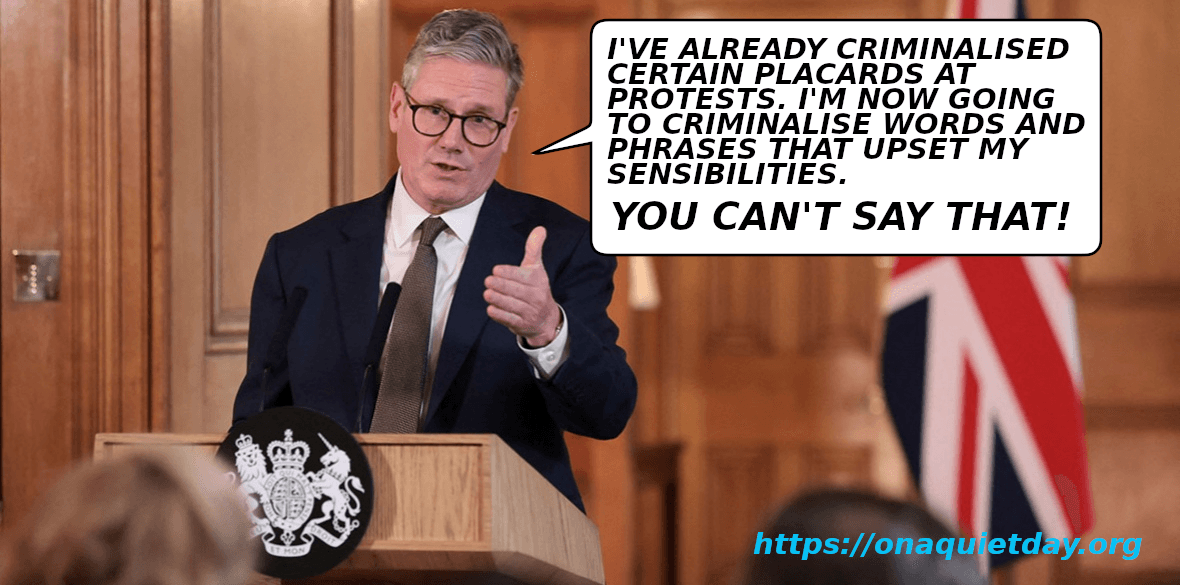
Keir Starmer objects to criticism of the IDF. He asks how could anyone object to them starving people to death, forced marches like the Nazis did, bombing Gaza’s hospitals and universities, mass-murdering journalists, healthworkers and starving people queuing for food, killing and raping prisoners and murdering children. He calls for people to stop obstructing his genocide for Israel.
A protest outside Woolwich Crown Court where the Palestine Action activists were tried (Photo: Alamy)
Rajiv Menon KC faced proceedings which his chambers said were unprecedented in English legal history
A leading human rights barrister has won his appeal against contempt of court proceedings, which were levelled at him for a closing speech in the trial of Palestine Action activists.
The court of appeal’s ruling on Tuesday in the case of Rajiv Menon KC comes as it has also emerged that four of the defendants found guilty in a retrial can be sentenced as terrorists.
Three court of appeal judges found that the trial judge, Mr Justice Johnson, “had no jurisdiction” to refer the case against Menon to the High Court.
…
Campaign group Defend Our Juries (DoJ) said: “Rajiv Menon KC did what every defence barrister should be free to do – in discharging his duty to his client: he told a jury the truth about their own rights.”
“The fact that contempt of court proceedings were even brought against a barrister for his closing speech – for the first time in British legal history – should deeply concern everyone who cares about the rule of law,” the group added.
Menon had been accused of violating Johnson’s orders in the first trial of six activists who broke into an Israeli-owned arms factory near Bristol in 2024 at the height of the Gaza genocide.
He barred the lawyers from inviting the jury to disregard the court’s ruling of law or to acquit the defendants on the basis of conscience, known as the principle of jury equity.
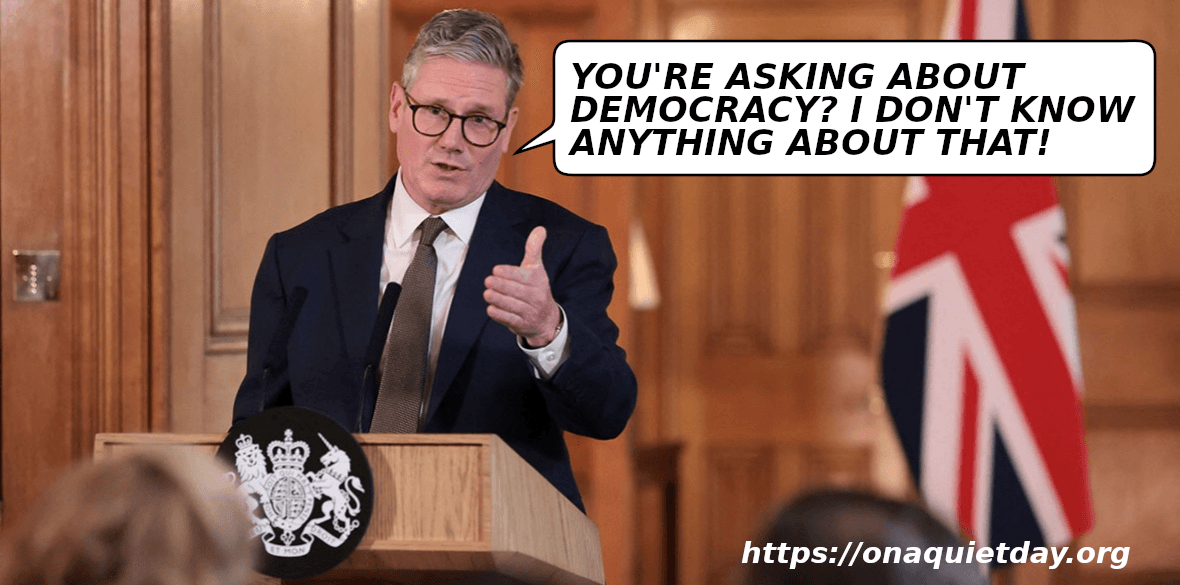
Keir Starmer says that he’s banning words and phrases now as well as placards.Palestine Action joke that appeared in the UK satirical magazine ‘Private Eye’.Keir Starmer confirms that he doesn’t know anything about democracy.
‘There was no medical evidence to support malfeasance’ … Lucy Letby. Composite: Guardian Design; Cheshire Constabulary/PA
When the former nurse was found guilty of murdering seven babies and attempting to murder seven others, a 1980s research paper was key to the prosecution’s case. But the author of the paper himself believes there has been a miscarriage of justice – and so too do other doctors
The convictions are unsafe and should be overturned as soon as possible
Dr Shoo Lee
On 4 February 2025, Lucy Letby’s barrister, Mark McDonald, convened a press conference at the grand baroque Westminster venue One Great George Street. It became a landmark moment, the culmination of months in which a number of distinguished experts had spoken out to question the former nurse’s convictions.
The media were addressed for an hour by a Canadian medical professor, Dr Shoo Lee. He said that a panel of international experts disputed the prosecution case that had led to Letby being found guilty in two trials of murdering seven babies at the Countess of Chester hospital in 2015 and 2016, and attempting to murder seven others. She was sentenced to 15 whole-life orders, and the court of appeal unanimously refused her permission to appeal.
“We did not find any murders,” Lee said. “In all cases, death or injury were due to natural causes or just bad medical care.”
Lee is one of the world’s leading neonatologists – doctors who specialise in the medical science and care of premature babies. Before his retirement from clinical practice in 2021, he held senior leadership positions in Canada, headed up international collaborations and conducted extensive research. His journey to becoming so involved in a criminal process pursued in the provinces of north-west England is a remarkable feature of the Letby case. It springs from Lee being told, after Letby was convicted, that a medical research paper he authored more than 30 years ago had been used as a basis for one of the prosecution’s central allegations – that Letby killed babies by injecting air into their veins.
Lee was dismayed, he told the Guardian, adding that the use of his paper was “incorrect” and a “categorical error”, and he was concerned Letby may have been wrongly convicted. He agreed to give evidence to the court of appeal but the judges dismissed it as “irrelevant” when they refused Letby’s application. He then committed to assembling a world-class panel who would fully assess the evidence. Lee’s eminence meant that the peers he could call on comprised leading specialists in Canada, the US, Japan and Europe, including two distinguished UK-based consultants, Dr Neena Modi, a pre-eminent neonatologist, and the renowned perinatal pathologist Dr Marta Cohen. Lee flew across the Atlantic at his own expense to present their findings at that bombshell press conference.
He explained the acute medical problems some of the premature babies had suffered, and said the panel found “no medical evidence to support malfeasance” or deliberate harm. But they had identified “so many problems” with the babies’ care, in a unit that had “inadequate numbers of appropriately trained” staff.
“If this had happened at a hospital in Canada,” Lee said bluntly, “it would have been shut down.”
Lengthy prison sentences have been imposed on five Just Stop Oil activists for coordinating direct action on the M25, the main ring road around London. For a non-violent protest, there is no equivalent in modern times.
The five years for Roger Hallam and four years for the remaining four: Daniel Shaw, Louise Lancaster, Cressida Gethin and Lucia Whittaker de Abreu, have been widely condemned as grossly disproportionate. According to one snap poll, 61% of the public consider the sentences too harsh.
But nobody should be surprised: these sentences are a logical outcome of Britain’s authoritarian turn against protest over the past five years.
Protest in England and Wales was previously dealt with by the courts according to what we call Hoffmann’s Bargain. This meant protesters should accept their guilt in court, but their conscientiousness – along with the wider importance of disruptive protest to democracy – would be rewarded with lenient sentences.
This changed with the prosecution of the Stansted 15, who were charged and found guilty of terrorist-related offences for stopping a deportation flight in 2017. The 15 were sentenced to community service, fines, and for some, short suspended prison sentences. On appeal, the Court of Appeal threw out the charges in 2021, but at the same time hardened the general approach of the courts to protest, confirming that a key defence (known as necessity) was not available to protest defendants in court.
Making it harder for activists to defend themselves
Since then, three things have happened. First, other potential defences that protesters could rely on, including lawful excuse, have been systematically restricted by the Court of Appeal.
Second, the Crown Prosecution Service (CPS) has sought where possible to bring more serious charges against protesters than used to be the case. In this they have been encouraged by new legislation brought in by the last government, notably the Police, Crime, Sentencing and Courts Act (2022) and the Public Order Act (2023).
Third, judges have typically sought to control and reduce the time that defendants have in court to explain their motives to the jury, because – without a defence in law – the defendants’ arguments are, in legal terms, not relevant.
We saw each of these dynamics in the Just Stop Oil “Conspiracy 5” trial. Before 2018, public nuisance itself was barely used for protest offences, but the CPS now regularly brings this charge against peaceful protesters. But the charge of a conspiracy to cause public nuisance, which these five defendants faced, is a further escalation as it treats protest movements as a criminal enterprise, and does not allow a lawful excuse defence. As a consequence, the stakes are higher and the outcomes more serious.
In court, the defendants were unable to argue that they had a lawful excuse for their action (Hallam repeatedly tried to argue this in court, and was repeatedly shut down by the trial judge). Finally, although the defendants did manage to explain their motives to the jury, the jury had no opportunity to find them not guilty in law. Although juries still have the power to find defendants not guilty by making a moral rather than a legal decision, this is much harder and rarer.
The result is that the first part of Hoffmann’s Bargain is being abandoned. With no recourse to a defence in law, protest defendants are now regularly being found guilty. But the second part of the bargain, leniency at sentencing, is increasingly being forgotten.
A new benchmark
In April 2023, Just Stop Oil activists Morgan Trowland and Marcus Decker were sentenced to three years and two years seven months in prison respectively after being convicted of public nuisance for disrupting the Dartford Crossing, a large bridge over the Thames to the east of London. Upheld by the Court of Appeal, these sentences have now become a benchmark.
In the Conspiracy 5 case, the trial judge explicitly cited this benchmark as the basis for the sentences he imposed, and any appeal against them will have to reckon with the Court of Appeal’s determination that they are fair.
This case brings into sharp focus two very contrasting visions of what a trial is, and what the criminal law is for. The courts are effectively treating protest trials as a legal flowchart, with a strict distinction between what is and what is not relevant on the shortest route to a verdict.
But defendants often see the courts as a place where they can make urgent arguments about moral values and social justice. Rather than a public nuisance, they consider their actions a public service. By not allowing defendants to account for their actions properly, the courts create an artificial separation between law and politics, and diminish the democratic agency of juries.
By imposing prison sentences on non-violent protesters, they impose authoritarian responses to pressing social problems.
Keir Starmer confirms that his government is cnutier than Suella Braverman on killing the right to protest.Orcas comment on killer apes destroying the planet by continuing to burn fossil fuels.
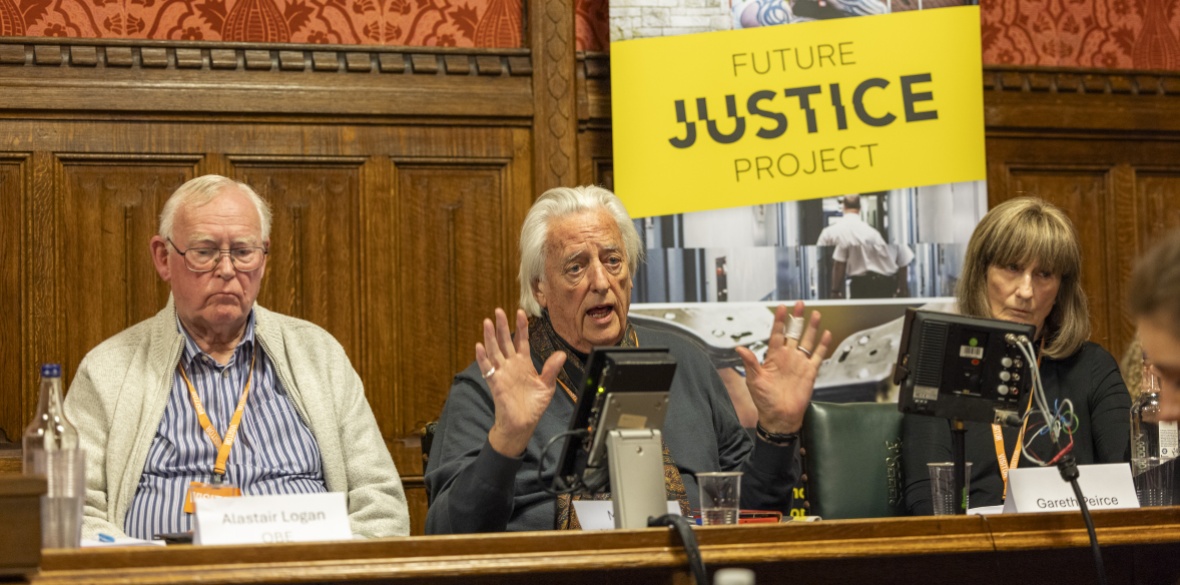
BRITAIN has returned to the “bad old days” of the Birmingham Six, with corrupt judges and police swapping Irish people for black and Muslim communities, top defence lawyers have said.
Fifty years on, the lessons from that monumental miscarriage of justice have “all been eroded” with senior judges back to pushing for guilty verdicts, an anniversary event in Parliament heard.
Renowned solicitor for the six men wrongly convicted of the 1974 terrorist pub bombing, Gareth Peirce, warned “frightening signals” by the Court of Appeal since their sensational 1991 acquittals have led to the “self-imposed censorship” of the Criminal Cases Review Commission (CCRC) watchdog.
She described how police and prosecutors have found “endlessly innovative” ways to subvert laws which were originally passed to prevent the state framing innocent people for terrorist attacks during the Troubles.
Ms Peirce said the “halcyon” days following the Court of Appeal’s quashing of those wrongful convictions, based on false confessions through police brutality, were over.
“The authorities can distort science in just the same way,” she told MPs, lawyers, victims and campaigners on Thursday.
…
“Individuals from communities that have different customs, different faiths, different ways of looking at things — it’s easy to distort those and present to a jury.”
She added: “The experience I and others have had are of ‘back to the bad old days’ of judges helping to push a guilty verdict in these kinds of cases.
“The Court of Appeal isn’t as it once was, in its mind to the possiblity of quashing convictions.