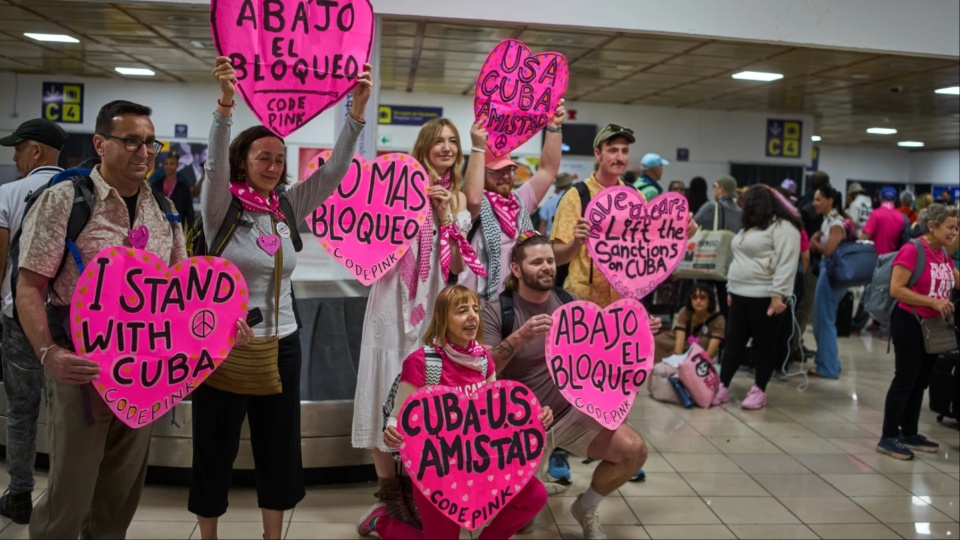
Morning Star Editorial: Defy Trump, resist imperialism and stand with socialist Cuba

Spread the love

https://morningstaronline.co.uk/article/defy-trump-resist-imperialism-and-stand-socialist-cuba

 Soldiers attend an event marking International Workers’ Day at Jose Marti Anti-Imperialist Square in Havana, Cuba, May 1, 2026

THE international peace conference in solidarity with socialist Cuba over the May Day weekend spoke important truths.

It linked the “multidimensional economic, financial, political, security and environmental crises” engulfing the planet — and noted that the “aggressive escalation of American imperialism” is intensifying them all.

It identified the United States as “the primary threat to global peace and security,” not so much a world policeman, as it has often thought of itself, but a global gangster that bullies, steals and destroys.

It connected US aggression against Cuba and Venezuela in the western hemisphere with its violence in the Middle East, and the genocide perpetrated by its ally Israel against the Palestinians.

And it brought together grassroots organisations, trade unions, peace campaigns and youth groups on an international basis to plan co-ordinated resistance.

No festival is so international as May Day, the workers’ day, with marches in Havana and Chicago, London and Rome, Baghdad and Beijing.

Rallies took up the message of defiance everywhere. Over 100 US unions took up the call “no work, no school, no shopping” for May Day, with specific marches like New York’s highlighting the connection between corporate power and state brutality under the slogan “Amazon delivers Ice.”

The Israeli police raided youth club premises to snatch Palestinian flags ahead of the demos, fearing any show of solidarity with the victims of their state’s relentless terror. In Cuba, electricity and energy workers took centre stage, as a whole nation saluted those trying to keep the lights on and the power flowing in the face of a brutal US siege.

So it was fitting that the International Meeting of Solidarity with Anti-Imperialism, dubbed 100 Years With Fidel, called on the world to stand with Cuba just as Cuba — exporter of medical care and education, valiant ally of the anti-apartheid struggle in South Africa, beacon of socialism on the doorstep of the world’s most aggressive capitalist power — has so often stood with the world.

It made important commitments. One, to keep promoting convoys to breach the blockade and deliver essential supplies to Cuba. This is practical solidarity, like that organised in Britain by the Cuba Solidarity Campaign through its Cuba Vive appeal.

Two, to build links between left media organisations to counter the labyrinth of lies built up by the news and opinion monopolies that dominate global communications.

Three, international mobilisation and protest. The ceasefire in Gaza — hugely inadequate and regularly violated as it is — was brought about by the global scale of protest for Palestine. Trump told Benjamin Netanyahu, “you can’t fight the world.” The US should be made to feel, through protests at embassies and pressure on governments, that to attack Cuba is to fight the world.

The US threat to Cuba is urgent — Donald Trump reiterated military threats on May Day itself. It is not something we can’t do anything about.

The US needs to know it will pay a heavy price for attacking Cuba, and that means pressure on our own government to grow a backbone. Britain votes against the illegal US blockade of Cuba every year — why can’t it stick up for its own sovereignty and protect British companies that trade with Cuba from extraterritorial US punishment, as China has just done for its companies sanctioned for trading with Iran?

As we saw in Havana, building ties across borders provides the surest defence against the world war Trump threatens, which our own rulers seem willing to join.

The international peace conference in London on June 20, following one in Paris and preceding one in Madrid, is key to confronting the militarists, averting war and charting a more rational future.

As they say in Cuba, another world is possible.

With the most reactionary racist, climate-denialist, violence-worshipping zealots taking US imperialism on a global rampage, winning that world is not just an existential question for Cubans, but for us all.

https://morningstaronline.co.uk/article/defy-trump-resist-imperialism-and-stand-socialist-cuba

Orcas discuss Donald Trump and the killer apes' concept of democracy. Front Orca warns that Trump is crashing his country's economy and that everything he does he does for the fantastically wealthy.
Orcas discuss Donald Trump and the killer apes’ concept of democracy. Front Orca warns that Trump is crashing his country’s economy and that everything he does he does for the fantastically wealthy.
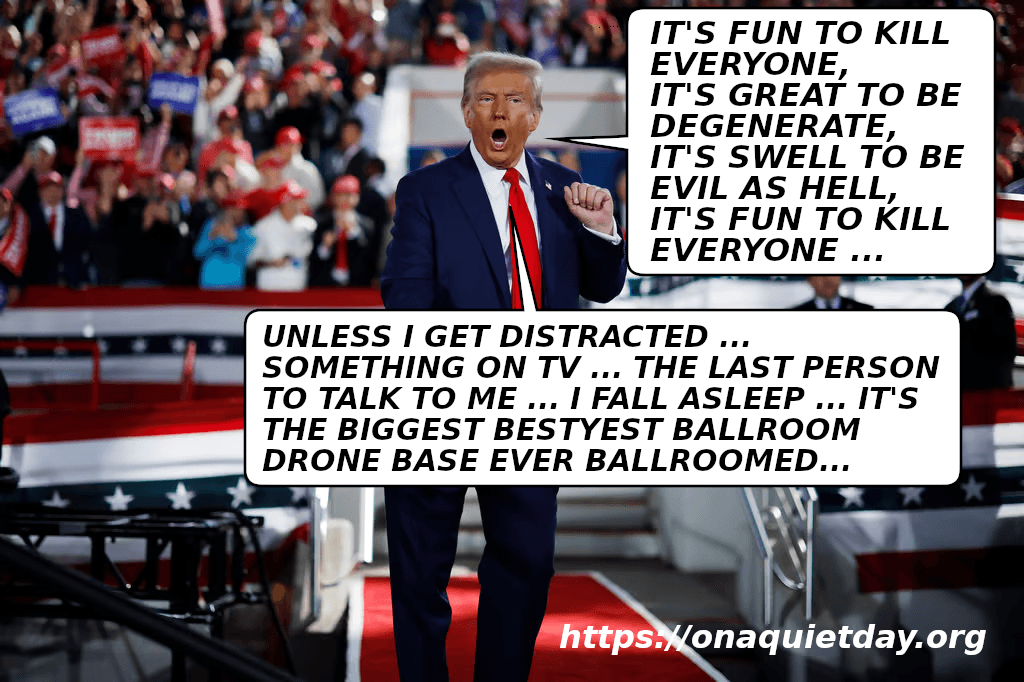
Donald Trump sings and dances, says that it's fun to kill everyone ...
Donald Trump sings and dances, says that it’s fun to kill everyone …
Climate science denier Donald Trump confirms that he knows nothing about democracy and that more liquid gold is being secured according to his policy of global privateering.
Continue ReadingMorning Star Editorial: Defy Trump, resist imperialism and stand with socialist Cuba

‘No Aggressor, No Matter How Powerful, Will Find Surrender in Cuba,’ President Warns Trump

Spread the love

Article by Jon Queally republished from Common Dreams under Creative Commons (CC BY-NC-ND 3.0).
Cuba’s President Miguel Diaz-Canel (C) takes part in the “Anti-Imperialist” protest in front of the US Embassy against the US incursion in Venezuela, where 32 Cuban soldiers lost their lives, in Havana on January 16, 2026. (Photo by Yamil Lage/ POOL / AFP via Getty Images)

After the US president again threatened invasion, Cuban President Miguel Díaz-Canel Bermúdez said he would only “find a people determined to defend sovereignty and independence in every inch of the national territory.”

President Miguel Díaz-Canel Bermúdez of Cuba on Saturday responded with stark and defiant words to the latest attacks coming from US President Donald Trump, who on Friday signed a new executive order authorizing even more aggressive sanctions against the island nation and later threatened to invade the country.

“The President of the United States escalates his threats of military aggression against Cuba to a dangerous and unprecedented scale,” said Díaz-Canel in a statement. “The international community must take note and, together with the people of the United States, determine whether such a drastic criminal act will be allowed to satisfy the interests of a small but wealthy and influential group, driven by desires for revenge and domination.”

RECOMMENDED…

People protest against Trump aggression against Cuba with signs reading "Stop the Blockade Against Cuba"

‘This Is Insane’: Alarm Bells Follow New Report of Looming US Plan to Attack Cuba

May Day celebrations mark annual workers parade in Havana

Citing Bogus ‘Threats’ to US, Trump Expands Already Devastating Sanctions on Cuba

“No aggressor, no matter how powerful, will find surrender in Cuba,” he added. If Trump were to attack the country, the Cuban president said, “he will find a people determined to defend sovereignty and independence in every inch of the national territory.”

“What does ‘No Kings’ mean when one man can snap his fingers and kill innocent Cubans on a whim?”

In addition “to blocking the US assets of foreign individuals and entities operating in Cuba’s energy, defense, financial services, metals, mining, and security sectors, as well as anyone acting on behalf of the Cuban government,” as Drop Site News notes, Friday’s executive order also “authorizes sanctions on foreign financial institutions that conduct significant transactions with designated Cuban entities, potentially cutting them off from US correspondent banking.”

As such, the outlet continued, the new sanctions “could further isolate Cuba from the international financial system, limit foreign investment, and exacerbate the island’s already severely restricted access to medicine, food imports, and basic goods.”

In addition to the signed executive order, Trump said during a Friday campaign-style event in Florida that the US “will be taking [Cuba] over almost immediately.”

Upon their return from Iran, where Trump has waged a deeply unpopular war, the US president told the crowd, “We’ll have maybe the USS Lincoln [aircraft carrier] come in offshore, and they’ll give up.”

In a floor speech earlier this week, Sen. Chris Van Hollen (D-Md.) rebuked the Trump administration for the humanitarian disaster it has unleashed in Cuba, which follows what he described as a “failed” policy towards the island country over decades.

“If we want to avoid war with Cuba,” said Van Hollen, “we must rein in this lawless president and learn from the failed, bipartisan policies that led us to this point.”

David Adler, the co-general coordinator of Progressive International, condemned the relative silence of US opponents to the Trump administration, who have not done, in his mind, nearly enough to challenge the blockade or condemn the administration’s repeated and ongoing threats to invade the island nation or overthrow its government.

“ Donald Trump has given [Secretary of State] Marco Rubio the green light to annihilate a peaceful nation and its people—and the ‘resistance’ is silent,” said Adler. “What does ‘No Kings’ mean when one man can snap his fingers and kill innocent Cubans on a whim?”

Article by Jon Queally republished from Common Dreams under Creative Commons (CC BY-NC-ND 3.0).

Orcas discuss how Trump was re-elected and him being an obviously insane, xenophobic Fascist.
Donald Trump explains why he established his Bored of Peace
Climate science denier Donald Trump confirms that he knows nothing about democracy and that more liquid gold is being secured according to his policy of global privateering.
Continue Reading‘No Aggressor, No Matter How Powerful, Will Find Surrender in Cuba,’ President Warns Trump

Citing Bogus ‘Threats’ to US, Trump Expands Already Devastating Sanctions on Cuba

Spread the love

Article by Brett Wilkins republished from Common Dreams under Creative Commons (CC BY-NC-ND 3.0).

Cubans hold a banner reading, “Knock Down the Blockade” during an International Workers’ Day rally near the US Embassy in Havana on May 1, 2026. (Photo by Magdalena Chodownik/Anadolu via Getty Images)

The president’s latest aggression toward Cuba comes amid his repeated threats to “take” the island.

Citing Cuba’s ties with its ally Iran, President Donald Trump on Friday signed an executive order expanding the already crippling US sanctions regime against Cuban officials, as the US administration has the island in its crosshairs after ousting Venezuela’s socialist leader.

Trump’s executive order cites highly dubious “national security threats posed by the communist Cuban regime,” including Havana’s alignment “with countries and malign actors hostile to the United States.”

RECOMMENDED…

People protest against Trump aggression against Cuba with signs reading "Stop the Blockade Against Cuba"

‘This Is Insane’: Alarm Bells Follow New Report of Looming US Plan to Attack Cuba

US Sen. John Fetterman in his hoodie in the Senate

Fetterman Helps GOP Senators Sink Democrat Effort to Block Trump War on Cuba

The directive “imposes new sanctions on entities, persons, or affiliates that support the Cuban regime’s security apparatus, are complicit in government corruption or serious human rights violations, or are agents, officials, or material supporters of the Cuban government,” without identifying any of the affected groups or individuals.

For 65 years, the US has imposed an economic embargo on Cuba that has adversely affected all sectors of the socialist island’s economy and severely limited Cubans’ access to basic necessities including food, fuel, healthcare, and medicines—with disastrous results. The Cuban government claims the blockade cost the country’s economy nearly $5 billion in just one 11-month period in 2022-23 alone. United Nations member states have perennially—and overwhelmingly—condemned the embargo.

The Trump administration also imposed a fuel blockade and reinstated Cuba on the US State Sponsors of Terrorism list, from which former President Joe Biden removed the country before leaving office in 2021. Cuba was initially added to the list during the Reagan administration amid a decadeslong campaign of US-backed Cuban exile terrorismfailed assassination attemptseconomic warfare, and covert operations large and small in a futile effort to overthrow the revolutionary government of longtime leader Fidel Castro.

Cuba says US-backed terrorism has killed or wounded more than 5,000 Cubans and cost its economy billions of dollars.

The Cuban government—which was celebrating International Workers’ Day on Friday—did not immediately respond to the expanded sanctions.

Experts warned that the new sanctions are worryingly broad, with Georgetown Law visiting scholar Peter Harrell writing on X that “basically any non-US person or company doing any business in/with Cuba could be sanctioned.”

Harrell noted that the edict “gives the Trump administration a fair amount of easy-to-deploy firepower to drive remaining international businesses out of Cuba.”

“The questions will be in implementation,” he added. “For example, will Trump sanction a Chinese firm installing renewable energy in Cuba?”

Trump’s edict comes months after the president ordered the invasion of Venezuela and abduction of socialist President Nicolás Maduro and amid the ongoing US-Israeli war on Iran, the 10th country bombed during the course of Trump’s two terms in office.

Trump last month declared that “we may stop by Cuba after we’re finished with this,” referring to war on Iran that’s left thousands of people dead or wounded, including hundreds of children. The president has also said that he believes he’ll “be having the honor of taking Cuba,” language echoing the 19th century US imperialists who conquered the island along with Puerto Rico, Guam, and the Philippines from Spain in another war waged on dubious pretense.

“Whether I free it, take it—I think I can do anything I want,” Trump said of the island and its 11 million inhabitants.

Article by Brett Wilkins republished from Common Dreams under Creative Commons (CC BY-NC-ND 3.0).
Orcas discuss how Trump was re-elected and him being an obviously insane, xenophobic Fascist.
Donald Fuhrump says that Amerikkka doesn't bother with crimes or charges anymore, not being 100% Amerikkkan and opposing his real estate intentions is enough.
Donald Fuhrump says that Amerikkka doesn’t bother with crimes or charges anymore, not being 100% Amerikkkan and opposing his real estate intentions is enough.
Donald Trump sings and dances, says that it's fun to kill everyone ...
Donald Trump sings and dances, says that it’s fun to kill everyone …

Continue ReadingCiting Bogus ‘Threats’ to US, Trump Expands Already Devastating Sanctions on Cuba

Cuba’s victory at Playa Girón and Castro’s legacy inspire renewed calls for global anti-imperialist solidarity

Spread the love

Article by Nicholas Mwangi republished from peoples dispatch under a Creative Commons Attribution-ShareAlike 4.0 (CC BY-SA) license.

US forces captured in the Bay of Pigs invasion. Photo: Wikimedia Commons

This month’s Anti-Fascist Friday in South Africa commemorated and reflected on the victory at the Bay of Pigs invasion, known in Cuba as Playa Girón, as well as the centenary of Fidel Castro. The event was addressed by Cuban diplomat Jesus Perz and veteran figure of South Africa’s liberation struggle Ronnie Kasrils.

On April 17, the Anti-Fascist Friday Forum in South Africa convened at the Forge in Johannesburg, marking two historic milestones: the centenary of Fidel Castro and the 65th anniversary of the victory at Playa Girón. The event was organized as a political intervention linking past revolutionary victories to the urgent tasks of confronting imperialism today. The event was addressed by Cuban diplomat Jesus Perz and veteran figure of the South African liberation struggle Ronnie Kasrils.

“Imperialism is not invincible” – Cuba’s defining moment

Opening the discussion, Jesus Perz delivered a detailed historical account of the events leading up to the invasion, emphasizing the political clarity and mass mobilization that defined Cuba’s response.

“On April 15, United States forces bombarded Cuban airfields to destroy our capacity to defend ourselves on air,” Perz explained. “But instead of weakening us, it prepared our people politically and militarily for what was coming.”

He described how, just a day later, a mass demonstration in Havana became a turning point.

“It was on April 16, during a massive gathering to honor those killed in the bombings, that Fidel Castro declared the socialist character of the Cuban Revolution,” Perz said. “He called on the people: ‘Let us march to the front, let us take up arms, and let us face the enemy with conviction.’”

The location holds symbolic importance. Playa Girón, he said, “Was an area where poor and humble Cubans lived, people for whom the revolution was made. The choice of that site by US imperialism shows clearly who they were targeting, the most oppressed.”

According to Perz, the battle that followed was fundamentally unequal, yet transformative.

“On one side, CIA-trained mercenaries. On the other, workers, peasants, women, Black Cubans, people who had never before held power,” he said. “And in less than 72 hours exactly, the invasion was defeated.”

Read more: Why the US wants to destroy Cuba

He stressed the broader significance of the victory:

“This was not only a military defeat of the United States. It was a defeat of imperialism by socialism. It showed the world that a small nation, organized and conscious, can defeat a superpower.”

Cuban diplomat in South Africa Jesus Perz and renowned South African anti-apartheid activist and veteran of the struggle Ronnie Kasrils. Photo: PAT

From military defeat to economic warfare

Perz explained that after its failure at Playa Girón, the United States shifted its strategy toward long-term destabilization.

“In 1960, US officials made it clear, if they could not defeat the revolution militarily, they would try to suffocate it economically,” he said. “The objective was to create hardship, lack of food, lack of medicine, so that the Cuban people would turn against their own government.”

He drew direct parallels to the present:

“What we are experiencing today is not new. The blockade, the pressure, the attempts to isolate Cuba, these are continuations of that same policy.”

Despite these pressures, Perz pointed out Cuba’s refusal to abandon its principles.

Read more: “This is our Moncada, our Bay of Pigs,” says young Cuban communist leader

“In the 1980s, we were told that if we stopped supporting African liberation struggles, the blockade could be lifted,” he said. “Our answer was clear; no. There is no possibility of abandoning our brothers and sisters in Africa.”

He situated this stance as important to Cuban identity:

“Internationalism is not optional for us. It is how we repay our debt to humanity. Our ancestors came from Africa, our strength, our resistance, our courage are rooted there. To abandon Africa would be to abandon ourselves.”

Kasrils: “The Cuban Revolution shaped our struggle”

Taking the floor, Ronnie Kasrils connected Cuba’s revolutionary experience to Africa’s liberation struggles, drawing from decades of personal involvement in the anti-apartheid movement.

Looking at the Cuban flag hanging on the wall, Kasrils remarked, “The Cuban flag stands for national independence, freedom, and anti-fascism.” “Its meaning has penetrated deeply into the consciousness of our struggle here in South Africa.”

He described how Cuba entered his political consciousness in the early 1960s.

“I had just joined the struggle as a young student after the Sharpeville massacre,” he recalled. “Within the movement, we began singing, ‘Go take the country the Castro way…’ That was the mood.”

Kasrils highlighted the decisive role Cuba played in Africa, particularly in Angola.

“When Angola was under threat from apartheid South Africa, from CIA-backed forces, it was Cuba that responded,” he said. “Not as invaders, but at the request of the Angolan people, to defend their sovereignty.”

He described the impact of this intervention:

“The Cuban presence changed the balance of forces. It was central to the defeat of apartheid’s regional aggression and contributed directly to our own liberation.”

Read more: Angola’s debt to Cuba is unfinished

Further he said; “[I] had the privilege of being in Cuba in a delegation led by Joe Slovo. We met Fidel Castro in the defense headquarters. He explained the battle of Cuito Cuanavale, how Cuban and Angolan forces dealt a decisive blow that led to Namibia’s independence and impacted South Africa’s freedom. Our freedom was driven by internal forces, but international solidarity was enormous.”

Humanity in struggle

A recurring theme in Kasrils’ remarks was the centrality of ordinary people in revolutionary struggle.

“Fidel said the revolution is of the humblest, by the humblest, and for the humblest,” he said. “When the humblest are armed with consciousness as well as weapons, real change becomes possible.”

He stressed that this principle remains relevant today.

“Revolutionary intellectuals are vital,” Kasrils noted, “but the link must always be with the humblest. They are the ones who stay with you to the end.”

National sovereignty and global struggle

Both speakers discussed the importance of sovereignty in contemporary struggles.

“The most important principle,” Kasrils argued, “is national sovereignty and independence. Without it, nothing else is possible.”

However, he warned against viewing struggles in isolation.

“The connection between Havana and Tehran, between Palestine and Africa, is not accidental,” he said. “These are all fronts in the same struggle against imperialism.”

Read more: Iran shows that sovereignty stems from military self-sufficiency and anti-colonialism, says Iranian professor

Perz echoed this sentiment:

“We are always open to dialogue with any country,” he said. “But it must be based on respect for our sovereignty, our independence, and our dignity as a people.”

With deepening crisis, widening inequalities, and intensifying imperialist interventions, the Anti-Fascist Friday gathering made clear that the anniversaries of Fidel Castro and the victory over the Bay of Pigs invasion are more than moments of remembrance, they are calls to action.

Article by Nicholas Mwangi republished from peoples dispatch under a Creative Commons Attribution-ShareAlike 4.0 (CC BY-SA) license.

Continue ReadingCuba’s victory at Playa Girón and Castro’s legacy inspire renewed calls for global anti-imperialist solidarity

Answering Trump’s war threats, Cuban workers plan mass May Day defense rallies

Spread the love

Article by Cameron Harrison republished from People’s World under creativecommons.org/licenses/by-nc-nd/3.0/us/

Defense of the homeland will be the central theme of May Day rallies in Cuba this year, in accordance with a call by the country’s main labor federation. | AP

HAVANA—As the Trump administration tightens its energy blockade on Cuba and threatens war and regime change, the Cuban labor movement—along with all of Cuban society—is gearing up for a mass mobilization on May 1. The Workers’ Central Union of Cuba (CTC) and its affiliates have issued a call for this year’s May Day, International Workers’ Day, to “defend the homeland.”

Their labor movement’s call comes at a moment of maximum pressure. On Jan. 29, the White House imposed a total oil blockade on Cuba, cutting off nearly all fuel supplies to the island of 11 million people. Countries that dare to send oil face extreme sanctions. Combined with the intensified economic, commercial, and financial blockade that has suffocated Cuba for more than 65 years, the new measures aim to starve the Revolution into submission.

Now, the U.S.’ economic war is also poised to possibly become a fighting war. On April 15, USA Today reported that the Pentagon is speeding up plans for a potential U.S. military operation against Cuba, awaiting a directive from President Donald Trump as to when they might strike. The threat comes amid recent statements by Trump that “Cuba is next” after Iran and that he will “take” the island.

Cuban workers are not backing down

“Faced with the growing threats from the U.S. government, reinforced by the executive order of Jan. 29, which added an energy blockade to the already intensified embargo that has been imposed on us for more than 65 years simply for wanting to build a dignified, sovereign, and independent nation, there is nothing more important and decisive today than to work together and grow as a country,” the CTC declared in their May Day call.

The labor federation urged workers to celebrate May Day in militant parades and events in every workplace, town, municipality, and province.

“It is a call to defend the country, from the fields, the factories, the classrooms, the scientific centers, thermoelectric plants, hospitals, culture, sports; from every battle trench.”

‘We have not collapsed’

Cuba is facing its worst energy crisis in decades. Before the energy blockade, the country consumed about 110,000 barrels of oil per day, with 40,000 produced domestically and the rest imported from partners like Venezuela, Mexico, and Russia. Since January, that supply has virtually dried up. Only one Russian tanker has reached Cuban ports in three months, covering barely a third of monthly fuel demand.

The result is devastating, with major cities at a standstill, industry paralyzed, food becoming scarce, and hospitals struggling. Power blackouts have now become routine. Yet the Cuban people, their government, and the Communist Party refuse to break.

President Miguel Díaz-Canel and former President Raúl Castro lead a march in Havana on Dec. 20, 2025. | Marcelino Vázquez / Cubadebate

In an extensive interview with NBC’s Kristen Welker, President Miguel Díaz-Canel rejected the narrative of collapse.

“What country in the world would be capable, as Cuba has done, of enduring 67 years of sustained aggression from the most powerful nation in the world, with more than 60 years of blockade, with the last six or seven years of an intensified blockade, and now with an energy blockade, and not collapse? We have not collapsed.”

Díaz-Canel pointed to Cuba’s universal healthcare, free education from primary school to university, advances in biotechnology, and a safe society free of drug trafficking and organized crime.

“They are trying to impose a narrative of collapse on us when, through an aggressive, genocidal policy of blockade, they are leading us to live through a complex situation.”

Prepared to defend the revolution

When asked if Cuba is actively preparing for a possible U.S. attack, Díaz-Canel was direct: “Yes, we are preparing for defense.”

He recalled the words of 19th-century independence hero Antonio Maceo: “He will only gather the dust of his blood-soaked soil if he does not perish in the struggle.” Díaz-Canel added, “If you go out on the street now and say the first part of that phrase to a child, an elderly person, a young Cuban, they will immediately complete it. That is how we have been raised.”

Díaz-Canel also dismissed any notion that removing him, which the Trump administration and particularly Secretary of State Marco Rubio demand, would break the revolution.

“We have a collective leadership characterized by unity, cohesion, ideological unity, and revolutionary discipline. Removing one person solves nothing. There are hundreds of people capable of assuming that responsibility.

“The United States cannot impose change on us, nor can they demand it. The U.S. government has no moral authority to demand anything from Cuba.”

The Trump administration’s objectives remain murky. While Rubio — himself the son of Cuban migrants — has signaled a desire for regime change, the White House may be pursuing a more “pragmatic” goal: forced economic “liberalization” that benefits U.S. monopolies and billionaires.

According to reports, Washington seeks access to Cuba’s energy, ports, tourism, and telecom sectors, along with larger private enterprise, banking opening, and dismantling of state-owned enterprises.

‘Hands off Cuba!’

International solidarity with Cuba, a principle of working-class internationalism, continues to grow. The World Federation of Trade Unions’ (WFTU) week of action in solidarity with Cuba just concluded, and the international labor federation will continue to organize and mobilize its affiliates and members to stand in solidarity with Cuban workers.

Countries such as Mexico, Russia, China, Vietnam, and Spain have also expressed support for Cuba. More than 100 activists, trade unionists, and even European Parliament members recently arrived in Havana with half-a-million euros in humanitarian aid.

The Communist Party USA has also weighed in, demanding an immediate end to the criminal blockade and Cuba’s removal from the “State Sponsors of Terrorism” list. In the party’s May Day call, it declared: “Hands off Cuba! No war on Iran! Cut the military budget! End the forever wars! U.S. imperialism must be defeated!

“The same monopolies that drive down our wages and bust our unions operate internationally,” the party said. “They consciously pit workers of different countries against each other, including in wars, to maximize profits. Our resistance must reflect international solidarity.”

May Day as resistance

For this May Day, the CTC is invoking the legacy of independence hero José Martí, revolutionary leader Fidel Castro in his centennial year, and Army General Raúl Castro.

“We invite Cuba’s friends around the world to join us, as they do every year, in celebrating International Workers’ Day,” the CTC said.

“We thank them in advance for their solidarity and for having the courage to share our fate amidst a real military threat, which, far from intimidating us, makes us repeat, with optimism and confidence in victory, the glorious verse of our national anthem: ‘To die for the Fatherland is to live.’”

Díaz-Canel echoed that: “If the time comes, there will be a fight, there will be a battle. We will defend ourselves, and if we must die, we will die.”

But he also held out hope for dialogue. “What both the American and Cuban people deserve is peace—a peace that allows us to have an atmosphere of trust, cooperation, collaboration, solidarity, and understanding. Lift the embargo, and see what we can do.”

As May Day approaches, Cuban workers are preparing to march—not in desperation, but in determination. The homeland, they insist, will be defended.

People’s World is in the midst of its annual fund drive, trying to raise $140,000 by May Day. To support working-class journalism, please consider make a donation or become a monthly sustainer. Thank you.

Article by Cameron Harrison republished from People’s World under creativecommons.org/licenses/by-nc-nd/3.0/us/

Donald Fuhrump says that Amerikkka doesn't bother with crimes or charges anymore, not being 100% Amerikkkan and opposing his real estate intentions is enough.
Donald Fuhrump says that Amerikkka doesn’t bother with crimes or charges anymore, not being 100% Amerikkkan and opposing his real estate intentions is enough.
Donald Trump sings and dances, says that it's fun to kill everyone ...
Donald Trump sings and dances, says that it’s fun to kill everyone …
Continue ReadingAnswering Trump’s war threats, Cuban workers plan mass May Day defense rallies