This work by Middle East Monitor is licensed under a Creative Commons Attribution-NonCommercial-ShareAlike 4.0 International License.
Palestinians attend the funeral of Nasrullah Mohammed Jamal Abu Siyam, who was killed after Israeli settlers opened fire during a raid on the town of Mukhmas, northeast of East Jerusalem, on February 19, 2026. [Issam Rimawi – Anadolu Agency]
The UN chief condemned the killing of a 19-year-old dual Palestinian-American citizen in the occupied West Bank, his spokesman said Friday, Anadolu reports.
Secretary-General Antonio Guterres called for “a prompt, thorough and transparent” investigation into the circumstances of the incident and for those responsible to be held to account, Stephane Dujarric told a news conference.
His remarks came a day after Nasrallah Abu Siyam was shot and beaten in an attack by Israeli settlers in the village of Mukhmas in the occupied West Bank.
“In the same attack, settlers shot and injured three other Palestinians. The secretary-general extends his heartfelt condolences to the family and loved ones of the victim,” he said.
Guterres urged Israel “to take concrete steps to halt and prevent all acts of violence by Israeli settlers against (the) Palestinian population” in line with its “obligations as the occupying power,” Dujarric added.
On Feb. 3-16, Dujarric said Israeli forces killed three Palestinians, bringing the total number in 2026 to nine, including two children.
“Overall, since January 2023, and as of 16 February, some 880 Palestinian families – that’s over 4,700 people – have been displaced across the West Bank due to settler attacks and access restrictions,” he added.
Israel has intensified operations in the West Bank, including East Jerusalem, since launching its military campaign in Gaza on Oct. 8, 2023. Palestinians view the escalation – including killings, arrests, displacement, and settlement expansion – as a step toward formal annexation of the territory.
In a landmark opinion in July 2024, the International Court of Justice declared Israel’s occupation of Palestinian territory illegal and called for the evacuation of all settlements in the West Bank and East Jerusalem.
This work by Middle East Monitor is licensed under a Creative Commons Attribution-NonCommercial-ShareAlike 4.0 International License.
Genocide denier and Current UK Prime Minister Keir Starmer is quoted that he supports Zionism without qualification. He also confirms that UK air force support has been essential in Israel’s mass-murdering genocide. Includes URLs https://www.declassifieduk.org/keir-starmers-100-spy-flights-over-gaza-in-support-of-israel/ and https://youtu.be/O74hZCKKdpAKeir Starmer objects to criticism of the IDF. He asks how could anyone object to them starving people to death, forced marches like the Nazis did, bombing Gaza’s hospitals and universities, mass-murdering journalists, healthworkers and starving people queuing for food, killing and raping prisoners and murdering children. He calls for people to stop obstructing his genocide for Israel.Orcas discuss Genocide-supporting and complicit Zionists. Donald Trump, Keith Starmer, David Lammy, Rachel Reeves, Angela Rayner and Wes Streeting are acknowledged as evil genocide-complicit and supporting cnuts.
This work by Middle East Monitor is licensed under a Creative Commons Attribution-NonCommercial-ShareAlike 4.0 International License.
Those injured and killed in the Israeli military’s airstrike on the Ain al-Hilweh Palestinian refugee camp are being taken to hospitals in Saida, southern Lebanon, on November 18, 2025. [Houssam Shbaro – Anadolu Agency]
Palestinian group Hamas on Friday rejected Israeli claims that a strike on the Ain al-Hilweh Palestinian refugee camp in southern Lebanon targeted one of its command centers, calling the attack a “crime against civilians” and a violation of Lebanese sovereignty, Anadolu reports.
In a statement, Hamas condemned the attack as a “brutal aggression” by the Israeli army against the camp in the city of Sidon, saying the strike resulted in deaths and injuries among civilians.
“Targeting a camp that houses thousands of Palestinian refugees and is densely populated constitutes a dangerous escalation and a blatant disregard for international laws and norms,” the statement said.
The movement denied Israeli allegations that the targeted site was a Hamas facility, calling them “baseless pretexts that do not stand up to facts.” It said the attacked building belonged to a joint security force responsible for maintaining order and stability inside the camp.
It held the Israeli government fully responsible for the consequences of the strike and called on the international community and Arab and Islamic countries to take urgent action to halt ongoing attacks and ensure protection for Palestinians “wherever they are present.”
Earlier, two people were killed and three others injured in an Israeli drone strike on the camp, according to the Palestinian Red Crescent in Ain al-Hilweh.
Lebanon’s official National News Agency reported that the strike hit the Hittin neighborhood inside the densely populated camp, causing material damage to the targeted building and surrounding structures.
The Israeli military claimed in a statement that it struck a Hamas command center in the Ain al-Hilweh area.
The Israeli army carried out a similar strike in November. 2025 in the same area where at least 13 people were killed and several others injured. Later, the army claimed that the attack targeted Hamas members inside the camp.
At the time, Hamas decried the attack as a “brutal assault” on civilians, saying the Israeli strike targeted a group of teenagers on an open sports field.
The latest attack came amid repeated Israeli violations of the ceasefire agreement reached in November 2024, killing and wounding hundreds of Lebanese. Israel continues to occupy five Lebanese hilltops seized during the latest war, in addition to other Lebanese areas it has held for decades.
This work by Middle East Monitor is licensed under a Creative Commons Attribution-NonCommercial-ShareAlike 4.0 International License.
Genocide denier and Current UK Prime Minister Keir Starmer is quoted that he supports Zionism without qualification. He also confirms that UK air force support has been essential in Israel’s mass-murdering genocide. Includes URLs https://www.declassifieduk.org/keir-starmers-100-spy-flights-over-gaza-in-support-of-israel/ and https://youtu.be/O74hZCKKdpAKeir Starmer objects to criticism of the IDF. He asks how could anyone object to them starving people to death, forced marches like the Nazis did, bombing Gaza’s hospitals and universities, mass-murdering journalists, healthworkers and starving people queuing for food, killing and raping prisoners and murdering children. He calls for people to stop obstructing his genocide for Israel.Orcas discuss Genocide-supporting and complicit Zionists. Donald Trump, Keith Starmer, David Lammy, Rachel Reeves, Angela Rayner and Wes Streeting are acknowledged as evil genocide-complicit and supporting cnuts.
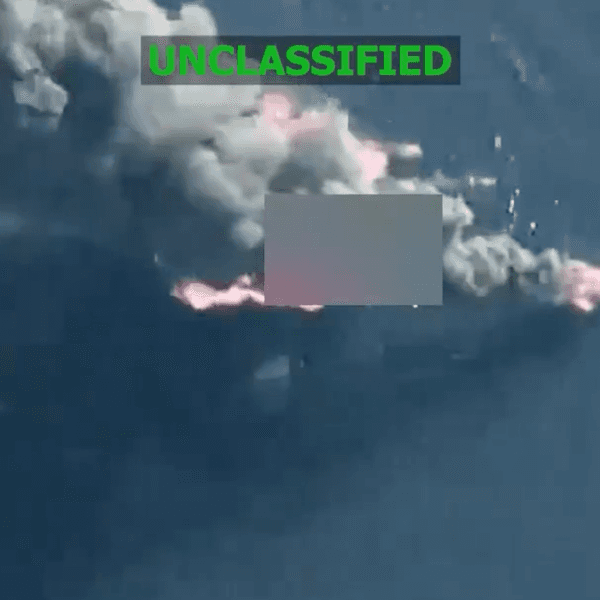
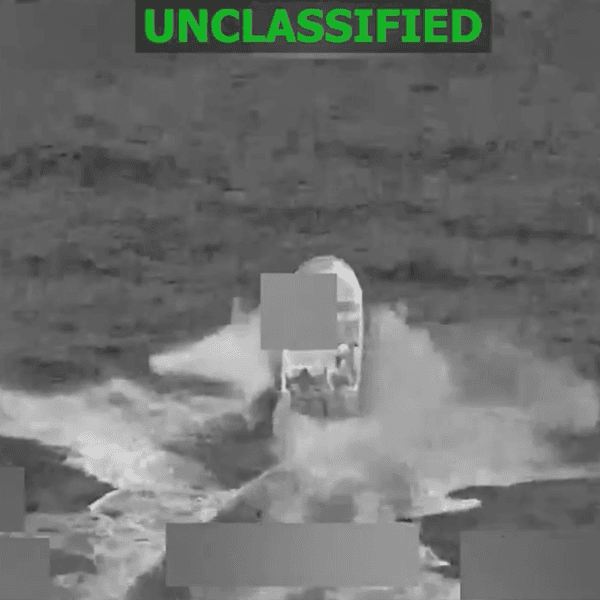
US Southern Command shared on social media a 16-second clip of a strike on a boat in the eastern Pacific that killed three people on February 20, 2026. (Photo: screen grab/SOUTHCOM/X)
“Demand Congress take action against these strikes now!” said Amnesty International USA.
President Donald Trump’s “summary executions continue,” Princeton University visiting professor Kenneth Roth said early Saturday after the US military announced its 43rd bombing of boaters whom the administration claimed were smuggling drugs.
Sharing a 16-second clip of the strike on social media, US Southern Command said late Friday that “Joint Task Force Southern Spear conducted a lethal kinetic strike on a vessel operated by designated terrorist organizations. Intelligence confirmed the vessel was transiting along known narco-trafficking routes in the eastern Pacific and was engaged in narco-trafficking operations. Three male narco-terrorists were killed during this action. No US military forces were harmed.”
Roth, the former longtime director of Human Rights Watch, noted that “the strike raised the death toll in Trump’s campaign against people accused of drug smuggling at sea to at least 147—each a murder.” Some tallies put the death toll at 148 or 149.
Since Trump started bombing boats in September, critics have condemned the strikes as “war crimes, murder, or both.” The administration has tried to justify the operation by arguing that it is in an “armed conflict” with drug cartels in Latin America, including Venezuela—whose president, Nicolás Maduro, was abducted by US forces last month and subsequently pleaded not guilty to narco-terrorism charges in a federal court in New York.
Various human rights advocates and legal experts, including Democrats and even some Republicans in Congress, have rejected that argument. However, both the GOP-controlled Senate and House of Representatives have declined to pass recent war powers resolutions intended to stop Trump’s boat bombings.
“Three more people have been killed. This is murder. Demand Congress take action against these strikes now!” Amnesty International USA said on social media Saturday, sharing a form constituents can use to contact their representatives.
Multiple journalists highlighted that in this case, and others, the targeted boat appeared to be stationary when the US bombed it.
This boat was not even moving. This killing is happening every week without any legal process or proof that the boats are in fact carrying drugs to the U.S. https://t.co/evSY1s39Gs
The Friday bombing came after the US Department of Defense announced that it had killed 11 people on three boats in the Caribbean Sea and the eastern Pacific late Monday.
“The US military has carried out strikes every three or four days since the new leader of the Southern Command, Gen. Francis L. Donovan of the Marine Corps, took over last month after the previous commander, Adm. Alvin Holsey, abruptly retired,” the New York Timesreported. “Defense Department and congressional officials said Adm. Holsey had expressed concerns about the strikes.”
Orcas discuss Donald Trump and the killer apes’ concept of democracy. Front Orca warns that Trump is crashing his country’s economy and that everything he does he does for the fantastically wealthy.Donald Fuhrump says that Amerikkka doesn’t bother with crimes or charges anymore, not being 100% Amerikkkan and opposing his real estate intentions is enough.Elon Musk urges you to be a Fascist like him, says that you can ignore facts and reality then.
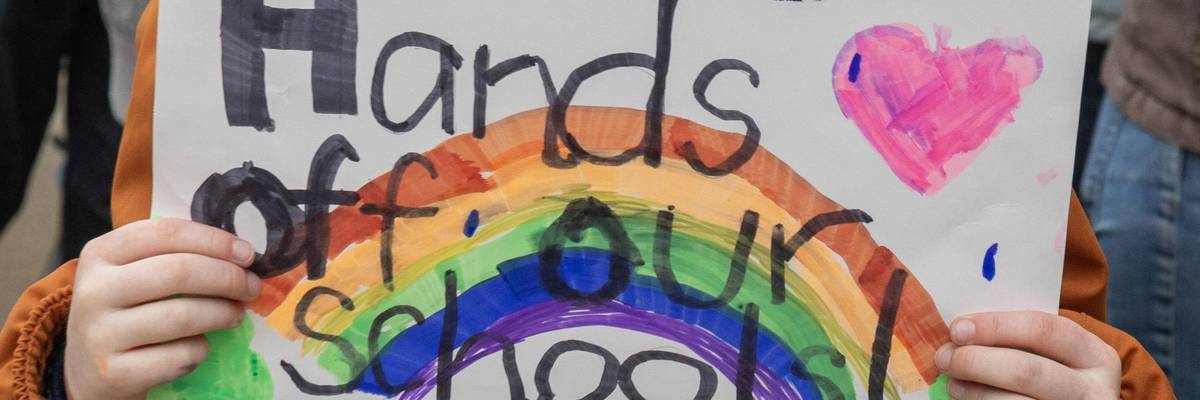
People participate in a “Hands Off” protest against the Trump administration in Detroit, Michigan, on April 5, 2025. (Photo by Jim West/UCG/Universal Images Group via Getty Images)
“We urge federal officials to focus on real threats to student well-being like gun violence, funding cuts, and staffing shortages rather than singling out districts that work to support all children,” said one advocacy leader.
Denouncing the Trump administration’s probes to determine whether three public school districts “have included sexual orientation and gender ideology” content in courses as “part of a broader attack on our rights as Michiganders,” the head of one progressive group pledged Friday to keep fighting to ensure that “all of our kids can thrive at school free from bullying, harassment, and other unfair treatment.”
The US Department of Justiceannounced Wednesday that its Civil Rights Division is investigating Detroit Public Schools Community District, Godfrey-Lee Public Schools, and the Lansing School District. The DOJ is examining content for pre-K through 12th grade courses, opt-out policies, and whether the districts “limit access to single-sex intimate spaces, such as bathrooms and locker rooms, based on biological sex.”
In a Friday statement, Justin Mendoza, executive director of Progress Michigan, emphasized that his state’s “civil rights laws explicitly protect LGBTQ+ students, and our state must enforce them to the fullest extent.”
Mendoza condemned not only the Trump administration’s efforts to harm “the most vulnerable and historically marginalized among us,” but also Republicans at the state and federal level who “are trying to limit honest conversations about our nation’s history, while fighting each and every attempt to create safe, inclusive schools for our children.”
“Attorney General Pam Bondi is setting a terrible example for younger generations—considering the way she behaved at a recent congressional hearing where she name-called members of Congress—and now she’s going a step further by throwing nondiscrimination policies into the dumpster,” he said. “People of all genders, races, and backgrounds benefit from strong nondiscrimination policies.”
“From Marquette to Monroe, teachers, students, and their families are committed to having an educational system that reflects the diversity of the world they live in,” Mendoza continued. “Classrooms deserve to have age-appropriate conversations about health, identity, and respect, and if parents choose to opt their children out of participating in these conversations, they are already allowed to by Michigan law.”
“The Trump Department of Justice is truly looking to invent problems instead of actually fighting crime and violence towards youth,” he concluded, “and Michiganders won’t take this intrusion into our education system.”
“The Trump Department of Justice is truly looking to invent problems instead of actually fighting crime and violence towards youth, and Michiganders won’t take this intrusion into our education system.”
Other state and nationwide groups have also spoken out against the administration’s probes and targeting of LGBTQ+ youth this week. Brian Dittmeier, director of LGBTQI+ equality at the National Women’s Law Center, blasted the investigations as a “blatant attempt to discourage inclusive education.”
Jay Kaplan, a staff attorney for the ACLU of Michigan, toldChalkbeat that “this is an attempt to harass and bully districts into discriminating against trans kids and into erasing the existence of LGBTQ people.”
Equality Michigan executive director Erin Knott said that “LGBTQ+ youth are among the most vulnerable young people in our state. They face higher rates of bullying, harassment, and mental health challenges. Inclusive education policies are not ‘ideology,’ they are evidence-based efforts to ensure that every student feels safe, respected, and seen in their own school community.”
“All kids deserve an education that reflects the diversity of the world they live in,” she stressed. “Age-appropriate discussions about health, identity, and respect help create safer classrooms for all students. We urge federal officials to focus on real threats to student well-being like gun violence, funding cuts, and staffing shortages rather than singling out districts that work to support all children.”
State Superintendent Glenn Maleyko was similarly critical of the federal administration in his response, saying Thursday that “the Michigan Department of Education strongly supports all students and supports the school districts that have been targeted by the US Department of Justice.”
Maleyko continued:
If we want to put Students First and make sure children can learn, we need all students to be healthy and safe and feel included. The much-needed updates to health education guidelines—which the Department of Justice falsely said are state requirements—help local districts make decisions on how they can support student health.
As required by state law, MCL 380.1507, local school boards set health curriculum with input from local sex education advisory boards. Local control remains in place. Parents retain the right to decide whether their children should participate in sex education instruction.
The Michigan Department of Education strongly supports and will work closely with the three districts’ efforts to select a curriculum that best supports the needs of their students, consistent with state standards and guidelines. We remain committed to protecting the rights of all students and to upholding Michigan’s constitutional guarantee of access to a free public education for every child.
“The breadth and scope of the federal requests, premised on a mischaracterization of the Michigan Health Education Standards Guidelines adopted by the State Board of Education, place a significant administrative burden on local districts and risk diverting time and resources away from the core mission of educating students,” Maleyko added.
As for the targeted districts, a spokesperson for the Detroit schools declined to comment, while Guillermo Lopez, the Lansing school board president, told the Detroit Free Press that parents in his district are informed that “they can opt out of certain classes.”
Arnetta Thompson, superintendent of Godfrey-Lee schools, told Chalkbeat that her district will provide information requested by the DOJ and “is not facing any charges or findings of wrongdoing. We remain committed to complying with all applicable federal, state, and local laws and have consistently operated in accordance with those laws.”
Donald Trump decrees forbidden terms denying sexual diversityElon Musk urges you to be a Fascist like him, says that you can ignore facts and reality then.Orcas discuss Donald Trump and the killer apes’ concept of democracy. Front Orca warns that Trump is crashing his country’s economy and that everything he does he does for the fantastically wealthy.
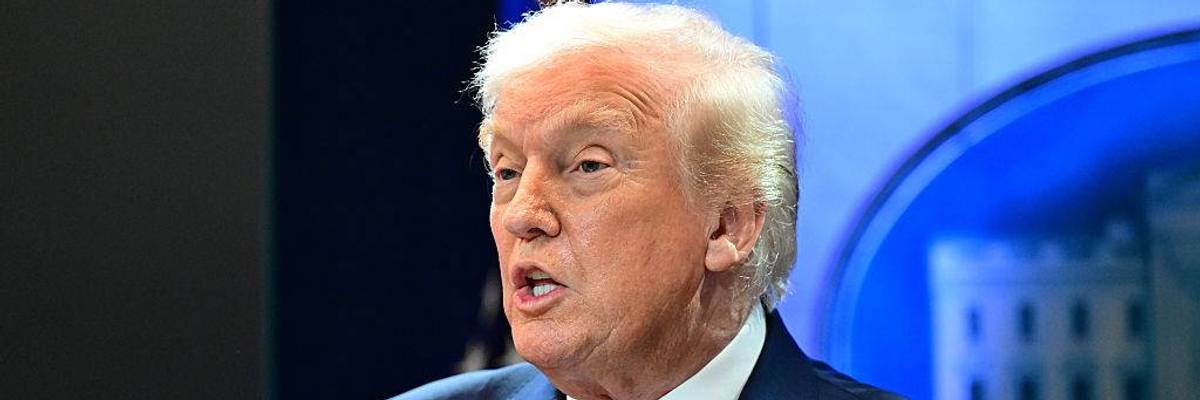
US President Donald Trump speaks during a press conference at the White House, Washington, D.C., US on February 20, 2026. (Photo by Kyle Mazza/Anadolu via Getty Images)
“Donald Trump illegally stole your money,” said Sen. Elizabeth Warren. “He should give it back to you.”
President Donald Trump defiantly vowed to continue slapping tariffs on imported goods on Friday after the US Supreme Courtoverturned the so-called “Liberation Day” tariffs he implemented last year.
In a press conference held hours after the Supreme Court ruled against the president’s tariff regime, Trump said that he had other tools at his disposal that allowed him to hit foreign products with taxes.
Among other things, Trump said he was going to issue a 10% global tariff using his authority under Section 122 of the Trade Act of 1974 that allows the president to levy tariffs to address “large and serious” balance-of-payments deficits with foreign nations.
However, as a Friday analysis by the libertarian Cato Institute explains, any tariffs enacted through Section 122 expire after 150 days without authorization from Congress, which in theory could put vulnerable congressional Republicans on the spot to vote for or against the president’s signature policy this summer right before the 2026 midterm elections.
The president’s decision to plow ahead with his politically unpopular tariffs drew immediate criticism from Sen. Amy Klobuchar (D-Minn.), who said during an interview with MS NOW that Trump was creating even more economic uncertainty.
“What he’s done is just doubled down and tried to make it worse,” Klobuchar explained, “which, of course, is going to create more cost and chaos for the American people.”
Klobuchar: "The scariest part from his press conference, in addition to the continued assault on the rule of law and the Constitution, is that he plans to continue doing this … [but] I think you're starting to see bipartisan opposition to the president's tariffs, which would… pic.twitter.com/pqniYagtyW
Nobel Prize-winning economist Paul Krugman also predicted more chaos in the months to come from Trump’s trade policies, particularly when it comes to businesses that will now lobby to get back the money illegally seized from them by the president’s unconstitutional tariff regime.
Writing on his Substack, Krugman argued that Trump finding alternative means to levy tariffs would not “obviate the need to refund the tariffs already collected,” because “if you seized money without constitutional authority, finding other revenue sources going forward doesn’t make the original seizure legal.”
David Frum, staff writer at The Atlantic, predicted that the coming lawsuits aimed at getting refunds for the illegal tariffs would be a massive mess.
“The post-tariff litigation is going to be nightmarish,” he wrote on social media. “Wrongfully taxed plaintiffs will now sue for return of their illegally taken money. Can their customers then sue for a portion of the higher prices caused by the wrongful taxes? More Trump chaos.”
However, US Treasury Secretary Scott Bessent downplayed the possibility of American businesses and consumers getting refunded for the tariffs.
While speaking at the Economic Club of Dallas on Friday, Bessent was asked if he expected a “food fight” for the $175 billion in tariff revenues that government has illegally collected since April.
“I’ve got a feeling the American people won’t see it,” Bessent said of the tariff money.
Bessent: I got a feeling the American people won't see the $175 billion in tariff revenue we collected pic.twitter.com/rj0Bmm0Exg
However, some Democrats indicated that they were not simply going to let the administration getting away with money they unlawfully confiscated from US businesses and consumers.
“Donald Trump illegally stole your money,” wrote Sen. Elizabeth Warren (D-Mass.). “He should give it back to you. Instead Trump is scheming up new ways to force Americans to pay even more.”
Democrats on the US House Ways and Means Committee wrote that “Trump does not want to refund the money he illegally stole from you,” vowing the party “won’t stop fighting to get your money back.”
Democratic Illinois Gov. JB Pritzker wrote Trump a letter after the Supreme Court ruling demanding that the president provide every family in his state a $1,700 refund for the tariffs, which he said “wreaked havoc on farmers, enraged our allies, and sent grocery prices through the roof.”
Donald Fuhrump says that Amerikkka doesn’t bother with crimes or charges anymore, not being 100% Amerikkkan and opposing his real estate intentions is enough.Elon Musk urges you to be a Fascist like him, says that you can ignore facts and reality then.Orcas discuss rotting brain. Front Orca says “Wish someone would lock him up”.