Donald Fuhrump says that Amerikkka doesn’t bother with crimes or charges anymore, not being 100% Amerikkkan and opposing his real estate intentions is enough.
There are many facets or aspects to Fascism: racist ideology; disregard and disdain for justice, human rights and the rule of law; what ‘Il Duce’ Benito Mussolini termed corporatism, “Fascism should more appropriately be called Corporatism because it is a merger of state and corporate power.”
Xenophobe President Donald Trump often demonstrates racism and a disdain for due process, democracy, human rights and the law .
Deporting Venezuelans to San Salvador’s CECOT prison.
Deploying National Guard and ICE in US cities. “Everyday is Halloween.”
Murdering fishermen
Project 2025 pursues a huge corparist agenda, hugely extending deregulation for the benefit of unaccountable corporations. Trump pursued huge corporate support for his reelection particularly from the fossil fuel industry. Now he’s intending to invade Venezuela for “all that oil.”
Demented assole Donald Trump urges you to be a Climate Science denier like him. He says that he makes millions and millions for destroying the planet, Burn, Baby, Burn, Flood, Baby, Flood.
When discussing Trump it is worth considering whether his obvious prejudices and limited abilities are further affected by senility. I suggest that senior officers of the wider US administration have due regard for other demands and obligations on them.
Orcas discuss how Trump was re-elected and him being an obviously insane, xenophobic Fascist.
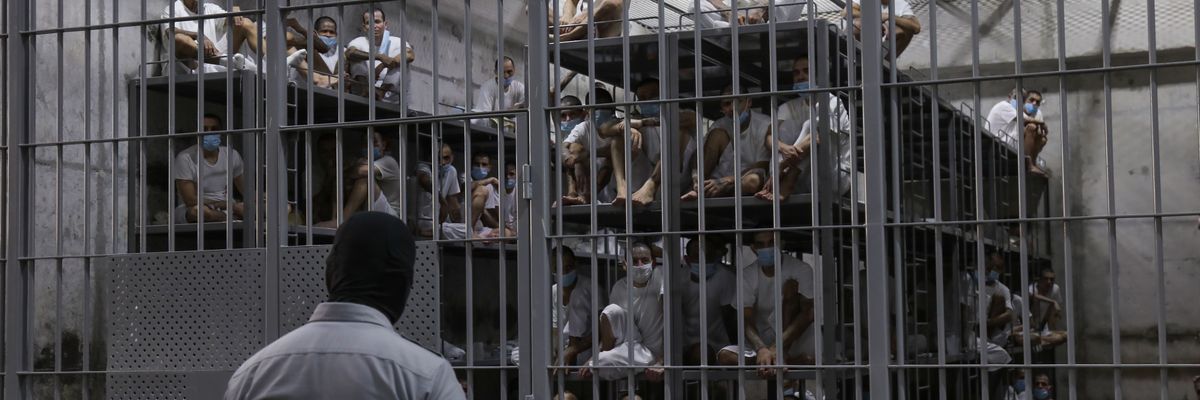
A guard stands outside a cell of prisoners at the Terrorism Confinement Center (CECOT) in Tecoluca, in San Vicente, El Salvador on April 4, 2025. (Photo by Alex Pena/Anadolu via Getty Images)
“The US government has not been linked to acts of systematic torture on this scale since Abu Ghraib.”
“You have arrived in hell.”
That’s what the director of El Salvador’s Terrorism Confinement Center (CECOT) told 26-year-old Gonzalo Y., one of the 252 Venezuelans deported by US President Donald Trump to the infamous prison in March and April, according to a report released Wednesday.
The report was compiled by US-based Human Rights Watch (HRW) and Cristosal, a regional group that fledEl Salvador in July, citing harassment and legal threats from President Nayib Bukele’s government. They used the CECOT director’s comment to Gonzalo as a title.
“When we arrived at the entrance of CECOT, guards made us kneel so they could shave our heads… One of the officers hit me on the legs with a baton, and I fell to the ground on my knees,” Gonzalo said. “The guards beat me many times, in the hallways of the prison module and in the punishment cell… They beat us almost every day.”
NEW: The Venezuelan nationals the US government sent to El Salvador in March and April were tortured and subjected to other abuses, including sexual violence.In a new report, HRW and @cristosal.bsky.social provide a comprehensive account of the treatment of these people in El Salvador.
Gonzalo is among 40 detainees interviewed for the report. The groups also spoke with 150 individuals with credible knowledge of the conditions, such as lawyers and relatives; consulted international forensic experts; and reviewed “a wide range” of materials, including criminal records, judicial documents in El Salvador and the United States, and photographs of injuries.
While the US and Salvadoran governments claimed that most of the migrants sent to CECOT were part of the Venezuelan gang Tren de Aragua, HRW and Cristosal found that “many of them had not been convicted of any crimes by federal or state authorities in the United States, nor in Venezuela or other Latin America countries where they had lived.”
Up until they were sent to Venezuela as part of a prisoner exchange on July 18, the report states, “the people held in CECOT were subjected to inhumane prison conditions, including prolonged incommunicado detention, inadequate food, denial of basic hygiene and sanitation, limited access to healthcare and medicine, and lack of recreational or educational activities, in violation of several provisions of the United Nations Standard Minimum Rules for the Treatment of Prisoners, also known as the ‘Mandela Rules.’”
“We also documented that detainees were subjected to constant beatings and other forms of ill-treatment, including some cases of sexual violence,” the publication continues. “Many of these abuses constitute torture under international human rights law.”
According to the 81-page report:
Daniel B., for instance, described how officers beat him after he spoke with [ International Committee of the Red Cross] staff members during their visit to CECOT in May. He said guards took him to “the Island,” where they beat him with a baton. He said a blow made his nose bleed. “They kept hitting me, in the stomach, and when I tried to breathe, I started to choke on the blood. My cellmates shouted for help, saying they were killing us, but the officers said they just wanted to make us suffer,” he said.
Three people held in CECOT told Human Rights Watch and Cristosal that they were subjected to sexual violence. One of them said that guards took him to “the Island,” where they beat him. He said four guards sexually abused him and forced him to perform oral sex on one of them. “They played with their batons on my body.” People held in CECOT said sexual abuse affected more people, but victims were unlikely to speak about what they had suffered due to stigma.
In a Wednesday statement, Cristosal executive director Noah Bullock drew a comparison to the early stages of the George W. Bush administration’s invasion of Iraq.
“The US government has not been linked to acts of systematic torture on this scale since Abu Ghraib and the network of clandestine prisons during the War on Terror,” he said. “Disappearing people into the hands of a government that tortures them runs against the very principles that historically made the United States a nation of laws.”
Although many migrants have been freed from El Salvador’s CECOT, “they continue to suffer lasting physical injuries and psychological trauma,” the report notes. They also face risks in Venezuela, which “suffers a humanitarian crisis and systematic human rights violations carried out by the administration of Nicolás Maduro.”
“Their repatriation to Venezuela violates the principle of nonrefoulement,” the document explains. “Additionally, in some cases, members of the Venezuelan intelligence services have appeared at the homes of people who were held in CECOT and forced them to record videos regarding their treatment in the United States.”
The CECOT renditions were crimes under both domestic and international law. and some people remain disappeared. www.hrw.org/report/2025/…
The report notably comes as Trump has spent recent months blowing up small boats from Venezuela under the guise of combating drug trafficking—which experts across the globe have condemned as blatantly illegal—and as the White Housestokes fears of strikes within the country aimed at forcing regime change.
Stressing that “officials cannot summarily kill people they accuse of smuggling drugs,” HRW Washington director Sarah Yager has called on the US military to “immediately halt any plans for future unlawful strikes” on boats in the Caribbean and Congress to “open a prompt and transparent investigation.”
With the release of the new report, HRW and Cristosal also issued fresh demands, including an end to the United States’ transfer of third-country nationals to El Salvador and for other nations and international bodies, including the United Nations Human Rights Council, to increase scrutiny of the Trump and Bukele governments’ human rights violations.
“The Trump administration paid El Salvador millions of dollars to arbitrarily detain Venezuelans who were then abused by Salvadoran security forces on a near-daily basis,” said HRW Americas director Juanita Goebertus. “The Trump administration is complicit in torture, enforced disappearance, and other grave violations, and should stop sending people to El Salvador or any other country where they face a risk of torture.”
Donald Fuhrump says that Amerikkka doesn’t bother with crimes or charges anymore, not being 100% Amerikkkan and opposing his real estate intentions is enough.
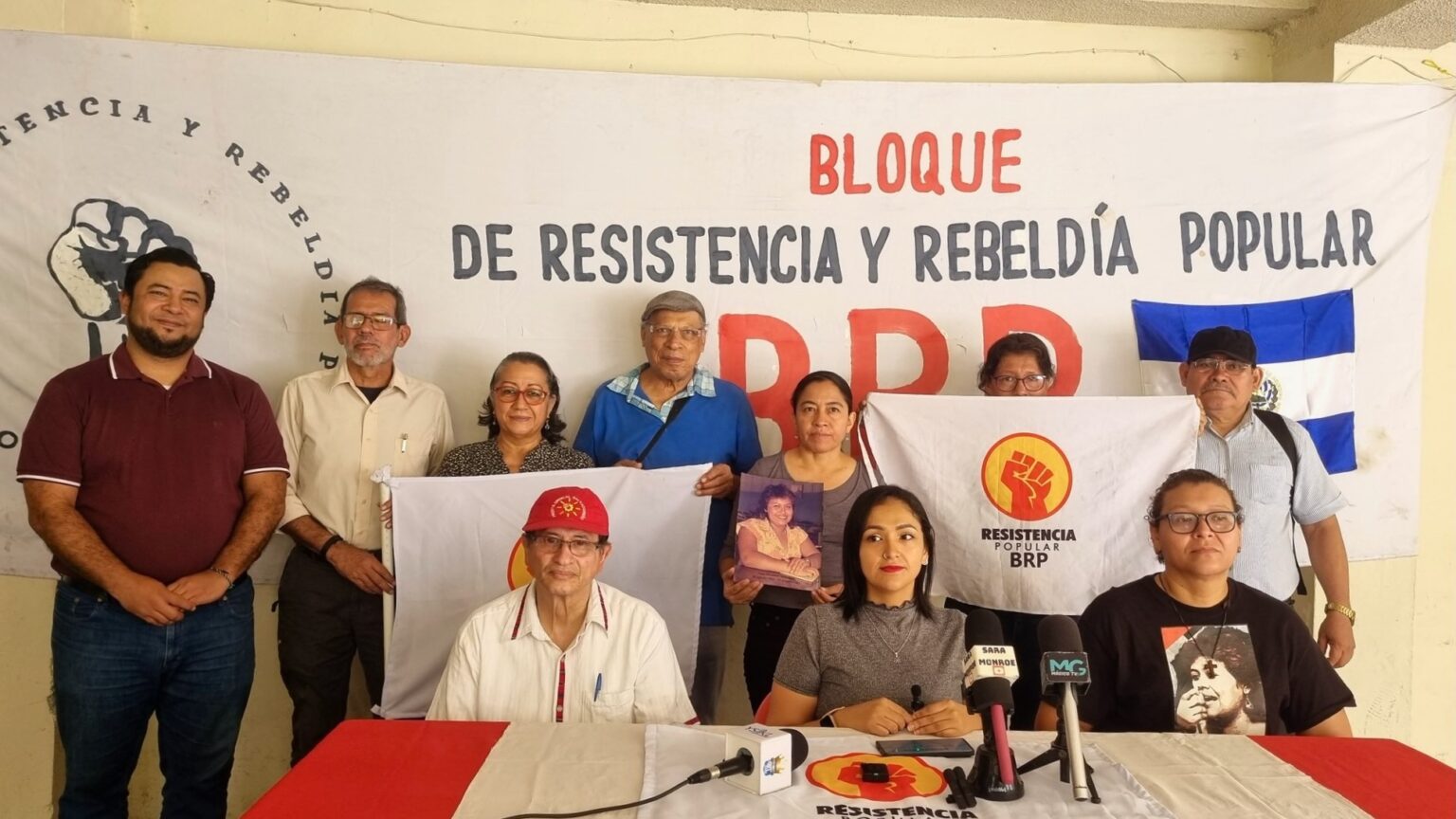
Organizers hold flags and a photo of labor martyr Febe Elizabeth Velasquéz during a press conference on the commemoration of the Day of the Salvadoran Trade Unionist. Photo: BRRP/X
The October 31 commemoration links past revolutionary struggles with today’s fight for labor rights and democracy
October 31 in El Salvador is recognized as the Day of the Salvadoran Trade Unionist.
This year’s commemoration event brought together veteran organizers and a new generation of grassroots leaders, bridging past and present struggles for workers’ rights and social change.
“This date brings us back to the origin of labor organizing in our country,” asserted Marisela Ramírez, a leader of the Popular Resistance and Rebellion Bloc, at the rally at Cuscatlán Park in San Salvador, organized by the group.
“We remember with dignity, the history of struggle, resistance, and sacrifice, of the labor movement in El Salvador.”
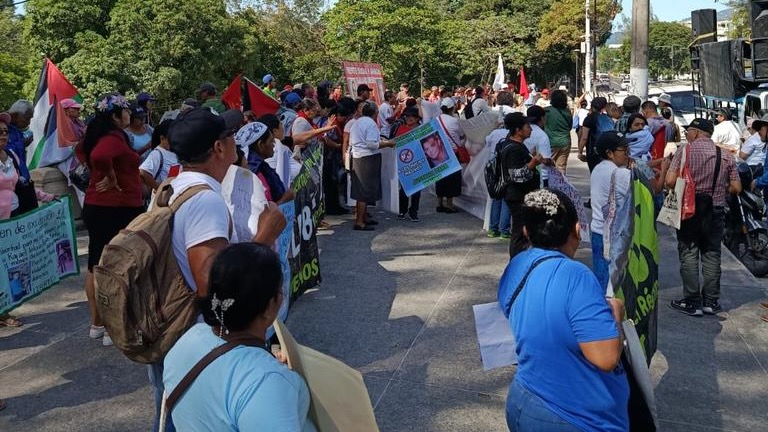
A few hundred people gathered with placards, flags, and banners representing various organizations, like the Salvadoran Social and Labor Front (FSS), the Permanent Roundtable for Labor Justice, the Movement of Victims of the Regime (MOVIR), and others.
Ramírez outlined the legacy that the day is tied to: the historic strikes of the 40s and 50s, the struggles for the 8-hour workday, for fair wages, and for the right to unionize. The event also paid tribute to “the thousands of women and men who, during the repression of the 70s and 80s, sacrificed their lives to defend justice and the dignity of the working class” against the US-backed Salvadoran government.
The Day of the Salvadoran Trade Unionist was established by Legislative Decree 589 (1990). It specifically honors the leaders of the National Union Federation of Salvadoran Workers (FENASTRAS) that were bombed by government forces on October 31, 1989.
Friday’s commemoration paid homage to prominent labor figure Febe Elizabeth Velasquéz and the nine other leaders martyred in the attack on the country’s principal organized labor front at the time.
A legacy of revolutionary struggle
The country’s trade groups have a long history of tying labor organizing to social change. These connections can be traced back to the formation of the Communist Party in 1930. Similarly, many of the 1989 FENASTRAS martyrs were affiliated with the National Unity of Salvadoran Workers (UNTS), the main federation tied to the popular movement aligned with the left guerilla force, the Farabundo Martí National Liberation Front (FMLN).
Legislative Decree 589 (1990) came two years before the 1992 Peace Accords, which officially ended the 12-year war between the FMLN (Farabundo Martí National Liberation Front) and the US-backed Salvadoran state.
By 1990, faced with continued armed opposition and a popular movement (made up of unions, student groups, and peasant associations) that had endured heavy repression, the Salvadoran government was under tremendous pressure to negotiate and recognize the legitimacy of the country’s social movements.
The deadly attack on FENASTRAS’ headquarters was a major factor in this outcome. Less than two weeks after the massacre, the FMLN would launch their historic final offensive, named in honor of the martyred union leader: “To the Limit, Period. Febe Elizabeth Lives”.
The Salvadoran military responded with intense fighting and indiscriminate aerial bombardment of residential neighborhoods, allegedly to dislodge the guerilla fighters. One US-trained Atlacatl Battalion unit stormed the Central American University (UCA) campus and murdered six Jesuit priests. The priests were known to advocate for a negotiated settlement to the conflict and spoke out against the military’s human rights abuses. The government and military claimed they were the “brain of the guerilla”.
International condemnation of the Salvadoran government grew louder than ever.
The FMLN was ultimately forced to retreat from the cities, but not before making it clear that a decisive military victory for the government was impossible. Negotiations became inevitable.
Decree 589 (1990) represented one of the first concessions by the state. It opened democratic space and acknowledged the sacrifices of trade unionists persecuted, imprisoned, or killed over the previous decade for their association with the revolutionary left. The FENASTRAS bombing and the martyrdom of Febe Elizabeth Velásquez was etched in history as the Day of the Salvadoran Trade Unionist.
Following these events, the power of the revolutionary movement and organized labor in El Salvador would completely restructure politics in the country through key democratic reforms signed into law in the 1992 Peace Accords.
Historical continuity and labor setbacks under Bukele
At the rally at Cuscatlán Park, the Bloc emphasized that this day is not only about remembrance, but also historical continuity: “the defense of labor rights today is part of the same battle for social justice that those martyrs defended with their lives,” Marisela Ramírez proclaimed.
The event’s organizers asserted that today, the Salvadoran trade unionist faces a new wave of “persecution and criminalization” by the “authoritarian regime of Nayib Bukele”.
“This regime has imposed a neoliberal and anti-union model that intends to eliminate all forms of independent organizing that defends labor rights,” says the Bloc leader.
The group has consistently denounced a systematic weakening of union structures by the Bukele regime. They claim that recently, dozens of union members have suffered arbitrary arrests, threats, and terminations without justification. Over 200 unions have been denied credentials.
Despite the increasing attacks, Ramírez tells Peoples Dispatch that the historic spirit of resistance in the Salvadoran labor movement is still alive.
“Just as before, today we see unionism as a collective and solidarity-based struggle, not only for economic improvements, but also for social transformation and justice,” she says.
Several Palestine flags were visible throughout the crowd, as well as placards that read “Respect our rights!” and “Freedom for political prisoners!” Some had photos of young men imprisoned or disappeared, asserting their innocence. Several placards displayed the image of Febe Elizabeth Velasquéz. Others, the image of Óscar Romero, the Archbishop of San Salvador, assassinated by government forces in 1980 after calling on the soldiers to disobey their orders amid escalating violence and massacres of civilians.
Commemoration event for the Day of the Salvadoran Trade Unionist. Photo: BRRP
“The impunity of yesterday is the impunity of today,” she declared.
“The only way to resist the impunity, the social injustice that we’re living under is through social struggle. We have to continue taking the streets and raising our voices.”
Rebuilding the labor movement in Bukele’s El Salvador
Ramírez says that what is lacking in the Salvadoran left is a political instrument that can “capture the discontent of the popular sectors and channel their demands towards a strategic commitment to social transformation.”
Amid Bukele’s “state of exception”, the challenge the new generation faces, she argues, is that of rebuilding and revitalizing Salvadoran trade unionism. Not just the infrastructure itself but the values and culture of historic movements. The new generation must promote “the active participation of women and young people in a process of organizational and ethical renewal that can re-articulate the labor struggles with broader social causes,” Ramírez says.
The Popular Resistance and Rebellion Bloc recently held a mass march on September 15, El Salvador’s Independence Day. It mobilized its various affiliated organizations, trade unions, civil society groups, and the general public against the human rights violations of the Bukele government.
September 15 mass march in El Salvador. Photo: BRRP
A new generation may be doing just that: revitalizing the historic struggles of the Central American country.
As resistance grows once again, organizers across generations maintain that commemorations like the Day of the Salvadoran Trade Unionist are crucial in giving shape, identity, and historical memory to the social movements of today.
The labor leaders targeted in the October 31, 1989 FRENASTRAS bombing are the following:
Febe Elizabeth Velásquez – General Secretary of FENASTRAS and member of the National Unity of Workers (UNTS); killed.
Ricardo Humberto Cestoni – Recording Secretary of the ANDA Workers’ Company Union (SETA); killed.
Rosa Hilda Saravia de Elías – Member of the Union of Workers of the Cotton, Synthetic, Textile Finishing and Related Industries (STITAS); killed.
Julia Tatiana Mendoza Aguirre – Member of the Gastronomic Union (STITGASC); killed.
Vicente Melgar – Secretary of Social Assistance of SETA; killed.
José Daniel López Meléndez – Member of SETA and Secretary of Conflicts of FENASTRAS; killed.
Luis Gerardo Vásquez – Member of the General Union of Bank Employees (SIGEBAN); killed.
María Magdalena Sánchez – FENASTRAS member; killed.
Carmen Hernández – FENASTRAS member; killed
Unidentified male worker – Died later from injuries sustained in the explosion
El Salvador’s President Nayib Bukele gives a press conference in San Salvador, El Salvador, January 14, 2025
THE party of El Salvador President Nayib Bukele changed the country’s constitution on Thursday, extending his term to six years and letting him run an unlimited number of times.
Ana Figueroa, from the New Ideas party, proposed the changes to the country’s Legislative Assembly which quickly approved them with 57 lawmakers in favour and three opposed.
President Bukele, who once dubbed himself “the world’s coolest dictator,” overwhelmingly won re-election last year despite a constitutional ban after Supreme Court justices, selected by his party, ruled in 2021 to allow re-election for a second five-year term.
People hold signs and read the names of detainees at CECOT, El Salvador’s maximum-security prison, as they gather outside the Permanent Mission of El Salvador to the United Nations in New York on June 5, 2025. (Photo: Kena Betancur/AFP via Getty Images)
“This further demonstrates the callousness and lack of due process involved and is further evidence that the U.S. government is disappearing people,” said one immigrant rights advocate.
“These were disappearances,” said one immigrant rights expert of the revelation that dozens of people who have never been acknowledged by the Trump administration were listed on flight manifests for three deportation flights from Texas to El Salvador in March.
404 Mediareported Thursday that in May, a hacker targeted the airline that operated the flights, which have been challenged in court by groups including the ACLU and Democracy Forward.
The data retrieved by the hacker showed that in addition to people whose names had been previously included on a list of deported migrants deported to El Salvador’s Terrorism Confinement Center (CECOT), published by CBS News, more than 40 men and women were listed on flight manifests for planes that the Trump administration sent on March 15
The CBS News story reported on 238 people who had been sent to CECOT without due process, under a $6 million deal with far-right President Nayib Bukele, but the list compiled from the flight manifests puts the total number at at least 281.
The flights landed in El Salvador despite a federal judge blocking them, and now, Michelle Brané of the immigrant rights group Together and Free told 404 Media, “we have this list of people that the U.S. government has not formally acknowledged in any real way and we pretty much have no idea if they are in CECOT or someplace else, or whether they received due process.”
“I think this further demonstrates the callousness and lack of due process involved and is further evidence that the U.S. government is disappearing people,” said Brané. “For almost all of these people, there’s no records whatsoever. No court records, nothing.”
It is unclear whether all the people on the flight manifests were actually on the planes, but if “they were indeed on the flights, it is unknown where they currently are,” 404 Media reported.
The outlet reported that the family of one of the men who is listed on the flight manifests but whose name has never been reported or acknowledged by the Trump administration, has been protesting his disappearance in his home country of Venezuela.
Keider Alexander Flores Navas’ mother, Ana Navas, said in a TikTok video in March that she suddenly stopped hearing from him the day the deportation flights took off—and then saw him in a photo of prisoners at CECOT.
“He was not on any list. But this photo is from El Salvador,” Navas told the Venezuelan outlet Diario VEA.
Aaron Reichlin-Melnick, a senior fellow at the American Immigration Council, called the news of the flight manifests “a horror story.”
404 Media‘s story “provides the first public confirmation of the identity of some of the people who were disappeared by the Trump administration on March 15,” said Reichlin-Melnick.
“Many of the people we sent to CECOT entered the U.S. legally at ports of entry after fully identifying themselves to the government,” he added. “But if they did enter illegally, nothing justifies disappearing people to life imprisonment without trial. It’s un-American.”
The news of the flight manifests comes days after a court filing revealed that Salvadoran officials said the U.S. has jurisdiction over the people being held in CECOT, in response to a United Nations Human Rights Office inquiry about the “involuntary disappearances” of four Venezuelans.
The Trump administration has denied having the power to return CECOT detainees to the United States, as has Bukele.
Lee Gelernt, lead counsel in the ACLU’s case regarding the deportation flights, told 404 Media that it is “critical” for the public to know who was on the March 15 flights.
“These individuals were sent to a gulag-type prison without any due process, possibly for the remainder of their lives, yet the government has provided no meaningful information about them, much less the evidence against them,” said Gelernt. “Transparency at a time like this is essential.”
Donald Fuhrump says that Amerikkka doesn’t bother with crimes or charges anymore, not being 100% Amerikkkan and opposing his real estate intentions is enough.