
Fossil fuel projects around the world threaten the health of 2bn people
https://www.theguardian.com/environment/2025/nov/12/fossil-fuel-projects-health-research
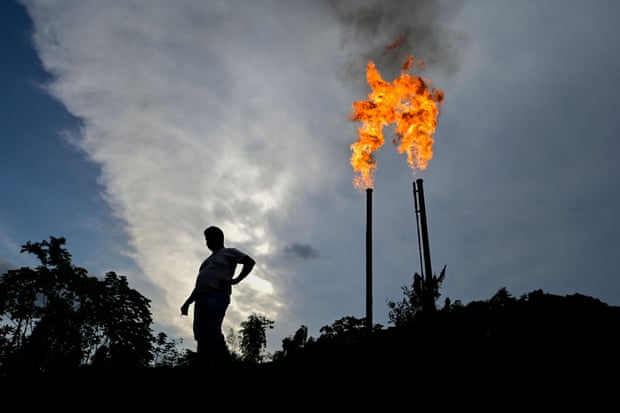
Exclusive: ‘Deep-rooted injustices’ affect billions of people due to location of wells, pipelines and other infrastructure
A quarter of the world’s population lives within three miles (5km) of operational fossil fuel projects, potentially threatening the health of more than 2 billion people as well as critical ecosystems, according to first-of-its-kind research.
A damning new report by Amnesty International, shared exclusively with the Guardian, found that more than 18,300 oil, gas and coal sites are currently distributed across 170 countries worldwide, occupying a vast area of the Earth’s surface.
Proximity to drilling wells, processing plants, pipelines and other fossil fuel facilities elevates the risk of cancer, respiratory conditions, heart disease, premature birth and death, as well as posing grave threats to water supplies and air quality, and degrades land.
Almost half a billion (463 million) people, including 124 million children, now live within 0.6 miles (1km) of fossil fuels sites, while another 3,500 or so new sites are currently proposed or under development that could force 135 million more people to endure fumes, flares and spills, according to Extraction Extinction: Why the Lifecycle of Fossil Fuels Threatens Life, Nature, and Human Rights.
Most active projects have created pollution hotspots, turning nearby communities and critical ecosystems into so-called sacrifice zones – heavily contaminated areas where low-income and marginalized groups bear the disproportionate burden of exposure to pollution and toxins.
…
Article continues at https://www.theguardian.com/environment/2025/nov/12/fossil-fuel-projects-health-research


No time to recover: Hurricane Melissa and the Caribbean’s compounding disaster trap as the storms keep coming
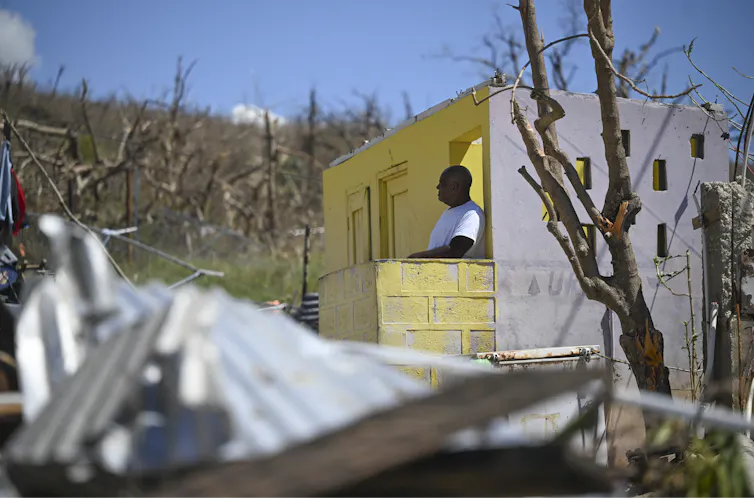
Farah Nibbs, University of Maryland, Baltimore County
Headlines have been filled with talk of the catastrophic power of Hurricane Melissa after the Category 5 storm devastated communities across Jamaica, Cuba and Haiti in October 2025. But to see this as a singular disaster misses the bigger picture: Melissa didn’t hit stable, resilient islands. It hit islands still rebuilding from the last hurricane.
Jamaica was still recovering from Hurricane Beryl, which sideswiped the island in July 2024 as a Category 4 storm. The parish of St. Elizabeth – known as Jamaica’s breadbasket – was devastated. The country’s Rural Agriculture Development Authority estimated that 45,000 farmers were affected by Beryl, with damage estimated at US$15.9 million.

In Cuba, the power grid collapsed during Hurricane Oscar in October 2024, leaving 10 million people in darkness. When Melissa arrived, it struck the same fragile infrastructure that Cubans had barely begun to rebuild.
Haiti’s fragile situation before Hurricane Melissa cannot be overstated. The island nation was still reeling from years of cascading disasters – deadly hurricanes, political instability, gang violence, an ongoing cholera crisis and widespread hunger – with over half the population already in need of humanitarian assistance even before this storm hit.
This is the new reality of the climate crisis: Disasters hitting the Caribbean are compounding and can trigger infrastructure collapse, social erosion and economic debt spirals.
The compounding disaster trap
I study disasters, with a focus on how Caribbean island systems absorb, adapt to and recover from recurring shocks, like the nations hit by Melissa are now experiencing.
It’s not just that hurricanes are more frequent; it’s that the time between major storms is now shorter than the time required for a full recovery. This pulls islands into a trap that works through three self-reinforcing loops:
Infrastructure collapse: When a major hurricane hits an already weakened system, it causes simultaneous infrastructure collapses. The failure of one system – such as power – cascades, taking down water pumps, communications and hospitals all at once. We saw this in Grenada after Hurricane Beryl and in Dominica after Hurricane Maria. This kind of cascading damage is now the baseline expectation for the Caribbean.
Economic debt spiral: When countries exhaust their economic reserves on one recovery, borrow to rebuild and are then hit again while still paying off that debt, it becomes a vicious cycle.
Hurricane Ivan, which struck the region in 2004, cost Grenada over 200% of its gross domestic product; Maria, in 2017, cost Dominica 224% of its GDP; and Dorian, in 2019, cost the Bahamas 25% of GDP. With each storm, debt balloons, credit ratings drop and borrowing for the next disaster becomes more expensive.
Social erosion: Each cycle weakens the human infrastructure, too. More than 200,000 people left Puerto Rico for the U.S. mainland in Maria’s aftermath, and nearly one-quarter of Dominica’s population left after the same storm. Community networks fragment as people leave, and psychological trauma becomes layered as each new storm reopens the wounds of the last. The very social fabric needed to manage recovery is itself being torn.

The trap is that all three of these loops reinforce each other. A country can’t rebuild infrastructure without money. It can’t generate economic activity without infrastructure. And it can’t retain the skilled workforce needed for either when people are fleeing to safer places.
Rebuilding a system of overlapping recoveries
The Caribbean is not merely recovering from disasters – it is living within a system of overlapping recoveries, meaning that its communities must begin rebuilding again before fully recovering from the last crisis.
Each new attempt at rebuilding happens on the unstable physical, social and institutional foundations left by the last disaster.
The question isn’t whether Jamaica will attempt to rebuild following Melissa. It will, somehow. The question is, what happens when the next major storm arrives before that recovery is complete? And the one after that?
Without fundamentally restructuring how we think about recovery – moving from crisis response to continuous adaptation – island nations will remain trapped in this loop.
The way forward
The compounding disaster trap persists because recovery models are broken. They apply one-size-fits-all solutions to crises unfolding across multiple layers of society.
Breaking free requires adaptive recovery at all levels, from household to global.

At the household level: Helping amid trauma
Recovery isn’t just about repairing a damaged roof. When families experience back-to-back disasters, trauma compounds. Direct cash assistance and long-term, community-based mental health services can help restore dignity.
Cash transfers allow families to address their own needs, stimulate local economies and restore control to people whose lives have been repeatedly upended.
At community level: Mending the social fabric
Repairing the “social fabric” means investing in farmer cooperatives, neighborhood associations and faith groups – networks that can lead recovery from the ground up.
Local networks are often the only ones capable of rebuilding trust and participation.
At the infrastructure level: Breaking the cycle
The pattern of rebuilding the same vulnerable roads or power lines only to see them wash away in the next storm fails the community and the nation. There are better, proven solutions that prepare communities to weather the next storm:
- Decentralized power grids with renewable energy sources can operate independently when the main grid fails.
- Natural infrastructure such as restored mangroves and wetlands provide natural storm barriers.
- Strong enforcement of modern building codes can require structures to withstand Category 4 and above winds.

At the global level: Fixing the debt trap
None of this is possible if recovery remains tied to high-interest loans. There are ways for internal financial institutions and global development lenders to allow for breathing room between disasters:
- Hurricane clauses in bond agreements can automatically pause all debt payments when disasters strike. These clauses allow governments to automatically suspend debt service payments to bondholders for up to two years when a qualifying disaster strikes. After Beryl, Grenada became the first government to activate a hurricane clause with private creditors.
- Comprehensive debt-for-climate swaps involve reducing existing debt – owed to private banks, institutional investors, countries or multilateral banks – in exchange for the debtor country committing funds to climate adaptation or resilience projects.
- Pre-positioned climate finance is money made available through dedicated international climate funds, such as the Green Climate Fund and Loss and Damage Fund, or parametric insurance mechanisms. It pays out before storms hit, not months later, so countries are ready to respond to the damage.
The current international disaster finance system, controlled by global lenders and donors, requires countries to prove their losses after a disaster in order to access assistance, often resulting in months of delay. “Proof” is established by formal evaluations or inspections, such as by the United Nations, and aid is released only after meeting certain requirements. This process can stall recovery at the moment when aid is needed the most.
The bottom line
The Caribbean needs a system that provides support before disasters strike, with agreed-upon funding commitments and regional risk-pooling mechanisms that can avoid the delays and bureaucratic burden that slow recovery.
What’s happening in Jamaica, Cuba and Haiti today is a glimpse of what’s coming for coastal and island communities worldwide as climate change accelerates. In my view, we can either learn from the Caribbean’s experiences and redesign disaster recovery now or wait until the trap closes around everyone.
Farah Nibbs, Assistant Professor of Emergency and Disaster Health Systems, University of Maryland, Baltimore County
This article is republished from The Conversation under a Creative Commons license. Read the original article.
Cop30 talks begin in Brazil with calls for faster action
https://morningstaronline.co.uk/article/cop30-talks-begin-brazil-calls-faster-action

 A pumpjack operates in the foreground while a wind turbine at the Buckeye Wind Energy wind farm rises in the distance, September 30, 2024, near Hays, Kansas, US
THE United Nations climate negotiations got under way today in the Brazilian city of Belem, known as the gateway to the Amazon River.
The negotiations follow the leaders’ summit which was held last Friday where leaders pushed for greater urgency and co-operation in the fight to curb global warming by drastically reducing the carbon pollution that causes it.
Andre Correa do Lago, president of this year’s Cop30, emphasised that negotiators engage in “mutirao,” a Brazilian word derived from an indigenous word that refers to a group uniting to work on a shared task.
“Either we decide to change by choice, together, or we will be imposed change by tragedy,” do Lago wrote in his letter to negotiators Sunday. “We can change. But we must do it together.”
Complicating the calls for togetherness is the United States. The Trump administration did not send high-level negotiators to the talks and is withdrawing for the second time from the 10-year-old Paris Agreement.
…
Article continues at https://morningstaronline.co.uk/article/cop30-talks-begin-brazil-calls-faster-action
In Grok we don’t trust: academics assess Elon Musk’s AI-powered encyclopedia

From publishing falsehoods to pushing far-right ideology, Grokipedia gives chatroom comments equal status to research
The eminent British historian Sir Richard Evans produced three expert witness reports for the libel trial involving the Holocaust denier David Irving, studied for a doctorate under the supervision of Theodore Zeldin, succeeded David Cannadine as Regius professor of history at Cambridge (a post endowed by Henry VIII) and supervised theses on Bismarck’s social policy.
That was some of what you could learn from Grokipedia, the AI-powered encyclopedia launched last week by the world’s richest person, Elon Musk. The problem was, as Prof Evans discovered when he logged on to check his own entry, all these facts were false.
It was part of a choppy start for humanity’s latest attempt to corral the sum of human knowledge or, as Musk put it, create a compendium of “the truth, the whole truth and nothing but the truth” – all revealed through the magic of his Grok artificial intelligence model.
When the multibillionaire switched on Grokipedia on Tuesday, he said it was “better than Wikipedia”, or “Wokepedia” as his supporters call it, reflecting a view that the dominant online encyclopedia often reflects leftwing talking points. One post on X caught the triumphant mood among Musk’s fans: “Elon just killed Wikipedia. Good riddance.”
But users found Grokipedia lifted large chunks from the website it intended to usurp, contained numerous factual errors and seemed to promote Musk’s favoured rightwing talking points. In between posts on X promoting his creation, Musk this week declared “civil war in Britain is inevitable”, called for the English “to ally with the hard men” such as the far-right agitator Tommy Robinson, and said only the far-right AfD party could “save Germany”.
Musk was so enamoured of his AI-encyclopedia he said he planned to one day etch the “comprehensive collection of all knowledge” into a stable oxide and “place copies … in orbit, the moon and Mars to preserve it for the future”.
…
Original article at https://www.theguardian.com/technology/2025/nov/03/grokipedia-academics-assess-elon-musk-ai-powered-encyclopedia
