Wes Streeting visiting Trafford general hospital in Manchester in February. The health secretary said last week the NHS was on track to reduce waiting times by the end of the parliament in 2029. Photograph: Martin Rickett/PA
Exclusive: Health secretary’s pledges in doubt as analysis shows health service will not deliver key improvements
…
The health service in England will not deliver a series of milestone improvements in its performance that ministers demanded it achieve by the time the fiscal year ends on Tuesday, a Guardian analysis of the NHS’s most recent data has found.
The lack of progress raises questions about pledges made last week by Wes Streeting, the health secretary, to get key waiting times back on track by the end of the parliament in 2029.
The findings will concern Keir Starmer, the prime minister, given Labour’s commitment to “get the NHS back on its feet” and the public’s strong desire to see an end to the routinely long waits for care that crept in from 2015.
The gloomy picture on waiting times also comes despite the NHS handing hospitals an extra £120m in recent weeks to fund a pre-deadline “elective sprint” – of extra appointments and more operations – intended to bolster its chances of delivering the necessary improvements by 31 March.
Streeting has repeatedly promised to ensure that 92% of people waiting for non-urgent hospital care such as appointments and operations get it within 18 weeks by 2029. However, the NHS only saw 61.5% of patents within 18 weeks in January. That was up on its 58.9% performance in January 2025 but still too low to hit the 65% year-end target for 2025-26.
This work by Middle East Monitor is licensed under a Creative Commons Attribution-NonCommercial-ShareAlike 4.0 International License.
People carrying Palestinian flags and banners, stage a demonstration and march to Wembley Stadium demanding Israel’s suspension from UEFA and FIFA, in London, United Kingdom on October 2, 2025. [Raşid Necati Aslım – Anadolu Agency]
Tens of thousands of signatures have been collected in England for a petition demanding that Israel be banned from international football over its actions in Gaza and calling for the cancellation of a match between Aston Villa and Maccabi Tel Aviv, Anadolu reports.
The petition, launched by the Palestine Solidarity Campaign in the UK and signed by 25,000 people, was delivered to the Football Association at Wembley Stadium by the platform’s director, Lewis Backon.
Backon said outside Wembley Stadium that teams from a state responsible for genocide and apartheid should not be playing in international football competitions.
Aston Villa will face Maccabi Tel Aviv at home in the UEFA Europa League on Thursday.
West Midlands Police had classified the match as “high risk” based on current intelligence and past incidents, while the Safety Advisory Group, comprised of police, the municipality and security experts, had announced that away fans would not be allowed into the stadium.
This work by Middle East Monitor is licensed under a Creative Commons Attribution-NonCommercial-ShareAlike 4.0 International License.
Orcas discuss Genocide-supporting and complicit Zionists. Donald Trump, Keith Starmer, David Lammy, Rachel Reeves, Angela Rayner and Wes Streeting are acknowledged as evil genocide-complicit and supporting cnuts.Keir Starmer objects to criticism of the IDF. He asks how could anyone object to them starving people to death, forced marches like the Nazis did, bombing Gaza’s hospitals and universities, mass-murdering journalists, healthworkers and starving people queuing for food, killing and raping prisoners and murdering children. He calls for people to stop obstructing his genocide for Israel.Genocide denier and Current UK Prime Minister Keir Starmer is quoted that he supports Zionism without qualification. He also confirms that UK air force support has been essential in Israel’s mass-murdering genocide. Includes URLs https://www.declassifieduk.org/keir-starmers-100-spy-flights-over-gaza-in-support-of-israel/ and https://youtu.be/O74hZCKKdpA
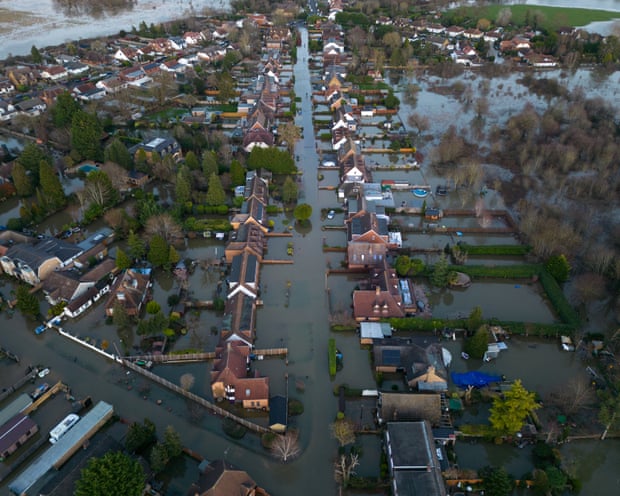
Flood waters surrounding houses in Wraysbury, Berkshire in January 2024. Greater London and Yorkshire and the Humber are two regions at particular risk in the coming years. Photograph: Daniel Leal/AFP/Getty Images
Every constituency projected to be at greater risk, with many areas likely to be uninsurable, Guardian investigation finds
Millions more homes in England, Scotland and Wales face devastating floods, and some towns may have to be abandoned as climate breakdown makes many areas uninsurable, a Guardian investigation has found.
New analysis from the insurance industry, seen by the Guardian, reveals the extent of concern in the sector, with bosses warning that large swathes of housing and commercial property in densely populated areas will be at greater risk.
Separately, experts have said that some towns may need to be abandoned as homes and businesses struggle to get insurance in areas repeatedly battered by storms and rising sea levels.
Densely populated areas including London, Manchester and parts of north-east England, are likely to be worst hit. Experts also say London’s flood defences need to be updated urgently to protect the capital from devastating floods.
…
Orcas comment on killer apes destroying the planet by continuing to burn fossil fuels.Neo-Fascist Climate Science Denier Donald Trump says Burn, Baby, Burn.Nigel Farage urges you to ignore facts and reality and be a climate science denier like him and his Deputy Richard Tice. He says that Reform UK has received £Millions and £Millions from the fossil fuel industry to promote climate denial and destroy the planet.
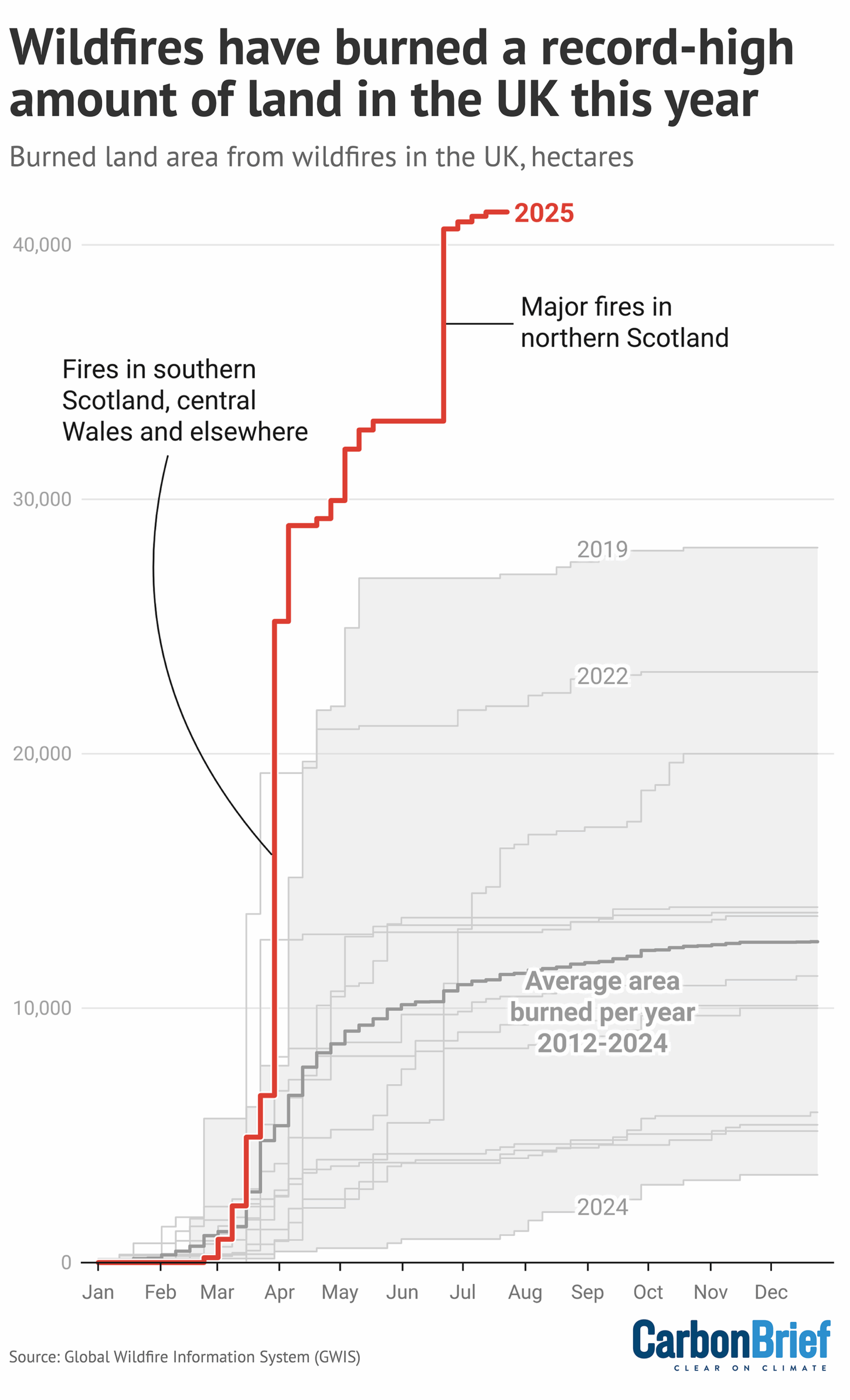
Wildfires have scorched more than 40,000 hectares of land so far this year across the UK – an area more than twice the size of the Scottish city of Glasgow.
This is already a record amount of land burned in a single year, far exceeding the previous high, Global Wildfire Information System (GWIS) data shows.
It is also almost four times the average area burned in wildfires by this stage of the year over 2012-24 – and 50% higher than the previous record amount burned by this time in 2019.
The burned area overtook the previous annual record in April, BBC News reported at the time, and has continued to soar in the months since.
Major wildfires
The chart below shows that UK wildfires in 2025 so far have already burned by far the largest area of land over any calendar year since GWIS records began in 2012. The previous record year was 2019, followed by 2022, while 2024 saw the lowest area size burned.
Annual land area burned by wildfires across the UK from 2012 to 2025 (red), alongside the average area burned each year over 2012-24. Source: Global Wildfire Information System.
Climate change can increase the risk and impact of wildfires. Warmer temperatures and drought can leave land parched and dry out vegetation, which helps fires spread more rapidly. Climate change is making these types of extreme conditions more likely to occur, as well as more severe.
Fire services in England and Wales responded to 564 wildfires from January to June 2025 – an increase from 69 fires in the same period last year, the National Fire Chiefs Council (NFCC) said in a statement in June.
Most wildfires in the UK are caused by human activity, whether accidental or deliberate, according to the NFCC. Some common ignition sources are disposable barbecues, lit cigarettes and campfires.
Jessica Richter, a research analyst at Global Forest Watch, says that, while fires are also a key part of some ecosystems, climate change is the “major driver behind the increasing fire activity around the globe”. She tells Carbon Brief:
“As we see more fires, we’re going to see more carbon being emitted and that’s just going to be, for lack of a better phrasing, adding fuel to the fire.”
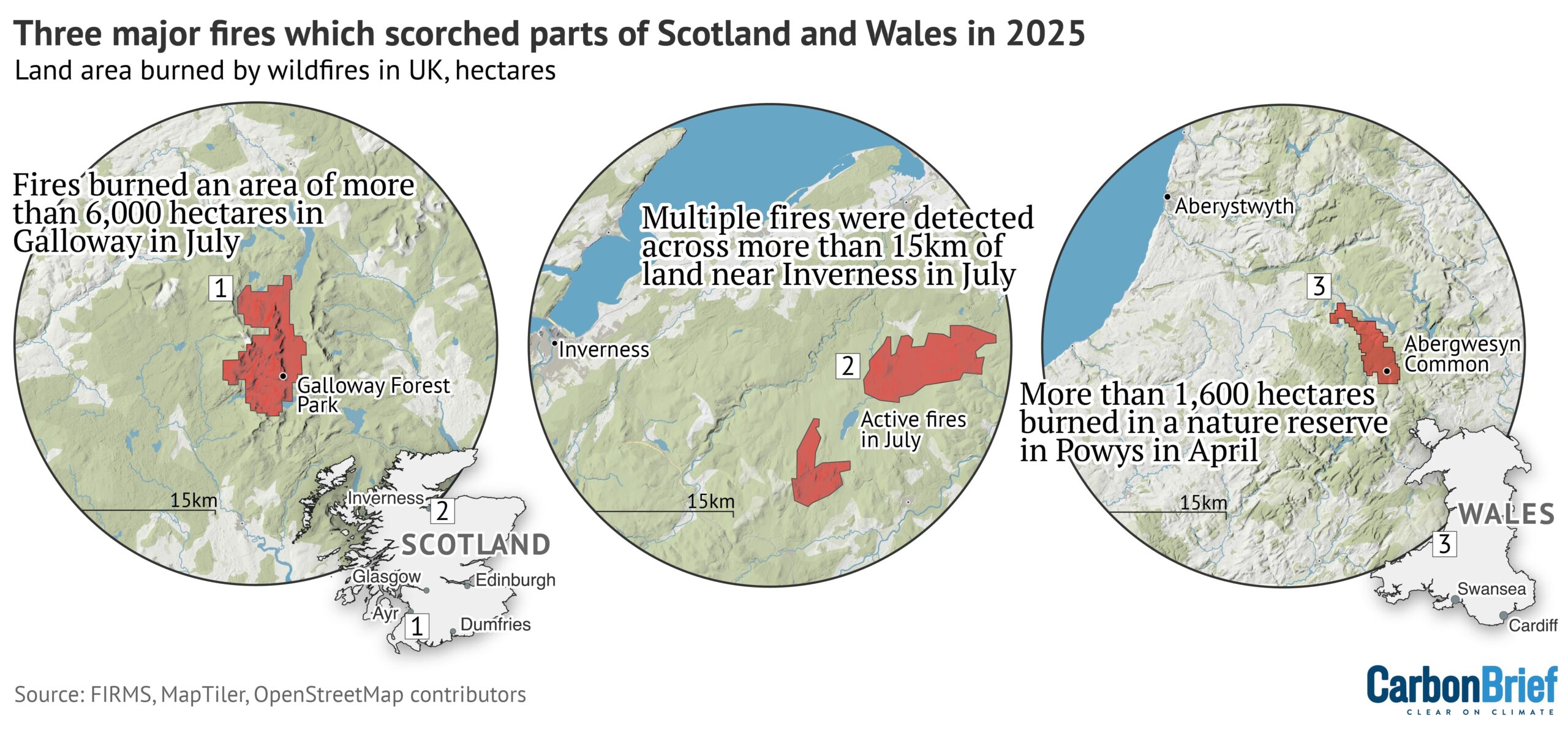
Examples of 2025 wildfires around Galloway (1) and Inverness (2) in Scotland, and a wildfire in Powys (3) in Wales. Source: FIRMS, MapTiler, OpenStreetMap contributors.
The UK has also recorded its highest-ever wildfire emissions this year, according to Copernicus, which was “primarily driven” by major wildfires in Scotland from late June to early July.
These were the largest wildfires ever recorded in the country, reported the Scotsman. They “ravaged” land in Moray and the Highlands in the north of the country, the newspaper added.
Scotland experienced an extreme wildfire in Galloway Forest Park in April, which was “so intense it could be seen from space”, the Financial Times said.
Elsewhere, in April, the Belfast News Letter reported that firefighters tackled almost 150 fires on the Mourne Mountains in Northern Ireland.
More recently, BBC News reported that firefighters in Dorset, England received “non-stop” wildfire calls in the first weekend of August, with one blaze “engulf[ing] an area the size of 30 football pitches”.
Wildfires have also caused devastation across many parts of Europe in recent weeks – including Albania, Cyprus, France, Greece, Spain and Turkey – as well as in the US and Canada.
Words by Orla Dwyer. Analysis by Ho Woo Nam. Charts by Tom Prater.
Nigel Farage urges you to ignore facts and reality and be a climate science denier like him. He says that Reform UK has received millions and millions from the fossil fuel industry to promote climate denial and destroy the planet.Donald Trump urges you to be a Climate Science denier like him. He says that he makes millions and millions for destroying the planet, Burn, Baby, Burn and Flood, Baby, Flood.
England’s privatised water industry may one day be considered a textbook case study of failed corporate responsibility, regulation and governance. The Cunliffe review, the recent report into England’s privatised water industry, concluded that the financial regulator, OfWat, needs to be disbanded and a new water regulator will be introduced.
For that to work effectively, better pollution monitoring and more clearly defined pollution incident criteria are essential. While politicians and water companies have claimed to be reducing pollution incidences, they might not strictly be tackling sources of pollution, so communications must be carefully scrutinised for disinformation.
The UK’s environment minister Steve Reed MP has described the water industry as “broken”. The public have rising water bills. Water companies owe over £60 billion in debts and have left the country with uncertain water security in the face of climate change.
The Environment Agency (EA) in England recently announced that serious pollution incidents in 2024 rose by 60% to 75 from 47 in the previous year. The EA classifies pollution incidents using a four-point scale called the common incident classification scheme. Trained EA officers consider the evidence reported via their incident hotline to assess its credibility and severity.
Get your news from actual experts, straight to your inbox.Sign up to our daily newsletter to receive all The Conversation UK’s latest coverage of news and research, from politics and business to the arts and sciences.
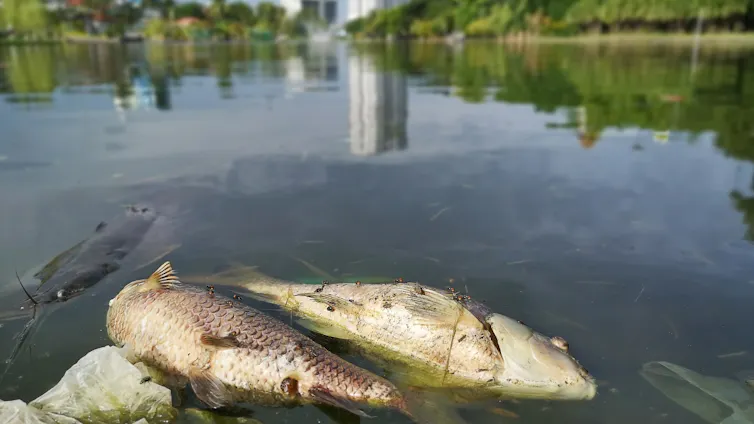
Category 1 is for major incidents, 2 for significant, 3 for minor incidents and 4 for no impact. Category 1 and 2 typically involve visible signs of dead fish floating. For salmon, if more than 10 adult or 100 young fish are dead, this is category 1. With fewer than ten adult and 100 young fish dead, it’s category 2.
No dead fish, no serious problem? The EA can also record damage on protected habitats as “pollution incidents” but these are harder to substantiate without investigative research that takes time and money.
Last year, more than 450,000 sewage discharges were recorded by event duration monitors. These are devices fitted to the end of overflow pipes that indicate when and for how long they have been discharging.
These discharges represent 3.6 million hours of untreated sewage going into our rivers and coasts. These contain chemical contaminants including pharmaceuticals, detergents and human pathogens. Only 75 incidents were recorded as serious or significant in 2024. Another 2,726 were classed as minor.
So lots of sewage discharges are not being classified as pollution incidents, despite containing pollutants. The EA advises its investigating officers to “record substantiated incidents that result in no environmental impact, or where the impact cannot be confirmed, as a category 4”.
The EA has been criticised for turning up late to 74% of category 1 and 2 pollution incidents and for being pressured to ignore low-level pollution – all claims that they have denied. However, they admit they are constrained by finances. Any new regulator must be adequately resourced and independent.
Pollution isn’t always classified as an official pollution incident. YueStock/Shutterstock
In their recent report into pollution incidences, the EA states that they respond to all category 1 and 2 (serious and significant) water industry incidents and will be increasing their attendance at category 3 (minor) incidents. They highlight that more inspections will identify more issues. This shows some acceptance that the more incidents they attend, the more would be substantiated or recorded appropriately.
Most sewage discharges would not have been reported to, or recorded by, the EA as pollution incidents because they were permitted discharges from combined stormwater overflows. Water companies are allowed to discharge untreated wastewater under exceptional rainfall or snowfall conditions to prevent sewage backing up through the pipes.
Extra water flow in rivers from rainfall is meant to dilute chemical contaminants in wastewater. However, some discharges can last days or weeks. The EA is currently investigating whether water companies have been breaching their permits and discharging untreated wastewater when there is low or even no rainfall.
What counts as pollution?
The UN classifies pollution as “presence of substances and energy (for example, light and heat) in environmental media (air, water, land) whose nature, location, or quantity produces undesirable environmental effects”. This definition differs markedly from the EA’s working definition of pollution incidents.
Many sewage discharges containing low concentrations of pollutants won’t kill fish but might still be harmful to fish larvae or small insects, for example.
However, the broad picture from EA data is that invertebrate communities at least are in a better state than they were three decades ago before wastewater treatment plants were upgraded following the EU’s Urban Wastewater Directive.
Some pollutants bioaccumulate through the food chain, so they become concentrated in top predators such as orcas. Some chemicals mimic reproductive hormones even in low concentrations and can feminise fish, for example. High levels of nutrients from agriculture and sewage in rivers can cause fungal diseases in seagrass meadows.
Other families of chemicals build up in wildlife and people, such as persistent “forever chemicals”, much of which comes from wastewater discharges. Continued discharges of antibiotics into waterways might not be classified as pollution incidents but still pose a substantial risk to human and ecosystem health through bacteria developing antibiotic resistance.
The government has just committed to cut sewage pollution by 50% by December 2029 based on 2024 data. But it’s not yet clear whether these involve cutting the frequency of discharges, the duration or both.
This data could also be manipulated so that a large number of small discharges can be consolidated into one official discharge event. Currently, the volume of discharges from stormwater overflows isn’t known. Without this vital data we can’t ascertain the risk posed by their contaminants.