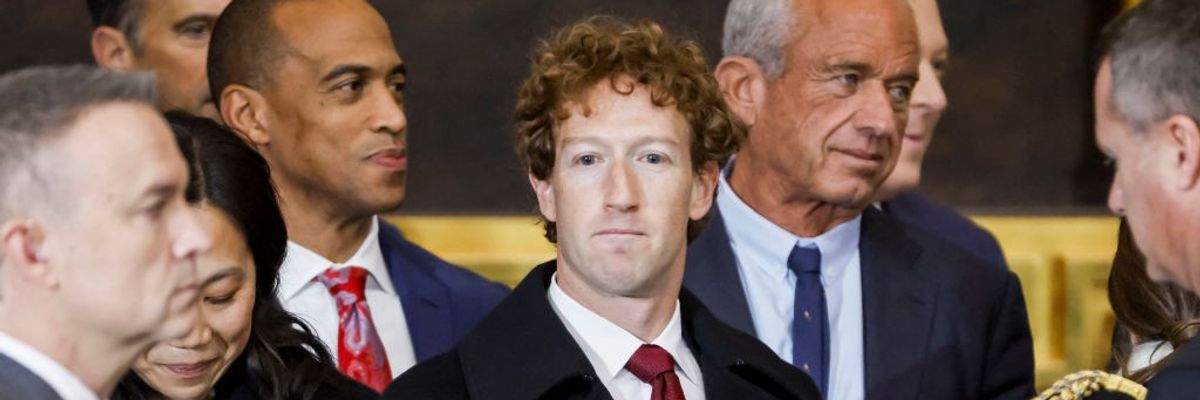
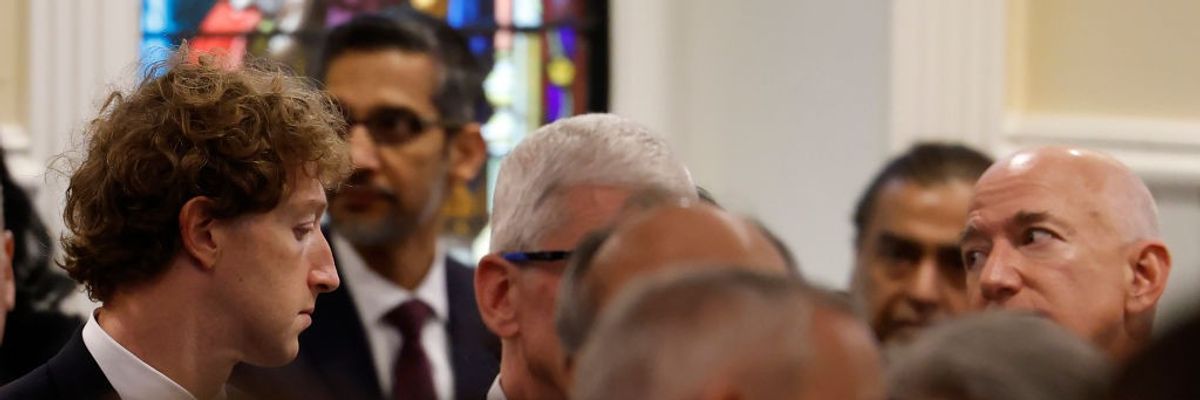
Meta and Facebook CEO Mark Zuckerberg (L), CEO of Apple Tim Cook, and Founder of Amazon and Blue Origin Jeff Bezos attend services as part of Inauguration ceremonies at St. John’s Church on January 20, 2025 in Washington, D.C. (Photo: Anna Moneymaker/Getty Images)
The very ripeness for scandal this time around calls for reasonable restrictions on the sources and amounts of inaugural donations.
U.S. President Donald Trump sounded a lot of populist notes on the campaign trail. But as he took the oath of office for the second time, he was joined onstage by billionaires and CEOs who’d spent millions to be there—leaving supporters who’d traveled across the country to attend literally out in the cold.
Presidential inaugurations have always been an opportunity for wealthy special interests to curry favor with the incoming administration with generous inaugural donations. But the nation has never seen influence peddling like we just witnessed at Trump’s second inauguration.
The sheer volume of today’s inaugural donations suggests that wealthy special interests believe it is worth the investment.
…
All the self-reporting donors—including Big Tech firms like Google, Microsoft, Meta, Amazon, and OpenAI—pledged $1 million or more. The cryptocurrency firm Ripple pledged $5 million. In fact, the cryptocurrency industry even hosted its own inaugural ball.
And of course, Wall Street is cozying up with major donations from Goldman Sachs, Bank of America, and billionaire hedge fund manager Ken Griffin.
“EVERYBODY WANTS TO BE MY FRIEND!!!” Trump marvels on his Truth Social account.
Original article by Jasper Jackson republished from TBIJ under This work is licensed under a Creative Commons Attribution-NonCommercial-NoDerivs 3.0 Unported License.
With tech titans openly disregarding the truth ahead of Trump’s second term, 2025 is likely to herald a new era of disinformation
The online information ecosystem has been in critical condition for some years now, but the prognosis for 2025 is looking more dire than ever.
Already this year two of the world’s richest men, who between them control a huge chunk of our communications infrastructure, have made it clear that they are not interested in our access to the truth.
On Tuesday, Mark Zuckerberg announced that his company Meta – which owns Facebook, Instagram and WhatsApp – would be scrapping its fact checking programme. The only exception to this for now will be in the EU, where strong regulations require it to police its platform.
The core purpose of this programme was to check content that had been flagged as containing potentially harmful misinformation, such as false claims about vaccines or military conflicts. These checks were carried out by third-party organisations, which had to follow rules around process and transparency – and which received significant funding from Meta.
In their place, Meta will now adopt a “community notes-style” system, which enables users themselves to weigh in on content that might be false. A similar set-up has already been adopted by X, where it has proven open to manipulation and failed abysmally to curb misinformation on the platform.
To be clear, Meta’s fact checking programme was not without its problems. For a start, there was no way it could catch every falsehood on the platforms. Meta’s financial arrangements with these organisations also raised questions. And ultimately, there is no definitive proof that showing people fact checks has any real impact on whether they believe the false claims.
But the programme did provide vital financial support to newsrooms that did hugely valuable work, from uncovering Russian propaganda campaigns to exposing online scam artists. And while it was only ever a partial solution at best, Meta’s programme was a sign that the company at least wanted to be seen to care about the accuracy of the information spreading across its platforms.
Zuckerberg’s about-turn came after a week in which another tech tycoon, Elon Musk, had been weighing in on UK politics, most notably with twisted falsehoods about the handling of child grooming cases and messages of support for Tommy Robinson, the far-right figure currently in prison for contempt of court after targeting a Syrian refugee with lies. On Monday, Musk suggested in a poll posted on X that “America should liberate the people of Britain from their tyrannical government”.
The recent behaviour of Zuckerberg and Musk can only be seen in light of the impending second term of Donald Trump, whose propensity for lying is legendary. Musk was already all in on Trump’s presidency. But since the election, much of the rest of the tech world has sought to curry favour with the incoming president, with many prominent figures making big donations to his inauguration.
Like the Trump presidency itself, Musk and Zuckerberg’s dismantling of systems that help protect the truth are logical consequences of the digital structures we have built. An online economy that rewards attention above all else has given new power to false claims. Outlandish lies spread quicker than boring truths. Telling people what they want to hear is more engaging than telling them what they need to hear.
And all the signs suggest that the problem will only be worsened by the tech world’s latest obsession: generative AI. Systems such as ChatGPT, which can come up with content that seems human and accurate but is often simply a convincing lie, are rapidly being incorporated into all our major channels of information and communication. Apple is putting inaccurate headlines on curated news articles. Meta is planning to flood its social networks with AI bots mimicking humans. Google is pushing AI-driven search that regularly throws up false results.
A huge amount of money has been poured into generative AI, and much of the tech industry is banking on it to deliver another lucrative boom. But it has turned out to be even worse than humans at telling fact from fiction – and even more willing to make things up. Dealing with this problem is vital for democracy, but it also threatens the industry’s next big payout. As Zuckerberg proved this week, it’s a lot easier to simply give up on accurate information altogether.
Big Tech is no longer even keeping up the pretence that it is committed to the truth. Keeping our information ecosystem healthy is going to be up to the rest of us.
Reporter: Jasper Jackson Deputy editor: Katie Mark Editor: Franz Wild Production editor: Alex Hess Fact checker: Frankie Goodway
TBIJ has a number of funders, a full list of which can be found here. None of our funders have any influence over editorial decisions or output.
Original article by Jasper Jackson republished from TBIJ under This work is licensed under a Creative Commons Attribution-NonCommercial-NoDerivs 3.0 Unported License.
This image added 11/1/25
Elon Musk urges you to be a Fascist like him, says that you can ignore facts and reality then.
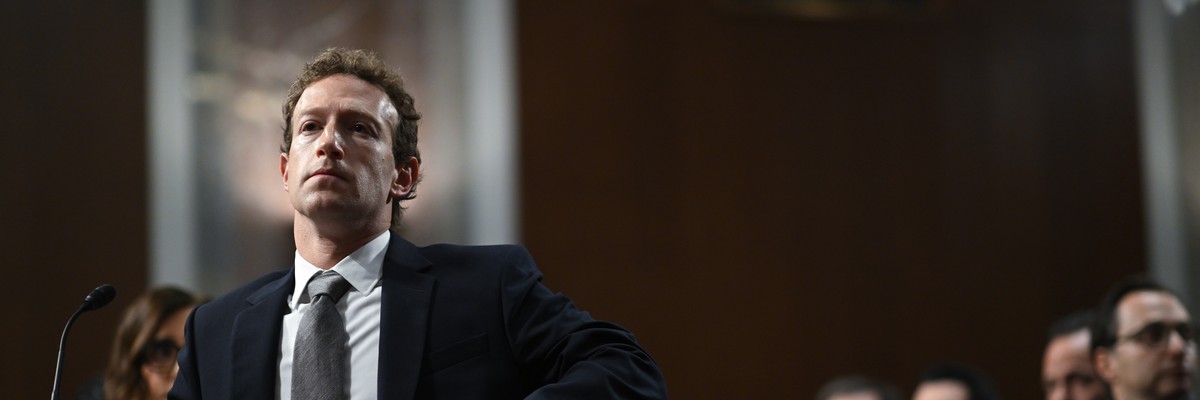
CEO of Meta, Mark Zuckerberg is seen during a Senate Judiciary Committee hearing with representatives of social media companies at the Dirksen Senate Office Building on Wednesday January 31, 2024 in Washington, DC. (Photo: Matt McClain/The Washington Post via Getty Images)
“Zuck isn’t just kissing the ring, he’s slobbering all over it,” said one media reporter.
In a move that some viewed as a means of currying favor with the incoming Trump administration, Meta CEO Mark Zuckerberg announced in a video Tuesday that the company is moving to end its third party fact-checking program.
Instead, the company will use a community notes approach, inspired by the Elon Musk’s platform X—where Musk’s misleading claims about the 2024 presidential election racked up billions of views.
Zuckerberg’s announcement was accompanied by a post authored by Meta’s new, “Trump-friendly” chief global affairs officer, Joel Kaplan, who described the change as “more speech and fewer mistakes.” Kaplan also went on Fox & Friends on Tuesday morning to discuss the update.
“Too much harmless content gets censored, too many people find themselves wrongly locked up in ‘Facebook jail,’ and we are often too slow to respond when they do,” wrote Kaplan in his post. Kaplan and Zuckerberg also noted that Meta plans to phase back in more civic content, as in posts about elections, politics, or social issues.
Real Facebook Oversight Board (RFOB), a group established to counter the perceived failures of Meta’s own oversight board, blasted the move, saying, “‘censorship’ is a manufactured crisis, political pandering to signal that Meta’s platforms are open for business to far-right propaganda.”
“Twitter’s shift from fact checking has turned the platform into a cesspool; Zuck is joining them in a race to the bottom,” the group wrote Tuesday.
The move generated other negative reactions.
“Meta went to Fox News to announce it’s ending its third-party fact checking program. Zuck isn’t just kissing the ring, he’s slobbering all over it,” wrote media reporter Oliver Darcy on Tuesday.
Also on Tuesday, Kara Swisher, a tech journalist, wrote “toxic floods of lies on social media platforms like Facebook have destroyed trust not fact checkers. Let me reiterate: Mark Zuckerberg has never cared about that and never will.”
Co-president of the watchdog group Public Citizen, Lisa Gilbert, weighed in, saying that “misinformation will flow more freely with this policy change, as we cannot assume that corrections will be made when false information proliferates. The American people deserve accurate information about our elections, health risks, the environment, and much more. We condemn this irresponsible move and the harm it will likely contribute to our discourse.”
“Meta’s new promise to scale back fact checking isn’t surprising—Zuckerberg is one of many billionaires who are cozying up to dangerous demagogues like Trump and pushing initiatives that favor their bottom lines at the expense of everything and everyone else,” wrote Nora Benavidez, senior counsel and director of digital justice and civil rights for the organization Free Press in a Tuesday statement.
Meta, which is angling for the U.S. government to use its AI and is facing an federal antitrust trial this spring, has made other bids to enter Trump’s good graces and thaw once frosty relations (Meta temporarily booted Trump from its platforms following his comments regarding the January 6 insurrection). Meta donated $1 million to Trump’s inauguration fund recently and Zuckerberg flew down to Trump’s Mar-A-Lago Club to meet with him this past fall.
Omar el Qataa is a photojournalist operating out of northern Gaza
Facebook has severely restricted the ability of Palestinian news outlets to reach an audience during the Israel-Gaza war, according to BBC research.
In a comprehensive analysis of Facebook data, we found that newsrooms in the Palestinian territories – in Gaza and the West Bank – had suffered a steep drop in audience engagement since October 2023.
The BBC has also seen leaked documents showing that Instagram – another Meta-owned platform – increased its moderation of Palestinian user comments after October 2023.
Meta – the owner of Facebook – says that any implication that it deliberately suppressed particular voices is “unequivocally false”.
…
During a period of war, audience engagement might be expected to rise. However, the data showed a 77% decline after the Hamas attacks on 7 October 2023.
Palestine TV has 5.8 million followers on Facebook. Journalists at the newsroom shared statistics with us showing a 60% drop in the number of people seeing their posts.
“Interaction was completely restricted, and our posts stopped reaching people,” says Tariq Ziad, a journalist at the channel.
Over the past year, Palestinian journalists have raised fears that their online content is being “shadow-banned” by Meta – in other words, restricted in how many people see it.
To test this, we carried out the same data analysis on the Facebook pages of 20 Israeli news organisations such as Yediot Ahronot, Israel Hayom and Channel 13. These pages also posted a large amount of war-related content, but their audience engagement increased by nearly 37%.
This article was originally posted 6/12/24 but was deleted probably by mistake.
Mark Zuckerberg, CEO of Meta, testifies before a U.S. Senate Judiciary Committee hearing on January 31, 2024, in Washington, D.C. (Photo: Celal Gunes/Anadolu via Getty Images)
“In the blind sprint to win on AI, Meta and the other tech giants have lost their way,” said a leader at Environment America.
Environmental advocates this week responded with concern to Meta looking for nuclear power developers to help the tech giant add 1-4 gigawatts of generation capacity in the United States starting in the early 2030s.
Meta—the parent company of Instagram, Facebook, WhatsApp, and more—released a request for proposals to identify developers, citing its artificial intelligence (AI) innovation and sustainability objectives. It is “seeking developers with strong community engagement, development, …permitting, and execution expertise that have development opportunities for new nuclear energy resources—either small modular reactors (SMR) or larger nuclear reactors.”
The company isn’t alone. As TechCrunch reported: “Microsoft is hoping to restart a reactor at Three Mile Island by 2028. Google is betting that SMR technology can help it deliver on its AI and sustainability goals, signing a deal with startup Kairos Power for 500 megawatts of electricity. Amazon has thrown its weight behind SMR startup X-Energy, investing in the company and inking two development agreements for around 300 megawatts of generating capacity.”
In response to Meta’s announcement, Johanna Neumann, Environment America Research & Policy Center’s senior director of the Campaign for 100% Renewable Energy, said: “The long history of overhyped nuclear promises reveals that nuclear energy is expensive and slow to build all while still being inherently dangerous. America already has 90,000 metric tons of nuclear waste that we don’t have a storage solution for.”
“Do we really want to create more radioactive waste to power the often dubious and questionable uses of AI?” Neumann asked. “In the blind sprint to win on AI, Meta and the other tech giants have lost their way. Big Tech should recommit to solutions that not only work but pose less risk to our environment and health.”
“Data centers should be as energy and water efficient as possible and powered solely with new renewable energy,” she added. “Without those guardrails, the tech industry’s insatiable thirst for energy risks derailing America’s efforts to get off polluting forms of power, including nuclear.”
In a May study, the Electric Power Research Institute found that “data centers could consume up to 9% of U.S. electricity generation by 2030—more than double the amount currently used.” The group noted that “AI queries require approximately 10 times the electricity of traditional internet searches and the generation of original music, photos, and videos requires much more.”
Meta is aiming to get the process started quickly: The intake form is due by January 3 and initial proposals are due February 7. It comes after a rare bee species thwarted Meta’s plans to build a data center powered by an existing nuclear plant.
Following the nuclear announcement, Meta and renewable energy firm Invenergy on Thursday announced a deal for 760 megawatts of solar power capacity. Operations for that four-state project are expected to begin no later than 2027.