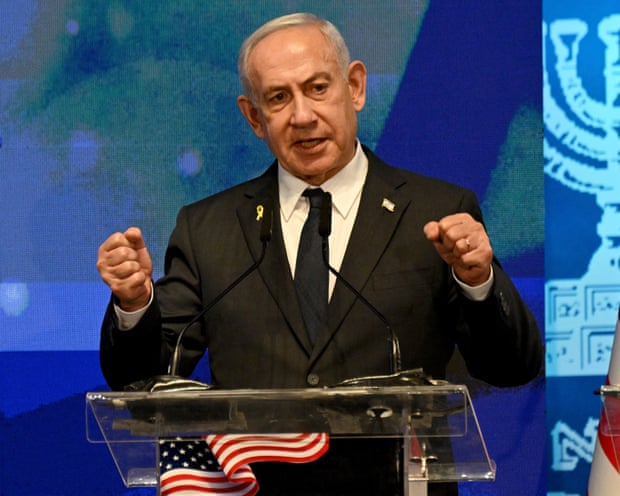
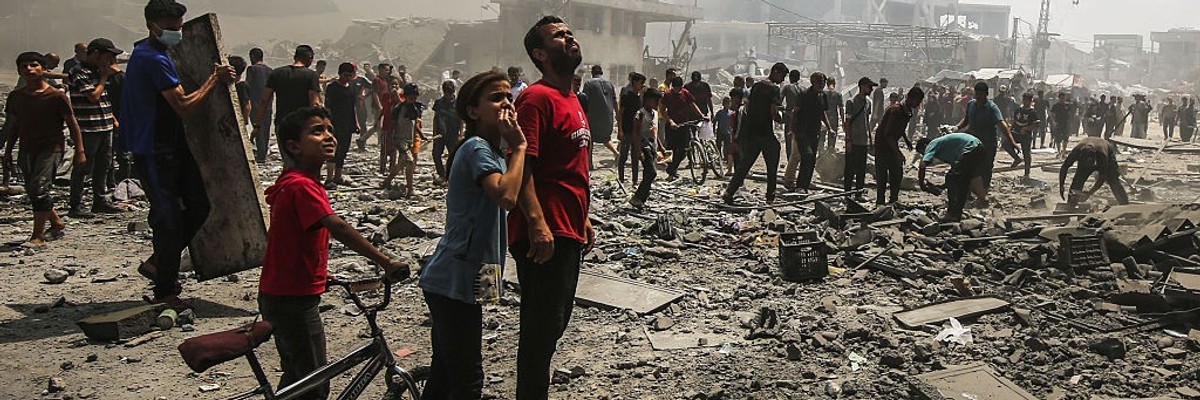
The commission concluded that statements by Benjamin Netanyahu and other officials were ‘direct evidence of genocidal intent’. Photograph: Debbie Hill/Reuters
Commission’s 72-page legal analysis cites examples including scale of killings, aid blockages and forced displacement
A UN commission of inquiry concluded on Tuesday that Israel had committed genocide in Gaza and that top Israeli officials including the prime minister, Benjamin Netanyahu, had incited these acts.
It cited examples of the scale of the killings, aid blockages, forced displacement and the destruction of a fertility clinic to back up its genocide finding, adding its voice to rights groups and others that have reached the same conclusion.
“Genocide is occurring in Gaza,” said Navi Pillay, the head of the commission of inquiry on the occupied Palestinian territory and a former international criminal court judge.
“The responsibility for these atrocity crimes lies with Israeli authorities at the highest echelons who have orchestrated a genocidal campaign for almost two years now with the specific intent to destroy the Palestinian group in Gaza.”
Israel has declined to cooperate with the commission. Israel’s diplomatic mission in Geneva accuses the commission of having a political agenda against Israel.
“Israel categorically rejects this distorted and false report and calls for the immediate abolition of this commission of inquiry,” a statement from the foreign ministry said.
The commission’s 72-page legal analysis is the strongest UN finding to date but the body is independent and does not officially speak for the UN. The UN has not yet used the term genocide but is under mounting pressure to do so.
Genocide denier and Current UK Prime Minister Keir Starmer is quoted that he supports Zionism without qualification. He also confirms that UK air force support has been essential in Israel’s mass-murdering genocide. Includes URLs https://www.declassifieduk.org/keir-starmers-100-spy-flights-over-gaza-in-support-of-israel/ and https://youtu.be/O74hZCKKdpAKeir Starmer objects to criticism of the IDF. He asks how could anyone object to them starving people to death, forced marches like the Nazis did, bombing Gaza’s hospitals and universities, mass-murdering journalists, healthworkers and starving people queuing for food, killing and raping prisoners and murdering children. He calls for people to stop obstructing his genocide for Israel.
This work by Middle East Monitor is licensed under a Creative Commons Attribution-NonCommercial-ShareAlike 4.0 International License.
Pose for a group photo following the Gulf Cooperation Council (GCC) Foreign Ministers meeting with Japan’s Foreign Minister in Kuwait City on September 1, 2025. [Photo by YASSER AL-ZAYYAT/AFP via Getty Images]
The Gulf Cooperation Council (GCC) called Monday for an immediate and lasting ceasefire in Gaza, the release of all hostages and detainees, and unrestricted humanitarian access to the enclave, Anadolu reports.
In a final communiqué following a ministerial session in Kuwait, the bloc pressed for full implementation of UN Security Council Resolution 2735, adopted in June 2024, and praised mediation efforts led by Qatar, Egypt and the US.
The ministers condemned Israel’s actions in Gaza as genocide, citing mass killings, forced displacement, starvation policies and the destruction of homes, hospitals, schools, mosques and churches. They urged the international community to take urgent steps to halt these crimes and hold perpetrators accountable.
The GCC rejected any Israeli attempt to annex parts of Gaza or impose direct military rule, stressing that Gaza and the West Bank must remain united under the Palestinian Authority.
The council also condemned repeated Israeli attacks on humanitarian convoys and aid workers, recalling UN Security Council Resolution 2730 on protecting humanitarian staff.
It welcomed statements by the European Union and a coalition of 26 international partners in July calling for an immediate end to the war and unrestricted delivery of aid.
On the Palestinian issue, the GCC reaffirmed its commitment to a two-state solution, calling for an independent Palestinian state on the 1967 borders with East Jerusalem as its capital, in line with the Arab Peace Initiative and international law.
It praised an international conference held at the UN last month, co-chaired by Saudi Arabia and France, which underscored support for setting a timeline to establish Palestinian statehood and ensure regional stability.
The ministers also welcomed the planned recognition of Palestine by France, the UK, Portugal, Malta, Canada, Australia and New Zealand, urging all other states to follow suit.
The GCC condemned Israel’s plan to transfer control of Hebron’s Ibrahimi Mosque to a Jewish religious council, settlement expansion in the West Bank, and calls by Israeli lawmakers to annex the occupied territory.
Israel has killed over 63,500 Palestinians in Gaza since October 2023. The military campaign has devastated the enclave, which is facing famine.
Last November, the International Criminal Court issued arrest warrants for Israeli Prime Minister Benjamin Netanyahu and his former Defense Minister Yoav Gallant for war crimes and crimes against humanity in Gaza.
Israel also faces a genocide case at the International Court of Justice for its war on the enclave.
Genocide denier and Current UK Prime Minister Keir Starmer is quoted that he supports Zionism without qualification. He also confirms that UK air force support has been essential in Israel’s mass-murdering genocide. Includes URLs https://www.declassifieduk.org/keir-starmers-100-spy-flights-over-gaza-in-support-of-israel/ and https://youtu.be/O74hZCKKdpAUK Labour Party government ministers Keir Starmer, Angela Rayner and Rachel Reeves explain that they are partners complicit in Israel’s Gaza genocide. The UK has provided Israel with arms, military and air force support. They explain that they don’t do gas chambers but do do forced marches, starvation, destroy hospitals, mass-murders of journalists and healthcare workers.Vote Labour for Genocide.
The GREAT scheme envisages a bustling port city bisected by a watercourse bordered by up to eight AI -powered high-tech megacities. Photograph: Supplied
Prospectus proposes forced displacement of entire population and puts territory into US trusteeship
A plan circulating in the White House to develop the “Gaza Riviera” as a string of high-tech megacities has been dismissed as an “insane” attempt to provide cover for the large-scale ethnic cleansing of the Palestinian territory’s population.
On Sunday the Washington Post published a leaked prospectus for the plan, which would involve the forced displacement of Gaza’s entire population of 2 million people and put the territory into a US trusteeship for at least a decade.
Named the Gaza Reconstitution, Economic Acceleration and Transformation Trust – or Great – the proposal was reportedly developed by some of the same Israelis who created and set in motion the US- and Israeli-backed Gaza Humanitarian Foundation with financial planning contributed by Boston Consulting Group.
Image from the Gaza Reconstitution, Economic Acceleration and Transformation Trust – or Great – proposal. Photograph: Supplied
Most controversially, the 38-page plan suggests what it calls “temporary relocation of all of Gaza’s more than 2 million population” – a proposal that would amount to ethnic cleansing, potentially a genocidal act.
Palestinians would be encouraged into “voluntary” departure to another country or into restricted, secure zones during reconstruction. Those who own land would be offered “a digital token” by the trust in exchange for rights to redevelop their property, to be used to finance a new life elsewhere.
Donald Fuhrump says that Amerikkka doesn’t bother with crimes or charges anymore, not being 100% Amerikkkan and opposing his real estate intentions is enough.Elon Musk urges you to be a Fascist like him, says that you can ignore facts and reality then.Genocide denier and Current UK Prime Minister Keir Starmer is quoted that he supports Zionism without qualification. He also confirms that UK air force support has been essential in Israel’s mass-murdering genocide. Includes URLs https://www.declassifieduk.org/keir-starmers-100-spy-flights-over-gaza-in-support-of-israel/ and https://youtu.be/O74hZCKKdpA
Palestinians are seen on street following the Israeli attack on ez-Zeytun neighborhood in Gaza City, Gaza on August 8, 2025. (Photo: Mahmoud Issa/Anadolu via Getty Images)
“People are being starved, children are being killed, families have lost everything,” said the United Nations agency for Palestinian Refugees.
The Gaza Health Ministry announced on Monday that more than 100 children in Gaza have died of severe hunger during Israel’s siege of the territory.
As Al Jazeerareported, the Hamas-run Health Ministry said that a total of 222 Palestinians have died from hunger during the siege, including 101 children. The vast majority of these deaths have come in just the last three weeks when the hunger crisis in Gaza started to garner international media attention, the ministry said.
The United Nations Relief and Works Agency for Palestine Refugees in the Near East on Monday emphasized the direness of the situation in a statement calling for a cease-fire to allow more aid into Gaza.
“People are being starved, children are being killed,” the agency said. “Families have lost everything. Political will and leadership can stop an escalation and end the war. Every heartbeat counts.”
Israeli Prime Minister Benjamin Netanyahu has claimed that there is no starvation crisis in Gaza and has said such reports are part of a “fake” propaganda campaign waged by Israel’s enemies.
However, it isn’t just the Gaza Health Ministry warning of a hunger crisis in the region, as international charity Save the Children last week said that 43% of pregnant and breastfeeding women who showed up to its clinics in Gaza last month were malnourished, which represented a threefold increase since March, when the Israeli military imposed a total siege on the area.
The latest numbers about starvation in Gaza come as the Israeli government is pushing forward with a plan to fully invade and occupy Gaza, which experts have warned will only exacerbate the humanitarian crisis among its people.
“If these plans are implemented, they will likely trigger another calamity in Gaza, reverberating across the region and causing further forced displacement, killings, and destruction,” said Miroslav Jenca, the United Nations assistant secretary general, over the weekend.
A Palestinian boy walks among the rubble of a home destroyed by Israeli bombing in Jabalia, Gaza, Palestine on May 29, 2025. (Photo: Bashar Taleb/AFP via Getty Images)
“The pattern suggests not an effort to neutralize a threat, but a deliberate campaign to dismantle and depopulate Gaza—a process of forced displacement which is a war crime.”
Israel’s U.S.-backed mass displacement of Palestinians in the Gaza Strip “is entirely erasing Gaza,” a leading international charity said Thursday as the United Nations’ Middle East peace envoy warned that ongoing airstrikes, forced starvation, and general despair have plunged the embattled coastal enclave into “an abyss.”
Since unilaterally breaking a cease-fire on March 2, “Israel issued nearly one displacement order every two days, strangling people into isolated areas covering less than 20% of the Gaza Strip,” Nairobi, Kenya-based Oxfam International noted.
“Combined with deliberate deprivation, this reveals a strategy not of targeting militants, but of dismantling and erasing Gaza itself,” Oxfam added. Some Israeli leaders have explicitly called for Gaza’s “erasure” to avenge the Hamas-led October 7, 2023 attack on Israel.
“People are so exhausted, many would rather face death than flee again.”
“For over 600 days, Israel has been saying it’s targeting Hamas, but it is civilians who have been corralled, bombed, and killed en masse every day,” said Bushra Khalidi, Oxfam’s policy lead in the Occupied Palestinian Territory.
“The displacement orders follow a clear and calculated pattern: using the threat of violence to herd civilians into ever-shrinking zones of confinement,” Khalidi added. “This isn’t counterterrorism, as Israel alleges—it’s the systematic clearing of Gaza through militarized force into enclaves of internment.”
📽️ WATCH: This map visualizes #Gaza’s systematic erasure. Since breaking the ceasefire, Israel issued nearly one displacement order every two days, strangling people into isolated areas covering less than 20 percent of the Gaza Strip. Find out more: oxf.am/3Hbshlz
Oxfam analyzed Israel’s more than 30 displacement orders, which, combined with Israel Defense Forces (IDF)-designated “no-go zones,” cover more than 80% of the 141-square mile Gaza Strip.
“The sheer scale and relentless frequency of these orders have made it virtually impossible for people to find refuge,” the charity said. “The pattern suggests not an effort to neutralize a threat, but a deliberate campaign to dismantle and depopulate Gaza—a process of forced displacement which is a war crime.”
As Oxfam noted:
In just the last week (15–20 May), over 160,000 people were displaced—part of a broader total of nearly 600,000 people displaced since March 18, many of them repeatedly. One of the most significant recent orders, issued on 20 May, covered 34.9 square kilometers, roughly 10% of Gaza’s land area, that affected 150,000–200,000 people in North Gaza’s Beit Lahia and Jabalia. The effect of such orders on already-displaced populations has been devastating.
“Imagine trying to move with four children or an elderly parent in the middle of the night, with no transport and nowhere to go,” said Oxfam gender adviser Fidaa Alaraj, who has been displaced with her family several times. “People are so exhausted, many would rather face death than flee again.”
Fugitive Israeli Prime Minister Benjamin Netanyahu—who is wanted by the International Criminal Court for alleged war crimes and crimes against humanity in Gaza, including extermination and forced starvation—recently said that Israel will control all of Gaza after Operation Gideon’s Chariots, a campaign to conquer, ethnically cleanse, and indefinitely occupy the strip.
Far-right members of Netanyahu’s Cabinet and the Israeli Knesset want to permanently seize Gaza and reestablish Jewish-only apartheid colonies in the coastal enclave, which U.S. President Donald Trump has proposed taking over and turning into the “Riviera of the Middle East.”
“There is one essential condition: We must not reach a situation of famine, both from a practical standpoint and a diplomatic one,” Netanyahu said on May 19. “People simply won’t support us.”
While 82% of Israelis surveyed in a recent poll said they supported the ethnic cleansing of Gaza—and nearly half backed a biblical genocide of Palestinians—much of the world is aghast at Israel’s annihilation of the strip, which has left more than 191,000 people dead, maimed, or missing and around 2 million others forcibly displaced, often more than once.
Meanwhile, the famine against which Netanyahu warned looms larger than ever as hundreds of Gazans, mostly children and the elderly, have recently died from malnutrition and lack of medical care, according to local officials.
On Thursday, Sigrid Kaag, the interim U.N. Special Coordinator for the Middle East Peace Process, warned that Gazans are “being starved and denied the very basics” by Israel, which in March tightened an already crippling “complete siege” of Gaza. The blockade has been cited in the South Africa-led genocide case against Israel currently before the International Court of Justice.
“The entire population of Gaza is facing the risk of famine,” she warned, likening the trickle of aid allowed into the strip by Israel to offering “a lifeboat after the ship has sunk.”
Kaag highlighted the despair pervasive among Gazans, who she said bid farewell not by saying, “Goodbye, see you tomorrow,” but rather with the words “see you in heaven.”
“Death is their companion. It’s not life, it’s not hope,” she said.
“Since the collapse of the ceasefire in March, civilians have constantly come under fire, confined to ever-shrinking spaces, and deprived of lifesaving relief,” Kaag added. “Israel must halt its devastating strikes on civilian life and infrastructure.”
“This annihilation campaign and the bloodshed must end.”
Echoing Kaag’s remarks, Oxfam’s Khalidi said that “this annihilation campaign and the bloodshed must end. It is long past time for Western governments and other influential powers to move beyond statements and apply meaningful pressure on Israel to lift the siege and abandon any designs on annexing Gaza.”
“Peace cannot be brokered on the ruins of Gaza nor the theft of Palestinian land,” she stressed. “Ahead of the Two-State Solution Summit planned in New York next month, world leaders must urge Israel to lift the siege and abandon any annexation plans of Gaza or the West Bank.”
“What’s at stake is not only Palestine’s future,” Khalidi argued, “but the integrity of every nation that claims to uphold international law.”
Genocide denier and Current UK Prime Minister Keir Starmer is quoted that he supports Zionism without qualification. He also confirms that UK air force support has been essential in Israel’s mass-murdering genocide. Includes URLs https://www.declassifieduk.org/keir-starmers-100-spy-flights-over-gaza-in-support-of-israel/ and https://youtu.be/O74hZCKKdpAUK Labour Party Shadow Foreign Secretary repeatedly heckled at a speech to the Fabian Society over his and the Labour Party’s support for and complicity in Israel’s genocide of Gaza.