IPCC Scientist Warns India-Pakistan Record Temps ‘Testing Limits of Human Survivability’

Spread the love

Republished from the Common Dreams

“Fossil fuels did this,” said one climate justice campaigner. “Unless we ditch fossil fuels immediately in favor of a just, renewable-energy based system, heatwaves like this one will continue to become more intense and more frequent.”

KENNY STANCILMay 2, 2022

As record-breaking temperatures continue to pummel the Indian subcontinent—endangering the lives of millions of people and scorching crops amid a global food crisis—climate scientists and activists are warning that deadly public health crises of this sort will only grow worse as long as societies keep burning fossil fuels.

“Governments can no longer approve fossil fuel projects, and financial institutions can no longer fund them, without our suffering on their hands.”

“This heatwave is definitely unprecedented,” Chandni Singh, senior researcher at the Indian Institute for Human Settlements and a lead author at the Intergovernmental Panel on Climate Change (IPCC), told CNN on Monday. “We have seen a change in its intensity, its arrival time, and duration.”

Although heatwaves are common in India, especially in May and June, overpowering temperatures arrived several weeks earlier than usual this year—a clear manifestation of the fossil fuel-driven climate emergency, according to Clare Nullis, an official at the World Meteorological Organization.

As CNN reported:

The average maximum temperature for northwest and central India in April was the highest since records began 122 years ago, reaching 35.9º and 37.78ºC (96.62º and 100ºF) respectively, according to the Indian Meteorological Department (IMD).

Last month, New Delhi saw seven consecutive days over 40ºC (104ºF), three degrees above the average temperature for the month of April, according to CNN meteorologists. In some states, the heat closed schools, damaged crops, and put pressure on energy supplies, as officials warned residents to remain indoors and keep hydrated.

The heatwave has also been felt by India’s neighbor Pakistan, where the cities of Jacobabad and Sibi in the country’s southeastern Sindh province recorded highs of 47ºC (116.6ºF) on Friday, according to data shared with CNN by Pakistan’s Meteorological Department (PMD). According to the PMD, this was the highest temperature recorded in any city in the Northern Hemisphere on that day.

“This is the first time in decades that Pakistan is experiencing what many call a ‘spring-less year,” Pakistan’s Minister of Climate Change, Sherry Rehman said in a statement.

April’s record-shattering temperatures came on the heels of India’s hottest March in more than a century and one of its driest. Meanwhile, the region’s annual monsoon season is still weeks away.

“This is what climate experts predicted and it will have cascading impacts on health,” said Singh. “This heatwave is testing the limits of human survivability.”

In a statement released late last week, Shibaya Raha, a senior digital organizer with 350.org South Asia, said that “we cannot deny this climate crisis any longer. We are experiencing heatwaves in spring.”

“The heat is unbearable and people are suffering,” Raha continued. “Many in heavily populated areas do not have access to air conditioning, and workers with outdoor jobs are unable to carry out their work in this extreme heat, impacting sources of income.”

Land surface temperatures—a measure of how hot the Earth’s surface would feel to the touch in a particular location—exceeded 60ºC or 140ºF in parts of northwest India on Saturday, according to satellite imagery.

In addition to putting the lives of millions of farmers at risk, extreme heat is wreaking havoc on wheat fields. Gurvinder Singh, director of agriculture in the northern state of Punjab, known as “India’s breadbasket,” told CNN that the April heatwave reduced yields by 500 kilograms per hectare.

“The IPCC report predicts significant increases in heatwaves globally, but we are the human faces of that science,” said Raha. “It looks daunting on paper but is even more devastating in reality and we demand immediate climate action.”

Namrata Chowdhary, chief of public engagement at 350.org, stressed that “the truth behind these heatwaves is searingly clear: fossil fuels did this.”

“While these temperatures are quite literally shocking, they come as no real surprise to communities that have long since lived on the frontlines of the climate crisis,” Chowdhary continued. “This is the latest spike in a rapidly worsening disaster, one that was foretold by climate activists the world over.”

“The IPCC report had already predicted that this densely populated region, where the vulnerabilities of over a billion people are compounded by power outages and lack of access to water, will be one of the worst affected by climate impacts,” said Chowdhary.

Zeke Hausfather, a climate scientist and previous IPCC contributor, pointed out last week that the current heatwave is occurring in the context of 1ºC and 1.2ºC of warming in India and Pakistan, respectively.

The United Nations warned last year that even if governments around the world fulfill their current greenhouse gas-reduction pledges—few of which are backed by legislation or dedicated funding—the planet is whirling toward a “catastrophic” global temperature rise of 2.7ºC by 2100.

Based on the world’s current emissions trajectory, India and Pakistan are expected to experience 3.5ºC of warming by century’s end, according to country-level projections from researchers at Berkeley Earth.

“Unless we ditch fossil fuels immediately in favor of a just, renewable-energy based system,” said Chowdhary, “heatwaves like this one will continue to become more intense and more frequent.”

Raha added that “governments can no longer approve fossil fuel projects, and financial institutions can no longer fund them, without our suffering on their hands.”


Our work is licensed under Creative Commons (CC BY-NC-ND 3.0). Feel free to republish and share widely.Comments 

Continue ReadingIPCC Scientist Warns India-Pakistan Record Temps ‘Testing Limits of Human Survivability’

No market for proposed Cumbrian coalmine

Spread the love

Steel boss dismisses claim that sector needs new Cumbrian coalmine

As final decision looms on controversial pit, industry expert says there is no domestic market for its fuel

Claims that a new coalmine in Cumbria will help supply British-made steel and replace Russian imports do not “stack up”, a senior industry figure has warned, as the government prepares to make a final decision over the project.

Supporters of the proposed mine, which would be the UK’s first new coalmine in 30 years, have suggested that at least a share of the coal produced would be used in domestic steel production. They also say it could lower reliance on Russian coking coal in the wake of the invasion of Ukraine.

However, influential figures in the steel industry have become increasingly frustrated about the claims – with the two domestic steel producers understood to be unlikely to be significant customers for the mine’s coal. Chris McDonald, chief executive of the Materials Processing Institute, which serves as the UK’s national centre for steel research, said there was no demand from his industry for the West Cumbria mine.

Continue ReadingNo market for proposed Cumbrian coalmine

Climate protest news 28 April 2022

Spread the love

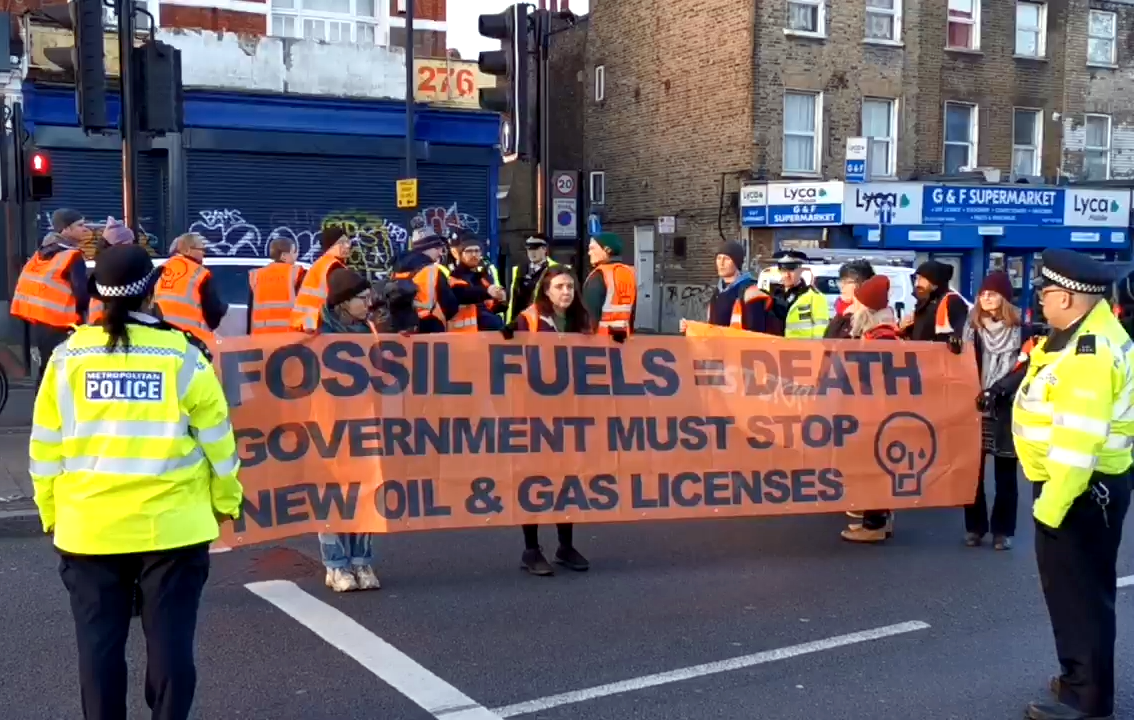
Just Stop Oil protesters sabotage petrol pumps on M25 motorway

About 35 supporters of the Just Stop Oil campaign staged blockades at the Cobham services in Surrey and the Clacket Lane services in Kent, both on the M25, smashing the display glass on petrol pumps with hammers and defacing them with spray paint.

The action against new fossil fuel targets came after the companies controlling the fuel terminals that had previously been targeted obtained civil injunctions banning protests at their sites.

The activists struck at the two motorway services at 7am. A video from one site showed a campaigner using a small window-breaking hammer to smash the glass on one pump, and spraying the broken dial with orange spray paint.

Continue ReadingClimate protest news 28 April 2022

Extinction Rebellion scientists: why we glued ourselves to a government department

Spread the love

Charlie Gardner, University of Kent; Emily Cox, Cardiff University, and Stuart Capstick, Cardiff University

One recent Wednesday, while most scientists around the world were carrying out their research, we stepped away from our day jobs to engage in a more direct form of communication.

Along with more than 20 others from Scientists for Extinction Rebellion and assisted in our efforts by Doctors for Extinction Rebellion, we pasted scientific papers to the UK government’s Department of Business, Energy and Industrial Strategy (BEIS). A group of us glued ourselves to the building, and nine scientists were arrested.

This kind of action may seem extreme for a scientist, but these are no ordinary times. As most members of the UK public now recognise, addressing the climate crisis requires drastic changes across society. In 2019, the UK parliament itself declared a climate emergency – and in an emergency, one must take urgent action.

Seemingly endless academic papers and reports highlight the need for the immediate and rapid decarbonisation of the global economy if we are to avert climate change so serious that it risks the collapse of human civilisation. The International Energy Agency, a respected policy advisory body to countries around the world, warned in 2021 that “if governments are serious about the climate crisis, there can be no new investments in oil, gas and coal, from now – from this year”.

Prime Minister Boris Johnson has stated that “it is time for us to listen to the warnings of the scientists” on the climate emergency. But despite this, the UK government is choosing not to wind down the fossil fuel industry, but instead to expand it.

The government recently published its energy security strategy. However, rather than focusing on home insulation, energy efficiency and onshore wind as most experts suggest, the strategy promotes the expansion of oil and gas production.

Such measures do very little to address the pressing issues of rising fuel bills or heavy imports of Russian oil and coal. And as a self-proclaimed leader in global climate action, the UK’s doubling down on fossil fuels also sends a dangerous message to the rest of the world.

Evidence alone is easily ignored

In a choice between fossil fuels and a liveable planet, the government has chosen oil and gas. For scientists who have dedicated their lives to research, this is hard to take. Many of us do our work in the belief that, if we provide scientific information to decision-makers, they will use it to make wise decisions in the public interest.

Yet the global response to the climate crisis, despite decades of increasingly dire warnings, shows this to be naive. The reason is as simple as it is obvious: governments don’t respond to science on these matters, but to the corporate interests that invest so heavily in political donations and lobbying.

Scientists must face a difficult truth that doesn’t come easily to those of us who are most comfortable working diligently on experiments and journal articles: evidence alone, even if expertly communicated, is very easily ignored by those that do not wish to hear it.

If we are to help bring about the transition away from fossil fuels that the world so urgently needs, we are going to have to become much harder to ignore. This does not mean disregarding the evidence or abandoning our integrity: quite the opposite. We must treat the scientific warnings on the climate crisis with the seriousness that they deserve.

Become hard to ignore

History suggests that one of the most powerful ways to become hard to ignore – and one of the few options available to those who do not have deep pockets or the ear of politicians – may be through nonviolent civil disobedience, the refusal to obey certain laws in order to bring public and media attention to an unjust situation.

From universal suffrage to civil rights for people of colour and action on the Aids pandemic, many of the most progressive social changes of the 20th century were brought about in this way. Many would likely agree that such actions are morally justified in a planetary emergency.

The recent blossoming of environmental civil disobedience movements around the world, led by Extinction Rebellion and the Greta Thunberg-inspired youth strikes, has been hugely influential in changing the global conversation on climate. These movements have been linked to an unprecedented surge of public concern and awareness about the climate crisis.

The scientists arrested on that Wednesday included an expert in energy policy, an air pollution specialist, three ecologists and two psychologists, across all career stages from junior researchers to established professors. Some work on the planetary crisis itself, others on our societal responses to it, but none of us took our actions lightly.

Our understanding of our planetary peril obliges us to take action to sound the alarm, even if it means risking our civil liberties. And we are not alone. On April 6 more than 1,200 scientists in 26 countries participated in a global Scientist Rebellion, which included pasting scientific papers to the UK headquarters of oil giant Shell.

Civil disobedience doesn’t always need a particular target to be effective, because the main objective is to ring the alarm by generating media and wider public attention. Extinction Rebellion protests, for example, has targeted fossil fuel infrastructure, media and finance institutions and airports used by private jets, in addition to the general disruption caused by roadblocks.

But we went to BEIS because, as the government department responsible for climate change, it should be leading the transition away from fossil fuels. Instead, through enabling and promoting new fossil fuel extraction, it is doing the opposite.

Recent acts of law-breaking by scientists may seem radical, but the world’s most senior diplomat disagrees. On the release of the IPCC’s latest report, the UN Secretary General António Guterres said: “Climate activists are sometimes depicted as dangerous radicals. But the truly dangerous radicals are the countries that are increasing the production of fossil fuels.”

He could not have said it more clearly: while we scientists may have been breaking the law, it is the government that’s placing us all in danger.

Charlie Gardner, Associate Senior Lecturer, Durrell Institute for Conservation and Ecology, University of Kent; Emily Cox, Research Associate, Environmental Policy, Cardiff University, and Stuart Capstick, Senior Research Fellow in Psychology, Cardiff University

This article is republished from The Conversation under a Creative Commons license. Read the original article.

First dog

Continue ReadingExtinction Rebellion scientists: why we glued ourselves to a government department