Just Stop Oil are demanding that the UK government halt any new licensing or consents for oil, gas and coal extraction in the UK.
In an escalation of resistance from previous weeks, 180 Just Stop Oil supporters, in fourteen groups, began marching on key roads in central London. They marched in groups of between 5 and 25 supporters, carrying placards reading “new oil = murder”, “ hottest June ever” and “can’t eat oil”.
Police followed numerous groups before marches began and stopped and searched dozens of people. Police began issuing Public Order Act (Section 12) notices at 8:10am, just minutes after the first march set off. Three Just Stop Oil supporters were arrested after 15 minutes of marching on Liverpool Street. Around twenty Just Stop Oil supporters were arrested as they attempted to leave Lambeth bridge, however 11 of these were de-arrested. The team in Victoria was removed by 8:35. Police were seen following marchers on the tube at 9:00am. Another two were arrested on Liverpool Street at 9:45. At 10:30 two were arrested on Victoria Street.
Frances Davis, 20, from Norwich spoke to the camera as she was held in handcuffs:
“I’ve been marching for just under 15 minutes and I’m under arrest for demanding the same thing as the IPCC (Intergovernmental Panel on Climate Change), the United Nations and the government’s own scientific advisors have been demanding- and we’ve just been ignored. We’ve tried everything else and now I’m in handcuffs, just for going on a march.”
This morning’s marches come as extreme heat continues to ravage Europe and now 110 million people have been issued extreme heat warnings in the US, as a heat dome over the US south-west has translated into coast to coast alerts. Temperature records could be broken in as many as 38 cities. In Las Vegas security guards can be seen guarding the fountains of upscale casinos and hotels to prevent people from jumping in, whilst mobile clinics are reporting treating homeless people suffering from third-degree burns.
Since the Just Stop Oil campaign launched on 14th February 2022, there have been over 2,200 arrests and 138 people have spent time in prison, many without trial. Just Stop Oil supporters Morgan Trowland and Marcus Decker are serving three-year prison sentences for resisting new oil, gas and coal in the longest sentences for peaceful climate action in British history.
Energy firms have made record profits by increasing production of oil and gas, far from their promises of rolling back emissions
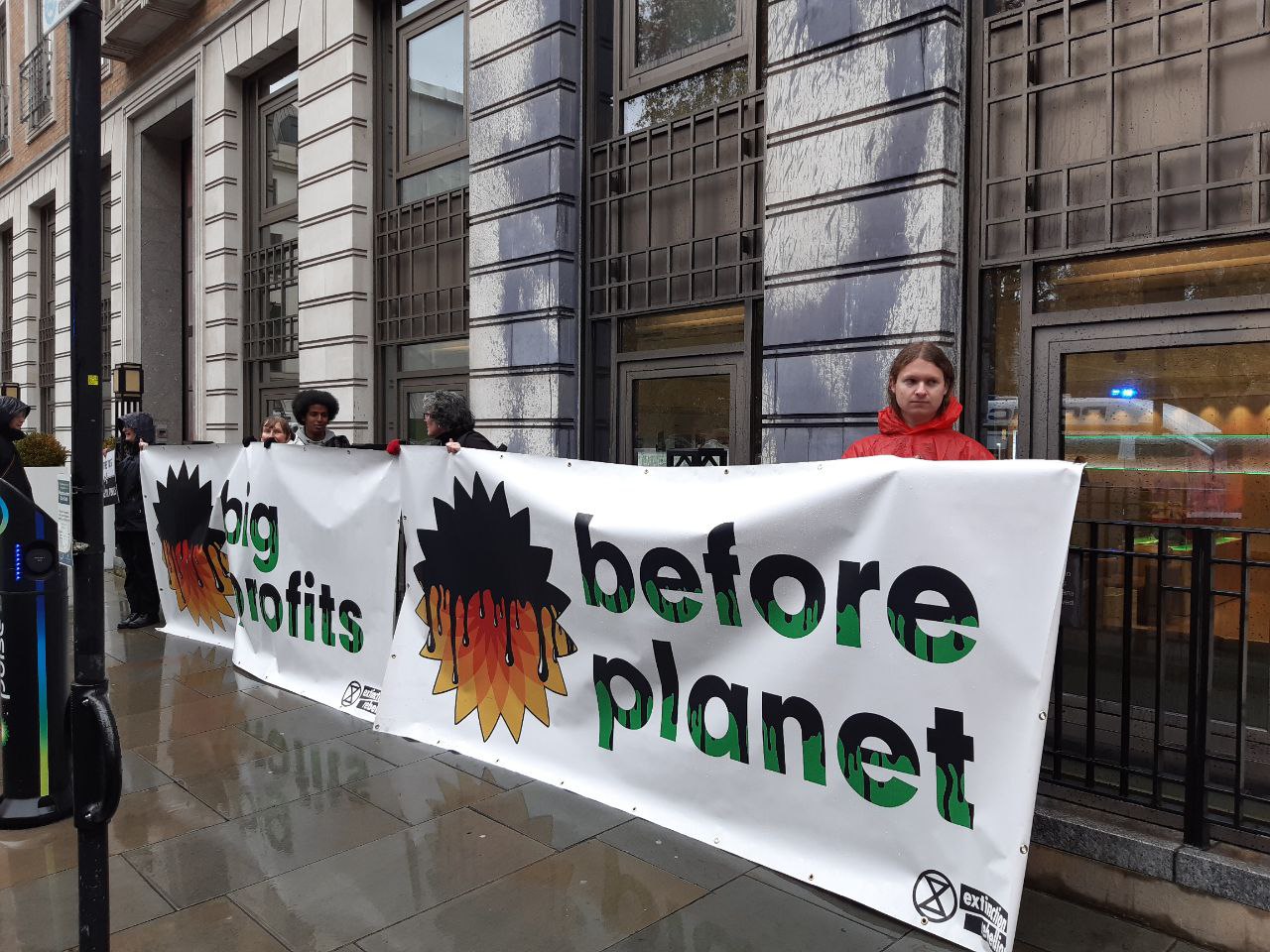
Extinction Rebellion protests at BP. Banner reads big profits before planet
…
Oil majors have, over the past several years, rolled out pledges to decrease oil and gas production and slash their emissions, citing concerns about the climate crisis. But more recently, many have walked those plans back.
Amid record-shattering warmth this February, BP scaled back an earlier goal of lowering its emissions by 35% by 2030, saying it will aim for a 20 to 30% cut instead. ExxonMobil quietly withdrew funding for a heavily publicized effort to use algae to create low-carbon fuel. And Shell announced that it would not increase its investments in renewable energy this year, despite earlier promises to dramatically slash its emissions.
Climate-fueledextreme weatherpersisted through spring and summer. But fossil fuel companies have only doubled down on their oil- and gas-filled business models. Shell promised to cut oil production by 20% by 2030, but then this year said it already met that goal by selling off some operations to another oil company –thereby not reducing emissions in the atmosphere. BP has also expanded gas drilling. And Exxon’s CEO, Darren Woods, told an industry conference last month that his company plans to double the amount of oil produced from its US shale holdings within the next five years.
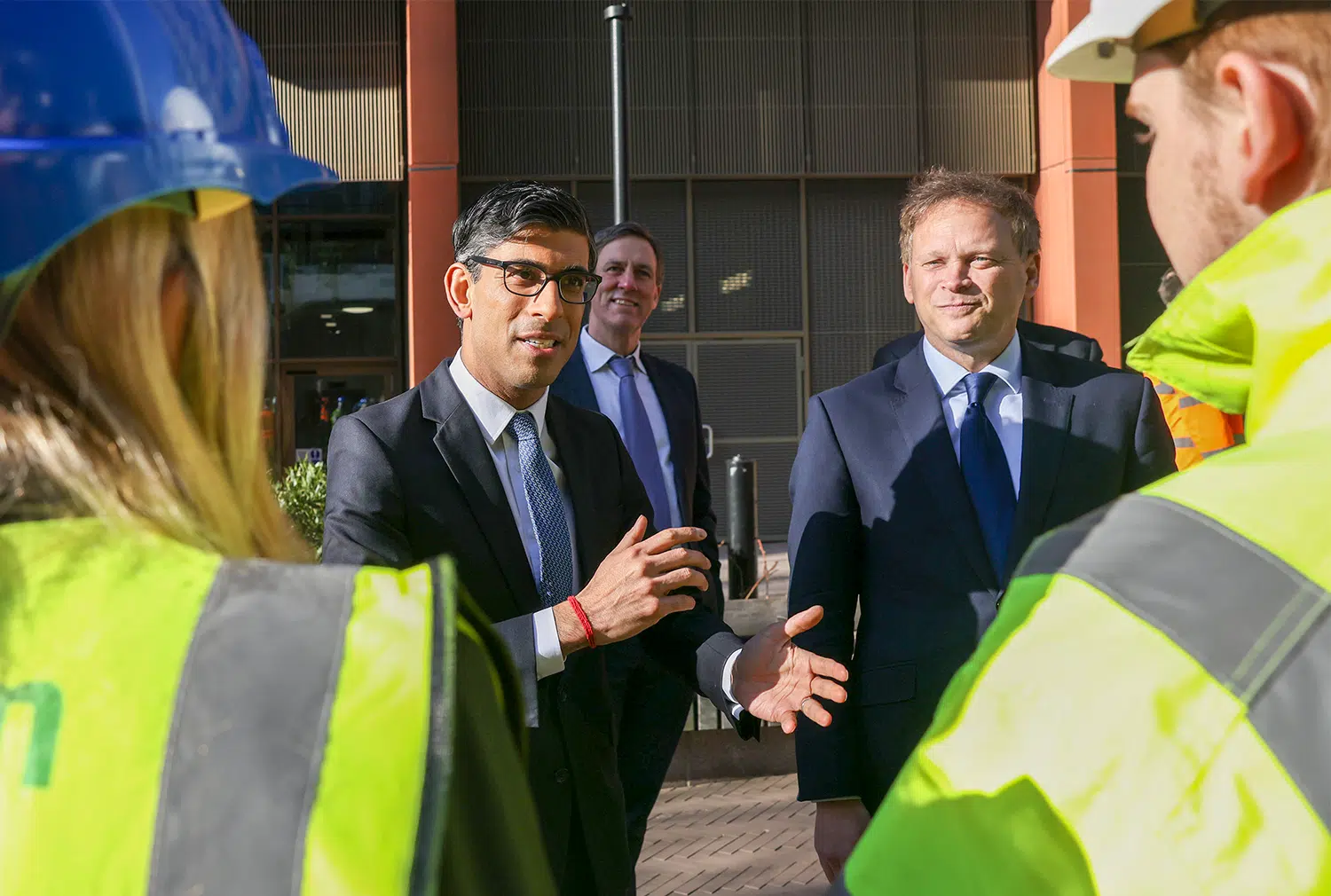
Prime Minister Rishi Sunak and Energy Security and Net Zero Secretary Grant Shapps. Credit: Simon Dawson / 10 Downing Street, CC BY-NC-ND 2.0
Individuals and entities linked to climate denial, fossil fuels and high pollution industries donated more than £3.5 million to the Conservative Party last year, DeSmog can reveal.
Electoral Commission records show that the party and its MPs received considerable sums from the highly polluting aviation and construction industries, mining and oil interests, and individuals linked to the Global Warming Policy Foundation, a think tank that denies climate science.
This revelation comes on the government’s supposed ‘green day’, when it has announced a long list of policies on energy and the transition to net zero.
However, rather than strengthen the commitment to the government’s legally binding climate targets, the policies are expected to entrench the role of fossil fuels in the UK’s energy system.
The government’s updated measures include a plan to loosen restrictions on oil and gas extraction in the North Sea, in which it says “we remain absolutely committed to maximising the vital production of UK oil and gas as the North Sea basin declines”.
The government’s failure to act on a number of key recommendations in the net zero review conducted by Conservative MP Chris Skidmore, along with a legal challenge to the UK’s climate plans, has prompted outrage from green campaigners.
“It’s clear this is not a strategy, just an assembly of lobby interests,” Tom Burke, a co-founder of the E3G think tank told The Guardian earlier this week.
Caroline Lucas told DeSmog that the government’s net zero announcements were becoming “muddier and murkier by the moment”.
The government’s green day “couldn’t be any more of a misnomer, when the Conservative Party is raking in millions of pounds’ worth of dirty donations from fossil fuel interests and climate deniers”, she added.
High-Pollution Industries
Aviation entrepreneur Christopher Harborne donated the largest total sum to the Conservatives in 2022, gifting £1.5 million to the party, which had an income of £31.7 million for the year ending 2021.
Harborne is the owner of AML Global, an aviation fuel supplier operating in 1,200 locations across the globe with a distribution network that includes “main and regional oil companies”, according to its website. Harborne is also the CEO of Sheriff Global Group, which trades in private jets.
Aviation emissions accounted for eight percent of the UK’s annual greenhouse gas emissions before the pandemic, according to the government’s Climate Change Committee (CCC).
Harborne has previously provided gifts to Conservative MP Steve Baker, who co-founded an anti-green group of back benchers, the Net Zero Scrutiny Group. Harborne has also donated some £6.5 million to the Brexit Party – now Reform UK – whose co-founder Nigel Farage has called for a referendum on the government’s net zero targets. Harborne has rarely spoken about the climate crisis, so the details of his personal views are unknown.
Harborne and all those cited in this article have been approached for comment.
One of the largest donations to the party in 2022 came from Mark Bamford, a member of the JCB construction dynasty, who gave £973,000. The JCB group, a multinational firm that manufactures equipment for construction, also donated more than £36,000 to the party during the year.
According to the government’s Environmental Audit Committee, the UK’s built environment is responsible for 25 percent of the UK’s greenhouse gas emissions, and “there has been a lack of government impetus or policy levers to assess and reduce these emissions”. The construction industry is also responsible for 18 percent of large particle pollution in the UK, a figure that rises to 30 percent in London, according to a recent report by Impact on Urban Health (IoUH) and the Centre for Low Emission Construction (CLEC).
Fossil Fuel Interests
The Conservative Party also received considerable sums from those directly tied to the fossil fuel industry.
This included more than £62,000 from Nova Venture Holdings, a firm wholly owned by Jacques Tohme, who describes himself as an “energy investor” on LinkedIn and lists his current role as co-founder and director of Tailwind Energy, an oil and gas company.
According to its website, Tailwind focuses on “maximis[ing] value in UK continental shelf (UKCS) opportunities”, an area which includes the North Sea. Serica Energy reportedly has an agreement in place to buy Tailwind, which will make Serica one of the 10 largest North Sea oil and gas producers.
The party also received £10,000 from Alan Lusty, the CEO of Adi Group, a “leading supplier of engineering services to the petrochemical industry”. These services “add significant value to petrochemical engineering companies”, Adi says, though the firm claims “to work towards delivering a low-carbon economy” through its products. Adi also provides engineering services to the aerospace and automotive industries.
Centrax, a firm that manufactures gas turbines, also gifted £35,000 to the Conservatives.
A further £23,900 was raised from Amjad Bseisu, the CEO of EnQuest, an oil and gas company. Bseisu has lobbied for support to maximise the exploration for fossil fuels in the North Sea, where EnQuest operates.
During the course of his Conservative leadership bid last summer, Rishi Sunak personally received £25,000 from Mick Davis – a mining tycoon and former CEO of the Conservative Party. Davis was the CEO of Xstrata, an Anglo-Swiss firm that specialised in coal production, among other things, before it was acquired by the commodities giant Glencore in 2013.
Sunak received a further £38,000 from Lord Michael Farmer, who founded the Red Kite metals trading and investment firm. According to his register of interests, Lord Farmer currently holds shares in Shell, BP, and Chesapeake Energy Corporation – an oil and gas company. Lord Farmer donated a further £50,000 directly to the Conservative Party in 2022.
Sunak’s leadership opponent Liz Truss was also the beneficiary of donations linked to the fossil fuel industry. Truss received £100,000, her largest single donation, from Fitriani Hay, a former director of Fosroc, which provides “construction solutions” to the oil and gas industry. Her husband, James Hay, is a former executive at the oil supermajor BP.
Truss also received substantial donations from individuals linked to groups lobbying for fracking regulations to be relaxed.
Lord Michael Spencer donated £286,000 to the Conservatives during the year, both personally and via his family firm IPGL, including a £25,000 donation to the Truss campaign. Lord Spencer, a reported billionaire, holds shares in several oil and gas companies.
Lord John Nash likewise donated £55,000 to the party, with the peer’s register of interests listing him as a shareholder in Shell and BHP.
Links to Climate Denial
Individuals and firms with close ties to the GWPF, an organisation that denies climate science, also helped to finance the Conservative Party last year.
This included Sir Michael Hintze, who donated £17,500 to the party and one of its MPs, Brandon Lewis. While Hintze avoids public statements on climate change, he was one of the early funders of the GWPF – an anti-green organisation that opposes what it describes as “extremely damaging and harmful policies” to mitigate climate change.
As revealed by DeSmog, Conservative MP Steve Baker received £5,000 from Neil Record in January 2022. Record is the chair of the Global Warming Policy Forum, the campaign arm of the GWPF, and has donated to the organisation.
Leader of the House of Commons Penny Mordaunt and Home Secretary Suella Braverman each received £10,000 in 2022 from First Corporate Consultants, owned by Terence Mordaunt, who sits on the board of the GWPF. Penny Mordaunt has previously distanced herself from the views of her namesake and donor in relation to climate change.
Net Zero Review
At least 60 new measures were unveiled today, focused on energy supply and the transition to net zero. The policies were previously set for a public launch in Aberdeen, the de facto capital of the UK’s oil and gas industry, before an outcry from green campaigners forced a re-think.
The government’s updated net zero policies are partly a response to a successful legal challenge, which proved that the government had failed to disclose sufficient details of how its climate goals will be achieved.
The revamped strategy is also a response to the net zero review commissioned from Chris Skidmore by former Prime Minister Liz Truss, released in January.
The government has defied several of Skidmore’s recommendations, such as refusing to ban flaring by 2025. Flaring is the process whereby fossil fuel extractors burn off the gas that comes out of the ground while drilling for oil.
Announcements have included the continued expansion of North Sea oil and gas exploration. The North Sea Transition Authority has this week announced that it is advocating new measures to “speed up North Sea oil and gas production” by “streamlin[ing] the buying and selling of assets”.
Green campaigners have suggested that the government’s updated plans continue to fall short of its climate targets – risking further legal action.
On Wednesday, the CCC released a new report on the UK’s climate change adaptation – saying that the country is “strikingly unprepared” for the impacts of global heating.
Baroness Brown, chair of the CCC’s Adaptation Committee, said: “The Government’s lack of urgency on climate resilience is in sharp contrast to the recent experience of people in this country. People, nature and infrastructure face damaging impacts as climate change takes hold. These impacts will only intensify in the coming decades”.
The record heatwave roiling parts of Texas, Louisiana and Mexico was made at least five times more likely due to human-caused climate change, scientists have found, marking the latest in a series of recent extreme “heat dome” events that have scorched various parts of the world.
…
More than 40 million people in the US, including those living in the Texas cities of Houston, San Antonio and Austin, have been placed under excessive heat warnings, raising fears over the health of people vulnerable to the heat and placing Texas’s energy grid under strain from surging air conditioner use.
The heating of the Earth’s atmosphere and oceans by the burning of fossil fuels made the extreme heatwave at least five times more likely, according to a recent analysis by Climate Central, a climate science non-profit. The punishing heat, which is forecast to linger further throughout the week in Texas, is creating “stressful conditions for millions of people”, according to Andrew Pershing, vice-president for science at Climate Central.