Israeli Prime Minister Benjamin Netanyahu arrives for a speech at his Jerusalem office on March 14, 2020 [GALI TIBBON/AFP via Getty Images]
Israeli Prime Minister Benjamin Netanyahu asked yesterday to reduce the number of days and the duration of his appearances before Tel Aviv District Court in his trial on corruption charges. He is due to attend in court from next Tuesday to defend himself against several charges including bribery, fraud and breach of trust.
According to Israel’s Channel 12, the prime minister is asking if he can testify twice a week, instead of three times as decided by the judiciary. “In addition, Netanyahu is requesting that each session be shortened to 5 hours instead of 6 hours, starting at 10:00 and ending at 15:00 local time, instead of the scheduled time between 9:00 and 15:00.”
Netanyahu’s defence team justified this by arguing, “He works almost every day until late at night, whether due to cabinet meetings, security consultations, or the need to communicate with various entities abroad.”
The court has yet to decide on Netanyahu’s request.
Channel 12 reported that court judges had already approved Netanyahu’s request to relocate his trial from Jerusalem to Tel Aviv for security reasons, noting that the sessions will be held in a “secret underground courtroom.”
He was initially scheduled to appear in court last Sunday, but the court agreed to his request to postpone his appearance until next Tuesday, due to his busy schedule.
The Israeli Broadcasting Authority said that media outlets had submitted a request to the court to broadcast Netanyahu’s testimony live, but the court rejected the request.
The corruption cases in which he is indicted are known as Cases 1000, 2000 and 4000, with former Attorney General Avichai Mandelblit filing an indictment against Netanyahu in late November 2019.
Case 1000 involves Netanyahu and members of his family receiving expensive gifts from wealthy businessmen, in exchange for favours and assistance to these individuals in various fields.
Case 2000 involves accusations that Netanyahu agreed with Yedioth Ahronoth newspaper publisher, Arnon Mozes, to obtain positive media coverage in exchange for weakening a rival.
Case 4000 is considered the most serious, in which Netanyahu advanced regulatory decisions that benefited Shaul Elovitch, the controlling shareholder in the Bezeq telecom giant, amounting to hundreds of millions of dollars, in exchange for positive coverage from the company’s Walla news site.
Netanyahu’s trial in these cases began in 2020 and is ongoing. He denies all the charges against him, calling them a political campaign aimed at ousting him.
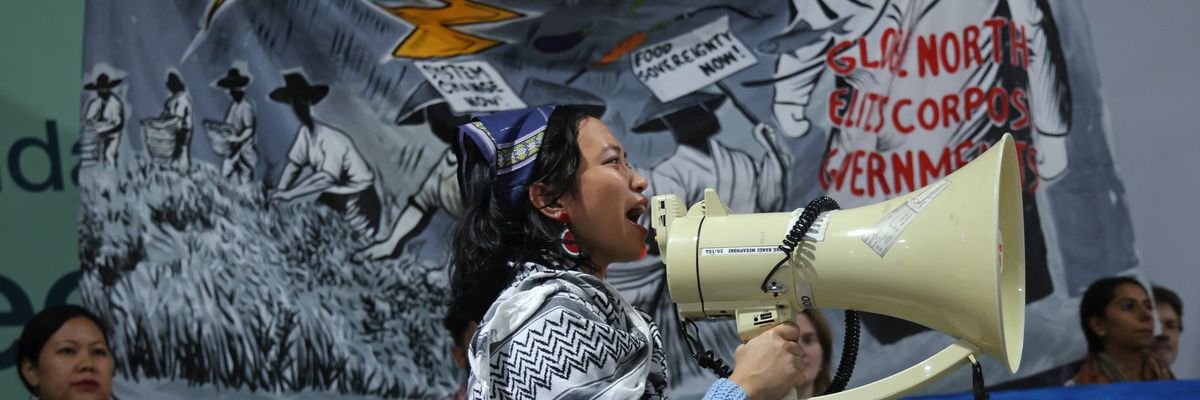
Activists demonstrate against industrial agriculture and agribusiness lobbyists on day eight at the UNFCCC COP29 Climate Conference on November 19, 2024 in Baku, Azerbaijan. (Photo by Sean Gallup/Getty Images)
“By the end of the UN climate talks, we must see at least a trillion dollars in public finance on the table,” said one campaigner.
As the clock winds down at the UN climate summit taking place in Baku, Azerbaijan, green groups are sounding the alarm Thursday following the release of a draft climate finance deal that they say falls short of what’s needed to support climate-vulnerable countries and adequately address the planetary crisis.
“The clock is ticking. COP29 is now down to the wire,” said UN Secretary-General António Guterres on Thursday, just a day before the two-week conference is set to conclude.
Finance has been a major focus of this year’s summit. Under the 20125 Paris Agreement, countries are supposed to come up with a “new collective quantified goal”—or NCQG in COP jargon—that will govern how much money from rich countries will be transferred to developing countries in order to help the latter cut their emissions and adapt to climate change.
No equivalent climate finance arrangement has been agreed to before, though countries at the summit broadly agree that richer countries, who are responsible for much of historic CO2 emissions, should help poorer and more climate-vulnerable nations deal with natural disasters and their transition to green energy.
The draft text that dropped early Thursday, however, was received poorly.
Oxfam International’s climate justice lead, Safa’ Al Jayoussi, said “COP29 must do more than simply repeat the same threadbare promises. Rich countries have spent decades now stalling and blocking genuine progress on climate finance. This has left the Global South suffering the most catastrophic consequences of a climate crisis they did not create. The draft text scandalously misses the crucial element of declaring a clear public commitment to a new climate finance goal.”
Instead of specifying how much annually should be funneled towards developing countries via climate finance, the NCQG draft text displayed “X” in place of any actual figures or monetary commitments.
Oscar Soria, a director at the Common Initiative think tank, told the Guardian: “The negotiating placeholder ‘X’ for climate finance is a testament of the ineptitude from rich nations and emerging economies that are failing to find a workable solution for everyone.”
“By the end of the UN climate talks, we must see at least a trillion dollars in public finance on the table,” added Andreas Sieber, 350.org associate director of policy and campaigns. Economists told the summit attendees last week that developing countries need at least $1 trillion annually by 2030 to deal with climate change.
A specific and shared concern from campaigners was the draft text’s inclusion of carbon market schemes as a way “to scale up” climate finance. While the draft promotes “high-integrity voluntary carbon markets” and other “instruments that mobilize new sources of climate finance and private finance” as part of the equation, critics have long warned that these market-based approaches are nothing but false solutions designed to benefit corporate investors, wealthier nations, and the fossil fuel industry itself.
“Labelling carbon credits as climate finance—which they are unreservedly not—should be axed from the text or risk creating a dangerous escape route for polluters. The same goes for explicitly allowing investments in fossil fuel infrastructure. This is fundamentally incompatible with the goals of the Paris Agreement,” said Laurie van der Burg, Oil Change International’s global public finance manager, in response to the draft text.
While Article 6 of the Paris Agreement allows for the international transfer of carbon credits, groups warned the changes in the COP29 draft would dramatically strengthen the foothold of such schemes.
“Shockingly, COP29 is set to agree to carbon markets that are even worse than the voluntary carbon markets,” said Kirtana Chandrasekaran, a climate campaigner with Friends of the Earth International. “We know these markets have failed. They are riddled with fraud and they do not reduce emissions or provide finance. Communities everywhere and, in fact, the planet itself is on the line.”
Without addressing these concerns, advocates of a meaningful deal at the conference say COP29 is headed for failure.
As 350.org‘s Sieber argued, paying the “historic debt that rich countries owe will enable all nations to take action on climate at home and meet the collective goal agreed last year at COP28—to triple renewable energy, and transition away from fossil fuels. Right now, we only see cowardice and a void in leadership, ignoring the undeniable science that we can’t keep polluting our planet with dirty oil, gas and coal.”
“The time to course correct is now—the European Union and other rich countries must stop playing poker with the planet and humankind’s future at stake,” Sieber added. “It’s time to put their cards on the table and commit real, transformative funding—no more excuses, no more delays, it’s time.”
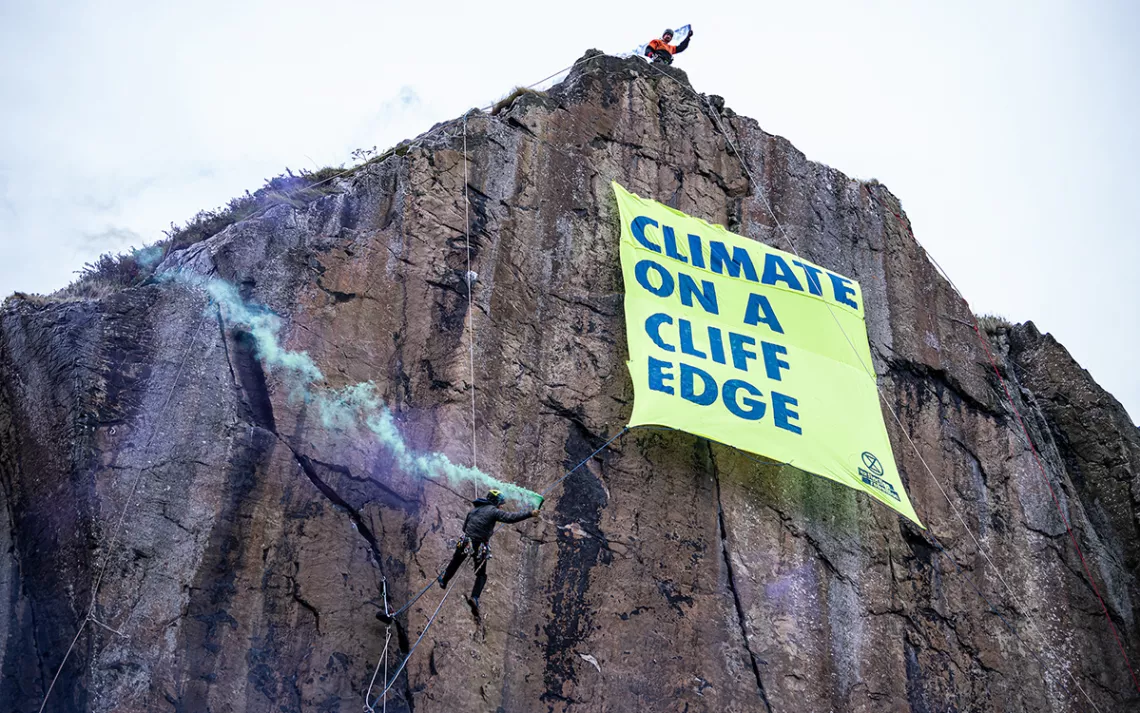
Experienced climbers scale a rock face near the historic Dumbarton castle in Glasgow, releasing a banner that reads “Climate on a Cliff Edge.” One activist, dressed as a globe, symbolically looms near the edge, while another plays the bagpipes on the shores below. | Photo courtesy of Extinction Rebellion and Mark RichardsOrcas comment on killer apes destroying the planet by continuing to burn fossil fuels. Second version, corrected text.
Exclusive: Energy firm making ‘misleading’ claims about ‘neutralising’ gas with carbon credits
The Labour Party’s biggest corporate donor has been accused of “greenwashing” after an investigation by openDemocracy.
Ecotricity Ltd, which has given almost £3.4m to Labour since Keir Starmer became leader in 2020, claims to be “Britain’s greenest energy supplier”.
Yet 99% of the gas it supplies comes from fossil fuels. The company claims this gas is “carbon-neutralised” because it invests in “carbon reduction programmes to cancel out the carbon burned”.
But openDemocracy has learned that Ecotricity has no active carbon credits – despite listing four environmental projects on its website that it says it supports.
When questioned about the company’s claims that “carbon emissions from our fossil fuel gas are offset by investing in carbon reduction schemes”, a spokesperson admitted that some of the schemes it previously supported had not done “as promised” – and said that information on its website would be “refreshed”.
But experts warned that even if the company held active carbon credits, its claims that these “neutralise” its fossil fuel gas would still be misleading.
“It is highly misleading for a company to claim that its product – or itself – is carbon- or climate-neutral,” said Lindsay Otis Nilles from Carbon Market Watch. “These false claims are based on heavily flawed scientific principles and lead to consumer confusion.”
The company has not broken any laws, but it will be illegal to claim that carbon offsets can “neutralise” fossil fuel products in the EU from 2026, as the bloc looks to crack down on greenwashing. An EU directive says these claims create a “false impression to consumers that the consumption of that product does not have an environmental impact”.
Analysis by openDemocracy shows that some of the carbon offset projects that Ecotricity previously pumped money into have been linked to environmental concerns and human rights abuses.
In some cases, records cast doubt on whether the company’s offsetting credits actually helped to reduce emissions at all – since the projects it invested in were already fully funded.
For example, two years ago, Ecotricity purchased credits in the Soubré hydropower plant, the largest hydroelectric dam in Ivory Coast, which was completed in 2017.
The project cost around £452m, 85% of which had already been secured by January 2017, with a loan from EXIM Bank of China. The remaining 15% was covered by the Ivory Coast government.
The Soubré powerplant previously came under fire in a 2019 report that accused it of having an “irresponsible” approach to monitoring its potential environmental impact.
The report, which was published by American environment and human rights organisation International Rivers, also included complaints by workers at the dam of instances of “discrimination and physical abuse” and “threats from the government” when they spoke out.
Meanwhile, the project’s main contractor, Chinese firm Sinohydro – which is responsible for its engineering, procurement and construction – has faced allegations of fraud elsewhere.
The company is currently excluded from projects financed by the European Investment Bank, following an investigation into “misconduct”. And in 2018, another investigation by the African Development Bank found that Sinohydro had “engaged in a fraudulent practice”.
Ecotricity has also held carbon credits in another hydroelectric power plant in Indonesia, called Asahan 1. Reports from as far back as 2012 say the company behind it, PT Bajradaya Sentranusa, had already secured funding from a bank “to take over the entire existing project loans for the construction” when Ecotricity bought the credits.
A spokesperson for Ecotricity said: “The information on the website about carbon reduction projects is being refreshed.”
They added: “We used carbon credits to entirely offset our gas supply for the financial year 2024 which is now closed and our offsetting programme for the financial year 2025 is currently under review which is why we do not currently hold any credits. Any suggestion that we do not or will not offset our gas in the future is false and misleading.”
“Offsetting is an annual accounting period practice and can take place at any point in that [financial year] – that is standard practice. Our offsetting programme for the financial year 2025 is currently under review. Any suggestion that we do not or will not offset our gas is wrong.”
The spokesperson added that Ecotricity is looking at “more direct carbon capture methods”, adding: “Carbon offsetting has been a bridge. We have always been clear about that.”
‘Greenwashing’
Ecotricity not only boasts about its own climate credentials, it also actively warns customers about “greenwashing” by rival energy suppliers.
“A number of energy companies claim green credentials for themselves or for some of their tariffs,” it says, “but are their claims genuine?”
But Ecotricity has itself now been accused of greenwashing. Responding to the company’s claims about carbon offsets, Nilles of Carbon Market Watch told openDemocracy: “It is a fallacy to think that purchasing carbon credits on the voluntary carbon market can magically ‘cancel out’ or ‘offset’ climate harm. Greenwashing practices like this must stop once and for all.”
Ecotricity’s founder, Dale Vince, recently joined Labour’s campaign in Bristol. His involvement in the constituency is controversial because it is seen as one of the few seats the Green Party has a genuine chance of winning in this week’s general election. But Vince tweeted: “Labour has a green manifesto and can make it happen.”
The self-styled “green industrialist” is the outright owner of Ecotricity’s parent company, Green Britain Group Limited. According to the latest accounts filed with Companies House, this firm made £38m profit in the year ending 30 April last year, after bringing in more than £550m turnover.
Responding to openDemocracy, Vince repeated the claim that carbon credits were used to achieve “net neutrality”.
He said: “Ecotricity bought carbon credits from the Asahan and Soubre schemes two years ago – we no longer do so. We’ve been reducing our carbon footprint annually for decades and only recently used carbon credits to achieve net neutrality, for our green gas while we built new gasmills.
“It’s important to reduce as far as possible before using credits, but that world is full of uncertainty, risk and projects that don’t do as promised, which these two schemes appear to be an example of. We welcome the EU move to clamp down on all forms of greenwashing.”
Vince accused openDemocracy of a “smear attack” with a “rather distorted presentation of facts”.
Prior to this response, openDemocracy had repeatedly asked Ecotricity to provide a complete and up-to-date list of its carbon credit portfolio, but it failed to do so.
Last week, Vince told the Financial Times that he was not seeking support for his own energy projects from Labour. “I don’t want support for my projects,” he said, “I’m not interested, life’s too short to be chasing money.”
The latest accounts filed by Green Britain Group Limited show it received £123m in “government grants” in the year ending April 2023. The financial support was designed to pay energy firms to cap prices for consumers.
The previous year, the company received a £9.4m Covid “business interruption” loan to support large companies in the pandemic.
However, Vince told openDemocracy: “Ecotricity hasn’t had any government subsidies.”
Prime Minister Rishi Sunak making a speech at an event at Petyt Hall, London, while on the General Election campaign trail, June 24, 2024
UP TO 15 Tories are now being investigated in the insider betting scandal, it emerged today.
According to BBC Newsnight, the Gambling Commission is looking at 15 candidates and senior officials in their inquiry into bets placed on the election date.
The Tory Party itself “could not confirm how many of their officials or candidates might be facing scrutiny.”
Two Conservative candidates have already been suspended and two top campaign organisers have been placed on leave of absence because of the probe, which has also caught up several police in the Premier’s security detail.
…
Labour has become embroiled too, with its candidate in Central Suffolk and North Ipswich Kevin Craig suspended after admitting that he had bet against himself winning the seat.
Original article by Ed Siddons republished from TBIJ under a Creative Commons Attribution-NonCommercial-NoDerivs 3.0 Unported License.
The number of civil tax avoidance leads looked into by HMRC’s Fraud Investigation Service has fallen by almost half in five years, while the number of civil cases it has formally opened has decreased by more than a quarter.
These figures, obtained by the Bureau of Investigative Journalism (TBIJ) under Freedom of Information laws, raise questions about the tax authority’s performance since the start of the pandemic.
The findings follow revelations by TBIJ and the Observer in September that prosecutions following HMRC investigations plummeted by two thirds in five years. TBIJ then revealed in January that HMRC has not charged a single company under a landmark 2017 law to clamp down on corporate tax evasion.
The new figures suggest that the tax authority’s civil enforcement has also declined alongside its use of criminal powers.
Margaret Hodge MP called on HMRC to “finally crack down on egregious tax avoidance and collect the revenues we desperately need”.
In the tax year of 2018/19, HMRC’s Fraud Investigation Service opened 37,273 “risks”, a term used to describe a preliminary inquiry into suspected error or false declaration. In 2022/23, that figure fell to just 21,338 – a 43% decline in five years.
The number of civil cases that were formally opened fell by 28% in the same period, from 17,424 to 12,585.
“The new revelations that HMRC is failing to make up for [declining numbers of criminal prosecutions] by undertaking more civil investigations is just disgraceful,” said Hodge. “These consecutive failures mean tax dodgers and their enablers can continue getting away scot-free.”
Stephen Daly, senior lecturer in corporate law at King’s College London, said: “[The number of] investigations has fallen off a cliff, and that can’t be good … If you don’t enforce the rules, then you create a culture in which people don’t have to worry about their tax returns later being checked.”
Civil inquiries and investigations declined sharply in 2020, when the Covid-19 pandemic interrupted HMRC’s enforcement activity. But despite a significant rise last year, the number of cases remains well below pre-pandemic levels. “If, in fact, this isn’t explained by Covid, then it’s unacceptable,” said Daly.
A HMRC spokesperson told TBIJ that figures relating to its Fraud Investigation Service “do not take account of our overall compliance activity”, including 300,000 interventions opened in 2022/23. They said the authority has recouped £136bn from compliance interventions since 2018/19.
Easy targets?
As well as the general decline in civil cases opened by HMRC’s fraud unit, the number opened by its team for investigating offshore, corporate and wealthy taxpayers has fallen especially steeply, by 56% in five years.
“Even when [HMRC is] opening civil cases, they appear to be going after the easier, lower value targets,” said Fiona Fernie, a partner at tax advisory firm Blick Rothenberg.
Last year, HMRC reached one of its highest ever tax settlements when former F1 mogul Bernie Ecclestone paid £650m after pleading guilty to tax fraud – but that success was “the exception, not the rule”, said Fernie.
Part of the problem is that the UK has an increasingly complex tax code, which makes enforcement action difficult, she said. “The staff are under considerable pressure, we get an increasingly complicated system every year, [and] it’s very difficult to get anybody to keep up with it.”
Robert Palmer, executive director of Tax Justice UK, said another issue was lack of resources. “We know HMRC is underfunded and resources have been diverted for work on Covid and Brexit,” he said.
HMRC estimates that it collects 95% of all the tax owed in the UK, a proportion it says has remained stable in recent years. However, it estimates that the remaining 5% still accounts for about £36bn.
“Parliamentary research shows that when the government invests in HMRC, the return on investment is significant. Until the department is properly funded, vast sums of money owed, often by the richest people and companies, will go unrecovered,” said Palmer.
The Public Accounts Committee last year found that for every £1 spent on compliance, HMRC recovers £18 in additional tax revenue. “The government is missing the opportunity to recover billions in lost revenue by not resourcing compliance,” it said.
Original article by Ed Siddons republished from TBIJ under a Creative Commons Attribution-NonCommercial-NoDerivs 3.0 Unported License.
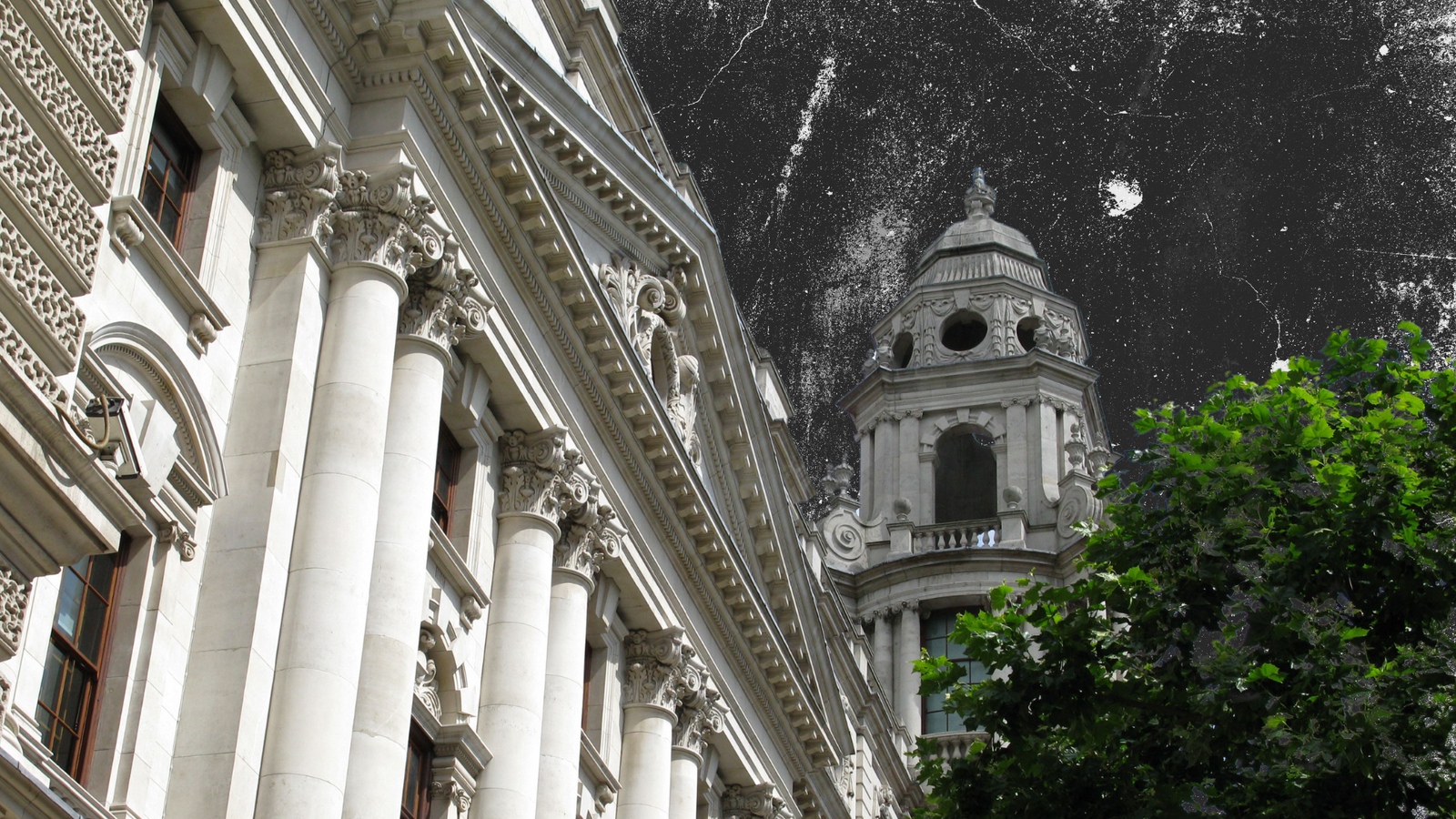
Lead image: Her Majesty’s Revenue and Customs building, London. Credit: Ian Bottle/Alamy Stock Photo