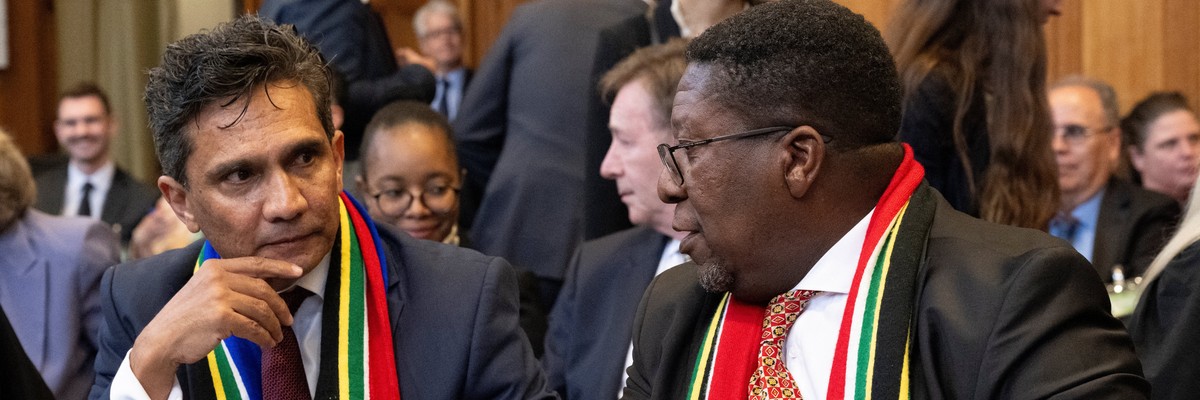
South African legal adviser Cornelius Scholtz (L) and South African Ambassador to the Netherlands Vusi Madonsela attend a hearing at the International Court of Justice (ICJ) on Israel’s incursion in Rafah, Gaza, in The Hague on May 16, 2024. (Photo: Lina Selg/ANP/AFP via Getty Images)
Israel’s assault on Rafah provides “evidence of the crime of genocide,” one legal expert said. “This attack is the final blow that is intended to destroy the Palestinian group in Gaza.”
South African officials on Thursday made their case before the International Court of Justice to stop Israel’s brutal invasion of Rafah, warning once again that Israeli officials have displayed clear “genocidal intent” and “genocidal conduct” in their military campaign in Gaza.
The case for the ICJ to stop the attack on Rafah was made by a number of lawyers, legal experts, and ambassadors, with the South African representatives outlining the bare facts of Israel’s military campaign, blocking of humanitarian aid, and statements of intent, just as they did when the court heard South Africa’s original claim that Israel is committing genocide.
That case, argued in January, resulted in a preliminary ruling in which the court said South Africa had made a “plausible” case and ordered Israel to prevent genocidal acts by the Israel Defense Forces (IDF).
On Thursday, South Africa urged the ICJ to see that Israel has not followed that order.
“It is difficult to imagine that the situation could get worse” than it was in January, international law professor John Dugard told the court. “But unfortunately, it has… Israel has now commenced its long-threatened assault on Rafah. It has ordered the evacuation of Palestinians in Rafah to the barren sand dunes of Al-Mawasi. It has closed critical border crossings to humanitarian aid, medical supplies, goods, and fuel, upon which the population depends.”
“Israel’s actions are in violation of fundamental international humanitarian law, but in addition, they provide evidence of the crime of genocide,” Dugard continued. “This attack is the final blow that is intended to destroy the Palestinian group in Gaza.”
Watch the livestream of the ICJ hearing below:
The South Africans made their case as the U.N. Relief and Works Agency for Palestinian Refugees in the Near East (UNRWA) said Thursday that an estimated 600,000 people have now been forcibly displaced from Rafah by Israel.
Despite tepid warnings from the U.S.—the biggest international funder of the IDF—for Israel to avoid attacking “population centers,” the IDF this week has moved into dense residential neighborhoods in central Rafah.
The U.S. has also called for Israel to allow humanitarian aid into Gaza, but the IDF’s seizure of the Rafah crossing between the enclave and Egypt last week led the World Food Program (WFP) on Thursday to warn that food and fuel rations “will run out in a matter of days.” Dozens of Palestinians have been starved to death so far by Israel’s blocking of relief shipments.
“The threat of famine in Gaza never loomed larger,” said the WFP as South Africa made its case in The Hague.
Three months after giving a 22-minute speech detailing the numerous statements of genocidal intent made by top Israeli officials since the Gaza assault began in October, South African lawyer Tembeka Ngcukaitobi during Thursday’s hearing, used the more recent words of Israeli Finance Minister Bezalel Smotrich, who publicly described the aim of the Rafah invasion as “total annihilation.”
In his presentation before the court, Ngcukaitobi invoked Smotrich’s language by arguing that the Rafah incursion “is the last stage of ‘total annihilation’ of Palestinian life.”
“For Palestinians to be able to continue to exist as a protected group under the Genocide Convention, they need a place from which to rebuild,” he continued. “Rafah is that place, the last stand… Without Rafah, the possibility to rebuild will be lost forever.”
In her speech, Irish lawyer Blinne Ni Ghralaigh outlined other developments in Gaza since the ICJ issued its preliminary ruling that illustrate the need for the court’s “invaluable intervention.”
Ni Ghralaigh detailed the destruction of hospitals like Al-Shifa, where mass graves have been found with the remains of women, children, and medical workers, and warned that “the same fate now awaits Rafah’s remaining hospitals, doctors, and medics.”
She also pointed to evidence that the IDF is treating evacuated areas as “extermination zones,” where soldiers are ordered to kill any remaining people, and its use of an error-prone AI system to target Palestinians.
The South African legal team said the court must order Israel “to immediately take all effective measures to ensure the access of persons able to investigate ongoing atrocities,” and called on the ICJ to “at least modify its provisional measures” from March, when it demanded that Israel allow humanitarian aid into Gaza.
“The court has the power to modify or make an explicit order for Israel to cease its military operations in Rafah, Gaza, and to withdraw from the Gaza Strip,” said Ni Ghralaigh, pointing out that the provisional measure from March could only take full effect if a cease-fire agreement was reached.
“No such resolution is in place. The court must itself, therefore, create the circumstances necessary for its provisional measures to take full effect. It must order Israel to cease its military operations system finally,” she said. “Enough is enough.”
Israel is expected to address the ICJ at a second day of hearings on Friday.
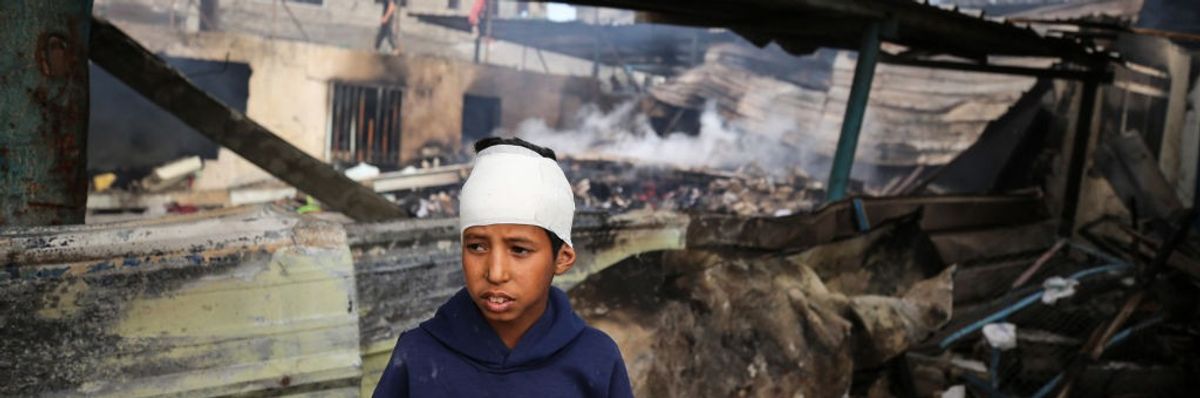
A Palestinian boy observes the site of an Israeli strike on a school sheltering displaced people in the central Gaza Strip on May 14, 2024. (Photo” Majdi Fathi/NurPhoto via Getty Images)
The University Network for Human Rights report also stresses that other nations are legally obligated to “refrain from recognizing Israel’s breaches as legal or taking any actions that may amount to complicity.”
The University Network for Human Rights on Wednesday released and sent to United Nations offices a 105-page report that it called “the most thorough legal analysis” yet to find “Israel is committing genocide” against Palestinians in the Gaza Strip.
The network partnered with the International Human Rights Clinic at Boston University School of Law, the International Human Rights Clinic at Cornell Law School, the Center for Human Rights at the University of Pretoria, and the Lowenstein Human Rights Project at Yale Law School for the analysis, which draws from “a diverse range of credible sources” and the territory’s history.
“After reviewing the facts established by independent human rights monitors, journalists, and United Nations agencies, we conclude that Israel’s actions in and regarding Gaza since October 7, 2023, violate the Genocide Convention,” the report states. “Israel has committed genocidal acts of killing, causing serious harm to, and inflicting conditions of life calculated to bring about the physical destruction of Palestinians in Gaza, a protected group that forms a substantial part of the Palestinian people.”
As of May 1, Israel’s assault had killed “more than 5% of Gaza’s population, with over 2% of Gaza’s children killed or injured,” the analysis notes. In recent days, Israeli forces have ramped up their attack on Rafah—where over a million people from other parts of the besieged enclave sought refuge—and the total death toll has risen to 35,233, according to Gaza health officials, with another 79,141 Palestinians injured.
“Israel’s military operation has destroyed up to 70% of homes in Gaza, and has decimated civilian infrastructure, including hospitals, schools, universities, U.N. facilities, and cultural and religious heritage sites,” the document says, noting the “staggering” number of forced displacements. “Civilians in Gaza face catastrophic levels of hunger and deprivation due to Israel’s restriction on, and failure to ensure adequate access to, basic essentials of life, including food, water, medicine, and fuel.”
“Children who do survive this war will not only bear the visible wounds of traumatic injuries, but the invisible ones too. . . . There is a repeated displacement, constant fear and witnessing family members literally dismembered before their eyes” (@MSF).
— University Network for Human Rights (@unitedforrights) May 15, 2024
“Israel’s genocidal acts in Gaza have been motivated by the requisite genocidal intent, as evidenced in this report by the statements of Israeli leaders, the character of the state and its military forces’ conduct against and relating to Palestinians in Gaza, and the direct nexus between them,” the publication continues, pointing to comments from “officials at all levels of Israeli government, up to and including” Prime Minister Benjamin Netanyahu.
Israel has faced mounting allegations of genocide since launching its retaliation for the Hamas-led October 7 attack—including an ongoing South Africa-led case at the International Court of Justice (ICJ), which found in January that the country is “plausibly” committing genocide.
Bolstering the ICJ’s conclusion, the Wednesday report declares that “Israel’s violations of the international legal prohibition of genocide amount to grave breaches of peremptory norms of international law that must cease immediately.”
“These violations give rise to obligations by all other states: to refrain from recognizing Israel’s breaches as legal or taking any actions that may amount to complicity in these breaches; and to take positive steps to suppress, prevent, and punish the commission by Israel of further genocidal acts against the Palestinian people in Gaza,” the document adds.
The United States has long provided Israel with billions of dollars in military aid and diplomatic support—which have soared since October 7, despite growing pressure on U.S. President Joe Biden to cut off such assistance. The Democrat has incrementally increased his criticism of the Israeli assault in recent weeks, angering far-right leaders in both countries.
The new legal analysis—which was sent to the U.N.’s Office of the High Commissioner for Human Rights, Office on Genocide Prevention and the Responsibility to Protect, and the Independent International Commission of Inquiry on the Occupied Palestinian Territory, including East Jerusalem, and Israel—came on the same day that 20 human rights groups issued a joint statement.
The rights organizations—including Amnesty International, Mercy Corps, and Oxfam—called on world leaders “to urgently act in bringing to an end, and pursue accountability for,” Israel’s grave breaches of international humanitarian law in Gaza.
Both documents were released on Nakba Day, which commemorates the ethnic cleansing of hundreds of thousands of Palestinians during the creation of the state of Israel in 1948. Some experts and campaigners contend that the Nakba—Arabic for catastrophe—continues today.
With over 17 million subscribers, the Morning, the New York Times’ flagship newsletter, is by far the most popular newsletter in the English-speaking world. (It has almost three times as many subscribers as the next most popular newsletter.)
Since October 7, as Israel has waged an unprecedented war on Palestinian children, journalists, hospitals and schools, the New York Times’ highly influential newsletter has bent over backwards to blame everyone but Israel for the carnage.
Waging a legitimate war
According to the Morning—led by head writer David Leonhardt—Israel’s war on Gaza is a targeted operation designed to eliminate Hamas. The Morning propagates this narrative despite well-documented declarations of collective punishment and even genocidal intent by high-ranking Israeli officials—a tendency that South Africa has forcefully documented in their case before the ICJ (UN, 12/29/23). Israeli President Isaac Herzog’s comments on October 12, 2023, are typical: “It’s an entire nation out there that is responsible. It’s not true, this rhetoric about civilians not aware, not involved.”
This sentiment has been echoed by Prime Minister Benjamin Netanyahu, multiple cabinet-level ministers and senior military officials. Speaking from a devastated northern Gaza, one top Israeli army official said (UN, 12/29/23): “Whoever returns here, if they return here after, will find scorched earth. No houses, no agriculture, no nothing. They have no future.”
The Morning (10/13/23) expresses what it sees as the main problem with mass death in Gaza: “The widespread killing of Palestinian civilians would damage Israel’s global reputation.”
Despite these statements and the body of supporting evidence, the Morning has consistently portrayed the war on Gaza as a focused campaign targeting the military infrastructure of Hamas.
For instance, in one October edition (10/13/23), Leonhardt and co-writer Lauren Jackson explained, “Israel’s goals are to prevent Hamas from being able to conduct more attacks and to reestablish the country’s military credibility.”
In similar fashion, in a late January edition (1/28/24), the Morning argued that Israel’s 17-year-long blockade of Gaza is primarily designed to debilitate Hamas—rather than to collectively punish Gazan civilians, as many analysts and human rights groups have argued:
For years, Israel has limited the flow of goods into Gaza, largely to prevent Hamas from gaining access to military supplies.
The Morning did, in the same edition (1/28/24), quote Israeli Defense Minister Yoav Gallant’s comments in the immediate aftermath of October 7:
After the Hamas-led October 7 terrorist attacks, Israel ordered what its defense minister called a “complete siege” of Gaza. The goal was both to weaken Hamas fighters and to ensure that no military supplies could enter.
This is, however, a downright fictional interpretation of Gallant’s quote (Al Jazeera, 10/9/23), given that the Morning failed to quote the next words out of his mouth:
There will be no electricity, no food, no water, no fuel, everything will be closed. We are fighting against human animals, and we are acting accordingly.
Blame the terrorists
The Morning (10/30/23) insists that “Hamas is responsible for many of the civilian deaths” caused by Israel—a division of responsibility it would never apply to civilians killed by Hamas on October 7.
The Morning consistently has argued that Hamas makes densely populated civilian areas legitimate targets for Israeli attacks by conducting military operations nearby. This deflects blame from Israel and frames civilian casualties as a necessary evil, as in the October 30 edition of the newsletter:
Hamas has hidden many weapons under hospitals, schools and mosques so that Israel risks killing civilians, and facing an international backlash, when it fights. Hamas fighters also slip above and below ground, blending with civilians.
These practices mean that Hamas is responsible for many of the civilian deaths, according to international law.
Similar rhetoric was deployed in this December edition (12/20/23):
Hamas has long hidden its fighters and weapons in and under populated civilian areas, such as hospitals and mosques. It does so partly to force Israel to make a gruesome calculation: To fight Hamas, Israel often must also harm civilians.
The Morning has not yet found it pertinent to report on, for instance, the Israeli soldiers who dressed as doctors to gain access to the Ibn Sina Hospital in the West Bank, and proceeded to assassinate three Palestinian militants in their hospital beds.
To the Morning (11/14/23), Israel’s mass slaughter of civilians is unavoidable:
The battle over Al-Shifa Hospital in Gaza highlights a tension that often goes unmentioned in the debate over the war between Israel and Hamas: There may be no way for Israel both to minimize civilian casualties and to eliminate Hamas.
It repeats this line again in a late January edition (1/22/24), once again framing the mass murder of civilians as a “difficult decision”:
The Israeli military faces a difficult decision about how to proceed in southern Gaza…. Israel will not easily be able to eliminate the fighters without killing innocent civilians.
Longer term, there will be more difficult choices. Many steps that Israel could take to reduce civilian casualties in Gaza, such as advance warnings of attacks, would also weaken its attempts to destroy Hamas’s control.
These themes are repeated across all editions of the Morning, and echo throughout the New York Times’ reporting on Israel. Israel’s motivations in the war (beyond eliminating Hamas) go unquestioned, while the openly genocidal statements made by high-ranking politicians and military leaders go unacknowledged.
And when Israeli mass murder of Palestinian civilians is mentioned, it is constantly qualified by the line that Hamas is fully or partially to blame.
‘Civilian death toll in Gaza’
David Leonhardt assures readers of the Morning (12/7/23) that “military experts say that there is probably no way for Israel to topple Hamas without a substantial civilian toll.” The possibility that this means that Israel should therefore not try to “topple Hamas” is not addressed.
Let’s break down one emblematic newsletter (12/7/23) written by Leonhardt in December, in which he “puts the [civilian death] toll in context and explains the reason for it.”
Leonhardt began by qualifying the Palestinian death toll—around 17,000 at time of writing in early December. First, he delegitimized the Gaza Health Ministry, which, he wrote, “seems to have spread false information during the war.” Though he acknowledged that “many international observers believe that the overall death toll is accurate…as do some top Israeli officials,” he wrote that “there is more debate about the breakdown between civilian and combatant deaths.” Leonhardt went on:
A senior Israeli military official told my colleague Isabel Kershner this week that about a third of the dead were likely Hamas-allied fighters, rather than civilians. Gazan officials have suggested that the combatant toll is lower, and the civilian toll higher, based on their breakdown of deaths among men, women and children.
Leonhardt only informs readers that Hamas has spread false information, while neglecting to mention Israel’s documented history of lying to the press (IMEU, 10/17/23; Intercept, 2/27/24). He also declined to investigate the implausibility of his source’s figure: At this point in the war, about 30% of Palestinian fatalities were adult men, meaning the Israeli figure implies that essentially every adult man killed by Israel was a Hamas fighter—all civilian men being miraculously spared.
Next, Leonhardt attempted to explain “who is most responsible for the high civilian death toll”—concluding, even before describing them, that “different people obviously put different amounts of blame on each.”
First he named Israel, and contextualized and rationalized Israel’s war crimes:
After the October 7 attacks—in which Hamas fighters killed more than 1,200 people, while committing sexual assault and torture, sometimes on video—Israeli leaders promised to eliminate Hamas. Israel is seeking to kill Hamas fighters, destroy their weapons stockpiles and collapse their network of tunnels. To do so, Israel has dropped 2,000-pound bombs on Gaza’s densely populated neighborhoods.
Note that Leonhardt framed the war as a campaign only to “kill Hamas fighters, destroy their weapons stockpiles and collapse their network of tunnels,” despite the evidence that Israel has targeted civilian infrastructure, journalists, healthcare workers and aid workers—actions backed by the aforementioned statements of genocidal intent.
Though Leonhardt briefly mentioned that Israel’s war has drawn international criticism, he made no mention of international law and concluded with his refrain that Israel can hardly avoid causing the deaths of “substantial” numbers of civilians:
Nonetheless, military experts say that there is probably no way for Israel to topple Hamas without a substantial civilian toll. The question is whether the toll could be lower than it has been.
Next, Leonhardt turned to his condemnation of Hamas:
The second responsible party is Hamas. It hides weapons in schools, mosques and hospitals, and its fighters disguise themselves as civilians, all of which are violations of international law.
This approach both helps Hamas to survive against a more powerful enemy — the Israeli military—and contributes to Hamas’s efforts to delegitimize Israel. The group has vowed to repeat the October 7 attacks and ultimately destroy Israel. Hamas’s strategy involves forcing Israel to choose between allowing Hamas to exist and killing Palestinian civilians.
Hamas is simply not prioritizing Palestinian lives.
It is notable that—unlike with Israel—Leonhardt did not attempt to contextualize Hamas’ actions by noting the horrifying conditions that Israel has imposed on Gaza for years, or the over 900 Palestinian children killed by Israel in the decade preceding October 7. To Leonhardt, history is only relevant when it justifies Israeli aggression.
While Leonhardt states unequivocally that Hamas is violating international law, he does not find it worthwhile to investigate Israel’s flagrant and abundantlydocumented violations of international law. He also does not mention the Palestinian right to resist occupation, a right enshrined under international law.
This unequal treatment leads straight to the jarringly contrasting conclusions, in which he essentially excuses Israel’s genocidal war as unavoidable, while he condemns Hamas for “simply not prioritizing Palestinian lives.”
Leonhardt’s December 7 piece is not an aberration: It is emblematic of the language, selective contextualization and framing that the Times‘ Morning newsletter wields to provide ideological cover for Israel’s crimes.