Climate Denial Funder Pumps Another £30,000 into Tory Leadership Race

Spread the love

Original article by Adam Barnett and Sam Bright republished from DeSmog
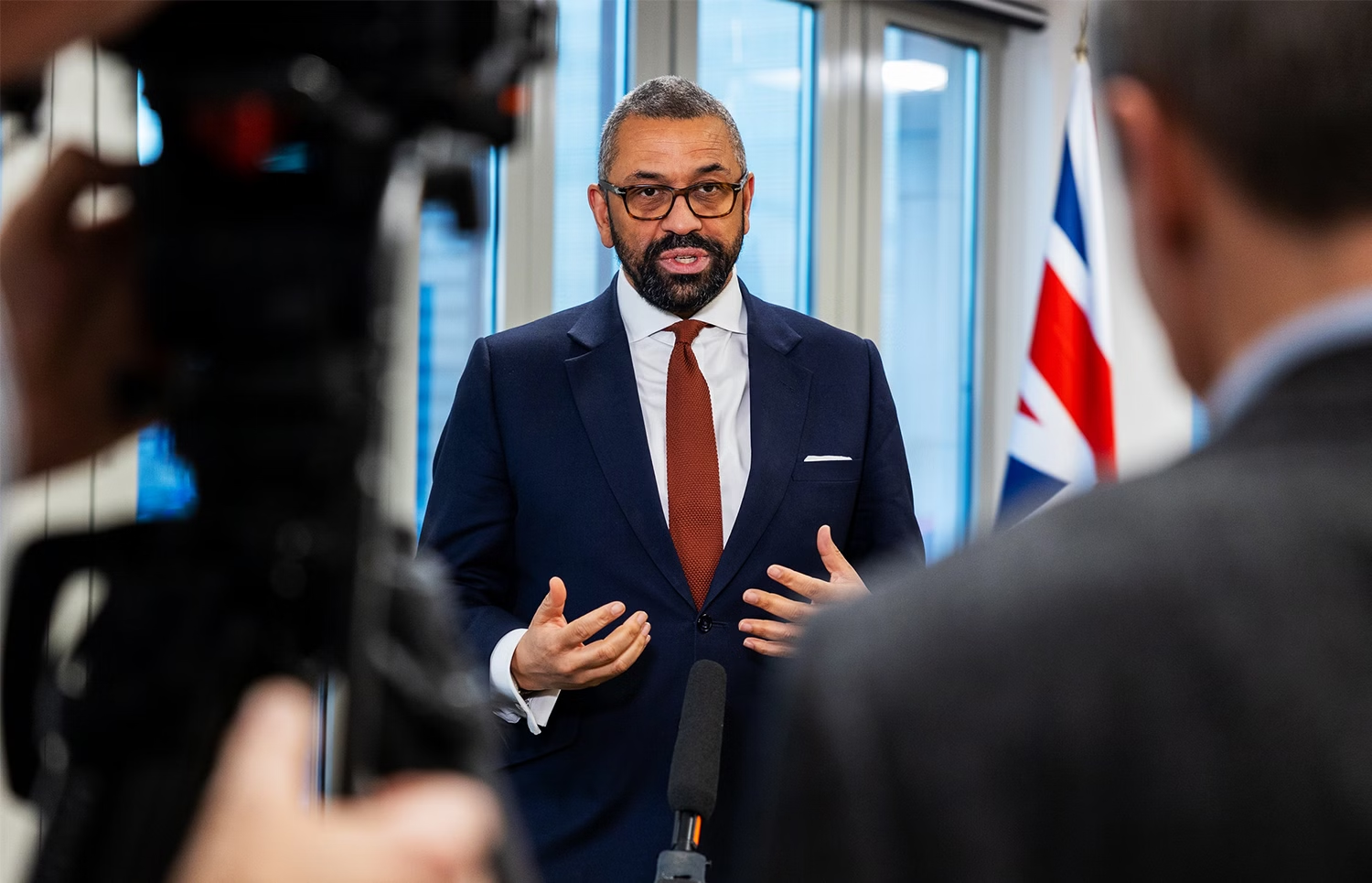
Conservative MP James Cleverly. Credit: Andy Taylor / Home Office (CC BY 2.0)

Tory peer and major party donor Michael Hintze has funded the Global Warming Policy Foundation.

Conservative Party leadership candidates have received tens of thousands in donations from a funder of the UK’s main climate science denial group. 

The latest register of MPs’ interests shows that James Cleverly and Tom Tugendhat each received £10,000 in August from Lord Michael Hintze, a Tory peer who is one of the few known funders of the Global Warming Policy Foundation (GWPF). 

Hintze, who has donated more than £4 million to the Conservatives since 2002, also donated £10,000 in August to leadership hopeful Priti Patel, who was voted out of the contest by Tory MPs this week. Tugendhat also received £3,000 from Hintze in December. 

The GWPF actively campaigns against the government’s climate policies and rejects established science on rising temperatures, calling carbon dioxide a “benefit to the planet”. 

Lord Hintze has said he believes “there is climate change” caused “in part due to human activity over the past century”, but “all sides must be heard” on climate change “to reach the right conclusion for society as a whole”.

Authors working for the world’s foremost climate science body, the UN’s Intergovernmental Panel on Climate Change (IPCC), have said that “it is a statement of fact, we cannot be any more certain; it is unequivocal and indisputable that humans are warming the planet”.

The IPCC has stated that we are in the midst of “widespread and rapid [changes] … unprecedented over many centuries, to many thousands of years”.

Between the 2019 general election and the start of the 2024 campaign, the Conservatives received £8.4 million from fossil fuel interests, highly polluting industries, and climate science deniers. 

Cleverly, Tugendhat, Patel are not the only Tory leadership hopefuls to have received donations from figures associated with the GWPF. DeSmog revealed in August that Kemi Badenoch had received £10,000 towards her campaign from Neil Record, a millionaire Tory donor and chair of Net Zero Watch (NZW), the GWPF’s campaign arm. 

Record is also a “life vice president” of the Institute of Economic Affairs (IEA) think tank, which he chaired until July 2023. The IEA, which supports new fossil fuel production, has received funding from the oil giant BP every year from 1967 to at least 2018. 

Record has given money to both the IEA and the GWPF, which are part of the Tufton Street network of think tanks and lobbying groups based in Westminster campaigning for less government regulation, including on climate change.

The latest register of interests also shows that Record donated £2,000 to Tory MP Jesse Norman, who is publicly supporting Badenoch’s campaign.

As DeSmog has reported, Tugendhat also received donations and gifts worth £7,000 during the general election campaign from Tory donor and former party treasurer Lord Michael Spencer, who is a fossil fuel investor.

Spencer is the largest shareholder in Deltic Energy, which this year received licences to explore the North Sea for oil and gas. He also holds shares in Pantheon Resources, a UK company exploring for oil in Alaska.  

Spencer, who has donated £6 million to the Conservatives since 2005, previously told DeSmog that oil and gas investments are less than two percent of his portfolio.

Views on Net Zero

Tugendhat, Badenoch, and Patel have vocally criticised the UK’s climate policies. 

In a July interview on GB News, Tugendhat said the UK’s target of achieving net zero emissions by 2050 was “not realistic”. Badenoch said in 2022 that it was “arbitrary” and last year suggested she would back delaying it, which would contravene the UK’s legally-binding climate commitments. Patel shares this position, and told GB News last year that net zero targets should be “paused” because the “public are not ready”.

Polling by More in Common and E3G during the general election period found that a majority of people in every UK constituency are worried about climate change. Some 61 percent of 2024 Conservative voters said they are worried about climate change, matched by 76 percent of Labour voters, and 65 percent of the country overall.

In his GB News interview, Tugendhat also defended the previous government’s support for new oil and gas extraction, saying: “Drilling our own oil in the North Sea is more carbon efficient than bringing it in from anywhere else.”

The claim that UK oil and gas has a lower carbon footprint than imports is “misleading” and can only be achieved “by comparing UK gas production to the very dirtiest gas imports”, according to the research and campaign group Uplift.

Cleverly has supported the 2050 target but has said he would favour a “competition-based approach” rather than using the power and funding of the state. However, the private sector has often acted to delay climate action. According to the non-profits groups NewClimate Institute and Carbon Market Watch, which surveyed 51 major companies, their median goal is to cut emissions by 30 percent by 2030 – well below the 43 percent reduction identified by the IPCC. 

Cleverly’s leadership campaign told DeSmog that “We thank all of our donors for their support for James Cleverly as the best candidate to unite the Conservative Party and win the next general election.”

Tugendhat, Patel, and Hintze have been approached for comment.

Original article by Adam Barnett and Sam Bright republished from DeSmog
Continue ReadingClimate Denial Funder Pumps Another £30,000 into Tory Leadership Race

Two Thirds of Anti-Net Zero Tories Wiped Out in UK Election

Spread the love

Original article by Adam Barnett and Joey Grostern republished from DeSmog.

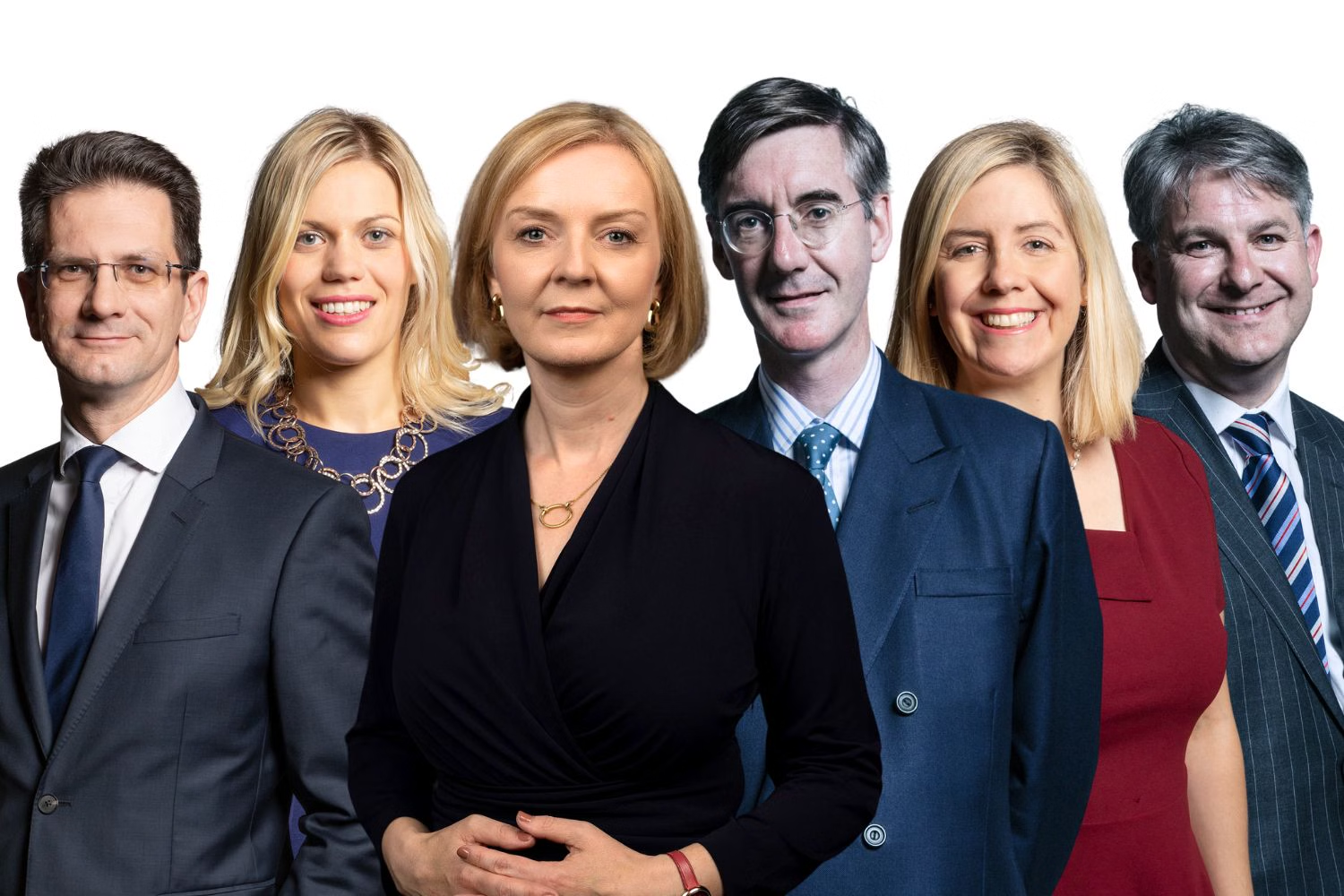
From left to right, outgoing net zero sceptic MPs Steve Baker, Miriam Cates, Liz Truss, Jacob Rees-Mogg, Andrea Jenkyns and Philip Davies. Credit: Official House of Commons portraits. Design: Adam Barnett

The result has “buried Sunak’s anti-green agenda once and for all”, said Will McCallum of Greenpeace UK.

Labour’s landslide victory over the Conservatives has left the party’s anti-net zero wing in tatters. 

DeSmog’s analysis of Westminster’s influential Net Zero Scrutiny Group (NZSG) found that two thirds of its supporters are no longer represented in parliament following the July 4 general election.

Twenty-four of the 37 MPs supportive of the backbench grouping were voted out – a loss of 65 percent of its backers. Outgoing supporters include former energy secretary Jacob Rees-Mogg, former NZSG co-chair Steve Baker, and Net Zero Watch board member Andrea Jenkyns. 

A further five stood down or resigned before the election, among them veteran climate crisis John Redwood.

The group’s former chair Craig Mackinlay, who contracted sepsis in September, has been appointed to the House of Lords by outgoing prime minister Rishi Sunak. Mackinlay has said he would use this platform to campaign for “sensible net zero”. 

The NZSG has actively campaigned against climate action since it was formed in 2021. The group’s joint letters to the Telegraph made front page news, as supporters urged the government to scrap “environmental levies on domestic energy”, “expand North Sea exploration” for oil and gas, and support “shale gas extraction” by lifting the ban on fracking. 

In addition to the NZSG grouping, former Prime Minister Liz Truss, who has become an outspoken critic of net zero since leaving Downing Street in 2022, was voted out on Thursday. 

Campaigners have welcomed the departure of MPs opposed to climate action. “This landslide election victory has buried Sunak’s anti-green agenda once and for all along with many of its principle architects”, Will McCallum, co-executive director at Greenpeace UK, told DeSmog. 

“Most of the former MPs who sought to sow division and disinformation about net zero have lost at the ballot box.”

Meanwhile, 14 anti-net zero MPs were re-elected, including Labour MP Graham Stringer, who is on the board of the Global Warming Policy Foundation (GWPF), the UK’s main climate denial group, and Lee Anderson, who defected from the Tories to Reform UK earlier this year.  

Four new Reform MPs were also elected, including party leader Nigel Farage and chairman Richard Tice, both of whom have a record of climate science denial. 

Despite this, campaigners are still positive. McCallum added that “the biggest winners [in the election] – Labour, the Liberal Democrats and the Green Party – contested this election on strong green policies that will slash emissions, lower bills and deliver hundreds of thousands of new jobs”. 

“There is and has long been a public consensus on climate action in this country”, he said, and “the new government should feel empowered to be bold”. 

Here are some of the most prominent critics of net zero who have lost their seats: 

Jacob Rees-Mogg

Jacob Rees-Mogg, who lost his North East Somerset seat by more than 6,000 votes to Labour’s Dan Norris, was secretary of state for business, energy and industrial strategy under Liz Truss between September and October 2022. 

While in office he reportedly argued for lifting the ban on fracking for shale gas, and told the head of the UAE’s state investment company, in a private meeting revealed by DeSmog, that people need to “stop demonising oil and gas”. 

Since January 2023, Rees-Mogg has presented his own show on GB News, which regularly broadcasts climate science denial. Rees-Mogg has been a harsh critic of the government’s net zero policies, stating that “the current headlong rush to net zero risks impoverishing the nation to no global benefit on emissions”.

Steve [“Number two”] Baker

Steve Baker has led the charge against climate policies in parliament. Baker was a trustee of the UK’s main climate denial group, the Global Warming Policy Foundation (GWPF), from May 2021 to September 2022, when he stepped down to serve as Northern Ireland minister. He was co-chair of the NZSG, which operated as the GWPF’s caucus in parliament.  

At a 2021 Conservative Party conference event, Baker said that much climate science is “contestable” and “sometimes propagandised”, while claiming that some UN climate scenarios were “implausible”.

In February 2022, Baker received £5,000, and a further £10,000 in February 2023, from Neil Record, chair of Net Zero Watch, the campaign arm of the GWPF. 

On Thursday Baker lost his Wycombe seat to Labour’s Emma Reynolds by more than 4,000 votes. 

Dame Andrea Jenkyns 

Andrea Jenkyns, who lost her seat of Leeds and South West Morley by more than 7,000 votes to Labour’s Mark Sewards, sits on the board of Net Zero Watch, the campaign arm of the GWPF, the UK’s main climate science denial group. 

In March 2023 Jenkyns told parliament: “Personally, net zero, I think we need to ditch these targets, especially at the moment, and use whatever resources we’ve got under our feet.” She has described herself on Twitter as holding “no-to-net-zero views”.

Miriam Cates

Miriam Cates lost her Penistone and Stocksbridge seat by more than 9,000 votes to Labour’s Marie Tidball in Thursday’s general election. 

Cates was tipped as a rising star of the Conservative party, a “darling” of the Tory right. She is the co-chair of the New Conservatives, a socially conservative faction of the Tory party which received £50,000 in January from GB News investors the Legatum Group.

Cates also sits on the advisory board of the Alliance for Responsible Citizenship (ARC), a right-wing group fronted by prominent climate denier Jordan Peterson

Speaking at the National Conservatism Conference in London last year, Cates suggested that “epidemic levels of anxiety and confusion” are being caused by teaching children that “humanity is killing the Earth”. 

Philip Davies  

Philip Davies, who lost his Shipley seat by more than 8,000 votes to Labour’s Anna Dixon, has a long record of opposing climate policies. Davies was one of only five MPs to vote against the UK’s Climate Change Act in 2008. 

He currently works as a presenter for GB News, as does his wife and fellow Conservative politician Esther McVey, who was re-elected on Thursday. 

Liz Truss

A number of net zero sceptic MPs existed outside the NZSG grouping, among them former prime minister Liz Truss, who resigned in October 2022 after just 49 days in the job. As well as appointing Rees-Mogg energy secretary, Truss overturned the UK’s moratorium on fracking for shale gas – a key demand from the Net Zero Scrutiny Group.

Since leaving Downing Street – and in between giving paid speeches to U.S. anti-climate groups like CPAC and the Heritage Foundation – Truss has become an open opponent of net zero policies. 

In her 2024 book “Ten Years to Save the West”, Truss called for the independent Climate Change Committee to be abolished, and attacked the UN COP process, which coordinates international action on climate change. Truss also claimed that while in cabinet she argued against the UK hosting the COP26 climate summit.

On Thursday, Truss lost her South West Norfolk seat by 630 votes to Labour’s Terry Jermy.

‘Watching Closely’

“It’s obviously fantastic news that 30 Tory MPs who’ve lobbied against climate policies are no longer in parliament”, said Jessica Townsend, founder of the MP Watch campaign group, which used DeSmog research in a recent event on “top ten climate denial MPs”.

Townsend noted that seven of the campaign’s list have won seats, including Reform’s Farage and GWPF director Graham Stringer.

“MP Watch will be watching these MPs closely in coming months as well as the influence fossil fuel companies and their think tanks may have on Labour in Westminster now that the power base has shifted,” she added.

Original article by Adam Barnett and Joey Grostern republished from DeSmog.

What does it mean to be a climate denier?

Continue ReadingTwo Thirds of Anti-Net Zero Tories Wiped Out in UK Election

Climate Obstructionism Runs Deep in the UK — Watch Out for It at the Election

Spread the love

Original article by Freddie Daley and Peter Newell republished from DeSmog.

Credit: Lindsay Grime.

Regardless of who wins next month, fossil fuel interests have multiple levers for influencing policy.

The UK is heading to the polls on July 4. Although it doesn’t get enough attention, the two major parties — the Conservatives and Labour — have chosen climate change and, in particular, fossil fuel production in the North Sea as a clear political dividing line for the electorate. 

As polling day draws closer, and election fervour takes hold, we will see the forces of British climate obstruction in full effect. Influential individuals, organisations and media outlets that seek to block, dilute, delay, or even reverse climate policies will attempt to widen that political dividing line with a mixture of claims to be defending individual freedoms, putting growth first, being ‘climate realists’, or by displacing concerns about the UK’s responsibility to act on climate change through ‘whataboutism’.

The Conservative government, under Prime Minister Rishi Sunak, has pushed ahead with issuing hundreds of new oil and gas licences in the North Sea. The government was due to further reform the licensing regime so permits are handed out on an annual basis, all under the auspices of ‘energy security’, but the election has halted the bill’s progress through Parliament. Future licences are expected to yield just three weeks’ worth of gas per year

Sir Keir Starmer’s Labour Party, however, announced that it will end new licensing for oil and gas in the North Sea, with the very large caveat of honouring those already approved. But even this announcement ignited fierce resistance from the media, trade unions, Labour’s political opponents and some figures it deemed allies. The plan was labelled as “Thatcher on steroids”“naive”, and risked “creating a cliff-edge” for industry and investment in and around the North Sea. In response to the vitriol, Starmer conceded that fossil fuels will continue to be used in the UK “for many, many years”.  

This episode provides a useful insight into how climate obstructionism operates in the UK. In a new publication for the Climate Social Science Network (CSSN) based at Brown University, alongside Dr Ruth McKie and Dr James Painter, we identified three major channels through which obstructionism operates in Britain and the network of organisations that sustain it. 

Financial Power

The first is the material. This speaks to the financial and structural power of the fossil fuel industry that allows it to use threats of capital flight and job losses to curry favourable policy conditions and fend off tax hikes that would dent profitability. It also speaks to party donations, where fossil fuel firms, or those that benefit from their expansion, provide funds to individual politicians or the wider party for access and a say over policy. 

Since 2019, the Conservatives have received £8.4 million in donations from big polluters and those with direct links to fossil fuel production. The current Energy Security and Net Zero Secretary, Claire Coutinho, accepted a £2,000 donation in January 2024 from Lord Michael Hintze, a funder of the UK’s leading climate science denial group, the Global Warming Policy Foundation. Labour too have taken money from big polluters, most notably Drax, whose North Yorkshire power plant is the UK’s single largest source of emissions.

Alongside the material sits the institutional. The policy making process in the UK provides a multitude of opportunities for actors to shape policy, all within the bounds of proper procedure and due process. All Party Parliamentary Groups (APPGs), informal groups of politicians organised around key themes or policy issues, have provided an effective fora for obstructionist actors to garner access and shape policy. The rules governing APPGs often inhibit public scrutiny. Trade associations, and the companies they represent, can be omitted from official parliamentary transparency logs as only benefits in kind above £1,500 a year must be declared — a threshold many industry bodies claim not to meet. 

Revolving doors between industry and government are another institutional means through which fossil fuel interests can determine policy. An investigation by The Ferret found that since 2011, 127 former oil and gas employees have gone into top government roles and been appointed to ministerial advisory boards. At least a dozen of these individuals were given roles in the North Sea Transition Authority, the organisation tasked with governing oil and gas production, as well as within departments responsible for writing energy and climate policy. Shutting this revolving door, or even just slowing it down through ‘cool-off’ periods, would go some way in curtailing obstructionism. 

Climate Delay

The final, and perhaps most pronounced, thread of climate obstructionism in the UK is discursive, primarily promoted through the media. The right-leaning media in the UK, such as the Daily Telegraph and Daily Mail, have persistently opposed climate policy and action. This opposition used to be grounded in outright denial, where the integrity of climate science was disputed and denigrated. Now, though, a more pernicious form of discursive obstructionism is prevalent; that of climate delay. 

Countless op-eds and articles have been published that acknowledge climate change but dispute the necessity of addressing it, the cost of implementing climate policy (both economically and in terms of national security), and the efficacy of green technologies such as wind turbines, electric vehicles (EVs) and heat pumps. These interventions, which are sometimes made by individuals with direct links to sceptic organisations or else use their framing, often push blatant untruths to the public, such as renewable energy pushing up household energy bills or solar panels  jeopardising British farming. The media continues to both demonise climate activists and undermine public support for key climate policies. 

In this election, watch out for climate obstructionism. While institutional channels may be curtailed due to purdah, others will pick up the slack. With all parties now firmly on an election footing, donations will become a crucial resource for knocking doors and getting out the vote in marginal seats. The sources of these donations, and the interests behind them, will bear the thumbprint of the fossil fuel industry. The media will increase its scrutiny of manifesto pledges and publish a litany of analyses. It is highly likely that Labour’s climate policy will be painted as a threat to national security, an insurmountable cost to the public purse, and reflecting the demands of both Vladimir Putin and Just Stop Oil simultaneously. The foundation of this framing has already been set. 

What is less clear, though, is what comes after July 4. With a change of government comes a reconfiguration of interests and, for the winners, concessions will be made to those actors and constituencies that helped get them past the post. For the losing party, most likely to be the Conservatives, there may be an ideological reorientation that ends the cross-party consensus on tackling climate breakdown, making them the party of climate obstructionism that challenges the necessity of net zero and fights for more oil and gas. 

This election might be the one that ends 14 years of Conservative rule, but it’s not likely to be the one to end climate obstructionism in the UK.  

Freddie Daley is a Research Associate at the Centre for Global Political Economy at the University of Sussex.

Peter Newell is a Professor of International Relations at the University of Sussex.

They are the authors of a chapter in Climate Obstructionism across Europe, a new collection of essays analysing the organisations, politicians, think tanks and media outlets seeking to delay, derail and denigrate climate policy, produced by the Climate Social Science Network.

Original article by Freddie Daley and Peter Newell republished from DeSmog.

dizzy: I don’t agree that there is “cross-party consensus on tackling climate breakdown.” I suggest that instead the Conservative and Labour parties are indistinguishable in their support of plutocracy, sucking up to the rich and powerful. The Conservatives under Sunak have made no pretence of their intention to forge ahead with exploiting North Sea fossil fuels all they can and Labour do not intend to stop the Rosebank North Sea oil and gas field. Starmer has abandoned so many pledges that he should be recognised as as much a liar as Tony Blair or Boris Johnson.

The title of “… the party of climate obstructionism that challenges the necessity of net zero and fights for more oil and gas. ” is currently shared by the Conservatives and climate denier Nigel Farage’s Reform UK.

Rishi Sunak on stopping Rosebank says that any chancellor can stop his huge 91% subsidy to build Rosebank, that Keir Starmer is as bad as him for sucking up to Murdoch and other plutocrats and that we (the plebs) need to get organised to elect MPs that will stop Rosebank.

Continue ReadingClimate Obstructionism Runs Deep in the UK — Watch Out for It at the Election

Who are the wealthy climate sceptics funding rightwing UK politics?

Spread the love
Image of Nigel Farage

https://www.theguardian.com/politics/article/2024/jun/07/who-are-the-wealthy-climate-sceptics-funding-rightwing-uk-politics

A number of wealthy climate sceptics are giving funding to Nigel Farage’s Reform UK, rightwing Conservatives, and the climate science-denying thinktank the Global Warming Policy Foundation. But who are they and how are they linked?

The biggest donor to the Reform party this year is the shipping magnate Terence Mordaunt, the head of First Corporate Shipping. His personal company, Corporate Consultants Ltd, has given £200,000 to Reform over the past 12 months. He was previously chair of the Global Warming Policy Foundation (GWPF) and is now a trustee.

Reform was formerly known as the Brexit party and is the third highest polling political party, aiming to win over rightwing voters who are disenchanted with the Tories. It states on its website: “Net zero means reducing man made CO2 emissions to stop climate change. It can’t. Climate change has happened for millions of years, before man made CO2 emissions, and will always change. We are better to adapt to warming, rather than pretend we can stop it. Up to 10 times more people die of cold than warmth.” The party advocates for scrapping net zero targets and increasing fracking and new nuclear power.

The GWPF is the thinktank set up by the former Conservative chancellor Nigel Lawson in 2009. Since then, it has released reports claiming rising carbon dioxide levels are good for humanity, and opposed climate action. Though Mordaunt has not made many public proclamations on climate science, he said when joining the GWPF in 2017: “I am delighted to continue my support for the GWPF which has brought much needed rigour into the climate debate.” His donations could shed some light on his views; his company also donated £100k to Vote Leave in 2016.

Mordaunt is also, according to DeSmog, a significant donor to the Conservative party, having donated £34,600between 2003 and 2009, according to electoral register data. His companies have also donated at least £135,000 to the party since 2008, including a £25,000 donation in 2017.

Articles continues identifying more rich climate denying donors at https://www.theguardian.com/politics/article/2024/jun/07/who-are-the-wealthy-climate-sceptics-funding-rightwing-uk-politics

Continue ReadingWho are the wealthy climate sceptics funding rightwing UK politics?

Labour Under Pressure for Reselecting Climate Denial Group Director as Election Candidate

Spread the love

Original article by Sam Bright republished from DeSmog.

Graham Stringer, Labour MP for Blackley and Broughton, on GB News. Credit: GB News / YouTube

It’s “a scandal” that the party continues to support Graham Stringer, campaigners say.

The Labour Party has been criticised by campaigners after a board member of the UK’s leading climate science denial group was reselected as a candidate at the upcoming general election. 

Graham Stringer, a Labour MP since 1997, has been reselected as the party’s candidate for Blackley and Broughton in Greater Manchester. Since 2015, Stringer has been a director of the Global Warming Policy Foundation, a group founded to contradict established climate science and advocate against policies to limit greenhouse gas emissions. 

The GWPF has in the past expressed the view that carbon dioxide has been mis-characterised as pollution, when in fact it is a “benefit to the planet”. GWPF director Benny Peiser has said “it’s extraordinary that anyone should think there is a climate crisis”.

Staff members at the GWPF and its sister group Net Zero Watch have been given a regular platform on the right-wing broadcaster GB News in recent months, during which they have claimed that the climate emergency is simply “scaremongering”, that “net zero is doing enormous damage to the economy”, and that “the lights will go out” if we divest from fossil fuels.

“It’s a scandal that Labour is allowing Graham Stringer to stand again,” said Carys Boughton of the Fossil Free Parliament campaign group. “To keep a forthright, prominent climate denier in the fold is to suggest that the party doesn’t understand the urgency of the crisis we are facing. We need Labour to actively stand against the forces that are compromising good climate policy, be they external or within their own ranks.”

The GWPF is based in 55 Tufton Street, Westminster, which has housed a number of libertarian groups that are opposed to clean energy policies and climate science.

Stringer has vocally questioned climate science and policies to achieve net zero emissions. At a Battle of Ideas event in 2023, he said that the policies adopted by the UK to address emissions “make China stronger, make us vulnerable to supply chains that we have no control over, and cost large amounts of money.”

In 2014, Stringer was one of only two MPs on Parliament’s Energy and Climate Change Committee to vote against accepting the conclusion of the UN’s Intergovernmental Panel on Climate Change (IPCC) that humans are the dominant cause of global warming.

Stringer and Conservative MP Peter Lilley said that they did “not dispute the science of the greenhouse effect”, but that “there remain great uncertainties about how much warming a given increase in greenhouse gases will cause, how much damage any temperature increase will cause and the best balance between adaptation to versus prevention of global warming.”

Stringer also planned to join Reform UK’s Nigel Farage and Richard Tice for their launch of a net zero referendum campaign in 2022 (though he later pulled out of the event). Reform wants to scrap the UK’s 2050 net zero target, while both Farage and Tice are critics of climate science. Tice has claimed that “CO2 isn’t poison. It’s plant food”.

Speaking on GB News about his initial decision to campaign alongside Farage and Tice, Stringer said that “I’ve argued for a long time against the extra costs being placed on people to achieve net zero.” 

Energy price rises triggered by Russia’s invasion of Ukraine in 2022 were exacerbated in the UK – the worst hit country in western Europe – due to its over-reliance on gas. The Office for Budget Responsibility, the government’s independent spending watchdog, has said that “the costs of failing to get climate change under control would be much larger than those of bringing emissions down to net zero”.

Conservative peer Lord David Frost is a director of the GWPF alongside Stringer. Tory and Reform donor Terence Mordaunt is also a director of the GWPF, while Conservative politician Andrea Jenkyns is a director of Net Zero Watch.

“Labour can claim a serious commitment to environmental and climate policy. Or it can select as an MP a candidate who is on the board of a Tufton Street climate science denial think tank. But it can’t do both,” said Jolyon Maugham, director of the Good Law Project. 

Labour and Climate Change

The Labour Party has this week been finalising its list of candidates for the general election, with its full slate set to be submitted on Friday (7 June) ahead of the 4 July vote. 

The party has been campaigning prominently on the issue of clean power, pledging to create a state-owned renewable energy investment vehicle, GB Energy, that it says will help to “speed up and scale the deployment of new technologies”. 

Labour has also said that it plans to remove fossil fuels from UK electricity production by 2030, five years earlier than current government plans, and to ban new North Sea oil and gas licences. 

Reports suggest that the party views climate change as a key dividing line of the election campaign, with Rishi Sunak’s Conservative government having overseen the watering down of several net zero policies over the last year. Sunak launched the election campaign by claiming that he had “prioritised energy security and your family finances over environmental dogma”.

However, Labour has been criticised for dropping its plan to invest £28 billion a year in green infrastructure to reach net zero. On announcing that the policy would be scaled down, Labour leader Keir Starmer said that “fiscal rules come first”, adding that higher interest rates meant that financing the plan would be more expensive. The pledged investment has now been reduced to £15 billion a year. 

Labour did not respond to DeSmog’s request for comment, but a spokesperson previously told The Guardian: “The choice at this election is clear: a Conservative government that pollutes our rivers with record levels of toxic sewage, is led by and funded by climate deniers and fails to meet our climate and nature targets; or a Labour government that will restore nature, deliver the largest investment in clean energy in our history so we can cut bills for families, make Britain energy independent and tackle the climate crisis to protect our home for our children and grandchildren.”

Original article by Sam Bright republished from DeSmog.

Continue ReadingLabour Under Pressure for Reselecting Climate Denial Group Director as Election Candidate