Campaigners from Oceana UK protest outside the Royal Courts of Justice in London, where the environmental group is taking the government to court over 31 licences for oil and gas exploration, March 26, 2025
NOT a single exploration well was drilled in North Sea waters in 2025 – the first year since oil and gas was discovered there in the 1960s, analysis finds.
Energy consultants Wood Mackenzie found oil and gas investment on the UK continental shelf, which stood at £4 billion this year, is set to plunge by more than 40 per cent in the next to £2.5bn, its lowest level for more than 50 years.
…
Greenpeace UK’s Paul Morozzo said: “This isn’t a temporary blip.
“The North Sea’s days as an oil and gas basin are coming to an end. Investment is falling because of physical constraints and decreased profitability.
“The real risk now is chasing a declining industry instead of preparing for what comes next.
“Doubling down on oil and gas won’t protect jobs, energy security or household bills.
“It’s time the government took action on the cost of living crisis, as well as to protect us all against the worst impacts of climate change.
“The way to do that is by investing in the industries of the future, not clinging to one that’s in terminal decline.”
Experienced climbers scale a rock face near the historic Dumbarton castle in Glasgow, releasing a banner that reads “Climate on a Cliff Edge.” One activist, dressed as a globe, symbolically looms near the edge, while another plays the bagpipes on the shores below. | Photo courtesy of Extinction Rebellion and Mark RichardsImage of InBedWithBigOil by Not Here To Be Liked + Hex Prints from Just Stop Oil’s You May Find Yourself… art auction. Featuring Rishi Sunak, Fossil Fuels and Rupert Murdoch.
Neo-Fascist Climate Science Denier Donald Trump says Burn, Baby, Burn.
Amsterdam, Netherlands – Greenpeace demands world leaders agree on a global response plan at COP30 as a new major UN report warned the global temperature is projected to rise to 2.3-2.5°C above pre-industrial era global temperatures, putting the Paris Agreement limit of 1.5°C at risk in the short-term.
The UNEP Emissions Gap Report 2025 warned the world is heading towards “a serious escalation of climate risks and damages” due to a lack of ambition and action, and reports the multi-decadal average of global temperature rise will exceed 1.5°C, at least temporarily, requiring faster and bigger cuts in emissions to minimise the overshoot.
Jasper Inventor, Deputy Programme Director, Greenpeace International said: “How many warnings do we need? The time is now, but our leaders are asleep at the wheel, on a collision course to more devastating storms like Hurricane Melissa, human suffering, economic damages and climate injustice.”
“Warnings of a 1.5°C overshoot must be a rallying call for action and yet 2035 climate action plans have failed to bridge the ambition gap. We’re still only inching forward on cutting our emissions despite the demands of people and communities around the world.”
“We have the renewable energy solutions and we are making progress, but emissions are still rising, the transition away from fossil fuels is too slow, and national climate action plans are barely moving the needle. It’s time for G20 countries, above all developed countries, to grab the wheel and really lead the transition, starting at COP30, where a global response plan to accelerate action must be agreed.”
The Emissions Gap Report 2025 predicted global temperatures to reach 2.3-2.5°C by the end of the century, down from 2.6-2.8°C last year. Since the adoption of the Paris Agreement 10 years ago, temperature predictions have fallen from 3-3.5°C, but faster action is required.
Similar to the UNFCCC’s NDC synthesis report, the UNEP also warned new 2035 climate action plans will have insufficient impact in reducing emissions, especially due to the intended US withdrawal from the Paris Agreement, and called on G20 nations to display climate leadership.
Elon Musk urges you to be a Fascist like him, says that you can ignore facts and reality then.Donald Trump urges you to be a Climate Science denier like him. He says that he makes millions and millions for destroying the planet, Burn, Baby, Burn and Flood, Baby, Flood.Nigel Farage urges you to ignore facts and reality and be a climate science denier like him and his Deputy Richard Tice. He says that Reform UK has received £Millions and £Millions from the fossil fuel industry to promote climate denial and destroy the planet.
CAMPAIGNERS encased statues of prominent social justice figures in prison bars today to challenge laws that criminalise protest.
Greenpeace activists imprisoned statues of Nelson Mandela, Mahatma Gandhi and Millicent Fawcett outside Westminster, to highlight how they would fall foul of the government’s anti-protest laws if they were protesting today.
A new analysis by the group found that out of all the arrests made under the Terrorism Act since it came into force 24 years ago, almost half (2,100 out of 4,322) occurred in the last four months, predominately targeting people protesting the ban on Palestine Action.
Since the group was proscribed on July 5, police have carried out mass arrests of activists silently holding signs against the ban.
Green Party leader Zack Polanski said: “Calling peaceful protesters ‘terrorists’ is one of the most blatantly ridiculous and dangerous things this government has done.
“Nelson Mandela was jailed for fighting apartheid, this lot would’ve called him a national security threat. When we criminalise protest, we don’t just attack activists. We attack democracy itself.”
An activist from the environmental movement Extinction Rebellion holds up a sign reading “Oil Kills” as police officers remove him from the premises of DNB Bank during a protest in Oslo, Norway on August 21, 2025. (Photo by Javad Parsa/NTB/AFP via Getty Images)
“Requiring governments to assess the global climate consequences of oil and gas combustion before approving new fossil projects is common sense, and long overdue,” said one campaigner.
Although the European Court of Human Rights on Tuesday sided with the Norwegian government over six young adults and a pair of climate groups, the plaintiffs still welcomed the tribunal’s ruling as “a major step forward,” in the words of Frode Pleym, head of GreenpeaceNorway.
The case stems from the Norwegian Ministry of Petroleum and Energy granting 10 exploration licenses to 13 companies for fossil fuel production in the Arctic Barents Sea in 2016. The plaintiffs argued that doing so violated Article 8 of the European Convention on Human Rights, or the right to respect for private and family life.
The court unanimously held that “there had been no violation” of Article 8, but it also affirmed that the government must conduct a full environmental impact assessment, including greenhouse gas emissions from combustion, for any new petroleum production.
“It’s a relief to see the court recognize what science has told us for years—that new oil and gas fields threaten our most basic human rights,” Pleym said in a statement. “Requiring governments to assess the global climate consequences of oil and gas combustion before approving new fossil projects is common sense, and long overdue.”
Young Friends of the Earth Norway, which sued alongside Greenpeace and the six individuals, also praised the ruling as progress.
“This decision is a quantum leap for climate accountability,” said the group’s leader, Sigrid Hoddevik Losnegård. “The government can no longer continue its oil and gas policy as if climate change doesn’t exist. This judgment will have ripple effects far beyond Norway.”
I can think of at least seven ways fossil fuel producers could wiggle out of this, but still: holy shit this is huge.
The plaintiffs noted in a joint statement that the ruling “builds on” recent decisions from the International Court of Justice and the UK Supreme Court. The ICJ said in a landmark advisory opinion in July that countries have a legal obligation to take cooperative action to address the fossil fuel-driven climate emergency. At the time, Danilo Garrido, legal counsel at Greenpeace International, hailed the development as “the start of a new era of climate accountability at a global level.”
That decision came roughly a year after the UK’s top court ruled that Surrey authorities’ approval of the Horse Hill drilling project “was unlawful” because they didn’t consider “emissions that will occur when the oil produced is burnt as fuel,” as required by law. Friends of the Earth UK called the ruling “a heavy blow for the fossil fuel industry” that could impact other projects.
The European court’s Tuesday decision came less than two weeks away from the start of the 30th United Nations Climate Change Conference in Belém, Brazil. In preparation for COP30, the UN on Tuesday released a report warning that governments’ climate plans would reduce fossil fuel emissions by just 10% by 2035 compared to 2019 levels, far short of what is needed to meet the Paris Agreement goal of limiting temperature rise this century to 1.5°C above preindustrial levels.
As Oil Change Internationalpointed out in a June report, Norway and three other wealthy nations—Australia, Canada, and the United States—account for the majority of planned oil and gas expansion over the next decade. This month, the group commissioned a poll that found a majority of Norwegians believe their country should either stop exploring for new oil and gas or slow down the pace.
“The data show that Norwegians increasingly want political leadership that aligns the country’s oil policy with its climate goals,” Oil Change’s North Sea campaign manager, Silje Lundberg, said Monday. “People are calling time on endless oil expansion—it’s the government that’s stuck in the past. The public clearly wants a plan to phase down oil and gas and deliver real climate leadership, not more empty talk from ministers protecting the industry.”
Orcas comment on killer apes destroying the planet by continuing to burn fossil fuels.Donald Trump urges you to be a Climate Science denier like him. He says that he makes millions and millions for destroying the planet, Burn, Baby, Burn and Flood, Baby, Flood.Nigel Farage urges you to ignore facts and reality and be a climate science denier like him and his Deputy Richard Tice. He says that Reform UK has received £Millions and £Millions from the fossil fuel industry to promote climate denial and destroy the planet.
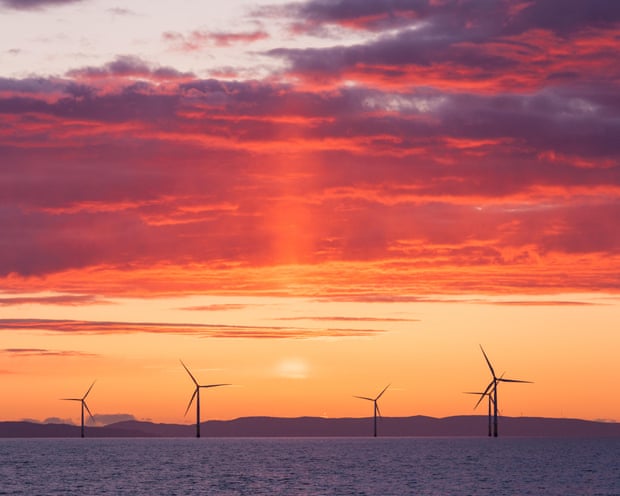
A windfarm off the Cumbrian coast. The crown estate commands hefty option fees from developers to secure areas of the seabed to build windfarms. Photograph: Rob Arnold/Alamy
Environmental group accuses king’s property management company of ‘milking for profit’ its monopoly ownership of seabed
Greenpeace is threatening to sue King Charles’s property management company, accusing it of exploiting its monopoly ownership of the seabed.
The environmental lobby group alleges the crown estate has driven up costs for wind power developers and boosted its own profits, as well as the royal household’s income, due to the “aggressive” way it auctions seabed rights.
The crown estate, as the legal owner of the seabed around England, Wales and Northern Ireland, is responsible for auctioning offshore wind rights. It has benefited from the huge growth in the industry, commanding hefty option fees from renewable energy developers to secure areas of the seabed to build their windfarms.
Will McCallum, co-executive director at Greenpeace UK, said the estate should be “managing the seabed in the interest of the nation and the common good, not as an asset to be milked for profit and outrageous bonuses”.
“We should leave no stone unturned in looking for solutions to lower energy bills that are causing misery to millions of households,” he said.

 Campaigners from Oceana UK protest outside the Royal Courts of Justice in London, where the environmental group is taking the government to court over 31 licences for oil and gas exploration, March 26, 2025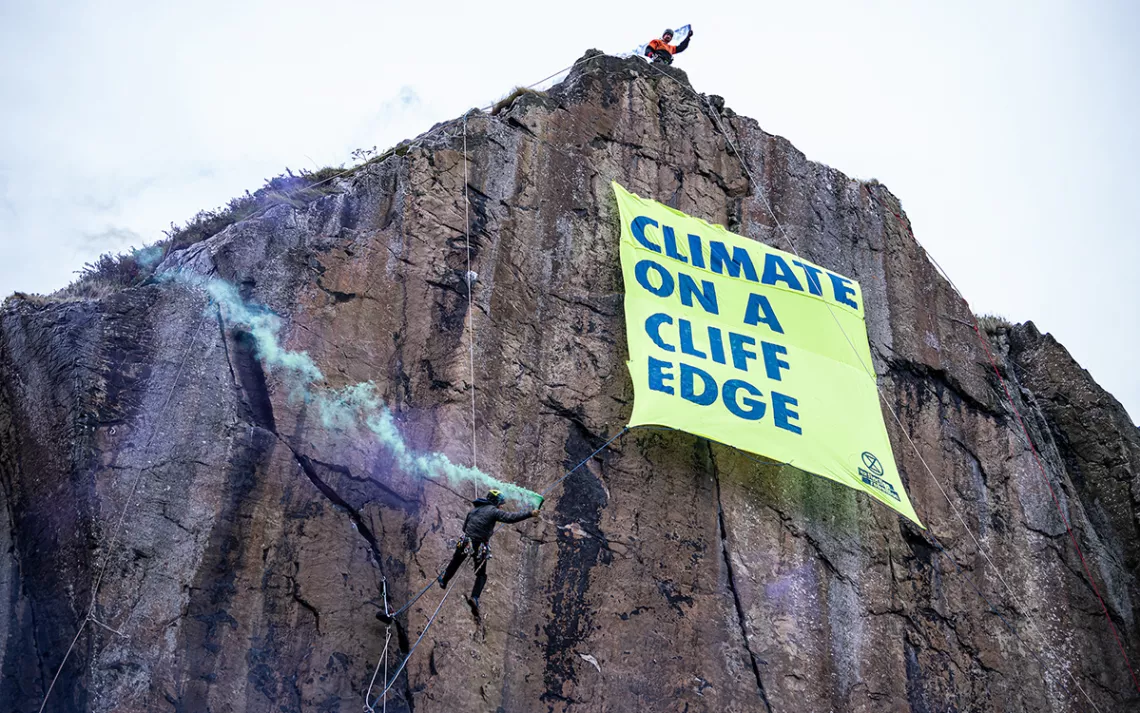



 Greenpeace activists install prison bars around three iconic statues – Nelson Mandela, Mahatma Gandhi and the Suffragist Millicent Fawcett – in Parliament Square, October 29, 2025 [Pic: © Kristian Buus / Greenpeace]