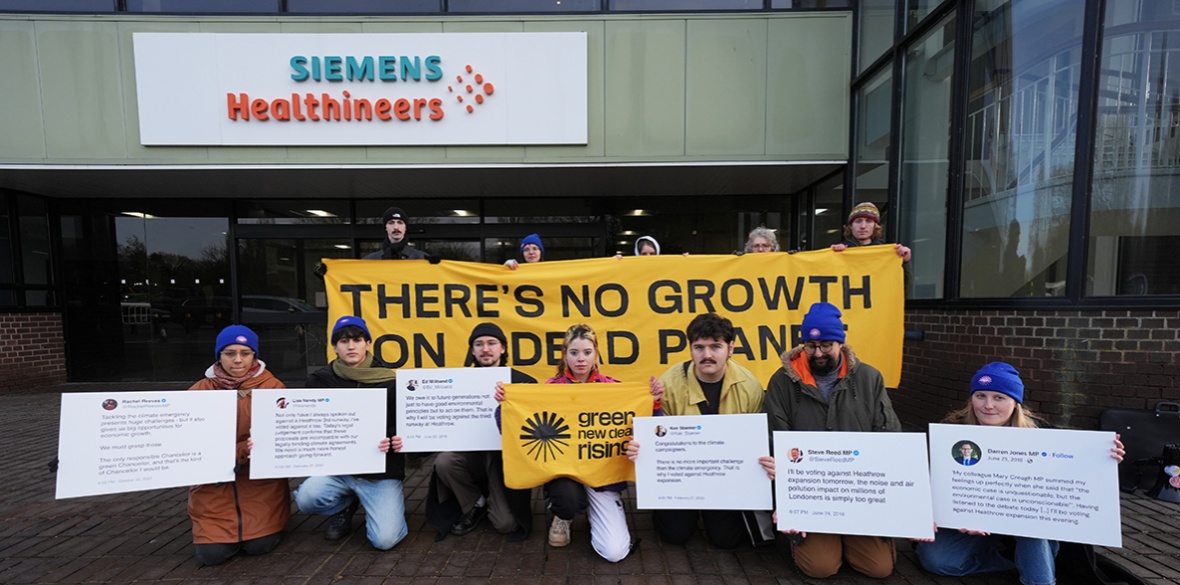
Activists from Fossil Free London and Green New Deal Rising take part in a protest against a third runway at Heathrow, and expansion at Gatwick and Luton, outside Siemens Healthineers in Eynsham, Oxfordshire, January 29, 2025
HEATHROW expansion cannot be the quick fix to the economy, campaigners warned today after the government backed a new multibillion-pound investment programme.
The airport’s chief executive Thomas Woldbye announced funding for upgrades and expansion ahead of its proposal for a third runway, expected to be submitted to the government this summer.
The government said that the investment programme will secure thousands of steel jobs by increasing the demand for British-made steel.
But polling by climate charities suggests a majority of the public believes expansion is the “wrong priority,” with 67 per cent of respondents also saying they did not see much, if any, benefit to taxpayers.
No Third Runway Coalition chairman Paul McGuinness called the announcement “almost Orwellian,” arguing that the government had relied on a Heathrow-commissioned report to promote the project rather than its own Treasury assessment.
…
Greenpeace UK’s chief scientist Dr Doug Parr said that the “real winners” will be Mr Woldbye and “the rest of the polluting aviation industry.”
“The only ‘perks’ for most people will be noise, air pollution and climate emissions,” he said.
Dr Parr said a third runway is “bad economics,” saying: “Instead of picking up any old polluting project from the discard pile, the Chancellor should focus on green industries that can attract investment and bring economic and social benefits for years to come, like secure jobs, affordable energy bills and cheaper, better transport.”
The Prime Minister is facing a growing internal backlash from Labour MPs after Treasury sources indicated Rachel Reeves is likely to give her backing for the proposed Rosebank development (Image: PA/Henry Nicholls)
WESTMINSTER politicians are reportedly at “breaking point” with Keir Starmer over the potential of approving a new oil and gas field in the North Sea.
The Prime Minister is facing a growing internal backlash from Labour MPs after Treasury sources indicated Rachel Reeves is likely to give her backing for the proposed Rosebank development.
MPs have reportedly called for Starmer to reiterate his own commitments to no further oil and gas licences.
Last week a judge ruled the Rosebank development, which was given the green light by the previous Tory administration, as unlawful following a legal challenge brought by Greenpeace and Uplift.
Previously the energy secretary, Ed Miliband, described the licence issued to Rosebank as “climate vandalism”.
Reeves is reportedly supportive of a new application for environmental consent for the North Sea development, despite Labour’s manifesto promising not to issue any new exploration licences.
MPs who are concerned about the climate emergency are reported to be likely to make their appeals directly to Keir Starmer about the importance of being seen to stand by the party’s manifesto commitment of no new oil and gas licences.
A court has ruled that consent for two new Scottish oil and gas fields was granted unlawfully and their owners must seek fresh approval from the UK government before drilling can begin.
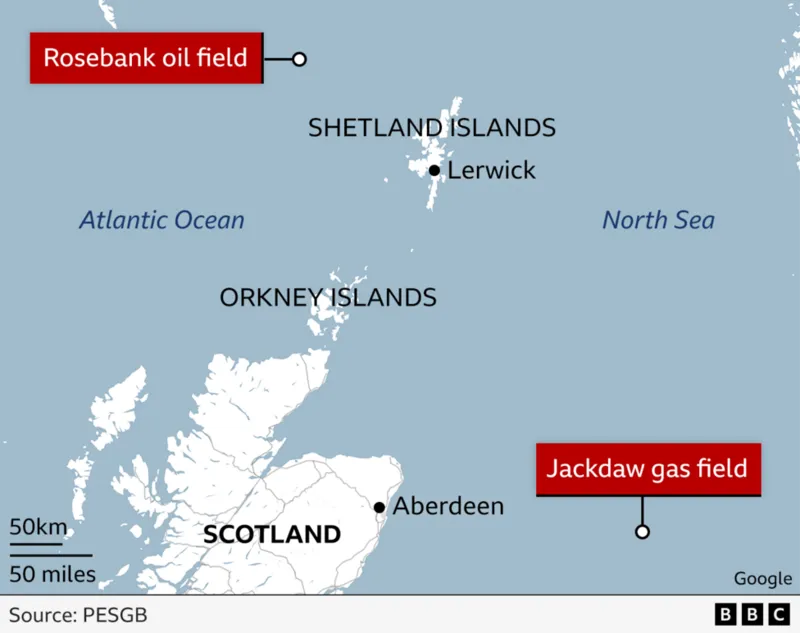
The written judgement on the Rosebank and Jackdaw fields came after a case brought by environmental campaigners, Uplift and Greenpeace, at the Court of Session in Edinburgh.
In his judgement, Lord Ericht said a more detailed assessment of the fields’ environmental impact was required, taking into account the effect on the climate of burning any fossil fuels extracted.
He said work on both fields could continue while the new information was gathered but no oil and gas could be extracted unless fresh approval was granted.
Permission for the Rosebank oil development, 80 miles west of Shetland in the North Atlantic, was granted in autumn 2023.
In a 57-page judgement, Lord Ericht wrote that there was a public interest in having the decision “remade on a lawful basis” because of the effects of climate change – which he said outweighed the interests of the developers.
The Crown Prosecution Service (CPS) has dropped all charges against 34 Greenpeace activists who blockaded Unilever’s London headquarters last September. The decision was made just days before the start of what would have been the largest ‘locking on’ trials ever seen in the UK.
Eight protesters had been facing charges of Aggravated Trespass and a further 26 protesters were charged with the new offence of ‘locking-on’ introduced in the Public Order Act 2023. The letter from the CPS said the charges were dropped because “there is not enough evidence to provide a realistic prospect of conviction”. The first trials were due to begin on 15 January at City of London Magistrates’ Court.
The charges related to 5 September 2024 when Greenpeace activists blockaded the entrances to Unilever House in protest at the firm’s ongoing failure to tackle plastic pollution. Climbers scaled the building and attached a huge artwork to the outside wall. Activists also blocked the entrances to the building, locking themselves onto large models of the company’s flagship Dove products and a ‘Dead Dove’ parody of the company logo.
Will McCallum, Co-Executive Director of Greenpeace UK said: “This is a bolt of good news in an otherwise bleak landscape for protest rights. Our activists were facing a combined total of up to 15 years in prison for standing up to one of the world’s largest plastic polluters. The invented crime of ‘locking-on’ is just one new tool in a well-stocked legal arsenal that is being used to stifle dissent and send peaceful protesters to jail. Previous governments brought in these laws and powers, but the responsibility lies with Keir Starmer to end their chilling effect on democracy and repeal them.”
The crime of ‘locking-on’ was one of a number of offences and powers created by recent Conservative governments to crack down on peaceful protest. It has resulted in hundreds of protesters being arrested, often for as little as walking down a street. Last year saw five climate activists sentenced to a total of 21 years in prison for taking part in a Zoom call to discuss a planned protest.
Greenpeace’s protest was part of an ongoing campaign against Unilever after the corporate giant announced a major rollback of plastic reduction targets last year. A Greenpeace International report showed that it was the largest corporate seller of single-use plastic sachets, selling the equivalent of 1,700 a second.
Daniel Jones, interim head of Greenpeace’s plastics campaign, said: “This is an important milestone in our campaign against Dove’s toxic brand of beauty. We reluctantly staged our protest last September after months of failed talks with Unilever and multiple attempts to raise our concerns in other ways. Since then, Unilever has come back to the table and has begun playing a more constructive role in negotiations for a Global Plastics Treaty. We won’t stop until the company commits to reducing plastic production – particularly of its super-polluting plastic sachets.”
‘Locking-on’ involves protesters attaching themselves to another person, building or object to make it harder for police to remove them. It has long been used as a tactic by protesters, including by the Suffragettes. The Public Order Act 2023 contained the new offences of locking-on and being ‘equipped for locking on’.