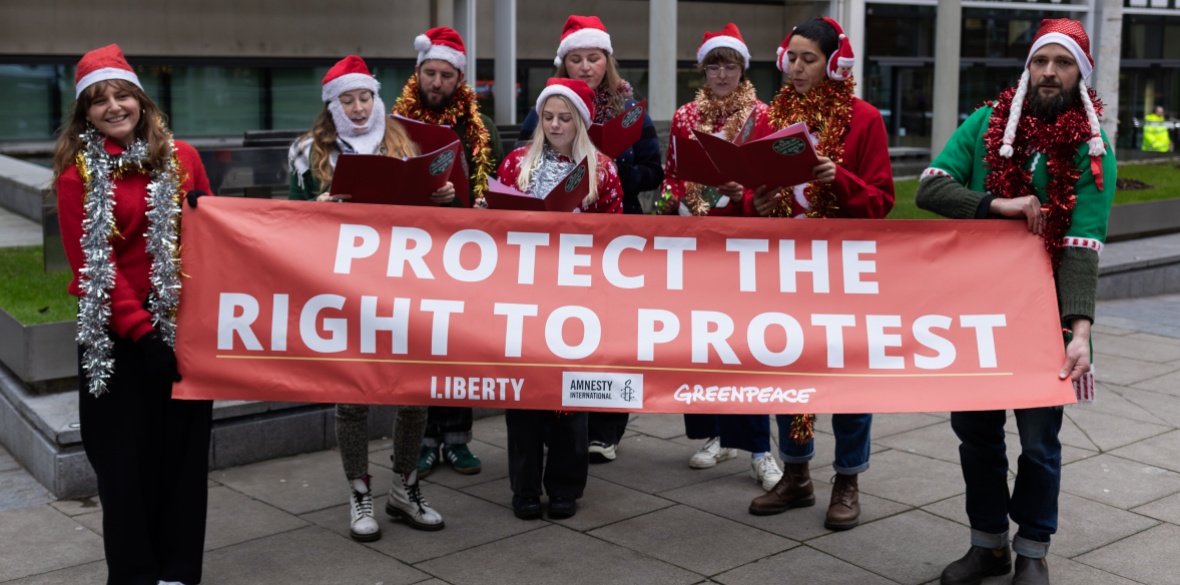
Protesters sing Christmas carols outside the Home Office, December 12, 2024Photo: Talia Woodin @taltakingpic
“AWAY in a police car” echoed outside the Home Office on Wednesday as campaigners belted out renditions of Christmas carols, calling for the government to repeal draconian anti-protest laws.
Dressed in Christmas jumpers and Santa hats, carollers from Amnesty International UK, Greenpeace and Liberty sang festive songs including The Twelve Days of Protest and Silent Protest.
They then handed in a petition to the Home Office, calling on it to scrap protest restrictions introduced by previous governments, alongside a letter to Home Secretary Yvette Cooper demanding an urgent meeting to discuss the state of protest rights in Britain.
A series of repressive laws have made the right to protest increasingly hard to exercise.
They include the Police, Crime, Sentencing and Courts Act 2022, which allows police to ban or restrict “unacceptable” protests, and the Public Order Act 2023 which criminalised protesters “locking on” and fastening themselves to each other or objects.
Punitive jail terms handed out since their enactment include one Just Stop Oil protester being sentenced to six months for slow marching on a road for 30 minutes, while five others from the group received a combined 21 years for co-ordinating a non-violent action over Zoom.
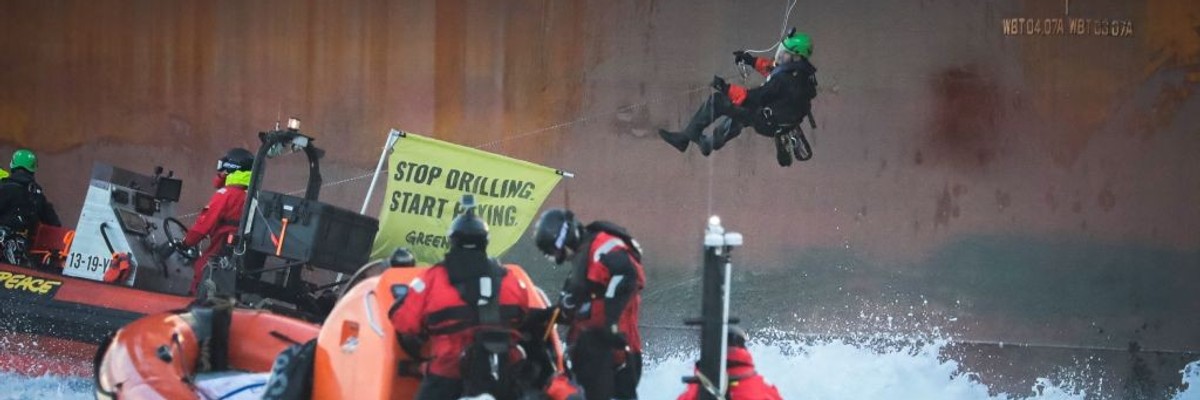
Greenpeace activists board a Shell platform headed toward the North Sea on February 6, 2023. (Photo: Lou Benoist/AFP via Getty Images)
“Shell thought suing us for millions over a peaceful protest would intimidate us, but this case became a PR millstone tied around its neck,” said the co-executive director of Greenpeace U.K.
The United Kingdom-based oil giant Shell agreed Tuesday to settle a major lawsuit the company brought against Greenpeace after activists from the group boarded and occupied a company oil platform last year to protest fossil fuel expansion.
Greenpeace said in a statement that as part of the settlement, it agreed to donate £300,000—roughly $382,000—to the Royal National Lifeboat Institution, a charity that helps save lives at sea, but will pay nothing to Shell and accept no liability. The donation represents a fraction of the over $11 million in damages and legal costs defendants faced, the group said.
The Greenpeace defendants have also “agreed to avoid protesting for a period at four Shell sites in the northern North Sea.”
“Shell thought suing us for millions over a peaceful protest would intimidate us, but this case became a PR millstone tied around its neck,” said Areeba Hamid, co-executive director of Greenpeace U.K. “The public backlash against its bullying tactics made it back down and settle out of court.”
“This settlement shows that people power works. Thousands of ordinary people across the country backed our fight against Shell and their support means we stay independent and can keep holding Big Oil to account,” Hamid added. “This legal battle might be over, but Big Oil’s dirty tricks aren’t going away. With Greenpeace facing further legal battles around the world, we won’t stop campaigning until the fossil fuel industry stops drilling and starts paying for the damage it is causing to people and planet.”
“These aggressive legal tactics, the huge sums of money, and attempts to block the right to protest pose a massive threat.”
Shell brought the case, which Greenpeace characterized as a “textbook” strategic lawsuit against public participation (SLAPP), in February 2023 and sought $1 million in damages from activists who boarded a Shell-contracted ship carrying equipment to drill for oil in the North Sea.
“When the protest ended, the only damage Shell could find was a padlock which, they alleged, our activists broke. That’s it,” Greenpeace U.K. said Tuesday. “Yet they came after us with a million-dollar lawsuit, which they justified for their spending on safety.”
The group, which warned that the case had dire implications for the right to protest, credited a “sustained, year-long campaign against the suit” for forcing the oil behemoth to back down. The campaign, according to Greenpeace, “turned the legal move into a PR embarrassment for Shell.”
“The case was dubbed the ‘Cousin Greg’ lawsuit by Forbes after a scene in the Emmy-awarded drama Succession, in which the hapless character threatens to sue Greenpeace to universal dismay,” the environmental group noted Tuesday.
Greenpeace is currently facing several other SLAPP suits, including one brought by Energy Transfer, majority-owner of the Dakota Access pipeline. The group said Tuesday that the Energy Transfer suit “threatens the very existence of Greenpeace in the U.S.”
“These aggressive legal tactics, the huge sums of money, and attempts to block the right to protest pose a massive threat. It could stop Greenpeace being able to make a real difference on the things that matter most,” the organization said Tuesday. “It’s part of a growing trend by powerful corporations and governments to crush peaceful protest—using draconian laws or intimidation lawsuits like this.”
“It seeks to silence the people most impacted by the climate crisis. This threatens the global fight for climate justice,” the group added. “We won’t give up. This is Shell versus all of us.”
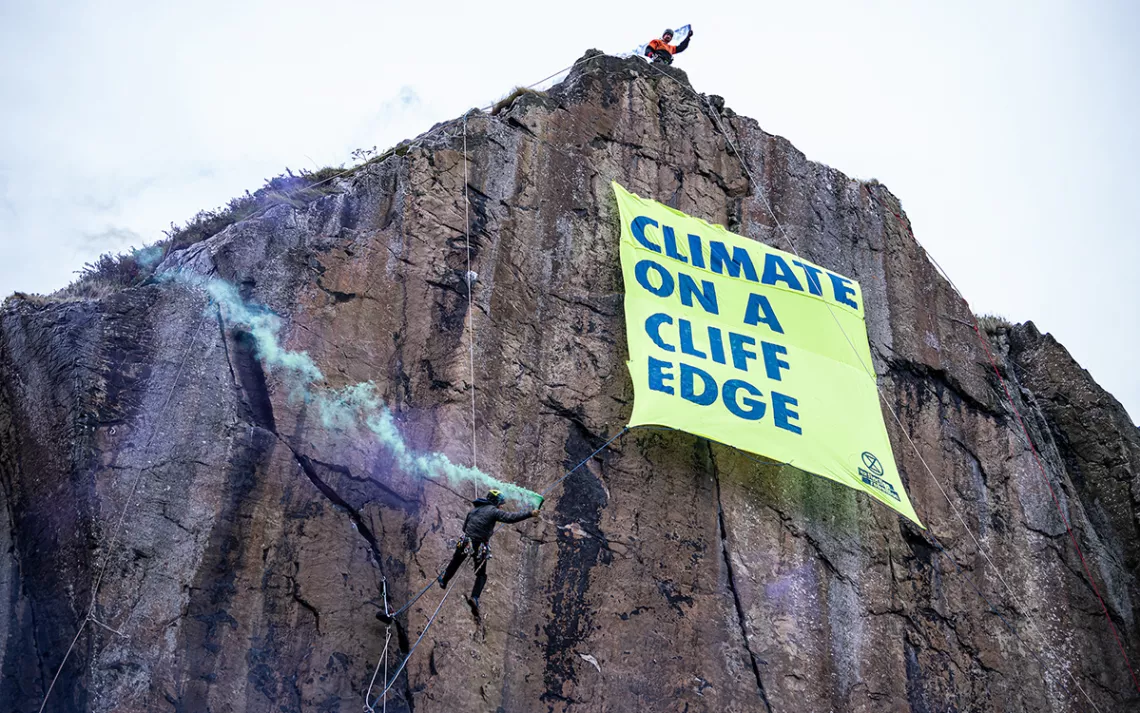
Experienced climbers scale a rock face near the historic Dumbarton castle in Glasgow, releasing a banner that reads “Climate on a Cliff Edge.” One activist, dressed as a globe, symbolically looms near the edge, while another plays the bagpipes on the shores below. | Photo courtesy of Extinction Rebellion and Mark Richards
A protester holds a sign with a Shell logo during a demonstration on March 11, 2023 in The Hague, Netherlands. (Photo: Michel Porro/Getty Images)
“This setback will only help us grow stronger,” said the Dutch climate group that originally brought the case. “Large polluters are powerful. But united, we as people have the power to change them.”
Climate campaigners didn’t sugarcoat their reactions to a Dutch court decision on Tuesday that overturned a landmark 2021 ruling ordering the oil behemoth Shell to cut its planet-warming emissions nearly in half by the end of this decade.
“We are shocked by today’s judgment,” said Donald Pols, director of Milieudefensie, the Netherlands-based environmental group that originally filed suit against Shell in 2018.
“It is a setback for us, for the climate movement, and for millions of people around the world who worry about their future,” Pols said of Tuesday’s ruling by the Hague Court of Appeal. “But if there’s one thing to know about us, it’s that we don’t give up. This setback will only help us grow stronger. Large polluters are powerful. But united, we as people have the power to change them.”
The original 2021 ruling, as CNBC noted, marked “the first time in history that a company was found to have been legally obliged to align its policies with the Paris Agreement” and “sparked a wave of lawsuits against other fossil fuel companies.”
Despite acknowledging that Shell has “an obligation toward citizens to reduce CO2 emissions,” the appeals court on Tuesday scrapped a legal mandate compelling the company to slash its emissions by 45% by 2030 compared with 2019 levels, saying it was “unable to establish that the social standard of care entails an obligation for Shell to reduce its CO2 emissions by 45%, or some other percentage.”
“It is primarily up to the government to ensure the protection of human rights,” the court added.
Laurie van der Burg of Oil Change Internationalsaid in response that “while we mourn today’s setback, the ruling establishes a responsibility for Big Oil and Gas to act that future litigation can build on.”
“The court ruled protection against climate change is a human right, and corporations have a responsibility to reduce their emissions,” she added. “As far as we know, this is the first case where a court has acknowledged that new investments in oil and gas are incompatible with international climate goals.”
“Today’s ruling underscores the importance of world leaders now negotiating at the U.N. Climate Summit in Baku taking responsibility.”
Shell, which is responsible for just over 2% of global CO2 emissions, said in a statement that it was “pleased” with the court’s ruling and claimed to be “making good progress in our strategy to deliver more value with less emissions.”
But research by the human rights organization Global Witness has found that Shell has consistently overstated the scale of its investments in green energy—including by characterizing fossil fuels as “renewable.”
“Even as Shell claims to be reducing its oil production, it is planning to grow its gas business by more than 20% over the next few years, leading to significant additional emissions,” Global Witness wrote in a complaint to the U.S. Securities and Exchange Commission last year.
Andy Palmen, the director of Greenpeace Netherlands, said Tuesday that while campaigners working toward a just phaseout of fossil fuel emissions are “disappointed that Shell is being allowed to continue polluting,” they “will not give up the fight.”
“This only motivates us more to take action against major polluters,” said Palmen. “It really gives hope that the court finds that Shell must respect human rights and has a duty to reduce its CO2 emissions.”
“Today’s ruling underscores the importance of world leaders now negotiating at the U.N. Climate Summit in Baku taking responsibility,” Palmen added, referring to the COP29 gathering that kicked off on Monday in Azerbaijan’s capital city. “The summit in Dubai last year marked the end of coal, oil, and gas, now governments must come up with concrete plans to move away from fossil fuels.”
The Dutch appeals court’s ruling came in the wake of new research showing that oil and gas production surged to an all-time high in 2023—the hottest year on record.
“The oil and gas industry is not transitioning,” the environmental group Urgewald and dozens of other NGOs found. “In fact, 95% of the upstream companies on [the Global Oil and Gas Exit List] are still exploring or developing new oil and gas resources. This includes the oil and gas producers TotalEnergies, Shell, BP, Eni, Equinor, OXY, OMV, and Ecopetrol, which all claim to be targeting net zero emissions by 2050.”
Nils Bartsch, head of oil and gas research at Urgewald, said Tuesday that the 2023 oil and gas production record is “deeply concerning.”
“If we do not end fossil fuel expansion and move towards a managed decline of oil and gas production,” said Bartsch, “the 1.5°C goal will be out of reach.”
A tanker pumping out excess sewage from the Lightlands Lane sewage pumping station in Cookham, Berskhire which flooded after heavy rainfall, January 10, 2024
ENVIRONMENTAL groups called on the public today to mobilise this autumn and ramp up pressure on the government to tackle Britain’s water pollution crisis.
River Action, Surfers Against Sewage and Greenpeace are among the groups who will join the March for Clean Water in Central London on October 26.
It will mark the end of the first 100 days of the Labour government, and take place just days before Chancellor Rachel Reeves’s first Budget.
An escalating water crisis looms, driven by factors such as ageing infrastructure, lack of investment from water firms and industrial pollution.
More than 3.6 million hours of raw sewage discharges poured into rivers and seas last year — a 105 per cent increase compared with 2022.
Shell is suing Greenpeace – threatening a multi million dollar lawsuit and a protest ban. We need your help to fight in court.
Earlier this year, six Greenpeace International activists managed to board and occupy a moving Shell oil platform. The platform was making its way towards the North Sea to unlock new oil wells.
Our demand was clear: Shell must stop drilling for new oil and gas, and start paying up for causing decades of climate damage.
The protest continued for 13 days and almost 4,000km. During this time, Shell reported record annual profits of nearly $40bn. But they won’t pay a penny towards fixing the climate chaos they’ve caused.
Like so many of us, the activists who occupied Shells’ platform all experience the climate crisis in different ways – from rising energy bills and flooding to heatwaves and typhoons. This protest took the fight for climate justice straight to Shell, in a way they couldn’t ignore. Standing with millions of people worldwide, who are losing their lives, loved ones and homes to climate breakdown caused by fossil fuel giants.
Well, we got Shell’s attention. Now they’re suing Greenpeace UK and Greenpeace International, threatening a multi million dollar lawsuit and a protest ban.
These bullying tactics threaten the global fight for climate justice. Will you help us stand up to Shell and donate today to the Stop Shell Appeal?