Firefighters work at the scene of an Israeli airstrike on the Haziz power station in southern Sanaa, Yemen, December 19, 2024
ISRAELI bombers pounded Yemen’s capital Sana’a and its port Hodeida today, killing at least nine as they sought to break the Houthi forces, which have launched attacks in solidarity with Palestine.
The bombing raids followed a Houthi missile strike against Israel. The military said it targeted infrastructure in Hodeida, another port Salif, and the Ras Isa oil terminal, then took out energy infrastructure in Sana’a.
Targeting civilian energy infrastructure is a war crime.
“After Hamas, Hezbollah and the Assad regime in Syria, the Houthis are almost the last remaining arm of Iran’s axis of evil,” Israeli Prime Minister Benjamin Netanyahu declared.
“Whoever raises a hand against the state of Israel, his hand will be cut off,” Israeli Defence Minister Israel Katz added. “Whoever harms us will be harmed sevenfold.”
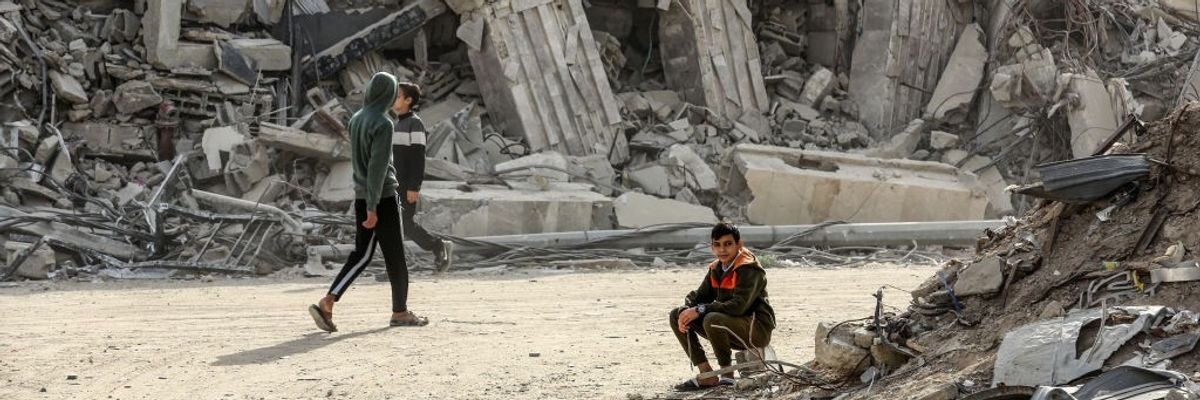
Palestinians are surrounded by buildings destroyed by Israeli attacks in Khan Younis, Gaza on December 10, 2024. (Photo: Abed Rahim Khatib/Anadolu via Getty Images)
“Failure to do so not only risks our leverage in ceasefire negotiations, it undermines our country’s own national security and weakens America’s commitment to human rights as a cornerstone of our foreign policy.”
Twenty progressives in the U.S. House of Representatives on Tuesday wrote to top Biden administration officials arguing that “the United States government must suspend offensive weapons” to Israel over its destruction of the Gaza Strip, citing federal and international law.
Led by Reps. Summer Lee (D-Pa.) and Greg Casar (D-Texas), the incoming Congressional Progressive Caucus chair, the lawmakers began by thanking U.S. Secretary of State Antony Blinken and Secretary of Defense Lloyd Austin for their October 13 letter threatening to cut off weapons to Israeli Prime Minister Benjamin Netanyahu’s government if it did not dramatically improve humanitarian conditions in Gaza.
“However, despite your administration acknowledging that the Netanyahu government did not fully address the United States’ concerns over Gaza and has failed to meet all of the conditions stipulated in this letter, the State Department decided not to take further action, including the suspension of offensive military assistance, to ensure full compliance,” the Democrats wrote.
“We believe continuing to transfer offensive weapons to the Israeli government prolongs the suffering of the Palestinian people and risks our own national security by sending a message to the world that the U.S. will apply its laws, policies, and international law selectively,” they continued. “Furthermore, a failure to act will put Israeli lives in danger by prolonging Netanyahu’s war, isolating Israel on the international stage, and creating further instability in the region.”
The new letter comes just over a month away from President Joe Biden leaving office and follows one from last week signed by 77 House Democrats—including Casar—that demanded “a full assessment of the status of Israel’s compliance with all relevant U.S. policies and laws, including National Security Memorandum 20 (NSM-20) and Section 620I of the Foreign Assistance Act.”
This one goes further, explicitly urging the Biden administration to suspend offensive military transfers and warning that “failure to do so not only risks our leverage in cease-fire negotiations, it undermines our country’s own national security and weakens America’s commitment to human rights as a cornerstone of our foreign policy.”
“We remain committed to saving Palestinian and Israeli lives. This means doing everything possible to prioritize the release of hostages, secure a lasting cease-fire deal, and move toward long-term peace,” the 20 progressives concluded.
In addition to Lee and Casar, Tuesday’s letter was signed by Democratic Reps. Jamaal Bowman (N.Y.), Cori Bush (Mo.), Joaquin Castro (Texas), Lloyd Doggett (Texas), Veronica Escobar (Texas), Jesús “Chuy” García (Ill.), Al Green (Texas), Sara Jacobs (Calif.), Pramila Jayapal (Wash.), Hank Johnson (Ga.), Jim McGovern (Mass.), Alexandria Ocasio-Cortez (N.Y.), Ilhan Omar (Minn.), Mark Pocan (Wis.), Ayanna Pressley (Mass.), Delia C. Ramirez (Ill.), Rashida Tlaib (Mich.), and Bonnie Watson Coleman (N.J.).
It came on the same day as a lawsuit filed by Palestinians and Palestinian Americans accusing the U.S. State Department of creating “unique, insurmountable processes to evade the Leahy Law requirement to sanction abusive Israeli units.”
As of Tuesday, the 14-month Israeli assault on Gaza in retaliation for the Hamas-led October 7, 2023 attack has killed at least 45,059 people and wounded another 107,041, according to local officials. Israel’s slaughter and starvation of Palestinian civilians have led to a genocide case at the International Court of Justice as well as International Criminal Court arrest warrants for Netanyahu and his former defense minister, Yoav Gallant.
Omar el Qataa is a photojournalist operating out of northern Gaza
Facebook has severely restricted the ability of Palestinian news outlets to reach an audience during the Israel-Gaza war, according to BBC research.
In a comprehensive analysis of Facebook data, we found that newsrooms in the Palestinian territories – in Gaza and the West Bank – had suffered a steep drop in audience engagement since October 2023.
The BBC has also seen leaked documents showing that Instagram – another Meta-owned platform – increased its moderation of Palestinian user comments after October 2023.
Meta – the owner of Facebook – says that any implication that it deliberately suppressed particular voices is “unequivocally false”.
…
During a period of war, audience engagement might be expected to rise. However, the data showed a 77% decline after the Hamas attacks on 7 October 2023.
Palestine TV has 5.8 million followers on Facebook. Journalists at the newsroom shared statistics with us showing a 60% drop in the number of people seeing their posts.
“Interaction was completely restricted, and our posts stopped reaching people,” says Tariq Ziad, a journalist at the channel.
Over the past year, Palestinian journalists have raised fears that their online content is being “shadow-banned” by Meta – in other words, restricted in how many people see it.
To test this, we carried out the same data analysis on the Facebook pages of 20 Israeli news organisations such as Yediot Ahronot, Israel Hayom and Channel 13. These pages also posted a large amount of war-related content, but their audience engagement increased by nearly 37%.
On the first day of the hearing at The International Court of Justice aka ICJ, which has been asked by South Africa to consider whether Israel is committing genocide against the Palestinians in Gaza, an advertising van drives around Westminster displaying the definition of genocide on 11th of January 2024 in London, United Kingdom. [Kristian Buus/In Pictures via Getty Images]
It was bound to happen. With continuing operations in Gaza and increasingly violent acts against Palestinians in the occupied territories, human rights organisations are making progressively severe assessments of Israel’s warring cause. While the world awaits the findings of the International Court of Justice (ICJ) on whether Israel’s campaign, as argued by South Africa, amounts to genocide, Amnesty International has already reached its conclusions.
In a 296-page report sporting the ominous title “You Feel Like You Are Subhuman”, the human rights body, after considering the events in Gaza between October 2023 and July 2024, identified a “pattern of conduct” indicating genocidal intent. These included, among other things, persistent direct attacks on civilians and objects; “deliberately indiscriminate strikes over the nine-month period, wiping out entire families repeatedly launched at times when these strikes would result in high numbers of casualties”; the nature of the weapons used; the speed and scale of destruction to civilian objects and infrastructure (homes, shelters, health facilities, water and sanitation infrastructure, agricultural land); the use of bulldozing and controlled demolitions and the use of incomprehensible, misleading and arbitrary evacuation orders.
The report does much to focus on statements from the highest officials to the common soldiery to reveal the mental state necessary to reveal genocide. One hundred two statements made by members of the Knesset, government officials and high-ranking commanders: “Dehumanised Palestinians, or called for, or justified genocidal acts or other crimes under international law against them.” The report also examined 62 videos, audio recordings and photographs posted online featuring gleeful Israeli soldiers rejoicing in the: “Destruction of Gaza or the denial of essential services to people in Gaza, or celebrated the destruction of Palestinian homes, mosques, schools and universities, including through controlled demolitions, in some cases without apparent military necessity.”
From its alternative universe, the Israeli public relations machine drew from its own agitprop specialists, working on mangling the language of the report. The formula is familiar: attack the authors first, not their premises. “The deplorable and fanatical organisation Amnesty International has once again produced a fabricated response that is entirely based on lies,” came the howl from Israeli Foreign Ministry spokesperson Oren Marmorstein.
Other methods of repudiation involve detaching Hamas and its war with Israel from any historical continuum, not least the fact that it was aided, supported and backed by Israel for years as a counter to Fatah in the West Bank. Isolating Hamas as a terrorist aberration also serves to treat it as alien, artificially foreign and not part of any resistance movement against suffocating Israeli occupation and strangulation. They, so goes this argument, are genocidal, and countering such a body can never be, by any stretch, genocidal. The pro-Israeli group NGO Monitor abides by this line of reasoning, calling allegations of genocide against Israel: “A reversal of the actual and clearly established intent of Hamas and its allies (including its patron, Iran) to wipe Israel off the map.”
Israel’s closest ally and sponsor, the US, proved predictable in rejecting the findings while still claiming to respect the humanitarian line. The US State Department’s principal deputy spokesperson, Vedant Patel, expressed disagreement with: “The conclusions of such a report. We had said previously and continue to find that the allegations of genocide are unfounded.” Patel did, however, pay lip service to the: “Vital role that civil society organisations like Amnesty International and human rights groups and NGOs play in providing information and analysis as it relates to Gaza and what’s going on.” Vital, but only up to a point.
Far less guarded assessments can be found in the US pro-Israeli chatter sphere. These follow the usual pattern. Orde Kittrie, senior fellow of the Foundation for Defense of Democracies, a name that can only imply that crimes committed in such a cause are bound to be justifiable, offers a neat illustration. Amnesty, he argues: “Systematically and repeatedly mischaracterises both the facts and the law.” Kittrie suggests his own mischaracterisation by parroting the Israel Defense Forces’ line that Hamas had: “Increased casualty counts by illegally using Palestinian civilian shields and by hiding weapons and war fighters in and below homes, hospitals, mosques, and other buildings.” This conveniently ignores the point that the numbers are not necessarily proof of genocidal intent, though it helps.
The report also notes that, even in the face of such tactics by Hamas, Israel was still: “Obligated to take all feasible precautions to spare civilians and avoid attacks that would be indiscriminate or disproportionate.”
Amnesty International’s report is yet another addition to the gloomy literature on the subject. Human Rights Watch, in November, pointed to violations of the laws of war, crimes against humanity and the provisional measures of the ICJ issued urging Israel to abide by the obligations imposed by the United Nations Genocide Convention of 1948. The Israeli human rights organisation B’Tselem stated in no uncertain terms in October that: “Israel intends to forcibly displace northern Gaza’s residents by committing some of the gravest crimes under the laws of war.”
Battling over the designation of whether a campaign is genocidal can act as a distraction, a field of quibbles for paper-pushing pedants. The “specific intent” in proof must be unequivocally demonstrated and beyond any other reasonable inference. A smokescreen is thereby deployed that risks masking the broader ambit of war crimes and crimes against humanity. But no amount of pedantry and disagreement can arrest the sense that Israel’s lethal conduct, whatever threshold it may reach in international law, is directed at destroying not merely Palestinian life but any worthwhile sense of viable sovereignty. Amnesty Israel, while rejecting the central claim of the parent organisation’s report, did make one concession: the country’s brutal response following 7 October, 2023: “May amount to crimes against humanity and ethnic cleansing.”
The views expressed in this article belong to the author and do not necessarily reflect the editorial policy of Middle East Monitor.
This work by Middle East Monitor is licensed under a Creative Commons Attribution-NonCommercial-ShareAlike 4.0 International License.
Hundreds of demonstrators, holding Israeli flags and photos of prisoners, gather at the streets and march from Jaffa Street in Jerusalem towards Prime Minister Benjamin Netanyahu’s residence, to demand a ceasefire and prisoner swap deal in Gaza in Jerusalem on December 14, 2024. [Saeed Qaq – Anadolu Agency]
The Al-Qassam Brigades, the military wing of the Palestinian resistance group Hamas, said Saturday that the Israeli army bombed a location in the Gaza Strip, where Israeli hostages were held, confirming that the bombing was repeated to ensure their death, Anadolu reports.
Abu Obaida, the spokesperson for the group, said on Telegram: “The occupation army recently bombed a location where some enemy prisoners were present and repeated the bombing to ensure their death.”
“We have intelligence confirming that the enemy deliberately bombed the location with the aim of killing the prisoners and their guards,” Obaida noted.
He added: “Our fighters attempted to rescue the enemy prisoners and succeeded in retrieving one of them, whose fate remains unknown.”
Obaida held Israeli Prime Minister Benjamin Netanyahu, his government, and the Israeli army “fully responsible for this event and the lives of their prisoners.”
A video released by al-Qassam Brigades showed the bombed location and a person without clarifying whether they were killed or injured, with no facial features shown.
The video included a statement: “Netanyahu and [Chief of General Staff Herzi] Halevi seek to get rid of their prisoners in Gaza by all means.”
Israel estimates that there are currently 101 Israeli prisoners held in Gaza.
Mediation efforts led by the US, Egypt, and Qatar to reach a cease-fire and prisoner swap agreement between Israel and Hamas have failed due to Netanyahu’s refusal to halt the ongoing conflict.
Israel has launched a genocidal war on the Gaza Strip that has killed more than 44,800 victims, mostly women and children, since an attack by the Palestinian resistance group, Hamas, on 7 October 2023.
The second year of genocide in Gaza has drawn growing international condemnation, with officials and institutions labeling the attacks and the blocking of aid deliveries as a deliberate attempt to destroy a population.
The International Criminal Court issued arrest warrants last month for Israeli Prime Minister Benjamin Netanyahu and his former defense chief Yoav Gallant for war crimes and crimes against humanity in Gaza.
Israel also faces a genocide case at the International Court of Justice for its war on Gaza.
This work by Middle East Monitor is licensed under a Creative Commons Attribution-NonCommercial-ShareAlike 4.0 International License.