Pope Francis speaks on December 25, 2023 in the Vatican City.(Photo: Alessandra Benedetti/Corbis via Getty Images)
The pontiff’s call comes as the International Court of Justice is reviewing evidence in a South Africa-led genocide case against Israel.
In a new book set to be released this week, Pope Francis I endorsed a genocide investigation into Israel’s war on Gaza—which has killed or maimed more than 150,000 Palestinians and forcibly displaced, starved, or sickened millions more over the past 13 months.
“In the Middle East, where the open doors of nations like Jordan or Lebanon continue to be a salvation for millions of people fleeing conflicts in the region: I am thinking above all of those who leave Gaza in the midst of the famine that has struck their Palestinian brothers and sisters given the difficulty of getting food and aid into their territory,” the pontiff wrote in his latest book, which goes on sale in some countries on November 19.
“According to some experts, what is happening in Gaza has the characteristics of a genocide,” the Pope added. “It should be carefully investigated to determine whether it fits into the technical definition formulated by jurists and international bodies.”
The Pope’s words echo last week’s finding by a United Nations expert panel that Israel’s annihilation of Gaza is “consistent with the characteristics of genocide.”
The International Court of Justice—a U.N. organ—is currently weighing a South Africa-led genocide case against Israel backed by more than 30 nations and regional blocs as well as hundreds of groups and experts around the world.
Meanwhile, the prosecutor of the International Criminal Court is seeking arrest warrants for Israeli Prime Minister Benjamin Netanyahu and former Israel Defense Minister Yoav Gallant, as well as three former Hamas leaders assassinated by Israel, for alleged war crimes and crimes against humanity, including extermination.
Many jurists, scholars, and other experts—including some of Israel’s leading Holocaust historians—have called Israel’s policies and actions in Gaza genocide. Early in the war, Raz Segal—an Israeli historian and professor of Holocaust and genocide studies at Stockton University in New Jersey—called Israel’s Gaza onslaught “a textbook case of genocide.”
Many Palestinian Christians have been killed, injured, or otherwise harmed by Israeli forces during the bombardment, invasion, and siege of Gaza. With just 800 to 1,000 people believed remaining in Gaza, members of the world’s oldest Christian community warned early in the war that they were “under threat of extinction.”
In their most infamous attack on Gaza Christians, Israeli forces bombed the 12th century Saint Porphyrius Greek Orthodox Church, Gaza’s oldest, in October 2023, killing 18 Palestinians including numerous children. Among the victims were two women and an infant related to former Republican U.S. Congressman Justin Amash of Michigan.
After an Israeli sniper fatally shot an elderly woman and her daughter on the grounds of a Catholic church in Gaza City last December, Pope Francis condemned what he called an act of “terrorism.”
Amid the death and destruction wrought by Israel’s assault on Gaza, last December’s Christmas celebrations were canceled in Bethlehem, the purported birthplace of Jesus Christ.
“How can we celebrate when we feel this war—this genocide—that is taking place could resume at any moment?” asked Palestinian Lutheran pastor Munther Isaac at the time.
The New York Times (10/12/24) says it “verified” supposed Hamas documents provided to the paper by Israel—which turns out to mostly mean that that the Israeli military “concluded the documents were real.”
Earlier this month, the New York Times (10/12/24), Washington Post (10/12/24) and Wall Street Journal (10/12/24) each published front-page articles based on different sets of documents handed to them by the Israeli military.
Israel claims it seized all the documents—in the form of meeting minutes, letters and planning documents—in its ground invasion of Gaza, and that they reveal insights into Hamas’s operations prior to the October 7 attacks. The documents include alleged evidence of Hamas’s pre-10/7 coordination with Iran, plans to blow up Israeli skyscrapers, and even a scheme to use horse-drawn chariots in an attack from Gaza.
Documents received directly from intelligence agencies should always be treated with skepticism, and that’s especially true when their government has a well-documented history of blatant lying. Yet leading newspapers took these Israeli document dumps largely at face value, advancing the agenda of a genocidal rogue state.
A history of lying
Fake “Hamas” documents were being cited in the press as recently as September 2024 (Middle East Eye, 9/9/24).
Israel’s use of fabrications to shape public perception is well known, and was put on display early in the assault on Gaza that began last October. After an explosion at Al Ahli hospital killed and injured hundreds (misreporting of which caused a great deal of confusion), the media naturally pointed the finger at Israel. The Israeli government, concerned about the public backlash, denied responsibility, claiming that the explosion was caused by a misfired rocket from Palestinian Islamic Jihad. (See FAIR.org, 11/3/23.)
To back up their claims, Israel released a recording allegedly capturing two Palestinian militants discussing Palestinian Islamic Jihad’s responsibility for the strike. However, an analysis by the firm Earshot found that the audio was the result of two separate channels being edited together (Channel 4, 10/19/23). In other words, Israel engineered a phony audio clip in an attempt to clear itself of war crimes in the public mind.
Investigations based on open sources have since come to various conclusions about the attack (Guardian, 10/18/23; Bellingcat, 10/18/23; Human Rights Watch, 11/26/23; AP, 11/22/23; Michael Kobs, 2023; New Arab, 2/19/24), but Israel’s fraudulent attempt to manipulate evidence certainly suggests that they had something to hide, and demonstrates their lack of reliability as a media source. Recently, the UN released a report accusing Israel of systematically targeting healthcare infrastructure in Gaza, making their denials of this earlier attack far less credible.
In another instance, Israel presented 3D renderings of a supposed Hamas “command center” beneath Al Shifa hospital, claiming it was based on intelligence. However, no such command center was ever found (FAIR.org, 12/1/23). Upon storming the hospital, Israel staged scenes in order to bolster claims that the facility was used by militant groups. The deception was so blatant that mainstream outlets were openly calling it out.
Recently Israel was caught actually providing fabricated documents to the press with the aim of manipulating public opinion. Earlier this year, the Israeli government provided documents to both the Jewish Chronicle (9/5/24) and the German paper Bild (9/6/24) that purportedly showed that Hamas had no interest in a ceasefire, and had a plan to sneak the late Hamas chief Yahya Sinwar out of Gaza to Iran, along with some of the remaining hostages. The reports were then uncritically repeated in outlets like the Times of Israel (9/6/24).
Shortly after these documents were published, the Israeli paper Yedioth Ahronoth (9/8/24) reported on an internal IDF investigation that found that they had been leaked to foreign media as part of a campaign to “shape public opinion on Israel.” The documents were determined to be forgeries, after a comprehensive search of all databases containing documents found in the wake of Israel’s operations. The IDF told the paper that an investigation was underway to determine the origin of the leak.
This non-exhaustive list of examples demonstrates a pattern of Israel engineering misleading narratives to shape public opinion, and fabricating the evidence needed to do so.
Questionable authenticity
The Washington Post (10/12/24) reported that “the documents’ authenticity could not be definitively established”—but there’s no trace of that doubt in the story’s headline or subhead.
Whether they are authentic or not, it is clear that the documents leaked to the Wall StreetJournal, New York Times and Washington Post serve the same purpose of propagandizing on behalf of Israel. In an attempt to preserve some journalistic integrity, the Post and Times both gave separate justifications for why they believed the respective documents leaked to them were authentic.
The Post was quick to note that “the documents’ authenticity could not be definitively established,” but gave readers the impression there was reason to believe they were real. First, it claimed that the contents of the documents it received were
“broadly consistent” with US and allies’ post–October 7 intelligence assessments about Hamas’s long-range planning and complex relationship with Iran.
Then it wrote that unnamed US and Israeli officials they shared the documents with did not express concerns about their authenticity. (Iranian and Hamas officials they consulted didn’t comment on the documents but accused Israel of having a history of “fabricating documents.”)
The New York Times consulted former Hamas member Salah al-Din al-Awawdeh, whom the paper frequently quotes on matters related to Hamas, and an unnamed Palestinian analyst with “knowledge of Hamas’s inner workings.” It also said an internal Israeli military report concluded the documents were authentic, and the paper “researched details mentioned in the meeting records to check that they corresponded with actual events.” It said “Hamas and Hezbollah did not respond to requests to comment” and that Iran “denied the claims made in the minutes.”
The Wall Street Journal story did not describe any attempt to verify the authenticity, and only reported that the paper “hasn’t independently verified the documents.”
But given Israel’s track record, there is no epistemologically sound way of verifying the validity of documents provided by the Israeli government without confirmation from Hamas itself. Citing sources who say that the documents resemble Hamas documents, without noting Israel’s history of creating credible forgeries, creates a patina of credibility without actually substantiating anything.
Advancing Israel’s agenda
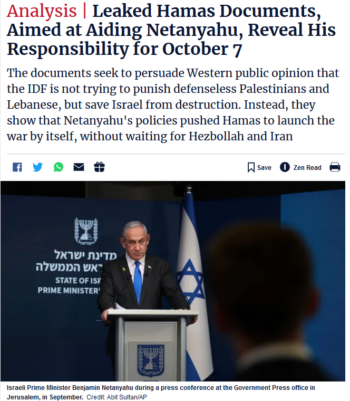
Haaretz (10/14/24): The documents bolster Netanyahu’s claim that Israel is “fighting a terrifying ‘axis of evil’ led by Iran that threatens to destroy Western culture as a whole.”
The Israeli paper Haaretz (10/14/24), which took the documents as authentic, argued that their release by Israel was “Aimed at Aiding Netanyahu.” While both the Times and the Post have largely advanced Israel’s agenda over the past year of bombing (FAIR.org, 10/13/23, 2/1/24, 10/7/24), both papers are considered to be on the critical end of the press spectrum in the US, particularly towards Netanyahu. As Haaretz explained, this perception enhances the propaganda value of the document leak: “The Times and the Post enjoy greater credibility when they fall in line with Israel’s narrative.”
While Haaretz made no note of the leaked documents provided to the Wall Street Journal, the article ironically acknowledged that
having them published by Fox News or even the Wall Street Journal would have looked like an Israeli public diplomacy operation rather than a legitimate journalistic investigative report.
Haaretz noted that the documents promote narratives that “Israel would be happy to burn into the world’s consciousness,” namely the well-known propaganda effort to equate Hamas with organizations that are universally reviled by Americans. The Post documents purportedly outlined a Hamas plan to blow up a skyscraper in Tel Aviv, evoking the September 11 attacks against the World Trade Center:
The Hamas documents are supposed to bolster Netanyahu’s claim that Israel isn’t fighting against a liberation movement seeking to free the occupied Palestinian people, or even against a paramilitary organization that is poorly funded and trained and lacks planes, the Iron Dome anti-missile system, tanks and artillery….
Rather, it is fighting a terrifying “axis of evil” led by Iran that threatens to destroy Western culture as a whole.
Haaretz also argued that this kind of propaganda campaign was designed to ensure that the violence continues to escalate:
In this spirit, the documents are supposed to justify Israel’s counterattack, which has so far caused enormous death and destruction in Gaza and, to an increasing degree, also in Lebanon.
Obvious PR value
Unlike the New York Times or Washington Post, the Wall Street Journal (10/12/24) acknowledged in its headline that the revelations in the documents are what “Israel says” they show.
While Haaretz overlooked the story from the Wall Street Journal, the same logic can be applied to the documents given to that paper as well. The Journal was apparently curious about the political purpose of the documents, noting that “the officials who provided the documents declined to say why they were releasing them now.”
The Journal wrote that the documents “suggest that Hamas leader Yahya Sinwar was negotiating with Iran over funding for a planned large-scale assault on Israel as far back as 2021,” and gave specific dollar amounts that Iran provided to Hamas’s armed wing. The obvious public relations value of these documents was that they boosted the negative image of Iran prior to Israel’s recent attack on that country.
Israel’s campaign of genocide in Gaza and greater war in the Middle East has been successful in part because the Israeli government can count on Western press to present and contextualize facts in a way that advances their narrative. Despite Israel’s long history of fabrications, the corporate media will dutifully republish documents, statements and explanations with complete credulity.
Netanyahu meets Harris July 2024. | Kenny Holston/The New York Times/Bloomberg via Getty Images.
This week, the US quietly deployed more weapons to Israel – particularly those that will be effective against Iran
US and Israeli leaders have celebrated this week’s death of Hamas military commander Yahya Sinwar. But while attention is focused on what it means for Gaza and the unlikely possibility of a ceasefire – few have noticed what this means for the much wider US-Iran war.
The US has, of course, put its military might, money and rhetoric behind Israel in its devastating operations in Gaza since last October. More specifically, the US even has a little-noticed permanent military presence in Israel itself – an advanced long-range over-the-horizon X-Band Radar system in the Negev. It is believed to be particularly effective against Iranian medium-range ballistic missiles.
But this week, two recent developments point to the US preparing for direct confrontation with Iran as it sharpens its ammunition and shares even more weaponry with its ally Israel.
First, we saw the US use long-range B-2 stealth bombers in attacks on underground weapons stores in Yemen for the first time. Only the US has these weapons which are thought to be the world’s most powerful ‘bunker-busters’ and can reach 200-feet underground. If there is a war with Iran it will be one of the very few means of inflicting damage on some of Iran’s most heavily protected targets.
That might sound scaremongering but the bombing of the Houthi targets in Yemen with these tools looks uncomfortably like a dry run for any conflict with Iran.
Secondly, we saw the deployment of an advanced US anti-missile system to Israel, again involving US military personnel. This is the THAAD weapon (terminal high-altitude aerial defence) which will supplement Israel’s own system that has not been as effective as the Israeli Defence Forces (IDF) would like.
From an IDF perspective, if Netanyahu agrees to a substantial military attack on Iran, the likely response from Iran will be to do its best to swamp Israeli missile defences. Thus, the US THAAD deployment will reduce the risk of an effective Iranian response.
This all seems a far cry from the repeated US calls for a ceasefire, but these are best seen as part of a smoke screen, behind which lies a long-term enemy
This all seems a far cry from the repeated US calls for a ceasefire, but these are best seen as part of a smoke screen, behind which lies a long-term enemy. Most Europeans, including the British, tend to forget that ever since the Iranian Revolution in 1979 it has been Iran that is seen in Washington as by far the worst threat to US political and economic interests in the Middle East.
This fits in substantially with the Israeli position where Iran is, in the longer term as by far the greatest threat to its security – far worse than Hamas, Hezbollah or any other political movement. Moreover, an an Iran equipped with nuclear weapons really would be seen as an existential threat. That existential threat may not fully extend to the US view, but Iran is by some measure the greatest challenge to US Middle East policy.
“Israeli military strikes are targeting Iran’s armed allies across a nearly 2000-mile stretch of the Middle East and threatening Iran itself. The efforts raise the possibility of an end to two decades of Iranian ascendancy in the region, to which the 2003 US invasion of Iraq inadvertently gave rise.”
Israel wants rid of the regime in Tehran but that would also be a very good outcome for the many hawkish elements in the US political system. While world attention may be on the war in Gaza with this week’s killing of Yahya Sinwar, a potential conflict involving Iran may turn out to be even more significant.
U.S. Rep. Alexandria Ocasio Cortez (D-N.Y.) speaks during a press conference to call for a cease-fire between Israel and Hamas in front of the U.S. Capitol in Washington, D.C. on November 13, 2023. (Photo: Mandel Ngan/AFP via Getty Images)
“I care about human rights,” said the New York congresswoman in response to her Democratic colleague in the Senate. “I care that billions of U.S. tax dollars’ worth of weapons are carrying out unspeakable atrocities.”
New York Rep. Alexandria Ocasio-Cortez criticized fellow Democrat and Pennsylvania Sen. John Fetterman on Wednesday for failing to hold the U.S.-armed Israeli military accountable for killing and harming civilians in the Gaza Strip.
Ocasio-Cortez’s remarks came in response to Fetterman’s dismissal of her earlier call for an arms embargo on Israel, which has received billions of dollars worth of weapons and other military aid since the Hamas-led October 7 attack.
“The tragedy in Gaza is 100% on Hamas,” Fetterman wrote on social media with a screengrab of a Hill headline outlining Ocasio-Cortez’s remarks. “Stop using civilians and hospitals as shields, surrender, and release all remaining hostages—and this ends.”
Ocasio-Cortez then retweeted Fetterman’s words with her own rebuttal.
“I dunno man. I care about little kids dying,” the New York lawmaker replied. “I care about human rights. I care that billions of U.S. tax dollars’ worth of weapons are carrying out unspeakable atrocities. I care enough for us to do better.”
“Hope this bleak dunk attempt gets you whatever it is you’re going for,” she concluded.
I dunno man. I care about little kids dying. I care about human rights. I care that billions of US tax dollars’ worth of weapons are carrying out unspeakable atrocities.
I care enough for us to do better.
Hope this bleak dunk attempt gets you whatever it is you’re going for. https://t.co/aGSDfSdrUI
The exchange comes as Israel has intensified its assault on northern Gaza in recent days, bombing homes and schools-turned-shelters in the Jabalia refugee camp and issuing new evacuation orders for the beleaguered region yet placing snipers on roofs and shooting people who try to flee. On Saturday, the Palestinian Deputy Observer to the United Nations Majed Bamya called Israel’s escalation in the north a “genocide within the genocide” and the World Food Program said that no food had been able to reach the area since October 1, warning that the ramped up attacks were having “a disastrous impact on food security for thousands of Palestinian families.” However, 50 trucks carrying aid including food were allowed to enter the north on Wednesday.
Ocasio-Cortez’s remarks that prompted Fetterman’s rejoinder came in response to the weekend’s atrocities.
“The horrors unfolding in northern Gaza are the result of a completely unrestrained Netanyahu gov, fully armed by the Biden admin while food aid is blocked and patients are bombed in hospitals,” she wrote on social media on Monday. “This is a genocide of Palestinians. The U.S. must stop enabling it. Arms embargo now.”
Ocasio-Cortez has been an outspoken critic of Israel’s assault on Gaza and the U.S. response. She backed a House resolution calling for a cease-fire weeks into the war, and demanded an end to the flow of weapons from the House floor in March, when she described Israel’s actions in Gaza as an “unfolding genocide.”
Fetterman, meanwhile, has faced protests from some of his more progressive constituents over his hardline pro-Israel stance.
On Tuesday, news broke that the Biden administration had reportedly written a letter to the Israeli government threatening to cut off the flow of weapons to the country unless it took “urgent and sustained actions” to improve the humanitarian situation in Gaza within 30 days.
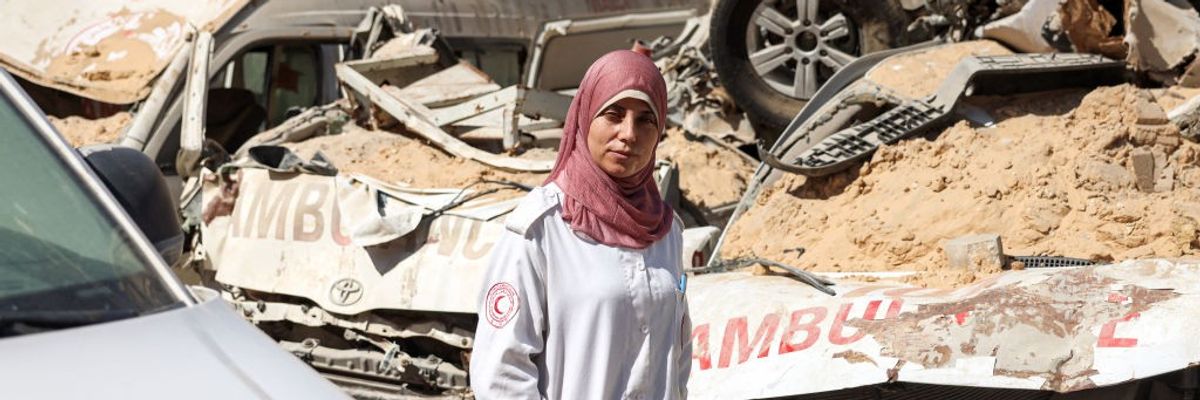
Palestinian paramedic Maha Wafi, 43, walks past destroyed ambulances destroyed by Israeli attacks in Khan Yunis in the southern Gaza Strip on September 15, 2024. (Photo: Bashar Taleb/AFP via Getty Images)
“Israel must immediately stop its unprecedented wanton destruction of healthcare facilities in Gaza,” the head of the inquiry stressed.
For the second time this year, a United Nations commission tasked with investigating Israel’s conduct during its yearlong invasion and blockade of Gaza has found that the U.S.-armed Israeli military is committing crimes against humanity against Palestinians.
The Independent International Commission of Inquiry on the Occupied Palestinian Territory released a report Thursday detailing how “Israel has perpetrated a concerted policy to destroy Gaza’s healthcare system as part of a broader assault on Gaza, committing war crimes and the crime against humanity of extermination with relentless and deliberate attacks on medical personnel and facilities.”
“The commission also investigated the treatment of Palestinian detainees in Israel and of Israeli and foreign hostages in Gaza since October 7, 2023 and concluded that Israel and Palestinian armed groups are responsible for torture and sexual and gender-based violence,” the Office of the U.N. High Commissioner for Human Rights (OHCHR) said in a summary of the report.
The report cites the U.N. World Health Organization’s findings that Israel carried out 498 attacks on healthcare facilities in the Gaza Strip between October 7, 2023—when Hamas launched the deadliest-ever attack on Israel—and July 30, 2024.
“A total of 747 persons were killed directly in those attacks, and 969 others were injured, and 110 facilities were affected,” the publication states. The report calls the attacks “widespread and systematic.”
.@UN Commission of Inquiry says in a new report that #Israel has perpetrated a concerted policy to destroy #Gaza’s healthcare system; war crimes & crimes against humanity committed in treatment of Palestinian detainees & Israeli & foreign hostages.
Israeli security forces carried out air strikes against hospitals, causing considerable damage to buildings and surroundings, as well as multiple casualties; surrounded and besieged hospital premises; prevented the entry of goods and medical equipment and exit/entry of civilians; issued evacuation orders but prevented safe evacuations; and raided hospitals, arresting hospital staff and patients. Israeli security forces also obstructed access by humanitarian agencies.
“Israel must immediately stop its unprecedented wanton destruction of healthcare facilities in Gaza,” said commission chair Navi Pillay. “By targeting healthcare facilities, Israel is targeting the right to health itself with significant long-term detrimental effects on the civilian population. Children in particular have borne the brunt of these attacks, suffering both directly and indirectly from the collapse of the health system.”
OHCHR said that “attacks on medical facilities in Gaza, particularly those devoted to pediatric and neonatal care, have led to incalculable suffering of child patients, including newborns.”
“In continuing these attacks, Israel has violated children’s right to life, denied children access to basic healthcare, and deliberately inflicted conditions of life resulting in the destruction of generations of Palestinian children and, potentially, the Palestinian people as a group,” the agency added.
The commission’s inquiry found that as of July 15, “113 ambulances had been attacked and at least 61 had been damaged,” including vehicles used by the U.N., International Committee of the Red Cross (ICRC), the Palestine Red Crescent Society (PRCS), and other organizations.
Israel bombed an ambulance carrying injured people in the middle of a crowd of civilians today.pic.twitter.com/SARWx2TO3Q
“Access was also reduced owing to closure of areas by Israeli security forces, [and] delays in coordination of safe routes, checkpoints, searches, or destruction of roads,” the report notes.
The commission investigated the January 29 attack that killed 6-year-old Hind Rajab and six of her relatives, as well as two paramedics who had Israeli permission to attempt to rescue them.
“They were attacked while trying to evacuate in their car,” the report said of the family. “The ambulance, carrying two paramedics, Yousef Zeino and Ahmed al-Madhoun, was dispatched after its route had been coordinated with Israeli security forces. It was hit by a tank shell at a distance of some 50 meters from the family’s car.”
“Hind was still alive at the time that the ambulance was dispatched,” the publication noted. “The presence of Israeli security forces in the area prevented access. As a result, the family members’ bodies could not be retrieved from their bullet-ridden car until 12 days after the incident.”
Israel Defense Forces officials have repeatedly claimed that no IDF troops were in the area at the time of the attack. Multiple journalistic investigations, including one published Tuesday by Sky News, showed that Israeli tank and machine gun fire killed the family and paramedics.
.@prem_thakker: [Hind Rajab] is illustrative of 10s of thousands of kids killed…how can US keep unconditionally sending weapons if this is how 🇮🇱 is dealing with investigations of potential violations
The new report’s authors also noted that “hundreds of medical personnel, including three hospital directors and the head of an orthopedic department, as well as patients and journalists were arrested by Israeli security forces” during raids on Gaza medical facilities.
“Reportedly, 128 health workers remain detained by Israeli authorities as of July 15, including four PRCS staff members,” the publication states.
“The institutionalized mistreatment of Palestinian detainees, a longstanding characteristic of the occupation, took place under direct orders from the Israeli minister in charge of the prison system, Itamar Ben-Gvir, and was fueled by Israeli government statements inciting violence and retribution,” said OHCHR.
Released Palestinian doctor Khaled Al-Sarr tells the horrific conditions & brutal torture faced by Palestinian prisoners being held inside israeli jails pic.twitter.com/tdphFnBV5E
The commission report also detailed crimes committed by Hamas and other Palestinian armed groups against Israelis on and after October 7, 2023, when more than 1,100 Israelis and others were killed—at least some by so-called “friendly fire” and under the fratricidal Hannibal Directive—and over 240 people abducted.
Hostages “were mistreated to inflict physical pain and severe mental suffering, including physical violence, abuse, sexual violence, forced isolation, limited access to hygiene facilities, water and food, threats and humiliation,” OHCHR said. “Hamas and other Palestinian armed groups committed the war crimes of torture, inhuman or cruel treatment, and the crimes against humanity of enforced disappearance and other inhumane acts causing great suffering or serious injury.”
In June, the same U.N. commission found Israel’s far-right government responsible for a range of war crimes and crimes against humanity in the Gaza Strip, including “extermination, torture, forcible transfer, and the use of starvation as a weapon of warfare.”
Over the course of its 370-day assault on Gaza, Israeli forces have killed at least 42,010 Palestinians in the coastal enclave—most of them women and children—and wounded more than 97,700 others, according to the Gaza Ministry of Health and international agencies.
At least 10,000 Palestinians are missing and believed to be dead and buried beneath the rubble of hundreds of thousands of bombed buildings. Israel’s “complete siege” of Gaza has forcibly displaced more than 90% of Gaza’s 2.3 million people, and has contributed to the starvation and sickening of hundreds of thousands of Gazans.
Israel is on trial for genocide at the U.N. International Court of Justice. Meanwhile, International Criminal Court Prosecutor Karim Khan is seeking arrest warrants for Israeli Prime Minister Benjamin Netanyahu, Israeli Defense Minister Yoav Gallant, and three Hamas leaders—at least one of whom, political chief Ismail Haniyeh, has been assassinated—for alleged war crimes and crimes against humanity, including extermination.