Israeli tanks are pictured near the Israel-Lebanon border on September 30, 2024. (Photo: Erik Marmor/Getty Images
“The Biden administration has acted recklessly in giving Israel a blank check to light the entire region on fire.”
Israeli forces invaded southern Lebanon early Tuesday with the open support of the United States, which endorsed what it called “limited operations to destroy Hezbollah infrastructure” despite warnings that a ground assault could spark a wider conflict and intensify the humanitarian disaster facing Lebanese civilians.
The Israel Defense Forces (IDF) described its ground invasion with the same terms it has used to characterize its bombing campaigns in Lebanon and Gaza, which—despite being called “targeted” at Hezbollah and Hamas—have frequently killed scores of civilians and obliterated schools, hospitals, shops, and residential buildings. Since mid-September, Israeli airstrikes in Lebanon have killed more than a thousand people and displaced roughly a million.
The IDF launched its ground invasion with the backing of the Biden administration. In a statement, the White House said that the invasion of Lebanon is “in line with Israel’s right to defend its citizens and safely return civilians to their homes.”
A spokesperson for the White House National Security Council acknowledged the risk of “mission creep” only to effectively wave it away, saying that “we will keep discussing that with the Israelis.”
Analysts likened Israel’s movement of troops into Lebanon to its invasion of the southern Gaza city of Rafah earlier this year—an operation that was initially described as limited but ultimately left the area in ruins.
“Gaza was a testing ground for Israel to see what they could get away with and, it turns out, the answer is absolutely anything it wants,” said historian and analyst Assal Rad. “It did not stop at Gaza or the West Bank and it may not stop at Lebanon, because war was [Israeli Prime Minister Benjamin] Netanyahu’s objective all along and his prize is Iran.”
“Make no mistake: The Biden administration is providing cover for Israel as it invades a neighboring, sovereign nation.”
The invasion comes after the Netanyahu government rejected a three-week cease-fire proposal put forth by the U.S., France, and other nations and intensified its bombing of Lebanon, hammering Beirut with airstrikes that killed Hezbollah leader Hassan Nasrallah and many civilians. The attack that killed Nasrallah was reportedly carried out with 2,000-pound bombs supplied by the U.S.
Coverage of the invasion in the Western corporate media painted the U.S. as “increasingly powerless,” with “limited” influence to forestall a massive ground assault on Lebanon. But the Biden administration has yet to seriously leverage American military aid to prevent a war that could envelop the entire region.
On the contrary, billions of dollars of aid and American weapons have continued to flow to Israel, enabling its war on Gaza and Lebanon. The Washington Post observed that “the events of recent weeks appear to fit a pattern in which the administration urges against specific Israeli actions only to later backtrack so it can avoid imposing conditions on military aid.”
The U.S. has also engaged in what’s been described as “unprecedented” intelligence-sharing with Israel, further deepening its complicity in the devastating wars.
Sarah Leah Whitson, executive director of Democracy for the Arab World Now (DAWN), said in a statement late Monday that “Israel’s invasion of Lebanon, following its devastating attacks on Lebanon over the past two weeks, is the entirely predictable consequence of the Biden administration’s ceaseless coddling and resupply of weapons to Israel, whatever public bleats for cease-fires the administration has otherwise made.”
“The Biden administration has acted recklessly in giving Israel a blank check to light the entire region on fire, all while disregarding our own legal obligations under both U.S. and international law to halt the weapons flow to them,” Whitson added.
The U.S.-based anti-war group CodePink said that “Israel claims its operation in Lebanon is ‘targeted,’ but like in Gaza, civilians are the real victims.”
“Make no mistake: The Biden administration is providing cover for Israel as it invades a neighboring, sovereign nation,” the group said. “U.S. taxpayers fund Israel’s military, providing billions annually and supplying weapons used to kill innocent people.”
“The Biden administration and Congress could halt this escalation by cutting military aid, demanding a cease-fire, and holding Israel accountable,” CodePink continued, “but instead, they allow continued aggression across the Middle East.”
Israeli airstrike on the Cola area in West Beirut which killed 3 leaders from the PFLP. Photo: via Telegram
Israel intensified assassinations of top leaders of the Axis of Resistance, ahead of the Israeli ground invasion into Lebanon
The Israeli Occupation Forces (IOF) assassinated five resistance leaders of groups affiliated with or supporting the Axis of Resistance in different parts of Lebanon within the last 48 hours. Three of the leaders were affiliated with the Popular Front for the Liberation of Palestine (PFLP), while the fourth leader was affiliated with the Palestinian Islamic Resistance Movement Hamas. The fifth was a top scholar and leader in Hezbollah.
The PFLP announced on Monday, September 30, that Israeli warplanes launched an airstrike near Kola intersection at the center of the Lebanese capital Beirut in the early hours of Monday morning killing three of its top leaders. PFLP identified the assassinated leaders as Imad Odeh, who was a PFLP military commander in Lebanon, along with Mohammad Abdel Aal and Abdul Rahman Abdel Aal, who were members of the movement’s political bureau in Lebanon. The Palestinian resistance group mourned its slain leaders in a statement vowing to “continue the path of struggle and resistance until the occupation will be swept away no matter how long it takes, and no matter how great the sacrifices.” Many have pointed out that the PFLP has not been involved in any of the strikes against Israel from Lebanese territory, making their assassination in this context even more concerning.
Meanwhile Hamas announced in a statement on Monday that Fateh Sharif Abu al-Amine, one of the movement’s leaders abroad, was killed along with his wife, son, and daughter, in an airstrike that targeted their house in the al-Buss refugee camp in South Lebanon. The movement mourned Abu al-Amin describing him as “active and vibrant” in addition to being “brave and courageous”. Hamas also pledged to remain steadfast “on the path of all Palestinian martyrs until the Israeli occupation is defeated and expelled from Palestine, and until Al-Quds and Palestinian prisoners in Israeli jails are liberated.”
On Sunday, September 29, Hezbollah announced that a member of its central council, Sheikh Nabil Qawouk was killed in an Israeli airstrike south of Beirut a day earlier. The Lebanese resistance group mourned Qawouk in a statement saying: “His Eminence Sheikh assumed many organizational responsibilities in the various units of Hezbollah, worthy of the trust he carried, a great scholar and fighter. Martyr Sheikh Nabil was always present in the arenas of Jihad, close to the fighters on the front lines, and spent his honorable life in the fields of Jihad and sacrifice.”
The Israeli army intensified its attacks to assassinate top resistance leaders in the region as it is prepared to launch an impending ground incursion in Lebanon which began in the early hours of Tuesday October 1.
Pro-Palestinian protesters take part in a Palestine Solidarity Campaign demonstration as they march to the Labour Party conference venue on September 21, 2024 in Liverpool, England. [Ian Forsyth/Getty Images]
It’s difficult to comprehend the horrors of what’s happening in Gaza, Lebanon and beyond in the Middle East. The heartbreaking scenes of dirt-encrusted toddlers screaming as they’re pulled from the rubble of what was once their homes; the small children carrying plastic bags containing the remains of their slain siblings; the white-bandaged bodies of whole families laid out next to hospitals in their hundreds; the shaking youngsters trying to hide as Israeli soldiers fire indiscriminately at anything that moves. Surely, feeling a deep, painful empathy for the victims of such savagery, especially the children, is part of what gives us our humanity.
This isn’t the same for everyone, of course. Not for the perpetrators, who use their cutting-edge western-manufactured machines of death to extinguish these innocent lives. Nor, in most cases, for politicians here in Britain. For Prime Minister Keir Starmer, these scenes are even the set up for a joke.
During the new prime minister’s triumphant speech at this week’s Labour Party conference, a heckler dared to challenge the Dear Leader on his lack of empathy for Israel’s victims. After Starmer said that, “Every child, every person, deserves to be respected for the contribution they make,” Labour member Daniel Riley, 18, shouted in response: “Does that include the children of Gaza?”
“This guy’s obviously got a pass from the 2019 conference,” quipped the smug Starmer, in a reference to years when Labour was led by pro-Palestinian Jeremy Corbyn. The more sycophantic element of Starmer’s congregation, stronger than ever thanks to Sir Keir’s purges of the left, lapped up the jibe.
It’s become a cliché to respond to such things with variations of “imagine the response if Corbyn had said something like that about Israeli children,” but sometimes you can’t help but be stunned at the double standards. Corbyn would never have said such a thing, but if he had it would have been frontpage news; irrefutable proof of his alleged anti-Semitism.
But they weren’t Israeli children. They were Arabs. And in mainstream western discourse, they don’t count. They don’t suffer. They don’t have dreams. They’re abstract numbers, if that.
They’re just Arabs, unworthy of our empathy.
To really hammer home the hypocrisy, the words “genocide” and “apartheid” had already been banned from the Labour conference. The Palestine Solidarity Campaign was forced to remove both words from the title of its fringe meeting. Some activists responded by painting the words “genocide conference” on the windows of the venue.
In many ways, the Labour government, elected in July after 14 years in the wilderness, is an improvement on their Conservative predecessors regarding Palestine. But that’s a pretty low bar. Starmer may have banned his MPs from attending the huge protests against the war on Gaza, which often numbered hundreds of thousands of people, but he didn’t go as far as former home secretary Suella Braverman, who branded them “hate marches”.
Pro-Palestinian protesters campaign near Downing Street in London, UK, on Wednesday, July 24, 2024. [Betty Laura Zapata/Bloomberg via Getty Images]
And despite Labour’s top team repeating the mantra that “Israel has the right to defend itself” like a broken record whenever the issue comes up, it has at least (and belatedly) called for a ceasefire and the establishment of a Palestinian state (however problematic that demand in itself is).
The Labour government has also drawn the ire of Israel for dropping its opposition to the International Criminal Court’s bid for an arrest warrant against Benjamin Netanyahu. A further schism was seen when the UK resumed its £21 million funding to the Palestinian refugee agency, UNRWA. Again, it was a low bar.
Much has also been made of the new government’s decision to block arms sales to Israel (although this is limited to a pitiful eight per cent of exports). Unsurprisingly, the Palestine solidarity movement says it’s not enough. And so do the British public: in May, 55 per cent of the British public wanted arms sales to Israel to be suspended until the war against the Palestinians in Gaza ends.
Even less surprisingly, it was met with fury from Israel. Benjamin Netanyahu said that it was “sending a horrible message” to Hamas. Starmer responded to Netanyahu’s comment during an interview on LBC Radio over the conference period. “No, he’s not right about that,” he tried to reassure the audience. “We had to comply with international law and our domestic law in relation to that. I’ve always been clear, I support Israel’s right to self-defence, I’ve been robust about that… I’ve taken blows in relation to that – there’s no doubting that support – but it’s got to be done in accordance with international law.”
In other words, “I’m really sorry, and I’m not saying you’re committing war crimes, it’s just that it would be a bad look for a former lawyer to end up in The Hague.”
Foreign Secretary David Lammy was also questioned on LBC during the conference about why the other 92 per cent of arms sales to Israel had not been banned, including the export of parts for F-35 fighter jets, which Israel has used, among other things, to bomb heavily-populated refugee camps in Gaza. Lammy said that a full embargo would limit Israel’s ability to fight the Houthis in Yemen “and other proxies”.
“I think that would be a mistake,” he added. “It would lead to a wider war and an escalation that we here in the UK are committed to stopping, so I’m afraid I disagree with that position.”
In Lammy’s eyes, war is peace.
By coincidence, two of the arms companies currently selling their merchandise to Israel for use in Gaza were also at the conference. According to Private Eye magazine, BAE Systems, which makes parts for the F-35, hosted a high-profile meeting with defence secretary John Healey. A separate event, featuring armed forces minister Luke Pollard, was sponsored by US arms firm Northrop Grumman. Northrop Grumman makes parts for the F-35, the F-16 and the Apache helicopter. All are being used to massacre civilians in Israel’s war in Gaza and the wider region.
To ensure compliance with the Zionist narrative, Israeli politicians came to the conference themselves. Among them was opposition leader Yair Golan, who has said that Palestinians should “starve to death” until the hostages are released. He was granted audiences with several ministers, including Lammy, and attended a meeting hosted by Labour Friends of Israel.
Nevertheless, the conference did at least spark some hope for the Palestine cause, albeit inadvertently. During its opening weekend, 15,000 protesters gathered in Liverpool to send a message to Labour over its appalling support for the occupation state.
And that’s where the hope is. The Labour government won’t stand up to Israel’s devastating behaviour without pressure. If what we’ve seen already isn’t enough to make them change this attitude, I’m not sure what would. If Israel invaded London, Keir Starmer would probably still be trying to sell them the weapons to do it with.
Labour has pretty much always backed wars that align with the needs of the British and now US empires, from the First World War to Vietnam. It wants to preserve the British state, its crown and its interests, albeit in a way that slightly improves life for its working-class base. It’s currently in the interests of the British ruling class to cling to the coattails of the United States. The US, in turn, needs Israel as its outpost in the Middle East. This is all hardwired into Establishment politics.
Politicians who deviate from such norms, such as Corbyn, are vilified. That’s not how we do grown-up politics in this country, don’t you know?
Starmer is no radical. He’s not really much at all.
His main use was to seize back control of the Labour party from the left and return it to the hands of the Establishment. He did this by standing on a left-wing manifesto during his leadership election only to abandon it, ally himself with the right of the party and purge the left once he assumed the leadership.
His domestic agenda is hampered severely by his unwillingness to tax the rich to repair the devastation left by the Conservatives. Instead, he is removing winter fuel allowances from pensioners and maintaining benefit restrictions on anyone with more than two children. These, he keeps saying, are “tough choices”, even though they are the easiest choices for him, as he is so scared of upsetting the rich and powerful.
He’s desperate to be seen as an effective manager for the British state, which means maintaining the easy ride enjoyed by the wealthy and aligning himself with US-led geopolitical interests. Moreover, the British Establishment that Starmer works for is fully behind the US and its Middle Eastern proxy, Israel.
Just as a middle manager at a fast food company would enthusiastically and unquestioningly promote its unhealthy products, despite their harmful effects on consumers, Starmer is hardwired to enthusiastically and unquestioningly execute the will of the people with real power over Britain. That’s not the electorate.
Tales of children suffering in Gaza are as irrelevant to him as children suffering under his benefit restrictions in Britain. Elderly people freezing in makeshift shelters in Lebanon are as irrelevant to him as elderly people freezing in Britain because they can’t afford to pay their energy bills.
And all the while, Starmer enjoys the patronage of the powerful. His bewilderment at a recent outcry over major donations of cash, designer clothes and tickets to football matches and concerts to him and his top team reveals his belief that he should be reaping the rewards of his subservience as much as any effective manager.
The Labour party conference showed us a government that will continue to stand firmly behind Israel, no matter what the state does or the wider horrors it looks set to unleash. Mild reprimands aside, Labour under Starmer will not abandon the apartheid state without huge pressure.
That’s why real opposition to Israel’s crimes remains in the hands of those outside parliament who take to the streets, occupy their universities and speak up loudly in defence of Palestinians. The Labour leadership’s limited concessions to Palestinian rights would not have been made without that pressure from below. It’s only when actions like these begin to challenge Starmer’s tentative grip on power that he will be forced to offer any sort of meaningful opposition to Israel’s barbarism.
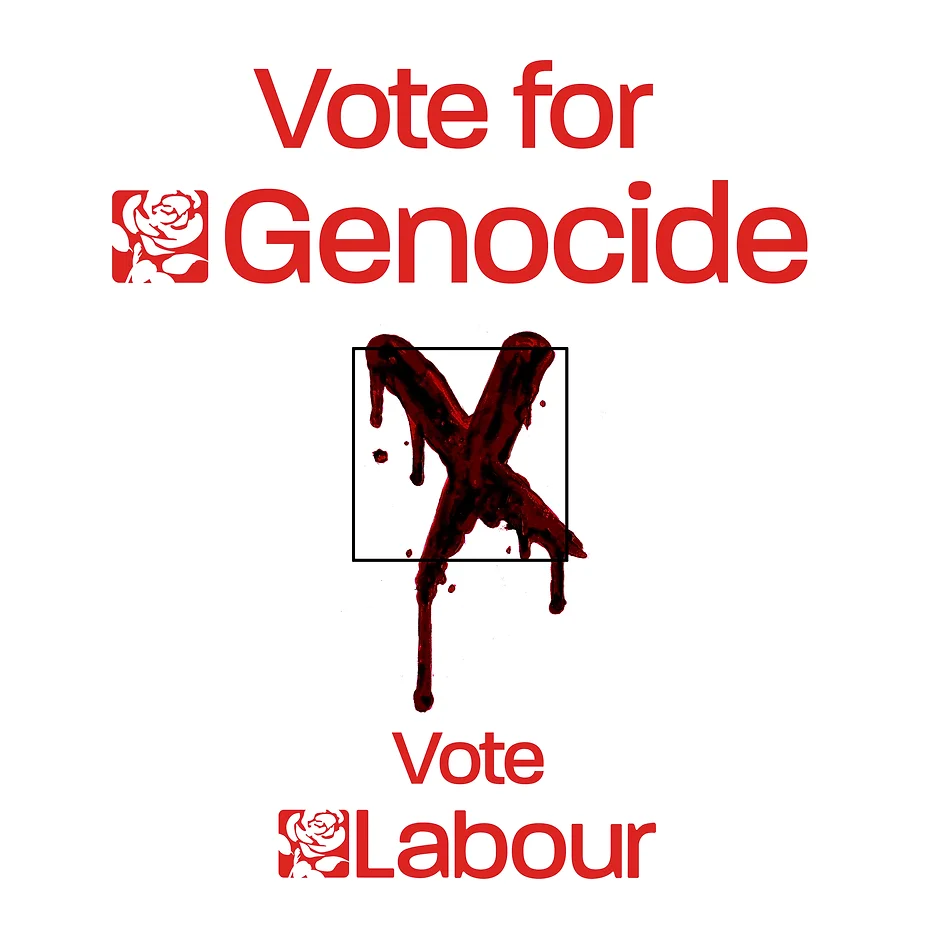
Zionist Keir Starmer is quoted “I support Zionism without qualification.” He’s asked whether that means that he supports Zionism under all circumstances, whatever Zionists do.Vote For Genocide Vote Labour.UK Foreign Secretary David Lammy says that UK is suspeding 30 of 350 arms licences to Israel. He also confirms the UK government’s support for Israel’s Gaza genocide.
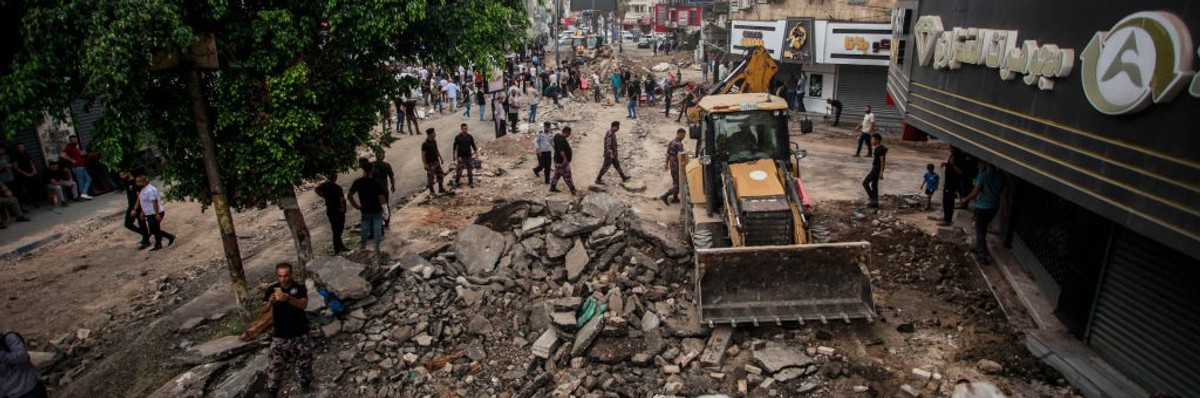
Palestinians walk around the damage in Jenin’s city center after an Israeli military raid in the occupied West Bank on September 6, 2024. (Photo: Nasser Ishtayeh/SOPA Images/LightRocket via Getty Images
“We watched their bulldozers tear up streets, demolish businesses, pharmacies, schools,” said one local leader. “They even bulldozed the town soccer field, and a tree in the middle of a road.”
As the world watched Israel’s assaults on Lebanon and the Gaza Strip, The New York Times on Wednesday also directed attention to the West Bank, detailing how “Israeli military bulldozers tore up mile after mile” of Jenin and Tulkarm in recent weeks.
While “nearly nightly raids” by the Israel Defense Forces (IDF) “have become the norm” in the West Bank since the Hamas-led October 7 attack, the military last month “launched one of its most extensive and deadliest raids” in the illegally occupied Palestinian territory in years, the newspaper reported, citing videos and interviews with residents.
“We watched their bulldozers tear up streets, demolish businesses, pharmacies, schools. They even bulldozed the town soccer field, and a tree in the middle of a road,” said Kamal Abu al-Rub, governor of Jenin. “What was the point of all of this?”
In addition to ground operations in the West Bank, the IDF has increased airstrikes that critics say run afoul of international law. The military defended the strikes and told the Times that in recent raids, troops found weapon stockpiles and killed or arrested dozens of militants—but also caused some “unavoidable harm to certain civilian structures.”
In response to videos included in the reporting, freelance journalist Pete Tucker accused Israeli soldiers of “methodically laying waste to” the West Bank.
Malini Ranganathan, an associate professor at American University’s School of International Service, said on social media that “Israel’s criminality knows no limits. IDF bulldozers have been obliterating the West Bank, even tearing up roundabouts.”
Israeli forces have damaged homes, shops, and roads along with internet, electricity, phone, water, and sewage lines in the West Bank. Emergency crews have been unable to respond to hundreds of calls per day, because they can’t reach people in need.
“They are imposing conditions, materially and psychologically, that make people feel: Gaza is coming to you,” Al Haq director Shawan Jabarin told the Times. “There is a feeling among Palestinians across the West Bank that what is coming is very bad—that it will be a plan to kill and expel us.”
Since the October 7 attack on Israel that killed more than 1,100 people, Israeli forces have slaughtered at least 41,455 Palestinians in Gaza and 716 in the West Bank. Across the Palestinian territories, over 100,000 others have been injured over the past year. The bloodshed led to an ongoing genocide case at the International Court of Justice (ICJ).
The ICJ in July issued a nonbinding advisory opinion that Israel’s decadeslong occupation of Gaza and the West Bank, including East Jerusalem, is illegal and must end “as rapidly as possible.” Instead, Israel has ramped up attacks on not only the Palestinian territories, but also Lebanon, home to the political and paramilitary group Hezbollah.
This week’s bombing campaign in Lebanon—which has killed at least 569 people—sparked fresh calls for the Biden administration to finally cut off weapons to Israel, as did the new reporting from the Times, which has been accused of pro-Israel bias in its coverage of the assault on Gaza.
Meanwhile, Israeli destruction in the West Bank continues. The International Middle East Media Centerreported that “on Wednesday, Israeli soldiers invaded the town of Beit Ula, west of Hebron in the occupied West Bank’s southern part, [and] bulldozed over 20 dunams of land, uprooting more than 600 fruit-bearing trees, and demolishing several agricultural structures and wells.”
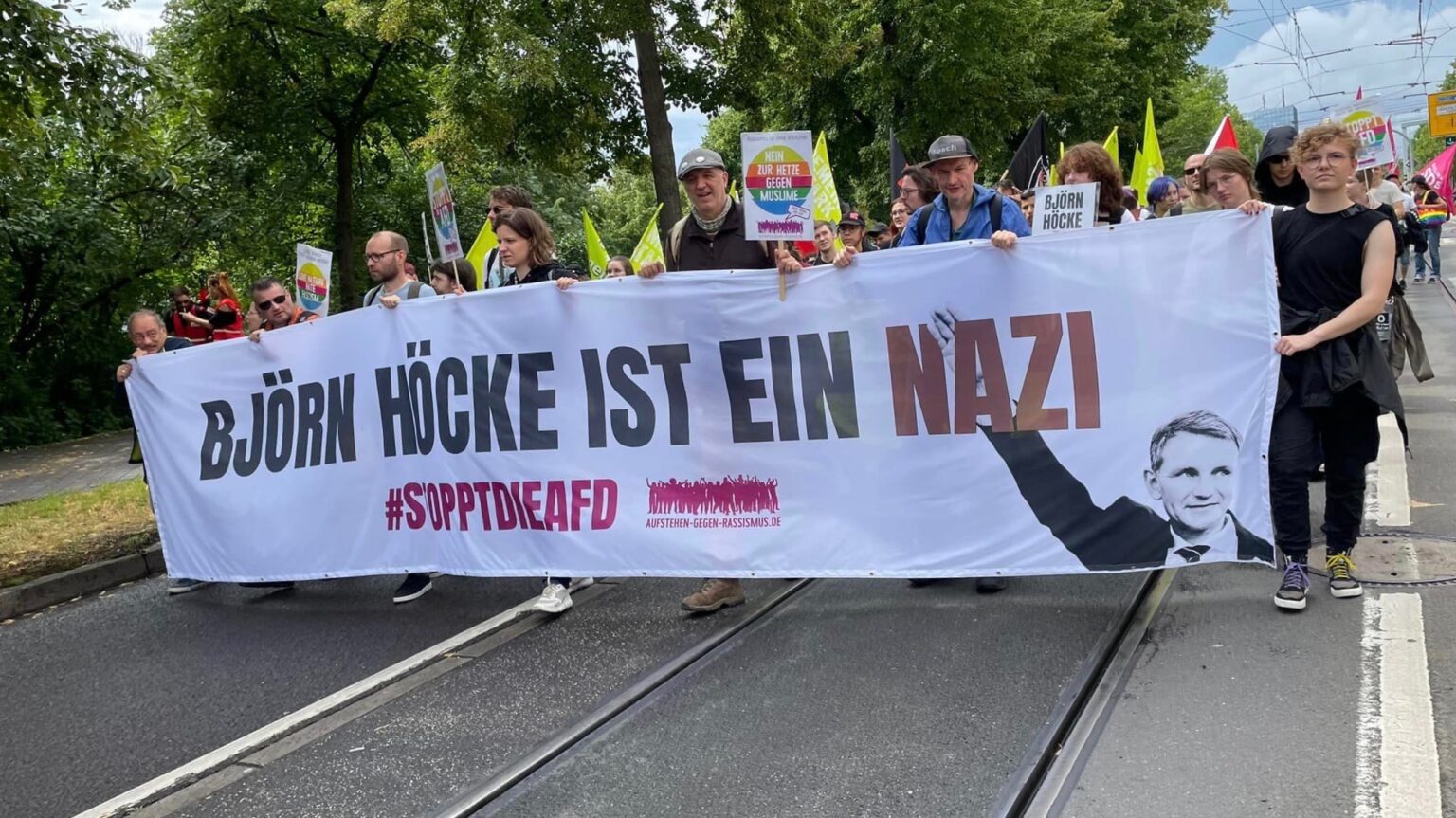
Anti-AfD protest in Magdeburg. (Photo: via Standing Up Against Racism)
The German government has defied EU law by imposing border controls, while Green politicians decry “the poison of Islam” in parliament. Meanwhile, the far-right AfD has surged in recent state elections. What’s driving Germany’s sharp shift to the right?
Germany is entering a period of reaction. This is not only evident from the rise of the far-right Alternative for Germany (Alternative für Deutschland, AfD), but also from the hardline policies of the governing coalition’s so-called centrist parties. The Social Democrats (SPD), Greens, and Liberal Democrats (FDP) have introduced unprecedented measures against migrants and critics of state policies. In September 2024, Federal Interior Minister Nancy Faeser (SPD) imposed border controls, defying European criticism and undermining the EU’s Schengen Agreement. Political scientist Christopher Wratil of the University of Vienna said that Berlin can “no longer claim others are not complying with EU law,” adding that the government is acting “as if the AfD were already in power.” Soon after Faeser’s announcement, Green parliamentary leader Katharina Dröge referred to “the poison of Islam” (das Gift des Islams) during a Bundestag session.
Germany challenged on multiple fronts
To explain this drastic rightward shift, it is necessary to understand the international situation confronting Germany’s ruling class. There are three main fronts on which the German state is currently bogged down.
Firstly, in Ukraine, where NATO’s confrontation with Russia is stalling, if not collapsing entirely. As the second-largest backer of the Zelensky regime, Berlin remains fully committed to winning the war. The government’s July 2024 decision to approve the stationing of US Tomahawk cruise missiles on German soil confirms this. Sanctions on Russia have strained the German economy, especially energy-intensive industries, but the state has absorbed much of the burden through subsidies. The Federation of German Industries, representing 100,000 companies, continues to back the government’s policies. However, popular support for the war is crumbling, as recent EU and state elections show. The two parties most critical of arms deliveries to Ukraine – the AfD and the Sahra Wagenknecht Alliance for Reason and Justice (Bündnis Sahra Wagenknecht, BSW) – made record gains, while the governing coalition suffered heavy losses.
The second front, not yet erupted into open conflict, is East Asia, in the confrontation with China. German capital faces the same dilemma as its US counterpart: while business with China remains lucrative, Chinese producers are outpacing American and European competitors, challenging Western hegemony. Germany has been more reserved than the US in taking a confrontational stance, but the government’s plan to invest 10 billion euros into a 30-billion-euro Intel chip production project in Germany shows its intent to reduce reliance on China. Meanwhile, the Green foreign minister, who called Xi Jinping a “dictator” in 2023, has led a cross-party effort to instrumentalize Taiwan against Beijing. The Ministry of Defense’s recent decision to send a warship through the Taiwan Strait is the latest move in this confrontational policy.
The third front is West Asia, where Germany remains the most outspoken advocate of Israel’s genocidal offensive in Gaza. Unlike the other fronts, there are no economic concerns holding German capital back from fully supporting Israel. This unified stance on Zionism and opposition to the so-called axis of resistance has allowed the government to swiftly implement policies against the Palestinian solidarity movement. While smearing protesters as antisemitic, basic rights such as freedom of assembly and speech are thrown out of the window. Homes are raided, activists arrested, solidarity organizations banned, and laws tightened—most recently with the liberal FDP calling to strip non-EU citizens of the right to assembly. Yet, the Western-backed offensive in Gaza has also stalled, with Israel unable to eliminate Hamas. Domestically, Germany uses force to suppress dissent, but it cannot do so internationally. States from the Global South are openly challenging Germany’s unconditional support for Israel. Namibia accused Berlin of supporting genocide while shirking responsibility for colonial crimes. Nicaragua has filed a case against Germany in the International Court of Justice, accusing it of violating the 1949 Genocide Convention. Others, like Malaysian Prime Minister Anwar Ibrahim, have directly confronted German politicians: “Where have we thrown away our humanity? Why this hypocrisy?”
The escalations on these fronts, along with rising domestic discontent, are fueling insecurity among Germany’s ruling class. A shift to the right is seen as necessary to capture broad sections of the population, keep them integrated into the system, and conjure scapegoats. The consistent messaging around the “Russian threat” and “Islamic terrorism” is used to justify massive military spending, cuts to social programs, and sweeping surveillance laws, including the right to secretly invade private homes. Meanwhile, migrants are blamed for housing shortages and the collapse of the healthcare system.
The collapse of the governing parties in eastern Germany
Elections for two state governments in eastern Germany made international headlines in August 2024 after the far-right AfD made massive gains, even becoming the strongest political force in Thuringia, where it led by almost 10%. There are several reasons for the far-right’s success.
Firstly, there is the historical trajectory of the post-1989 era. Over 30 years have passed since the socialist German Democratic Republic (GDR) was incorporated into the Federal Republic, yet West German promises of “blossoming landscapes” remain unfulfilled. The privatization of the East German economy was the largest wealth transfer in European history: millions lost their jobs and were deprived of their rightful shares in the public property they had built. This left East Germans with little to pass to their children. Almost all key positions in the state and economy were taken by West Germans. Deindustrialization led to higher unemployment, lower incomes, and longer working hours compared to the West. The result was a mass exodus, with nearly 4 million people moving westward since 1989 to escape the bleakness.
The East German population has essentially been relegated to second-class citizens in the Federal Republic. This has fostered a general distrust of Western political parties, whose approach has often been to “educate” rather than represent the East: “Your system lost, you have lost, so we will show you how it’s done.” The natural rejection of this condescending, paternalistic attitude has long been reflected in voter support for anti-establishment parties like The Left (Die Linke) and, more recently, the far-right AfD.
While The Left enjoyed broad support in the early 2000s for opposing the neoliberalization of the labor market, it gradually fell out of favor after joining regional and city governments, where it helped implement the same neoliberal policies it once opposed (such as the privatization of public housing in Berlin). This created a political vacuum in which the AfD was able to present itself as the only oppositional force, despite being a neoliberal party. The AfD taps into the economic and social challenges people face, blaming migrants or incompetent politicians in Berlin rather than the economic system itself. It has been especially successful among skilled laborers and small business owners—those most threatened by, or fearful of, social degradation.
This dynamic, which had already been unfolding for several years – was accelerated by the escalation of the Ukraine war in 2022. The question of arms deliveries to Kiev now played a central role in political debates.
The EU elections in June 2024 – in which the whole country participated – showed that Germans are dissatisfied with the governing coalition (SPD, Greens, and liberal FDP). Voters are now turning to the conservative CDU and far-right AfD, both of which call for tougher social cuts in response to current crises. The AfD gained nearly 5%, becoming the second-largest German party in the EU parliament, surpassing even the SPD. While the AfD has criticized further arms deliveries to Ukraine, it does not oppose NATO or the ongoing militarization in Germany. Many likely voted for the AfD due to its demagoguery on Ukraine, particularly calls to end the war with Russia. Polls from September 2024 show more Germans now oppose further arms deliveries to Ukraine (51%) than support them (38%), and 52% believe diplomatic efforts for peace have been insufficient. The BSW, a new party that split from The Left in 2023, centered this issue in its campaign and secured 6% of the national vote in the EU elections.
The two state elections in August 2024 further revealed that consensus around the Ukraine war effort is breaking down, especially in eastern Germany. All three governing parties lost votes, while the AfD and BSW made record gains. The Left, which had been the strongest party in Thuringia and supported arms deliveries to Ukraine, lost nearly 18% and was overtaken by the BSW. The AfD is now the largest party in Thuringia, winning almost a third of the vote. In Saxony, the AfD came close, with 30.6% compared to the CDU’s 31.9%. Notably, the CDU leader in Saxony has broken from the party’s line, calling for an end to arms deliveries and diplomatic negotiations with Russia.
The successes of the AfD and BSW have left the two eastern German states without a clear path forward. All parties currently refuse to form coalitions with the far-right AfD. While mainstream parties have derided the BSW as the “long arm of the Kremlin,” they also acknowledge the need to contend with this new party. Wagenknecht has stated that the BSW will only join coalitions with parties that oppose the stationing of US Tomahawk cruise missiles in Germany—a largely symbolic stance, as state governments have no control over this decision. More concerning for centrist parties is the disintegration of the political landscape, which could allow the opposition to block decisions requiring a two-thirds majority, including the election of constitutional judges. There is a palpable angst that minority parties in federal and state parliaments could “shut down” Germany’s constitutional courts.
Dark prospects
The upsets in eastern Germany are driven, at least in part, by dissent over NATO’s war effort against Russia. Both the AfD and BSW, from different perspectives, argue that supplying more weapons to Ukraine is not in Germany’s “national interest.” This domestic dissent, coupled with military setbacks in Donbass, is clearly causing doubts within the governing coalition. Just days after the elections in Thuringia and Saxony, Chancellor Olaf Scholz (SPD) expressed support for diplomatic negotiations with Moscow to “discuss how we can move from this war situation towards peace more quickly.”
While the German ruling class grapples with the Ukraine dilemma, its commitment to militarizing society remains strong. In this endeavor, the AfD does not stand in its way. Although the far-right party differs on issues like the war against Russia, relations with the USA, and the future of the EU, it poses no threat to German capital. On the contrary, centrist parties can mask themselves as an anti-fascist bulwark, rallying much of the population (including many on the left) around the slogan of “stopping the AfD,” while simultaneously enacting similarly racist and inflammatory policies toward migrants.
Asylum seekers are once again being deported back to Afghanistan, in flagrant disregard of the EU’s own human rights convention. Even “liking” certain social media posts warrants deportation, according to Interior Minister Nancy Faeser (SPD). At the same time, the German government is ramping up its “brain drain” strategy against the Global South. Just a few days after ordering controls on all of Germany’s borders, Faeser signed an agreement with the Kenyan government to make it easier for Germany to poach Kenyan professionals. A similar agreement with Uzbekistan followed a week later.
Germany’s increasingly aggressive neo-colonial policies abroad and its ever-more repressive policies at home are thus two sides of the same coin.