The Direct Links Between Southern Brazil’s Massive Flooding and Climate Denial

Spread the love

Original article by Lucas Araldi republished from DeSmog.
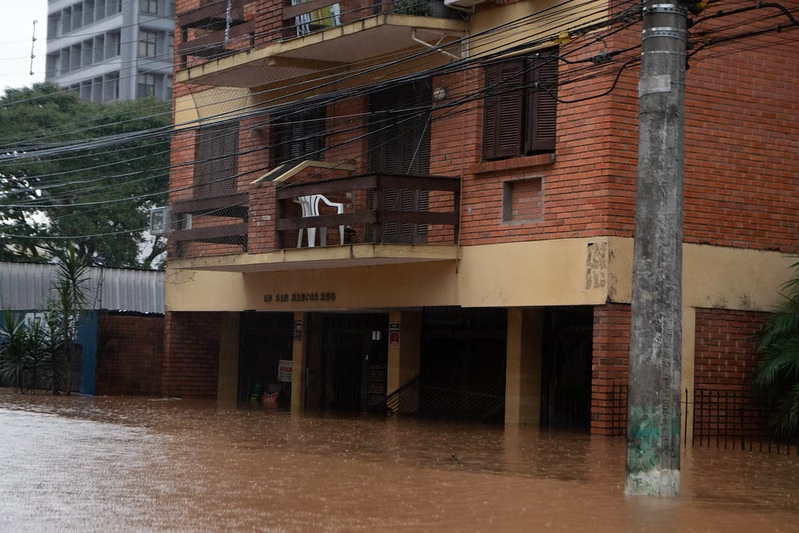
Flooding in Rio Grande do Sul on May 8. Credit: Thales Renato/Flickr (CC BY-NC-ND 2.0)

Right-wing groups are peddling false claims that the heavy rainfall that led to the region’s disastrous flooding in May is not related to climate change.

On May 9, volunteers and emergency workers were still rescuing people and animals who remained stranded on the sixth day of flooding on the streets of Rio Grande do Sul’s capital, Porto Alegre. Social media images of the rooftop rescue of a horse named Caramelo shocked the world. 

A day before the dramatic rescue, Porto Alegre’s deputy mayor, Ricardo Gomes, appeared on a livestream wearing a cap with the Brasil Paralelo logo. Brasil Paralelo is a far-right media company with a streaming platform focusing on “journalism, entertainment, and education,” as its website states. The company was founded in Porto Alegre in 2016 and serves as a main channel of climate denialism among right-wing groups in Brazil. By wearing the Brasil Paralelo logo, Gomes associated himself with an institution that experts say is a purveyor of climate denialism, at the height of a climate-related disaster. 

Some days later, Ricardo Felício, a professor of Brasil Paralelo’s education wing who has also appeared on many of the platform’s documentaries, wrote that climate change did not cause the extreme rainfall in South Brazil. He published his opinions in the Revista Oeste (West Magazine), a print and online publication that caters to far-right followers of former President Jair Bolsonaro, saying “CO2 has nothing to do with it!” 

Southern Brazil was under water for the entire month of May, and two months later, it’s still facing the consequences of the worst flood in its history. Hundreds of thousands have been displaced – 180 have died, and 32 are still missing. 

Flooded rivers swept away entire communities in a disaster on par with 2005’s Hurricane Katrina. The town of Estrela, located on the banks of Taquari River, was more than 70 percent submerged. In recent years, the region has experienced more and more extreme rainfall. Residents of towns on the Taquari River are still feeling the impacts of their third consecutive flood in a six-month period.

Porto Alegre, with 1.4 million inhabitants, was flooded for four weeks between May and June due to swelling water from the Guaiba River and failures of the city’s anti-flood system. The region’s main airport, Salgado Filho International Airport, is not expected to operate again until December.

Porto Alegre’s mayor, Sebastião Melo, and Deputy Mayor Gomes have led its city council since 2021. Both were elected in the wake of Bolsonarism and won decisive victories. And both have faced media criticism for failures in managing the city’s emergency responses to the flood and for failing to update its anti-flood system.

Gomes has participated in events run by Atlas Network, an extensive global collective of more than 500 think tanks, many known to have a history of working against climate action. He attended Atlas Network’s 2019 CEO Summit of the Americas, where leaders of right-wing think tanks gathered to exchange ideas. He appeared at the summit as president of RELIAL, a network of right-wing Latin American research organizations. He is a member of Atlas Network’s Global Council of CEOs team.

Gomes also participated in Atlas Network’s 2020 Latin America Liberty Forum online, again representing RELIAL. The politician is also a long-standing ally, teacher, and host of a political series on Brasil Paralelo’s YouTube channel. His political connections reveal an intricate network that links Brazilian far-right organizations that deny climate change with international think tanks.

Brasil Paralelo’s Roots

In the months after the center-left Brazilian president Dilma Rousseff was impeached in 2016, far-right proponents established Brasil Paralelo, which arose from the growth of far-right ideas that gained ground in the country at the time. Its five founders, who were students, claimed that mass media was overwhelmingly left-wing, and they wanted to challenge mainstream public opinion about the nation’s political crisis after Rouseff’s impeachment.

Three of the original founders, Lucas Ferrugem, Henrique Viana, and Filipe Valerim, now run the company. Experts interviewed for the platform’s first documentaries included names from Instituto Millenium, Instituto Liberal, and Instituto Mises, partner think tanks of Atlas Network in Brazil in 2016.

Inside Brasil Paralelo’s studios. Credit: Brasil Paralelo/Wikimedia Commons.

A panel titled “Entrepreneurship for Common Good” by Atlas Network partner Acton Institute used Brasil Paralelo’s founding and development as a case study in 2021. The panel explored how “entertainment can shape a society’s culture,” and Brasil Paralelo’s role within the “prevailing cultural winds to point Brazil towards pillars of freedom and virtue through a holistic approach to education and entrepreneurship,” as the video states. 

Alejandro Chafuenpresident of Atlas Network between 1991 and 2018 and a Mont Pelerin Society member, taught a Brasil Paralelo course about faith and free-market ideas in 2019. Chafuen also mentioned the media company in his Forbes magazine column in 2023, in which he compared the Brazilian organization to the U.S. nonprofit conservative media group PragerU. He made the same comparison to his YouTube subscribers (over 3.38 million) and Instagram followers (2.5 million), indicating that Brasil Paralelo surpassed PragerU’s audience levels with more than 300,000 subscribers on YouTube and around 400,000 on Instagram. 

Chafuen compares the popularity of Brasil Paralelo to widespread support for Olavo de Carvalho, the deceased influential far-right philosopher who was also known for his strident scientific denialism, including climate denialism. Chafuen also wrote in Forbes that “Brasil Paralelo is planning to land in the United States and replicate its success with U.S.-focused topics, teams, and profiles.”

In August 2023, Brasil Paralelo ran an article raising doubts about the effects of climate change stemming from a speech by UN Secretary Antonio Guiterrez claiming that “the era of global boiling has arrived”. According to the article,”It is not a question of denying climate change, but of discussing whether or not humankind influences this process and to what degree the planet will warm up (or cool down).” 

Chafuen’s article promoted a 2021 Brasil Paralelo documentary called “Cortina de Fumaça” (“Smoke Screen”). It stated that the documentary seeks to answer questions such as, “How does the environmental movement affect the economy in Brazil and other countries? What lies behind some of the main environmentalist misinformation?”

Patrick Moore, a known climate science denier, is presented in the documentary as a co-founder of Greenpeace. Years before, DeSmog had reported that this claim was false. Moore stated in the documentary that Greenpeace is “a conspiracy organization, spreading junk science around the world.” 

One of the sections in “Smoke Screen,” which is available on YouTube, is titled “Environmental apocalyptic predictions that are false.” The journalist Augusto Nunes, one of the founders of Revista Oeste, said in the segment that the Amazon rainforest is not being destroyed, contradicting official data from 2021. Other sources in Brazil, including Aldo Rebelo, former minister of defense during Rousseff’s government, supported the same argument. 

According to the documentary, environmental campaigners’ criticisms and so-called “lies” about the Amazon rainforest’s deforestation are attempts to protect the U.S. and European agricultural markets. 

In another article in September 2023, Brasil Paralelo defended the idea that global warming legitimizes NGOs’ actions pushing international actions such as the Paris Agreement, which the platform claims keeps developing countries producing less while first-world countries maintain their production. 

In an interview with The Intercept Brasil, researcher Renata Nagamine from the Brazilian Center of Analysis and Planning (Cebrap) said Brasil Paralelo’s “Smoke Screen” uses a “scientific repertoire on the margins of climate science.” 

When contacted by DeSmog, representatives for Brasil Paralelo did not respond to requests for comment.

“CO2 Has Nothing to Do With It!”

Climate change boosted the rainfall volume in Rio Grande do Sul by 15 percent, according to a study by the website Clima Meter, which confirmed the influence of climate change on the recent  flooding disaster in the region. 

Clima Meter is “an experimental rapid framework for understanding extreme weather events in a changing climate based on looking at similar past weather situations.” From the analysis of the patterns of local precipitation and the ElNiño-Southern Oscillation, the researchers interpreted the “Brazil floods as an event whose local characteristics can mostly be ascribed to human driven climate change.”
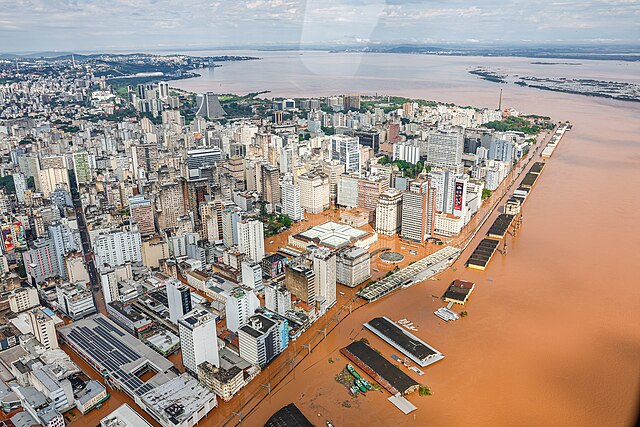
Flooding in South Brazil on May 5. Credit: Ricardo Stuckert/Wikimedia Commons

Davide Faranda, a researcher of the Laboratory for Sciences of Climate and Environment at the Institute Pierre Simon Laplace and coauthor of Clima Meter’s study on Brazil’s flooding, said in an interview with the local newspaper, GaúchaZH, that floods have been intensified by the burning of fossil fuels and have a major impact on vulnerable communities, which bear the brunt of climate change.

However, Ricardo Felício, who teaches courses at Brasil Paralelo and is a professor of geography at the University of São Paulo (USP), offered a contradictory explanation for the disaster.

“It is confusing to relate the climate to a meteorological scenario of large dimensions, which is the case here,” wrote Felício in his May 12 weekly column in Revista Oeste. “CO2 has nothing to do with it!” 

In addition to writing for Revista Oeste, Felício is a well-known climate denier in Brazilian politics. DeSmog uncovered an interview with Felício on a once-popular Brazilian TV show, where Felício stated in 2012, “There is no scientific proof of global warming.” Brazil’s ex-president Bolsonaro tweeted an interview between Nando Moura, a well-known right-wing influencer, and Felicio in 2017.

Between 2017 and 2021, Felício gave several lectures at universities and trade associations across the country denying climate change after the Aprosoja Mato Grosso (an association of soybean growers) sponsored his talks, according to a BBC investigation.

Journalists and media executives founded Revista Oeste in 2020. It is a self-proclaimed conservative outlet and claims the problems of capitalism should be solved with more capitalism.

The magazine’s print cover in June 2024, a month after the tragedy in Rio Grande do Sul, showed the planet resting on a palm, followed by the headline “The global warming hoax.” The periodical also published other articles on the floods in Rio Grande do Sul, denying climate change had a part in the disaster.

“Historically, apocalyptic predictions about the climate have not come close to coming true. Now, activists are blaming climate change for the floods in Rio Grande do Sul,” wrote the journalist Myllena Valença. The piece claimed that “facts overturn the delirious prophecies of environmental activists, who for decades have been announcing disasters caused by global warming.” Felício is a leading source in the report. 
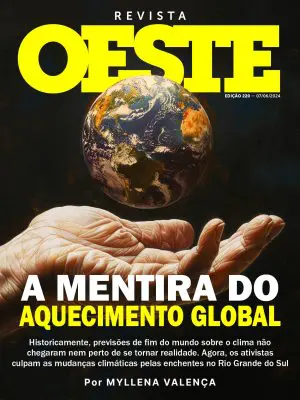
Revista Oeste’s June 2024 cover. Credit: The Wayback Machine

The June print edition also featured an interview with the president of Environmental Progress, Michael Shellenberger, a well-known nuclear energy enthusiast and a Republican witness in climate hearings in the U.S. Congress. In the interview, he pointed out he is optimistic about the environment and pessimistic about civilization. “I’m worried about the hysteria around global warming,” Shellenberger said. 

When contacted by DeSmog, representatives for Revista Oeste did not respond to requests for comment.

A Well-Connected Deputy Mayor 

Donations poured into Rio Grande do Sul in the aftermath of the flooding disaster to help people who had lost everything. Brasil Paralelo asked for donations for an organization called Instituto Cultural Floresta (ICF). 

Porto Alegre’s Deputy Mayor Gomes also requested donations to the same organization, even though his City Hall made its own donation channel available, an Agência Pública investigation revealed last month. 

The ICF is a nonprofit organization based in Porto Alegre, and according to its website, it focuses on providing security forces with military equipment. Leaders and members of the organization are connected to the Instituto de Estudos Empresariais (IEE), an Atlas Network think tank partner in Brazil that promotes the right-wing annual meeting, Liberty Forum, which is sponsored directly by Atlas Network, and boosts right-wing political candidates. 

Leonardo Fração is president of the ICF and a former IEE president. He spoke at the Liberty Forum in 2018 and in 2010.

Other ICF members are affiliated with IEE, including Bruno Zaffari, the owner of real estate and supermarket companies, and Wilson Ling, the director of the plastic packaging and forestry company Évora S.A. 

Gomes held various positions, including president of the IEE from 2009 to 2012. But his relations with right-wing think tanks stretch much further. Between 2016 and 2020, he served as the president of RELIAL, and he also is a member of the Mont Pelerin Society. DeSmog research found that Mont Pelerin Society members are affiliated with over 100 organizations that also appear on the membership list of the Atlas Network.

Atlas Network also quoted Gomes in a report about the Latin America Liberty Forum in 2021.

RELIAL presents itself as a network of brain trusts that “disseminate and implement liberal principles as their flag.” Agustín Etchebarne, a member and a former director of  RELIAL, is also the general director of the Fundación Libertad y Progreso, an Argentinian Atlas-affiliated think tank that supported the election of far-right Argentinian President Javier Gerardo Milei.   

Atlas Network awarded Fundación Libertad y Progresoa a grant in 2024. The organization spent the money to promote an international summit in partnership with the Cato Institute for the six-month anniversary of the inauguration of Milei. The event took place June 11-12 in Buenos Aires, and Milei attended.
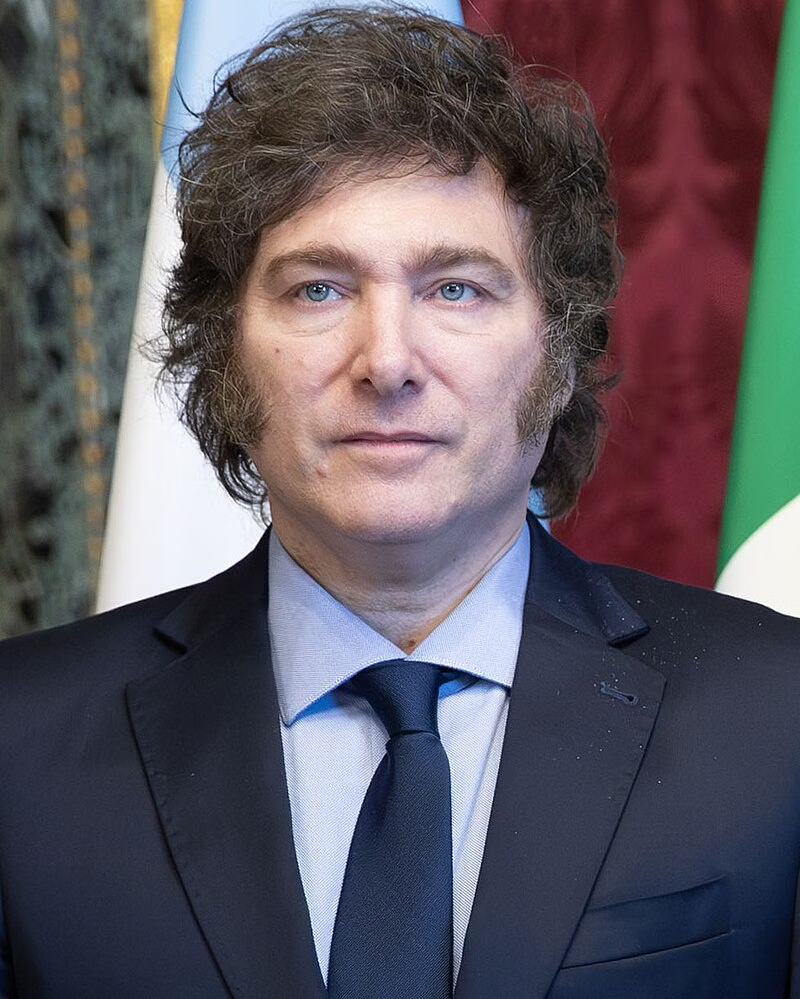
Fundación Libertad y Progresoa promoted an international summit in partnership with the Cato Institute for the six-month anniversary of the inauguration of Argentininan President Javier Milei. Credit: Wikipedia

When contacted for comment,  Atlas Network said in a statement that the organization “has no grant programs related to climate change and makes no policy prescriptions to its partners on the subject of climate change.” It also stated that it “does not fund initiatives advocating against the existence of climate change.”

The organization stated that it “has no partnerships with candidates, parties, or government officials,” and that its “partners are independent, nonprofit organizations engaged in public policy issues.”  

Atlas also asserted that “there are no ‘Atlas Network groups’ in Brazil,” but instead “independent partner organizations that apply to receive training, grants, and networking opportunities from Atlas Network.”  The think tank network also stated that its partners are “each governed independently and are not managed by our organization.” 

Political Negligence and Climate Denialism

The media has widely criticized Porto Alegre’s Mayor Melo for his crisis management issues and his administration’s low budget for flood prevention. To defend against the criticism, Melo claimed online that, “I’m not a denialist on anything, much less on the climate issue.”

Porto Alegre suffered two severe floods in 2023, including its biggest flood since 1941. However, since 2021, the city council reduced its investment in flood protection, and added no additional protection in 2023. 

Experts also condemned the city’s failure to maintain its anti-flooding system, which was designed in the 1970s. The Municipal Department of Water and Sewage, which operates the system, has laid off more than half of its employees since 2013. In addition, Melo’s term in office has included environmental scandals and conflicts with environmentalists and indigenous people. 

When contacted by DeSmog, Porto Alegre’s City Hall Press Office, which represents Melo and Gomes, did not respond to requests for comment.

When the flooding crisis deepened in Porto Alegre, Melo used a Bolsonarist style, applying the motto that every person looks out for his own, which summarizes his way of doing politics. “If you have a house on the beach and can afford to leave, I recommend that you leave and go to the beach,” he said, talking about wealthier families who have second homes at the beach. This comes from the mayor of a city where inequality is so entrenched that many people don’t have one home, let alone a second beach house. 

Gomes has said he will not seek reelection with Melo this year, but that he will continue supporting Melo against “the radical left.” Everything suggests, however, that the Brasil Paralelo cap will officially be part of his uniform. 

Original article by Lucas Araldi republished from DeSmog.
Continue ReadingThe Direct Links Between Southern Brazil’s Massive Flooding and Climate Denial

Revealed: UK ‘double counting’ £500m of aid for war-torn countries as climate finance

Spread the love

Original article by JOSH GABBATISS republished from Carbon Brief under a CC license.

The UK government has reclassified nearly £500m of aid for war-torn and impoverished countries as “climate finance”, in a bid to meet its international commitments under the Paris Agreement.

This follows reports that the UK’s pledge to spend £11.6bn on climate aid between 2021-22 and 2025-26 is slipping out of reach, due to government cuts.

A freedom-of-information (FOI) request by Carbon Brief reveals how, after the reclassification, money for humanitarian work in nations including Afghanistan, Yemen and Somalia is now being double-counted as climate finance to help the UK hit its goal.  

The projects being double-counted include work to provide food and basic necessities that have no explicit link to climate action, Carbon Brief’s analysis reveals. Some of their internal reports even state clearly that they are not climate-finance projects. 

This is part of a wider revision of climate-finance accounting, introduced by the government in 2023 to ensure the UK achieves its £11.6bn target. 

By redefining existing funds pegged for development banks, investment in foreign businesses and humanitarian aid as “climate finance”, the government expects to add £1.72bn to its total.

Experts tell Carbon Brief it is “problematic” and “unjust” to relabel existing funds as climate finance rather than providing new money. One says the UK could meet its target, at least in part, by “double counting development and climate finance”.

The chair of the Least Developed Countries (LDC) group at UN climate talks says the UK’s actions are a “clear deviation from the path to climate justice”.

‘Moving the goalposts’

The UK government has committed to spending £11.6bn on international climate finance (ICF) between 2021-22 and 2025-26. This is the nation’s contribution to climate action in developing countries, which it is obliged to provide under the Paris Agreement

Developed countries, such as the UK, have committed to sending “new and additional” climate finance to developing countries. This is generally interpreted as spending extra money on top of existing foreign aid.

The UK government itself has described the £11.6bn goal as “dedicated ring-fenced funding that is distinguishable from non-climate [aid]”.

However, reports began to emerge in 2023 that the government was not on track to meet its target.

Experts attributed this to the government cutting its overall foreign aid budget. In November 2020, the government suspended a target to give 0.7% of national income as overseas aid – reducing it to 0.5% as a “temporary measure”. 

The government is also spending more of the remaining funds on supporting refugees within the UK. The latest figures show that in 2023, the UK spent more of its aid budget on supporting asylum seekers and refugees in the country than on overseas projects.

In order to remain on track for the £11.6bn goal, development minister Andrew Mitchell announced in October 2023 that the government was changing the way it calculated ICF spending.

This immediately sparked concerns that the government was inflating its climate-finance figures without providing any new aid money for developing countries. Mitchell provided limited details of how the government was getting its target back on track.

More information came in a report released in February by the Independent Commission for Aid Impact (ICAI). It concluded that, by “moving the goalposts”, the government had reclassified £1.72bn of spending as climate finance between 2021-22 and 2025-26.

This figure includes four tranches of funding that had not previously been considered ICF:

  • £746m from assuming that a share of the “core” funding the UK gives to the World Bank and other multilateral development banks (MDBs) will be assigned to climate-related projects.
  • £497m from automatically labelling 30% of the humanitarian aid spent in the 10% of countries that are most vulnerable to climate change as ICF.
  • An estimated £266m from defining more payments into British International Investment (BII), the UK’s overseas development finance institution, as ICF.
  • £215m from civil servants “scrubbing” the aid portfolio – namely, going back over existing projects and adding any climate-relevant funding they had previously missed.

The figures cited by ICAI are based on unpublished government analysis, which Carbon Brief has now obtained via FOI. 

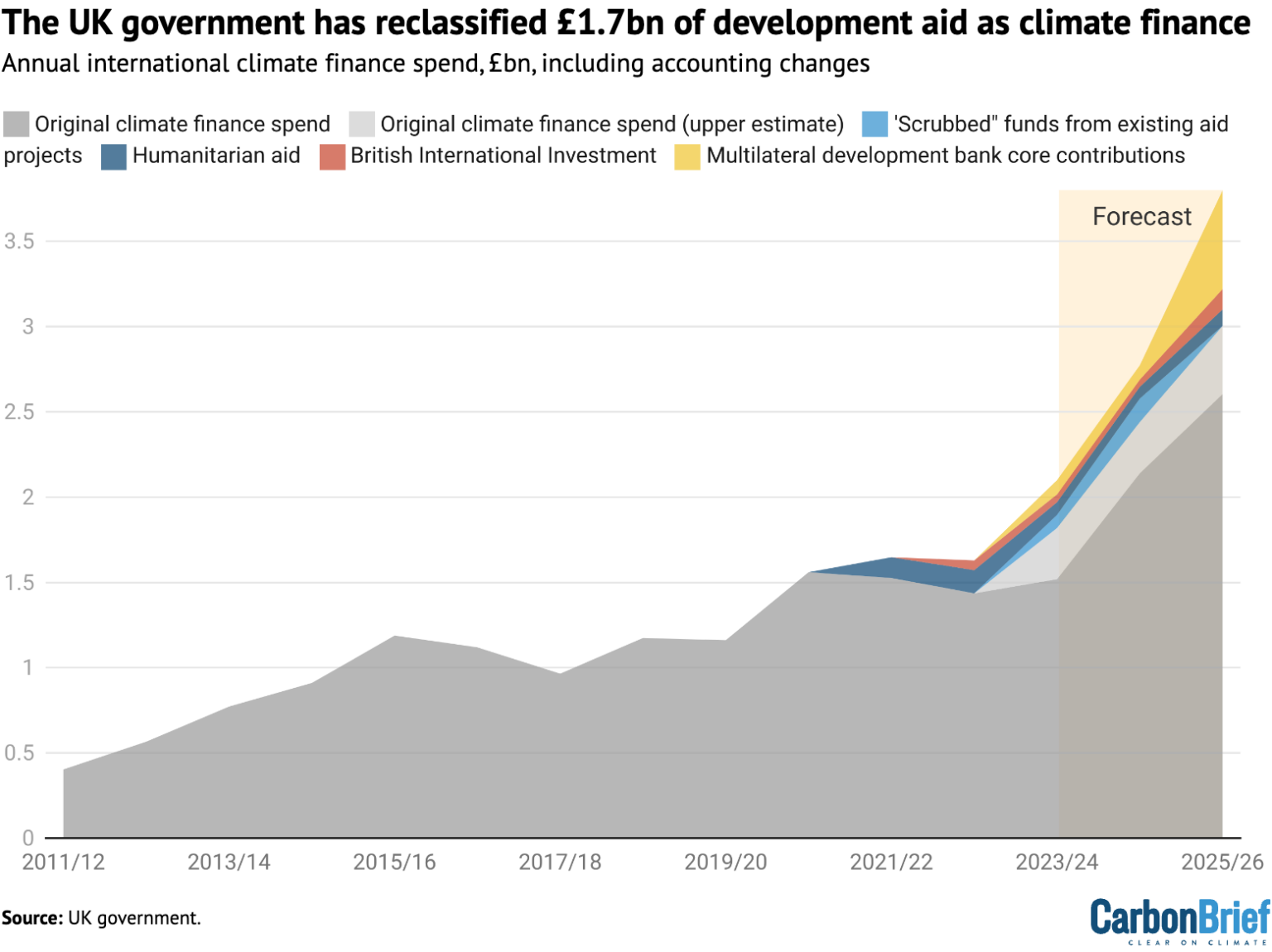
The analysis includes the annual contributions each of these sources are expected to provide over the period from 2021-22 to 2025-26, which can be seen in the coloured sections of the chart below.

Annual UK ICF spending, £bn, by financial year for the period 2011/12 to 2025/26. The grey area indicates ICF spending under the original accounting methodology used until October 2023. Beyond 2022/23 the figures are forecasts, with the light grey area indicating the upper bound and the darker grey indicating the lower bound. The coloured areas indicate the funding newly reclassified as counting towards ICF, following methodology changes introduced in October 2023. For multilateral development bank contributions, Carbon Brief understands that the UK will pledge £495m to the World Bank in 2025/26, and the remaining contributions that make up the £746m total are spread evenly across the 2011/12-2025/26 period. Source: UK government.

As the chart indicates, even with the methodology changes, the £11.6bn target is still “backloaded”, with a significant uptick in ICF spending required beyond 2023-24 to meet it. 

ICAI notes that, since the government cut its aid spending from the UN-backed benchmark of 0.7% to 0.5% of gross national income (GNI), “serious concerns remain over whether the heavily backloaded spending plan can be delivered”.

Core funding

The largest tranche of redefined ICF – some £740m – comes from the government starting to assume that a share of its “core” MDB funding counts as climate finance.

This is money that the UK government already hands to these organisations to distribute according to their own priorities, primarily through loans. None of this money has previously been counted by the UK government as ICF, even though some went towards climate action.

MDBs, including the World Bank, the African Development Bank (AfDB) and others have placed a growing emphasis on climate change in recent years. The World Bank, for example, has a target of spending 35% of its finance on climate-related projects.

Following the reclassification, the UK government will simply assume that 35% of the money it gives to the World Bank – some £495m of £1.4bn total due in 2025/26 – counts as ICF.

It will use a similar approach for its funding of other MDBs, with these changes adding a total of £740m to the amount of the UK’s aid spending that is classified as ICF.

This move will not result in the UK providing any new funds for climate action, as it was already planning on distributing this money. In fact, the government has cut its spending on MDBs in recent years, due to the overall cut in the UK’s foreign aid budget.

Humanitarian aid

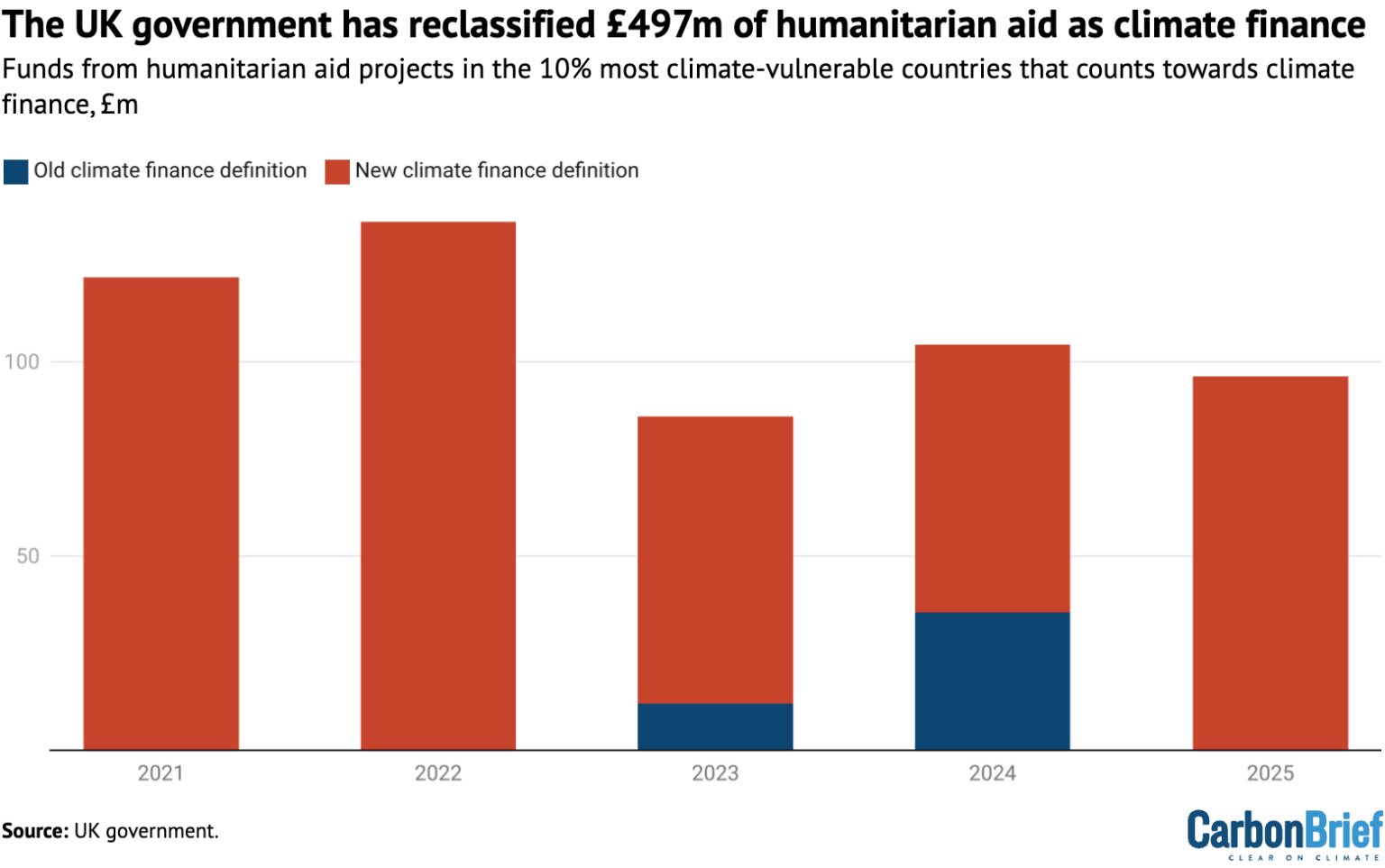
The second-largest tranche of newly reclassified climate finance is from projects in climate-vulnerable countries, an additional £497m of which is being counted as ICF.

The government dataset obtained by Carbon Brief via FOI reveals the 28 humanitarian projects and five more general, country-specific funds that will contribute to this additional £497m. 

The projects are based in some of the poorest and most war-torn countries in the world – Afghanistan, the Democratic Republic of the Congo (DRC), Somalia, Sudan, Uganda, Yemen and Zimbabwe.

They largely focus on essential provisions, such as food and basic infrastructure.

Prior to the recent changes, these programmes would have contributed just £47.5m to ICF, according to the government data released to Carbon Brief.

By automatically counting 30% of their spend as ICF, this figure has now multiplied more than 10 times. The chart below shows, in red, these additional ICF funds.

Annual UK ICF spending, £m, sourced from humanitarian aid projects for the 10% most climate-vulnerable countries, as defined by the Notre Dame Global Adaptation Initiative. Blue columns indicate the ICF spending that was expected from these projects prior to the methodology change, and red columns indicate ICF spending from these projects after the change. Source: UK government.

For the 23 of the 28 projects with documentation available online, Carbon Brief assessed the relevant sections of their “business case and summary” documents for evidence that they were related to climate action.

Many of the project documents reference climate change and say they will provide climate benefits. For example, all four projects in Somalia, a nation that has faced devastating drought and floods in recent years, mention the importance of climate resilience in their work.

However, some of the projects explicitly state that they are not intended to provide climate-finance. 

The summary document for the Assurance and Learning Programme (ALP) in Afghanistan, published in 2021, states: “The programme will not be eligible for ICF nor will it monitor ICF funded programmes.”

Similarly, the Congo Humanitarian, Resilience and Protection (CHRESP) Programme summary document, also published in 2021, notes “we do not anticipate that any of our programming under this programme will be eligible as ICF”.

Another project, titled Yemen: Access, Logistics, Liaison, and Accountability, will provide “few opportunities” to address climate change, according to the summary document. A further four project documents do not contain any reference to climate change. 

Despite this, following the government’s reclassification, these seven projects will collectively contribute £166.9m of UK climate finance in the coming years.

Euan Ritchie, a senior development finance policy advisor at the thinktank Development Initiatives, says blanket approaches to assigning climate finance are “problematic”. He tells Carbon Brief:

“Just because humanitarian aid is going to a country that is vulnerable to climate change doesn’t mean it addresses that vulnerability. And these projects have already been screened for their climate focus.”

He points to one of the projects, the Somalia Humanitarian and Resilience Programme, as an example. Ritchie says, based on International Aid Transparency Initiative data, that officials had already decided around 12% of this programme’s spending was ICF, and asks:

“So what rationale is there for bumping it up to 30%? Were officials wrong the first time?”

Fatuma Hussein, a programme manager at the thinktank Power Shift Africa, tells Carbon Brief such an approach is “unfair and unjust” as it “risks conflating” the “distinct needs” of climate aid and other humanitarian objectives.

In its guidance for categorising what counts as climate finance, the Organisation for Economic Co-operation and Development’s Development Assistance Committee recommends scoring many humanitarian projects “zero”, indicating programmes that “generally do not qualify” as climate aid.

More private investment

The third-largest tranche of reclassified development aid relates to state-backed private sector investment under British International Investment (BII).

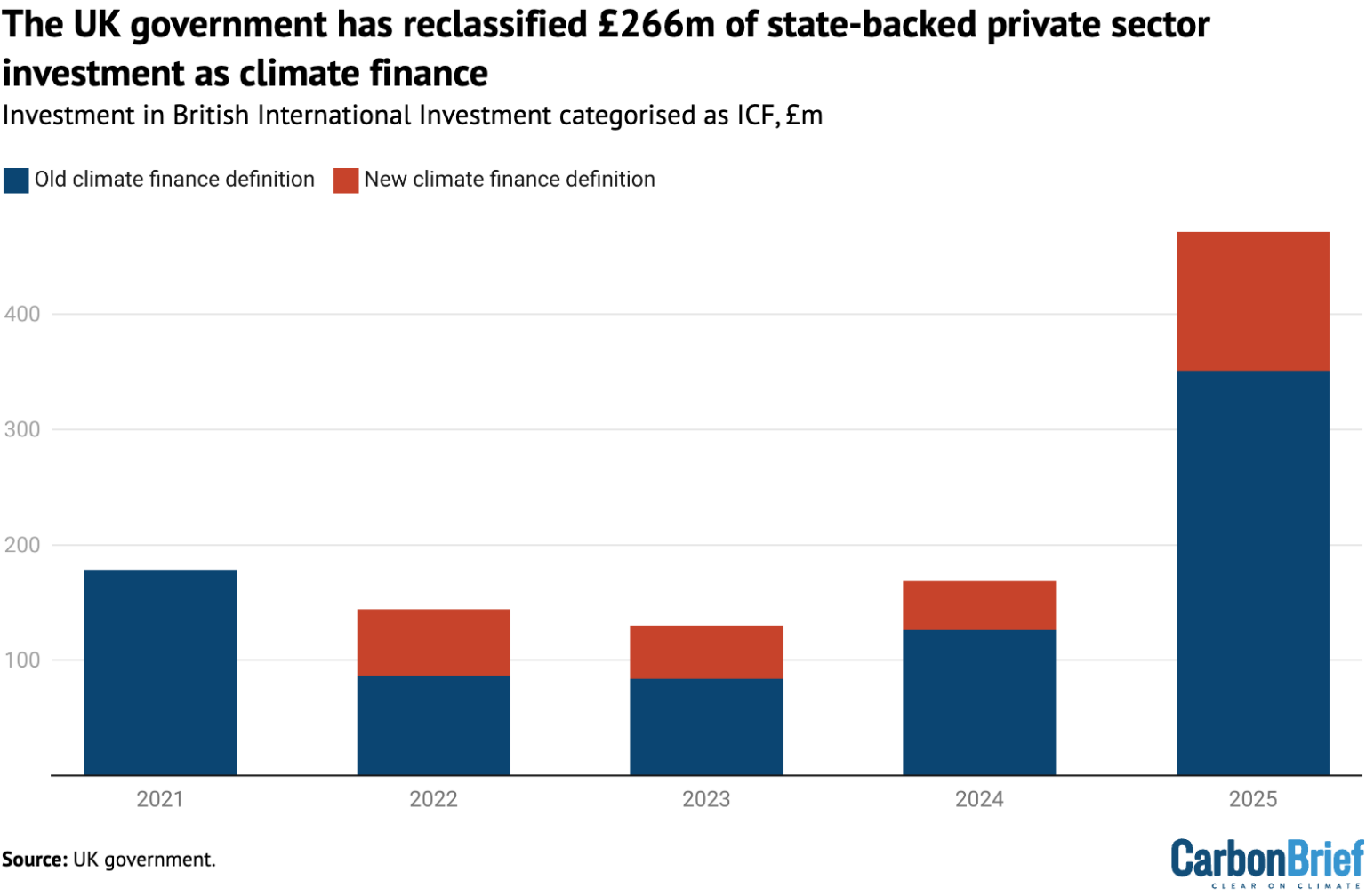
The UK government will also now count more of its payments into BII as climate finance, amounting to around an extra £266m by 2025-26. Unlike aid spending, these are investments in the private sector and are expected to yield a financial return for the UK.

Previously, the government counted a fixed 30% of BII spending as climate finance. It now intends to include a higher percentage to reflect a growing focus on climate investments.

The new approach to BII investments assesses the share of each project that should count towards UK climate finance case-by-case, rather than using a blanket 30% share.

It will record 100% of investments in a programme covering the Philippines, Indonesia and other parts of south-east Asia as ICF, as part of the government’s “Indo-Pacific tilt”. Investments in other regions also contribute a higher share of ICF – rising as high as 46% in 2022-23.

The chart below shows the extra BII investment money (red) that now counts as ICF.

Annual UK ICF spending, £m, from British International Investment (BII) contributions. Blue columns indicate the ICF spending that was expected from BII prior to the methodology change and red columns indicate ICF spending from BII after the change. Source: UK government.

The figure above shows that the government expects private sector investment via BII to play an increasingly large role in its climate finance in the future.

Many observers have expressed concerns about the government leaning more on private investment through BII to boost its ICF spending. 

report last year by the parliamentary international development committee criticised BII’s investment in, among other things, fossil fuels and “high-net-worth individuals”.

BII prioritises loans and projects in middle-income nations where there is money to be made, rather than the nations that are most in need of climate finance. 

ICAI highlighted this in its review of the UK’s climate finance commitments earlier this year, stating that private investment “is not always the most appropriate, realistic or preferred form of climate finance in the poorest and most fragile contexts”.

Not new, not additional

Developing countries will require trillions of dollars of investment in the coming years to meet their climate goals. 

To help achieve this, developed countries, such as the UK, are expected to provide finance under the UN climate system that is “new and additional”. Discussions around a new climate finance goal will take centre stage this year at the COP29 climate summit in Baku.

Experts tell Carbon Brief that the UK government’s changes to its ICF undermine the notion that it is providing new, “ring-fenced” funding. Regarding the “arbitrary” labelling of humanitarian funds as ICF, Ritchie says:

“If the UK is counting a fixed share of projects as ICF it can no longer claim that ICF is distinguishable from non-climate [aid].” 

Gideon Rabinowitz, director of policy and advocacy at the international development network Bond, tells Carbon Brief:

“The change of definition means they will be able to reach the target by spending less money than they would have done otherwise through double counting development and climate finance.”

Development NGOs say the best way for the UK to scale up its climate finance would be to return its foreign aid budget to 0.7% of GNI. However, with an election looming, neither the ruling Conservatives nor their Labour challengers have indicated a willingness to do this.

There will be considerable pressure on developed countries in the coming months to commit to providing plentiful, high-quality climate finance in the run up to COP29. 

Evans Njewa, the chair of the LDC group, to which nearly all of the UK’s humanitarian aid ICF recipients belong, tells Carbon Brief:

“Reclassifying existing donor aid as climate finance is a clear deviation from the path to climate justice, and closing the finance gap cannot be achieved this way.” 

Climate-finance reporting has been described as a “wild west”, with countries announcing figures based on vastly different definitions. This has led to nations counting money for coal, hotels and films in their totals, as there is no binding international standard to guide them.

The UK government noted last year that its changes are in line with other countries’ methods. But experts point out that the UK was previously viewed as setting a high standard for other countries to reach. 

In contrast, the new approach “risks breeding cynicism and mistrust because you are going to find programmes that have very little to do with climate change, but end up being reported in the pot as climate finance”, Rabinowitz says.

Hussein agrees, telling Carbon Brief:

“This not only highlights the disparity between western countries’ rhetoric on climate finance and their actual financial commitments to developing countries but also risks undermining trust that underpins global climate action.”

She argues that nations should agree on common definitions and accounting methodologies for climate finance to ensure that governments cannot backslide as the UK has.

Responding to Carbon Brief’s questions about the government’s methodology changes, a spokesperson from the Foreign, Commonwealth and Development Office (FCDO) said:

“Since 2011, UK funding has helped more than 100 million people cope with the effects of climate change, given 70 million people access to clean energy and reduced or avoided over 86m tonnes of greenhouse gas emissions.

“The UK remains on track to meet the £11.6bn international climate finance commitment.”

Original article by JOSH GABBATISS republished from Carbon Brief under a CC license.

Continue ReadingRevealed: UK ‘double counting’ £500m of aid for war-torn countries as climate finance