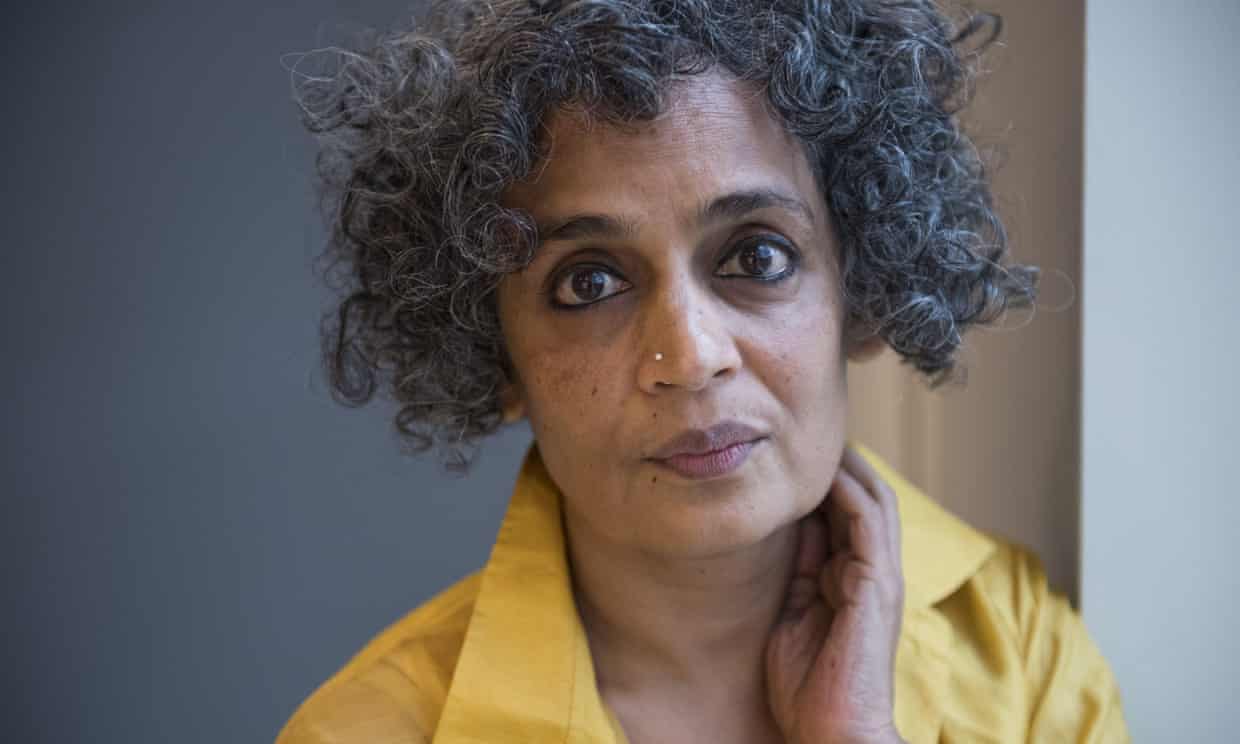
Arundhati Roy has stood out as one of the most high-profile critics of Modi’s government, which has been accused of suppressing free speech. Photograph: TT News Agency/Alamy
Official from ruling BJP party allows action against Booker winner under controversial anti-terrorism law
Indian authorities have granted permission for the prosecution of the Booker prize-winning Indian novelist Arundhati Roy over comments she made about Kashmir at an event in 2010.
The top official in the Delhi administration, VK Saxena, gave the go-ahead for legal action against Roy, whose novel The God of Small Things won the Booker prize in 1997, under anti-terrorism legislation, alongside a former university professor, Sheikh Showkat Hussain.
The action against Roy and Hussain, a former professor at the Central University of Kashmir, is over allegedly making provocative speeches, the Press Trust of India reports, citing officials from Saxena’s office.
Saxena, who is serving as the lieutenant governor, is a politician from prime minister Narendra Modi’s ruling BJP.
While Roy, 62, is one of India’s most famous living authors, her activism and outspoken criticism of Modi’s government, including over laws targeting minorities, have made her a polarising figure in India.
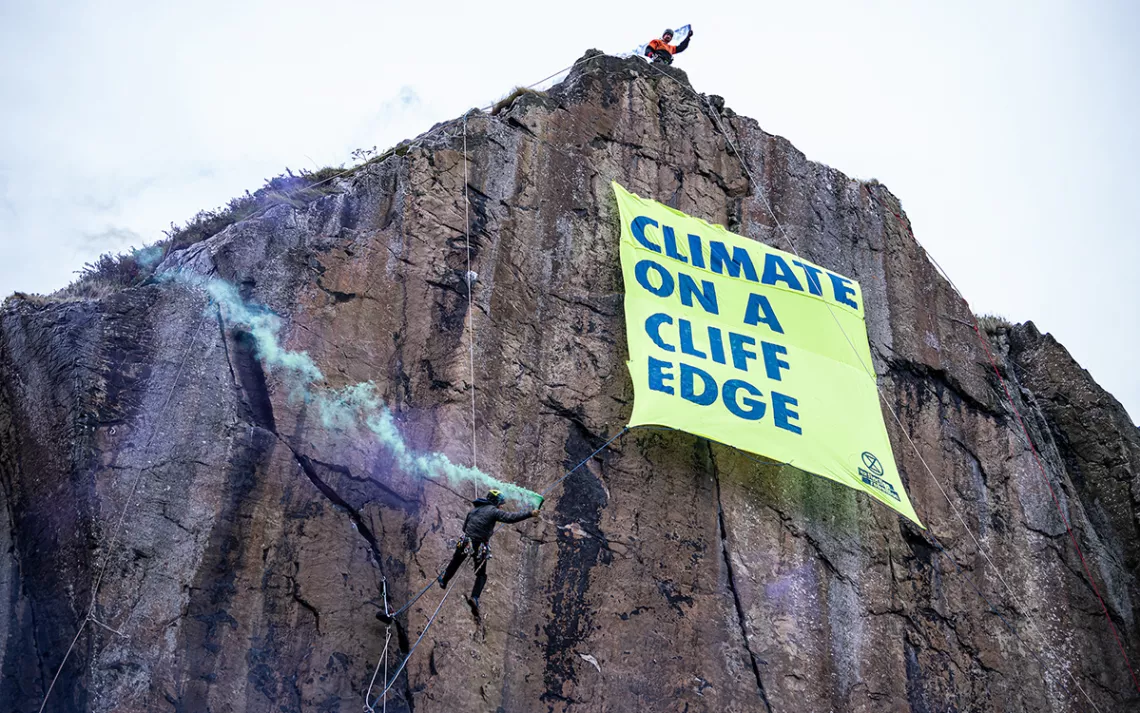
Experienced climbers scale a rock face near the historic Dumbarton castle in Glasgow, releasing a banner that reads “Climate on a Cliff Edge.” One activist, dressed as a globe, symbolically looms near the edge, while another plays the bagpipes on the shores below. | Photo courtesy of Extinction Rebellion and Mark Richards
Hundreds of deaths have been attributed to heatwave that saw temperatures approaching 50C in Delhi
The unprecedented heatwaves that scorched northern and central India in May were made 1.5 degrees Celsius hotter by the climate crisis, a new scientific assessment has found.
In the last week of May, India experienced a spell of severe heatwaves, with 37 cities recording temperatures above 45C, prompting warnings of heatstroke. The capital Delhi saw a record temperature of 49.1C.
The heatwaves led to hundreds of deaths, including one voter and several workers conducting the mammoth national election, which ended after six weeks on 1 June.
The heatwaves were nearly 1.5C warmer than the hottest heatwaves the country had seen previously despite occurring later in the typical summer season, according to a report published by ClimaMeter, a research project funded by the European Union and the French National Centre for Scientific Research, or CNRS.
The study found that the heatwaves were “a largely unique event whose characteristics can mostly be ascribed to human driven climate change”.
Indian Prime Minister Narendra Modi may still be popular after a decade in power but his government’s failures to address basic livelihood issues for the majority of the people may give an advantage to the opposition.
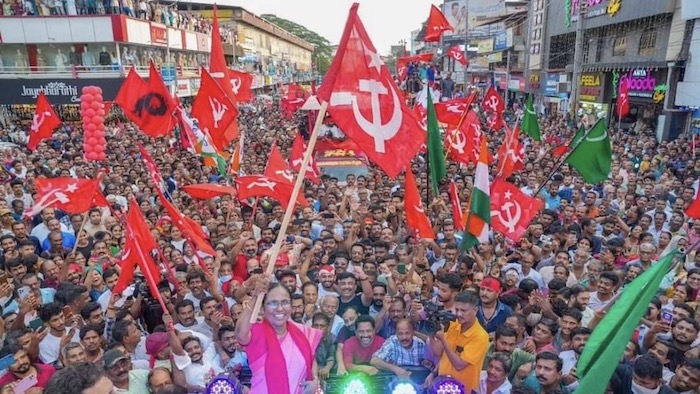
India, the world’s most populous nation, is in the middle of its 18th national elections. Two of the eight phases are already over, sealing the fate of over one third of representatives. However, the fight is still on for the majority of the seats. The incumbent Narendra Modi-led right-wing government, seeking a third straight term, is facing an upbeat center and left alliance led by Congress.
This national election for India’s lower house of the parliament, called the Lok Sabha (the house of the people), is stretched between April 19 and June 1 and takes place in eight phases. The votes will be counted on June 4 and results will be declared on the same day.
India is a parliamentary democracy with the first past the poll system. It is divided into 543 constituencies for the national elections with each constituency electing a single member for the Lok Sabha each. The party or alliance which wins the majority of seats (272) in the Lok Sabha elects the prime minister and forms the central government.
Though India has a multiparty system, most of the parties this time are aligned with the two major pre-poll alliances seeking popular mandate. The ruling Bharatiya Janata Party (BJP) led right-wing National Democratic Alliance (NDA) and the Congress-led, center-left opposition, Indian National Developmental Inclusive Alliance (I.N.D.I.A.) or just INDIA.
All the major left parties are part of the INDIA alliance and are contesting a large number of seats in states of Kerala, West Bengal, Tamil Nadu, Bihar and elsewhere with an objective to increase the presence of the left in the Indian parliament.
Along with the national election, three states/provinces, Odisha, Andhra Pradesh in the country’s south-east, and Sikkim in the north-east, will also elect members of their respective state assemblies.
Key issues
Unlike the last national elections in India when Prime Minister Narendra Modi was able to use the popular polarization of votes around the issue of nationalism and national security, the present elections are largely being fought on the issue of his government’s failure on all major fronts affecting the majority of the population, principally economic issues such as price rises and unemployment.
Indians are facing an unprecedented rise in the prices of all major essential commodities which has, in the absence of corresponding rise in the income, created a major crisis of living for the majority of the households in the country but particularly among the urban poor. India has seen an unprecedented decline in its standing on the annual global hunger index despite being one of the major food producers in the world and world’s fastest growing economy.
The rising inequality and the growing perception of the Modi government being pro-big capital and allegations of cronyism have also become a major poll issue. Opposition parties have pointed out that while select corporate houses in the country have risen and made tremendous profits, it is at the cost of most of the small and medium sized enterprises in the country as well as public sector entities.
The International Labor Organization (ILO) report on rising unemployment among educated youth in India has also attracted the attention of major opposition parties and become a major poll issue.
Apart from the major economic issues, the opposition has raised the issue of alleged threats to democracy under the BJP rule. They have accused BJP of trying to suppress the voices of dissent by misusing the central law enforcement agencies. Several opposition leaders such as sitting chief minister of Delhi, Arvind Kejriwal, and former chief minister of Jharkhand, Hemant Soren, were arrested in allegedly trumped up corruption charges. BJP has also been accused of intimidating opposition leaders to switch sides using the threats of persecution or by offering them money.
BJP and NDA have rejected most of the claims made by the opposition and instead accused INDIA alliance partners of being corrupt. The right-wing alliance has also declared that the INDIA alliance and particularly Congress is against the interest of the majority community in the country. It has sought the third term by also claiming it has been able to keep the Indian economy afloat amidst the challenges of COVID-19 and global recession.
Uncertain predictions
In the last elections in May 2019, the BJP-led NDA won 353 seats. BJP alone scored over 37% of votes and over 300 seats. It now seeks an over two-third majority in the ongoing elections with a slogan of “abki baar, 400 paar” (More than 400 seats in this election). While most of the pre-poll surveys predict a comfortable win for the NDA, the opposition has rejected those surveyed as compromised and claimed that the NDA will not get a majority.
There are over 970 million eligible voters in the country of over 1.4 billion according to the Election Commission of India (ECI). A significant number of them are first time voters who are facing the challenges of unemployment and price increases, and the opposition is hoping they will vote for their agenda which promises more jobs and increased social spending.
The left and other constituents of the INDIA alliance also believe that the most important factor in the revival of the opposition’s fate would be the farmers and workers who have faced complete neglect during the BJP rule in the last decade and even faced state repression during the months-long farmers’ agitation at Delhi’s borders and during the COVID-19 lockdowns.
The opposition also believes that there is growing disenchantment among Dalits and other marginalized sections of the Indian society from the Narendra Modi government as there is a growing threat to affirmative action and social justice policy measures enshrined in the Indian constitution due to BJP’s aggressive pro-corporate and pro-market orientation.
Will the BJP-led NDA fall under the weight of its own contradictions as the center-left alliance predicts, or will the BJP’s pro-corporate politics prevail? On June 4, the world will find out.
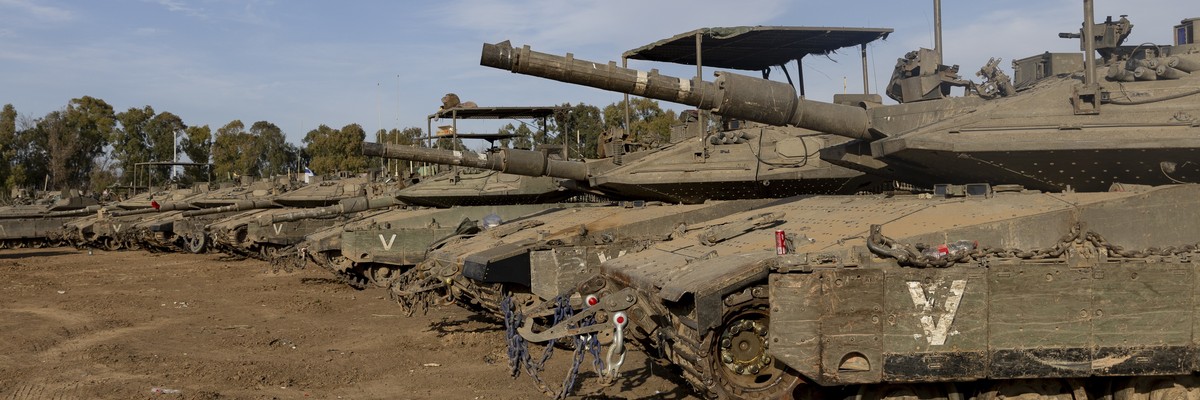
A row of tanks is pictured in southern Israel on March 14, 2024. (Photo: Amir Levy/Getty Images
“Can we get some healthcare please, or maybe feed some of the 40 million+ Americans who can’t get enough food?” asked the watchdog group Public Citizen.
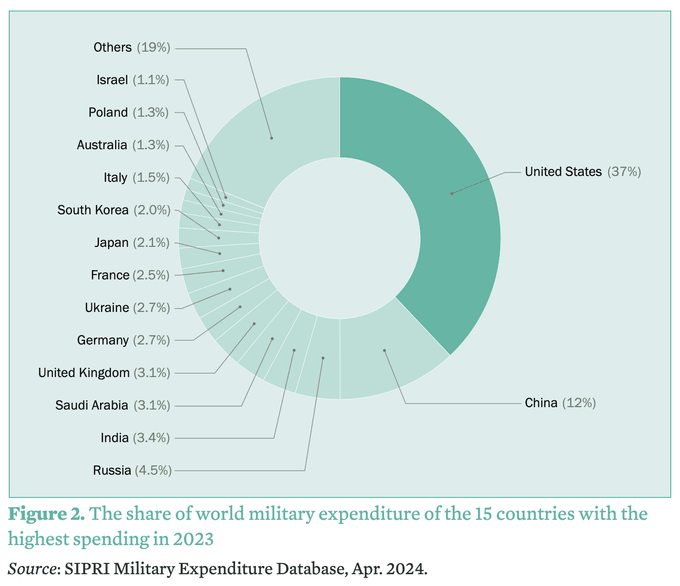
New research published Monday shows that global military spending increased in 2023 for the ninth consecutive year, surging to $2.4 trillion as Russia’s assault on Ukraine and Israel’s war on the Gaza Strip helped push war-related outlays to an all-time high.
The Stockholm International Peace Research Institute (SIPRI) recorded military spending increases in every geographical region it examined last year, from Europe to Oceania to the Middle East. Last year’s global increase of 6.8% was the largest since 2009, SIPRI said.
The United States was by far the largest military spender at $916 billion in 2023, up 2.3% compared to the previous year. The next biggest spender was China, which poured an estimated $296 billion into its military last year—three times less than the U.S.
“Can we get some healthcare please, or maybe feed some of the 40 million+ Americans who can’t get enough food?” asked the watchdog group Public Citizen in response to SIPRI’s report, which found that the U.S. accounted for 37% of the world’s total military spending last year.
A separate analysis of U.S. military spending in 2023 found that 62% of the country’s federal discretionary budget went to militarized programs, leaving less than half of the budget for healthcare, housing, nutrition assistance, education, and other domestic priorities.
Together, SIPRI found, the top five biggest military spenders last year—the U.S., China, Russia, India, and Saudi Arabia—accounted for 61% of global military outlays.
“The unprecedented rise in military spending is a direct response to the global deterioration in peace and security,” Nan Tian, senior researcher with SIPRI’s Military Expenditure and Arms Production Program, said in a statement. “States are prioritizing military strength but they risk an action-reaction spiral in the increasingly volatile geopolitical and security landscape.”
In the Middle East, military spending jumped by 9% last year—the highest annual growth rate in the past decade. Israel, which relies heavily on weapons imports from the U.S., spent 24% more on its military last year than in 2022, according to SIPRI, an increase fueled by the country’s devastating assault on Gaza.
SIPRI found that NATO’s 31 member countries dumped a combined $1.3 trillion into military expenditures in 2023, accounting for 55% of the global total.
U.S. military spending, which is poised to continue surging in the coming years, made up 68% of NATO’s 2023 total.
A woman uses an iPhone in front of the building of the NSO Group, developer of the spyware Pegasus, on August 28, 2016, in Herzliya, Israel. (Photo: Jack Guez/AFP via Getty Images)
“Increasingly, journalists in India face the threat of unlawful surveillance simply for doing their jobs,” said one advocate.
Amnesty International on Thursday demanded transparency from the Indian government regarding its contracts with surveillance companies, including the Israeli firm NSO Group, after the rights organization joined The Washington Post in publishing what it called “shocking new details” about the use of spyware to target journalists in India.
Amnesty’s Security Lab revealed that a round of “state-sponsored attacker” notifications that were sent to Apple customers in October by the tech company went to more than 20 Indian journalists including Siddharth Varadarajan, founding editor of The Wire, and Anand Mangnale, South Asia editor at the Organized Crime and Corruption Report Project (OCCRP).
The Security Lab ran a forensic analysis of the two reporters’ devices and found evidence that the NSO Group’s highly invasive Pegasus spyware, which is capable of eavesdropping on phone calls and harvesting data, had been installed on phones owned by Varadarajan and Mangnale.
In Mangnale’s case, the journalist appeared to have received a “zero-click exploit” via iMessage on August 23, allowing the individual or group who sent it to covertly install Pegasus spyware on his phone without requiring Mangnale to take any action, such as clicking a link.
At the time of the attempted attack, said Amnesty, Mangnale was working on a story about alleged stock manipulation by a major Indian multinational firm with ties to Indian Prime Minister Narendra Modi. The journalist told Agence France Presse that his phone was targeted “within hours” of his sending interview questions to the company.
The timing of the attack—and the fact that NSO Group has said it only licenses Pegasus to governments and security agencies—was “a hell of a coincidence,” Mangnale said.
“We know Pegasus is only licensed to governments, and we know that the attack happened hours after we sent the email. I am not pointing at anyone, but that is a hell of a coincidence.”#Pegasus
I don’t have the evidence yet. So for now, it’s just a “coincidence”. For Now.
“Targeting journalists solely for doing their work amounts to an unlawful attack on their privacy and violates their right to freedom of expression,” said Donncha Ó Cearbhaill, head of Amnesty’s Security Lab. “All states, including India, have an obligation to protect human rights by protecting people from unlawful surveillance.”
The Indian government was previously accused of targeting journalists, opposition politicians, and activists with Pegasus in 2021, when leaked documents showed the spyware had attacked more than 1,000 phone numbers.
India has fallen 21 spots to 161 out of 180 countries in Reporters Without Borders’ World Press Freedom Index since Modi took office in 2014. In addition to the alleged use of spyware by the government, journalists have been arrested and detained while covering anti-government protests, and reporters have been targeted by coordinated social media campaigns inciting hatred and violence.
Varadarajan was the subject of an earlier report by Amnesty, which documented how he had previously been targeted by Pegasus spyware in 2018.
This past October the same email address used in the Pegasus attack on Mangnale was identified on Varadarajan’s phone, confirming he was targeted again.
Varadarajan toldThe Washington Post that at the time of the most recent covert spyware installation, he had been leading public opposition to the detention of a news publisher in New Delhi.
“Our latest findings show that increasingly, journalists in India face the threat of unlawful surveillance simply for doing their jobs, alongside other tools of repression including imprisonment under draconian laws, smear campaigns, harassment, and intimidation,” said Ó Cearbhaill.
The group called for the Indian Supreme Court to immediately release the findings of a technical committee report on Pegasus, which was completed in 2022 but has still not been made public.
“Despite repeated revelations,” said Ó Cearbhaill, “there has been a shameful lack of accountability about the use of Pegasus spyware in India which only intensifies the sense of impunity over these human rights violations.”