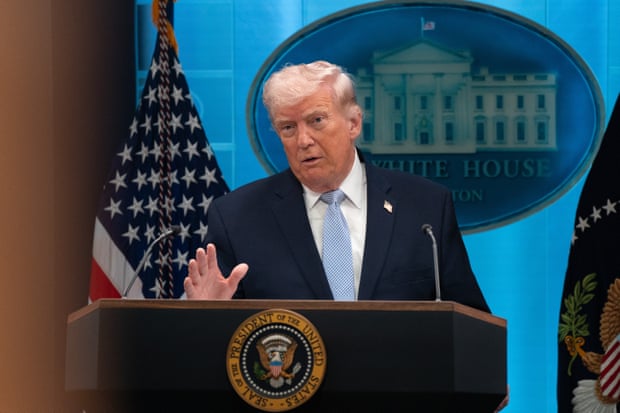
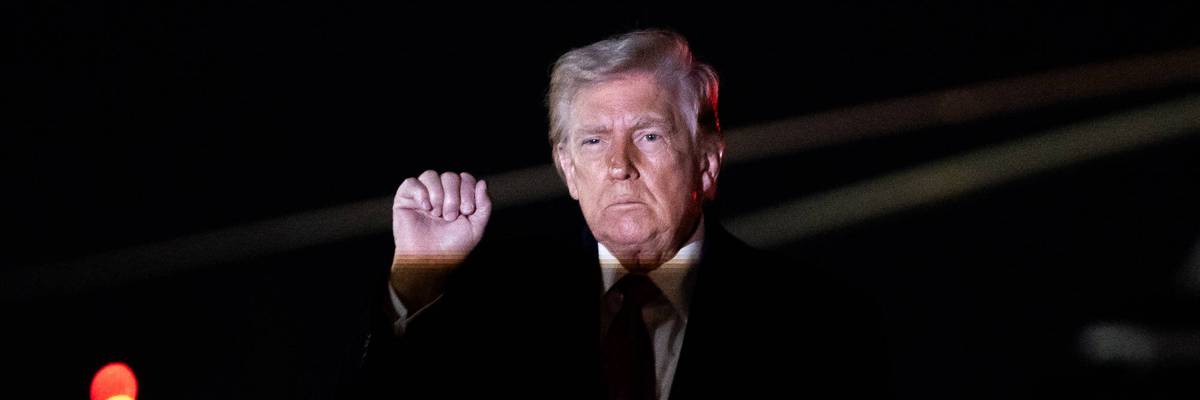
Donald Trump at the White House on 6 April. The US and Iran have agreed to a two-week conditional ceasefire. Photograph: The Washington Post/Getty
US president abandons threat for Iran to surrender or face destruction with last-minute intervention led by Pakistan
The US and Iran agreed to a two-week conditional ceasefire on Tuesday evening, which included a temporary reopening of the strait of Hormuz, after a last-minute diplomatic intervention led by Pakistan, canceling an ultimatum from Donald Trump for Iran to surrender or face widespread destruction.
Trump’s announcement of the ceasefire agreement came less than two hours before the US president’s self-imposed 8pm Eastern time deadline to bomb Iran’s power plants and bridges in a move that legal scholars, as well as officials from numerous countries and the pope, had warned could constitute war crimes.
…
For several hours afterwards, Israel’s position or agreement with the deal was unclear. But just before midnight ET, the prime minister, Benjamin Netanyahu, said Israel backed the US ceasefire with Iran but that the deal did not cover fighting against Hezbollah in Lebanon. His office said Israel also supported US efforts to ensure Iran no longer posed a nuclear or missile threat.
Pakistan’s prime minister had previously said that the agreed ceasefire covered “everywhere including Lebanon”.
…
Iran’s foreign minister, Abbas Araghchi, issued a statement shortly after Trump’s announcement saying Iran had agreed to the ceasefire. “For a period of two weeks, safe passage through the Strait of Hormuz will be possible via coordinating with Iran’s Armed Forces,” he wrote. …
For several hours afterwards, Israel’s position or agreement with the deal was unclear. But just before midnight ET, the prime minister, Benjamin Netanyahu, said Israel backed the US ceasefire with Iran but that the deal did not cover fighting against Hezbollah in Lebanon. His office said Israel also supported US efforts to ensure Iran no longer posed a nuclear or missile threat.
Pakistan’s prime minister had previously said that the agreed ceasefire covered “everywhere including Lebanon”.
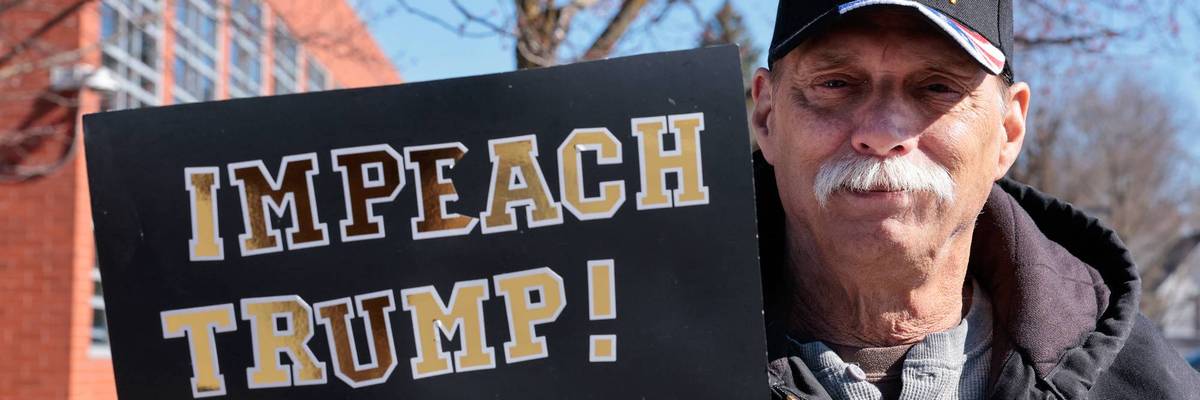
A man holds a sign calling for the impeachment of President Donald Trump during a “No Kings” protest in Howell, Michigan, on March 28, 2026. (Photo by Jeff Kowalsky/AFP via Getty Images)
“The American people understand that Donald Trump poses a direct threat to our Constitution and to the rule of law and must be impeached and removed from public office,” said the head of Free Speech for People.
After just 14 months of President Donald Trump’s return to the White House, polling released Monday found that a majority of likely US voters support impeaching him a historic third time—which one pollster called “an unprecedented result this early in a presidential term.”
Lake Research Partners conducted the poll March 26-30 for Free Speech for People, a legal advocacy organization that has launched a campaign to “Impeach Trump. Again.” As part of that effort, FSFP gathered more than 1 million supportive signatures ahead of the latest “No Kings” rallies and has publicly detailed over 25 grounds for impeachment.
First on that list is that “in Latin America, the Caribbean, and the Middle East, Trump is abusing his role as commander of the US military to commit atrocities that violate US and international law.” The president notably spent the weekend threatening to commit more war crimes in Iran if it doesn’t reopen the Strait of Hormuz to all ship traffic—which it only closed in response to the joint Israel-US attack on February 28.
Another key argument for impeachment on the FSFP list is that “Trump has militarized and weaponized federal law enforcement, particularly US Immigration and Customs Enforcement (ICE), to punish the opposition party, disrupt local communities, instill fear in the civilian population, and quell lawful political dissent.”
Pollsters noted both of those grounds in their question, asking respondents: “Several members of Congress have recently come out in support of impeaching President Donald Trump for violating Americans’ constitutional rights and the law, including actions by ICE in the US and the war he started with Iran. Do you support or oppose President Trump being impeached?”
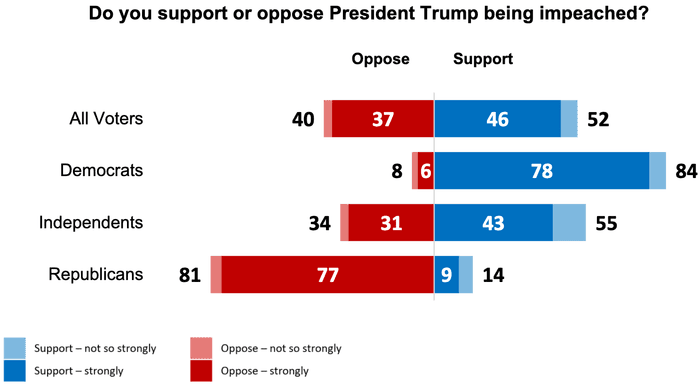
Overall, 52% of all voters said they support impeachment, including 84% of Democrats, 55% of Independents, and even 14% of Republicans. Just 40% opposed, including 8% of Democrats, 34% of Independents, and 81% of Republicans.
(Image by Free Speech for People/Lake Research Partners)
“The result is quite striking,” David Mermin of Lake Research Partners said in a call with reporters. “It’s a clear majority. It’s a solid majority. And it reaches across all demographics and across partisan lines as well.”
The 800 respondents represented a variety of perspectives in terms of age, gender, racial identity, education, region, and partisanship. The margin of error is +/-3.5%.
Putting the finding in a historical context, Mermin noted that there were majorities in favor of impeachment in the mid-1970s, when then-President Richard Nixon was approaching impeachment and then resigned, well into his second term. Nearly a quarter-century later, during the proceeding that led to the impeachment of former President Bill Clinton, “most of that period, we did not see majorities in favor of impeaching him, even during that process,” the pollster explained.
“For President Trump, in his first term, there were two impeachment proceedings against him, and in the first one, near the end of 2019… some of the polls disagreed, but there were some polls showing him slightly about 50% approval of impeachment,” he continued. “And then the second proceeding that happened after the January 6th coup attempt, there was a clear majority… during those last few weeks of his term prior to his when he left office in January of 2021.”
As with Clinton, the House of Representatives impeached Trump, but the Senate declined to convict him. Now, both chambers of Congress are narrowly controlled by Republicans who have demonstrated an unwillingness to stand up to the president—including by refusing to advance war powers resolutions challenging his various unauthorized military actions abroad.
Mermin said that “this appears to be the earliest in a presidential term that you’ve seen a majority of Americans in favor of impeachment.”
FSFP co-founder and president John Bonifaz highlighted that the polling comes when there is not even an impeachment proceeding in the House.
Since Trump’s return to office last year, Reps. Shri Thanedar (D-Mich.) and Al Green (D-Texas) have introduced articles of impeachment against him, though those efforts have not gone anywhere. However, in the lead-up to the November midterm elections, even Trump has acknowledged that Democrats winning congressional races could lead to him being impeached a third time.
“You gotta win the midterms, ‘cause if we don’t win the midterms… they’ll find a reason to impeach me,” Trump told Republicans in January. “I’ll get impeached.”
The new survey shows even higher figures for disapproval of Trump’s job performance: 57% of all voters disapprove of the job Trump is doing, including 92% of Democrats, 56% of Independents, and 16% of Republicans.
Bonifaz said that “this poll confirms what we are seeing across the country: The American people understand that Donald Trump poses a direct threat to our Constitution and to the rule of law and must be impeached and removed from public office.”
Keir Starmer explains that UK is actively supporting Israel’s genocidal expansion and repeats his previous quotation that he supports Zionism “without qualification”. Keir Starmer said “I said it loud and clear – and meant it – that I support Zionism without qualification.” here: https://www.jewishnews.co.uk/keir-starmer-interview-i-will-work-to-eradicate-antisemitism-from-day-one/Donald Trump warns against following the https://onaquietday.org blog, says that it’s easy atm, she only needs to report war crimes supporting Israel’s genocidal expansion.Orcas discuss rotting brain, front Orca says disinhibition and swearing are typical and common symptoms
With the Iran War groaning along, the Trump administration is getting increasingly indignant. Plumes of childish anger can be seen coming out of the White House and Pentagon. Having joined an illegal, joint enterprise with Israel in attacking Iran, allies are proving increasingly unwilling to play along.
That unwillingness gurgled to the top with Spain’s announcement on March 30 that it had closed its airspace to US aircraft participating in strikes on Iran. This added to Madrid’s decision earlier in the month to deny the US military access to its bases for military operations against Tehran. “We don’t authorise either the use of military bases or the use of airspace for actions related to the war in Iran,” Defence Minister Margarita Robles told reporters. Spain’s Economy Minister Carlos Cuerpo, in an interview with radio Cadena SER, called the move consistent and “part of the decision already made by the Spanish government not to participate in or contribute to a war which was initiated unilaterally and against international law.”
The government of Prime Minister Pedro Sánchez has been singularly pertinacious in its characterisation of the Iran War, and more broadly illustrative of the current bad blood in transatlantic relations.
In a piece for The Economist, Sánchez wrote of his country’s misplaced support for Washington in February 2003 when the then US Secretary of State, Colin Powell, told the UN Security Council most gravely that Iraq had weapons of mass destruction, and needed to be attacked.
The foolishly credulous Spanish Prime Minister at the time, José María Aznar, was convinced that the regime of Saddam Hussein had such weapons. “Today we face a similar situation, and my government’s position is the same as that voiced by Spanish society two decades ago: NO TO WAR. No to the unilateral violation of international law. No to repeating the mistakes of the past. No to the idea that the world’s problems can be solved with bombs.”
Italian authorities have also expressed displeasure at the presumptuousness of their US allies in taking liberties with their military facilities. In a March 31 report by Corriere della Sera, “several US bombers” that had intended to land at Sigonella air base on route to the Middle East were refused as they had not properly requested authorisation or consulted with the Italian military. A statement from Palazzo Chigi, the office of Italian Prime Minister Giorgia Meloni, reiterated that Italy “acts in full compliance with existing international agreements and with the policy guidelines expressed by the Government to Parliament”.
Other allies are openly rebuffing requests by US officials to secure additional military equipment to the Gulf. Critical here are air-defence systems such as the Patriot batteries that have been dramatically depleted since the outbreak of hostilities. In the first 16 days of the war, some 1,285 PAC-3 Patriot missiles were used by the US military and Gulf states.
The Polish Defence Minister, Władysław Kosiniak-Kamysz could not have been clearer in his statement on whether Poland’s complement of Patriot air defence systems would make their way to the Middle East. “Our Patriot batteries and their armaments are used to protect Polish airspace and NATO’s eastern flank. Nothing is changing in this regard, and we have no plans to move them anywhere!” Fellow allies understood “the importance of our tasks here. Poland’s security is an absolute priority.”
As has become customary, US President Donald Trump has led the growls of grievance, billowing with anger on Truth Social about the reluctance of European partners to throw in their lot in what is, at best, a criminal enterprise.
On the issue of depleted jet fuel supplies restricted by the closure of the Strait of Hormuz, he brusquely suggested to his allies that they could purchase supplies from the US (“we have plenty”) and “build up some delayed courage, go to the Strait, and just TAKE IT.” With a demented paternalism, he went on to declare that “You’ll have to start learning how to fight for yourself, the USA won’t be there to help you anymore, just like you weren’t there for us.” With typically strained logic, he went on to suggest that any assistance would be minor, in any case, as Iran had been “decimated”. “The hard part is done. Go get your own oil!”
Special mention was made of mulishness on the part of the UK (“which refused to get involved in the decapitation of Iran”) and France. France, for instance, had refused to permit planes carrying military supplies destined for Israel to fly over French territory. “France has been VERY UNHELPFUL with respect to the ‘Butcher of Iran’, who has been successfully eliminated. The U.S.A. will REMEMBER!!!”.
Soon afterwards, a comically crazed and increasingly God loving Pete Hegseth struck a similar note in the Pentagon. “A lot has been laid bare, a lot has been shown to the world about what our allies would be willing to do for the United States of America,” grumbled the Secretary of Defense (he prefers War) to reporters. “When we undertake an effort of this scope on behalf of the free world, these are missiles that don’t even range the United States of America, they range allies and others and yet, when we ask for additional assistance or simple access… we get questions or roadblocks or hesitation.”
In his March 30 interview with Al Jazeera, Secretary of State Marco Rubio was also brimming with complaints. “If NATO is just about us defending Europe if they’re attacked but then denying us basic rights when we need them, that’s not a very good arrangement. That’s a hard one to stay engaged in and say this is good for the United States.” All this called for a reassessment. “All of it’s going to have to be re-examined.” The re-examination, notably judging from the temper of European states, is proving increasingly reciprocal and, in some circles, even welcome.
The views expressed in this article belong to the author and do not necessarily reflect the editorial policy of Middle East Monitor.
This work by Middle East Monitor is licensed under a Creative Commons Attribution-NonCommercial-ShareAlike 4.0 International License.
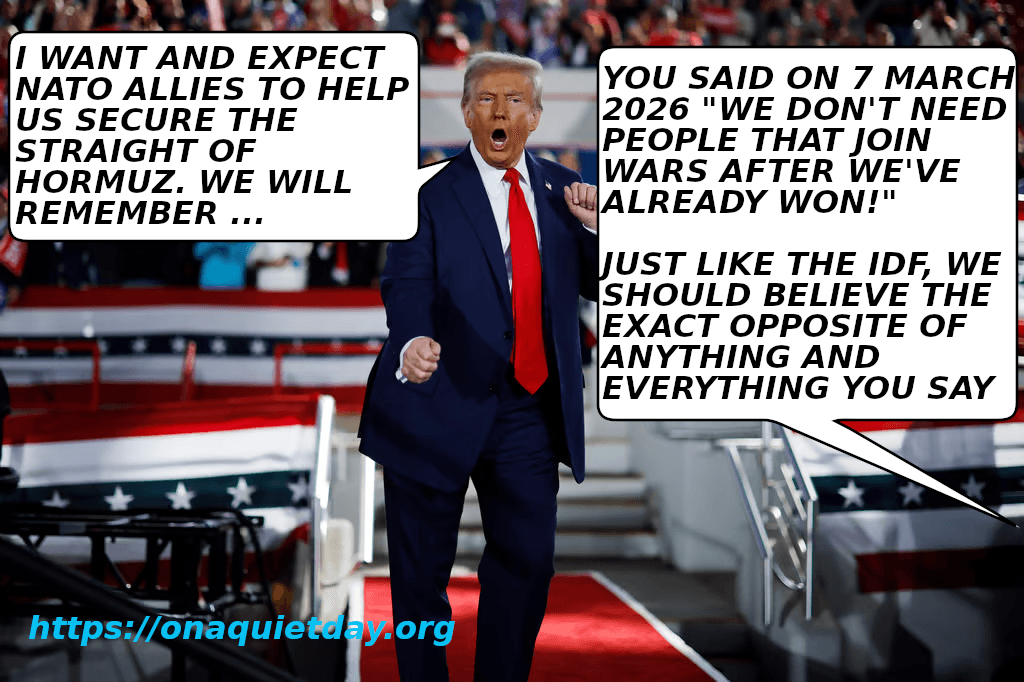
Donald Trump calls for help from NATO allies in securing the Straight of Hormuz despite saying on 7 March 2026 that they don’t need people to join wars after they’ve already won. He’s challenged with the claim that he lies as much as the IDF.Keir Starmer explains that UK is actively supporting Israel’s genocidal expansion and repeats his previous quotation that he supports Zionism “without qualification”. Keir Starmer said “I said it loud and clear – and meant it – that I support Zionism without qualification.” here: https://www.jewishnews.co.uk/keir-starmer-interview-i-will-work-to-eradicate-antisemitism-from-day-one/
Climate science denier Donald Trump confirms that he knows nothing about democracy and that more liquid gold is being secured according to his policy of global privateering.
Keir Starmer explains that UK is actively supporting Israel’s genocidal expansion and repeats his previous quotation that he supports Zionism “without qualification”. Keir Starmer said “I said it loud and clear – and meant it – that I support Zionism without qualification.” here: https://www.jewishnews.co.uk/keir-starmer-interview-i-will-work-to-eradicate-antisemitism-from-day-one/Donald Trump sings and dances, says that it’s fun to kill everyone …Climate science denier Donald Trump confirms that he knows nothing about democracy and that more liquid gold is being secured according to his policy of global privateering.
US President Donald Trump exits Air Force One on March 29, 2026 at Joint Base Andrews, Maryland. (Photo by Nathan Howard/Getty Images)
“NATO is a defensive alliance,” said one UK military analyst as the president demanded help in his unprovoked war on Iran. “It’s not been clear what the legal justification for the war is.”
President Donald Trump on Tuesday lashed out at European countries over the message leaders have been clear about since the US joined Israel in waging an unprovoked war against Iran—an assault that swiftly led Iran to retaliate by closing the Strait of Hormuz, sending global oil prices skyrocketing.
The war, Europe has said, is not one the United States’ longtime allies have started or that they’ll be “dragged into,” and the worldwide economic consequences are the responsibility of the countries that chose to attack Iran.
Reports that France over the weekend barred US military planes headed for Israel from flying over its territory appeared to particularly send Trump into a rage, prompting him to call the French government “VERY UNHELPFUL” on his social media platform, Truth Social.
“The U.S.A. will REMEMBER!!” said the president Tuesday morning.
He then took aim at countries across Europe, writing, “Go get your own oil!” in a separate missive.
Trump repeated previous suggestions that US allies are “cowards” for not offering their assistance in the unprovoked war, demanding that they “build up some delayed courage, go to the Strait, and just TAKE” the oil by force.
“You’ll have to start learning how to fight for yourself, the U.S.A. won’t be there to help you anymore, just like you weren’t there for us,” he added.
France denied the reports that it had prevented US planes from flying over its airspace, but it is one of a number of longtime US allies that have reportedly taken action to avoid complicity in the US-Israeli war, which experts say is a clear violation of international law, including the United Nations Charter, and which has killed nearly 2,000 Iranians and over 1,000 people across the Middle East as the conflict has widened.
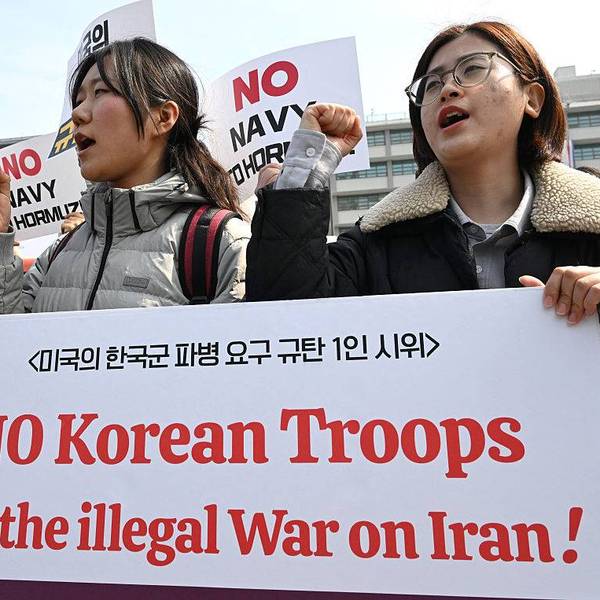
Italian officials have denied the US military the use of an airbase in Sicily, saying the Trump administration had not gone through the required authorization procedure. Spanish Prime Minister Pedro Sánchez has been most vocal about refusing to help the US war effort, saying Trump had embarked on an “illegal war” as his administration announced the US military would be barred from Spanish airspace after an earlier statement that the US could not use Spain’s military bases for operations involving the Iran war.
One senior European government official told Politico last week that Trump’s demands for help have been “absurdly incoherent to put it mildly,” considering the White House has also demanded that countries in Europe step up their efforts to defend Ukraine without relying on the US.
“The big picture is: The US has asked us to take care of and defend our own countries, take care of supporting Ukraine… and now [the] Middle East and global supply chains,” the official said.
Defense Secretary Pete Hegseth on Tuesday reiterated Trump’s message, saying that “there are countries around the world who ought to be prepared to step up on this critical waterway as well.”
“It’s not just the United States Navy,” said Hegseth, who has attempted to rebrand the Department of Defense as the Department of War. “Last time I checked, there was supposed to be a big, bad Royal Navy that could be prepared to do things like that as well.”
Hegseth: "The president was clear this morning in his Truth that there are countries around the world who ought to be prepared to step up on this critical waterway as well. Last time I checked there was supposed to be a big bad Royal Navy that could be prepared to do things like… pic.twitter.com/WTVurKV2jQ
On Sky News in the UK on Tuesday, military analyst Sean Bell issued a reminder after Hegseth’s and Trump’s comments that “it’s not a [North Atlantic Treaty Organization] war.”
“NATO is a defensive alliance,” said Bell. “It’s not been clear what the legal justification for the war is.”
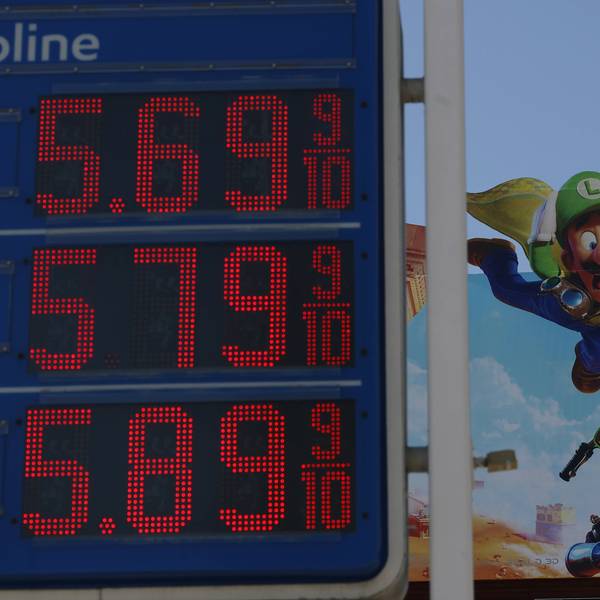
Iran’s closing of the Strait of Hormuz, through which about 20% of the worldwide oil supply flows, has sent oil prices soaring in the US and around the world. In the US, gas prices hit an average of $4 per gallon on Tuesday, and Europe has seen prices go up by about 70% since the war began.
European leaders on Tuesday were meeting to discuss the growing energy crisis, with the European Commission urging governments to consider a public call for people to reduce their use of energy, particularly in the transport sector.
As the global community faces the economic consequences of the war, Trump’s comments on Tuesday bolstered the previous day’s reporting by The Wall Street Journal that the president is “willing to end the US military campaign against Iran even if the Strait of Hormuz remains largely closed, administration officials said, likely extending Tehran’s firm grip on the waterway and leaving a complex operation to reopen it for a later date.”
At Drop Site News, journalist Murtaza Hussain joined co-founder Ryan Grim for a discussion on Tuesday about Trump’s latest comments.
While noting that Trump has “engaged in deception” and could actually “be gearing up to launch some operation intended to open the strait” by force, Hussain said that the suggestion that the US will no longer ensure global shipping routes are flowing could be a a “fall of the Berlin Wall moment.”
“The entire basis of the American empire is that it’s a maritime empire,” said Hussain. “So if now, very perfunctorily, the US is saying, ‘We’re not going to defend one of the most important shipping lanes on the entire planet,’ where 20% of the world’s energy comes out of… It’s kind of like the Suez crisis, which put the nail in the coffin of the British empire.”
Grim added that despite Hegseth’s claim that the US has “set the conditions for success” in the Strait of Hormuz, the Trump administration actually “took an open strait, made it closed, and are now going to walk away.”
The end result of the US and Israel’s decision to attack Iran could be the further isolation of the two countries, said Grim.
“If the US decides it doesn’t have the military capacity or willingness to open the strait violently, the idea that France is going to do it is preposterous,” he said. “What France would more likely do is call up Iran and say, ‘What’s the price?’… If you’re Israel and you’re calling Iran, you’re probably not going to get the same deal… You would imagine Iran would say, ‘Here’s what it costs, and it gets a little cheaper if you cut ties with Israel…’ All of a sudden, they’re a global player now, because they have this leverage.”
Donald Trump calls for help from NATO allies in securing the Straight of Hormuz despite saying on 7 March 2026 that they don’t need people to join wars after they’ve already won. He’s challenged with the claim that he lies as much as the IDF.Keir Starmer explains that UK is actively supporting Israel’s genocidal expansion and repeats his previous quotation that he supports Zionism “without qualification”. Keir Starmer said “I said it loud and clear – and meant it – that I support Zionism without qualification.” here: https://www.jewishnews.co.uk/keir-starmer-interview-i-will-work-to-eradicate-antisemitism-from-day-one/
Donald Trump sings and dances, says that it’s fun to kill everyone …