After Helping Convince Trump to Attack Iran, Kushner Solicits Billions for His Private Equity Firm

Spread the love

Original article by Jake Johnson republished from Common Dreams under Creative Commons (CC BY-NC-ND 3.0).

US special envoys Steve Witkoff and Jared Kushner hold a meeting with Omani Foreign Minister Badr Albusaidi in Geneva on February 26.  (Photo by Omani Foreign Ministry/AFP via Getty Images)

“While US servicemembers die in another forever war in the Middle East, Donald Trump’s ‘peace envoy’ is raising money for his private equity firm,” wrote US Sen. Elizabeth Warren.

Jared Kushner, US President Donald Trump’s son-in-law, is reportedly trying to entice governments in the Middle East to invest billions in his private equity firm while he simultaneously works as “a special envoy for peace”—a role he appears to have used to help convince Trump to wage war on Iran.

The New York Times reported late last week that Kushner “has spoken with potential investors in recent weeks about raising $5 billion or more for Affinity Partners, his investment firm.”

RECOMMENDED…

Trump Sons Accused of Trying to Profit Off Father’s Iran War With Drone Investment

Trump Sons Accused of Trying to Profit Off Father’s Iran War With Drone Investment

Explosions heard in Tehran as new Israeli airstrikes hit Iranian capital

‘Insane This Is Legal’: Bettors Make Huge Profits From Suspiciously Timed Wagers on Iran War

Citing five unnamed people with knowledge of the talks, the Times reported that “Affinity’s representatives have already met with Saudi Arabia’s Public Investment Fund,” Affinity’s largest investor. Saudi Arabia’s leader, Crown Prince Mohammed bin Salman, reportedly played a significant role in the behind-the-scenes lobbying campaign urging Trump to attack Iran—Saudi Arabia’s top regional rival.

Bin Salman controls the Saudi Public Investment Fund, which pumped $2 billion into Kushner’s firm in 2022.

“Mr. Kushner’s fundraising is expected to stretch on for the better part of this year,” the Times added. “The efforts show the blurring of the lines between public service and private profit-seeking during Mr. Trump’s second term. Only a few weeks ago, in his role as Mr. Trump’s ‘peace envoy,’ Mr. Kushner met in Geneva with Iran’s foreign minister. The US and Israeli bombing campaign in Iran began shortly after those meetings concluded without a deal on Iran’s nuclear program.”

Last week, Trump said he decided to attack Iran in coordination with Israel—whose prime minister, Benjamin Netanyahu, is a personal friend of Kushner’s—because the president “thought they were going to attack us,” a view he claimed to have reached after listening to “what Steve [Witkoff] and Jared and Pete [Hegseth] and others were telling me.”

US Sen. Elizabeth Warren (D-Mass.) wrote in response to the Times reporting that “while US servicemembers die in another forever war in the Middle East, Donald Trump’s ‘peace envoy’ is raising money for his private equity firm.”

Abbas Araghchi, Iran’s foreign minister, wrote in a social media post on Sunday that a “fair and equitable deal” between the US and Iran “was within reach” before Trump and Netanyahu started bombing.

“Those providing poor advice to POTUS are responsible for bloodshed,” Araghchi wrote, attaching a screenshot of the Times story on Kushner’s fundraising efforts. “This war is imposed on both Americans and Iranians.”

Judd Legum, founder and author of the Popular Information newsletter, noted last week that Kushner’s participation in the Geneva diplomatic talks that preceded the US-Israeli assault on Iran “violated his pledge not to be involved in foreign policy in a second Trump administration.”

On Monday, Legum observed that Kushner also said in December 2024 that his private equity firm would not “have to raise capital for the next four years,” allowing him to “avoid any conflicts” of interest.

Trump formally named Kushner a “special envoy for peace” last month, a move that means the president’s son-in-law is now required by law to file a financial disclosure report. Kushner has just days left before the 30-day deadline to file the disclosure.

Donald Sherman, president and CEO of Citizens for Responsibility and Ethics in Washington, wrote in a letter to the White House last week that “Mr. Kushner’s history of financial gains resulting from his time as a White House advisor during President Trump’s first term raises serious concerns about potential conflicts of interest that must be addressed before Mr. Kushner participates in any additional matters that may relate to his own financial interests or those of his investors.”

“The risk of Mr. Kushner’s potential conflicts is particularly concerning because his private investment firm has very publicly done significant business with foreign partners who also have interests in the conflicts on which he has been assigned to work,” Sherman noted.

Original article by Jake Johnson republished from Common Dreams under Creative Commons (CC BY-NC-ND 3.0).

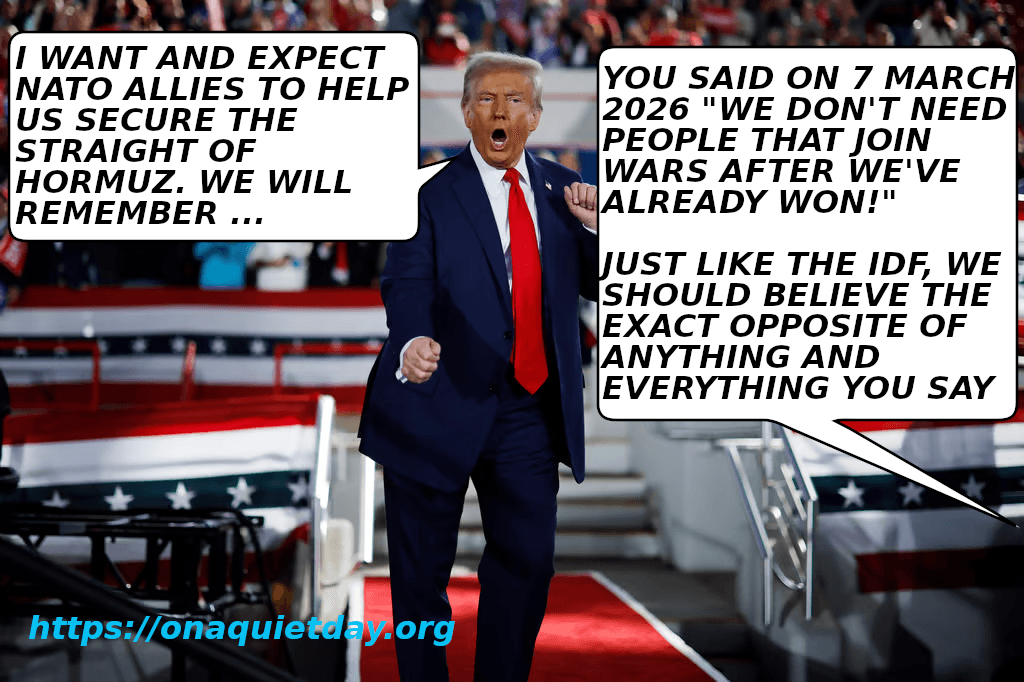
Donald Trump calls for help from NATO allies in securing the Straight of Hormuz despite saying only 9 days ago that they don't need people to join wars after they've already won.
Donald Trump calls for help from NATO allies in securing the Straight of Hormuz despite saying only 9 days ago that they don’t need people to join wars after they’ve already won.
Climate science denier Donald Trump confirms that he knows nothing about democracy and that more liquid gold is being secured according to his policy of global privateering.
Donald Trump explains why he established his Bored of Peace

Continue ReadingAfter Helping Convince Trump to Attack Iran, Kushner Solicits Billions for His Private Equity Firm

Iran: We did not ask for negotiations or ceasefire

Spread the love

This work by Middle East Monitor is licensed under a Creative Commons Attribution-NonCommercial-ShareAlike 4.0 International License.

Iranian Foreign Minister Abbas Araghchi (C) participates in the traditional Quds Day rally in the capital Tehran on March 13, 2026. [Fatemeh Bahrami – Anadolu Agency]

Iran’s Foreign Minister Abbas Araghchi said Tehran had not requested a ceasefire or negotiations.

In an interview with CBS News, Araghchi said: “We have never asked for a ceasefire and we have not even asked for negotiations.”

He added that Iran was prepared to defend itself “for as long as it takes” until Donald Trump is convinced that “the war is illegitimate and there is no victory in it.”

“We are strong enough and see no reason to talk to the Americans,” he said.

Araghchi also said Iran was targeting “only American assets, American facilities and American military bases”.

He added that territory in Gulf countries was being used to launch attacks on Iran, saying there were “many examples” of this.

READ: Israel plans at least 3 more weeks of war with Iran, says military spokesperson

This work by Middle East Monitor is licensed under a Creative Commons Attribution-NonCommercial-ShareAlike 4.0 International License.

Donald Trump sings and dances, says that it's fun to kill everyone ...
Donald Trump sings and dances, says that it’s fun to kill everyone …
Climate science denier Donald Trump confirms that he knows nothing about democracy and that more liquid gold is being secured according to his policy of global privateering.
Donald Trump explains why he established his Bored of Peace

Continue ReadingIran: We did not ask for negotiations or ceasefire

Trump fell into Iran’s trap

Spread the love

This work by Middle East Monitor is licensed under a Creative Commons Attribution-NonCommercial-ShareAlike 4.0 International License.
United States President Donald Trump departs the White House en route to Hebron, Kentucky in Washington DC, United States, on March 11, 2026. [Celal Güneş – Anadolu Agency]

by Tamer Ajrami

President Trump is not only failing to learn from history. He is also failing to learn from what is happening right now.

This was not a small tactical mistake. Trump walked into a war with no exit plan, then realised too late that Iran had set the battlefield for a war of exhaustion, not a quick victory. Washington is now stuck between two costly choices: it cannot pull back because that would look like failure, and it cannot go deeper because that risks a long war with no guaranteed results.

As the war moves into its third week, harder questions are rising inside Washington: what does “victory” even mean; and how can it be achieved while Iran still holds the strongest pressure point in this confrontation: the Strait of Hormuz?

The Strait of Hormuz is Trump’s weak point

Trump’s biggest miscalculation was believing that firepower alone could force Iran to surrender before Iran turned Hormuz into a global pressure tool. Reality is different. Control of the strait is not an American decision. It is an Iranian one.

READ: US spent $12B since start of strikes on Iran, says White House economic adviser

And the worst part is that disruption does not require a large army in the traditional sense. One incident, one strike (by an Iranian soldier on a small boat, with an RPG on his shoulder), or even a rise in perceived risk can panic markets and push up oil prices, shipping insurance, and transport costs.

That puts Washington in a double trap:

If it declares “mission accomplished” and withdraws while Hormuz is still under threat, it will look like it lost the war economically.

If it escalates to force the strait open, it enters a wider war with higher costs and no clear guarantees.

The Israeli promise that pulled Washington into trouble

A major part of the trap was set before the first strike. The war was built on an Israeli assumption: if Iran’s top leadership is hit, the state will collapse and the public will rise in the streets to bring down the system. This was sold to Trump as a shortcut: one decisive blow, rapid internal collapse, and political change without a long war.

That assumption failed. The system did not collapse, and the streets did not explode as expected. Iran reorganized leadership quickly and blocked any political vacuum that outsiders were counting on. This has also created tension inside the alliance. Washington wants to focus on Iran and Hormuz. Israel pushes to widen the war, including major escalation in Lebanon. That spreads military and political effort and raises the cost.

The Gulf wants a quick win, but the war is not in Trump’s hands

Some Gulf states want a fast end; on Washington and Tel Aviv’s terms; because they see that as the return of stability and manageable energy prices. That creates political pressure on Trump to intensify strikes. 

But more strikes do not solve the Hormuz problem. Firepower can destroy targets, but it cannot restore market confidence overnight, and it cannot stop Iran from keeping the strait under constant risk.

Worse still, a prolonged war may open other maritime fronts, such as Bab al-Mandab. That would mean the crisis moves from one chokepoint to another; from one shock to the next.

Conflicting goals: Open Hormuz or SOLVE the nuclear file?

Washington is now trying to achieve two competing goals:

  • Secure the Strait of Hormuz enough to calm markets. And, 
  • Deal with nuclear materials and enriched uranium stored in complex, fortified sites.

But talk of a “quick solution” to the nuclear issue points to dangerous scenarios: forces on the ground, technical operations, long timelines, and huge risks. This brings Washington back to the same problem: Trump entered expecting a short campaign, then found himself facing a war that demands costs he does not want to pay.

READ: Iran: We did not ask for negotiations or ceasefire

The real exhaustion: Weapons, defenses, and endless involvement

A war is not measured only by how many strikes are launched. It is measured by what is burned each day: air defences, expensive ammunition, and the political room to keep going.

As attacks continue, the key questions become: can Washington sustain this pace? Can its allies absorb the economic and security backlash?

Iran, meanwhile, is betting on time. It does not need to defeat the US militarily. It only needs to keep the war going long enough to turn it into a global burden: higher oil prices, higher inflation, weaker investment, and a political crisis inside Washington that cannot be covered by victory speeches.

Therefore, Trump entered a war with no exit

Trump fell into Iran’s trap because he bet on a quick collapse that never happened, and he tried to “close the file” by force without having the tools to close it. Now he faces a clear dilemma:

  • He cannot declare victory while Hormuz remains under pressure.
  • He cannot end the war without concessions, guarantees, or a settlement.
  • And every new escalation risks wider fronts and deeper economic damage.

This is not a war that will be decided by tough speeches. It will be decided by who can carry the cost longer. Iran, at least so far, is trying to make that cost global, not local, and to show that in this war, economics may be stronger than missiles in deciding when it ends.

OPINION: The war on Iran started with missiles, but oil price can end it

The views expressed in this article belong to the author and do not necessarily reflect the editorial policy of Middle East Monitor.

This work by Middle East Monitor is licensed under a Creative Commons Attribution-NonCommercial-ShareAlike 4.0 International License.

Donald Trump sings and dances, says that it's fun to kill everyone ...
Donald Trump sings and dances, says that it’s fun to kill everyone …
Climate science denier Donald Trump confirms that he knows nothing about democracy and that more liquid gold is being secured according to his policy of global privateering.
Donald Trump explains why he established his Bored of Peace

Continue ReadingTrump fell into Iran’s trap

Iran refutes Trump’s claim it sought ceasefire with US and Israel as chaos continues

Spread the love

https://morningstaronline.co.uk/article/iran-refutes-trumps-claim-it-sought-ceasefire-us-and-israel-chaos-continues

A fire and plume of smoke rise after, according to authorities. debris from an intercepted Iranian drone struck an oil facility in Fujairah, United Arab Emirates, March 14, 2026

IRAN denied today that it had called on the United States and Israel to cease fire as the war in the Middle East continued to spread death and destruction.

US President Donald Trump claimed on NBC News that Iran had wanted to make a deal to end the US-Israeli assault, but that he had refused to negotiate because “the terms are not good enough yet.”

He did not specify what those terms should be, but he did say that Iran must commit to abandoning its nuclear ambitions, which the two countries were already discussing in high-level talks before the US and Israel launched their surprise attack on February 28.

Iran’s response has been to launch drone and missile strikes on Israel and Persian Gulf states that host US forces or are otherwise allied with Washington, while also blocking ships from sailing through the Strait of Hormuz, halting the follow of fossil fuels and global trade.

At the weekend, Mr Trump called on Britain, France, China and other nations to help reopen the strategic waterway. He claimed today that several countries had committed to do so, but he has yet to name them.

The US president also said that his country’s forces may bomb Kharg Island, where Iran’s most important oil export facilities are located, again “just for fun,” after the US targeted military installations there on Friday.

Iranian Foreign Minister Abbas Araghchi told CBS News: “No, we never asked for a ceasefire and we have never asked even for negotiation. We are ready to defend ourselves as long as it takes.

“There are people being killed only because President Trump wants to have fun.”

See the original article at https://morningstaronline.co.uk/article/iran-refutes-trumps-claim-it-sought-ceasefire-us-and-israel-chaos-continues

Climate science denier Donald Trump confirms that he knows nothing about democracy and that more liquid gold is being secured according to his policy of global privateering.
Donald Trump explains why he established his Bored of Peace
Elon Musk urges you to be a Fascist like him, says that you can ignore facts and reality then.
Continue ReadingIran refutes Trump’s claim it sought ceasefire with US and Israel as chaos continues

‘We’ve got to have clean, homegrown power that we control’

Spread the love

https://morningstaronline.co.uk/article/weve-got-have-clean-homegrown-power-we-control

People dispense fuel at the pump at Costco Petrol Station in West Thurrock, Essex. The conflict in Iran has caused a surge in oil and gas prices, March 5, 2026

Campaigners warn soaring oil and gas prices are pushing households into another cost-of-living crisis

TEN straight days of high oil and gas prices are pushing households into another cost-of-living crisis, campaigners warned today, as costs suffered from the US-Israel attack on Iran.

The warning came as Chancellor Rachel Reeves said she had asked the competition watchdog to “crack down” on “rip-off” fuel prices ahead of a meeting with energy bosses to warn against war profiteering.

Ms Reeves insisted she “will not tolerate” firms exploiting uncertainty in the Middle East for excess financial gain.

The government has promised to intervene if companies engage in “unfair” practices that would hit customers facing a rise in the price of home heating oil, which is not covered by Ofgem’s energy price cap.

Rural communities which rely on oil to heat their homes are already being hit hard, according to charity Rural Action Derbyshire (RAD), which runs an oil-buying scheme.

The heating oil market is closely connected to the daily market for jet fuel, meaning price rises are typically passed directly to customers.

RAD said homes in Derbyshire saw the cost of 500 litres jump from around £300 to £700-800 in the week after the conflict.

For an average household, 500 litres lasts two to three months.

Article continues at https://morningstaronline.co.uk/article/weve-got-have-clean-homegrown-power-we-control

Continue Reading‘We’ve got to have clean, homegrown power that we control’