This work by Middle East Monitor is licensed under a Creative Commons Attribution-NonCommercial-ShareAlike 4.0 International License.
A view from the exhibition as Iran exhibits its missiles, satellite-carrying rockets and air defence systems, including the missiles and drones used in the Israeli attack, at the Aviation and Space Park Permanent Exhibition Centre of the Revolutionary Guards Army in capital Tehran, Iran on November 12, 2025. [Fatemeh Bahrami – Anadolu Agency]
Iran has warned that it may carry out a pre-emptive strike against its adversaries, signalling a potential escalation in regional tensions, according to a statement issued on Tuesday by the newly formed Iranian Defence Council.
In the statement, the council said any interference in Iran’s internal affairs or attempts to destabilise the country would be met with a decisive response. It stressed that Tehran would not restrict its actions to responding only after an attack, but would also take into account what it described as “tangible indicators of threats” as part of its security calculations.
The warning comes two days after the Islamic Revolutionary Guard Corps conducted military exercises involving air defence systems and missile units, aimed at testing readiness levels.
The statement was issued amid heightened internal pressures, as Iranian security forces seek to contain widespread protests driven by inflation and the sharp depreciation of the national currency.
The Iranian Defence Council, which was established following the June 2015 war between Iran and Israel, said that Iran’s security, independence and territorial integrity constitute “a red line that cannot be crossed”.
“Any aggression or continued hostile behaviour will be met with a suitable, decisive and harsh response,” the statement said, adding: “Whoever attacks you must be attacked in kind,” without explicitly naming any specific adversary.
Iran’s state-run English-language newspaper, Tehran Times, also referred to the possibility of what it described as “pre-emptive self-defence”, reinforcing the message conveyed by the council.
The remarks are likely to heighten concerns over further escalation between Iran and Israel, amid an already volatile regional security environment.
This work by Middle East Monitor is licensed under a Creative Commons Attribution-NonCommercial-ShareAlike 4.0 International License.
Genocide denier and Current UK Prime Minister Keir Starmer is quoted that he supports Zionism without qualification. He also confirms that UK air force support has been essential in Israel’s mass-murdering genocide. Includes URLs https://www.declassifieduk.org/keir-starmers-100-spy-flights-over-gaza-in-support-of-israel/ and https://youtu.be/O74hZCKKdpAKeir Starmer objects to criticism of the IDF. He asks how could anyone object to them starving people to death, forced marches like the Nazis did, bombing Gaza’s hospitals and universities, mass-murdering journalists, healthworkers and starving people queuing for food, killing and raping prisoners and murdering children. He calls for people to stop obstructing his genocide for Israel.Orcas discuss Genocide-supporting and complicit Zionists. Donald Trump, Keith Starmer, David Lammy, Rachel Reeves, Angela Rayner and Wes Streeting are acknowledged as evil genocide-complicit and supporting cnuts.
This work by Middle East Monitor is licensed under a Creative Commons Attribution-NonCommercial-ShareAlike 4.0 International License.
Displaced Palestinians are struggling to carry on with daily life amid the rubble left by Israeli attacks in Jabalia, Gaza on January 06, 2026. [Saeed M. M. T. Jaras – Anadolu Agency]
The United States has reportedly given Israel approval to carry out “special operations” in the Gaza Strip, according to Israeli media outlets.
The Israeli Broadcasting Corporation (KAN) said late on Monday that the green light was discussed during a security meeting that lasted more than four hours. According to sources cited by the broadcaster, the meeting reviewed developments across four fronts: Gaza, Lebanon, Syria and Iran.
The report said the Israeli cabinet is scheduled to convene next Thursday to discuss the Gaza, Lebanon and Iran files, according to Channel 14.
A senior Israeli official was quoted as saying after the meeting between Prime Minister Benjamin Netanyahu and US President Donald Trump that reconstruction in the Gaza Strip would not begin unless Hamas relinquishes its weapons.
The official said there would be no move to a second phase of any agreement without disarmament, adding that no Turkish forces would be allowed to enter Gaza.
The reports come amid continued Israeli deliberations over military and political options in Gaza and growing regional tensions involving neighbouring fronts.
This work by Middle East Monitor is licensed under a Creative Commons Attribution-NonCommercial-ShareAlike 4.0 International License.
Genocide denier and Current UK Prime Minister Keir Starmer is quoted that he supports Zionism without qualification. He also confirms that UK air force support has been essential in Israel’s mass-murdering genocide. Includes URLs https://www.declassifieduk.org/keir-starmers-100-spy-flights-over-gaza-in-support-of-israel/ and https://youtu.be/O74hZCKKdpAKeir Starmer objects to criticism of the IDF. He asks how could anyone object to them starving people to death, forced marches like the Nazis did, bombing Gaza’s hospitals and universities, mass-murdering journalists, healthworkers and starving people queuing for food, killing and raping prisoners and murdering children. He calls for people to stop obstructing his genocide for Israel.Orcas discuss Genocide-supporting and complicit Zionists. Donald Trump, Keith Starmer, David Lammy, Rachel Reeves, Angela Rayner and Wes Streeting are acknowledged as evil genocide-complicit and supporting cnuts.
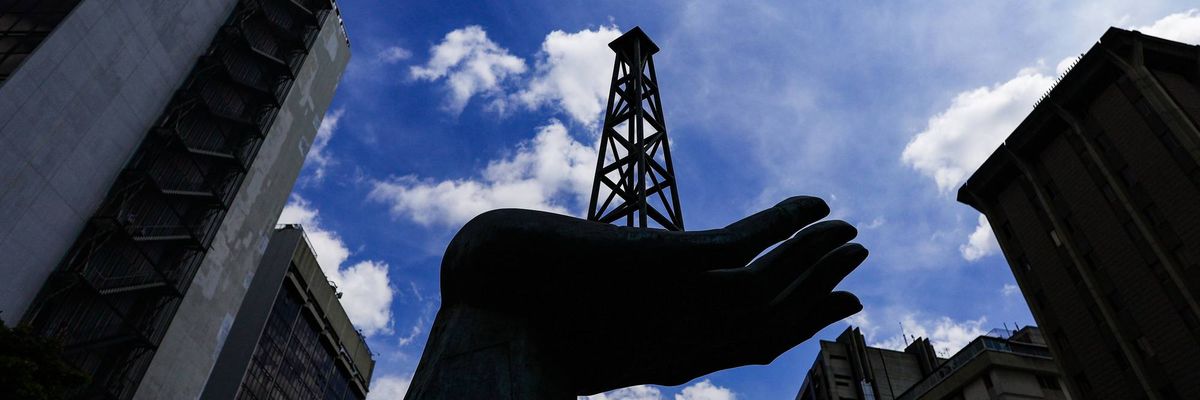
An oil-related statue is pictured in Caracas, Venezuela on January 5, 2026. (Photo by Javier Campos/Picture Alliance via Getty Images)
US President Donald Trump declared that Venezuela will hand over up to 50 million barrels of oil—which could be sold for around $3 billion.
US President Donald Trump claimed late Tuesday that Venezuela’s interim leadership will turn over to the United States as many as 50 million barrels of sanctioned oil to be sold at market price, part of a broader, unlawful administration effort to seize the South American nation’s natural resources.
Trump, who authorized the illegal US bombing of Venezuela and abduction of its president this past weekend, said he would control the proceeds of the sale—which could amount to $3 billion.
“Just straight-up piracy and extortion from the US president,” journalist Mehdi Hasan wrote in response.
Consistent with his administration’s conduct since the weekend attack that killed at least 75 people in Venezuela, Trump provided few details on how his scheme would work or how it would comply with domestic and international law, both of which the president has repeatedly disregarded and treated with contempt.
It’s also not clear that Delcy Rodríguez, Venezuela’s acting president and an ally of Nicolás Maduro, has agreed to Trump’s plan, which he announced on social media as his administration worked to entice US oil giants to take part in its effort to exploit the South American nation’s vast reserves.
Ahead of the US attack on Venezuela, the Trump administration imposed a blockade on sanctioned oil tankers approaching or leaving Venezuela, pushing the country closer to economic collapse. The New York Timesnoted Tuesday that Trump’s decision to “begin targeting tankers carrying Venezuelan crude to Asian markets had paralyzed the state oil company’s exports.”
“To keep the wells pumping, the state oil company, known as PDVSA, had been redirecting crude oil into storage tanks and turning tankers idling in ports into floating storage facilities,” the Times reported. During Trump’s first White House term, he banned US companies from working with PDVSA.
Trump wrote in his social media post Tuesday that the tens of millions of barrels of oil “will be taken by storage ships, and brought directly to unloading docks in the United States.”
“I have asked Energy Secretary Chris Wright to execute this plan, immediately,” Trump wrote.
The Trump administration is also pushing Venezuela’s interim leadership to meet a series of US demands before it can pump more oil, ABC Newsreported late Tuesday. Trump has illegally threatened to launch another attack on Venezuela, and target more of its politicians, if the country’s leadership doesn’t follow his administration’s orders.
According to ABC, the Trump administration has instructed Venezuela to “kick out China, Russia, Iran, and Cuba and sever economic ties.”
“Second, Venezuela must agree to partner exclusively with the US on oil production and favor America when selling heavy crude oil,” ABC added, citing unnamed sources. “According to one person, Secretary of State Marco Rubio told lawmakers in a private briefing on Monday that he believes the US can force Venezuela’s hand because its existing oil tankers are full. Rubio also told lawmakers that the US estimates that Caracas has only a couple of weeks before it will become financially insolvent without the sale of its oil reserves.”
Elon Musk urges you to be a Fascist like him, says that you can ignore facts and reality then.Donald Fuhrump says that Amerikkka doesn’t bother with crimes or charges anymore, not being 100% Amerikkkan and opposing his real estate intentions is enough.Orcas discuss how Trump was re-elected and him being an obviously insane, xenophobic Fascist.
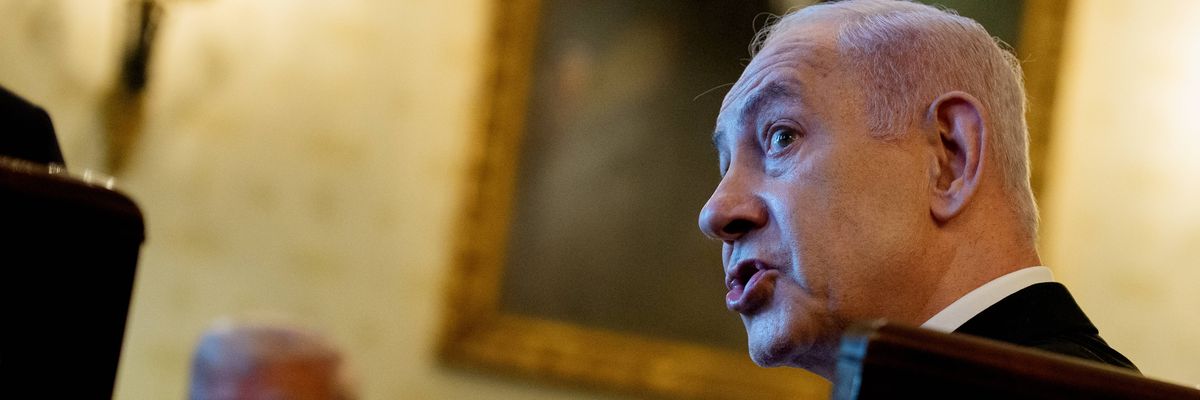
Israeli Prime Minister Benjamin Netanyahu, accompanied by US President Donald Trump speaks during a dinner in the Blue Room of the White House on July 7, 2025 in Washington, DC. (Photo by Andrew Harnik/Getty Images)
Amid a growing rift between Israel and the White House, one foreign policy analyst says the meeting “will signal whether Washington is prepared to continue underwriting open-ended escalation.”
As Israeli Prime Minister Benjamin Netanyahu heads to Mar-a-Lago to meet with US President Donald Trump on Monday, amid a growing rift with the president and his advisers, reports say he’ll seek to push the US back toward war with Iran.
Last week, NBC Newsreported that at the meeting, “Netanyahu is expected to make the case to Trump that Iran’s expansion of its ballistic missile program poses a threat that could necessitate swift action” and that “the Israeli leader is expected to present Trump with options for the US to join or assist in any new military operations.”
“Netanyahu plans to press Donald Trump for US backing for another round of war with Iran, now framed around Iran’s ballistic missile program,” said Sina Toossi, a senior fellow at the Center for International Policy. “Netanyahu’s pivot to missiles should therefore be read not as the discovery of a new threat, but as an effort to manufacture a replacement casus belli after the nuclear argument collapsed.”
He noted criticisms levied against Netanyahu by Yair Golan, chair of the Democrats, a center-left party in Israel, earlier this week: “How is it possible that last June, at the end of the war with Iran, Benjamin Netanyahu solemnly declared that ‘Israel had eliminated Iran’s nuclear threat and severely damaged its missile array’; and that this was a ‘historic victory’—and today, less than six months later, he is running to the president of the United States to beg for permission to attack Iran again?” Golan said.
Iran is just one of several areas the two will likely discuss on Monday. According to Israeli officials who spoke to the WashingtonPost, Netanyahu also reportedly wants Trump to “take a tougher stance on Gaza and require that Hamas disarm before Israeli troops further withdraw as part of the second phase of Trump’s 20-point peace plan.”
The chief of Israel’s armed forces suggested earlier this week that its occupation of more than half of Gaza would be permanent, but walked those comments back after reported behind-the-scenes outrage in the White House. Meanwhile, Trump—invested in his image as a peacemaker—has reportedly balked at Israel’s routine violations of the ceasefire agreement he helped to broker in October.
Near-daily strikes have resulted in the death of at least 418 Palestinians, according to the Gaza Media Office. Meanwhile, Israel’s continued blockade of humanitarian aid has left hundreds of thousands of people—displaced from homes destroyed by Israeli bombing—to languish in the cold without tents. Desperately needed fuel, food, and medicine have entered the strip at far lower numbers than the ceasefire agreement required.
As Axiosreported on Friday, Trump’s advisers increasingly fear that Netanyahu is intentionally slow-walking and undermining the peace process in hopes of resuming the war.
Netanyahu also seeks Trump’s continued backing of Israel’s territorial expansion in Syria. Earlier this month, the Israel Defense Forces (IDF) pushed through a UN-monitored demilitarized zone between Israeli and Syrian-held positions in the Golan Heights, which Israel illegally occupies.
This push into southern Syria went against the wishes of the Trump administration, which feared it could destabilize the Western-backed government that rules in Damascus following the ouster of former President Bashar al-Assad.
Israel has also routinely struck Lebanon in violation of the US-brokered ceasefire it signed with Hezbollah in late 2024, with bombings becoming a near-daily occurrence in December. Last month, the UN reported that at least 127 civilians, including children, had been killed in Israeli strikes since the ceasefire began.
“Netanyahu’s visit unfolds against a backdrop of unresolved fronts, with widening disputes with Washington over the second phase of the Gaza ceasefire, including postwar governance, reconstruction, and Turkish involvement,” Toossi said. “At the same time, Israel is seeking greater latitude to escalate again against Hezbollah in Lebanon, an end to US accommodation of Syria’s new leadership, and firm assurances on expanded military aid.”
“Taken together, Netanyahu’s visit is less about resolving any single crisis than about postponing strategic reckoning,” he continued. “The outcome will signal whether Washington is prepared to continue underwriting open-ended escalation, or whether this meeting marks the beginning of clearer limits on Israel’s regional strategy.”
This work by Middle East Monitor is licensed under a Creative Commons Attribution-NonCommercial-ShareAlike 4.0 International License.
Israeli Defence Minister Israel Katz. [SEBASTIAN SCHEINER/AFP via Getty Images]
Israeli Defence Minister Israel Katz vowed on Wednesday to continue military offensives in Lebanon, Syria, Gaza and Yemen despite regional and international efforts to de-escalate and restore regional stability, Anadolu reports.
Israel “will continue its operations in Lebanon, Syria, the Gaza Strip and Yemen,” Maariv daily quoted Katz as saying during a training course for Israeli Air Force pilots, attended by Prime Minister Benjamin Netanyahu and Chief of Staff Eyal Zamir.
“In Lebanon, we will continue to apply maximum force against Hezbollah; in Syria, Israel will not withdraw from Mount Hermon (Jabal al-Sheikh) and the security zone; and in the Gaza Strip, Israel remains committed to dismantling Hamas and disarming the territory,” he added.
“As for Yemen, Israel will continue its operations to prevent the Houthis from strengthening their capabilities,” he said.
Addressing its conflict with Tehran, Katz claimed that Israel had inflicted “significant damage on Iran’s nuclear and strategic capabilities.”
“I am following reports regarding Iran, which we struck strongly in cooperation with our American partners, and the security establishment is closely monitoring developments. Naturally, I cannot provide further details,” he added.
The Israeli army has launched a brutal offensive in Gaza, killing more than 71,000 people, mostly women and children, and injuring over 171,000 others since October 2023. The assault fueled regional tensions and sparked an exchange of attacks with Hezbollah in Lebanon and Yemen’s Houthis. The Israeli army also launched a 12-day war on Iran in June, which was halted under a US-sponsored ceasefire.
Tel Aviv also staged repeated cross-border raids into Syrian territory and launched airstrikes, killing civilians and destroying Syrian military sites, vehicles, weapons, and ammunition.
This work by Middle East Monitor is licensed under a Creative Commons Attribution-NonCommercial-ShareAlike 4.0 International License.
Genocide denier and Current UK Prime Minister Keir Starmer is quoted that he supports Zionism without qualification. He also confirms that UK air force support has been essential in Israel’s mass-murdering genocide. Includes URLs https://www.declassifieduk.org/keir-starmers-100-spy-flights-over-gaza-in-support-of-israel/ and https://youtu.be/O74hZCKKdpAKeir Starmer objects to criticism of the IDF. He asks how could anyone object to them starving people to death, forced marches like the Nazis did, bombing Gaza’s hospitals and universities, mass-murdering journalists, healthworkers and starving people queuing for food, killing and raping prisoners and murdering children. He calls for people to stop obstructing his genocide for Israel.Orcas discuss Genocide-supporting and complicit Zionists. Donald Trump, Keith Starmer, David Lammy, Rachel Reeves, Angela Rayner and Wes Streeting are acknowledged as evil genocide-complicit and supporting cnuts.