Washington has launched a “counter-narcotics operation” with seven warships in international waters in the Caribbean.
President Luiz Inácio da Silva said on Monday, October 20, that foreign interventions in Latin America and the Caribbean could cause “greater damage than what is intended to be avoided” amid the escalation of tension between Venezuela and the United States.
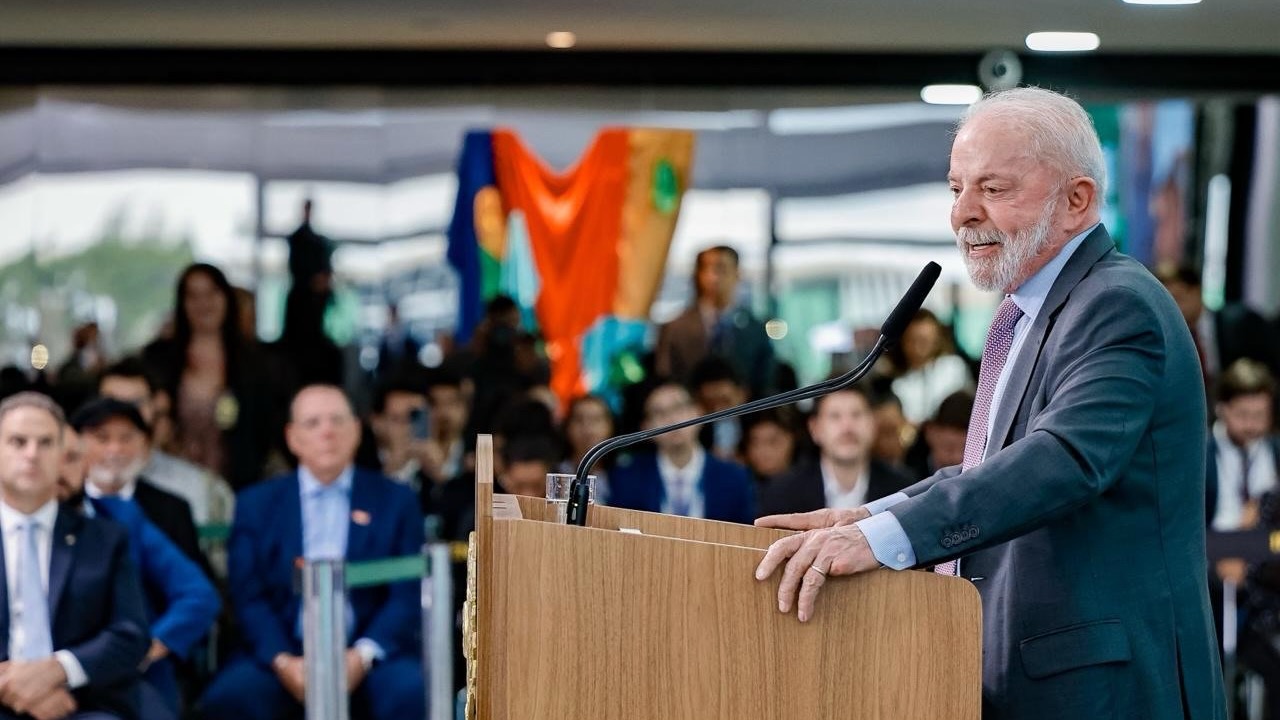
During his speech at the ceremony to hand over credentials to ambassadors at the Itamaraty Palace, Lula did not directly mention Venezuelan President Nicolás Maduro or US President Donald Trump, but said that maintaining peace in a region experiencing a period of instability is a priority for Brazil.
“In Latin America and the Caribbean, we are also experiencing a time of growing polarization and instability. Maintaining the region as a zone of peace is our priority. We are a continent free of weapons of mass destruction, without ethnic or religious conflicts. Foreign interventions can cause greater damage than intended,” the president stated.
Last Thursday, October 16, the president publicly defended the neighboring country. “Everyone says that we are going to turn Brazil into Venezuela, and Brazil will never be Venezuela, and Venezuela will never be Brazil, each one will be themselves. What we defend is that the Venezuelan people are the masters of their destiny, and it is not any president of another country who has to give advice on what Venezuela or Cuba will be like,” he said without naming Trump.
In response, Maduro, who considers the action a “threat” to pressure “regime change,” ordered military exercises along the borders. The head of state also announced the activation of three new Comprehensive Defense Operational Zones (ZODI) in the states of Nueva Esparta, Sucre, and Delta Amacuro.
“This is how we are concluding all the necessary preparations, reaching the ideal state for the comprehensive defense of the Homeland,” Maduro said on his Telegram channel.
Venezuelan deputy Raúl Campos, who was in Brazil last Friday, October 17, to discuss the current situation, said that the population is organizing to defeat the “imperialist maneuver”.
“In Venezuela, we are experiencing an unprecedented aggression from US imperialism, which is desperate. It is desperate because all attempts to defeat the Bolivarian government have failed. Right now, the people enjoy complete tranquility and peace. They are dedicated to studying, working, and preparing for the Christmas holidays, but we are also preparing to defend the territory,” Campos declared.
This article was first published by Brasil de Fato in Portuguese.
Donald Fuhrump says that Amerikkka doesn’t bother with crimes or charges anymore, not being 100% Amerikkkan and opposing his real estate intentions is enough.
This article by republished from peoples dispatch under a Creative Commons Attribution-ShareAlike 4.0 (CC BY-SA) license.
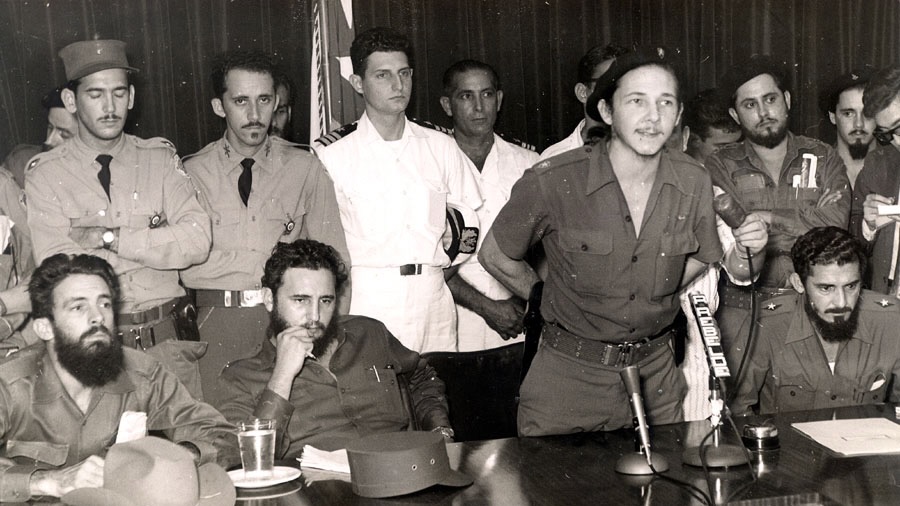
On February 16, 1959, Cuba established the Ministry of the Revolutionary Armed Forces, the executive body of their defense force, and its first Army General, Raúl Castro Ruz. Photo: Miguel Díaz-Canel/X
A recent webinar by Pan Africanism Today and the International Peoples’ Assembly looked at global struggles, from Africa to Latin America, showing how Cuba’s enduring resistance offers vital lessons in organization, unity, and internationalism for today’s movements fighting oppression and war.
The world is in an era marked by relentless wars and overlapping crises, from the devastating civil war in Sudan and violence in the Democratic Republic of Congo to the unfolding genocide in Palestine. The demand to end all wars has never carried greater urgency. And in the midst of all these visible battlegrounds persists a more enduring and insidious conflict; the hybrid war and economic blockade waged against the Cuban people and their revolution.
This was the central focus of a recent global webinar convened under the banner of Pan-African and internationalist solidarity, bringing together progressive voices to draw lessons from Cuba’s anti-imperialist struggle. The session, held on October 15, was facilitated by Mbali Gwenda from Pan Africanism Today, who situated the discussion within a broader historical and moral framework, invoking the revolutionary spirits of Thomas Sankara, martyred on the same date in 1987, and Assata Shakur who recently passed, and whose life consistently symbolized uncompromising resistance to oppression.
“We are dealing with the question of the hybrid war and blockade against the Cuban Revolution and her people,” Gwenda said. “A revolution that has been a source of inspiration for all oppressed peoples throughout the world till this day.”
The keynote address was delivered by Manolo De Los Santos, executive director of The People’s Forum and a researcher at the Tricontinental: Institute for Social Research, who framed Cuba’s defiance not as a miracle, but as the outcome of a centuries-long process of people’s struggle, organization, and consciousness.
The long arc of revolution
De Los Santos began by looking at Cuba’s revolution more than an event confined to the years 1953–1959, when Fidel Castro, Che Guevara, and others led the guerrilla war against the Batista dictatorship. Revolutions, he reminded the audience, are not events but processes, collective journeys of resistance that unfold across generations.
Cuba’s revolution, he argued, has roots reaching back to centuries of anti-colonial and anti-slavery resistance, when the island was still a colony of the Spanish Empire. Unlike many independence movements in Latin America, Cuban revolutionaries understood that genuine freedom required addressing three interlinked questions:
Could Cuba truly be independent if it remained a slaveholding society?
Could it be free if it continued under the exploitative system of capitalism?
Could it claim sovereignty while dominated by imperial powers, first Spain and later the United States?
These questions shaped the consciousness of generations of Cuban patriots, culminating in the 1959 triumph of the socialist revolution. But as he explained, the revolution’s endurance has rested on three essential pillars: organization, unity, and internationalism.
Organization: the bedrock of resistance
Organization, De Los Santos emphasized, has been the Cuban people’s greatest weapon against imperial aggression. From the early independence wars to the 26th of July Movement led by Fidel Castro, Cubans have understood that only a disciplined, organized people can confront an empire with infinite resources.
This organizational spirit persisted after 1959, with the creation of mass democratic structures that unite workers, women, peasants, students, and youth. The Federation of Cuban Women, for example, mobilizes millions in defense of gender equality and revolutionary ideals, while student and peasant organizations remain vital spaces for political education and collective problem-solving.
Even under today’s extreme shortages such as the lack of fuel to power garbage collection, Cuban communities respond not with despair but with collective initiative, a reflection of their revolutionary organization and social consciousness.
Unity, he continued, has been the second indispensable lesson from Cuba. Every time the people were divided, the empire gained the upper hand; every time they stood together, they won. This unity has transcended class, race, and regional divisions, dismantling the legacies of slavery and racism that imperialism imposed.
The Cuban Revolution’s unity was forged not just through ideology but through practice, through collective participation in building a new society. It remains, as Manolo put it, “the most important defense the Cuban people have.”
Internationalism is the soul of the revolution
If organization is the body and unity the shield, then internationalism is the soul of the Cuban Revolution.
Quoting Fidel Castro, the New York-based researcher reminded participants that “a people who are not willing to fight for the freedom of others will never be able to fully fight for their own freedom.”
This principle drove Cuba to send tens of thousands of its sons and daughters to fight alongside liberation movements in Angola, Namibia, and South Africa, contributing directly to the defeat of apartheid. As he noted, “Cuba doesn’t need gold or minerals from Africa, it knows that its freedom is tied to the freedom of the peoples of the African continent.”
Even today, with over 24,000 Cuban doctors working abroad, many across Africa, Cuba continues this legacy of solidarity. The US, in its campaign of distortion, now accuses Cuba of “human trafficking” for this very act of humanitarianism.
The United States’ war against Cuba has been fought through unconventional means. It is a hybrid war, a combination of economic blockade, financial strangulation, media disinformation, and covert sabotage.
For more than 65 years, the blockade has inflicted immense human and economic damage. In 2024 alone, it cost Cuba USD 7.5 billion, money that could have been used to buy food, medicine, or oil for its 11 million citizens.
The war is also fought in the terrain of ideas. US-funded media campaigns spread false narratives about repression and poverty in Cuba while erasing the country’s achievements in health, education, and solidarity.
Socialism and survival
When asked on how Cuba has managed to survive more than six decades of blockade, Manolo’s answer was clear: because Cuba made a socialist revolution.
Socialism, he said, allowed Cuba to create a system where the needs of the people come before profit. In capitalist societies, when crises hit, the rich survive and the poor starve. In Cuba, food, healthcare, and education are distributed equitably, even in times of scarcity. This social organization transforms a siege economy into a community of resilience.
This difference, he explained, is what makes Cuba unique among nations facing US aggression. It’s also what inspires global movements seeking alternatives to neoliberalism and imperial domination.
Cuba, Sankara, and the spirit of resistance
The session also honored Thomas Sankara linking a symbolic bridge between the African and Latin American revolutionary traditions. Both embodied a commitment to self-reliance, dignity, and international solidarity.
Sankara’s vision of a self-determined Africa resonated deeply with the Cuban experience. His assassination on October 15, 1987 marked a turning point in African politics, yet his ideas continue to inspire movements across the continent, just as Cuba continues to stand as living proof that another world is possible.
In closing, Manolo issued a clear call; the Cuban people will overcome the blockade, but they cannot and should not do it alone. Their survival depends on the solidarity of all who believe in justice, sovereignty, and equality.
Cuba’s endurance is not simply a Cuban story; it is a lesson for all peoples resisting imperial domination. As the world faces renewed militarization and economic warfare, the spirit of organization, unity, and internationalism must also be crucial as ever.
“When they stand with the Palestinians, when they stand with the Congolese, when they stand with the peoples of the African continent,” Manolo concluded, “they are breaking the blockade too.”
This article by republished from peoples dispatch under a Creative Commons Attribution-ShareAlike 4.0 (CC BY-SA) license.
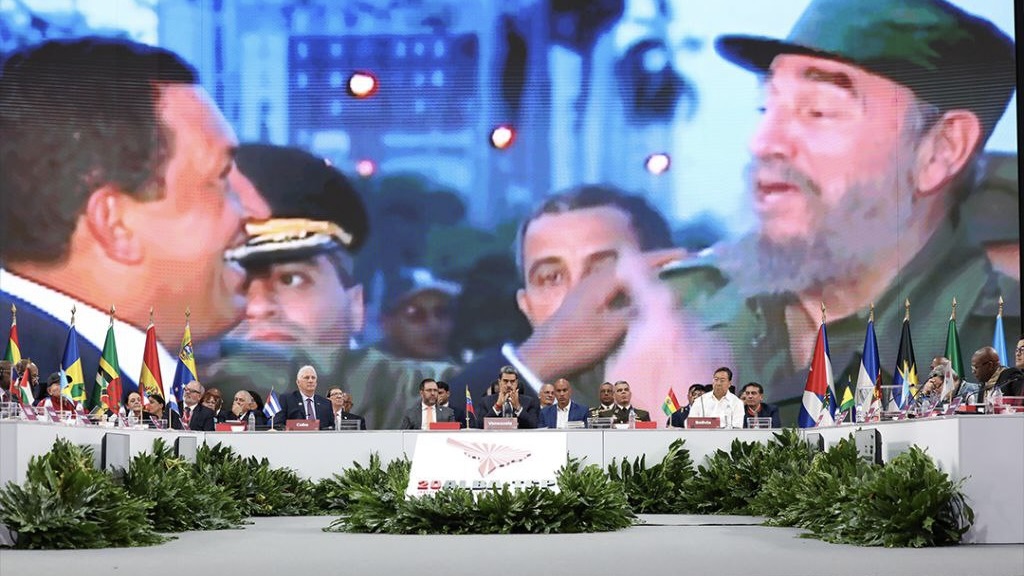
Heads of State Summit of ALBA-TCP in Caracas, Venezuela. Photo: ALBA-TCP
ALBA-TCP was founded in 2004 in an attempt to counter the US proposal of creating a “free trade zone of the Americas
December 14 marked the 20th anniversary of the creation of the Bolivarian Alliance for the Peoples of Our America-People’s-Trade Agreement (ALBA-TCP). ALBA-TCP was created in 2004 as a geopolitical alternative to the devastating advance of neoliberalism in the region.
The project was founded on December 14, 2004, in Havana by Cuban President Fidel Castro and Venezuelan President Hugo Chávez. Currently, the organization has 10 member countries and four countries considered “special guests.” In 2006, Bolivia signed its membership; in 2007, Nicaragua; in 2008, Dominica; in 2009, Antigua and Barbuda and St. Vincent and the Grenadines; in 2014, St. Kitts and Nevis and Grenada; and in 2021, St. Lucia. The special invited countries are Syria, Haiti, Suriname, and now Palestine.
To commemorate the 20 years, social movements, political parties, and heads of state gathered in Caracas, Venezuela for the 24th Heads of State Summit as well as parallel meetings. The event was attended by the host, Venezuelan President Nicolás Maduro; Bolivian President Luis Arce; Cuban President Miguel Díaz-Canel; Nicaraguan President Daniel Ortega; Prime Minister of St. Vincent and the Grenadines, Ralph Gonsalves; Prime Minister of Dominica, Roosevelt Skerrit; and the Prime Minister of Antigua and Barbuda, Gaston Browne.
Independence and solidarity among countries
In their addresses during the Summit on December 14, the heads of state and invited countries stressed the importance of solidarity among countries seeking alternative ways of development and the need for unrestricted solidarity among people struggling against imperialist attacks. They also demonstrated their support for Nicolás Maduro and his victory in the last presidential elections.
Miguel Díaz-Canel said “We reiterate the strongest support for the Bolivarian revolution, led by President Nicolás Maduro…We also call for the elimination of the blockade against Cuba …We cry out for a free Puerto Rico and declare our solidarity with Haiti, our Cuban doctors are there…We reiterate our demand for a ceasefire in Gaza and condemn the attacks perpetrated by Israel against Lebanon, Syria, and Iran.”
The Bolivian President, Luis Arce, highlighted the historical importance of ALBA in its fight against economic projects promoted by the United States such as the FTAA (Free Trade Area of the Americas): “The embrace of Hugo Chávez and Fidel Castro not only marked history but also manifested the defeat of the hegemonic project of the FTAA. ALBA was born, ALBA placed the human being at the center, promoting that a better world is possible. Bolivia reaffirms, once again, its commitment to ALBA-TCP, because it is a resistance that raises its voice against the unjust and criminal blockade against Cuba…ALBA is also a firm voice against the arbitrary and unilateral measures imposed against Venezuela and Nicaragua, which affect the welfare of our peoples.”
Nicolás Maduro said, “We must win the battle of life and truth in the streets, networks, media, and walls, as well as in the conscience and spirituality of the people.” He also added the importance of the struggle of the people to be masters of their destiny without imperial impositions or impositions of any kind. In the same line of discourse, Nicaraguan President Daniel Ortega said “From Nicaragua we reaffirm our commitment to ALBA. We will continue to fight the battle.”
The Prime Minister of Dominica, Roosevelt Skerrit stated “We congratulate the electoral triumph of President Nicolas Maduro on July 28. We wish him all the best…We also want to reaffirm our solidarity with the people of Cuba, a brave people for whom we have our greatest respect and love; we will never cease to lend our voice against the United States to eliminate the blockade against Cuba.”
Ralph Gonsalves, Prime Minister of St. Vincent and the Grenadines, harshly criticized US interference in the development of the past Venezuelan elections “Perhaps [the US government] thinks it is superior,” he said in this regard. He also stressed that the creation of ALBA-TCP was a fundamental invention for the emancipation of the American people, “ALBA is the product of the geniuses of our peoples.”
Inclusion of Palestine to ALBA-TCP
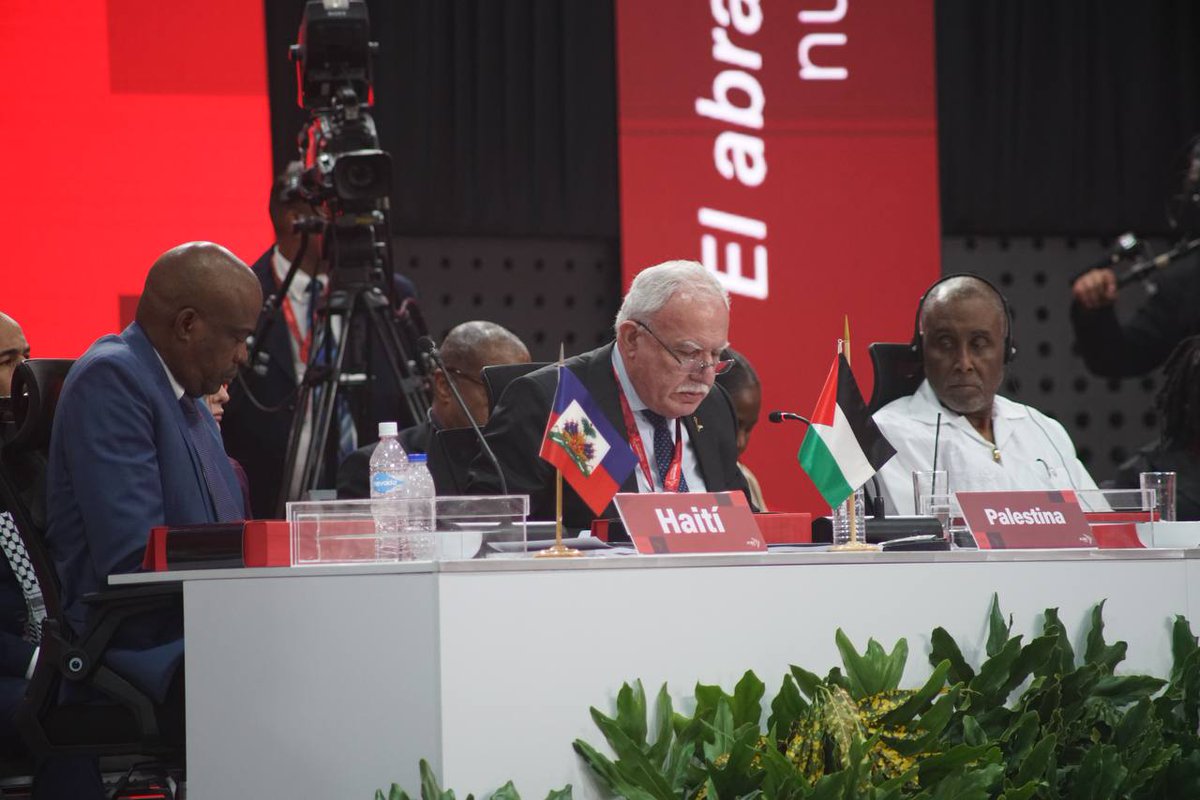
At the current summit, it was announced that Palestine had been included as a “brotherly country” and was included as a “permanent guest”. According to the resolution of the Heads of State, ALBA-TCP condemns the attacks against the Palestinian population and the “illegally occupied territories” and rejects “the merciless and inhuman genocide committed by the State of Israel, the occupying power, as well as its plan of spoliation, invasion, and domination.” Likewise, they denounced the support of several governments currently collaborating with the actions of the Israeli army and called for an “immediate ceasefire…From the heart of the peoples and governments of this alliance, we declare Palestine a brother country of the ALBA-TCP, and reaffirm our commitment to the defense of the Palestinian cause, which is the defense of humanity,” reads the resolution.
In this regard, Riyad al-Malki, advisor to the President of State for International Affairs of Palestine said “History will remember those who stood on the side of justice, ALBA’s lasting solidarity with Palestine is a testimony of freedom and collective resistance.” Furthermore, Malki added “This Alliance is a living testimony of collective integration to challenge imperialism and ensure a just world. These values resonate with the Palestinian struggle, an end to the illegal occupation.”
A call for counter-hegemonic struggle
The joint document signed by all the countries highlights the historical importance of ALBA-TCP in the struggle for a more equitable world: “Twenty years after this giant step, we pay homage to the founding leaders, Hugo Chávez Frías and Fidel Castro Ruz, who adopted that December 14, 2004, in Havana, Cuba, the vision of the future embodied in the founding documents of ALBA, which have allowed us to walk united until the present, animated by the ancestral force that led our peoples to be free and that encourages us to continue integrated in this Alliance for Life.”
Similarly, it was stressed that the existence of this multilateral organization operates as a possibility to create a region that resists the impositions of the most developed countries: “Today, we want to ratify before our peoples, the counter-hegemonic, democratic, anti-imperialist and anti-fascist nature of our Alliance and renew our commitment to help and protect each other, to continue building together a future of shared goals under the founding principles of complementarity, cooperation, social justice, defense of our sovereignty and solidarity.”
In this sense, Luis Arce stressed that “In the face of the challenges of a world threatened by fascism and neo-fascism, ALBA is not an option, ALBA is a necessity that must continue with firm steps, reaffirming the founding principles of solidarity, justice, and cooperation…ALBA is not only an alliance, it is a promise for the future, a living resistance, an instrument for the most dispossessed, and a reminder that together, as peoples, we are invincible.”
Objectives and principles of ALBA-TCP
According to ALBA’s official website, the fundamental objective of the project is “to achieve integral development, ensure social equality and contribute to guaranteeing the quality of life, good living, independence, self-determination and identity of the peoples.” For this very reason, the principles of ALBA-TCP propose that political decisions be made horizontally and take into account the economic differences of its members without meaning that the importance of each of the members is underestimated.
The principles shared by the countries are “trade and investment should not be ends in themselves, but instruments to achieve sustainable development; special and differentiated treatment, according to the level of development of the various countries; economic complementarity and cooperation; cooperation and solidarity; the creation of the Social Emergency Fund; the integrative development of communications and transportation; the sustainability of development; energy integration; the promotion of investments of Latin American capital in the region; the defense of Latin American and Caribbean identity and culture; respect for intellectual property; and the agreement of multilateral positions and in negotiations with countries and blocs in other regions.”
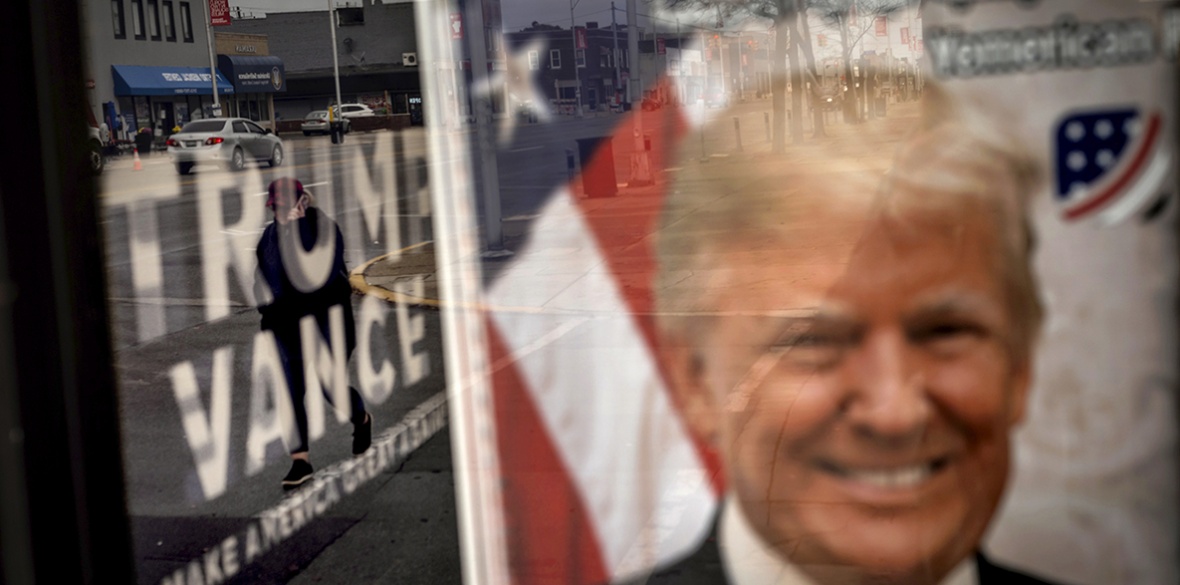
An image of Republican presidential nominee former President Donald Trump hangs in the window of a campaign office in Hamtramck, Michigan, November 4, 2024
TIM YOUNG warns that the president-elect’s record of economic and political interference from his last stint in the White House show dangerous potential for escalated aggression against the Bolivarian government from 2025
THE US election result raises the spectre of Trump renewing the assault on Venezuela that his loss to Biden interrupted in 2020.
In office between 2016 and 2020, Trump’s approach to Latin America showed an implacable hostility towards Venezuela, as well as other governments in the region determined to advance their population’s interests, not those of the US.
Venezuela has been subjected to US extraterritorial intervention and interference for over two decades. From the early days of Hugo Chavez’s election as president in 1998, the US has sought, in conjunction with Venezuela’s economic and political elites, to topple the Venezuelan government and re-establish its control and influence over the country and its oil wealth.
…
While the global situation has changed since 2020, with wars in Ukraine and the Middle East and the US’s developing aggressive strategy towards Russia and China, there is no reason to believe the US’s long-standing desire to destabilise the Venezuelan government and achieve “regime change” is off the table.
For his part, Trump made it plain when campaigning this year in North Carolina what motivated his drive to unseat Maduro: “When I left, Venezuela was ready to collapse. We would have taken it over; we would have gotten all that oil.”
The solidarity movement in Britain must be prepared to defend Venezuela’s sovereignty against any renewed offensive by Trump when he assumes the presidency in 2025 — as well as continuing to campaign for Britain to give Venezuela back its gold.
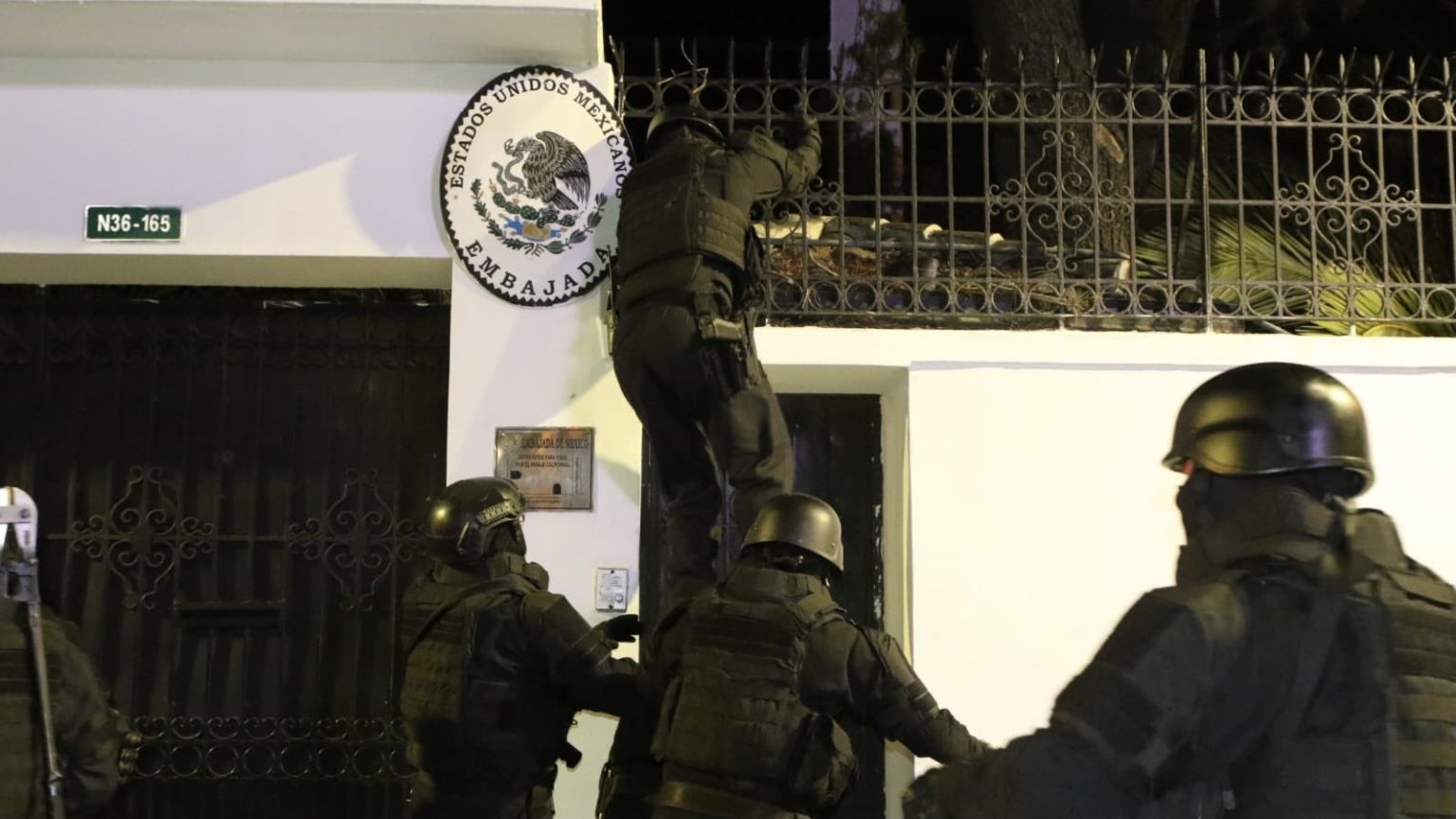
Late on Friday April 5, dozens of Ecuadorian police officers forcibly entered the Mexican Embassy in Quito and detained former Ecuadorian vice president Jorge Glas. Glas had been conceded political asylum by Mexico earlier that day after having applied in December 2023 amid intensified political persecution against him.
The move has been widely condemned by nearly the entire political spectrum in Mexico as a grave violation of Mexican sovereignty and has also been widely condemned by progressives in Ecuador.
Following the incident, Mexican President Andrés Manuel López Obrador and Foreign Minister Alicia Bárcena announced that Mexico was suspending diplomatic relations with the country.
Roberto Canseco, the head of Foreign Ministry and Political Affairs at the Mexican Embassy in Quito who was present when the incursion took place, spoke to the press shortly after the incident. “They threw me to the floor. I tried to physically stop them from entering but like criminals they raided the Mexican Embassy in Ecuador. This is not possible, this cannot be, it is insane,” Canseco told reporters incredulously.
The diplomat told reporters that there had been no prior warning to the police raid, but that it clearly happened because Glas is being persecuted. He also expressed concern over the whereabouts and wellbeing of the former VP.
He added, “Risking my life, I defended the honor and sovereignty of my country.”
The unprecedented incident took place amid rising tensions between the two countries. Jorge Glas had been seeking refuge at the Mexican embassy since December 18, 2023 and residing at the embassy as a “guest” after Ecuadorian authorities began to intensify pressure on Glas and summon him for investigations. This past week, the government of Daniel Noboa announced that it declared the Mexican Ambassador Raquel Serur Smeke a “persona non-grata” allegedly in response to comments made by President López Obrador in his morning press conference which insinuated that Noboa had benefited from the assassination of presidential candidate Fernando Villavicencio. However, many analysts have pointed to Glas’ presence in the embassy as the key factor behind Quito’s attacks on Mexico, and the events of April 5 seem to have confirmed this theory.
Jorge Glas: Victim of lawfare in Ecuador
Glas spent five years in prison, after being convicted of criminal conspiracy in the Odebrecht case, as part of the vicious lawfare campaign against members of Rafael Correa’s administration. Glas was later convicted in April 2020, along with Correa, in the “Bribes Case”, which alleged that they and 18 other government officials accepted bribes from private companies in exchange for public contracts. As prosecutors were unable to find evidence that the two received bribes, Glas and Correa were accused of “psychic influence” on their subordinates who allegedly carried out these deals and sentenced to several years in prison. Correa was also banned from participating in politics for 25 years.
Throughout the intense lawfare campaign against him and others, Glas has maintained that he is innocent and that both the charges and the harsh sentencing of him constitutes political persecution.
During the Correa presidency, Glas was one of the key leaders in the “Citizen’s Revolution” political project, which sought to make important social and economic reforms to better conditions for the majority. During this period, the Correa administration launched a Constituent Assembly to rewrite Ecuador’s constitution to guarantee essential rights for all, among other measures to promote national culture, Indigenous rights; it promoted Latin American regional integration over ties with the US and kicked out the US military base; and maintained anti-neoliberal economic policies, favoring social investment over cuts to public spending and social programs.
This project was brought to a halt in 2017 when Lenín Moreno was elected president and made a volte-face in Ecuador’s policies across the board, taking out a massive loan from the IMF, exiting regional integration spaces and attacking the country’s regional allies and economic partners like Venezuela, and imposing harsh austerity measures and brutally repressing protests against the measures. Under Moreno, the Attorney General also began its targeted attacks on leaders and officials of the Citizen’s Revolution.
Glas was eventually released on November 28, 2022 and granted “provisional freedom” as he had fulfilled over 40% of his prison sentence. However, in December 2023, days after he arrived at the Mexican embassy and weeks after Daniel Noboa took office as president, a judge revoked Glas’ provisional freedom and called for his arrest and imprisonment. Fearing for his life, Glas remained at the embassy and applied for political asylum, which was granted April 5, 2024.
The left in Ecuador responds
Progressive groups in Ecuador immediately expressed outrage at the actions of Noboa’s government and the National Police and issued sharp condemnations.
The Confederation of Indigenous Nationalities (CONAIE) wrote in a statement on X, “The violation of the Mexican embassy in Ecuador is an extremely serious fascist act that threatens diplomatic relations and international law…It is worrying to observe how the authoritarian and fascist government of Ecuador uses force to secure its political trophies. This flagrant violation not only affects bilateral relations between Mexico and Ecuador, but also sends a dangerous message to the international community.”
Pabel Muñoz, the mayor of Quito and a member of the Citizen’s Revolution Movement party, stated, “Unacceptable, a global embarrassment. What just happened in the Mexican Embassy in Quito creates a complex situation for Ecuador before the international system and law. Is there any doubt that Jorge Glas is the victim of terrible persecution? The more concerning part is that he had already been granted political asylum.”
Correa also issued a short statement repudiating the attack on Mexico and the arrest of Glas, “What the government of Noboa has done is unprecedented in Latin American history. Not even in the worst dictatorships was the embassy of a country violated. We do not live under rule of law, it is a state of barbarie, with a guy who improvises [Noboa] that confuses the Homeland with one of his banana farms. We hold Daniel Noboa responsible for the safety and physical and psychological integrity of former Vice President Jorge Glas. To Mexico, its people and its Government, our apologies and eternal admiration.”
Mexico unites in defense of its sovereignty
People across Mexico have expressed outrage in response to the brazen violation of the country’s sovereignty and of international law. In the statement announcing the suspension of diplomatic relations, President López Obrador said it was “an authoritarian act” and a “flagrant violation of international law and Mexican sovereignty”.
Foreign Minister Alicia Bárcena said in an interview with TeleSur that in addition to suspending diplomatic ties, Mexico would take Ecuador to the International Court of Justice and all multilateral bodies over its unprecedented actions.
Presidential candidate for MORENA, Dr. Claudia Sheinbaum called the incident “an attack on diplomacy and international law that is inadmissible”.
Mexico’s Senate also released a statement “energetically condemning” the Ecuadorian government’s actions and demanding “respect to our sovereignty and to the integrity of our Embassy and diplomatic personnel.” They called on the Ecuadorian government to reconsider its actions and resume the diplomatic path to resolve issues.
Both traditional right-wing parties PRI and PAN issued condemnations of the police invasion, while their joint candidate in the upcoming elections released a lukewarm statement saying that diplomatic missions cannot be violated.