This work by Middle East Monitor is licensed under a Creative Commons Attribution-NonCommercial-ShareAlike 4.0 International License.
US President Donald Trump (R) meets with the Israeli Prime Minister Benjamin Netanyahu (L) at the White House on February 11, in Washington DC, United States. [Avi Ohayon – GPO – Anadolu Agency]
Israel has told the US administration that its current policy of restraint in Lebanon is undermining its deterrent capability and serving Hezbollah’s interests.
Channel 12 reported that Israeli Prime Minister Benjamin Netanyahu discussed the issue with US President Donald Trump in a phone call. It said Netanyahu warned that relying only on reactive responses, without taking the initiative, gives Hezbollah an opportunity to recover and strengthen its ideological position, while exposing Israeli forces on the ground to growing risks.
According to the Israeli position, the continued use of limited operations is gradually eroding deterrence and negatively affecting the security of residents in the north, as well as the army’s operational readiness.
In this context, Netanyahu has asked Trump to urgently limit the duration of the diplomatic track with the Lebanese government to no more than mid-May, meaning around two to three weeks.
This comes after Trump rejected an Iranian proposal that included a ceasefire and the opening of the Strait of Hormuz before discussions on the nuclear file.
Tel Aviv believes that continued Hezbollah attacks on northern forces and communities are undermining the chances of any successful negotiations. It is calling on Washington to set a clear timeframe, and if talks fail within that period, to allow it to “return to the original plan”, a reference to wider military escalation, according to Channel 12.
Israel views US restrictions as limiting its freedom of military action and giving Hezbollah space to reorganise. With no clear timeline for how long this policy will continue, the decision is largely linked to Washington’s desire to maintain a broader negotiating track with Iran, placing Tel Aviv in a complex position between US strategic calculations and its own immediate security needs.
Climate science denier Donald Trump confirms that he knows nothing about democracy and that more liquid gold is being secured according to his policy of global privateering.Orcas discuss Genocide-supporting and complicit Zionists. Donald Trump, Keith Starmer, David Lammy, Rachel Reeves, Angela Rayner and Wes Streeting are acknowledged as evil genocide-complicit and supporting cnuts.
This work by Middle East Monitor is licensed under a Creative Commons Attribution-NonCommercial-ShareAlike 4.0 International License.
Lebanese survivor Ali Hijazi of an Israeli airstrike that targeted six adjacent buildings just three minutes before the ceasefire took effect speaks in Tyre, Lebanon on April 20, 2026. [Muhammed Emin Canik – Anadolu Agency]
Tehran has set out its demands within the framework of ongoing negotiations with the United States.
Al Mayadeen reported that “Iran has presented mediators with a three-phase negotiation framework, with talks set to resume if the United States agrees to it.”
The first phase focuses on ending the war and securing guarantees that it will not resume against Iran or Lebanon. Tehran will not discuss any additional issues at this stage.
The channel added that “If an agreement is reached, negotiations would move to a second phase addressing the management of the Strait of Hormuz, including coordination with Oman to establish a new legal framework.”
It further noted that “A third phase would then tackle the nuclear issue, which Iran insists will only be discussed after agreements are secured in the first two stages.”
Climate science denier Donald Trump confirms that he knows nothing about democracy and that more liquid gold is being secured according to his policy of global privateering.Donald Trump sings and dances, says that it’s fun to kill everyone …
This work by Middle East Monitor is licensed under a Creative Commons Attribution-NonCommercial-ShareAlike 4.0 International License.
A view of the destruction after an Israeli airstrike that targeted six adjacent buildings just three minutes before the ceasefire took effect speaks in Tyre, Lebanon on April 20, 2026. [Muhammed Emin Canik – Anadolu Agency]
Lebanon said Saturday that five people were killed and six others wounded over the past 24 hours, raising the death toll from Israeli attacks to 2,496 killed and 7,725 injured since March 2, Anadolu reports.
The figures were published in a report by the Lebanese Cabinet’s Disaster Risk Management Unit, as reported by the National News Agency (NAA).
The update comes as Israel continues to violate a temporary ceasefire in Lebanon that began on April 17.
The previous official toll stood at 2,491 killed and 7,719 injured, in addition to more than 1 million displaced, before the updated figures were released.
The unit did not provide further details on how the figures were calculated.
According to field sources and local media, authorities continue to recover bodies of victims killed before the ceasefire took effect, while the rise in injuries is attributed to data updates and newly reported cases from recent days.
On April 17, US President Donald Trump announced a 10-day ceasefire in Lebanon between Israel and Lebanon, later extending it on Thursday by an additional three weeks.
Since March 2, Israel has continued to violate the fragile ceasefire, resulting in casualties and widespread destruction, while Hezbollah has responded by targeting Israeli military positions in southern Lebanon and Israeli communities.
This work by Middle East Monitor is licensed under a Creative Commons Attribution-NonCommercial-ShareAlike 4.0 International License.
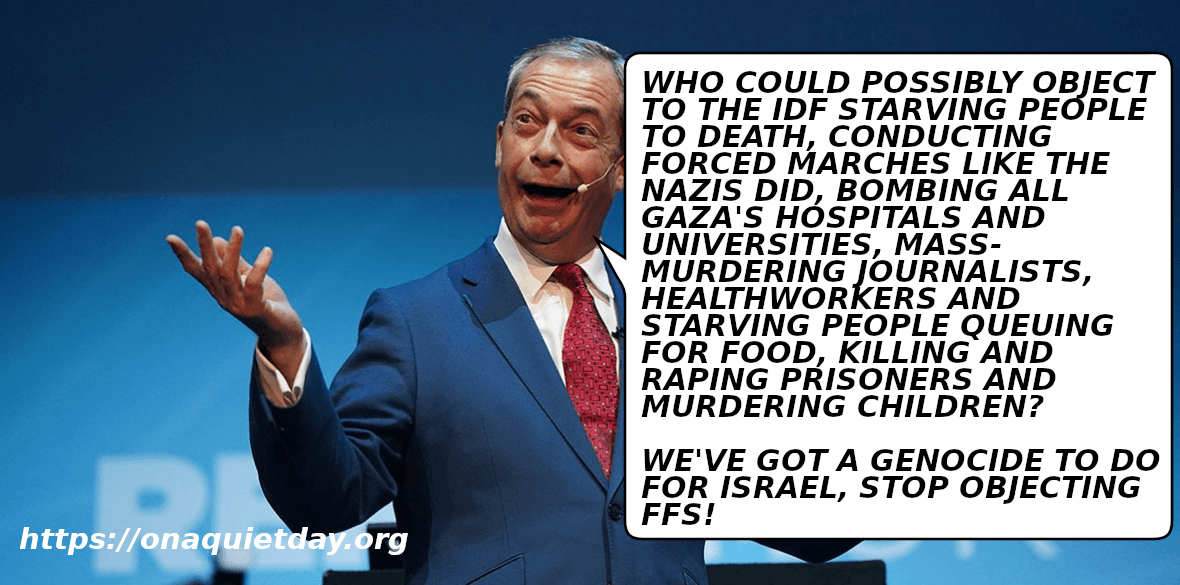
Nigel Farage objects to criticism of the IDF. He asks how could anyone object to them starving people to death, forced marches like the Nazis did, bombing Gaza’s hospitals and universities, mass-murdering journalists, healthworkers and starving people queuing for food, killing and raping prisoners and murdering children. He calls for people to stop obstructing his genocide for Israel.Keir Starmer explains that UK is actively supporting Israel’s genocidal expansion and repeats his previous quotation that he supports Zionism “without qualification”. Keir Starmer said “I said it loud and clear – and meant it – that I support Zionism without qualification.” here: https://www.jewishnews.co.uk/keir-starmer-interview-i-will-work-to-eradicate-antisemitism-from-day-one/
This work by Middle East Monitor is licensed under a Creative Commons Attribution-NonCommercial-ShareAlike 4.0 International License.
The flowers on the chair, where Halil’s photo, press vest, and helmet were placed, is seen during funeral ceremony for journalist Emel Halil, who was killed in an Israeli military strike targeting the village of Tayri, in Nabatieh, Lebanon on April 23, 2026. [Elif Öztürk – Anadolu Agency]
The UK and Finland on Saturday condemned attacks on journalists and media workers in Lebanon, calling for urgent measures to ensure their safety, Anadolu reports.
In a statement, the two countries, acting as co-chairs of the Media Freedom Coalition, said journalists play a vital role in exposing the realities of war and must be protected.
“Journalists and media workers play an essential role in putting the spotlight on the devastating reality of war. Attacks on journalists in Lebanon, including journalist Amal Khalil killed in an Israeli strike on 22 April, are unacceptable,” they said.
“As co-chairs of the Media Freedom Coalition, the UK and Finland strongly condemn all violence directed against journalists and media workers,” the statement added.
They urged all parties, including Israeli authorities, to ensure that media workers in Lebanon can operate freely and safely.
“We call on the Israeli authorities and all other parties to make every effort to ensure that media workers in Lebanon can conduct their work freely and safely,” they said.
This came as the Lebanese Press Syndicate Editors reported that at least 27 journalists and media workers have been killed in Israeli attacks in Lebanon since March 2, with many others wounded.
The syndicate said journalist Amal Khalil was killed in an Israeli strike on Wednesday in the southern town of Tayri, while her colleague Zeinab Faraj was wounded. It added that Khalil had previously received death threats from the Israeli army.
“With her killing, the number of journalists and media workers killed has risen to 27, in addition to a large number of injured,” the syndicate said. It condemned what it described as Israel’s deliberate targeting of journalists and called on international and Arab press organizations to support Lebanese media workers.
According to Lebanon’s state news agency, Israeli forces prevented rescue teams from reaching the wounded journalists during the attack and targeted roads linking Tayri and nearby areas to block emergency access.
This work by Middle East Monitor is licensed under a Creative Commons Attribution-NonCommercial-ShareAlike 4.0 International License.
Nigel Farage objects to criticism of the IDF. He asks how could anyone object to them starving people to death, forced marches like the Nazis did, bombing Gaza’s hospitals and universities, mass-murdering journalists, healthworkers and starving people queuing for food, killing and raping prisoners and murdering children. He calls for people to stop obstructing his genocide for Israel.Keir Starmer explains that UK is actively supporting Israel’s genocidal expansion and repeats his previous quotation that he supports Zionism “without qualification”. Keir Starmer said “I said it loud and clear – and meant it – that I support Zionism without qualification.” here: https://www.jewishnews.co.uk/keir-starmer-interview-i-will-work-to-eradicate-antisemitism-from-day-one/
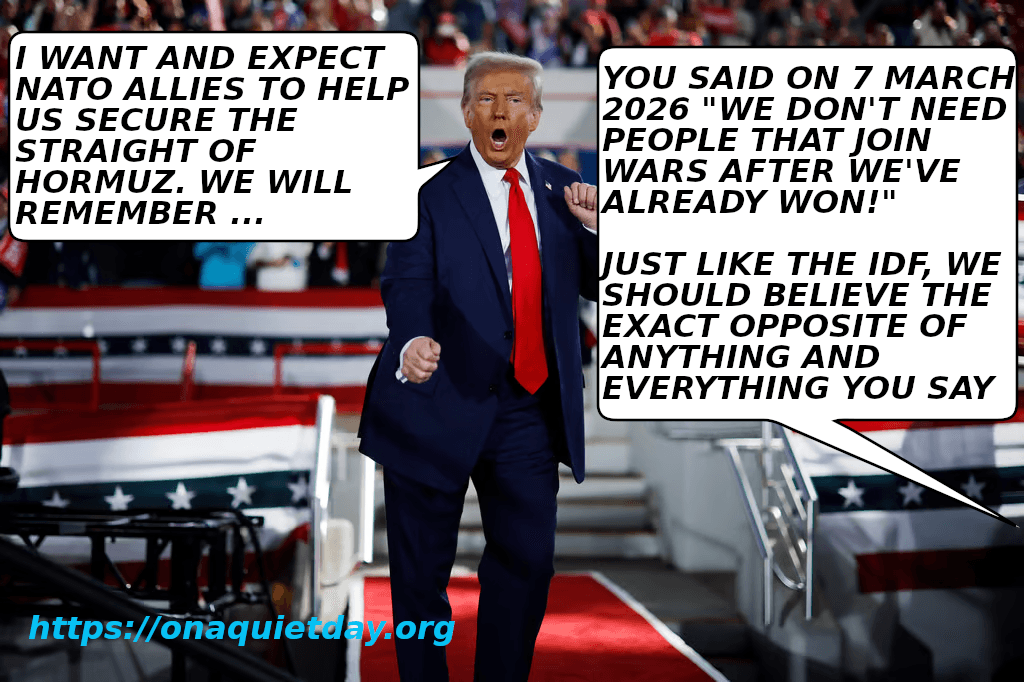
Donald Trump calls for help from NATO allies in securing the Strait of Hormuz despite saying on 7 March 2026 that they don’t need people to join wars after they’ve already won. He’s challenged with the claim that he lies as much as the IDF.
This work by Middle East Monitor is licensed under a Creative Commons Attribution-NonCommercial-ShareAlike 4.0 International License.
People attend funeral ceremony for journalist Amal Khalil, who was killed in an Israeli military strike targeting the village of Tayri, in Nabatieh, Lebanon on April 23, 2026. [Elif Öztürk – Anadolu Agency]
There is a particular cruelty in silencing those whose sole weapon is a camera, a notebook, or a voice. The killing of Lebanese journalist Amal Khalil in southern Lebanon is not an isolated tragedy; it is part of a pattern that is becoming impossible to ignore, and even harder to explain away. In a war already saturated with grief, the deliberate or reckless targeting of journalists signals something deeper than battlefield error. It suggests an erosion of the very rules that once attempted to civilise conflict.
On 22nd April 2026, during what was meant to be a brief, US-mediated ceasefire, Israeli strikes hit a civilian vehicle near al-Tayri. When Khalil and her colleague Zeinab Faraj moved to report on the aftermath, a second strike hit the building where they had taken shelter. Rescue teams attempting to reach them were themselves targeted, delaying aid for hours. By the time access was finally granted, Khalil was dead beneath the rubble.
She became the fourth Lebanese journalist killed in just weeks. The sequence—strike, response, second strike—has been described by observers as a ‘double tap’, a tactic that raises serious legal and moral questions.
The outrage from Lebanese officials was immediate and justified. The language used—“flagrant violation”, “brazen crime”—was not diplomatic excess; it reflected a growing consensus among legal experts and press-freedom organisations that such incidents may constitute grave breaches of international humanitarian law.
Journalists are civilians. That principle is not ambiguous. The Geneva Conventions and the Rome Statute are explicit: targeting civilians, including media workers, is a war crime.
Yet the facts on the ground continue to collide with official denials. Israel maintains that it does not target journalists and often asserts that strikes are aimed at militants. In some cases, it has posthumously alleged links between slain reporters and armed groups. These claims, frequently unsubstantiated, have been repeatedly challenged by organisations such as Human Rights Watch and the Committee to Protect Journalists, which point to video evidence and patterns of strikes on clearly marked media personnel. The dissonance between assertion and evidence is widening, and with it, the credibility gap.
The scale of the violence underscores the urgency. As of March 2026, more than 2,400 people have reportedly been killed in Lebanon, with over a million displaced. Across the broader conflict landscape, including Gaza and the West Bank, dozens of journalists have lost their lives since late 2023. One investigation counted at least 61 journalists killed in that period alone, making it one of the deadliest eras for the profession in modern history. These are not incidental losses; they represent a systemic threat to the flow of information itself.
What is unfolding in Lebanon cannot be disentangled from a far larger and more troubling pattern that has already taken shape in Gaza, where the scale of journalist killings has reached historic proportions.
By late 2025, nearly 250 journalists had been killed since October 2023—more than in Vietnam, Iraq, Syria and Ukraine combined, according to the Committee to Protect Journalists and United Nations assessments.
Gaza has, in effect, become the deadliest environment for media workers ever recorded, a distinction that should unsettle any government that claims allegiance to international humanitarian law. The killing of figures such as Abed Shaat, a clearly identified cameraman struck while documenting an aid convoy, underscores how ambiguity has replaced accountability, and how denial has become routine rather than exceptional. experts warn that this erosion is not contained; it is setting precedent, normalising impunity, and accelerating a global decline in journalist safety, with UNESCO reporting a 67 per cent increase in deaths in conflict zones in recent years.
In this light, the strike that killed Amal Khalil does not stand alone as an aberration—it sits within an emerging doctrine of war in which the elimination of witnesses risks becoming tacitly permissible. For policymakers, the implication is stark: when the systematic silencing of journalists is absorbed into the background of conflict, the collapse is not only operational but normative, corroding the credibility of the very international order that depends on the visibility of truth.
What is at stake extends beyond individual lives. When journalists are killed, the immediate effect is silence. Stories go untold, evidence goes unrecorded, and accountability becomes more elusive. In conflicts where narratives are fiercely contested, controlling information can be as strategically valuable as controlling territory. Analysts have noted that targeting journalists reflects a shift towards ‘information warfare’, where the aim is not only to defeat an opponent but to shape the story that reaches the outside world.
This dynamic is not unique to Lebanon, but the current context is particularly stark. The perception—widely held in Beirut and increasingly echoed in international circles—is that impunity persists. Despite repeated condemnations from the United Nations, UNESCO, and global NGOs, meaningful accountability remains elusive. The continued military support provided to Israel by key allies, including the United States and several European nations, complicates efforts to enforce compliance with international norms.
It raises uncomfortable questions about whether the so-called rules-based order applies equally to all, or only to those without powerful backers.
For policymakers everywhere, this is no longer a distant or containable crisis but a direct test of the integrity of the international system itself. States that claim fidelity to international law, press freedom and a rules-based order cannot afford the luxury of selective consistency without paying a strategic price.
When the killing of journalists provokes outrage in one theatre yet equivocation in another, the signal sent is not nuance but hierarchy—of whose lives, whose truths, and whose laws matter.
That inconsistency does more than weaken moral authority; it actively erodes deterrence, inviting repetition by those who see that consequences are negotiable. In such an environment, silence is not restraint but complicity, and credibility—once fractured—rarely returns intact.
There is also a strategic dimension. Erosion of international norms does not occur in isolation; it invites replication. If one state can target journalists without consequence, others may follow. The result is a more dangerous world for reporters, and by extension, for anyone who relies on accurate information to make decisions—governments included. Intelligence, diplomacy, and humanitarian response all depend on credible reporting from conflict zones.
The human dimension, however, remains central. Amal Khalil was not a statistic. She was a witness, a storyteller, and a participant in the essential democratic function of informing the public. Her death resonates not only in Lebanon but across a global community of journalists who increasingly find themselves on the front lines. The message her killing sends—to hesitate, to withdraw, to remain silent—is precisely the message that must be resisted.
There are practical steps that can and should be taken. Ceasefire agreements must include explicit protections for journalists and humanitarian workers, with mechanisms for real-time coordination and verification. Independent investigations into alleged violations must be supported, not obstructed. Military aid and cooperation should be conditioned on adherence to international humanitarian law, with clear consequences for breaches. These measures are not radical; they are the minimum required to preserve a semblance of order in war.
Ultimately, the question is not only about legality but about values. The protection of journalists is a proxy for the protection of truth itself. When that protection erodes, so too does the capacity of the international community to respond effectively to crises. Decisions become less informed, debates more polarised, and solutions more elusive.
The killing of Amal Khalil is a warning. It signals that the boundaries of acceptable conduct in war are being tested, and perhaps redrawn. Whether those boundaries hold will depend on the willingness of states—large and small—to insist that they matter. Silence, in this context, is not neutrality. It is acquiescence.
In the end, wars are remembered not only for their outcomes but for the principles they uphold or abandon. The fate of journalists in Lebanon will be one measure of that legacy.
The views expressed in this article belong to the author and do not necessarily reflect the editorial policy of Middle East Monitor.
This work by Middle East Monitor is licensed under a Creative Commons Attribution-NonCommercial-ShareAlike 4.0 International License.
Keir Starmer explains that UK is actively supporting Israel’s genocidal expansion and repeats his previous quotation that he supports Zionism “without qualification”. Keir Starmer said “I said it loud and clear – and meant it – that I support Zionism without qualification.” here: https://www.jewishnews.co.uk/keir-starmer-interview-i-will-work-to-eradicate-antisemitism-from-day-one/Donald Trump calls for help from NATO allies in securing the Straight of Hormuz despite saying on 7 March 2026 that they don’t need people to join wars after they’ve already won. He’s challenged with the claim that he lies as much as the IDF.