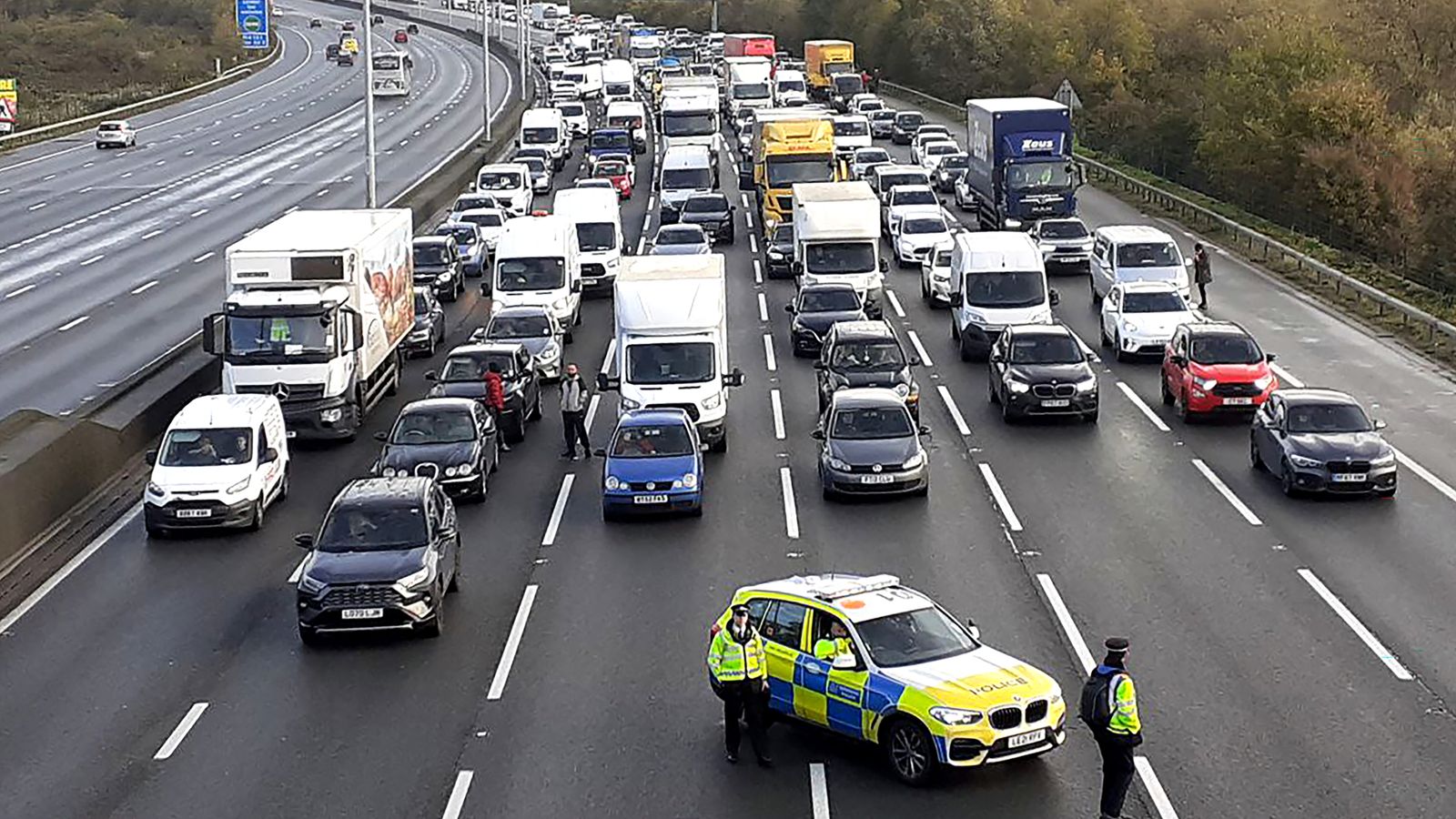
Delays on the M25 from a Just Stop Oil protest. Pic: Just Stop Oil/PA
Protesters now face up to two years in prison, but there has been international condemnation of the increasing severity of sentences for non-violent protest.
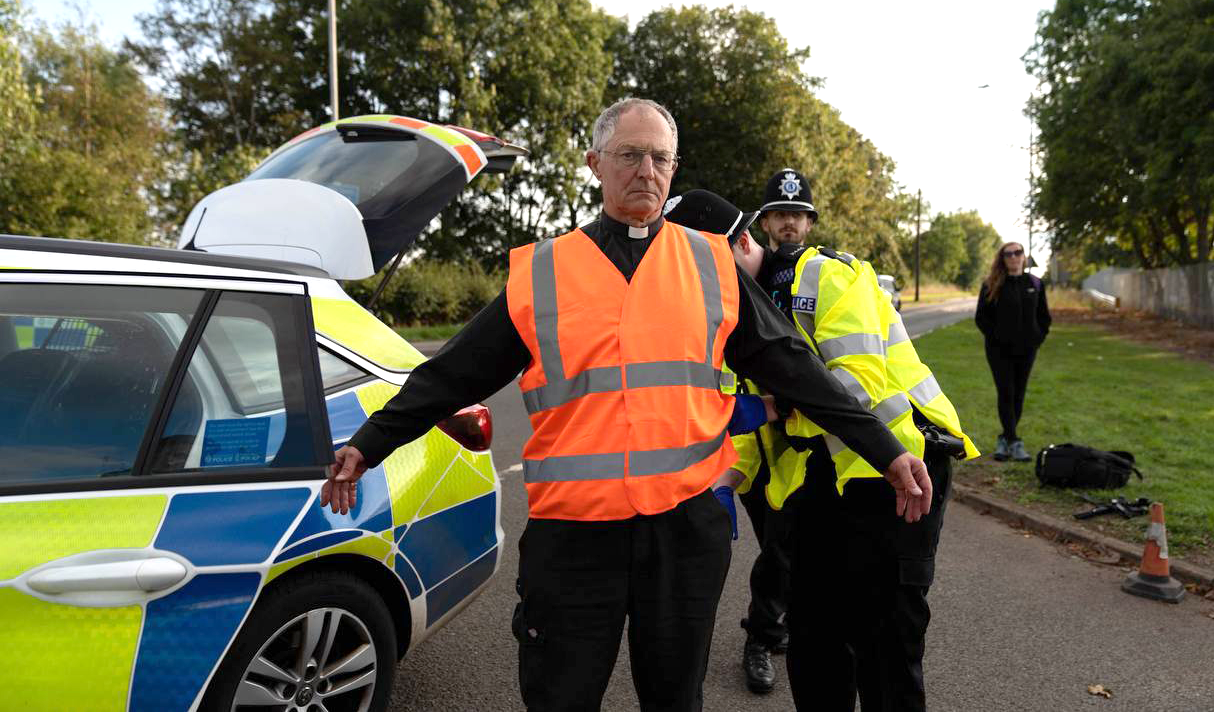
Five Just Stop Oil activists have just been jailed for up to two years after they climbed gantries over the M25 motorway and caused temporary gridlock.
For many of the 181,000 motorists the Highways Agency estimated were delayed in November 2022 by the coordinated four-day-long campaign of disruption, it may feel like justice served.
But there has been international condemnation of the increasing severity of sentences for non-violent protest.
“There can be no justification for the level of sentences that are being imposed,” says Raj Chada, a solicitor at Hodge Jones & Allen who represented one of the activists – a 77-year-old woman.
“These are sentences which have traditionally been reserved for violent offences. And in the UK, we’ve always said that no matter what the protest, even if it is disruptive, you get credit for it being non-violent,” said Mr Chada.
The latest sentences, of between two years and 20 months, follow those in July of jail terms between four and five years for Just Stop Oil campaigners who planned and recruited volunteers for the M25 protest.
“Today marks a very dark day for fundamental human rights in the UK,” wrote Michel Forst, the United Nations Special Rapporteur on Environmental Defenders, who attended their trial at Southwark Crown Court.
…
Lawyers representing some of the Just Stop Oil activists sentenced in both recent court cases said they would appeal the length of sentences.
The Court of Appeal has previously upheld judges decisions in protest cases, meaning the UK’s recent record on punishing environmental activists is likely to end up before the European Court of Human Rights.
Just Stop Oil are being branded “fanatics” for disruptive actions whose like hardly raised an eyebrow a decade ago
I wasn’t terribly surprised to see, in the weekend Morning Star, a letter suggesting that while the sentencingof theJust Stop Oil Five was overly harsh, they deserved punishment for their conspiracy to disrupt traffic on the M25.
The Star is, to be fair, generally quite supportive of JSO’s right to protest, while having some knee-jerk types in its readership, particularly in the crusty old tankie set. But such complaints get at the heart of an issue JSO has had for some time — they’re often really annoying even for their nominal allies.
Many of them are quite posh and can sound patronising or smug. Their targets are disruptive but less often to the wealthy and more to a cross-class cohort of art lovers, or pagans, or sports enthusiasts, or holiday makers. And motorists, of course. Roger Hallam, as their most famous face, often acts like a self-aggrandising edgelordwhose projects have a habit of getting people in trouble without much of a plan for long-term support.
It sometimes makes JSO hard to love, and it gives grouches in politics and the media an excuse to label them attention seekers, or cultists, or extremists.
But here’s the thing: for all their PR controversies, JSO aren’t actually extreme at all, and not only in comparison to, say, cops throwing their weight around on a Friday night, or any major event that gridlocks a city centre. Comparing them to similar campaigns from the 1990s or even the early 2000s, JSO are tamer than Lassie. The anti-roads movement,Animal Liberation Front, Earth First!,Reclaim The Streets, even Greenpeace — have all mounted considerably more disruptive campaigns within living memory. You can find reports on some of them in old issues of Freedom and Schnews.
In fact, a quick look through the latter’s archive for mentions of the M25 very quickly turns up this articlefrom 2012, with the Tories already in power, which notes the following action:
On Monday 16th July a Greenpeace co-ordinated swoop saw seventy-seven petrol stations within the M25 shut down, and another thirteen in Edinburgh - hitting Shell on the forecourt and in their pockets. Activists disassembled the emergency fuel shut off switches and chained the pumps together, stopping business for the day.
Twelve years ago, shutting down nearly the entire refuelling system around London and Edinburgh wasn’t considered big enough to fluster the Graun, which reported the whole thing as just another news story for the day. Shell were careful to say they respected the protesters’ views, and the police didn’t even bother to comment! My goodness what a difference a few years makes. Can you imagine the level of dribbling outrage the press would indulge in now?
This impressive gap in the treatment of disruptive protests on the same road is symptomatic of an issue touched on in a recent Freedom discussion, which has been worsening for a long time and accelerated, strangely, alongside the culture wars. While the left was accused of going woke and indulging in cancel culture, the right was becoming so pathetically unable to handle confrontation that it changed the laws to jail people for being annoying. Part of Suella Braverman’s anti-protest law(since struck down) literally gave police the power to break up protests for being “too noisy”.
And now we’re at the point where Hallam and co. are being jailed for 4-5 years each for conspiracy to disrupt the flow of traffic. But what’s worse is they’ve managed to somehow convince the public this is all a response to sudden rising environmental “fanaticism” entailing behaviour we’ve never seen before. A straight-up bald faced lie to a population who, if they are adults, should be able to personally remember examples of this not being the case which has nevertheless sunk in as truth. What a stunning propaganda victory! If the left had done it, you can bet your life the word “Orwellian” would be burning holes in printing presses across the nation.
Which brings us back to our letter writer in the Star. The left (and of course the anarchists) need to remember our history, and why it is that solidarity applies even to people we don’t get on with ideologically (or personally). We need to be much, much better at getting our heads out of our arses and fighting back against the demonisation of disruptive protest. It’s not a matter of whether we approve of JSO or Roger the Public Nuisance, or whether think their work is counterproductive in terms of public opinion.
Because not too long ago what they’ve been doing wouldn’t have been a jailable offence, or even a front page one. Not too long ago, columnists opining about disruptive protest being “anti-democratic” would have been quite rightly ridiculed for their lack of commitment to human rights. JSO’s re-designation as extremists courting much-deserved jail time is our re-designation.
Kier Starmer needs to be pressured on this from all sides. He has, after all, taken away the left’s voice in Parliament. Now he needs to hear it in the streets.
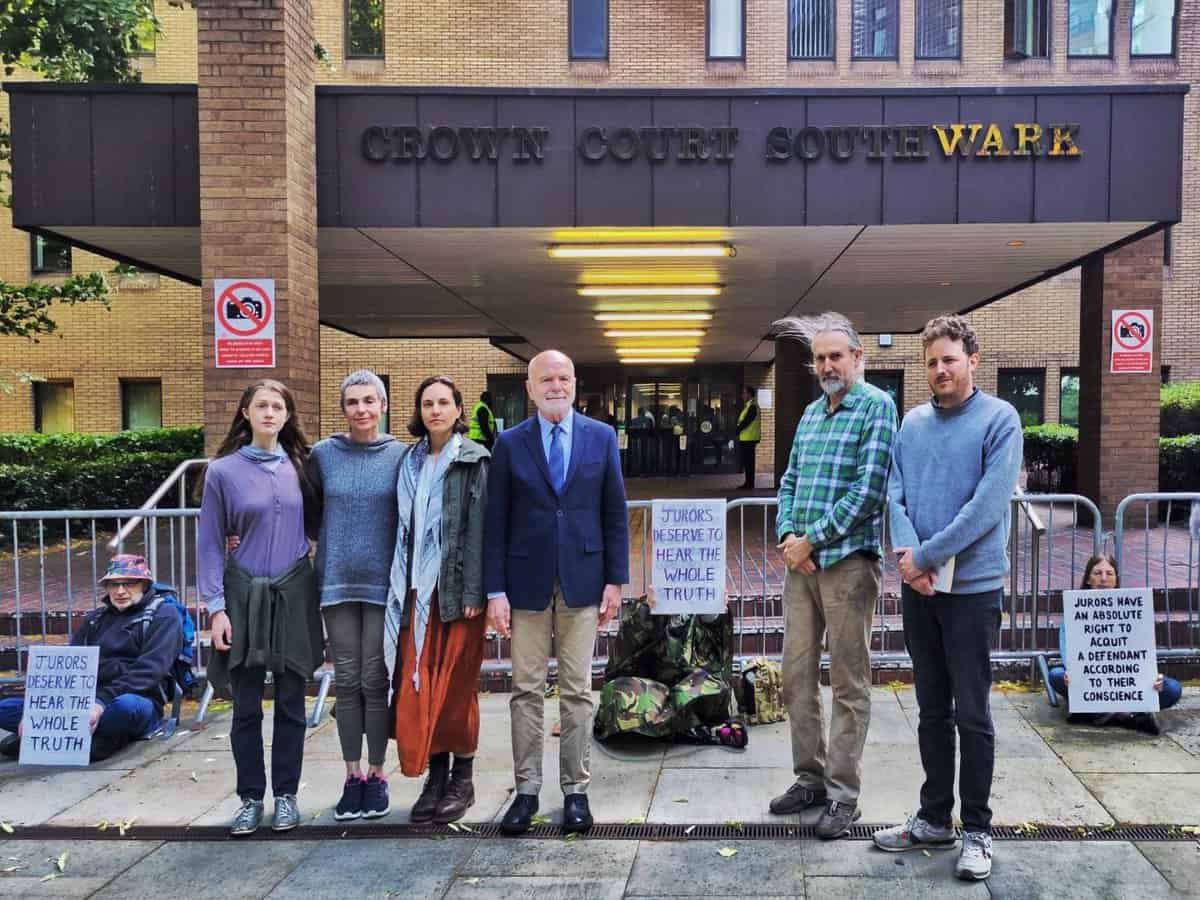
UN Special Rapporteur on Environmental Defenders under the Aarhus Convention Michel Forst attended the trial of five Just Stop Oil supporters at Southwark Crown Court. He attended as an observer because of his serious concerns.
Prosecution of five Just Stop Oil activists over M25 protest led to chaotic scenes in court and concerns about ‘judicial persecution’
As part of his role as UN rapporteur for environmental defenders, Michel Forst has been watching proceedings against climate activists at courts across Europe.
But he may not have seen anything like what unfolded at Southwark crown court in London over the past two and a half weeks, where five Just Stop Oil activists were convicted for conspiring to cause gridlock on the M25 in November 2022.
On the days Forst visited, he witnessed three of the five defendants being arrested in court and dragged to the cells, protesters outside attempting to warn jurors they were not hearing the full case and a judge desperately trying to maintain control over his courtroom.
The judge, Christopher Hehir, had ruled that information about climate breakdown could not be entered into evidence, and could only be referred to by defendants briefly as the “political and philosophical beliefs” that motivated them – which he would tell the jury were in any case irrelevant to their deliberations.
But the defendants had other plans. They sought to turn Hehir’s court into a “site of civil resistance”, causing as much disruption as necessary to ensure that if the jury could not see their evidence on climate breakdown, then the jurors could at least be in no doubt it was being kept from them.
By the time the jury retired to consider a verdict, police had been called into court no fewer than seven times, four of the five defendants had been remanded to prison and 11 others were facing contempt of court proceedings for protests outside the courtroom.
…
By the end of the trial, Whittaker De Abreu, the only one who had not represented herself, was the only defendant left in court.
As a punishment for their “persistent disruption”, Hehir slashed the time given to each defendant from one hour to 20 minutes. He further prohibited any mention of the climate crisis, the legal defences he had disallowed or the principle of jury equity – the idea that jurors can acquit based on their conscience.
As Hallam, Shaw, Lancaster and Gethin gave their speeches from behind the reinforced glass screen of the dock, they each proceeded to flout Hehir’s prohibitions, arguing they had been denied a right to a fair trial.
Hallam told jurors: “It’s blindingly obvious to us here first that you have not been given all the evidence you need. You cannot be sure of our guilt if you are not sure that you have not been given the evidence … we have received no good reason why we are not allowed to tell you what is blindingly obvious, namely what I’m not allowed to speak about. If you are not allowed to hear the blindingly obvious then it’s not a fair trial is it?”
It took just a day’s deliberations for the jury to unanimously find them guilty.
Given the recent history of UK climate protest trials, in which defendants have been sentenced to jail for merely mentioning the words “climate change”, and notwithstanding the dramatic arrests in court, Forst said he was surprised the judge gave them an opportunity to mention climate breakdown at all.
“But the little latitude they had to mention climate change was in the meantime emptied of its very meaning by the fact that, overall, the jury was told to ignore most of it,” he added.
UN Special Rapporteur on Environmental Defenders under the Aarhus Convention Michel Forst attended the trial of five Just Stop Oil supporters at Southwark Crown Court. He attended as an observer because of his serious concerns.
The jury is now deliberating the verdict in a case involving Just Stop Oil supporters Daniel Shaw, Cressie Gethin, Lucia De-Abreu-Whittaker, Louise Lancaster, and Roger Hallam. The five are currently on trial at Southwark Crown Court. They are charged with conspiracy to cause a public nuisance in connection with the M25 gantry actions in November 2022.
They were first arrested in 2022 either pre-emptively in police raids at their homes after attending a Zoom call (in which a Sun journalist was present), or travelling near the M25. The Sun alleged it had ‘infiltrated’ the meeting, tipping off the police and enabling National Highways to secure a public injunction. Some of the five defendants were imprisoned for up to 113 days without trial. They were released subject to stringent conditions including a 10pm to 7am house curfew, stipulations not to be within a one-mile radius of the M25, no contact with other defendants, and not to participate in any climate change demonstration.
The trial began on 24th June, presided over by Crown Court Judge Hehir.
At the start of the trial, the office of the UN Special Rapporteur on Environmental Defenders released a statement expressing its views on the criminal prosecution of Daniel Shaw. Due to his “grave concerns” about the criminalisation of UK environmental defenders, Special Rapporteur Michel Forst attended the trial in person on 4th and 5th July. [1]
During the trial so far, Judge Hehir has ordered nine separate arrests from the courtroom: three times each for Roger Hallam and Daniel Shaw, twice for Louise Lancaster, and once for Cressie Gethin. Additionally, the defendants have collectively spent seven nights in remand since the trial began, with Daniel, Roger, and Louise each spending two nights, and Cressie spending one night.
On the 4th of July, the prosecution made a historic concession by admitting to the following, in the list of agreed facts to be presented for the jury’s consideration:
“1. On 17 December 2020, Her Majesty’s Treasury published the New Zero Interim Report which states, ‘Climate change is an existential threat to humanity. Without global action to limit greenhouse gas emissions, the climate will change catastrophically with almost unimaginable consequences for societies across the world.’ In recognition of the risks, the UK became, in 2019, the first major economy to implement a legally binding net zero target.
2. Scientific consensus is that beyond 1.5 degrees Celsius warming above pre-industrial levels risks catastrophic and irreversible consequences for humanity, which will be irreversible.
3. Over the past five years, the global average temperature rise since pre-industrial times has averaged just under 1.3 degrees Celsius. For the 12 months to June 2024, it averaged 1.63 degrees Celsius and is estimated to top 1.5 degrees Celsius permanently before 2030.
4. In October 2022, the UK Government opened the 33rd licensing round to allow oil and gas companies to explore for more fossil fuels in the North Sea.”
Despite the presence of these agreed facts and the explicit provision for the defence of ‘reasonable excuse’ under section 78 of the Police, Crime, Sentencing and Courts Act 2022, Judge Hehir ruled that the defendants would not be allowed any defence under law, repeating at various points in the trial as well as in his written directions to the jury that any facts pertaining to “man-made climate change” were “entirely irrelevant” to the defendants’ charges.
Roger Hallam, on trial for conspiring to block traffic on the M25 in 2022, said he wanted to ‘speak the whole truth’. Photograph: Ollie Millington/Getty
Accused speak out of turn about climate threat and challenge judge who orders jury to leave
There was chaos in the courtroom at a climate protest trial when two defendants stood and made statements defying the authority of the court.
At separate points during the trial on Thursday, Roger Hallam and Daniel Shaw, charged along with three others with conspiring to block traffic on the M25 in 2022, stood up in front of the jury and spoke out of turn.
Hallam, whose evidence was discontinued on Wednesday, stood up just as court got under way on Thursday and said: “I wish to communicate to the jury and the court that I was forcibly removed from the court yesterday for refusing to break my oath and speak the whole truth.”
Later on, while Louise Lancaster, a co-defendant, was in the witness box, Shaw, whose evidence was also discontinued on Wednesday, stood up from his place in the court and directly challenged the judge.
He said: “Climate change represents an existential threat to humanity. The court agrees with that. Why are you not trying the people causing this crisis?”
Each time the defendants continued speaking as the judge, Christopher Hehir, ordered the jury to leave the court.
Lancaster refused to submit to cross-examination by the prosecution, as Shaw and Hallam had done the previous day, prompting Hehir to discontinue her evidence.
Hehir told jurors: “Members of the jury, in your absence I had a discussion in open court with Miss Lancaster. In frank and straightforward terms she has told me she is not prepared to submit to cross-examination. In those circumstances her evidence is at an end.”