Estimated 27 children killed by famine, with fears many more will suffer lifelong effects, despite Israel’s promise of more aid
Even if the war in Gaza ended tomorrow, for some of the Palestinian territory’s children, it would not help. Hunger and malnutrition have already claimed an estimated 27 young lives, and for many more, it may be too late to reverse the excruciating toll that starvation takes on small, growing bodies.
Nuzha Awad’s triplets, Malek, Khader and Moustafa, born two months before the war began when Hamas attacked Israel on 7 October, did not stop crying as she spoke to the Guardian. She fled Gaza City when food and formula for her babies began to run out; in their new home, a makeshift tent in the central town of Deir al-Balah, she is still desperately afraid for their futures.
“At this age a child should weigh 8 kilos. They weigh 2 kilos … They don’t have thighs yet. At this stage they are supposed to be crawling and preparing to walk. And now you can see the state they’re in,” she said.
“Are these the arms of an eight-month-old child? … It’s death there, death, death. Death in the literal meaning of the word.”
UN-backed food insecurity experts assessed in mid-March that famine n Gaza could set in between later that month and mid-May. Last week, Samantha Power, the head of the US humanitarian and development agency, USAid, became the first American official to confirm publicly that in some areas, famine had already taken hold.
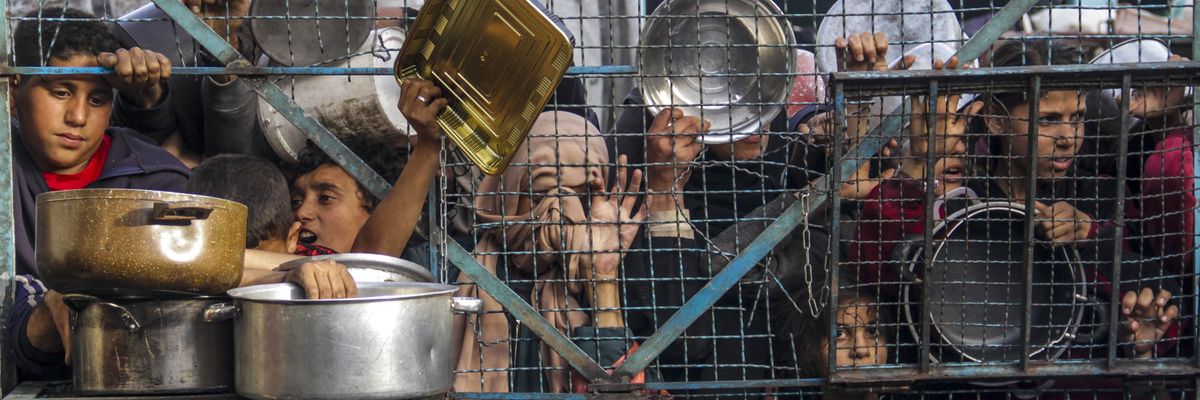
A crowd of starving Palestinians, including children, waits to receive food distributed by charity organizations amid Israel’s blockade at the Jabalia refugee camp in Gaza on March 27, 2024. (Photo by Mahmoud Issa/Anadolu via Getty Images)
“The Israeli government’s use of starvation as a weapon of war has proven deadly for children in Gaza.”
The Israeli government is starving children to death in the Gaza Strip with its deliberate and systematic obstruction of food aid, Human Rights Watch said in a report released Tuesday, citing firsthand accounts from doctors and families in the besieged enclave.
At least 32 people, including 28 children, have died of malnutrition and dehydration so far in northern Gaza, which is facing famine conditions due to Israel’s illegal blockade.
HRW’s new report builds on its December assessment that Israel was “using starvation of civilians as a method of warfare” in Gaza, with disastrous consequences for the territory’s civilian population.
“The Israeli government’s use of starvation as a weapon of war has proven deadly for children in Gaza,” said Omar Shakir, HRW’s Israel and Palestine director. “Israel needs to end this war crime, stop this suffering, and allow humanitarian aid to reach all of Gaza unhindered.”
For its new report, HRW interviewed doctors who have treated malnourished patients and family members of children who have starved to death in recent weeks. The group also reviewed photographs and video footage showing emaciated children who have died of malnutrition.
Dr. Hussam Abu Safiya, the head of the pediatrics unit of a northern Gaza hospital targeted by Israeli forces, said that 26 children in his facility alone have died from starvation-related health complications. Safiya told HRW that at least 16 of the children were under five months old, and one of them was just two days old.
The mother, he said, “had no milk to give him.”
“Israel’s allies like the U.S., U.K., France, and Germany need to press for full-throttle aid delivery by immediately suspending their arms transfers.”
Already badly hindered by Israel’s siege, aid deliveries to Gaza have been further disrupted by Israeli attacks on humanitarian workers and convoys. Israeli forces’ killing of seven World Central Kitchen workers last week led several aid groups to suspend their operations in Gaza.
While Israel agreed in the wake of the deadly attack—and in the face of massive international pressure—to reopen a key border crossing in northern Gaza, aid groups say far more is needed to prevent mass starvation.
“Governments outraged by the Israeli government starving civilians in Gaza should not be looking for band-aid solutions to this humanitarian crisis,” Shakir said Tuesday. “Israel’s announcement that it will increase aid shows that outside pressure works. Israel’s allies like the U.S., U.K., France, and Germany need to press for full-throttle aid delivery by immediately suspending their arms transfers.”
Israel’s six-month war on Gaza has been catastrophic for the territory’s children. According to one recent analysis, over 2% of Gaza’s child population—nearly 26,000 kids—has been killed or wounded during the assault, with at least 1,000 children losing one or both of their legs.
The war has also taken a devastating psychological toll on Gaza’s kids, many of whom have been displaced repeatedly and seen family members maimed or killed by Israeli bombs.
“The emotional distress of dodging bombs and bullets, losing loved ones, being forced to flee through streets littered with debris and corpses, and waking up every morning not knowing if they will be able to eat has also left parents and caregivers increasingly unable to cope,” Save the Children said last month.
Speaking to HRW, the father of newborn twin girls said that one of his babies died of malnutrition at northern Gaza’s Kamal Adwan Hospital eight days after she was born.
“He said that he struggled to feed his family prior to the girls’ birth, but that they only had bread to eat, without meat or protein,” the human rights organization noted in its new report. “He said that after the twins’ birth, his wife could not produce milk to breastfeed the girls and that store-bought milk was scarce.”
One mother of a 6-year-old boy with cystic fibrosis told HRW that “because of the Israeli blockade, she struggled to obtain the necessary medication and provide adequate nourishment.”
“By mid-January, Fadi’s health had deteriorated to the point where he could no longer walk, prompting his hospitalization,” HRW said. Late last month, the boy was evacuated from Kamal Adwan Hospital to receive treatment at a facility in Cairo.
Lama Fakih, HRW’s Middle East and North Africa director, said Tuesday that Israeli officials upholding the blockade that is starving children in Gaza “are committing war crimes.”
“Governments should impose targeted sanctions, including travel bans and asset freezes, against responsible officials,” said Fakih.
But the U.S., Israel’s top ally and arms supplier, is refusing to take concrete action even as damning evidence of Israeli war crimes mounts.
Asked during a Monday press briefing “how many Palestinian citizens should be killed, whether by fire or starvation, so you can seriously intervene,” U.S. State Department spokesperson Matthew Miller said that “we do not want to see a single Palestinian killed.”
“And that is why we have made clear that Israel needs to do more to improve its deconfliction and coordination measures,” Miller said, brushing off the idea of imposing strict conditions on U.S. military aid. The Biden administration is currently pressing Congress to sign off on an $18 billion sale of F-15 fighter jets to Israel.
Earlier in Monday’s briefing, Miller said the U.S. has “not yet at this time concluded that Israel has violated international humanitarian law.”
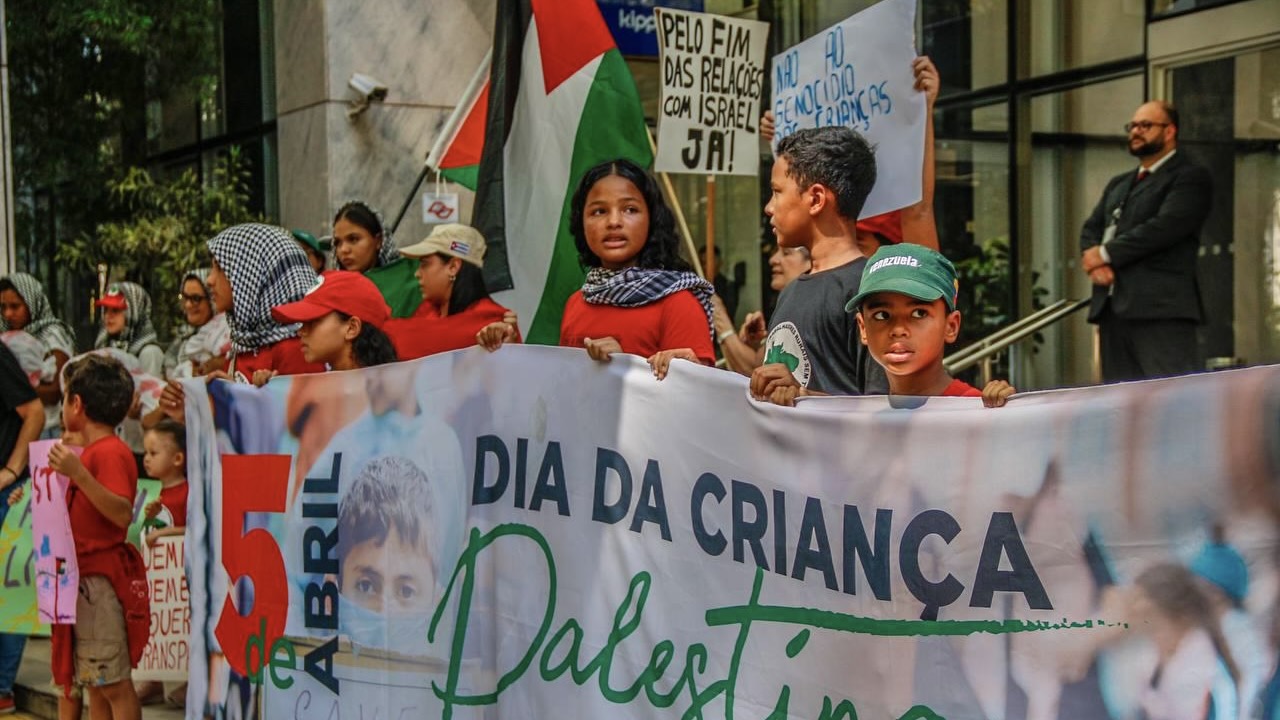
Rallies for Palestinian Children’s Day were held across Brazil, including in São Paulo. Photo: Priscila Ramos
Over 14,000 children have been killed and nearly 17,000 others have lost at least one or both of their parents in the Israeli bombings or ground offensives in the last six months in Gaza
Israel has killed 14,350 Palestinian children between October 7 and April 4. This means children account for 44% of all Palestinians killed in Israel’s genocidal war on Gaza, Palestinian Central Bureau of Statistics (PCBS) said in a press release ahead of Palestinian Children’s Day.
Women and children constitute nearly 70% of over 7,000 additional persons missing in the same period, and the majority of the over 75,000 wounded Palestinians are women and children.
Out of a total of 455 Palestinians killed in the occupied West Bank by the Israeli forces in the same period, 117 were children.
Over 17,000 Palestinian children have also been orphaned as a result of Israel’s genocidal attacks, according to UNICEF data, after either both or one of their parents were killed in the Israeli bombings and ground offensives since October 7.
Palestinians celebrate Children’s Day on April 5 every year. Human rights groups such as Defense of Children International Palestine, Palestinian Network for Children’s Rights (PNCR) and others mark the day as International Day of Solidarity with the Palestinian Children in order to highlight Israel’s systematic crimes against them.
Israel starves Palestinian children to death
At least 31 Palestinian children have been starved to death in Gaza in the last couple of months. The starvation is a product of the deliberate blockade and restrictions imposed by the Israeli forces on the delivery and distribution of food and other humanitarian aid in the besieged territory. The entire population of Gaza is now facing acute levels of food insecurity.
A large number of pregnant women in Gaza are deprived of adequate medical care as well, due to the genocide and Israel’s repeated attacks on the health facilities and workers.
According to the PCBS, by the middle of this year, there would be around 2.4 million children below the age of 18 in the occupied Palestinian territories, 43% of the total Palestinian population in West Bank and Gaza. The population of children in Palestine is almost equally divided between the West Bank (over 1.3 million) and Gaza (over 1 million).
Around 816,000 children in Gaza need psychological assistance due to trauma caused by the ongoing genocide. Around 620,000 have been out of school, with eight out of ten schools destroyed by the invading Israeli forces in indiscriminate bombings on civilian infrastructures and deliberate acts of sabotage. Another 133 schools are used as temporary shelters for displaced people.
The child prisoners of Palestine
Though since October 7, Israeli forces detained over 500 Palestinian children, some were released later. However, still there are over 200 Palestinian children in different Israeli jails. According to Addameer, 41 Palestinian child prisoners are being kept under administrative detainees.
Palestinians children detained by the Israeli forces have often been subjected to torture and abuse both during their arrests and in the prison. In a large number of cases, Palestinian children have been treated like criminals when arrested by Israeli forces with their hands tied, blindfolded. They are often tried in military courts.
In a report submitted last year by Francesca Albanese, UN special rapporteur on human rights in the Palestinian territories, claimed that over “10,000 Palestinian children have experienced institutionalized ill treatment during arrests, prosecutions, sentencing and consequent traumas on themselves and their families.”
Some children released from Israeli prison recently have also testified that they were isolated in the prison and tortured and severely beaten, Addameerclaimed.
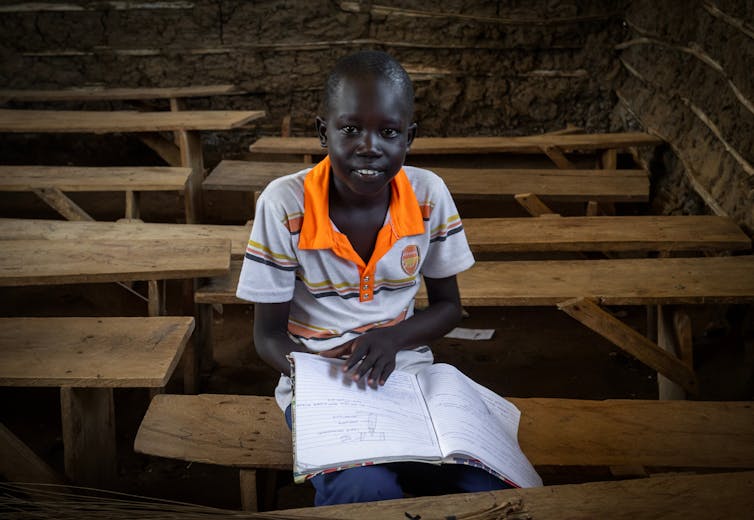
The education of students in countries like Sudan is already being negatively affected by the extremes of climate change. Richard Juilliart/Shutterstock
Schools across South Sudan have been ordered to close as a heat wave of 45°C sweeps across the country. In recent years, severe flooding has already caused major disruptions to schooling in South Sudan where, on average, children complete less than five years of formal education across their lives.
As researchers interested in both climate change and learning, we’ve been surprised that most public debate in this area concerns how best to teach children about climate change as part of the curriculum. Recently, we examined a less discussed, but arguably much more consequential, question: How is climate change impacting children’s education worldwide?
In a recent paper published in Nature Climate Change, we reviewed studies linking climate change-related events or “climate stressors” to education outcomes. One of the clearest connections was between heat exposure and reduced academic performance.
A study in the US found that adolescents’ maths scores decreased significantly on days above 26°C. In China, hotter day-of-test temperatures were associated with a drop in exam performance equal to losing a quarter of a year – or several months – of schooling.
But it’s not just test days that matter. Studies show that raised temperatures also affect learning over longer time periods. For example, pupils’ test scores suffered when there were more hot days across the school year and even when the hotter weather occurred three to four years before exam day.
Our review also highlights how climate-related regional disasters like wildfires, storms, droughts and floods are keeping many children out of school entirely. Floods can prevent children from travelling to school and cause damage to school buildings and materials, which disrupts learning and lowers test scores.
In developing countries, storms and droughts commonly cause children to leave school permanently to join the workforce and support their families. Children in higher-income countries are not immune. They miss school days due to hurricanes and wildfires and these absences have measurable effects on education outcomes.
The impacts of climate disasters can also affect children before they are born with consequences that reverberate across their lives. For example, children whose mothers were pregnant during Hurricane Sandy were more likely to be diagnosed with attention-deficit hyperactivity disorder (ADHD), a condition that can make schooling more challenging.
In India, researchers found that raised temperatures lead to lower test scores due to crop failure and malnutrition, highlighting the importance of indirect links between climate stressors and subsequent school participation and learning.
Educational injustice
Our analysis suggests that climate change will exacerbate existing inequalities in global education access and attainment, with already disadvantaged groups facing the largest learning setbacks. In the US, heat had worse effects on exam scores for racial and ethnic minorities and children living in lower-income school districts.
Following a super typhoon in the Philippines, children whose families had fewer financial resources and smaller social networks were more likely to drop out of school than their better-resourced neighbours. In contexts where girls’ education is less prioritised than boys’, their school attendance and exam scores have suffered more following climate change stressors such as droughts and storms.
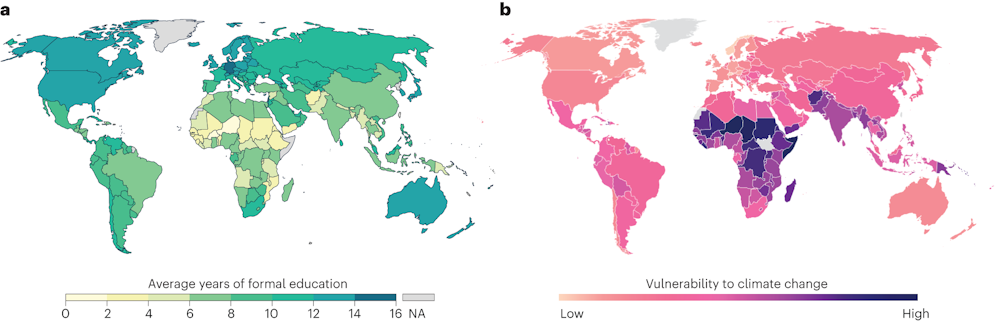
Globally, regions where people are more vulnerable to the effects of climate change – in terms of risk of harmful stressors occurring and resources available to adapt – are also regions where children already receive fewer years of schooling.
These maps show the average years of formal education (left) and vulnerability to climate change by country (right). CC BY
The impacts of climate change on education are already widely visible. While the scale of the problem is daunting, there are many ways to take action. Most critically, global heating urgently needs to be limited by reducing emissions of greenhouse gases.
At the same time, children’s education must be protected from climate change stressors that are already occurring. Possible measures include installing cooling technologies, effective disaster response planning, building stressor-resilient schools and addressing systemic global inequalities related to socioeconomic, gender and racial discrimination.
Preventing harm to children’s education is a worthy goal in itself. But improving education can also contribute to greater awareness and climate literacy, while mitigating climate change and making children more resilient in the face of climate stressors.
Education can help fight climate change. But we must also fight climate change to prevent harm to education. Without action, the future of young people around the world hangs in the balance.
Israel has deliberately slowed the flow of aid to Gaza with hundreds of trucks stranded on the Egyptian side of the Rafah border at a time when over two dozen Palestinian children have died of malnutrition
UN agencies have repeatedly condemned Israel’s refusal to expedite the process of aid delivery to Gaza which has been under siege by Israel for nearly six months. This is despite repeated calls for urgency in the context of critical humanitarian conditions which are becoming worse with each passing day.
According to the latest alerts issued by the Integrated Food Security Phase Classification (IPC) on March 18, most of northern Gaza would move into the category five indicating the highest stage of food insecurity or catastrophic levels of hunger. The IPC explains that this would mean that Palestinian households would face “an extreme lack of food and extremely critical levels of acute malnutrition.”
The IPC has assessed that the region which continues to face Israeli bombing and ground offensive already faces category four levels of malnutrition with huge gaps between need and actual availability of food.
— The Integrated Food Security Phase Classification (@theIPCinfo) March 18, 2024
UNRWA has already confirmed that one in three children in northern Gaza are malnourished. In the last few weeks over 25 children have died due to the same. The situation in other parts of Gaza is approaching similar levels at an alarming speed.
The same day that the IPC released its findings, Philippe Lazzarini, the head of UNRWA, was denied entry to Gaza by Israeli authorities. In a post on X, Lazzarini wrote, “UNRWA has by far the largest presence among all humanitarian organizations in Gaza. My visit today was supposed to coordinate & improve the humanitarian response.”
He added, “This man-made starvation under our watch is a stain on our collective humanity. Too much time was wasted, all land crossings must open now. Famine can be averted with political will.”
The UNRWA head also noted that over 1.1 million people in Gaza facing phase five levels of starvation “is the highest number of people ever recorded as facing catastrophic hunger and is double the number of just three months ago.”
Beth Bechdol, deputy director general of the UN Food and Agricultural Organization (FAO) told Al-Jazeera on Tuesday that, almost half of the total population of Gaza is at the acute level of malnutrition and at the risk of ultimately death.
The United Nations Children Fund (UNICEF) stated on Sunday that thousands of Palestinian children in Gaza are so malnourished that they do not have enough “energy to cry.”
Over 13,000 Palestinian children have been killed in the Israeli war on Gaza which began on October 7. According to different UN agencies, as many children have been injured and now hundreds of thousands are being forced into starvation by Israel.
UNICEF’s Executive Director Catherine Russell had earlier made similar assertions saying that there are “very great bureaucratic challenges” which prevent the humanitarian aid to reach two million Palestinians in Gaza.
Israel has restricted the entry of the aid through land borders using different kinds of excuses, for example presence of scissors in the aid boxes or alleged overcrowding of Palestinians at aid distribution centers among others.
James Elder, UNICEF spokesperson, called the blocking of aid supplies to Gaza “outrageous.” He posted on X showing hundreds of trucks with humanitarian aid stranded at the Rafah border as Israel has not allowed them to enter Gaza.
Adele Khodr, UNICEF’s regional director for the Middle East and North Africa called for the opening of all crossings. “The world’s inaction is shocking as more children succumb to slow death. All border crossing must open now to allow unfettered access to humanitarian aid” Khodr said in the tweet on Tuesday.