Israel Is Using Starvation as a Weapon of War in Gaza and the World Has Failed to Stop It

Spread the love

Original article by RAMZY BAROUD republished from Common Dreams under Creative Commons (CC BY-NC-ND 3.0). 
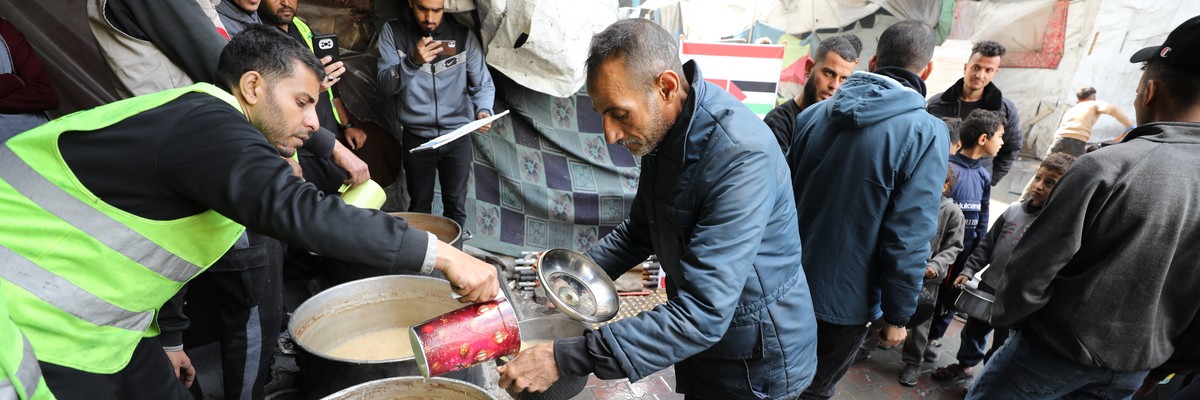
Relief workers distribute food in Gaza City, Gaza on March 14, 2024. (Photo: Dawoud Abo Alkas/Anadolu via Getty Images)

Providing aid to Gaza and ensuring the reconstruction of the strip must not be a political item for negotiations. It is a basic human right that must be honored under any circumstance.

Humanitarian aid should never be politicized though, quite often, the very survival of nations is used as political bargaining chips.

Sadly, Gaza remains a prime example. Even before the current war, the Gaza Strip suffered under a 17-year hermetic blockade, which has rendered the impoverished area virtually “unlivable.”

That very term, “unlivable” was used by the then-United Nations Special Rapporteur for the Situation of Palestine, Michael Lynk, in 2018.

Scenes and images of thousands of starving Palestinians chasing after boxes of aid parachuted into Gaza will remain etched in the collective memory of humanity as an example of our failed morality.

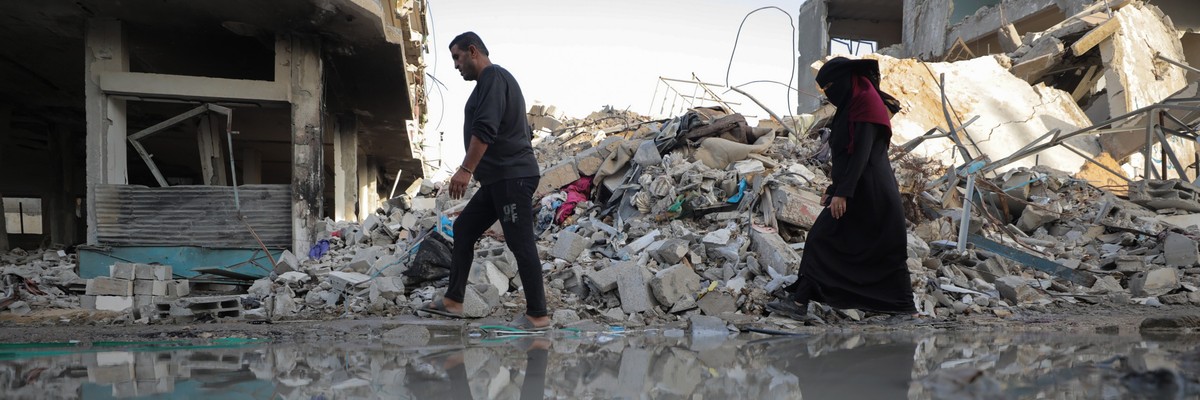
As of mid-December of last year, “nearly 70% of Gaza’s 439,000 homes and about half of its buildings have been damaged or destroyed,” The Wall Street Journal reported, citing experts who conducted a thorough analysis of satellite data.

As tragic as the situation was in December, now it is far worse.

Sixty-seven percent of Gaza’s water, sanitation facilities, and infrastructure have been destroyed or damaged, according to a statement by the United Nations Agency for Palestinian Refugees, UNRWA, on June 19, leading to the spreading of infectious diseases, which has ravaged the beleaguered population for months.

The spread of disease is also linked to the accumulation of garbage everywhere in Gaza. Earlier, the refugees agency reported that “as of June 9, over 330,000 tons of waste have accumulated in or near populated areas across Gaza, posing catastrophic environmental (and) health risks.”

The situation was already disastrous. Indeed, three years before the war, the Global Institute for Water, Environment, and Health (GIWEH) said, in a joint statement with the Euro-Mediterranean Human Rights Monitor, that 97% of Gaza water was undrinkable and unfit for human consumption.

Yet, so far, any conversation on allowing aid to Gaza, or the rebuilding of Gaza after the war, has been placed largely within political contexts.

By shutting down all border crossings, including the Egypt-Gaza Rafah Crossing—which, on June 17, was set ablaze—Israel has politicized food, fuel, and medicine as tools in its war in the strip.

This is not a mere inference, but the actual statement made by Israeli Minister of Defense Yoav Gallant, who on October 9 declared that he had ordered a “complete siege” and that “there will be no electricity, no food, no fuel, no water” entering Gaza.

The timing of the statement, which has indeed been put into action from the first day of the war, suggests that Israel did not apply the strategy as a last resort. It was one of the most important pieces in the war stratagem, which remains in effect to this day.

Instead of pressuring Israel, Washington tried to obtain its own political leverage, also by politicizing aid. On March 2, the U.S. Air Force started airdropping aid into northern Gaza. A far more conducive and less humiliating option for Palestinians, however, would have been direct U.S. pressure on Israel to allow access to aid trucks arriving through Rafah, Karem Abu Salem Crossing, or any other.

Scenes and images of thousands of starving Palestinians chasing after boxes of aid parachuted into Gaza will remain etched in the collective memory of humanity as an example of our failed morality.

News reports spoke of people who were killed under the weight of the dropped “aid,” much of which had fallen in the Mediterranean, never to be retrieved.

Even the Gaza pier, constructed by the U.S. military on the Gaza shore in May, did little to alleviate the situation. It merely transported 137 aid trucks, according to the U.S.’ own estimation, enough to cover Gaza’s need for food for a few hours only.

During the years of siege, an average of 500 trucks arriving daily in Gaza has kept the 2.3 million population of the strip alive, though malnourished.

To deal with the outcome of the war, and to stave off current starvation, especially in the north, the number of aid trucks would have to be much higher. Yet, whole days would pass without a single truck making its way to the suffering population. This is unacceptable.

Not only did the international community fail at ending the war, it has also failed in delinking humanitarian aid from political and military objectives.

The problem with politicizing aid is that innocent civilians become a bargaining chip for politicians and military men. This goes against the very foundation of international humanitarian law.

According to the International Committee of the Red Cross, citing the Hague Regulations, “international humanitarian law is the branch of international law that seeks to impose limits on the destruction and suffering caused by armed conflict.” In Gaza, no such “limits” have been “imposed” by anyone.

Providing aid to Gaza and ensuring the reconstruction of the strip must not be a political item for negotiations. It is a basic human right that must be honored under any circumstance.

Meaningful pressure must be placed on Israel to end the Gaza siege, and urgent plans must be drafted, starting today, by representatives of U.N. humanitarian institutions, the Arab League, and Palestinian and Gaza authorities to be the entities responsible for delivering aid to Gaza.

Humanitarian aid to Gaza must not be used as political leverage, or a tool in a cruel war, whose primary victims are millions of Palestinian civilians.

Original article by RAMZY BAROUD republished from Common Dreams under Creative Commons (CC BY-NC-ND 3.0). 

Vote For Genocide Vote Labour.

Zionist Keir Starmes is quoted "I support Zionism without qualification." He's asked whether that means that he supports Zionism under all circumstances, whatever Zionists do.
Zionist Keir Starmes is quoted “I support Zionism without qualification.” He’s asked whether that means that he supports Zionism under all circumstances, whatever Zionists do.
Continue ReadingIsrael Is Using Starvation as a Weapon of War in Gaza and the World Has Failed to Stop It

‘The World Must Not Stay Silent!’: Fresh Israeli Bombings Amid Humanitarian Hellscape in Gaza

Spread the love

Original article by JULIA CONLEY republished from Common Dreams under a CC licence.

Gazans, including children, walk past rubble and leaked sewage at Bureij camp after Israeli attacks in Deir al Balah, Gaza on June 20, 2024.
 (Photo by Hassan Jedi/Anadolu via Getty Images)

As the IDF stepped up attacks in Gaza City, one resident said, “We are being starved… with no hope that this war is ever ending.”

Residents of Gaza City’s Shujayea neighborhood found themselves on Thursday among the main targets of new Israeli military operations, with thousands of people fleeing as they were “hunted by tanks and planes,” as one Palestinian man told Reuters—even as Israel claimed the “intense” phase of the war was over.

Al Jazeera reported that the Israel Defense Forces targeted five residential homes in the Shujayea and Sabra neighborhoods in the early morning hours of Thursday, killing at least five people in the former area and three in the latter.

Evacuation orders from the IDF came about 30 minutes after the shelling began in Shujayea, according to Al Jazeera, with families rushing to move west after receiving text messages and leaflets from the military. The IDF published a map showing that certain blocks of the residential neighborhood were now part of a combat zone where tanks were moving in.

“We were suddenly and intensively bombarded by Israel,” one man fleeing the area on foot told Al Jazeera. “We came out and we don’t know where to go.”

Artillery attacks were also reported in the Zeitoun, Hawa, and Sheikh Ijlin neighborhoods of Gaza City. Shujayea was a key target of the IDF in the first weeks of Israel’s bombardment of Gaza last October.

As Israel claims to be drawing down its attacks while rejecting a permanent cease-fire agreement, “the world must not stay silent” about the ongoing assault on Gaza, said researcher and academic Nour Naim.

The Gaza Health Ministry reported Thursday that the people who were killed in Gaza City overnight were among 47 Palestinians killed across the enclave in the past 24 hours. Fifty-two people were reported wounded in the same time period—the latest of dozens each day who are taken to hospitals where doctors struggle to treat people with severely limited supplies due to continued humanitarian aid delays and blockades.

“There are moments when anesthesia is not available, but in order to save the lives of citizens, we resort to amputation, and this causes severe pain for the wounded,” a surgeon at al-Ahli Arab Hospital in Gaza City, told AFP. “Every day, there are attacks that result in amputations of legs or arms for children, adults, and women.”

Six people were killed overnight in an Israeli attack in Jabalia, northern Gaza, and an attack on a family home killed one person in the northern town of Beit Lahiya.

In southern Gaza, women and children were among those killed in an attack on a school where displaced people have been staying, and Israeli ground forces “systematically demolished residential buildings in the west of the city” of Rafah, Al Jazeera reported.

As the IDF has stepped up attacks in Gaza City and continued its bombardment of other areas across the enclave, doctors, humanitarian workers, and civilians described the realities of daily life in Gaza, where aid blockades and the disruption of sanitation services and water treatment have all contributed to “grim living conditions” and heightened health risks.

Joanne Perry, a doctor working with Doctors Without Borders (MSF), described to the Associated Press living conditions that have caused concern that a cholera outbreak could soon take hold.

“The crowded conditions, the lack of water, the heat, the poor sanitation—these are the preconditions of cholera,” Perry told the AP.

Israeli attacks since October have destroyed Gaza’s wastewater treatment plants, water desalination plants, sewage pumping facilities, and wells, and have killed government workers who have tried to repair the infrastructure, leading Palestinians to rely on contaminated and “salty” water.

“We found worms in the water. I had been drinking from it,” 21-year-old Adel Dalloul told the AP. “It was salty, polluted, and full of germs… I had gastrointestinal problems and diarrhea, and my stomach hurts until this moment.”

The World Health Organization has reported 485,000 cases of diarrhea—the third-leading cause of death in young children worldwide—since October, and has warned of at least one outbreak of Hepatitis A, which is spread through the consumption of water and food contaminated with fecal matter.

A mother of six in Khan Younis told Reuters that her family is relying on a charity kitchen’s daily visits to their U.N.-run shelter, as 12 million pounds of food aid and other supplies have been held up since June 9, according to U.S. officials.

“If the charity kitchen did not come here for one day, we would wonder about what we will eat that day,” Umm Feisal Abu Nqera told Reuters. “We are living the worst days of our lives in terms of famine and deprivation… Today, your son looks at you and you bleed from within, because you cannot provide him with his most basic rights and the simplest needs for his life.”

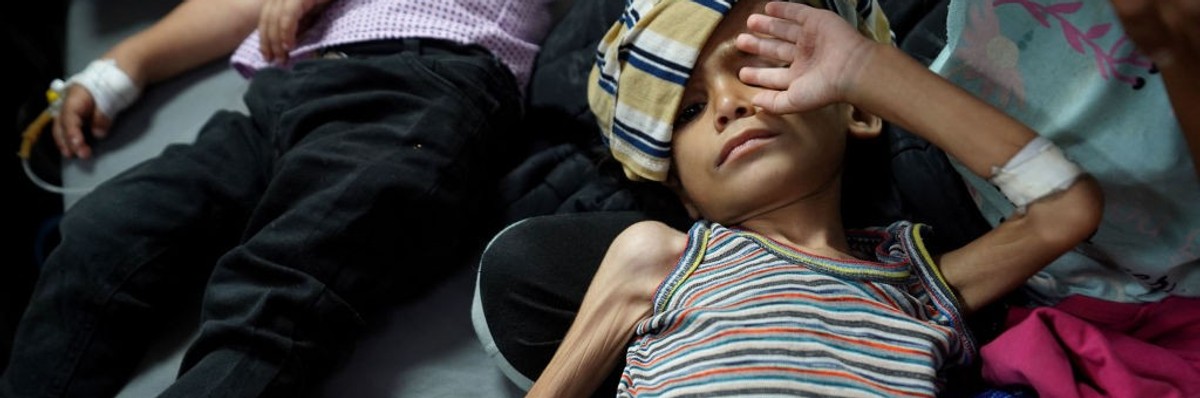
A girl died of malnutrition on Thursday at Kamal Adwan Hospital in Beit Lahia, bringing the official death toll from malnutrition and dehydration among children to 31.
“We are being starved in Gaza City,” 25-year-old Mohammad Jamal toldReuters as the renewed Israeli offensive took hold, “with no hope that this war is ever ending.”

Original article by JULIA CONLEY republished from Common Dreams under a CC licence.

Zionist Keir Starmes is quoted "I support Zionism without qualification." He's asked whether that means that he supports Zionism under all circumstances, whatever Zionists do.
Zionist Keir Starmes is quoted “I support Zionism without qualification.” He’s asked whether that means that he supports Zionism under all circumstances, whatever Zionists do.

Vote For Genocide Vote Labour.
Continue Reading‘The World Must Not Stay Silent!’: Fresh Israeli Bombings Amid Humanitarian Hellscape in Gaza

Israeli Military Has Killed 500 Gaza Healthcare Workers—Two a Day Since Assault Began

Spread the love

Original article by JAKE JOHNSON republished from Common Dreams under a CC licence.

Mourners carry the body of Palestinian doctor Hani al-Jaafarawi, Gaza’s ambulance and emergency teams chief, during his funeral in Gaza City, Gaza on June 24, 2024. (Photo: Omar Al-Qattaa/AFP via Getty Images)

“This cannot be allowed to continue any longer,” said one advocate. “Every potential serious violation must be independently investigated and those responsible brought to justice.”

Doctors and humanitarian organizations demanded international investigations and action on Wednesday after the United Nations announced that Israel’s military has now killed 500 healthcare workers in Gaza—roughly two per day on average—during its nearly nine-month assault on the besieged Palestinian enclave.

The U.N. Human Rights Office said in a statement Tuesday that Israeli forces’ killing of hundreds of healthcare workers has “occurred against the backdrop of systematic attacks on hospitals and other medical facilities in violation of the laws of war.” The World Health Organization has documented more than 460 attacks on healthcare workers and infrastructure in Gaza since October 7.

“The latest health worker reportedly killed was Mr. Hani Al Ja’afarwi, head of Emergency and Ambulance Services at a health clinic in Gaza City on 23 June 2024,” said the U.N. Human Rights Office. “Many health workers have also died with their family members when residential buildings were struck by the Israel Defense Forces (IDF).”

The U.N.’s latest tally did not include Fadi Al-Wadiya, a 33-year-old Médecins Sans Frontières (MSF) staffer who was killed along with five other people Tuesday in an attack in Gaza City. MSF did not explicitly assign blame for the attack, which the group described as “yet another brutal example of the senseless killing of Palestinian civilians and healthcare workers in Gaza.”

Rohan Talbot, director of advocacy and campaigns at Medical Aid for Palestinians (MAP), said Wednesday that “hospitals, medical staff, and civilians all have protected status under international law, law that the Israel military has flagrantly ignored every day through its repeated targeting of healthcare facilities and staff.”

“Though now happening at an unprecedented rate in Gaza, attacks on Palestinian healthcare by the Israeli military have recurred over many years, ever-worsening because of chronic impunity,” said Talbot. “This cannot be allowed to continue any longer. Every potential serious violation must be independently investigated and those responsible brought to justice.”

Not a single hospital is fully functioning in the Gaza Strip after months of relentless Israeli bombing, and medical workers have been forced to treat airstrike victims and other patients in overwhelmed facilities without necessary equipment and medications, including anesthesia.

As Israel’s blockade leaves the occupied territory’s population without sufficient access to clean water and other essentials, infectious diseases have been spreading rapidly as the health crisis spirals out of control, starvation proliferates, and the death toll mounts.

“Systematic attacks on healthcare by Israeli forces are exacerbating the worst humanitarian crisis ever seen in Gaza,” MAP said Wednesday. “More than 37,000 Palestinians have been killed and at least 86,000 injured since Israel’s assault began, with an estimated 10,000 still trapped under rubble, most presumed dead. Instead of being able to safely provide medical care for those in urgent need, Palestinian healthcare workers have themselves come under both indiscriminate and apparent targeted attack by the Israeli military.”

Tanya Haj-Hassan, a doctor who volunteered in a hospital with MAP earlier this year, said that “Palestinian healthcare workers have told me that when they leave the hospital, civilians give them civilian clothing because wearing scrubs is putting a target sticker on their back.”

“This is how systematically healthcare has been targeted in Gaza,” Haj-Hassan added.

Haider Al-Qudra, executive director of the Palestine Red Crescent Society (PRCS) in Gaza, told MAP that “as long as the international community does not take any measures against Israeli forces that continue to violate international humanitarian law, we will lose more personnel working to meet the health and humanitarian needs of citizens on the frontline.”

“Because of this systematic targeting from Israeli forces,” said Al-Qudra, “34 PRCS staff have lost their lives, most of them emergency medical services staff, including 19 while they tried to respond to emergency calls from citizens.”

Original article by JAKE JOHNSON republished from Common Dreams under a CC licence.

The Gaza Project Exposes Israel’s ‘Chilling Pattern’ of Killing Journalists

Aid Group Warns New UN Figures Show ‘Hunger Catastrophe’ for Gaza Children

Over 20,000 Children Missing in Gaza, With ‘Unknown Number’ in Mass Graves: Report

Zionist Keir Starmes is quoted "I support Zionism without qualification." He's asked whether that means that he supports Zionism under all circumstances, whatever Zionists do.
Zionist Keir Starmes is quoted “I support Zionism without qualification.” He’s asked whether that means that he supports Zionism under all circumstances, whatever Zionists do.

Continue ReadingIsraeli Military Has Killed 500 Gaza Healthcare Workers—Two a Day Since Assault Began

UN to Warn Half a Million Gazans Facing ‘Catastrophic’ Food Insecurity

Spread the love

Original article by BRETT WILKINS republished from Common Dreams under Creative Commons (CC BY-NC-ND 3.0).

Children receive malnourishment treatment at Al-Aqsa Martyrs Hospital in Deir al-Balah in the central Gaza Strip on May 30, 2024, amid Israel’s ongoing assault on the besieged enclave. (Photo: Bashar Taleb/AFP via Getty Images)

“The international community must apply relentless pressure to achieve a cease-fire and ensure sustained humanitarian access now,” said one advocate.

More than 1 in 5 people in the Gaza Strip are “facing catastrophic levels of food insecurity” amid Israel’s relentless assault and siege against the Palestinian territory, according to a draft report set to be published Tuesday by the United Nations’ hunger monitoring system.

The latest Integrated Food Security Phase Classification (IPC) Acute Food Insecurity Special Snapshot—which was previewed by various news agencies—says that more than 495,000 Gazans—who already face “an extreme lack of food, starvation, and exhaustion”—are expected to suffer the highest level of starvation over the coming months.

The draft report states that while a sharp increase in food aid in northern Gaza in March and April can be credited with “likely averting a famine,” the situation is “deteriorating again following renewed hostilities.”

“A high risk of famine persists across the whole of the Gaza Strip as long as conflict continues and humanitarian access is restricted,” IPC noted.

The IPC draft report also says more than half of all Gaza households had to sell or swap clothing in order to obtain food, and that the majority of Gazan families often “do not have any food to eat in the house, and over 20% go entire days and nights without eating.”

“The population cannot endure these hardships any longer.”

Kate Phillips-Barrasso, vice president of global policy and advocacy at Mercy Corps, an Oregon-based humanitarian NGO, told The Guardian that “people are enduring subhuman conditions resorting to desperate measures like boiling weeds, eating animal feed, and exchanging clothes for money to stave off hunger and keep their children alive.”

“The humanitarian situation is deteriorating rapidly, and the specter of famine continues to hang over Gaza,” she added. “The international community must apply relentless pressure to achieve a cease-fire and ensure sustained humanitarian access now. The population cannot endure these hardships any longer.”

Although the IPC stopped short of the rare step of declaring a famine in Gaza, it warned that “the recent trajectory is negative and highly unstable.”

“Should this continue, the improvements seen in April could be rapidly reversed,” the agency added.

The IPC’s famine review panel previously said there is not enough data to make a determination on whether there is a famine in Gaza since research was being blocked by “conflict and humanitarian access constraints.”

The Geneva-based group Euro-Mediterranean Human Rights Monitor said Monday that “the Famine Review Committee’s inability to declare the current food situation in the Gaza Strip to be a famine does not negate the existence of famine in the strip, as pockets of famine are forming and spreading among different age groups, particularly children, and there is a noticeable increase in deaths from hunger, malnutrition, and related diseases.”

“The committee’s failure to declare the existence of a famine is solely related to its inability to provide certain technical information because of illegal Israeli restrictions and policies that aim to conceal evidence related to the crimes it commits and prevent criminal investigations into them by independent U.N. and international committees, particularly by preventing these committees from entering the strip,” the group added.

U.N. World Food Program Executive Director Cindy McCain said last month that “full-blown famine” had taken hold in Gaza and was spreading south. According to Gaza officials, at least 40 people—mostly children—have died from malnutrition and dehydration during the 262-day Israeli onslaught. Almost all of the victims are from northern Gaza.

Israel began bombing, and later invaded, Gaza after Hamas-led attacks left more than 1,100 Israelis and others dead and over 240 others kidnapped on October 7. At least some of the victims were killed by Israeli forces in so-called “friendly fire” incidents, according to Israeli and international media reports.

Since then, Israeli forces have killed at least 37,626 Palestinians—most of them women and children—in Gaza, while wounding over 86,000 others, according to Palestinian and international agencies. At least 11,000 people, including over 4,000 children, are missing and presumed dead and buried beneath the rubble of hundreds of thousands of bombed-out homes and other buildings.

Michael Fakhri, the United Nations special rapporteur on the right to food and a law professor at the University of Oregon, said in late February that Israel is committing genocide by intentionally starving Gazans. Israel’s siege—and Israeli attacks on humanitarian aid shipments, workers, and recipients—are being reviewed by the International Court of Justice as part of a South Africa-led genocide case backed by over 30 countries and regional blocs.

Original article by BRETT WILKINS republished from Common Dreams under Creative Commons (CC BY-NC-ND 3.0).

Over 20,000 Children Missing in Gaza, With ‘Unknown Number’ in Mass Graves: Report

‘Visible Signs of Wasting’: Heat, Forced Malnutrition Strangle People of Gaza

Biden Continues to Cement a Bloody and Immoral Legacy in Gaza

Continue ReadingUN to Warn Half a Million Gazans Facing ‘Catastrophic’ Food Insecurity

50,000 Gaza children require urgent treatment for malnutrition: UN

Spread the love

https://www.aljazeera.com/news/2024/6/15/over-50000-children-in-gaza-need-treatment-for-malnutrition-un-says

Internally displaced Palestinians walk in the courtyard of a destroyed UNRWA school [File: Mohammed Saber/EPA-EFE]

UNRWA warns people in Gaza face ‘catastrophic’ levels of hunger because of Israeli restrictions on humanitarian aid.

The UN agency for Palestinian refugees (UNRWA) says more than 50,000 children in the Gaza Strip require immediate medical treatment for acute malnutrition.

In a statement on Saturday, the agency noted “with continued restrictions to humanitarian access, people in Gaza continue to face desperate levels of hunger. UNRWA teams work tirelessly to reach families with aid, but the situation is catastrophic”.

UNICEF spokesperson James Elder also described how difficult it is to not only get aid into Gaza, but also to distribute it across the war-battered coastal enclave.

“More aid workers have been killed in this war than any war since the advent of the UN,” he told Al Jazeera.

On Wednesday, UNICEF had a mission to drive a truck full of nutritional and medical supplies for 10,000 children, Elder said. Their task was to deliver the aid, which was pre-approved by Israeli authorities, from Deir el-Balah to Gaza City, a 40km (25 miles) round trip.

“It took 13 hours and we spent eight of those around checkpoints, arguing around paperwork – ‘was it a truck or a van’,” he said.

“The reality is this truck was denied access. Those 10,000 children did not get that aid … Israel as the occupying power has the legal responsibility to facilitate that aid.”

https://www.aljazeera.com/news/2024/6/15/over-50000-children-in-gaza-need-treatment-for-malnutrition-un-says

Continue Reading50,000 Gaza children require urgent treatment for malnutrition: UN