Critics Ask If Trump and Musk Are ‘Intentionally Crashing the Economy’

Spread the love

Original article by Brett Wilkins republished from Common Dreams under Creative Commons (CC BY-NC-ND 3.0). 
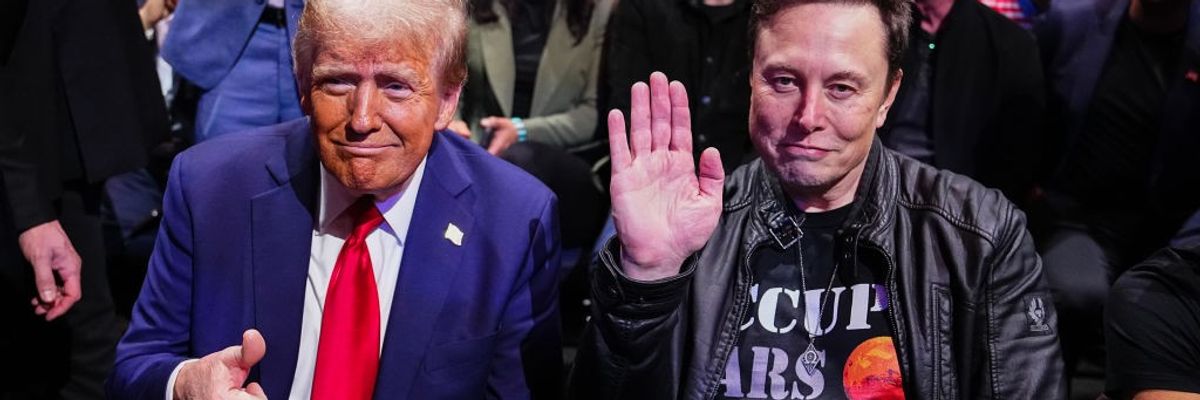
Then President-elect Donald Trump and Elon Musk pose for a photo during the UFC 309 event at Madison Square Garden on November 16, 2024 in New York City. (Photo: Jeff Bottari/Zuffa LLC via Getty Images)

“If you think back at the last economic crashes… the rich were able to buy up assets on the cheap and emerged even wealthier and more powerful than before,” noted one progressive commentator.

Are U.S. President Donald Trump, top adviser Elon Musk, and allied oligarchs deliberately trying to tank the economy in order to line their own gilded pockets?

More and more observers from both sides of the political aisle are asking the question this week as the U.S. president implemented steep tariffs on some of the country’s biggest trade partners, threatened a global trade war, and is taking chainsaw to government spending and programs—policies that, while inflicting economic pain upon nearly everyone else, could dramatically boost their already stratospheric wealth.

Numerous observers have likened it to the ” disaster capitalism” examined in Naomi Klein’s seminal 2007 book, The Shock Doctrine: The Rise of Disaster Capitalism—politicians and plutocrats exploit the chaos of natural or human-caused crises to push through unpopular policies like privatization and deregulation that harm the masses while boosting the wealth and power of the ruling class.

Economic alarm bells were already ringing before Trump’s 25% tariffs on most products from Canada and Mexico and an additional 10% on China—for a total of 20%—took effect on Tuesday, prompting retaliatory measures and threats of more to come.

Then, during his rambling joint address to Congress on Tuesday night, Trump threatened to impose reciprocal tariffs on every nation on Earth starting April 2 (because he “didn’t want to be accused of April Fools’ Day”) if those countries did not lower barriers to trade with the United States.

New York Times economic policy reporters Alan Rappeport and Ana Swanson called Trump’s sweeping tariffs “one of the biggest gambles of his presidency,” and a move “that risks undermining the United States economy.”

But what if that’s the whole point?

“I’ve been entertaining this theory a little bit more lately, because [Trump’s] economic moves seem so stupid and terrible and counterproductive without thinking that he is intentionally trying to cause harm,” progressive political commentator Krystal Ball—who also has a degree in economics and is a certified public accountant— said Tuesday on the social media site X.

Ball cited an X post by Saikat Chakrabarti, a progressive Democrat running for Congresswoman Nancy Pelosi’s (D-Calif.) House seat who worked on Wall Street for six years and helped found the online payment processing company Stripe, in which he accused Trump of “manufacturing a recession.”

“But it makes sense when you realize his goal is to create something like Russia where the economy is run by a few oligarchs loyal to him,” Chakrabarti added. “Creating that state is hard in a large, dynamic, powerful economy with too many actors who can oppose him. So he’s accelerating concentrating money and power into the hands of his loyalists while he crashes the rest out.”

Responding to this, Ball asserted that “at this point, until proven otherwise, the primary actor in the government and the economy is actually Elon, so I think it makes sense to think of Elon’s incentives here and what he may actually want to accomplish.”

“If you think back at the last economic crashes—both in Covid and in the 2008 financial crash—while initially everyone suffered, including the rich, out of both, the rich were able to buy up assets on the cheap and emerged even wealthier and more powerful than before,” she noted.

“So in 2008, not only did they get their own custom bailout, but they were able to buy housing stock at absurdly low prices,” Ball recalled. “The rich got richer than ever, inequality skyrocketed, and the big banks got bigger than ever.”

“Same deal with the Covid-era recession,” she continued. “So, while again, everyone suffered initially, there was a huge bailout package which, yes, did benefit ordinary people, but if you look at who came out really on top… you could see people like Elon Musk, people like Jeff Bezos, people like Mark Zuckerberg getting far wealthier. Their net worths, which were already very high, skyrocketed beyond anyone’s wildest dreams.”

Indeed, as Common Dreams reported, 700 billionaires got $1.7 trillion richer during two years of pandemic. Between March 2020 and April 2022, Musk got 10 times richer, while Zuckerberg’s net worth more than tripled and Bezos’ grew by nearly $80 billion, according to Forbes.

“Here’s the other piece that’s worth thinking about as well,” Ball added. “Crash and crisis leads to governments and authoritarian leaders claiming more power for themselves. They can use the crisis and the emergency as a justification for taking on extraordinary powers and for taking extraordinary measures… measures that can be custom fit to primarily benefit oligarchs like Elon Musk.”

“So I don’t know guys, while we’re running around here going… ‘can’t they understand how this is going to be devastating for the economy,’ maybe they do understand,” she concluded, “and maybe that’s kind of the point.”

Original article by Brett Wilkins republished from Common Dreams under Creative Commons (CC BY-NC-ND 3.0). 

Neo-Fascist Climate Science Denier Donald Trump says Burn, Baby, Burn.
Elon Musk urges you to be a Fascist like him, says that you can ignore facts and reality then.

Would love the explainer on why they are pushing us into a (likely) recession

dizzy: While it is accepted that the filthy rich benefit from economic collapse I suspect that there might be a more deliberate action to benefit certain actors more directly.

I suggest that you compare to the experience of short-lived former Prime Minister Liz Truss in UK. She was also supported and followed the instruction of an established, influential think-tank. Powerful and wealthy Capitalists may have benefited directly from market reactions to their directed actions. I would look at hedge funds and similar actors associated with those respective think tanks. Is it the same actor dominating and directing both think-tanks? Was the Liz Truss experience an initial test run?

Continue ReadingCritics Ask If Trump and Musk Are ‘Intentionally Crashing the Economy’

Will Trump’s entire presidency be as damaging as his first month?

Spread the love

Original article by Paul Rogers republished from Open Democracy under a Creative Commons Attribution-NonCommercial 4.0 International licence

Ater a disastrous press conference, it may be Trump, not Zelenskyy, who needs to watch his back
 | Andrew Harnik/Getty Images

From blowing up at Zelenskyy to fast-tracking Executive Orders, what can we learn from Trump’s recent behaviour?

Donald Trump’s presidency has barely entered its second month, and the change he has brought about has already been so significant and so rapid that it is hard to imagine how his administration will evolve in the long term.

The substantial changes are, in part, due to the extensive planning done in anticipation of his winning a second term. The 900-page Project 2025 put together by the Heritage Foundation has provided a blueprint for Trump’s far-right conservatism that, combined with the decision to act very fast, has allowed him to already issue more than sixty Executive Orders – catching opponents off-guard.

Looking to the future may be better helped by understanding both Trump’s behaviour and his overall outlook on life, with two recent examples pointing the way. Some commentators see the president as an unpredictable figurehead who is hardly able to direct affairs, but that doesn’t face up to his being the locus of power for now and, in any case, he has plenty of determined advisers who have been waiting years for his second presidency.

The first example of Trump’s behaviour was shown by his reaction to a tragedy that happened just after his inauguration, when an American Airlines flight and a US Army helicopter collided and crashed into the Potomac River close to Ronald Reagan National Airport in Washington, DC. All 67 people on board the two aircraft were killed.

While the cause of the crash is still under investigation, within hours Trump had blamed the diversity-linked hiring policies of previous Democrat administrations, claiming they had lowered personnel standards in air traffic control. A tragedy became an occasion for immediate political point scoring.

More recently, we have seen Trump use social media to promote the new ‘Trump Gaza’. The president shared a bizarre AI-generated video in which the area had been ethnically cleansed of its Palestinian population and transformed into “the Riviera of the Middle East”. Perhaps most telling is the full-colour representation of the main street, which Trump envisages as being dominated by a 60-foot high golden statue of himself.

Together, these instances point to someone who is comprehensively self-obsessed. He might be seen as an egotist or narcissist but certainly has an element of the solipsist in his make-up as well. He is, in other words, beyond egocentric.

But Trump’s impact on the world stage has to reckon with how the world is already changing, especially the rise of the global oligarchy, with vast power concentrated in the hands of a few hundred super-rich individuals. It’s clear that the president views these people as the true exemplars of success – he has formed a singularly powerful group of them around him.

Most notable among Trump’s circle of favoured oligarchs is Elon Musk, who supported his 2024 election campaign to the tune of $277m and has since been given an unofficial role in government and attended Cabinet meetings and Oval Office press conferences.

The wealth of Musk and two other oligarchs close to Trump, Jeff Bezos and Mark Zuckerberg, extends to $905bn, as US Senator Bernie Sanders reminded us last month. Writing in the Guardian, Sanders pointed out that this is “more wealth than the bottom half of American society – 170 million people”, adding that “since Trump’s election their wealth has grown by $217bn”.

This is in line with the findings in Oxfam’s 2025 Davos Report, which last week reported that while the number of people in poverty has remained near stagnant for the past 35 years, extreme wealth is surging. Four more people become billionaires each week, and the world is now on course to have five trillionaires and well over four thousand billionaires within the next decade.

The rising global oligarchy is not easily mapped with precision. Some members of the super-rich stay well out of the public eye, a few become patrons of the arts and philanthropists, but many others are heavily involved in the use of political power.

Though a degree of oligarchic power is evident in many countries worldwide, there are particular concentrations in a handful of nations, particularly Russia, China, India and the US – where Mark Twain’s quip about having “the best government money can buy” still stands.

Between Trump’s personality and his billionaire associates, the best guide to the next four years is to simply assume that ‘self’ and ‘wealth’ will be the president’s constant driving forces. It is not a happy prospect and will require persistent opposition, combined with repeated expressions of more positive ways forward. But is there anything that might limit him as he works to remake the US?

The first answer might just be his very associates. Many incredibly wealthy people are used to getting their own way, which could easily lead to disagreements sufficient to unbalance the administration. That will be much to the dislike and anger of Trump, who may well end up causing great disruption as he finds and disposes of the scapegoats who can keep the blame well away from him.

Then there is internal opposition stemming from numerous legal challenges that are already being mounted, many of them in recognition of the mass use of executive orders, which may undermine the authority of Article II of the US constitution.

Trump is also likely to run into problems due to the huge and vast array of experience and knowledge that will have been lost as a result of his administration’s decision to fire many thousands of federal employees from the Internal Revenue Service, Department of Energy, the Department of Agriculture, the Forestry Service, National Parks, US AID and elsewhere. This is eventually likely to lead to numerous mistakes and delays right across government.

Then there is the matter of US foreign policy, where the ‘Trump Gaza’ fiasco is the clearest possible indicator that Trump just does not have a clue how many people feel. Beyond that, though, is the question of Trump’s view of Vladimir Putin. It is becoming uncomfortably clear that either the Russian president has some kind of hold over Trump or else Trump really does see him as simply another very powerful and hugely rich person just like himself – a kindred spirit in a new oligarchic world of disorder.

This leads to one other question: how long will Trump even be in the White House? A clue may come from Friday’s notorious press conference with Ukrainian president Volodymyr Zelenskyy. People across the world will have seen clips of Zelenskyy being hung out to dry by Trump and his vice-president, JD Vance, but watching the entire 45-minute video, not just the blow-up, reveals a rather different element.

The conference was largely good-natured for the first 35 minutes, with Zelenskyy comfortably holding his own and Trump even praising Ukraine while doing his usual trick of claiming to be the greatest American since George Washington. It is only at the end that Vance moves in aggressively on Zelensky in a manner seemingly designed to get Trump to lose his cool.

Perhaps it is Trump, not Zelensky, who should be worried when reflecting on the experience – and who should watch his back. It may have been on the last day of February but Vance’s behaviour was not too far from the Ides of March.

Original article by Paul Rogers republished from Open Democracy under a Creative Commons Attribution-NonCommercial 4.0 International licence

Continue ReadingWill Trump’s entire presidency be as damaging as his first month?

Capitalism’s Free Speech Trap: Bezos Shows How Billionaires Set the Boundaries of Debate

Spread the love

Original article by Peter Bloom republished from Common Dreams under Creative Commons (CC BY-NC-ND 3.0). 

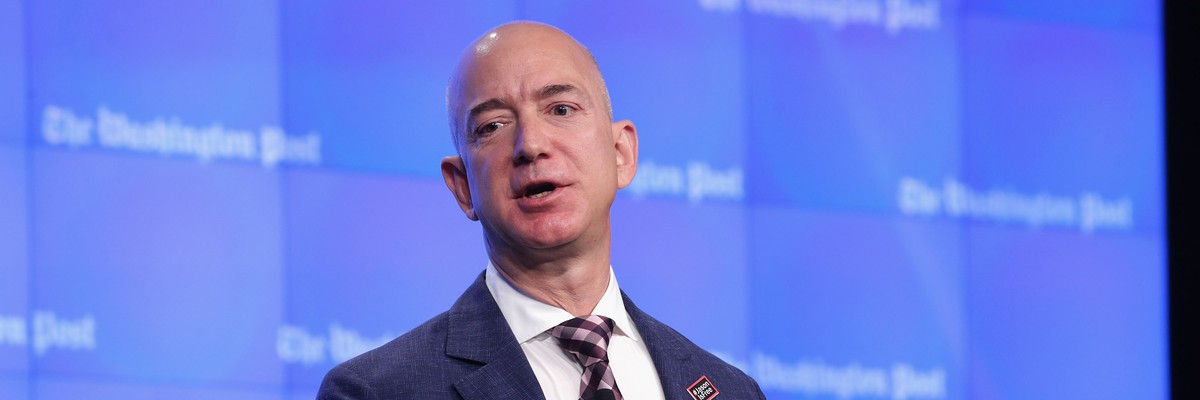
Amazon founder and Washington Post owner Jeff Bezos delivers remarks during the opening ceremony of the media company’s new location January 28, 2016 in Washington, D.C. (Photo: Chip Somodevilla/Getty Images)

The Washington Post’s shift toward free-market advocacy is not simply an editorial decision; it is a strategic move to reinforce the dominant ideological framework that benefits the billionaire class.

The recent directive by Jeff Bezos that The Washington Post editorial section should promote “personal liberties and free markets” is a stark reminder of how freedom under capitalism often boils down to the freedom of economic elites to dictate the parameters of public discourse. While Bezos has suggested that social media provides alternative perspectives, thus absolving his newspaper of the responsibility to represent diverse viewpoints, his decision is part of a broader trend of billionaire media ownership shaping acceptable discourse.

This phenomenon is visible across digital platforms as well. Elon Musk’s control over X (formerly Twitter) has demonstrated how ownership can shape public debate—both through direct interventions, such as the alleged suppression of progressive perspectives, and through more subtle changes to platform algorithms. Similarly, Mark Zuckerberg’s Meta has faced repeated allegations of privileging certain political narratives while suppressing others, including ending its “fact checking” policy that could challenge far-right viewpoints.

Perhaps the most glaring contradiction in Bezos’ advocacy for free markets is the extent to which he, and other billionaires like him, have benefited from state intervention as part of an intentional strategy of “corporate welfare.”

In each case, the rhetoric of “free speech” is selectively applied. While these platforms and newspapers claim to support open debate, their policies ultimately reflect the ideological preferences of their owners. This demonstrates a fundamental truth: In capitalist societies, freedom of expression is often contingent on the interests of those who control the means of communication. The Washington Post’s shift toward free-market advocacy is not simply an editorial decision; it is a strategic move to reinforce the dominant ideological framework that benefits the billionaire class.

The Myth of Meritocracy and the Far-Right’s War on DEI

Bezos’ framing of free markets as inherently linked to personal liberties exposes a deeper ideological assumption—namely, that economic success is the result of individual talent and merit rather than systemic privilege. This assumption is not unique to Bezos but is foundational to the way many economic elites understand their own wealth and influence.

The logic behind Bezos’ editorial direction is similar to the arguments used by the contemporary far-right to attack Diversity, Equity, and Inclusion (DEI) initiatives. The opposition to DEI is rooted in a desire to preserve the myth that success is determined purely by hard work and ability, rather than by racial, gender, or class privilege. By rejecting policies that acknowledge structural inequalities, The far-right seeks to uphold a narrative that justifies existing economic and social hierarchies.

This worldview is deeply intertwined with the ideology of neoliberalism, which insists that markets are neutral mechanisms that reward the most capable individuals. However, history shows that markets are anything but neutral. The barriers faced by marginalized groups are not simply the result of individual shortcomings; they are the product of centuries of systemic exclusion. The far-right’s attack on DEI serves to obscure these realities, just as Bezos’ insistence on free markets seeks to erase the role of privilege and power in determining economic outcomes.

By positioning The Washington Post as a champion of free markets, Bezos is promoting the idea that capitalism functions as a pure meritocracy. This serves not only to legitimize his own position but also to delegitimize calls for policies that challenge structural inequality, whether in the form of DEI programs, labor protections, or wealth redistribution measures.

The Illusion of the Free Market and Its Political Implications

Perhaps the most glaring contradiction in Bezos’ advocacy for free markets is the extent to which he, and other billionaires like him, have benefited from state intervention as part of an intentional strategy of “corporate welfare.” The notion of a truly free market, where economic actors compete on equal footing without government interference, is a fantasy. In reality, corporations like Amazon have thrived not because of unregulated competition, but because of significant government support.

From tax incentives to government contracts, Amazon has received billions in subsidies that have allowed it to dominate the retail and logistics industries. Moreover, the U.S. government plays a critical role in enforcing corporate-friendly trade policies, suppressing labor movements, and protecting the interests of multinational corporations abroad. These interventions are rarely acknowledged in discussions of free markets, yet they are crucial to understanding the power dynamics of contemporary capitalism.

If freedom under capitalism ultimately means the freedom of the wealthy to dictate the terms of discourse, then the very concept of free speech is in jeopardy.

Politically, Bezos’ editorial directive at The Washington Post serves to strengthen a broader ideological alignment between neoliberal economics and far-right nationalism. By framing free-market capitalism as an essential component of personal liberty, Bezos is laying the groundwork for a political agenda that fuses economic libertarianism with nationalist conservatism. This is significant because it provides an ideological foundation for challenging emerging economic policies that deviate from neoliberal orthodoxy—such as the rise of protectionism in response to globalization.

This alignment between free-market ideology and far-right nationalism is not new. Historically, neoliberalism has often coexisted with reactionary politics, as seen in the economic policies of figures like former U.S. President Ronald Reagan and former U.K. Prime Minister Margaret Thatcher. Today, this synthesis is being revived as right-wing populists seek to defend corporate interests while simultaneously appealing to nationalist sentiments. Bezos’ intervention in The Washington Post should be understood within this broader context: It is not just about shaping editorial policy but about consolidating an ideological framework that benefits economic elites while limiting the scope of acceptable political debate.

The Dangers of Billionaire-Controlled Media

Bezos’ decision to impose a free-market ideology on The Washington Post is not an isolated event; it is part of a larger trend in which media ownership is used to shape public discourse in ways that serve elite interests. This phenomenon extends beyond traditional journalism to social media platforms, where billionaires like Musk and Zuckerberg wield immense power over the flow of information.

At its core, this issue is about more than just media bias—it is about the fundamental tension between democracy and concentrated economic power. A truly free and open society requires a diversity of perspectives, yet the dominance of billionaire-controlled media threatens to constrain the range of acceptable debate. If freedom under capitalism ultimately means the freedom of the wealthy to dictate the terms of discourse, then the very concept of free speech is in jeopardy.

The consolidation of media power in the hands of a few ultra-wealthy individuals raises urgent questions about the future of democratic debate. If we are to challenge the ideological hegemony of economic elites, we must first recognize the mechanisms through which they shape public discourse. Bezos’ editorial mandate is not just about The Washington Post—it is a reflection of the broader struggle over who gets to define the boundaries of political and economic debate in the 21st century.

Original article by Peter Bloom republished from Common Dreams under Creative Commons (CC BY-NC-ND 3.0). 

Continue ReadingCapitalism’s Free Speech Trap: Bezos Shows How Billionaires Set the Boundaries of Debate

‘Extremely Dangerous Time’: Sanders Warns of Oligarchs’ War on Working Class

Spread the love

Original article by Jessica Corbett republished from Common Dreams under Creative Commons (CC BY-NC-ND 3.0).

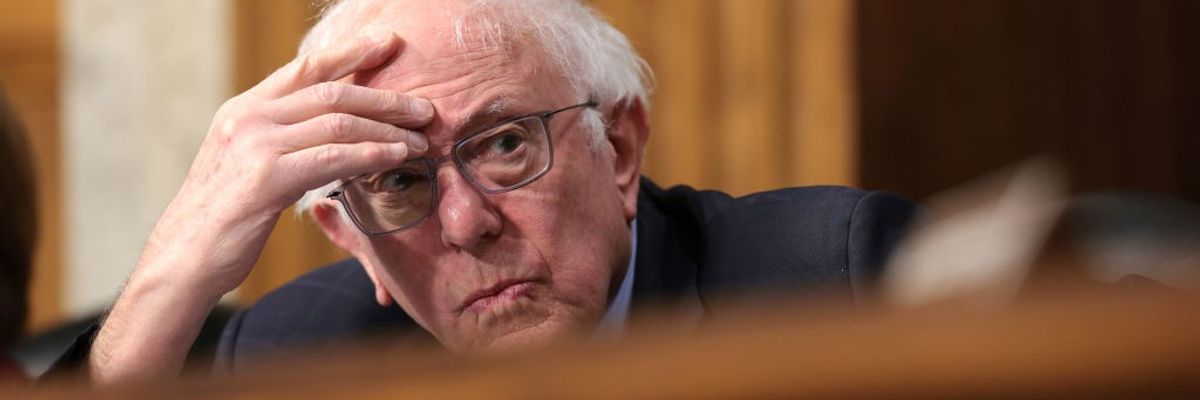
U.S. Sen. Bernie Sanders (I-Vt.) attends a Senate hearing on January 29, 2025 in Washington, D.C. (Photo: Win McNamee/Getty Images)

“Does anyone really think that the oligarchs give a damn about ordinary Americans?” the senator asked. “Trust me, they don’t.”

As U.S. President Donald Trump and billionaire Elon Musk on Tuesday continued their effort to gut the federal government, Sen. Bernie Sanders warned that “the oligarchs, with their unlimited amounts of money, are waging a war on the working class of our country, and it is a war that they are intent on winning.”

A week after delivering a speech that sounded the alarm about “America’s dangerous movement toward oligarchy, authoritarianism, and kleptocracy,” Sanders (I-Vt.) took the Senate floor again to target the world’s three richest people—Musk, Jeff Bezos, and Mark Zuckerberg—and the politicians who serve them.

“We are living in an extremely dangerous time,” the seantor said Tuesday. “Future generations will look back at this moment—what we do right now—and remember whether we had the courage to defend our democracy against the growing threats of oligarchy and authoritarianism.”

As chair of Trump’s so-called Department of Government Efficiency (DOGE), Musk’s targets have included the U.S. Agency for International DevelopmentConsumer Financial Protection BureauDepartment of EducationNational Oceanic and Atmospheric Administration, and a critical U.S. Treasury Department payment system. Reporting—and remarks from the billionaire—suggest that the agencies responsible for Medicaid, Medicare, and Social Security are next.

“As we speak, right now, Elon Musk, the wealthiest man on the planet, is attempting to dismantle major agencies of the federal government which are designed to protect the needs of working families and the disadvantaged,” said Sanders. “These agencies were created by the U.S. Congress and it is Congress’ responsibility to maintain them, to reform them, or to end them. It is not Mr. Musk’s responsibility. What Mr. Musk is doing is patently illegal and unconstitutional—and must be ended.”

Sanders also detailed Trump and his allies’ attacks on the federal judiciary, which has delivered a series of blows to the Republican president’s agenda since he took office last month.

“Mr. Trump and his friends are not just trying to undermine two of the three pillars of our constitutional government—Congress and the courts—they are also going after the media, in a way that we have never seen in the modern history of this country,” the senator said. While recognizing that the media “makes mistakes every day,” he added that “I do hope that every member of Congress understands that you cannot have a functioning democracy, you cannot have a free flow of information, you cannot have the pursuit of truth, without an independent press.”

The senator also how the top three billionaires impact what information reaches people by buying news outlets and social media platforms—as Musk did with Twitter, which he rebranded X, and Bezos did with The Washington Post and Twitch. Zuckerberg, meanwhile, has made his money through Meta, the parent company of Facebook and Instagram.

“They will use the enormous media operations they own to deflect attention away from the impact of their policies while they ‘entertain us to death,'” Sanders warns. “They and their fellow oligarchs will continue within our corrupt campaign finance system to spend huge amounts of money to buy politicians in both major political parties.”

“Does anyone really think that the oligarchs give a damn about ordinary Americans?” he asked. “Trust me, they don’t.”

Sanders warned that “if we do not stop them, they will soon be going after the healthcare, nutrition, housing, and educational programs that protect the most vulnerable people in our country—all so that they can raise they money they need to provide huge tax breaks for themselves and for others billionaires. As modern-day kings who believe they have the absolute right to rule, they will sacrifice, without hesitation, the well-being of working people in order to protect their power and their privileges.”

However, he also stressed that “the worst fear of the ruling class of our country is that the American people—whether they are Black or white or Latino, whether they are urban or rural, whether they are young or old, gay or straight, whatever—the fear of the ruling class is that the American people come together to demand a government that represents all of us, not just the people on top.”

“The oligarch’s nightmare is that we will not allow ourselves to be divided up by race, religion, sexual orientation, or country of origin and will come together and have the courage to take them on,” he declared. “If we stand together, we’re gonna win this fight, and not only will we save American democracy, we’re gonna create the kind of nation that I think most of us know we should become.”

Original article by Jessica Corbett republished from Common Dreams under Creative Commons (CC BY-NC-ND 3.0).

Elon Musk urges you to be a Fascist like him, says that you can ignore facts and reality then.
Climate Science Denier Donald Trump says Burn, Baby, Burn.
Continue Reading‘Extremely Dangerous Time’: Sanders Warns of Oligarchs’ War on Working Class

Trump 2.0: the rise of an ‘anti-elite’ elite in US politics

Spread the love
Elon Musk urges you to be a Fascist like him, says that you can ignore facts and reality then.

William Genieys, Sciences Po and Mohammad-Saïd Darviche, Université de Montpellier

US president Donald Trump is surrounded by a new cohort of politicians and officials. While one of his campaign promises was to overthrow the “corrupt elites” he accuses of flooding the American political arena, his second term in office has elevated elites chosen, above all, for their political loyalty to him.

The media’s focus on Trump’s comments on making Canada the 51st US state and annexing Greenland and billionaire Elon Musk’s support for some far-right parties in Europe has obscured the ambitious programme to transform the federal government that the new political elite intends to implement.

In the wake of Trump’s inauguration on January 20, the Republican elites most loyal to the MAGA (“Make America Great Again”) leader, who staunchly oppose Democratic elites and their policies, are operating amid their party’s control over the executive and legislative branches (at least until the midterm elections in 2026), a conservative-dominated Supreme Court that includes three Trump-appointed justices, and a federal judiciary that shifted right during his first term.

However, the political project of the Trumpist camp consists less of challenging elitism in general than attacking a specific elite: one particular to liberal democracies.

Castigating democratic elitism

Typical anti-elite political propaganda, along the lines of “I speak for you, the people, against the elites who betray and deceive you,” claims that a populist leader would be able to exercise power for and on behalf of the people without the mediation of an elite disconnected from their needs.

Political theorist John Higley sees behind this form of anti-elite discourse an association between so-called “forceful leaders” and “leonine elites” (who take advantage of the former and their political success): a phenomenon that threatens the future of Western democracies.

Since the Second World War, there has been a consensus in US politics on the idea of democratic elitism. According to this principle, elitist mediation is inevitable in mass democracies and must be based on two criteria: respect for the results of elections (which must be free and competitive); and the relative autonomy of political institutions.

The challenge to this consensus has been growing since the 1990s with the increased polarization of American politics. It gained new momentum during and after the 2016 presidential campaign, which was marked by anti-elite rhetoric from both Republicans and Democrats (such as senators Bernie Sanders and Elizabeth Warren). At the heart of some of their diatribes was an aversion to “the Establishment” on the east and west coasts of the United States, where many prestigious financial, political and academic institutions are based, and the conspiracy notion of the “deep state”.

The re-election of Trump, who has never admitted defeat in the 2020 presidential vote, growing political hostility and the direct involvement of tech tycoons in political communication –especially on the Republican side– further reinforce the denial of democratic elitism.

Trump’s populism from above: a revolt of the elites

The idea that democracy could be betrayed by “the revolt of the elites”, put forward by the US historian Christopher Lasch (1932-1994), is not new. For the anthropologist Arjun Appadurai, it is a particular feature of contemporary populism, which comes “from above.” Indeed, if the 20th century was the era of the “revolt of the masses”, the 21st century, according to Appadurai, “is characterized by the ‘revolt of the elites’.” This would explain the rise of populist autocracies (such as those currently led by Viktor Orban in Hungary, Recep Tayyip Erdogan in Turkey and Narendra Modi in India, and formerly led by Jair Bolsonaro in Brazil), but also the election successes of populist leaders in consolidated democracies (including those of Trump in the US, Giorgia Meloni in Italy, and Geert Wilders in the Netherlands, for example).

As Appadurai explains, the success of Trumpian populism, which represents a revolt by ordinary Americans against the elites, casts a veil over the fact that, following Trump’s victory in November, “it is a new elite that has ousted from power the despised Democratic elite that had occupied the White House for nearly four years.”

The aim of this “alter elite” is to replace the “regular” Democrat elites, but also the moderate Republicans, by deeply discrediting their values (such as liberalism and so-called “wokeism”) and their supposedly corrupt political practices. As a result, this populism “from above” carried out by the President’s supporters constitutes an alternative elite configuration, the effects of which on American democratic life could be more significant than those observed during Trump’s first term.

Beyond the idea of a ‘Muskoligarchy’

The idea that we are witnessing the formation of a “Muskoligarchy” –in other words, an economic elite (including tech barons such as Jeff Bezos, Mark Zuckerberg and Marc Andreessen) rallying around the figurehead of Elon Musk, whom Trump asked to lead what the president has called a “Department of Government Efficiency” (DOGE) –is seductive. It perfectly combines the vision of an alliance between a “conspiratorial, coherent, conscious” ruling class and an oligarchy made up of the “ultra-rich”. For the Financial Times columnist Martin Wolf, it is even a sign of the development of “pluto-populism”. (It is also worth noting that former president Joe Biden, in his farewell speech, referred to “an oligarchy… of extreme wealth” and “the potential rise of a tech-industrial complex.”)

However, some observers are cautious about the advent of a “Muskoligarchy.” They point to the sociological eclecticism of the new Trumpian elite, whose facade of unity is held together above all by a political loyalty, for the time being unfailing, to the MAGA leader. The fact remains, however, that the various factions of this new “anti-elite” elite are converging around a common agenda: to rid the federal government of the supposed stranglehold of Democratic “insiders.”

An ‘anti-elite’ elite against the ‘deep state’

In his presidential inauguration speech in 1981, Ronald Reagan said: “Government is not the solution to our problem; government is the problem.” The anti-elitism of the Trump elite is inspired by this diagnosis, and defends a simple political programme: rid democracy of the “deep state.”

Although the idea that the US is “beleaguered” by an “unelected and unaccountable elite” and “insiders” who subvert the general interest has been shown to be unfounded, it is nonetheless predominant in the new Trump Administration.

This conspiracy theory has been taken to the extreme by Kash Patel, the candidate being considered to head the FBI. In his book, Government Gangsters, a veritable manifesto against the federal administration, the former lawyer writes about the need to resort to “purges” in order to bring elite Democrats to justice. He lists around 60 people, including Biden, ex-secretary of state Hillary Clinton and ex-vice president Kamala Harris.

Government Gangsters, Kash Patel’s controversial book. Google Books

The appointment of Russell Vought as head of the Office of Management and Budget at the White House, a person who is known for having sought to obstruct the transition to the Biden Administration in 2021, also highlights the hard turn that the Trump administration is likely to take.

Reshaping the state around political loyalty

To “deconstruct the administrative state”, the “anti-elite” elites are relying on Project 2025, a 900-plus page programme report that the conservative think-tank The Heritage Foundation, which published it, says was produced by “more than 400 scholars and policy experts.” According to former Project 2025 director Paul Dans, “never before has the entire movement… banded together to construct a comprehensive plan” for this purpose. On this basis, the “anti-elite” elite want to impose loyalty to Project 2025 on federal civil servants.

But this idea is not new. At the end of his first term, Trump issued an executive order facilitating the dismissal of statutory federal civil servants occupying “policy-related positions” and considered to be “disloyal”. The decree was rescinded by president Biden, but Trump on his first day back in office signed an executive order that seeks to void Biden’s rescindment. As President, Trump is also able to allocate senior positions within the federal administration to his supporters.

The “anti-elite” elite not only want to reduce the size of the state, as was the case under Reagan’s “neoliberalism”, but to deconstruct and rebuild it in their own image. Their real aim is a more lasting victory: the transformation of democratic elitism into populist elitism.

William Genieys, Directeur de recherche CNRS au CEE, Sciences Po and Mohammad-Saïd Darviche, Maître de conférences, Université de Montpellier

This article is republished from The Conversation under a Creative Commons license. Read the original article.

Continue ReadingTrump 2.0: the rise of an ‘anti-elite’ elite in US politics