Wealth of World’s Richest Has Doubled Over Past Decade

Spread the love

Original article by Julia Conley republished from Common Dreams under Creative Commons (CC BY-NC-ND 3.0). 

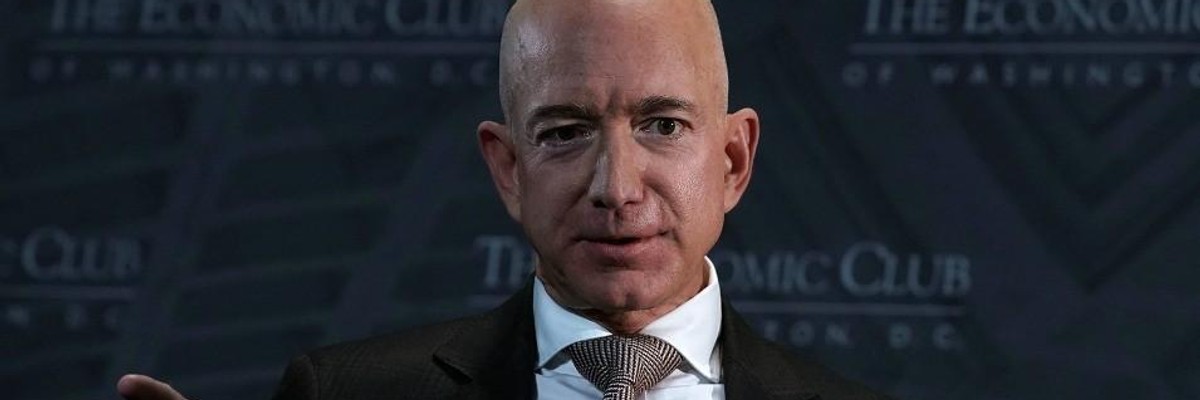
Amazion founder Jeff Bezos participates in a discussion during a Milestone Celebration dinner September 13, 2018 in Washington, D.C. (Photo: Alex Wong/Getty Images)

The total wealth of billionaires increased by 121% from 2015-24.

Driven largely by the accumulation of massive wealth by the richest people in the United States, the Swiss wealth manager UBS said Thursday the assets of billionaires around the world more than doubled over the past decade.

Between 2015-24, the total wealth of billionaires increased by 121%, from $6.3 trillion to $14 trillion.

Meanwhile, the MSCI AC World Index of global equities, which measures the performance of more than 3,000 stocks from both developed and emerging markets, rose by 73%.

The planet’s total gross domestic product is about $105.4 trillion, with a population of just over 8 billion, underscoring the extreme concentration of wealth among the very richest people.

The number of billionaires rose from 1,757 to 2,682 over the past decade, while the wealthiest people in the world boasted significant gains over just the past year.

Billionaires’ wealth jumped by about 17% in 2024, with the accumulation of wealth among the richest people in the U.S. offsetting a decline in China.

U.S. billionaires amassed wealth gains that were 27.6% higher than the previous year, accumulating a total of $5.8 trillion—more than 40% of international billionaire wealth.

The tax cuts pushed through by President-elect Donald Trump and the Republican Party in 2017 are still in effect in the U.S. Tax policy analysts have found that the law was skewed to the rich, with households in the top 1% of incomes expecting to receive an average tax cut of more than $60,000 in 2025 compared to an average tax cut of less than $500 for people in the bottom 60%.

As Common Dreams reported this week, the top 12 U.S. billionaires now control $2 trillion. The wealth of the four richest people in the U.S.—Tesla CEO Elon Musk, Amazon founder Jeff Bezos, Oracle co-founder Larry Ellison, and Meta CEO Mark Zuckerberg—has hit $1 trillion.

https://twitter.com/OurRevolution/status/1865044573086470545?ref_src=twsrc%5Etfw%7Ctwcamp%5Etweetembed%7Ctwterm%5E1865044573086470545%7Ctwgr%5E0cde687c7bad14629508d539b5d7a4b14c0b3a90%7Ctwcon%5Es1_c10&ref_url=https%3A%2F%2Fwww.commondreams.org%2Fnews%2Fhow-many-billionaires-in-world

“These four men were worth $74 billion 12 short years ago,” said Americans for Tax Fairness. “Tax billionaires.”

At the G20 Summit last month, world leaders agreed to “engage cooperatively to ensure that ultra-high-net-worth individuals are effectively taxed.”

Original article by Julia Conley republished from Common Dreams under Creative Commons (CC BY-NC-ND 3.0). 

Keir Starmer warns against following the https://onaquietday.org blog.
Continue ReadingWealth of World’s Richest Has Doubled Over Past Decade

Green Group Sounds Alarm Over Meta’s Nuclear Power Plans

Spread the love

This article was originally posted 6/12/24 but was deleted probably by mistake.

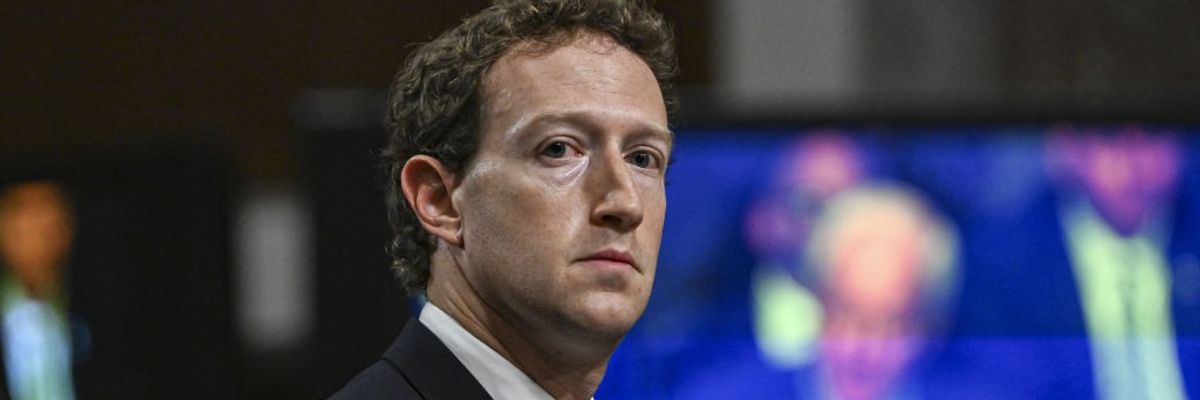
Mark Zuckerberg, CEO of Meta, testifies before a U.S. Senate Judiciary Committee hearing on January 31, 2024, in Washington, D.C.
(Photo: Celal Gunes/Anadolu via Getty Images)

“In the blind sprint to win on AI, Meta and the other tech giants have lost their way,” said a leader at Environment America.

Environmental advocates this week responded with concern to Meta looking for nuclear power developers to help the tech giant add 1-4 gigawatts of generation capacity in the United States starting in the early 2030s.

Meta—the parent company of Instagram, Facebook, WhatsApp, and more—released a request for proposals to identify developers, citing its artificial intelligence (AI) innovation and sustainability objectives. It is “seeking developers with strong community engagement, development, …permitting, and execution expertise that have development opportunities for new nuclear energy resources—either small modular reactors (SMR) or larger nuclear reactors.”

The company isn’t alone. As TechCrunch reported: “Microsoft is hoping to restart a reactor at Three Mile Island by 2028. Google is betting that SMR technology can help it deliver on its AI and sustainability goals, signing a deal with startup Kairos Power for 500 megawatts of electricity. Amazon has thrown its weight behind SMR startup X-Energy, investing in the company and inking two development agreements for around 300 megawatts of generating capacity.”

In response to Meta’s announcement, Johanna Neumann, Environment America Research & Policy Center’s senior director of the Campaign for 100% Renewable Energy, said: “The long history of overhyped nuclear promises reveals that nuclear energy is expensive and slow to build all while still being inherently dangerous. America already has 90,000 metric tons of nuclear waste that we don’t have a storage solution for.”

“Do we really want to create more radioactive waste to power the often dubious and questionable uses of AI?” Neumann asked. “In the blind sprint to win on AI, Meta and the other tech giants have lost their way. Big Tech should recommit to solutions that not only work but pose less risk to our environment and health.”

“Data centers should be as energy and water efficient as possible and powered solely with new renewable energy,” she added. “Without those guardrails, the tech industry’s insatiable thirst for energy risks derailing America’s efforts to get off polluting forms of power, including nuclear.”

In a May study, the Electric Power Research Institute found that “data centers could consume up to 9% of U.S. electricity generation by 2030—more than double the amount currently used.” The group noted that “AI queries require approximately 10 times the electricity of traditional internet searches and the generation of original music, photos, and videos requires much more.”

Meta is aiming to get the process started quickly: The intake form is due by January 3 and initial proposals are due February 7. It comes after a rare bee species thwarted Meta’s plans to build a data center powered by an existing nuclear plant.

Following the nuclear announcement, Meta and renewable energy firm Invenergy on Thursday announced a deal for 760 megawatts of solar power capacity. Operations for that four-state project are expected to begin no later than 2027.

Original article by Jessica Corbett republished from Common Dreams under Creative Commons (CC BY-NC-ND 3.0).

Continue ReadingGreen Group Sounds Alarm Over Meta’s Nuclear Power Plans

‘Unsettling New Milestone’: Top 12 US Billionaires Now Control $2 Trillion in Wealth

Spread the love

Original article by Eloise Goldsmith republished from Common Dreams under Creative Commons (CC BY-NC-ND 3.0).
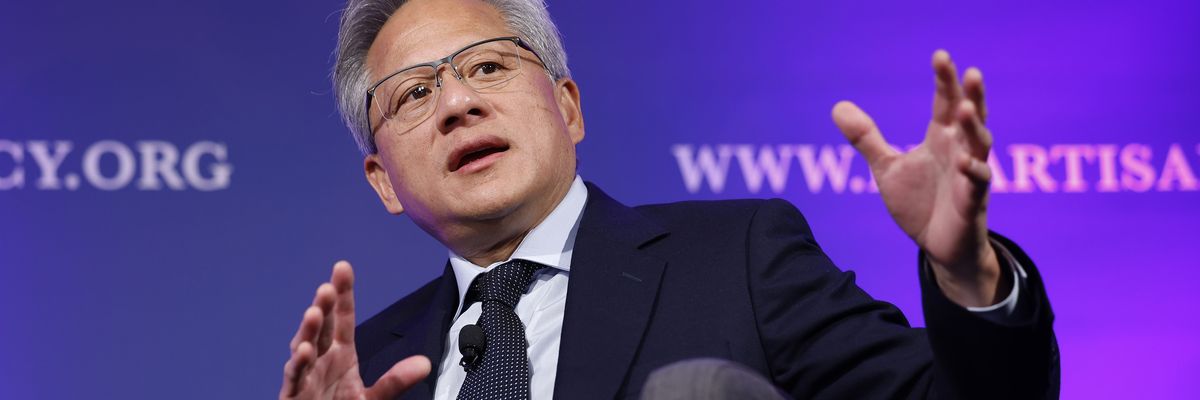
Jensen Huang of Nvidia speaks about the future of artificial intelligence and its effect on energy consumption and production at the Bipartisan Policy Center on September 27, 2024 in Washington, DC. (Photo by Chip Somodevilla/Getty Images)

“The oligarchic dozen is richer than ever, and they are endowed with extreme material power that can be used to pursue narrow political interests at the expense of democratic majorities,” according to the author of a new analysis.

Just 12 U.S. billionaires now have a collective net worth of over $2 trillion—a figure that amounts to a little less than a third of total federal spending in 2023—according to an analysis out Tuesday from Inequality.org, a project of the Institute for Policy Studies (IPS).

The $2 trillion number is also twice the amount of wealth that the top 12 US billionaires held in 2020, according to researchers at IPS, a progressive organization.

The full list of 12 billionaires includes Jeff Bezos, Bill Gates, Mark Zuckerberg, Warren Buffett, Elon Musk, Steve Ballmer, Larry Ellison, Larry Page, Sergey Brin, Jim Walton, Rob Walton, and Jensen Huang.

“This is an unsettling new milestone for wealth concentration in the United States. The oligarchic dozen is richer than ever, and they are endowed with extreme material power that can be used to pursue narrow political interests at the expense of democratic majorities,” wrote the author of the analysis, Omar Ocampo, a researcher at IPS.

New to the “oligarchic dozen” is Jensen Huang, the co-founder and CEO of the tech company Nvidia. Nvidia, which became the most valuable publicly traded company this year, has seen its profits jump thanks to the world’s ravenous appetite for the artificial intelligence chips that the firm produces. According to the analysis, Huang’s personal wealth “has skyrocketed from $4.7 billion in 2020 to $122.4 billion—a mind-boggling 2,504 percent increase—over the last four years.”

Each of the billionaires on the list “owns or is a controlling shareholder of a business that is investing billions of dollars in artificial intelligence,” according to Ocampo, which raises concerns about their respective carbon footprints.

Fueling AI is energy intensive, and AI data centers in the U.S. are largely powered by fossil fuels, meaning their proliferation poses a threat to the environment and a transition to a green economy.

Ocampo also discusses the political reach of the billionaires on the list. Elon Musk and Jeff Bezos, who respectively own X and The Washington Post, “have both purchased large media platforms, which has granted them the ability to set the terms of public debate with the hopes of influencing public opinion in their favor.”

Musk specifically has established himself as a major power broker within the GOP. The billionaire spent hundreds of millions helping to re-elect Donald Trump and is now poised to play a major role in the president-elect’s administration, helping oversee a new advisory committee tasked with slashing government spending.

As of early December, Trump had tapped an “unprecedented” total of seven reported billionaires for key positions in his administration, according to a separate piece of analysis by Inequality.org.

“We see the effects of this growing concentration of wealth and economic inequality everywhere—plutocratic influence on our politics, wealth transfers from the bottom to the top, and the acceleration of climate breakdown,” Ocampo wrote on Tuesday.

Original article by Eloise Goldsmith republished from Common Dreams under Creative Commons (CC BY-NC-ND 3.0).
Continue Reading‘Unsettling New Milestone’: Top 12 US Billionaires Now Control $2 Trillion in Wealth

Meta and Koch Industries to Sponsor Event Featuring Climate Denier Barry Cooper 

Spread the love

Original article by Geoff Dembicki republished from DeSmog.

Facebook founder Mark Zuckerberg pledged $33 million to fight climate change in 2021. Credit: Anthony Quintano / Wikimedia Commons

Chris Rufo, the conservative activist who created a moral panic around ‘critical race theory,’ is headlining.

Meta CEO Mark Zuckerberg has called climate change “one of the most urgent challenges of our time” and pledged tens of millions of dollars to help fight it.

Yet his company Meta, the owner of Facebook and Instagram, is listed as a “gold sponsor” for an event in Alberta next month featuring Barry Cooper, a University of Calgary political scientist who’s argued that there is “growing scientific skepticism” about whether humans are causing the climate to warm. 

Another gold sponsor is Koch Industries, the oil and gas company whose billionaire owner Charles Koch, along with his late brother David, has given more than $100 million since 1997 to organizations that dispute or deny climate science, according to Greenpeace calculations. 

The event is headlined by Chris Rufo, the U.S. conservative activist who created a moral panic around “critical race theory” and has argued that “transgenderism” is “threatening families and kids all over the United States.”

“It’s pretty unusual,” Sean Buchan, a researcher with the organization Climate Action Against Disinformation (CAAD), said of Meta’s sponsorship. “They generally speaking do their best to have a clean public image. These are some pretty toxic brands to be associated with.”

Meta didn’t reply to detailed questions from DeSmog. 

Chris Rufo leads an ongoing culture war against diversity and inclusion. Credit: Stanford Classical Liberalism Initiative

Rufo Influenced Donald Trump

The event, which takes place September 21, is a regional networking conference for the Canada Strong and Free Network, an organization committed to building the country’s conservative movement. “We aim to delve deep into the foundational principles that have shaped our nation and its conservative values,” a description of the conference reads

Rufo, the keynote speaker, is advertised as being “a prominent figure in the fight against critical race theory in American institutions.” His activism reportedly helped inspire President Donald Trump to sign an executive order banning racial sensitivity training in federal institutions. 

The Southern Poverty Law Center describes Rufo as a leader “in the right-wing anti-LGBTQ+ culture war.” And the Guardian reported earlier this year that he maintains a close relationship with a rightwing magazine called IM-1776 that “regularly showers praise on dictators and authoritarians, puffs racist ideologues, and attacks liberal democracy.”

University of Calgary political scientist Barry Cooper has argued there is ‘growing scientific skepticism’ about human-caused warming. Credit: Conversations That Matter

Denying Climate Since 2005

He’ll be joined at the event by Cooper, a longtime climate change denier. Cooper was involved with the release of a 23-minute video from 2005 entitled “Climate Catastrophe Cancelled: What You’re Not Being Told About the Science of Climate Change.” 

Through his position at the University of Calgary, Cooper helped facilitate fundraising for an organization called Friends of Science, which in 2014 ran a billboard in Calgary stating that “the sun is the main driver of climate change. Not You. Not CO2.”

Cooper in 2021 wrote a report for the Alberta government where he questioned whether humans are the main driver of climate change and claimed incorrectly that “there are good reasons for a decline in the plausibility of alarmist rhetoric.” 

Meta claims to be taking steps to combat misleading climate claims on its platforms, including partnering with “more than 90 independent fact-checking organizations.” The company characterizes misinformation as “false information that outside experts say undermines the existence or impacts of climate change, misrepresents scientific data and mischaracterizes mitigation and adaptation efforts.”  

Yet Meta’s enforcement of penalties against accounts that spread false claims is haphazard and lacking, CAAD argued in a report last year. Sponsoring a conservative networking event alongside Koch Industries which features a known climate denier would seem to flout the company’s policies on misinformation entirely, Buchan argues. 

“I’m kind of surprised,” he said. “To sponsor something like this so publicly seems like a reputational risk.”

Original article by Geoff Dembicki republished from DeSmog.

Continue ReadingMeta and Koch Industries to Sponsor Event Featuring Climate Denier Barry Cooper