Trump returns: nine things to expect for the climate

Spread the love

Below the Sky/Shutterstock

Jack Marley, The Conversation

Climate scientists are probably among those most aggrieved by Donald Trump’s return as US president.

Trump has scoffed at the increasingly dire warnings of these scientists and declared his enthusiasm for digging up and burning the coal, oil and gas that is overheating Earth. His empowerment of the far right dims prospects for collective solutions to collective problems, but what is he likely to change about US climate policy?


This roundup of The Conversation’s climate coverage comes from our award-winning weekly climate action newsletter. Every Wednesday, The Conversation’s environment editor writes Imagine, a short email that goes a little deeper into just one climate issue. Join the 40,000+ readers who’ve subscribed.


Trump has not published a climate agenda. To discern his impact on domestic and international policy, we have to sift through statements, appointments to political positions and the record of his first term.

Here, our academics glean grim portents for the years ahead – and some continuities with supposedly pro-climate presidents of the past.

1. It’s still ‘drill, baby, drill’

Trump’s three-word campaign slogan, “drill, baby, drill”, is intended to sum up his plans for the US oil and gas industry. It’s also an apt summary of existing US energy policy.

Since 2008, when Democrat Barack Obama was elected, oil production has soared from a 50-year low of 6.8 billion barrels a day to 19.4 billion in 2023.

A dry landscape littered with oil derricks.
Not starved of investment: an oil field in California. Alizada Studios/Shutterstock

“The United States is already producing more crude oil than any country ever,” says Gautam Jain, an energy and finance expert at Columbia University.

“Oil and gas companies are buying back stocks and paying dividends to shareholders at a record pace, which they wouldn’t do if they saw better investment opportunities.”

2. We won’t always have Paris (or even Rio)

Trump withdrew the US from the 2015 Paris agreement on the first day of his second term (it took him six months to do it last time).

Jain frets that he may go further and exit international negotiations entirely, by rescinding his country’s membership of the UN Framework Convention on Climate Change, which was adopted in Rio de Janeiro in 1992.

Rejoining would be “nearly impossible”, Jain says, as a future president would need the consent of two-thirds of the Senate.

The US risks dropping the mantle of climate leadership on China, he adds. A recent analysis by Oxford economists Matthew Carl Ives and Natalie Sum Yue Chung suggests that that ship may have sailed years ago.

“China already processes most of the clean energy supply materials and has an advanced manufacturing base that is more capable of scaling up production to meet the rising demand,” they say.

3. The bucks stop here?

A US retreat from international climate diplomacy would afflict people who are particularly vulnerable to the mounting crisis in Earth’s atmosphere. Jain highlights how Trump’s predecessor Joe Biden donated several billions of dollars more towards renewable energy and adaptation in the developing world, compared with Trump in his first term.

However, a 2023 study that estimated each country’s “fair share” of this climate finance pot according to income, population size and historical emissions, issued this withering assessment while Biden was president:

“Based on these metrics, we found that the US is overwhelmingly responsible for the climate finance shortfall,” says environmental economist Sarah Colenbrander (University of Oxford).

“The world’s largest economy should be providing US$43.5 billion of climate finance a year. In 2021, it gave just US$9.3 billion – a meagre 21% of its fair share.”

4. Biden’s green tax credits may endure…

Trump could keep some Biden-era investments in clean energy (tax breaks for investors in renewables, for example) as the benefits are accruing in Republican states, Jain says.

He may still cut tax credits for people buying electric vehicles, though. This would slow the transition from combustion-engine transport by making it harder for people to afford an EV. (Biden’s 100% tariff on Chinese-made EVs hasn’t help either).

5. … but his methane tax probably won’t

Jain predicts that the greatest damage inflicted by Trump will be to the regulation of fossil fuels and emissions. In his crosshairs is a federal charge for the release of methane from oil and gas wells and pipelines.

Biden identified cutting methane emissions as a potential brake on the accelerating pace of global heating. That’s because methane is a greenhouse gas that lingers in our atmosphere for decades instead of centuries like CO₂ and is far more potent in trapping heat during that time.

Reducing methane emissions could reduce climate change quickly – a climate action lifeline we will be sorry to see thrown away.

6. The nuclear option

Trump seems to have a soft spot for one low-carbon energy source: nuclear power. Perhaps because civil nuclear maintains the skills and supply chains needed for its military applications?

7. Up is down, left is right

Democrats may regret making “trust the science” their dividing line against Trump.

Eric Nast, an environmental governance expert at the University of Guelph, tracked how the first Trump administration altered language on US government websites.

He expects Trump to disguise his regulation bonfire as “strengthening transparency” (blocking air pollution standards that rely on private health data) and championing “citizen science” (dismissing academics from advisory boards for private citizens rich in time and money, who might benefit from scrapping rules and limiting scrutiny).

8. Fighting fire with money

Tesla’s Elon Musk, Amazon’s Jeff Bezos and Meta’s Mark Zuckerberg attended Trump’s second inauguration. Their presence – plus a pointed farewell speech by Biden – has provoked murmurs of “oligarchy”: rule by people whose immense wealth and influence has utterly captured ostensibly democratic societies.

At the still-raging LA fires, an oligarch-friendly response to climate change has presented itself: firefighters-for-hire.

“As public firefighters struggle to cope, affluent residents and businesses have turned to private firefighting services to protect their properties,” says Doug Specht, a University of Westminster geographer.

9. Arctic relations

What explains Trump’s sudden interest in the Arctic? Oil, gas and critical minerals newly liberated by thawing ice in a region warming four times faster than the global average says engineer Tricia Stadnyk at the University of Calgary.

“The second Trump administration is aware of both the new opportunities and risks as global temperatures shatter new records and thresholds, and an ice-free Arctic becomes a possibility,” she says.

Jack Marley, Environment + Energy Editor, The Conversation

This article is republished from The Conversation under a Creative Commons license. Read the original article.

Orcas comment on killer apes destroying the planet by continuing to burn fossil fuels.
Continue ReadingTrump returns: nine things to expect for the climate

Trump’s Second Inauguration Took Influence Peddling to a Whole New Level

Spread the love

https://www.commondreams.org/opinion/trump-inauguration-donations

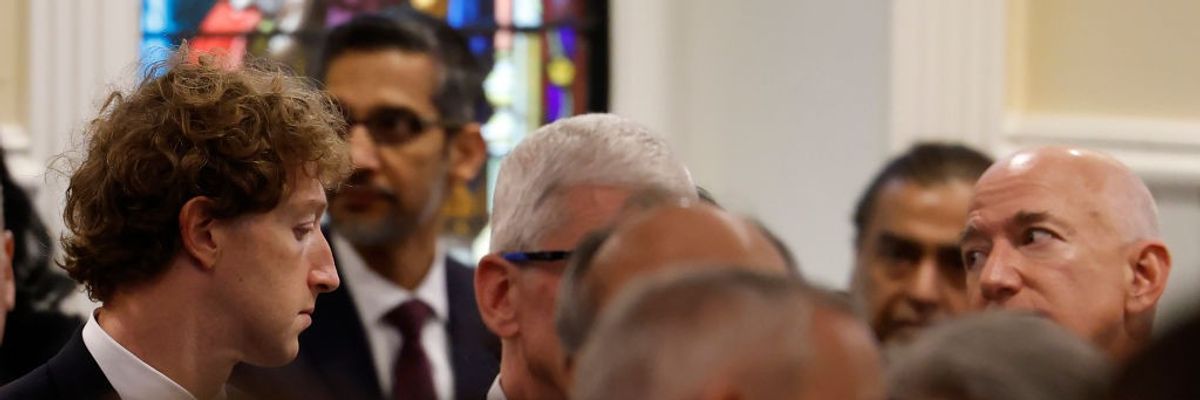
Meta and Facebook CEO Mark Zuckerberg (L), CEO of Apple Tim Cook, and Founder of Amazon and Blue Origin Jeff Bezos attend services as part of Inauguration ceremonies at St. John’s Church on January 20, 2025 in Washington, D.C. (Photo: Anna Moneymaker/Getty Images)

The very ripeness for scandal this time around calls for reasonable restrictions on the sources and amounts of inaugural donations.

U.S. President Donald Trump sounded a lot of populist notes on the campaign trail. But as he took the oath of office for the second time, he was joined onstage by billionaires and CEOs who’d spent millions to be there—leaving supporters who’d traveled across the country to attend literally out in the cold.

Presidential inaugurations have always been an opportunity for wealthy special interests to curry favor with the incoming administration with generous inaugural donations. But the nation has never seen influence peddling like we just witnessed at Trump’s second inauguration.

Shattering all records, the Trump Vance Inaugural Committee, Inc. raised and spent over $200 million in special interest money celebrating the 2024 election victory. (The all-time previous record was $107 million for Trump’s first inauguration in 2017. By contrast, former President Joe Biden’s 2021 inauguration raised and spent nearly $62 million.)

The sheer volume of today’s inaugural donations suggests that wealthy special interests believe it is worth the investment.

All the self-reporting donors—including Big Tech firms like Google, Microsoft, Meta, Amazon, and OpenAI—pledged $1 million or more. The cryptocurrency firm Ripple pledged $5 million. In fact, the cryptocurrency industry even hosted its own inaugural ball.

And of course, Wall Street is cozying up with major donations from Goldman SachsBank of America, and billionaire hedge fund manager Ken Griffin.

“EVERYBODY WANTS TO BE MY FRIEND!!!” Trump marvels on his Truth Social account.

https://www.commondreams.org/opinion/trump-inauguration-donations

Elon Musk urges you to be a Fascist like him, says that you can ignore facts and reality then.
Continue ReadingTrump’s Second Inauguration Took Influence Peddling to a Whole New Level

Elon Musk and the phoney far-right narrative of ‘protecting’ women

Spread the love
Elon Musk urges you to be a Fascist like him, says that you can ignore facts and reality then.

Elizabeth Pearson, Royal Holloway University of London

Across the 2000s, a series of child sex exploitation cases affected British towns, including Telford, Rochdale, Oxford and Rotherham, scarring the lives of hundreds of children. In 2011, Times journalist Andrew Norfolk reported that networks – so-called “grooming gangs” – of largely British Asian men of Pakistani heritage had trafficked and raped hundreds of mainly girls and young women.

These are facts that are widely known in the UK and have been the subject of multiple investigations. The 2014 Jay report found that authorities had been slow to act, sometimes for fear of being accused of racism.

Police had in some cases blamed victims, criminalising children as prostitutes. Alexis Jay, who also led the 2022 independent inquiry into child sexual abuse, has noted the “appalling and lifelong effects” of abuse on victims.

Elon Musk – the billionaire owner of social media platform X and incoming lead on US government efficiency – has, it seems, just found out about this devastating national scandal.

In a series of posts on X, Musk politicised these crimes to denounce Prime Minister Keir Starmer as “evil”, and to call for a new general election in the UK. He also reposted the anti-Islam activist Tommy Robinson, calling for his release from prison where he is serving 18 months for contempt of court.

Musk portrayed Robinson as campaigning to expose the “truth” about grooming, as though the story had not been subject to widespread investigation, media coverage and public debate.

Of course, women’s rights within our criminal justice and political systems desperately need to be improved. But, Musk is no cheerleader for women and there is no evidence that he is “genuinely incensed” by child sexual exploitation.

Musk has not shown an interest in women’s rights or sexual abuse before. If he had, he might not have accepted a job in the administration of Donald Trump, a man found liable for sexual abuse.

Musk’s newfound interest evidently isn’t in all sex offences – apparently just those perpetrated by “Muslim men” against white women. He has not shown any obvious interest in cases where Muslim women were also abused, nor does he have much if anything to say about abuse perpetrated by white men.

He appears to support women’s protections when they are politically useful to him in fanning division – a common far-right tactic.

Musk has supported far-right actors, reinstating Tommy Robinson to X in November 2023, just in time for him to organise a mass rally at the Cenotaph in London, stoking division and, as I noted at the time, threatening democracy. He has also recently written in support of Germany’s anti-Islam party the Alternative für Deutschland (AfD), and hosted its leader Alice Weidel in live discussion on X.

By publicising the UK’s “grooming gangs” scandal, Musk has aligned himself with a gendered narrative: it is men’s duty to protect women – even when it means breaking rules or using force. This gender binary – strong men must be ready to use force to protect weak women, especially from hostile alien men – is the core narrative of patriarchal, nationalist, ultra nationalist and also Nazi groups.

It is highly racialised – only vulnerable white women matter – and it relates to class, in that it regards white, liberal women as betraying working-class girls. Musk has singled out Labour safeguarding minister Jess Phillips as a “rape genocide apologist” and “wicked witch”, thereby putting her at risk.

Exploiting women victims, protecting patriarchy

The recent attack on Phillips reveals Musk’s call to protect women for what it really is: a means to protect powerful men. Feminist women are understood as fair targets, because they challenge a gender order in which men have natural dominance.

Patriarchy protects (some) men by positioning men’s role as leaders and fighters, protectors and providers, for nation and family, wives and children. This is protection without care, which is gendered as feminine, and weak. It is protection as a means of control.

Musk is not in a position of moral authority regarding either protection or care. Before his takeover, social media platform Twitter appeared to care for workers, prioritising health and wellbeing.

The ethos of X is the opposite: Musk has gutted staff numbers, and transformed workplace practices aimed at safeguarding both employees and users. He now promises to do the same across the US government as head of efficiency in the Trump administration.

Social media has always been a space in which women are at risk of both personal and structural misogyny; these harms are amplified through Musk’s approach to X. Musk has sought to amplify the voices of influencers who decry women’s rights.

Musk has reposted Andrew Tate, who police in the UK have linked to an epidemic of misogyny and violence against women, and who has faced charges of rape and sex trafficking. He has allowed white supremacist Nick Fuentes to use X to promote the phrase “your body, my choice”. There is no real protection here, no care – only white men’s control of women.

Race to the bottom

Where Musk leads, others follow. Meta chief Mark Zuckerberg has recently ceded fact-checking to the “community”, and noted the need for a more “masculine” and “aggressive” corporate culture. Zuckerberg also ended the company’s diversity equity and inclusion policy, which minorities rely upon for some degree of workplace protection.

As Silicon Valley is dominated by men, Zuckerberg’s remarks are essentially a call to those men to push back on liberal culture. His comments drew praise from Tate.

In an age of strong-man politics, where young men are choosing role models from a marketplace of competing masculinities, hypermasculinity wins. Young men aged 18-29 voted overwhelmingly for Trump in the US elections, supported by men’s rights activists in the online “manosphere”. Musk knows this.

Musk has money and social media power, but he is a “tech bro” – a “nerd”. Exploiting the horror of British child sexual exploitation scandals has enabled him to attempt to assert himself as a protector of women – a hero of the forgotten.

He has amplified a far-right political position, and the voices of far-right actors he believes embody this, like Robinson. But Musk has no moral authority to speak on the protection of women, or on care more generally.

Those British politicians cynically lauding Musk’s apparently protective stance on women to attack the government – and the UK’s parliamentary democracy – should recognise this is nothing but hypocrisy. And, from that perspective, Musk has no authority to dictate the political agenda on girls’ and women’s rights in Britain, or anywhere else.

Elizabeth Pearson, Programme Lead MSc Terrorism and Counter-Terrorism Studies, Royal Holloway University of London

This article is republished from The Conversation under a Creative Commons license. Read the original article.

Continue ReadingElon Musk and the phoney far-right narrative of ‘protecting’ women

Zuckerberg and Musk have shown that Big Tech doesn’t care about facts

Spread the love

Original article by Jasper Jackson republished from TBIJ under This work is licensed under a Creative Commons Attribution-NonCommercial-NoDerivs 3.0 Unported License.

With tech titans openly disregarding the truth ahead of Trump’s second term, 2025 is likely to herald a new era of disinformation

The online information ecosystem has been in critical condition for some years now, but the prognosis for 2025 is looking more dire than ever.

Already this year two of the world’s richest men, who between them control a huge chunk of our communications infrastructure, have made it clear that they are not interested in our access to the truth.

On Tuesday, Mark Zuckerberg announced that his company Meta – which owns Facebook, Instagram and WhatsApp – would be scrapping its fact checking programme. The only exception to this for now will be in the EU, where strong regulations require it to police its platform.

The core purpose of this programme was to check content that had been flagged as containing potentially harmful misinformation, such as false claims about vaccines or military conflicts. These checks were carried out by third-party organisations, which had to follow rules around process and transparency – and which received significant funding from Meta.

In their place, Meta will now adopt a “community notes-style” system, which enables users themselves to weigh in on content that might be false. A similar set-up has already been adopted by X, where it has proven open to manipulation and failed abysmally to curb misinformation on the platform.

Recommended Articles

To be clear, Meta’s fact checking programme was not without its problems. For a start, there was no way it could catch every falsehood on the platforms. Meta’s financial arrangements with these organisations also raised questions. And ultimately, there is no definitive proof that showing people fact checks has any real impact on whether they believe the false claims.

But the programme did provide vital financial support to newsrooms that did hugely valuable work, from uncovering Russian propaganda campaigns to exposing online scam artists. And while it was only ever a partial solution at best, Meta’s programme was a sign that the company at least wanted to be seen to care about the accuracy of the information spreading across its platforms.

Zuckerberg’s about-turn came after a week in which another tech tycoon, Elon Musk, had been weighing in on UK politics, most notably with twisted falsehoods about the handling of child grooming cases and messages of support for Tommy Robinson, the far-right figure currently in prison for contempt of court after targeting a Syrian refugee with lies. On Monday, Musk suggested in a poll posted on X that “America should liberate the people of Britain from their tyrannical government”.

Click to sign up to TBIJ newsletter now

The recent behaviour of Zuckerberg and Musk can only be seen in light of the impending second term of Donald Trump, whose propensity for lying is legendary. Musk was already all in on Trump’s presidency. But since the election, much of the rest of the tech world has sought to curry favour with the incoming president, with many prominent figures making big donations to his inauguration.

Like the Trump presidency itself, Musk and Zuckerberg’s dismantling of systems that help protect the truth are logical consequences of the digital structures we have built. An online economy that rewards attention above all else has given new power to false claims. Outlandish lies spread quicker than boring truths. Telling people what they want to hear is more engaging than telling them what they need to hear.

And all the signs suggest that the problem will only be worsened by the tech world’s latest obsession: generative AI. Systems such as ChatGPT, which can come up with content that seems human and accurate but is often simply a convincing lie, are rapidly being incorporated into all our major channels of information and communication. Apple is putting inaccurate headlines on curated news articles. Meta is planning to flood its social networks with AI bots mimicking humans. Google is pushing AI-driven search that regularly throws up false results.

A huge amount of money has been poured into generative AI, and much of the tech industry is banking on it to deliver another lucrative boom. But it has turned out to be even worse than humans at telling fact from fiction – and even more willing to make things up. Dealing with this problem is vital for democracy, but it also threatens the industry’s next big payout. As Zuckerberg proved this week, it’s a lot easier to simply give up on accurate information altogether.

Big Tech is no longer even keeping up the pretence that it is committed to the truth. Keeping our information ecosystem healthy is going to be up to the rest of us.

Reporter: Jasper Jackson
Deputy editor: Katie Mark
Editor: Franz Wild

Production editor: Alex Hess
Fact checker: Frankie Goodway

TBIJ has a number of funders, a full list of which can be found here. None of our funders have any influence over editorial decisions or output.

Original article by Jasper Jackson republished from TBIJ under This work is licensed under a Creative Commons Attribution-NonCommercial-NoDerivs 3.0 Unported License.

This image added 11/1/25

Elon Musk urges you to be a Fascist like him, says that you can ignore facts and reality then.
Continue ReadingZuckerberg and Musk have shown that Big Tech doesn’t care about facts

Facebook Follows X Down Path to Becoming Right-Wing ‘Cesspool’ by Ending Fact-Checking Efforts

Spread the love

Original article by Eloise Goldsmith republished from Common Dreams under Creative Commons (CC BY-NC-ND 3.0).

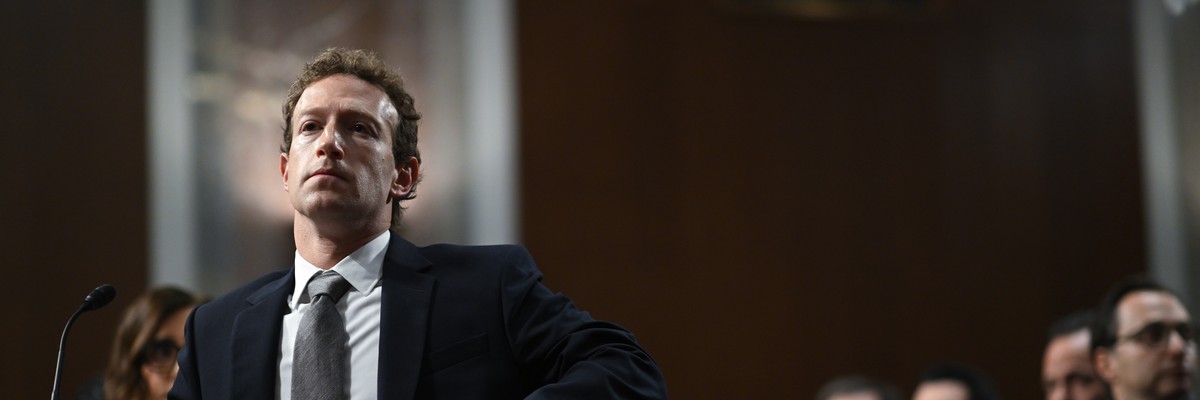
CEO of Meta, Mark Zuckerberg is seen during a Senate Judiciary Committee hearing with representatives of social media companies at the Dirksen Senate Office Building on Wednesday January 31, 2024 in Washington, DC. (Photo: Matt McClain/The Washington Post via Getty Images)

“Zuck isn’t just kissing the ring, he’s slobbering all over it,” said one media reporter.

In a move that some viewed as a means of currying favor with the incoming Trump administration, Meta CEO Mark Zuckerberg announced in a video Tuesday that the company is moving to end its third party fact-checking program.

Instead, the company will use a community notes approach, inspired by the Elon Musk’s platform X—where Musk’s misleading claims about the 2024 presidential election racked up billions of views.

Zuckerberg’s announcement was accompanied by a post authored by Meta’s new, “Trump-friendly” chief global affairs officer, Joel Kaplan, who described the change as “more speech and fewer mistakes.” Kaplan also went on Fox & Friends on Tuesday morning to discuss the update.

“Too much harmless content gets censored, too many people find themselves wrongly locked up in ‘Facebook jail,’ and we are often too slow to respond when they do,” wrote Kaplan in his post. Kaplan and Zuckerberg also noted that Meta plans to phase back in more civic content, as in posts about elections, politics, or social issues.

Real Facebook Oversight Board (RFOB), a group established to counter the perceived failures of Meta’s own oversight board, blasted the move, saying, “‘censorship’ is a manufactured crisis, political pandering to signal that Meta’s platforms are open for business to far-right propaganda.”

“Twitter’s shift from fact checking has turned the platform into a cesspool; Zuck is joining them in a race to the bottom,” the group wrote Tuesday.

The move generated other negative reactions.

“Meta went to Fox News to announce it’s ending its third-party fact checking program. Zuck isn’t just kissing the ring, he’s slobbering all over it,” wrote media reporter Oliver Darcy on Tuesday.

Also on Tuesday, Kara Swisher, a tech journalist, wrote “toxic floods of lies on social media platforms like Facebook have destroyed trust not fact checkers. Let me reiterate: Mark Zuckerberg has never cared about that and never will.”

Co-president of the watchdog group Public Citizen, Lisa Gilbert, weighed in, saying that “misinformation will flow more freely with this policy change, as we cannot assume that corrections will be made when false information proliferates. The American people deserve accurate information about our elections, health risks, the environment, and much more. We condemn this irresponsible move and the harm it will likely contribute to our discourse.”

“Meta’s new promise to scale back fact checking isn’t surprising—Zuckerberg is one of many billionaires who are cozying up to dangerous demagogues like Trump and pushing initiatives that favor their bottom lines at the expense of everything and everyone else,” wrote Nora Benavidez, senior counsel and director of digital justice and civil rights for the organization Free Press in a Tuesday statement.

Meta, which is angling for the U.S. government to use its AI and is facing an federal antitrust trial this spring, has made other bids to enter Trump’s good graces and thaw once frosty relations (Meta temporarily booted Trump from its platforms following his comments regarding the January 6 insurrection). Meta donated $1 million to Trump’s inauguration fund recently and Zuckerberg flew down to Trump’s Mar-A-Lago Club to meet with him this past fall.

Original article by Eloise Goldsmith republished from Common Dreams under Creative Commons (CC BY-NC-ND 3.0).

Continue ReadingFacebook Follows X Down Path to Becoming Right-Wing ‘Cesspool’ by Ending Fact-Checking Efforts