Global Protests Tell Trump and His Cronies: ‘Hands Off Venezuela’

Spread the love

Original article by Jake Johnson republished from Common Dreams under Creative Commons (CC BY-NC-ND 3.0).
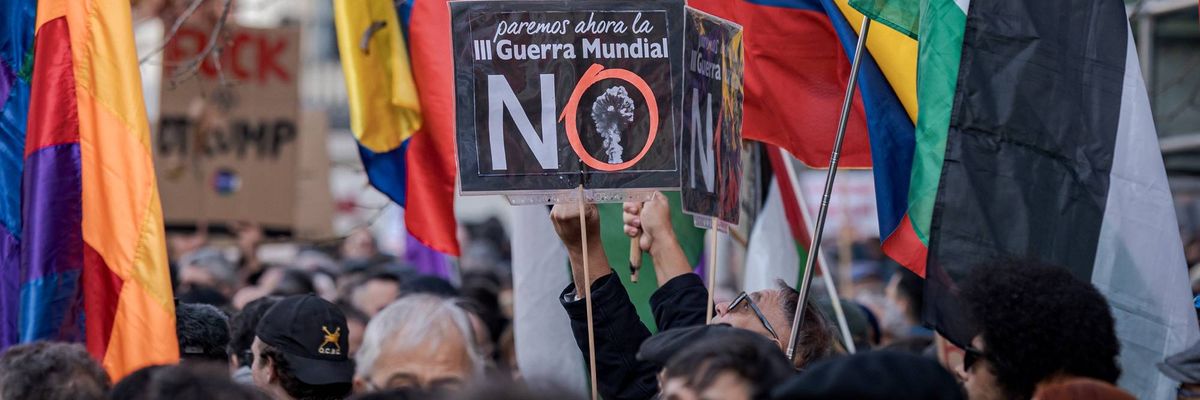
People gather outside the US Embassy in Madrid, Spain to protest the Trump administration’s attack on Venezuela on January 4, 2025. (Photo by Diego Radames/Anadolu via Getty Images)

“This is militarized authoritarianism,” said one advocacy group. “We must act to stop it now, before it spreads to enflame the entire region, if not the entire globe, in a dangerous, unnecessary conflict.”

Protests broke out at US diplomatic outposts across the globe Saturday and Sunday following the Trump administration’s deadly attack on Venezuela and abduction of the nation’s president, brazen violations of international law that—according to the American president—were just the start of a sustained intervention in Venezuela’s politics and oil industry.

Demonstrators took to the streets of Brussels, Madrid, Ankara, Mexico City, Los Angeles, and other major cities worldwide to voice opposition to the US assault on Venezuela and Trump administration officials’ pledge to “run” the country’s government for an unspecified period of time, a plan that Venezuelan leaders have publicly met with defiance.

RECOMMENDED…
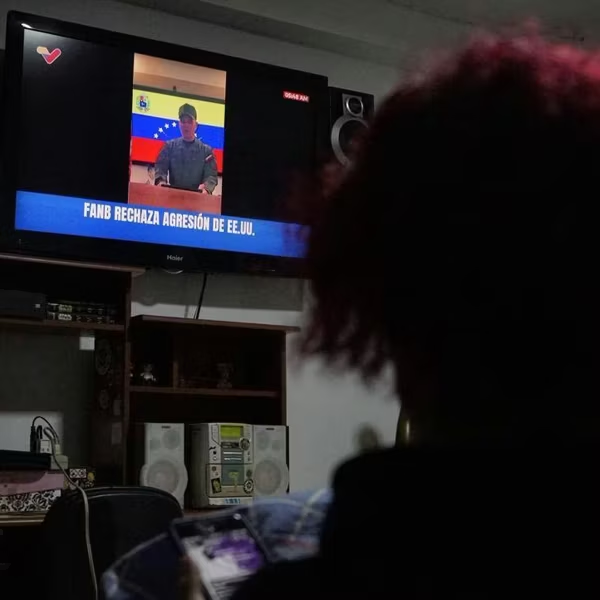
A woman watches a public television broadcast by Venezuelan Defense Minister Vladimir Padrino

‘This Is State Terrorism’: Global Outrage as Trump Launches Illegal Assault on Venezuela
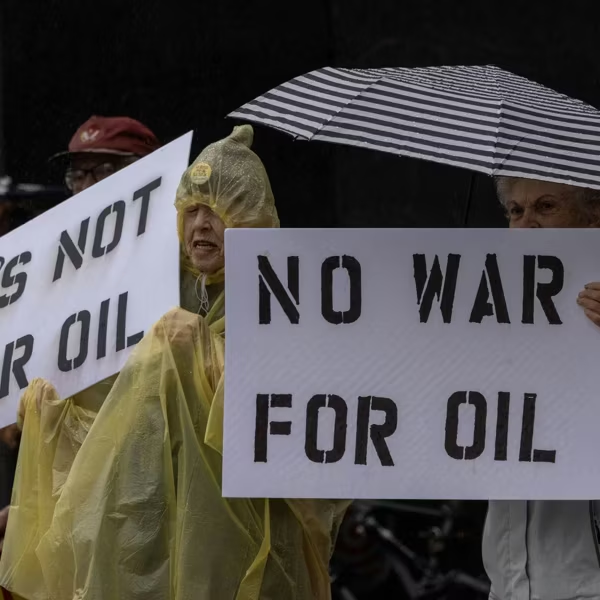
People participate in a "No War on Venezuela" protest

‘Get the Oil Flowing’: Trump’s Own Words Make His War Aims in Venezuela Clear

The US Mission to Mexico—one of several Latin American countries Trump threatened in the aftermath of the attack on Venezuela—warned in an alert issued Saturday that “a protest denouncing US actions against Venezuela continues to take place in front of the US Embassy in the Polanco neighborhood of Mexico City.”

“Protestors have thrown rocks and painted vandalism on exterior walls,” the alert read. “Social media posts about the protest have included anti-American sentiment. Embassy personnel have been advised to avoid the area.”
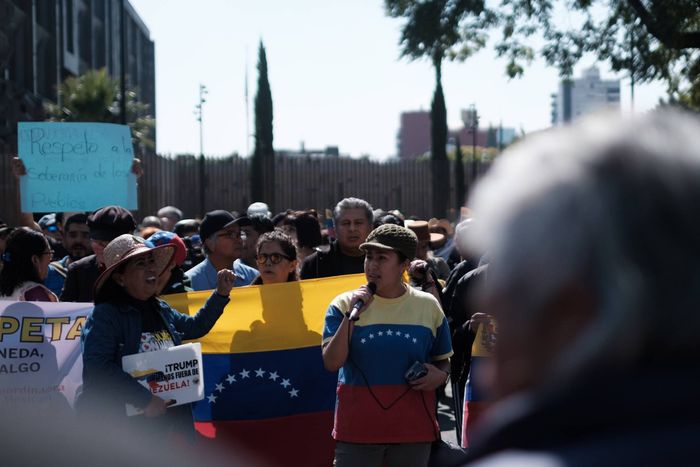
Protest Against U.S. Intervention In Venezuela

Social and political organizations mobilized to the US Embassy in Mexico City, Mexico on January 3, 2026. (Photo by Miguel M. Caamano/NurPhoto via Getty Images)
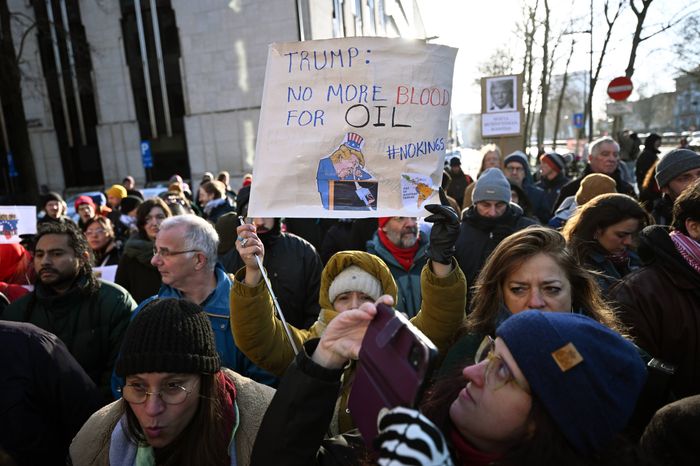
Hundreds gather in front of the US Embassy in Brussels, Belgium on January 4, 2025. (Photo by Dursun Aydemir/Anadolu via Getty Images)
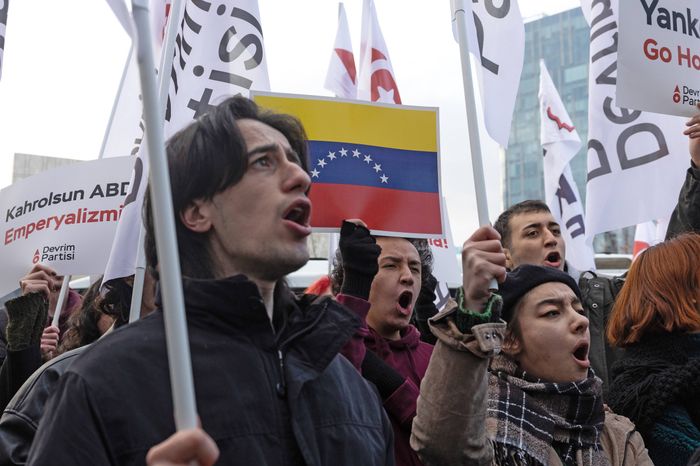
Protesters In Ankara Demonstrate Against US Actions In Venezuela

Demonstrators hold posters and chant slogans during a protest in front of the US Embassy on January 4, 2026 in Ankara, Turkey. (Photo by Serdar Ozsoy/Getty Images)
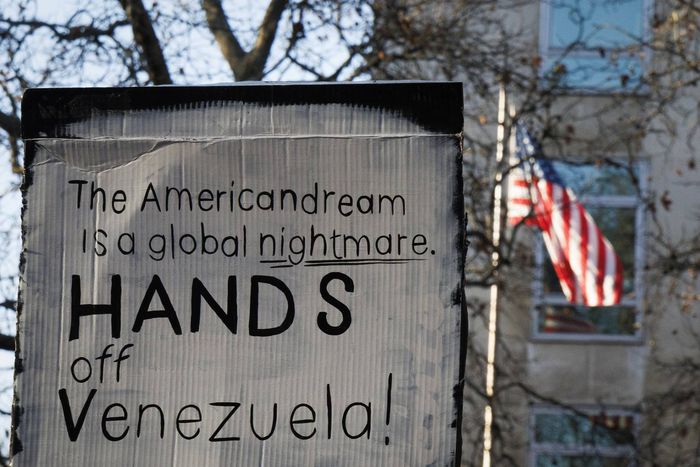
A photograph taken on January 4, 2026 shows an anti-war placard in Brussels

A photograph taken on January 4, 2026 shows an anti-war placard in Brussels during a demonstration against the US attack on Venezuela. (Photo by Nicolas Maeterlinck/Belga/AFP via Getty Images)
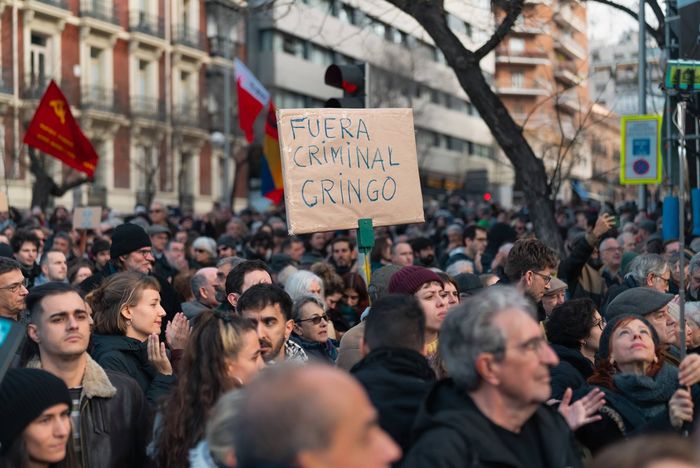
Protesters gather during a demonstration in front of the US Embassy in Madrid

Protesters gather during a demonstration in front of the US Embassy on January 4, 2026 in Madrid, Spain. (Photo by Olmo Blanco/Getty Images)

The global demonstrations came as some world leaders, including top European officials, faced backlash for failing to adequately condemn—or condemn at all—the US attack on Venezuela and continued menacing of a sovereign nation.

Ursula von der Leyen, president of the European Commission, said she supports “a peaceful and democratic transition,” without mentioning or denouncing the illegal abduction of Venezuelan President Nicolás Maduro and US bombings that reportedly killed at least 40 people, including civilians.

Greek Prime Minister Kyriakos Mitsotakis declared that “this is not the time to comment on the legality of the recent actions” as protesters gathered in Athens in opposition to the US assault.

“If you still believe that the European Union cares about international law, then look no further,” wrote Progressive International co-general coordinator David Adler, pointing to Mitsotakis’ statement.

“We are outraged, but this moment demands more than outrage. It demands organized, coordinated resistance.”

Mass protests and demands for international action to halt US aggression proliferated amid ongoing questions about how the Trump administration intends to carry out its stated plan to control Venezuela and exploit its oil reserves—objectives that experts say would run afoul of domestic and international law.

US Secretary of State Marco Rubio, who played a central role in planning the Venezuela attack and has been chosen by Trump to manage the aftermath, said Sunday that the administration intends to keep in place a military “quarantine” around the South American nation—including the massive naval force amassed in the Caribbean in recent months—to pressure the country’s leadership to bow to US demands.

“That’s a tremendous amount of leverage that will continue to be in place until we see changes, not just to further the national interest of the United States, which is number one, but also that lead to a better future for the people of Venezuela,” Rubio said in a television interview.

Rubio also suggested the president could deploy US troops to Venezuela and dodged questions about the legal authority the Trump administration has to intervene in the country. The administration has not sought congressional authorization for any of its attacks on vessels in the Caribbean or Venezuela directly.

US Rep. Greg Casar (D-Texas), chair of the Congressional Progressive Caucus, said Sunday that “in recent history, we’ve tried ‘running’ multiple countries in Latin America and the Middle East. It’s been a disaster for us, and for them, every single time.”

“Congress must pass a War Powers Resolution to get our military back to defending the US, instead of ‘running’ Venezuela,” Casar added.

Progressive Democrats of America echoed that demand, saying in a statement that “this is militarized authoritarianism.”

“We must act to stop it now, before it spreads to enflame the entire region, if not the entire globe, in a dangerous, unnecessary conflict,” the group added. “We are outraged, but this moment demands more than outrage. It demands organized, coordinated resistance.”

Original article by Jake Johnson republished from Common Dreams under Creative Commons (CC BY-NC-ND 3.0).

Donald Fuhrump says that Amerikkka doesn't bother with crimes or charges anymore, not being 100% Amerikkkan and opposing his real estate intentions is enough.
Donald Fuhrump says that Amerikkka doesn’t bother with crimes or charges anymore, not being 100% Amerikkkan and opposing his real estate intentions is enough.
Continue ReadingGlobal Protests Tell Trump and His Cronies: ‘Hands Off Venezuela’

400,000 in Mexico City’s Zócalo celebrate one year of Claudia Sheinbaum’s government

Spread the love

Original article by Tallis Boerne Marcus republished from peoples dispatch under a Creative Commons Attribution-ShareAlike 4.0 (CC BY-SA) license.

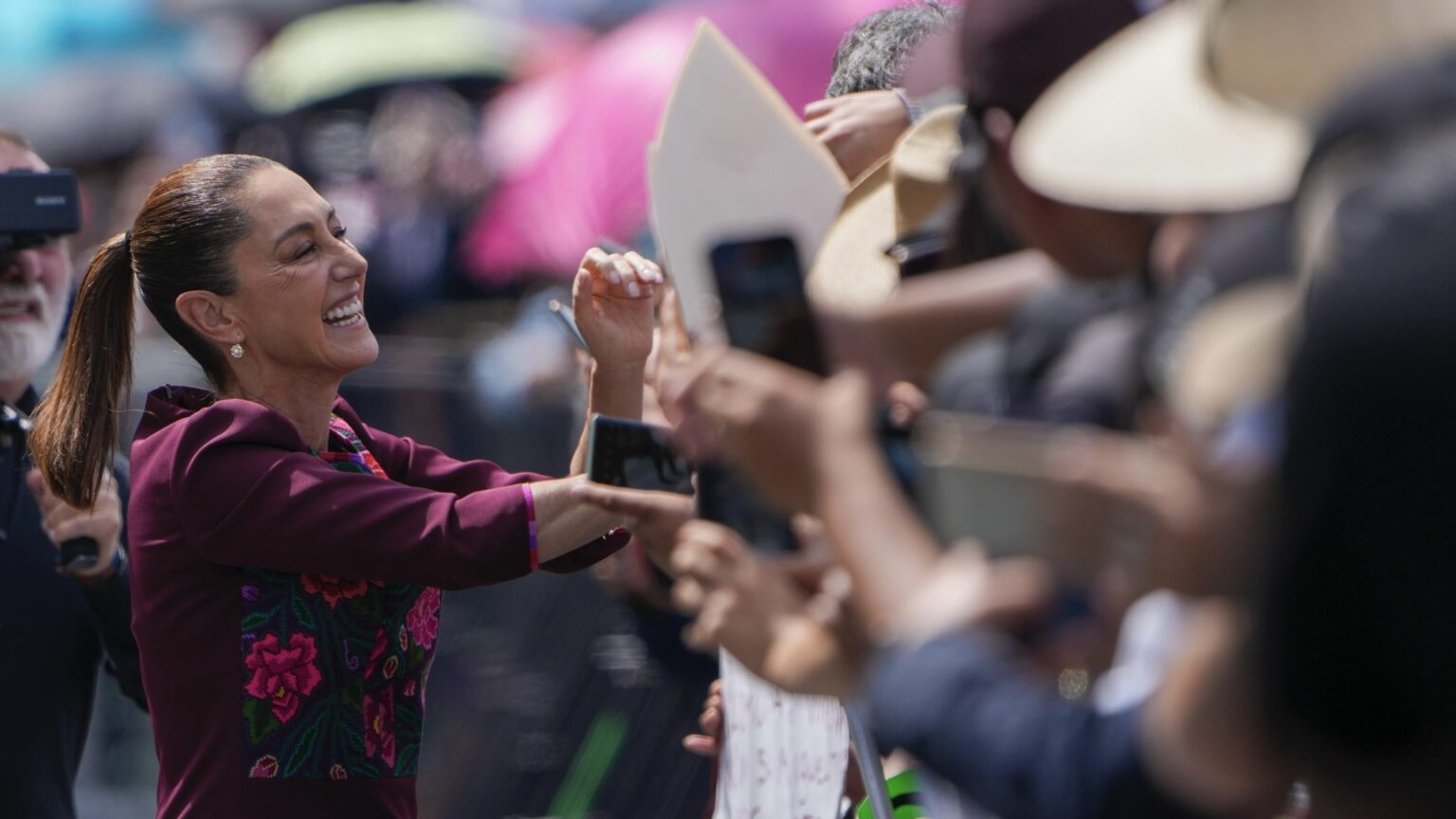
Mexican President Claudia Sheinbaum greets supporters in the Zócalo on October 5, marking one year of her administration. Photo: MORENA / X

In her speech to a full Zócalo, Sheinbaum reviewed her government’s major accomplishments in a year of global turbulence largely amid a US tariff war and military threats

Mass mobilizations have been a feature of Claudia Sheinbaum’s first year presiding over Mexico, and to finish her first “accountability” tour of Mexico and mark one year of governance, she had her biggest yet. More than 400,000 people came out to watch her speak for nearly an hour on Sunday, October 5, reflecting on her and the party’s achievements in the first year of her term, and the continued “fourth transformation” of Mexico.

In recent weeks, Sheinbaum has visited all 31 states of Mexico, outlining her administration’s current projects, plans and results in each state.

The communication strategy of MORENA, the governing party, is very front-facing, with both Sheinbaum and her predecessor Andrés Manuel López Obrador hosting daily press conferences from Monday to Friday, and then generally traveling to one or two parts of Mexico over the weekend. This has proven extremely effective in countering the narratives from the large press corporations that own and operate the majority of Mexican media outlets, as well as of course maintaining closer communication and accountability with the people of Mexico.

Sheinbaum has faced significant challenges in her first year, most notably due to relations with the administration of US President Donald Trump, with problems ranging from tariff threats even to members of his administration suggesting unilateral military intervention against Mexico. While Trump has threatened Mexico with tariffs at every turn, Sheinbaum’s firm but open stance has proved effective in negotiations with Trump and today the country has managed to achieve important exceptions to the aggressive tariff regime.

Sheinbaum arrives at one year in charge with historic levels of approval, depending on the poll you choose your approval rate is somewhere between 72% and 79%. While other countries around the world aren’t as comprehensive in approval polls as Mexico, this likely makes Sheinbaum the most popular leader in the world.

Her approval is above 70% in all states of Mexico and remarkably, she even has over 70% approval from voters of the three opposition parties in Mexico, the centrist party Movimiento Ciudadano and the right-wing parties of PAN and PRI.

So, how did she get to that level of popularity and what are her challenges in maintaining or growing it? Here are some of the points mentioned by Sheinbaum in her speech and the highlights from her first year governing Mexico.

Reiterating economic achievements

  • Sheinbaum began by reiterating some of the economic achievements, both that MORENA has accomplished since 2018, and some of the present moment.
  • Between 2018 and 2014, 13.5 million Mexican, Mexico is now the second least unequal country in the Americas, behind only Canada, and the income gap between the richest and poorest was reduced from 27 to 14 times over.
  • Annual inflation has settled at 3.7% percent, unemployment is at 2.7%, a record level of foreign direct investment was reached and annual economic growth is expected at 1.2%.

Sheinbaum’s initiatives from her first 12 months.

  • Sheinbaum created three new social programs. One is Salud Casa por Casa, a door-to-door free healthcare system for the elderly, where healthcare professionals come into their home for regular check ups. Another is Pensión Mujeres Bienestar, which gives women their pension from 60 years of age, rather than 65, to recognize unpaid work in the home. The final is Beca “Rita Cetina”, which is a universal scholarship for all secondary students in public schools, this is a payment every two months of 1900 pesos (USD 103) to cover schooling costs.
  • The constitutional recognition of several rights, such as the right for women to live lives free from violence, the right of access to the internet, the right of access to housing, the right to social programs and more.
  • Mexico has served more than 86,000 deported Mexicans who have been deported from the US in special comprehensive care centers, under a program called ‘Mexico embraces you”. This includes registering them into Mexicans social security systems to assist them with access to housing, employment and transportation to their area of origin, as well as food and shelter in the meantime.
  • Sheinbaum said the “4T is bringing back the trains”, with many rail projects underway, after they were previously privatized in the late 90s. These make up more than 3000kms of railway across the country, including two trains from Mexico City, to Pacucha and Queretaro respectively, and further expansion of the Interoceanic train, which is a key part of Mexico’s attempt to create an alternative trade corridor to the Panama Canal.
  • Sheinbaum emphasized the administration’s goal to “promote equality and the recognition and just development of women in Mexico.” The current government has created The Secretariat for Women as an official government ministry, opened a national support line for women, has opened the first 678 free centers for women that focus on comprehensive care for women, but the administration is aiming to build 2,500 in total. The government is also aiming to build 1,000 early education and childcare centers, which will provide free childcare to children from 40 to 1,000 days old.
  • Sheinbaum has also made access to water a key feature of her first year in charge. About four billion cubic meters of water have been de-privatized, a new agricultural irrigation technology program is being developed across 13 states, and there are 20 new strategic drinking water and sanitation projects.
  • The Sheinbaum administration will build 1.7 million homes, 400,000 of those for Mexicans without social security, and the rest with accessible loan offers for those who earn less than two minimum wages.
  • Another key feature of her first year in charge has been more scientific investment and projects, with funding for scientific research projects increasing by 193%. These include the production of an electric car, a project for Mexico to make its own semiconductors, the production of observation satellites and more.

Security

A challenge moving forward for Sheinbaum will be continuing to manage the security situations, although her early strategies have proved effective.

52% of Mexicans rank insecurity and drug trafficking as the most important issue affecting the country, and 63% of Mexicans living in urban areas consider it unsafe to live in their city. This figure rose from the previous year, but in fairness, levels were historically low before.

Sheinbaum and Omar Garcia Harfuch, her secretary of security, have taken a different approach to security than AMLO had. Sheinbaum and Garcia Harfuch also worked together when Sheinbaum was the mayor of Mexico City, and homicides dropped 50% in the six years they worked together.

Sheinbaum’s shift was towards a more direct and carefully coordinated strategy against crime and drug trafficking was clear. In her first 100 days of governing operations against criminal groups went up 597%, arrest numbers grew by 1216%, confiscated weapons went up 5811% and drug seizures went up 1000%.

The results have been swift, with Sheinbaum reporting a 32% reduction in homicides over her first year. Between September 2024 and July 2025, there was an average of 64.9 homicides per day. While these numbers are stark, it is a marked improvement from the 98.5 per day that Mexico was experiencing in 2018, when MORENA first came to power.

In 2007, before Felipe Calderon’s aggressive, US-backed security strategy, Mexico was experiencing 24.3 daily homicides.

Mexico also recently managed to get the United States to sign an agreement to attempt to limit the inflow of weapons from the US into Mexico. This is a huge point for Mexican security as even the US itself has recognized that 74% of weapons used by organized crime groups in Mexico arrive illegally from the United States.

However, Mexican political commentator and editor of Mexico Decoded, Viri Rios makes the point that this agreement focuses only on increased border surveillance and inspection, and misses the core problem of dangerous weapons being too easily acquired and severely unregulated in the US.

In theory, the US agreeing to this new policy will give them more accountability for the guns that continue to arrive in Mexico.

Early results are extremely promising, but Sheinbaum’s grapple with security and US relations will be critical moving forward.

Tallis Boerne Marcus is an Australian journalist currently based in Mexico City.

Original article by Tallis Boerne Marcus republished from peoples dispatch under a Creative Commons Attribution-ShareAlike 4.0 (CC BY-SA) license.

Continue Reading400,000 in Mexico City’s Zócalo celebrate one year of Claudia Sheinbaum’s government