NYT Reported Iran Deal From Pro-Israel, Pro-War Perspective

Spread the love

Article by Olivia Riggio republished from FAIR under a Creative Commons Attribution-NonCommercial-NoDerivs 3.0 Unported License.
The New York Times, the US’s most powerful establishment news outlet, has reported on President Donald Trump’s “memorandum of understanding” with Iran from a pro-war and/or pro-Israel perspective.  Why did Trump end the war without limiting Iran’s “nuclear program” and its support for “proxy forces,” or without conducting “regime” change? These are the questions that have preoccupied the paper of record’s news reporting.

As I’ve noted before (FAIR.org3/30/26), multiple Times employees are reporting from and currently living in Israel, despite Israel’s blanket censorship policies, not to mention its killing hundreds of journalists. Meanwhile, the paper has no reporters in Iran, a situation it blames on Iran’s press restrictions.

This editorial decision has no doubt contributed to the paper covering the memorandum from an Israeli perspective, which is not aligned with the 59% of the US adult population who say the US using military force in Iran was the wrong decision.

Frightening new reality’

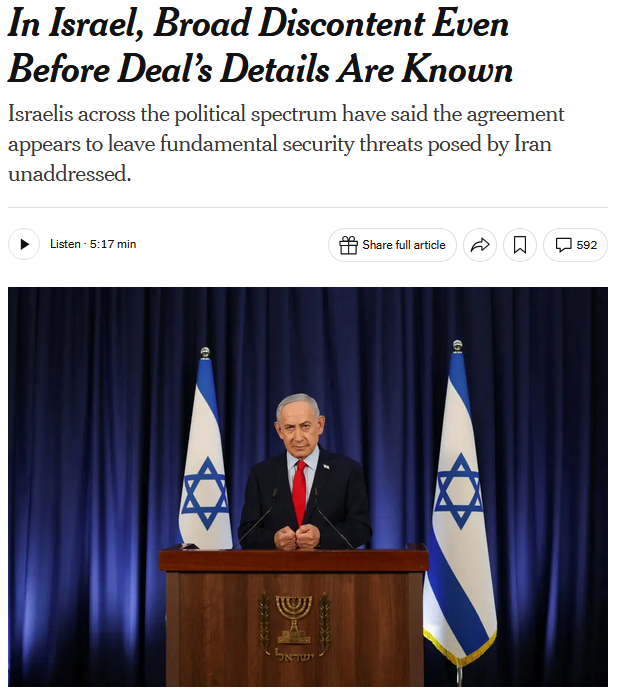
NYT: In Israel, Broad Discontent Even Before Deal’s Details Are Known

The New York Times (6/14/26) reports that Israel faults a deal that Iran agreed to for not “creating the conditions for the collapse of the Iranian government.”

Over its first article (6/14/26) published about the memorandum, the New York Times headline read, “In Israel, Broad Discontent Even Before Deal’s Details Are Known.” The subhead noted that “Israelis across the political spectrum have said the agreement appears to leave fundamental security threats posed by Iran unaddressed.”

The piece, by Times Jerusalem correspondent Isabel Kershner, uncritically granted anonymity to an “Israeli who had been briefed on the deal with Iran” to “discuss diplomacy.” They listed their “main problems” with the proposal: “no clear answers regarding the treatment of Iran’s stockpile of enriched uranium, and not enough curbs on Iran’s nuclear program,” no “conditions for the collapse of the Iranian government” and “no clear mechanism for forcing Iran to halt its support for its proxy forces.”

One day later, the Times (6/15/26) published an article headlined “Israel Counts the Ways That Netanyahu’s Iran Strategy Failed.” Times Jerusalem bureau chief David M. Halbfinger and Tel Aviv staff writer Ronen Bergman noted that the agreement “omits some of the most important things Israel wanted.”

These “important things” included “to curb Iran’s ballistic missile arsenal” and “its funding of regional proxies like Hezbollah in Lebanon and the Houthis in Yemen, who have attacked Israel with their own arsenals.” The deal “could help Iran bolster those proxies by easing sanctions, which would allow billions of dollars to flow into its bank accounts,” Halbfinger and Bergman added.

‘Catastrophic capitulation’
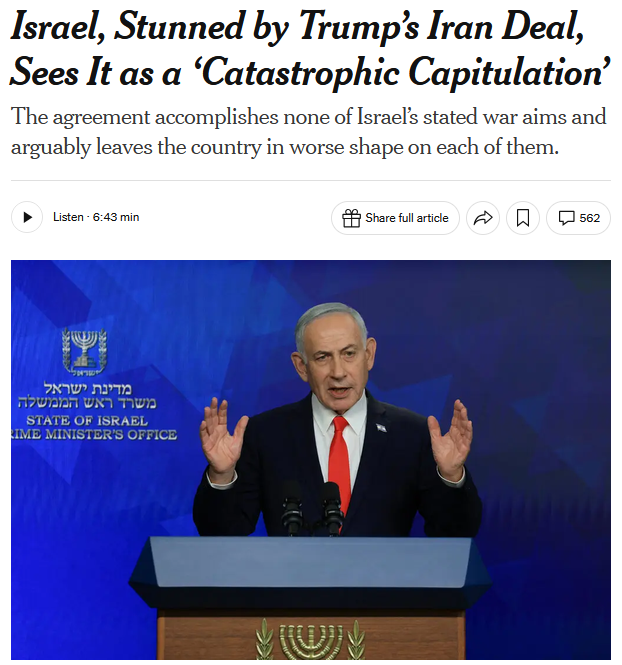
New York Times: Israel, Stunned by Trump’s Iran Deal, Sees It as a ‘Catastrophic Capitulation’

The New York Times (6/18/26) says “Israel awoke to a frightening new reality”—one that “seeks to handcuff Israel” by forcing it to withdraw from a country it invaded.

Three days later, Halbfinger published an article (6/18/26) headlined “Israel, Stunned by Trump’s Iran Deal, Sees It as a ‘Catastrophic Capitulation.’”

This time, Halbfinger wrote that

Israel awoke to a frightening new reality on Thursday as it absorbed, with disbelief and largely in silence, the terms of President Trump’s preliminary agreement to end the war with Iran.

Halbfinger noted that “it accomplishes none of Israel’s war aims, analysts and officials said, and arguably leaves the country in worse shape on each of them.” Among those aims? “Regime change,” “ballistic missiles and proxy militias” and “Iran’s nuclear program,” listed Halbfinger.

Uncritically parroting Israeli government talking points that frame Israel as the victim is journalistic obfuscation at best: Israel privately lobbied to assassinate Iran’s lead negotiator and to “restart the war with a new round of strikes targeting the country’s oil infrastructure” (Capital and Empire, 5/28/26), and it insists it has the right to continue ethnically cleansing Lebanon.

‘One of the biggest challenges of his career’
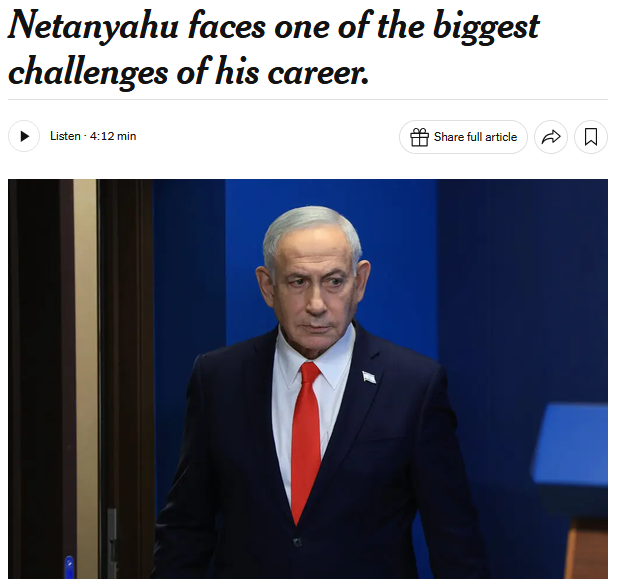
NYT: Netanyahu faces one of the biggest challenges of his career.

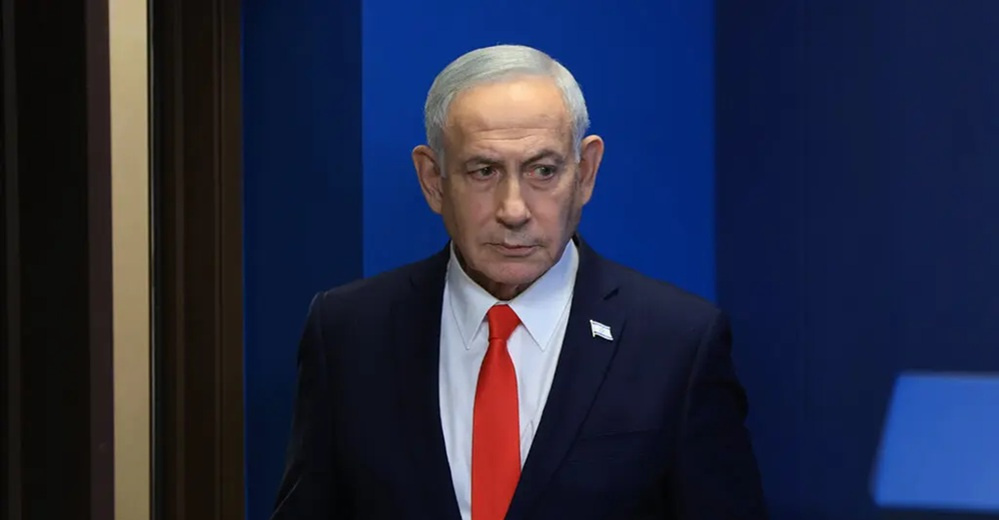
The New York Times (6/21/26) says Israeli Prime Minister Benjamin Netanyahu is “fighting for his political survival”—as opposed to the Palestinians, Lebanese and Iranians Netanyahu would like to keep bombing, who are fighting for their actual survival. 

One week after her first article about the memorandum was published, the Times’ Kershner wrote another article (6/21/26) headlined “Netanyahu Faces One of the Biggest Challenges of His Career.”

Her thesis was that Netanyahu “is fighting for his political survival” due to “the emergence of a peace deal that Israel is not a party to.” Kershner wrote that Netanyahu “has staked his career on preventing Iran from developing nuclear weapons, which Israel views as an existential threat.”

Kershner, like Halbfinger and Bergman, ignored the fact that Iran has upheld its promise not to build a nuclear weapon (Arms Control Association, 2/25). By contrast, Israel—not Iran—is the only country in the Middle East to possess nuclear weapons, and the US remains the only country to ever use a nuclear weapon in war.

Kershner wrote:

The agreement seeks to curtail Israel’s freedom of action in Lebanon, where the Israeli military has been fighting Hezbollah, the Iran-backed proxy militia on its doorstep. The deal makes no mention of curbing Iran’s ballistic missiles, which Iran has used to attack Israel and US Gulf allies during the wars. And it leaves the nuclear issue to be addressed in further negotiations.

Framing Israel’s killing of more than 4,100 people in Lebanon and displacement of 1.2 million since March (Drop Site News6/22/26), as “Israel’s freedom of action” insinuates that Israel is entitled to occupation and ethnic cleansing. And by noting that Iran has used its ballistic missiles “to attack Israel and US Gulf allies during the wars,” Kershner ignored which two countries attacked the other first, and which country used its ballistic missile arsenal to defend itself against further attacks (PBS6/18/26Middle East Eye6/23/26).

‘A let down and reality check’
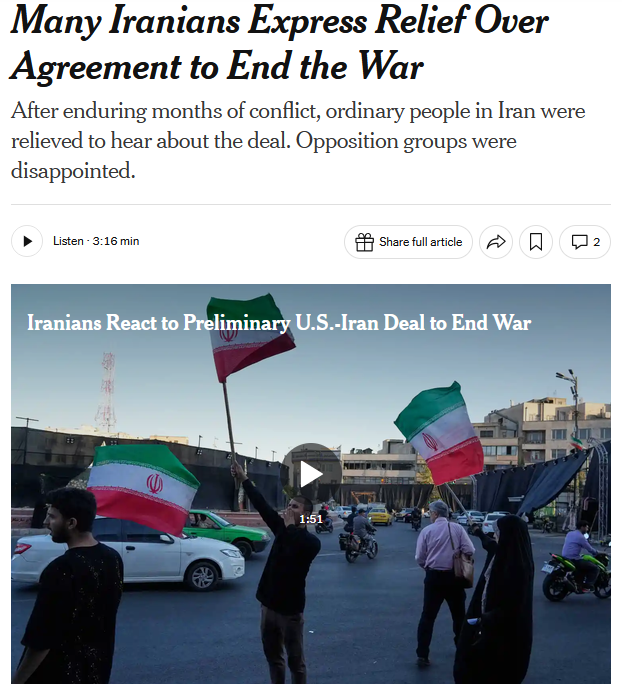
New York Times: Many Iranians Express Relief Over Agreement to End the War

In a New York Times piece (6/15/26) on Iranian reaction to the deal, there is no criticism of the US or Israel, other than an attack on Trump from “a monarchist political activist in Washington who has supported the war against Iran.” 

As for the Iranian perspective, the Times published an article (6/15/26) headlined “Many Iranians Express Relief Over Agreement to End the War.” The subhead read, “After enduring months of conflict, ordinary people in Iran were relieved to hear about the deal. Opposition groups were disappointed.”

The Times’ Farnaz Fassihi noted that

Iranians expressed a range of emotions over the agreement to end a war that killed thousands across the region and brought enormous loss with no gain for millions of others.

Fassihi quoted just two sources based in Tehran, one of whom she interviewed by telephone, the other by text message. One asked, “What was the point of this war? What did it bring us exactly?” The other asked: “Is this REAL? Are they serious?”

Fassihi added that

for Iranian opposition groups and some members of the diaspora who had hoped the war would topple the Islamic Republic, the agreement was both a let down and a reality check.

Fassihi cited a social media post by Behnam Amini, a “monarchist political activist in Washington who has supported the war against Iran.”

Fassihi also noted:

In Iran, a minority within the hard-line political faction—those who ideologically favor destruction of Israel and war with the US by any means—unleashed fury at Foreign Minister Abbas Araghchi and Gen. Mohammad Bagher Ghalibaf, the lead negotiator and speaker of parliament.

The piece was unable to quote a source that expressed explicit opposition to the US/Israel’s attacks on Iran—which suggests the limitations of the Times’ long-distance approach to covering Iranian opinion.

FAIR’s work is sustained by our generous contributors, who allow us to remain independent. Donate today to be a part of this important mission.

Keir Starmer explains that UK is actively supporting Israel's genocidal expansion and repeats his previous quotation that he supports Zionism "without qualification". Keir Starmer said “I said it loud and clear – and meant it – that I support Zionism without qualification.” here: https://www.jewishnews.co.uk/keir-starmer-interview-i-will-work-to-eradicate-antisemitism-from-day-one/
Keir Starmer explains that UK is actively supporting Israel’s genocidal expansion and repeats his previous quotation that he supports Zionism “without qualification”. Keir Starmer said “I said it loud and clear – and meant it – that I support Zionism without qualification.” here: https://www.jewishnews.co.uk/keir-starmer-interview-i-will-work-to-eradicate-antisemitism-from-day-one/
Keir Starmer objects to criticism of the IDF. He asks how could anyone object to them starving people to death, forced marches like the Nazis did, bombing Gaza's hospitals and universities, mass-murdering journalists, healthworkers and starving people queuing for food, killing and raping prisoners and murdering children. He calls for people to stop obstructing his genocide for Israel.
Keir Starmer objects to criticism of the IDF. He asks how could anyone object to them starving people to death, forced marches like the Nazis did, bombing Gaza’s hospitals and universities, mass-murdering journalists, healthworkers and starving people queuing for food, killing and raping prisoners and murdering children. He calls for people to stop obstructing his genocide for Israel.
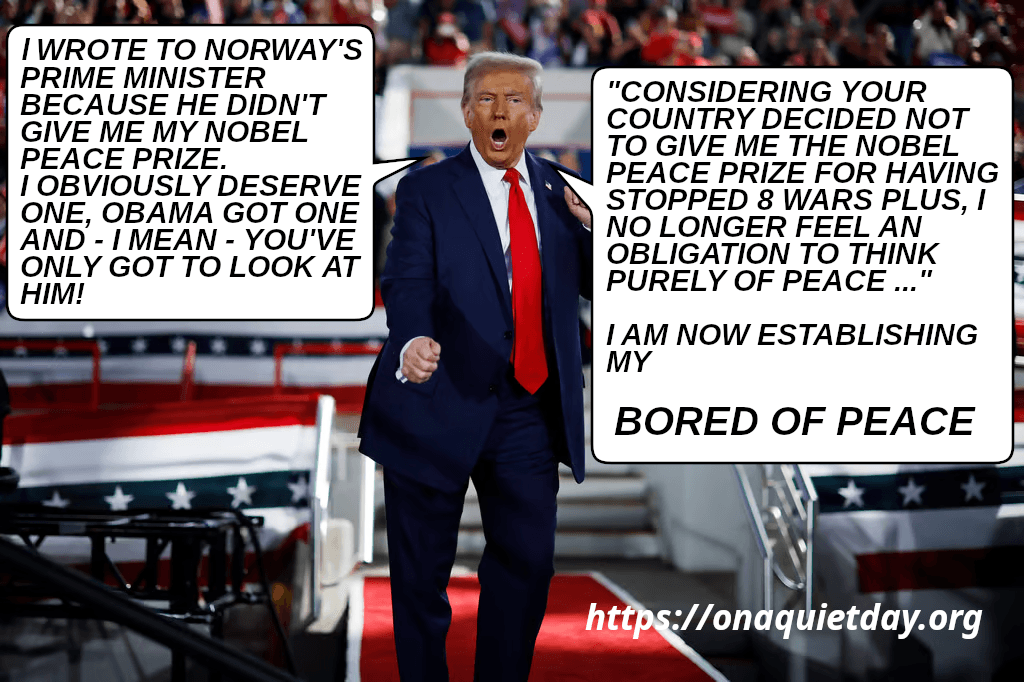
Donald Trump explains why he established his Bored of Peace

Continue ReadingNYT Reported Iran Deal From Pro-Israel, Pro-War Perspective

‘Reporting Isn’t Treason’: Trump Rant at Journalists Sparks Alarm

Spread the love

Article by Brad Reed republished form Common Dreams under Creative Commons (CC BY-NC-ND 3.0). 

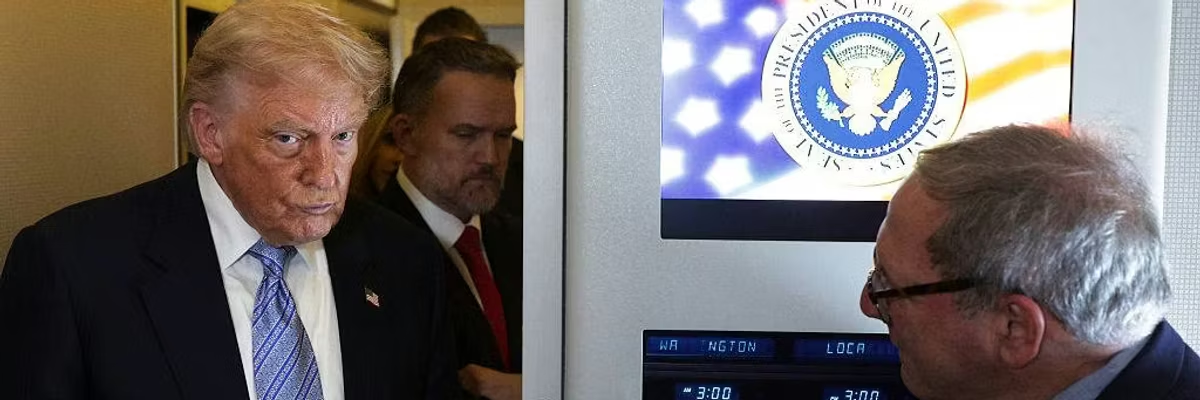
President Donald Trump briefs reporters after he concluded his trip to Beijing aboard Air Force One on May 15, 2026 as he returns to the United States.
 (Photo by Alex Wong/Getty Images)

“No American should be comfortable with the president of the United States accusing a reporter of treason for critical reporting.”

President Donald Trump on Friday sparked alarm among press freedom advocates when he accused New York Times reported David Sanger of committing “treason” for portraying his illegal war with Iran in a negative light.

Speaking with journalists aboard Air Force One on his flight home from China, Trump was asked by Sanger about his failure to accomplish political changes in Iran that he swore to achieve when he launched the war without congressional authorization in late February.

RECOMMENDED…

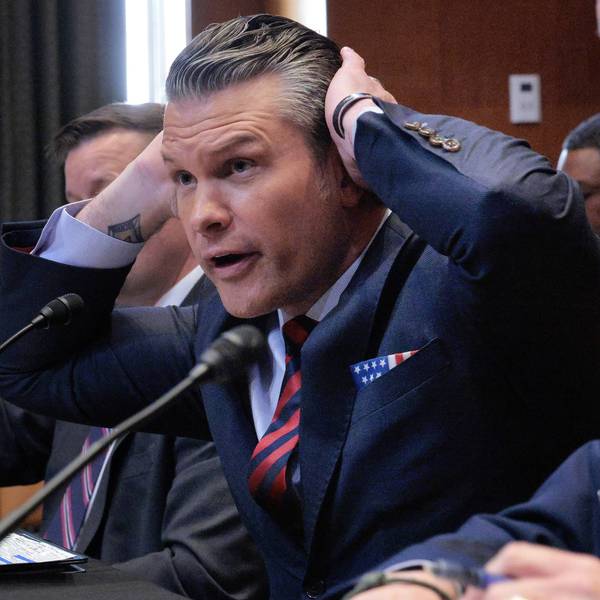
Pete Hegseth

Trump Cries ‘Virtual Treason’ as US News Outlets Detail Iran War Intel Assessments

Acting US Attorney General Todd Blanche and FBI Director Kash Patel

‘Effort to Stifle and Intimidate’: Trump DOJ Subpoenas News Outlets Over Iran War Coverage

“I had a total military victory,” Trump replied. “But the fake news, guys like you, write incorrectly. You’re a fake guy, and guys like you write incorrectly. We had a total military victory. We knocked out their entire navy, we knocked out their entire air force, we knocked out all their anti-aircraft weaponry.”

Despite this purported “total victory,” however, Iran still controls the Strait of Hormuz and has prevented commercial vessels from traveling through it for the last two months.

After attacking the Times’ reporting about the Iran War, the president pivoted to impugning Sanger’s patriotism.

“I actually think it’s sort of treasonous what you write,” the president said. “You and The New York Times, and CNN, I would say, are the worst… You should be ashamed of yourself. I actually think it’s treason.”

The Times on Tuesday reported that the Trump administration’s “public portrayal of a shattered Iranian military is sharply at odds with what US intelligence agencies are telling policymakers behind closed doors, according to classified assessments from early this month that show Iran has regained access to most of its missile sites, launchers, and underground facilities.”

Hours after the president’s tirade against Sanger—which echoed Trump’s previous remarks about media coverage of the war—New York Times spokesperson Charlie Stadtlander released a statement defending its reporting on the Iran war.

“Reporting isn’t treason,” Stadtlander said. “It’s foundational to a free press and the work that America’s founders wrote the First Amendment to protect. That includes making clear when the claims of government officials and the reality of their actions don’t line up… We will continue this important, constitutionally protected work.”

Trump’s treason accusation also drew a rebuke from Will Creeley, legal director of the Foundation for Individual Rights and Expression, who said that “no American should be comfortable with the president of the United States accusing a reporter of treason for critical reporting.”

New York Times columnist Nicholas Kristof argued that Trump’s attack on Sanger was really a sign of weakness given the failures of his military campaign against Iran.

“President Trump unloading on David Sander reflects a combination of anxiety, insecurity, and desperation about the Iran War,” Kristof wrote. “David is the dean of national security reporters: experienced, meticulous, and fair. Blaming the messenger underscores that the reality itself is pretty bad.”

Kristof’s sentiment was echoed by former ABC News journalist Terry Moran, who wrote that he can’t “understand how anyone can see Trump here and not see weakness.”

Former Republican Illinois Congressman Joe Walsh said Trump’s interaction with Sanger exposed him as “the biggest fucking crybaby in all of human history.”

Article by Brad Reed republished form Common Dreams under Creative Commons (CC BY-NC-ND 3.0). 

Continue Reading‘Reporting Isn’t Treason’: Trump Rant at Journalists Sparks Alarm

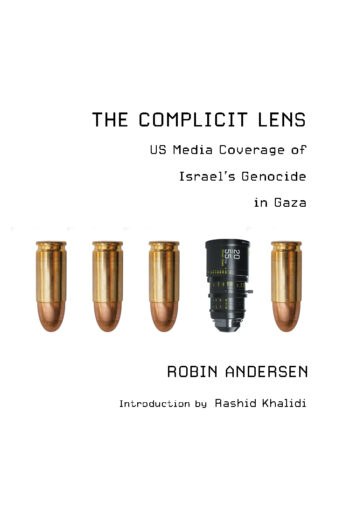
The Complicit Lens: US Media Coverage of Israel’s Genocide in Gaza

Spread the love

This work by Middle East Monitor is licensed under a Creative Commons Attribution-NonCommercial-ShareAlike 4.0 International License

  • Book Author(s):Robin Andersen
  • Published Date:July 2026
  • Publisher:OR Books
  • ISBN-13:9781682196267

by Ramona Wadi  walzerscent

While independent and alternative media wrought a change in US public opinion since the start of Israel’s genocide in Gaza, mainstream media provided Israel with a coverup for its crimes. “This book does not make for easy reading,” Rashid Khalidi wrote in the introduction to Robin Andersen’s The Complicit Lens: US Media Coverage of Israel’s Genocide in Gaza (OR Books, 2026). While legacy media justified genocide and acted as a mouthpiece for Israel and the US, independent media illustrated genocide as it happened. As Israel’s genocide continued without political opposition, legacy and mainstream media framed Palestinians in Gaza and anyone opposing the genocide as “the villains of the story, rather than the war criminals who perpetrated these murders, and this destruction and starvation.”

Mainstream media portrayal of Israel’s genocide in Gaza followed not only a predictable sequence, but also one that became ingrained and fortified despite the countless times such reporting was debunked by facts.

One notable discrepancy, Andersen writes, is the readily available information from Israeli media itself on the start of the genocide. While Western journalism simplified the start of the genocide through Hamas’s infiltration and attack on Israel, Israeli media noted the military’s role in the killing of Israeli civilians, with testimonies from Israelis expressing anger at the military. Andersen notes that if US media had included Israel’s killing of its own citizens while implementing the Hannibal directive, “the rudimentary narrative structure would have lost a good deal of its persuasive value.”

Indeed, the simplistic narrative emphasised by US mainstream media required a starting point. October 7 provided the peg not only for supporting Israel’s genocide, but for obliterating the entire Zionist colonial history and appropriation of Palestinian territory. Without context, news became a series of events obfuscated and far removed from history. However, language still played an important role. As Andersen states, “Genocide does not happen without a language to incite it.” From the initial statements by Israeli officials, the media hastened to demonise Palestinians also by choosing to omit the accurate terminology which would have described Israel’s genocidal actions.

Leaked memos from legacy media showed the extent to which news was disseminated in a manipulated manner. Editorial directives controlled the narrative omitting genocide, even as genocide was livestreamed through alternative and social media.

Israel’s kill toll was questioned as rhetorical propaganda, while  outlets such as CNN and the New York Times failed to attribute airstrikes to Israel. Language depicting Palestinians’ living conditions during the genocide also eliminated how Israel forcibly displaced Gaza’s population – neighbourhoods, instead of camps. Evidence of dead bodies was framed in assumptions that questioned realities, while Israel’s massacres at the so-called aid sites were described as “food-aid related deaths” by the Guardian, for example. The New York Times fared no better: “Death of Gazans Hungry for Food Prompt Fresh Calls for Ceasefire”.  

BOOK REVIEW: The Spectral Palestinian: Presence Before Politics

Similar tactics were employed by mainstream media’s discussion of Israel’s bombing of Al-Shifa hospital. Focusing on Israel’s propaganda justifying the strikes – a Hamas command and control centre beneath the hospital – mainstream media linked Al-Shifa to war crimes, but not Israel. As happened during the start of the genocide, when many statements were debunked by alternative media, Israel’s narratives on al-Shifa proved to be false. However, mainstream media still relied on Israel’s official narrative, which were altered several times as independent investigations progressed. When Israel targeted a refugee camp and burnt Palestinians to death, CNN reported on what Israel told the Biden administration. “It’s what Israel said to us,” a US official stated to CNN. Language, in the context of Israel’s attacks on al-Shifa hospital, was even more ambiguous. Andersen quotes the New York Times, which frames the attacks within the language of natural disasters – al-Shifa “stood in ruins on Sunday, as if a tsunami had surged through it following a tornado.” 

Andersen notes that for every instance of mainstream media’s manipulation of genocide for Israel’s benefit, alternative and independent media carried the investigations and answers to the public. From the initial disproven claims of beheaded babies that unleashed a frenzied support for Israel’s genocide, to claims of rape attributed to Hamas, independent media provided not only the proof of untruths, but also the network that supported the disseminated lies. Independent media also established the targeted killing of Palestinian journalists in Gaza, creating a sharp contrast between journalists covering genocide in real time, and mainstream reporters whose priority was to impart the Zionist narrative. Mainstream media’s refusal to mention targeted assassinations of Palestinian journalists contributes to Israel’s efforts to silence journalists reporting from Gaza – the only sources available also considering that Israel refused entry to international journalists. The tacit silence from mainstream media in the US contradicts the essence of journalism, all for preserving the continuation of genocide. 

“The many examples of journalistic malpractice include in this book expose corporate media’s acquiesce to power and their abandonment of independence and the mandate to inform,” Andersen writes in the conclusion. Israel’s genocide in Gaza exposed the extending parameters of incitement, and the reach Zionism has at an international level. Mainstream media in the US contributed to a growing divide not only between media sources, but also in disrupting clarity – those that advocate for justice are now equated with terrorists, and those that defame people calling for justice are thriving in impunity.

The numerous examples Andersen cites in her extensive research of media reporting on Gaza call for a sobering scrutiny, not only on intent, but on the violation of language and its repercussions on Palestine, on Gaza, and on all people opposing colonialism and genocide. 

Andersen notes that the manipulation of Israel’s genocide in Gaza had other precedents, such as the US war on Iraq which was based on fabricated claims of weapons of mass destruction. Within the Iraq context, however, mainstream media had issued public apologies for their propaganda. Andersen notes that none have been forthcoming so far with regard to Israel’s genocide in Gaza. 

BLOG: EU sanctions on settlers is turning a blind eye to colonialism

This work by Middle East Monitor is licensed under a Creative Commons Attribution-NonCommercial-ShareAlike 4.0 International License

Keir Starmer explains that UK is actively supporting Israel's genocidal expansion and repeats his previous quotation that he supports Zionism "without qualification". Keir Starmer said “I said it loud and clear – and meant it – that I support Zionism without qualification.” here: https://www.jewishnews.co.uk/keir-starmer-interview-i-will-work-to-eradicate-antisemitism-from-day-one/
Keir Starmer explains that UK is actively supporting Israel’s genocidal expansion and repeats his previous quotation that he supports Zionism “without qualification”. Keir Starmer said “I said it loud and clear – and meant it – that I support Zionism without qualification.” here: https://www.jewishnews.co.uk/keir-starmer-interview-i-will-work-to-eradicate-antisemitism-from-day-one/
Keir Starmer objects to criticism of the IDF. He asks how could anyone object to them starving people to death, forced marches like the Nazis did, bombing Gaza's hospitals and universities, mass-murdering journalists, healthworkers and starving people queuing for food, killing and raping prisoners and murdering children. He calls for people to stop obstructing his genocide for Israel.
Keir Starmer objects to criticism of the IDF. He asks how could anyone object to them starving people to death, forced marches like the Nazis did, bombing Gaza’s hospitals and universities, mass-murdering journalists, healthworkers and starving people queuing for food, killing and raping prisoners and murdering children. He calls for people to stop obstructing his genocide for Israel.
Keir Starmer confirms that he doesn't know anything about democracy.
Keir Starmer confirms that he doesn’t know anything about democracy.

Continue ReadingThe Complicit Lens: US Media Coverage of Israel’s Genocide in Gaza

Genocide Doesn’t Happen Without Language to Incite It

Spread the love

Article by Robin Andersen republished from FAIR under http://creativecommons.org/licenses/by-nc-nd/3.0/

This is a lightly edited excerpt from Robin Andersen’s The Complicit Lens: US Media Coverage of Israel’s Genocide in Gaza, published by OR Books.

Intercept: Leaked NYT Gaza Memo Tells Journalists to Avoid Words “Genocide,” “Ethnic Cleansing,” and “Occupied Territory”

Intercept (4/15/24)

How is information made legitimate, and when is it appropriate for journalists to introduce skepticism? What happens when only one side of a conflict is given the legitimate voice, always repeated and rarely questioned, even when those sources have proven many times to have promulgated lies?

Military studies scholars and analysts understand that there is always a long genesis of historical, political and economic factors that can eventually erupt into conflict. In many ways, US establishment media seemed unwilling or unable (but likely both) to narrate a more complex, historically accurate account of the war on Gaza.

The Intercept (4/15/24) reported that editorial directives at the New York Times and CNN, two of the most important news sources in the US, advised reporters to avoid certain “taboo” words, such as “genocide” and “massacre.” Yet between October 7 and November 24, 2023, the Times used the word “massacre” 53 times—referring to Israelis killed by Palestinians, but only once to refer to a Palestinian killed by Israel (Intercept1/9/24).

From November onward, as deaths in Gaza piled up, the Times habitually avoided using emotionally fraught terms for Palestinians. Another term, “ethnic cleansing,” was also barred from use, along with “refugee camps” and “occupied territories.”

As the Times source who leaked the directives said, “You are basically taking the occupation out of the coverage, which is the actual core of the conflict.”

US news outlets were crippled by these verbal restrictions, incapable of offering an accurate explanation of what was happening in Gaza by imposing such constraints on humanitarian language, and international principles and laws.

Islamophobic tropes

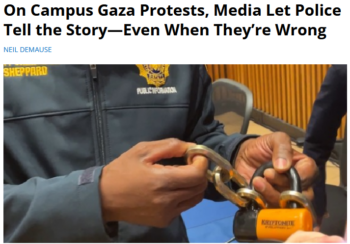
FAIR: On Campus Gaza Protests, Media Let Police Tell the Story—Even When They’re Wrong

FAIR.org (5/9/24)

Media frames are based on underlying assumptions, articulated through familiar tropes that appear unquestioned in language and representation. Some stories are recognizable as reflections of beliefs and myths, and others are accurate renderings when accompanied by on-the-ground documentation.

Seasoned journalists entrusted to cover such a monumental conflict seemed not to be schooled in the differences. They failed to identify the history and uses of atrocity stories as propaganda, and showed no awareness of the use of Islamophobic tropes such as the “brutish knife-wielding Arab terrorist,” or the West’s long history of Orientalism and the hypersexualized Arab male, as identified by Edward Said.

Establishment media applied a “lawlessness” trope, identified by Rebecca Solnit (A Paradise Built in Hell2009) as a dictate of convention to blame the victims of humanitarian disasters, when in fact in such crises, she argued, communities come together to help one another. The lawlessness frame was used to direct the causes of starvation away from Israel’s engineered famine, and point the finger of blame at starving Palestinians, who were being shot by IDF snipers as they looked for food.

By April 2024, when police were called to break up student encampments, media relied on another powerful framing device, complete with its attendant language, to condone police violence against students at colleges and universities, first at Columbia, then at other campuses around the country. Campuses, they said, had been infiltrated by “outside agitators” (FAIR.org5/9/24).

Yet the critical debate articulated by student protests was part of American public discourse at the time. Though they were violently attacked by pro-Israel protesters and US law enforcement, students helped move American sentiment about the genocide to the center of cultural and political debate. By the fall of 2024, students would be hit by a wave of repression and attacks on their civil liberties and rights to freedom of expression.

Were these stereotypes taken into consideration when deciding which stories would be told, which talking points would be followed, and which perspectives would be ignored? Many of the narratives we are left with, used to explain this so-called “Israel/Palestine conflict,” are familiar media constructs and simply cannot explain a genocide.

Language of confusion

The Complicit Lens, by Robin Andersen

OR Books (2026)

In so many ways, big media failed to provide accurate information about Israel’s bombing attacks and their consequences on the people in Gaza. They improvised a language of confusion, denial and justification.

A combination of media tropes and frames, together with verbal inventions, downplayed Israel’s increasingly brutal genocidal violence, along with the hollow echoes that explained away every military act of violence, as the media served as “stenographers to power.” These strategies facilitated the continuation of a genocide. The failure to accurately cover the destruction of Gaza was inimical to the basic professional canons of journalism.

Genocide does not happen without a language to incite it. From collective punishment to ethnic cleansing, and the destruction of infrastructure to the withholding of food, water and medical care, Israel continually committed war crimes on a much greater scale than the initial Hamas attacks. Such acts depended on the demonization of an entire people, and the undervaluing of Palestinian life was a major feature of US reporting.

In Gaza, in addition to dismantling civilian infrastructure such as hospitals, Israel also carried out the destruction of cultural heritage sites, universities, schools and mosques, acts of destruction understood to deliberately eliminate an entire group of people defined by their ethnicity, religion, culture and identity. These are the crimes of genocide. Yet the words associated with these crimes were rarely if ever used in establishment media reporting on Israel’s attacks on Gaza.

FAIR’s work is sustained by our generous contributors, who allow us to remain independent. Donate today to be a part of this important mission.

Article by Robin Andersen republished from FAIR under http://creativecommons.org/licenses/by-nc-nd/3.0/

Keir Starmer objects to criticism of the IDF. He asks how could anyone object to them starving people to death, forced marches like the Nazis did, bombing Gaza's hospitals and universities, mass-murdering journalists, healthworkers and starving people queuing for food, killing and raping prisoners and murdering children. He calls for people to stop obstructing his genocide for Israel.
Keir Starmer objects to criticism of the IDF. He asks how could anyone object to them starving people to death, forced marches like the Nazis did, bombing Gaza’s hospitals and universities, mass-murdering journalists, healthworkers and starving people queuing for food, killing and raping prisoners and murdering children. He calls for people to stop obstructing his genocide for Israel.
Keir Starmer explains that UK is actively supporting Israel's genocidal expansion and repeats his previous quotation that he supports Zionism "without qualification". Keir Starmer said “I said it loud and clear – and meant it – that I support Zionism without qualification.” here: https://www.jewishnews.co.uk/keir-starmer-interview-i-will-work-to-eradicate-antisemitism-from-day-one/
Keir Starmer explains that UK is actively supporting Israel’s genocidal expansion and repeats his previous quotation that he supports Zionism “without qualification”. Keir Starmer said “I said it loud and clear – and meant it – that I support Zionism without qualification.” here: https://www.jewishnews.co.uk/keir-starmer-interview-i-will-work-to-eradicate-antisemitism-from-day-one/
Donald Trump sings and dances, says that it's fun to kill everyone ...
Donald Trump sings and dances, says that it’s fun to kill everyone …

Continue ReadingGenocide Doesn’t Happen Without Language to Incite It

Meta Drops $65 Million on Super PACs to Back Pro-AI Candidates Against Big Tech Critics

Spread the love

Original article by republished from Common Dreams under Creative Commons (CC BY-NC-ND 3.0). 

Meta CEO Mark Zuckerberg shows a prototype of computer glasses that can display digital objects in transparent lenses at the Meta Connect developers conference in Menlo Park, California on September 25, 2024. (Photo: Andrej Sokolow/picture alliance via Getty Images)

“We can’t afford more corrupt politicians bought by Big Tech,” said one Democratic US House candidate.

Meta, the parent company of social media giants Facebook, Instagram, and WhatsApp, is spending big bucks to ensure that government regulations don’t interfere with its ambitions in artificial intelligence.

The New York Times reported on Wednesday that Meta is planning to spend $65 million on this year’s midterm elections, with one super political action committee (PAC) dedicated to electing AI-friendly Democrats, and another dedicated to electing AI-friendly Republicans.

RECOMMENDED…

‘What Oligarchy Looks Like’: AI Giants Pledge to Pump $100 Million Into 2026 Midterms

‘What Oligarchy Looks Like’: AI Giants Pledge to Pump $100 Million Into 2026 Midterms

Bernie Sanders 2/4/26

‘What a Surprise’: Sanders Undeterred by Bezos-Owned Washington Post’s Dismissal of AI Data Center Pause

The pro-Democratic super PAC, called Making Our Tomorrow, will work to influence congressional races in Illinois, while the pro-GOP PAC, called Forge the Future Project, will be focusing on congressional races in Texas.

The Times noted that Meta has in the past been “cautious about campaign engagements, making small donations out of a corporate political action committee and contributing to presidential inaugurations,” but it has decided to ramp up its spending to defend its AI business from governmental interference.

Meta’s spending splurge to elect pro-AI candidates is just one of many efforts by the AI industry to ensure a friendly regulatory environment.

CNN reported last week that Leading the Future—a super PAC backed by venture capital firm Andreessen Horowitz, Palantir co-founder Joe Lonsdale, and other AI heavyweights—is pledging to spend at least $100 million to influence the 2026 midterm election.

The goal of the PAC will be to elect lawmakers who will pass legislation to set a single set of AI regulations that will take effect throughout the US, overriding any restrictions placed on the technology by state governments.

The PACs’ big spending comes as a nationwide backlash to Big Tech has been forming across the US, as many communities are fighting against the construction of energy-devouring AI data centers that are raising electricity prices and have been accused of degrading the quality of local water supplies.

Reed Showalter, a Democratic US House of Representatives candidate running in Illinois’ 7th Congressional District, said the report of Meta’s big spending showed the importance of ensuring that voters elect leaders who will hold the major tech companies accountable.

“We deserve representatives who are going to take an honest look at AI and regulate it accordingly,” he wrote in a social media post. “We can’t afford more corrupt politicians bought by Big Tech.”

Democratic New York congressional candidate Alex Bores, who is running on a platform of regulating AI, said during an interview with CNN on Wednesday that the tech companies’ actions show they are “terrified” of being held accountable by elected officials.

He also noted that being attacked by the Leading the Future super PAC has ironically helped his candidacy.

“The fact that they’re being so aggressive with it, I think, has been redounding to my benefit,” he told host Dana Bash. “I’ve had a lot of constituents who have reached out and said, ‘I hadn’t even heard of you until all these text messages [from the AI super PAC].”

Watchdog social media account @OilPACTracker predicted that Meta’s major political spending could turn into a liability if voters are made aware of its machinations.

“We would make sure the electorate knows about it,” the watchdog wrote. “Big Tech money is toxic.

Orcas discuss how Trump was re-elected and him being an obviously insane, xenophobic Fascist.
Donald Fuhrump says that Amerikkka doesn't bother with crimes or charges anymore, not being 100% Amerikkkan and opposing his real estate intentions is enough.
Donald Fuhrump says that Amerikkka doesn’t bother with crimes or charges anymore, not being 100% Amerikkkan and opposing his real estate intentions is enough.
Elon Musk urges you to be a Fascist like him, says that you can ignore facts and reality then.

Continue ReadingMeta Drops $65 Million on Super PACs to Back Pro-AI Candidates Against Big Tech Critics