FW Pomeroy’s Statue of Justice stands atop the Central Criminal Court building, Old Bailey, London
THE conviction of Palestine Solidarity and Stop the War leaders Ben Jamal and Chris Nineham is a perfect example of the way in which Establishment values underpin the functioning of the state, its coercive apparatus — the police, and the Metropolitan Police in particular — and, as clearly demonstrated today, the judicial system.
Last year’s January 18 protest was one in a series of Palestine solidarity demonstrations in response to the Gaza genocide. By and large they passed without public order incidents and the police, no doubt conscious of the huge public support for the issue, proved careful and courteous in dealing with both organisers and participants.
In this particular case, however, a different mood developed. The police and intelligence organisations know full well — through long experience and with excellent sources of information — that the solidarity movement is in the business of shifting public opinion, not causing disorder.
The charitable will put the police conduct on the day down to incompetence and confusion. The less charitable to conscious design.
Let the legal representatives of the defendants and their organisations speak to the judicial bias exhibited by the court and let us go beyond the surface appearances of bourgeois justice to see how these parts of the system work together.
Keir Starmer explains that UK is actively supporting Israel’s genocidal expansion and repeats his previous quotation that he supports Zionism “without qualification”. Keir Starmer said “I said it loud and clear – and meant it – that I support Zionism without qualification.” here: https://www.jewishnews.co.uk/keir-starmer-interview-i-will-work-to-eradicate-antisemitism-from-day-one/
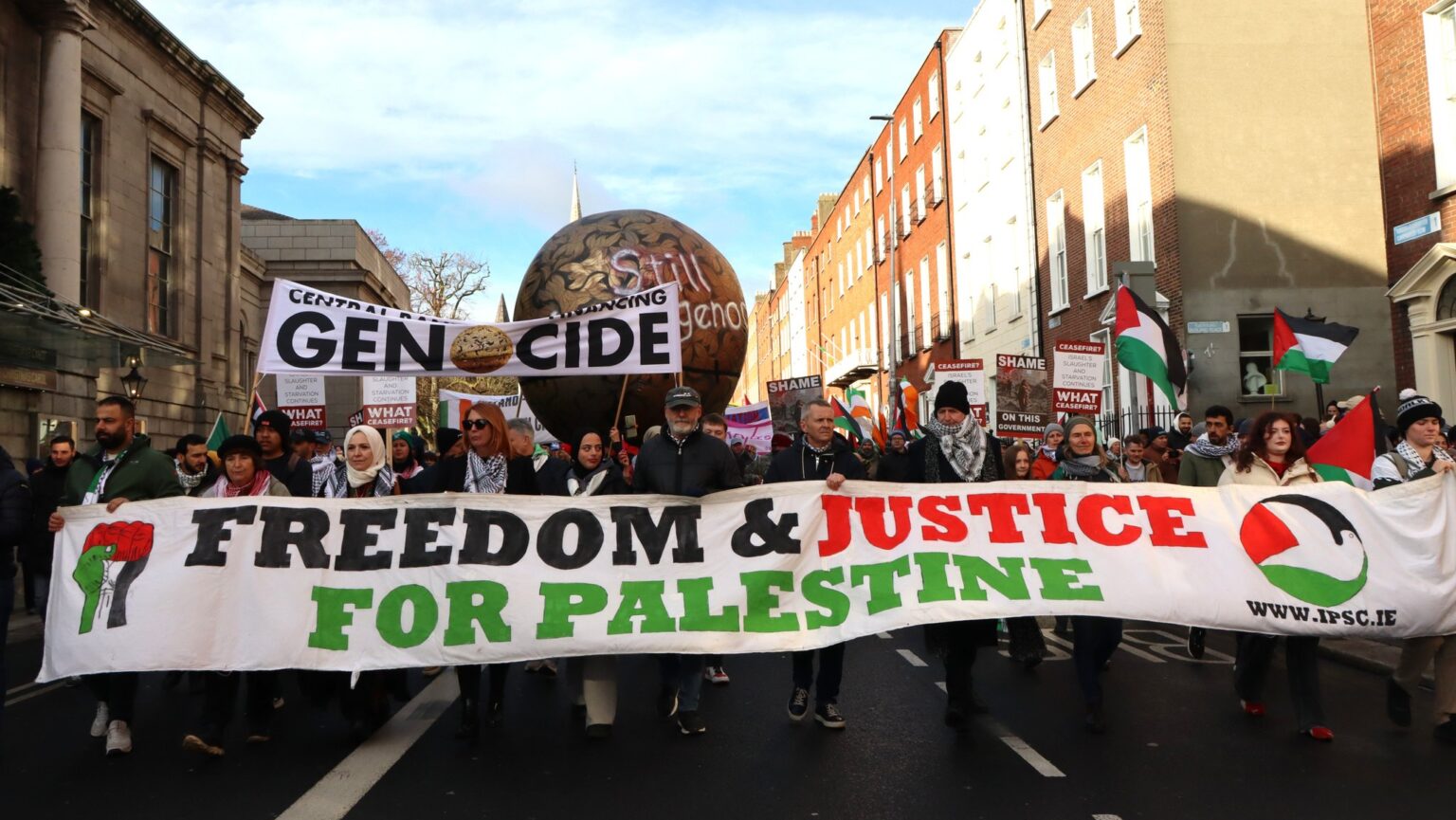
On November 29, hundreds of thousands marched across Europe in support of Palestine and against government complicity in Israel’s genocide.
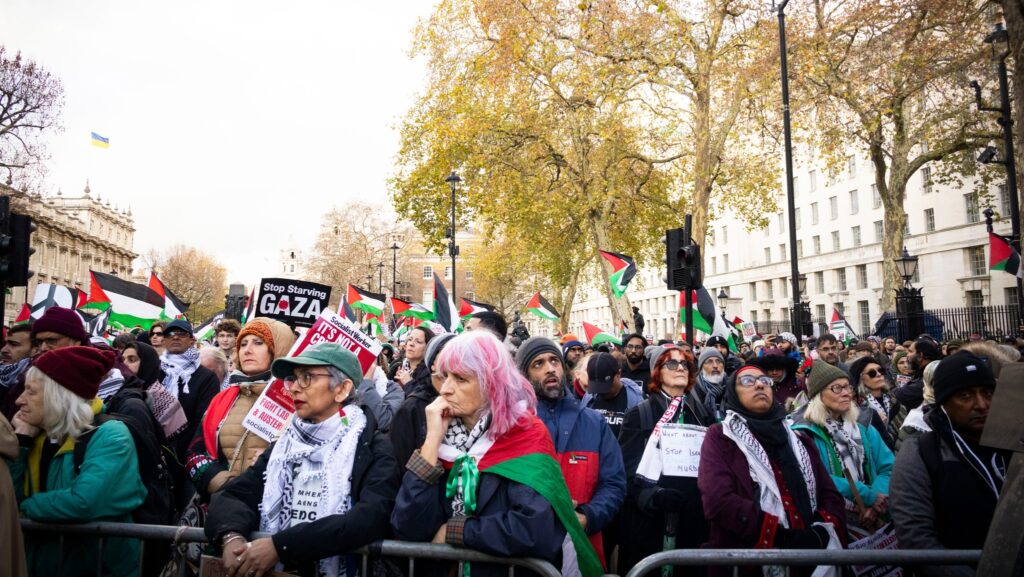
The Palestine solidarity movement in Europe again brought record numbers to the streets on the UN’s International Day of Solidarity with the Palestinian People, November 29, reaffirming demands for an end to government complicity in the ongoing genocide in Gaza and the occupation of Palestine. Hundreds of thousands marched across the region, with demonstrations in London and Rome each reaching an estimated 100,000 participants.
“On this day, people around the world express their support for the inalienable rights that are currently denied to Palestinians: the right to live free from discrimination, the right to self-determination, and the right to return to their lands,” the Palestine Solidarity Campaign (PSC) wrote on social media. “Despite this Britain continues to arm Israel and refuses to implement meaningful sanctions or end its diplomatic support. It still provides parts for Israel’s F-35 fighter jets, used to bomb Palestinians in Gaza and maintains contracts with Israeli weapons manufacturers like Elbit Systems.”
Saturday’s demonstration was the 33rd national march for Palestine in Britain. In addition to local activists, it also welcomed international guests who have stood with Palestinians since the beginning of the genocide, including Belgian MEP Marc Botenga of the Workers’ Party of Belgium (PTB-PVDA), French parliamentarian Nadège Abomangoli of France Unbowed (LFI), and Sinn Féin leader Mary Lou McDonald. While addressing the crowd in London, they emphasized the internationalist character of the mobilization and echoed demands that could be heard in their home countries around the same time.
As thousands marched in Paris and Dublin, they insisted on the need to continue organizing despite political obstruction and attacks. Irish actor Liam Cunningham, a vocal supporter of Palestine, helped lead Dublin’s demonstration. Responding to artists being de-platformed for speaking out against genocide, he said: “If anyone doesn’t want to employ me because I’ve taken a stand against injustice, against the refusal to give self-determination to a group of people who are politically, culturally on the same track that my country was on for 800 years […] they’re not going to be very good at their job, because they’ve no soul.”
Another recurring message across Europe refused the mainstream media allegation of a “ceasefire” in Gaza. “There’s no ceasefire just because it’s written on a Western media banner,” Cunningham added. “Let’s come up with another word, ‘ceasefire’ is not working.”
In Italy, the central mobilization followed a successful day of general strike organized by the grassroots union Unione Sindacale di Base (USB). The march welcomed UN Special Rapporteur Francesca Albanese and Freedom Flotilla activists Greta Thunberg and Thiago Ávila. Dockworkers and firefighters affiliated with USB, who have played key roles in earlier protests and faced reprisals for this, also formed notable protest blocs. The response of Italy’s political establishment to growing support for Palestine mirrors that of other European governments: attempting to suppress dissent and insisting that further militarization is the only path forward.
Palestine solidarity march in London, November 29, 2025. Source: Marc Botenga/Facebook
“Today we see what this path has created: a genocide, broadcast live, carried out with the complicity of Western governments; massacres in the Mediterranean; NATO wars; bombs across the world,” said Marta Collot, spokesperson for the left party Potere al Popolo, during the Rome demonstration. “But something has changed too. The September mobilizations, the three general strikes called by USB that brought everything to a halt, and our march today show that they were wrong […] Our demonstration is the message coming from Palestine, from socialist Cuba resisting, from Venezuela. It shows that an alternative path is not only necessary, but that it’s possible.”
“Today there are two Europes,” Marc Botenga emphasized in London. “There is the Europe of the establishment, the Europe of the governments that have funded this genocide, that have supported this genocide, and that are continuing to do so. And then, there’s the other Europe, there’s the Europe that we incarnate here today. That is the Europe of liberation, the Europe that says no to occupation.”
Orcas discuss Genocide-supporting and complicit Zionists. Donald Trump, Keith Starmer, David Lammy, Rachel Reeves, Angela Rayner and Wes Streeting are acknowledged as evil genocide-complicit and supporting cnuts.Genocide denier and Current UK Prime Minister Keir Starmer is quoted that he supports Zionism without qualification. He also confirms that UK air force support has been essential in Israel’s mass-murdering genocide. Includes URLs https://www.declassifieduk.org/keir-starmers-100-spy-flights-over-gaza-in-support-of-israel/ and https://youtu.be/O74hZCKKdpAKeir Starmer objects to criticism of the IDF. He asks how could anyone object to them starving people to death, forced marches like the Nazis did, bombing Gaza’s hospitals and universities, mass-murdering journalists, healthworkers and starving people queuing for food, killing and raping prisoners and murdering children. He calls for people to stop obstructing his genocide for Israel.
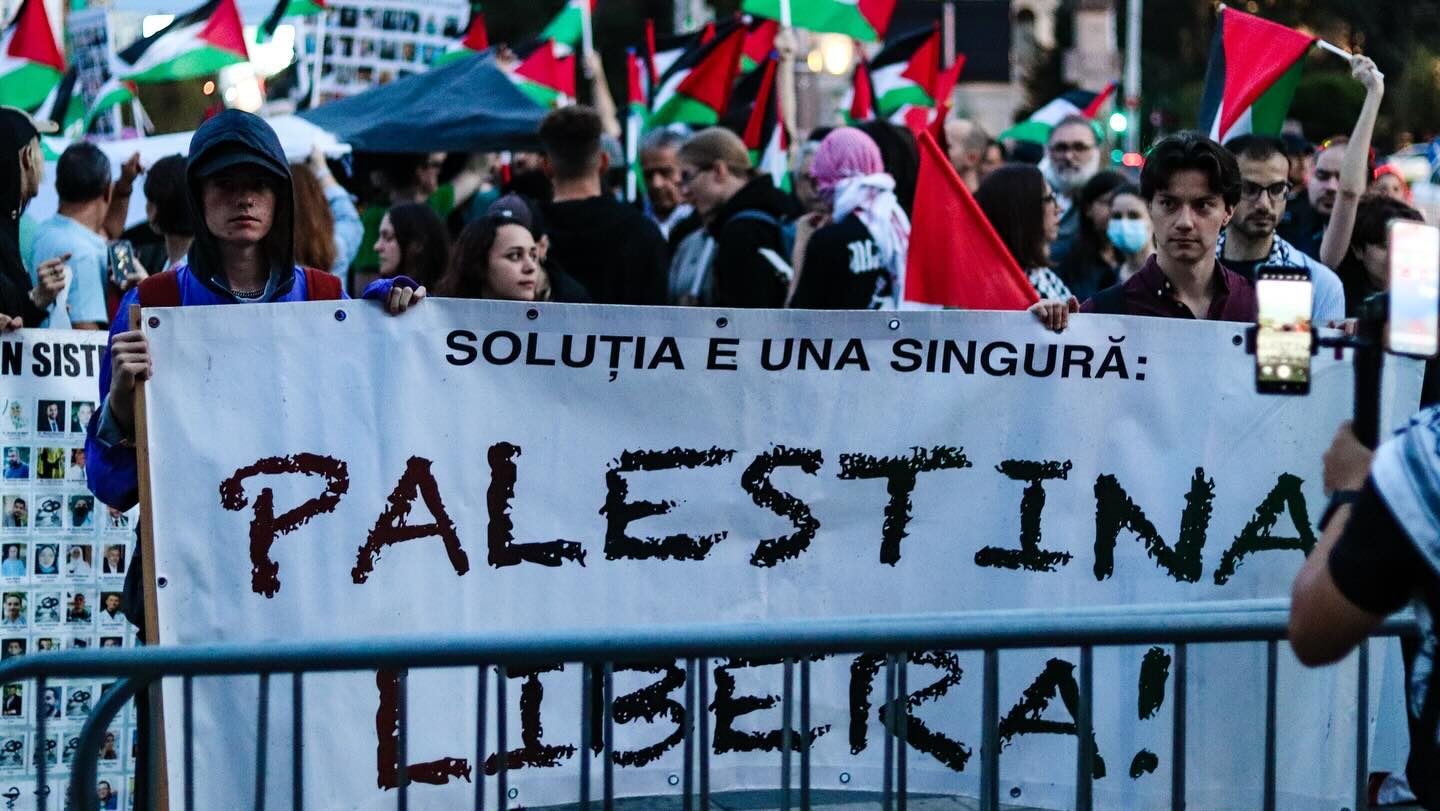
Palestine solidarity protest in Romania, 2025. Source: Solidaritate Romania-Palestina/Facebook
Palestine solidarity groups in Romania and beyond are launching a campaign to end ties with Israeli arms company Elbit Systems.
A coalition of Romanian and international groups standing in solidarity with Palestine has launched the “Elbit Out!” campaign, aiming to expel Israeli arms manufacturer Elbit Systems from Romania. Elbit is one of Israel’s largest arms manufacturers and is present in Romania with three companies, the organizers explain. “There, it manufactures components for weapons that have been tested on Palestinians and are partly still used in Gaza today.”
According to statements of Israeli officials, Elbit facilities in Brașov and Bacău, along with a production site in Măgurele outside Bucharest, made Romania the company’s third-largest manufacturing hub in 2021 – behind only Israel and the United States. The arms producer’s presence has been a constant for years, with early 2010s reports already highlighting its peculiar position in Romania.
“The continuation of these cooperative relations between Romania and the Israeli state violates Romania’s international legal obligations and the fundamental principles of human rights,” campaigners warn. “Through the arms trade, Romania is an active partner in genocide, in maintaining the apartheid regime, and in the systematic oppression of the Palestinian civilian population.”
While the campaign is demanding Romanian authorities end ties with Elbit, it also stresses that complicity in Israel’s war crimes extends further. One issue is the scale of military exports from Romania to Israel. Activists point out that in the past two years alone, these have amounted to dozens of millions of euros. Such transfers have been another steady feature of the bilateral relationship. In 2012, Israel was Romania’s third-largest arms client. “While other export destinations decreased in volume, as all European arms export decreased due to the economic crisis, Israel continued to be a good customer of the Romanian arms industry,” Wendela de Vries from the Dutch campaign Stop Arms Trade noted in LeftEast in 2014. “It continued buying components for air-to-air missiles, military ground vehicles, and testing equipment for military planes.”
At the same time, Romania has consistently purchased Israeli military technology, much of it tested on Palestinians living under occupation. This cooperation has included technology exchange for drones and air defense systems, involving not only Elbit but also Israel Aerospace Industries and Rafael Advanced Defense Systems. Most recently, over €2 billion was awarded to Rafael in a contract for an air defense system to be deployed in Romania. The deal will draw funding from Romania’s strained public budget, but is also likely to benefit from the European Union’s recent armament programs, according to early reports.
As a result of this background, the campaign will also focus on halting all military imports and exports between Romania and Israel, as well as terminating bilateral military agreements. After a public inauguration on October 5, with the participation of representatives from BDS Campaign Europe and Law for Palestine, it will include field work with trade unions, legal petitions, and engaged advocacy. It is expected to culminate with a conference focusing on solidarity with Palestine and internationalism, organized as a counterpoint to the Black Sea Defense, Aerospace and Security International Exhibition in Bucharest in mid-May 2026.
The initiative is coordinated by Palestine Solidarity Cluj-Napoca in cooperation with Solidaritate România-Palestina, Moldova pentru Palestina, Absorbante pentru Toate, Blocul Tineretului Muncitoresc, Căși Sociale ACUM!, Colectiva Urzica, Fundraisers for Falastin RO, Grupul de Acțiune Socialistă, Partidul SENS, and Platforma L.E.F.T. It has also secured endorsements from the Boycott, Divestment, Sanctions (BDS) Campaign, Stop ReArm Europe, and the International People’s Assembly (IPA), showing that the push to end European complicity in Israel’s crimes is growing stronger by the day.
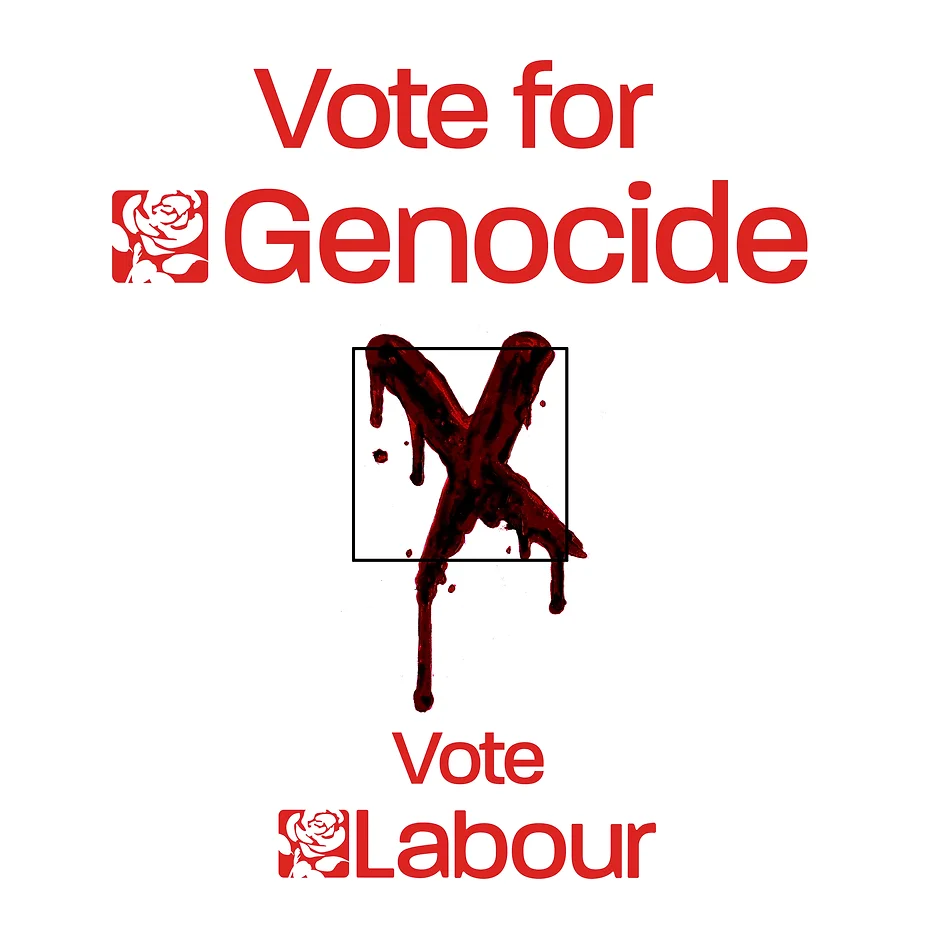
Keir Starmer objects to criticism of the IDF. He asks how could anyone object to them starving people to death, forced marches like the Nazis did, bombing Gaza’s hospitals and universities, mass-murdering journalists, healthworkers and starving people queuing for food, killing and raping prisoners and murdering children. He calls for people to stop obstructing his genocide for Israel.Vote Labour for Genocide.
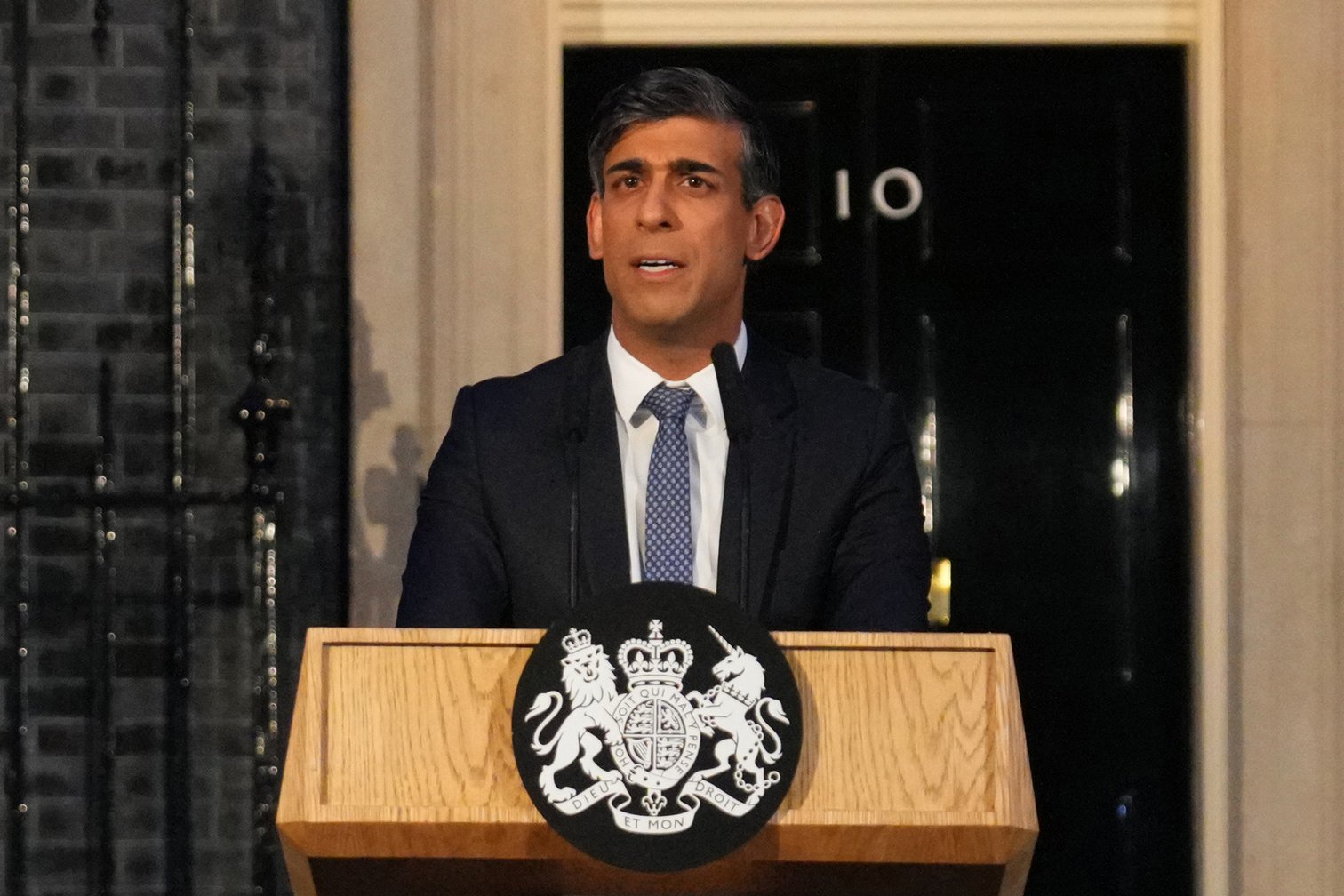
Rishi Sunak used his first speech outside 10 Downing Street to say “hateful” groups had “hijacked” the streets in recent months, in reference to pro-Palestine marches | Carl Court/Getty Images
Daughter of terror attack victim Makram Ali says politicians are ‘fuelling fire’ by equating Muslims with extremism
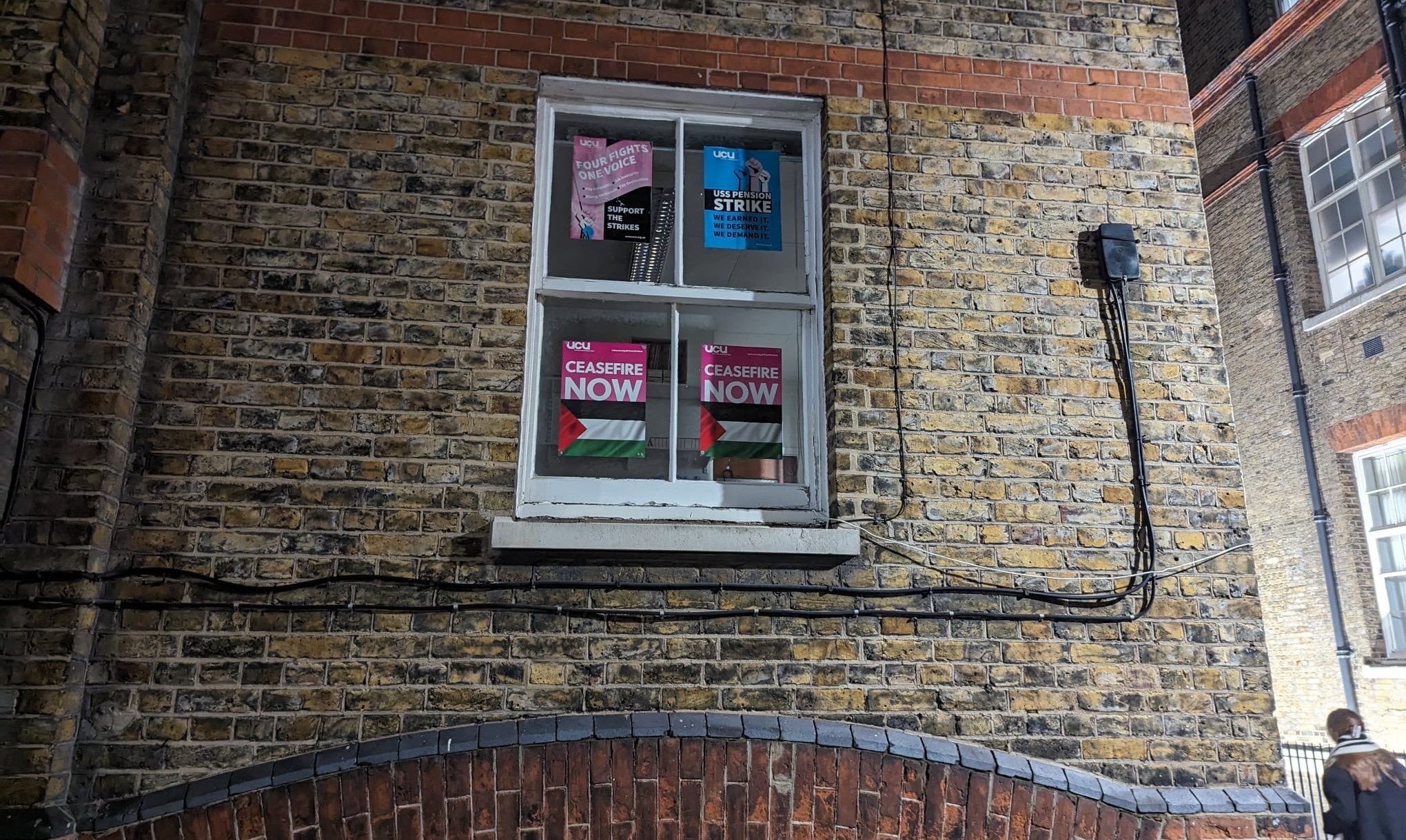
James Eastwood and his union colleagues got to their office one Tuesday afternoon to find that someone had broken in. The intruder hadn’t taken personal valuables or expensive equipment: all they had done was pull down the pro-Palestine posters in the window.
The break-in didn’t come as a huge shock to Eastwood, co-chair of the University and College Union (UCU) branch at Queen Mary University in east London. A day earlier, uni bosses had called him asking for access to the office so they could remove the posters, one of which had a Palestinian flag on it, and another of which read: “From the river to the sea, Palestine will be free.” Eastwood had agreed, requesting only that he be allowed to make the case before any action was taken.
The university was unwilling to wait, and forced the lock the next day. But Eastwood lays the blame beyond the office of the president and principal, Colin Bailey, who last year took home nearly £359,000. Instead, he holds the government responsible, feeling ministers have decided that “it’s not OK to be in solidarity with Palestine”. The university admits it took the posters down, telling openDemocracy that “such permanent displays… can stifle freedom of speech and make members of our community feel unsafe”.
Communities secretary Michael Gove is this week expected to widen the government’s definition of extremism to include “promotion or advancement of ideology based on hatred, intolerance or violence or undermining or overturning the rights or freedoms of others, or of undermining democracy itself”.
This might sound reasonable in isolation. But Gove’s intervention is the culmination of a months-long campaign by Tory politicians to paint pro-Palestine protesters as extremists.
Ahead of a march on 11 November, then home secretary Suella Braverman called the demonstrations “hate marches” and suggested the sanctity of Armistice Day was under threat. This led hundreds of far-right thugs – more than 90 of whom were arrested – to gather in Whitehall to “protect” the cenotaph from a march for Palestine that was taking place in another part of the city.
The posters were displayed on the windows of UCU’s office at Queen Mary University of London | James Eastwood
Emboldened by this narrative, former deputy Tory Party chair Lee Anderson last month claimed “Islamists” had “got control” of Sadiq Khan, London’s first Muslim mayor. He later doubled down and refused to apologise, after which he was suspended for conflating “all Muslims with Islamist extremism”. The prime minister described Anderson’s comments as “wrong” but avoided calling them Islamophobic.
This rhetoric, which also included false claims from MPs that there were “no-go” Muslim-majority areas in Birmingham and east London, climaxed in a hastily-arranged, Friday night speech from Sunak outside 10 Downing Street at the beginning of March. This was a significant intervention – it was the first time he had addressed the nation in this way since becoming PM 18 months ago.
He warned that “extremists” were “spewing hate” and “hijacking” protests. He also called on protesters “to stand together to combat the forces of division and beat this poison”.
Campaigners believe the new definition of “extremism” will in practice mean public authorities being forced to cut links with a widening circle of proscribed pro-Palestine groups. Even three former Tory home secretaries said yesterday the politicisation of extremism had gone too far.
Eastwood said the mood music from the government “filters down and creates a climate where organisations including universities feel pressure to show that they’re doing something”.
“You see a reproduction of some of the government lines on what’s acceptable speech, what’s offensive speech, what speech is to be allowed or not allowed,” he added.
Fuelling the fire
On 18 June 2017, Darren Osborne drove a van from Cardiff to London with plans to attack a pro-Palestinian march. A jury would go on to hear he had wanted to kill then Labour leader Jeremy Corbyn, as well as Sadiq Khan.
Osborne, 48, had viewed posts on social media by former English Defence League leader Stephen Yaxley-Lennon (also known as Tommy Robinson) and Britain First before driving his van directly into a crowd of people leaving the Muslim Welfare House in Finsbury Park – Corbyn’s constituency – following evening Ramadan prayers. He killed 51-year-old Makram Ali and injured 12 others.
As he tried to escape, he is reported to have said: “I want to kill more Muslims.”
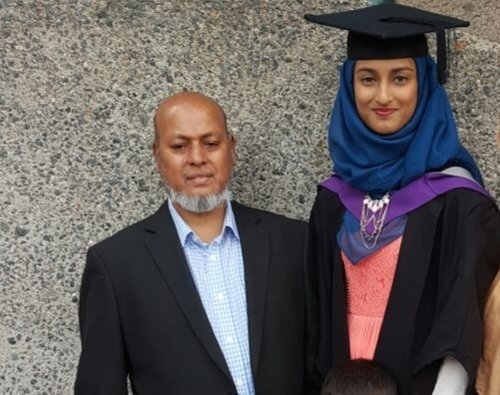
Ali’s daughter, Ruzina Akhtar, says politicians’ attempts to equate Islam with extremism are “fuelling the fire” and “inciting more hatred” towards Muslims.
“Every day, that’s going into someone’s ears who doesn’t have positive feelings towards Muslims,” she told openDemocracy. “It only takes one comment, or one thing to push someone over the edge. It’s not just actions – words speak loudly as well. Politicians need to be really careful with what they say and how they say it, because every single word could potentially be a threat to someone’s life.”
While politicians pontificate over definitions, Akhtar warned: “They’re in their own political bubble. They’re not thinking about the wider effect their words could have.
“Instead of inciting hatred, they need to be working together with communities. On the one hand, they’ll talk about how Britain is multicultural and so inclusive, but then they’re putting targets on people’s backs.”
Ruzina Akhtar and her dad, Makram Ali | Ruzina Akhtar
Akhtar will be easing into yet another Ramadan without her dad today. The one thing she wants people to remember is how dangerous these dehumanising, Islamophobic tropes can be. “Muslims can be targets as well,” she said. “It doesn’t matter who you are. At the end of the day, we’re all human beings.”
Of course, the UK government’s rebranding of pro-Palestine voices and peaceful protesters as extremists is not a new phenomenon.
For years, people who support Palestine vocally and publicly have been targeted under Prevent – the UK government-led counter-terrorism programme, which human rights organisations say is discriminatory and ineffective. In his speech, Sunak doubled down on his support for the programme.
In 2016, Rahmaan Mohammadi – a schoolboy from Luton – was referred to Prevent and questioned by anti-terrorism police for wearing ‘free Palestine’ badges and wristbands to school. He also claimed that he was told to stop talking about Palestine in school.
Now, ahead of a general election, Fatima Rajina, an academic specialising in issues on identity, race, British Muslims and postcolonialism, says long-standing Islamophobic and anti-Muslim tropes have been invoked in order to win votes and deflect from government failures.
“It’s stoking fear, because that is what has been done for the last 20-plus years,” she said. “The ‘war on terror’ rhetoric has meant that politicians rely on very well established tropes about Muslims. And they proceed with that because that is what gets into people’s minds.”
War on terror
If you’ve ever been to a march for Palestine you might have watched the prime minister’s Downing Street address and wondered if you were being gaslit. For many, the marches have been largely peaceful, with people of different faiths, backgrounds and ethnicities coming together to call for a ceasefire in Gaza.
openDemocracy recently revealed that, despite attempts by some MPs to form a narrative that the marches amounted to “mass extremism” and were “openly criminal”, only 36 people out of the millions who attended last year had been charged with a crime.
The post 9/11 so-called ‘war on terror’ touched all aspects of day-to-day life for Muslims in the UK, from Prevent referrals to surveillance in mosques and schools, as well as so-called ‘schedule 7’ stops at UK ports and airports and increased use of stop and search.
Rajina says the government relies on convincing people that such measures are for the sake of “safety” and the public good, and calls this framing “very sinister”.
“All of these concerns are packaged into ‘the Muslim is the problem’,” she said. As children starve to death in Gaza, more airtime is given to the concerns of politicians who say they feel threatened by constituents who want the attacks in Palestine to stop.
But the mood music isn’t just coming from the government. Labour politicians including deputy leader Angela Rayner and shadow chancellor Rachel Reeves last month reported feeling “unsafe” and “intimidated” by members of the public protesting the siege on Gaza, while Commons speaker Lindsay Hoyle suggested MPs could be in danger from pro-Palestinian constituents for voting against a ceasefire.
“It’s Muslims who are being targeted as the ones who are causing all this trouble outside MPs’ offices, scaring them,” said Rajina. “And that is because there’s already an established fear. Tapping into that then makes people think: ‘Oh my God, these Muslims don’t know how democracy works’.
“I think this idea of it being a Muslim issue, and framing it in that way, is really and truly about the upcoming election. It is about stoking fear and playing with established fear. It’s also to deflect from the fact that we’re going through a cost of living crisis.”
What’s also clear is that the UK government’s branding of activists and protesters as ‘extremists’ hasn’t been limited to Muslims and pro-Palestine voices.
When Black Lives Matter protests swept through the UK in 2020 following the murder of George Floyd, then prime minister Boris Johnson similarly claimed that anti-racism protests in the UK had been “hijacked by extremists intent on violence”.
And when Extinction Rebellion (XR) gained prominence after its first action in 2018, its activists were labelled as “eco-terrorists”.
The backlash bears the fingerprints of right-wing think tanks. In a 2019 report, influential right-wing think tank Policy Exchange called XR an “extremist group” that wanted to overturn democracy and ran the risk of “[breaking] with organisational discipline and [becoming] violent”. Months later, XR was designated an extremist group by counter-terror police, while openDemocracy revealed in 2022 that a controversial anti-protest law appeared to have come directly from the Policy Exchange report.
Policy Exchange has now turned its attention to pro-Palestinian voices, briefing politicians that academics on the board of equality and diversity at Research England – a government science and research body – had showed “support for radical anti-Israeli views”.
The document appears to have made its way into the hands of cabinet minister Michelle Donelan, who was last week forced to pay damages to one of the academics in question after wrongly accusing her of supporting Hamas. Her £15,000 libel bill is being footed by the taxpayer.
As well as arrests under the Policing Act – and its sequel, the Public Order Act, which also gives police more powers to restrict protests – an increased number of activists with groups such as XR and Just Stop Oil have been referred to the Prevent anti-terror scheme.
Ban
This narrative that activist movements are undemocratic or opposed to British values is underlined by John Woodcock, a peer and former Labour MP who now serves as the government’s adviser on political violence. Woodcock believes a ban on MPs and councillors having contact with groups like Palestine Solidarity Campaign, Extinction Rebellion, and Just Stop Oil, would restore faith in liberal democracy.
But the attempt to turn supposedly ‘ordinary’ Brits against ‘extremist’ protesters has very real human consequences, particularly when layered with Islamophobia and anti-Muslim hate.
As recently as last month, amid a wave of Islamophobic and antisemitic hate crime since October 7, an east London mosque reported its second bomb threat in two months.
And citing experiences of Islamophobia reported by MPs Apsana Begum and Zarah Sultana, Rajina said: “These are prominent and well known public figures here in Britain. So then imagine what it looks like when it trickles down to the ordinary person who is just going about their everyday activities, doing their shopping and catching the train and whatever other mundane activity, and then suddenly they are at the receiving end of Islamophobic abuse.”
The demonisation of protesters has also laid the foundation for violence against peaceful climate activists.
“We’re trying to teach young people to go out there, make sure you’re holding your MP to account… put pressure on councils. And now suddenly, we’re saying: ‘Hold on a second, that’s not the way to do it’. But what are we saying? What sort of citizenship are we looking for? What do you want people to do?”
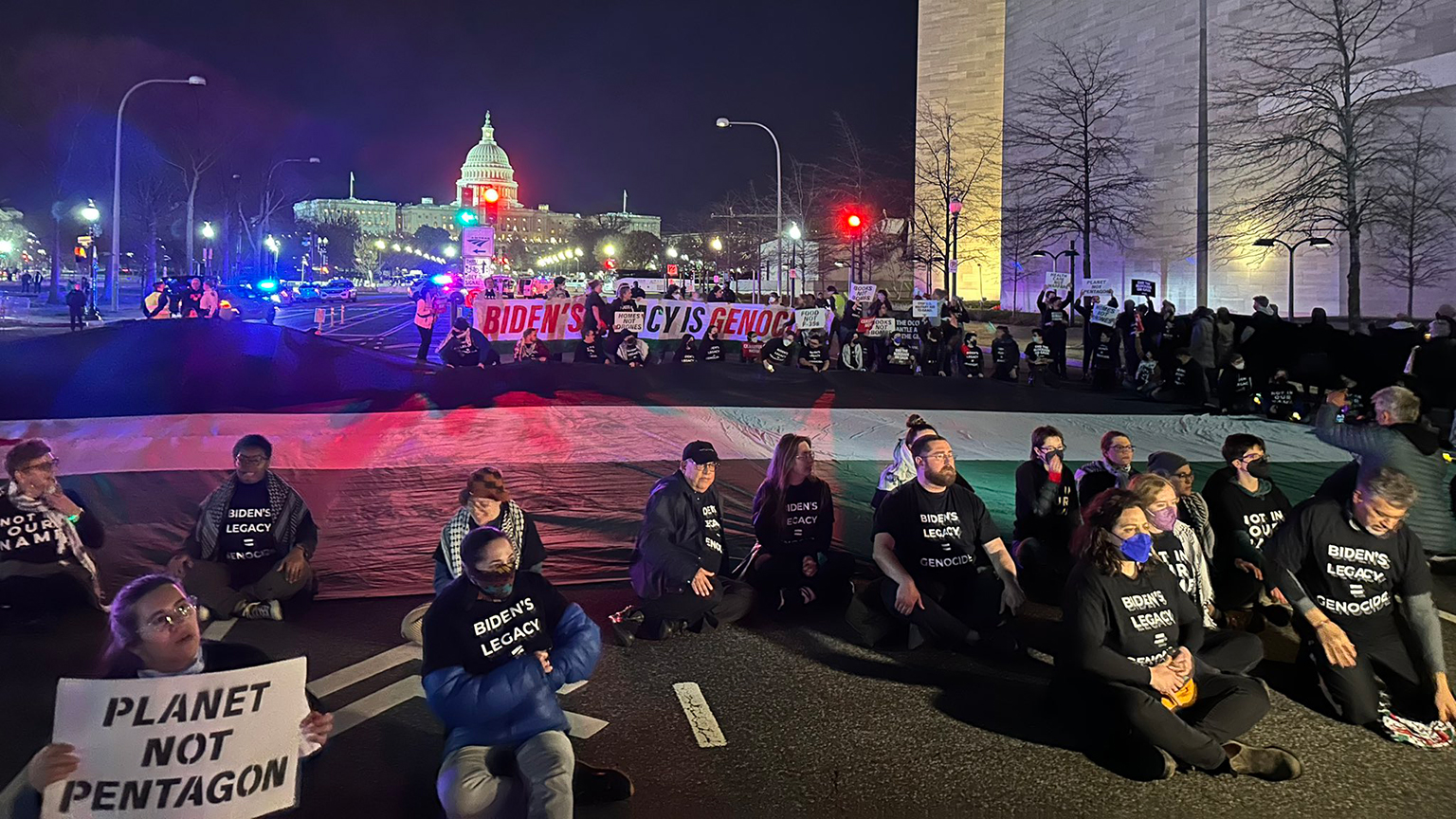
Demonstrators outside of the Capitol blocked Biden’s motorcade, causing a delay in his State of the Union speech (Photo: NYC-DSA)
US President Joe Biden’s unwavering support for Israeli genocide in Gaza has earned him the nickname “Genocide Joe” and made it necessary to hide from constituents on the campaign trail, due to the frequency of pro-Palestine disruptions at his events.
Yesterday, on March 7, Biden gave the annual “State of the Union” address amid protests from lawmakers themselves on his Gaza policy. When Biden began to bring up Gaza in his speech, Rashida Tlaib, the only Palestinian in Congress, was joined by several other progressive representatives in holding up signs that said “lasting ceasefire now.” Biden did say in his speech that “we’ve been working non-stop to establish an immediate ceasefire that would last for at least six weeks,” however, he still does not support a permanent ceasefire. Israel seeks the ability to revisit any ceasefire after six weeks.
Outside of the Capitol, where Biden gave his speech, hundreds of protesters gathered to hold a “People’s State of the Union” and blocked the major streets outside the building. The protest was large enough to cause Biden’s motorcade to take the “long way” to the House of Representatives chamber to give his address, delaying his speech. Protesters held banners that read “Biden’s legacy is genocide” and “The people demand: stop arming Israel”. Left-wing and Palestine solidarity organizations such as the Democratic Socialists of America, Dissenters, Jewish Voice for Peace, and Adalah Justice Project participated in the demonstration.
“Biden, Biden you can’t hide, We charge you with genocide.”
During Biden’s speech, he claimed that he is directing the US military to build a temporary pier on the Gaza coast that would increase the amount of humanitarian aid entering the Strip. At least five people were killed on March 8 after being struck by aid dropped into Gaza via planes. The United States has been carrying out aid drops, despite posing danger, in lieu of pressuring Israel to open land routes to allow aid trucks to move into Gaza freely.
Aid to the besieged Gaza Strip has fallen due in part to Israeli restrictions on two crossing points, according to the UN. In February, an average of just 98 trucks entered Gaza per day, in comparison to around 200 trucks per day in January. Before October 7, Israel would allow around 500 trucks a day into the besieged territory for a population of over 2.3 million.
“That’s not what Gaza needs,” said a protester outside of the Capitol. “Gaza needs liberation. They need an end to US military funding for Israel, and they need to be able to finally end… 75 plus years of ethnic cleansing.”
Biden caves to right-wing on immigration
In his speech, Biden also appeared to continue the process of caving entirely to the right-wing about tougher policies against migrants and refugees, and the further militarization of the US-Mexico border. Biden was heckled at one point during his speech by ultra-right-wing lawmaker Marjorie Taylor-Greene, who shouted about Laken Riley, a student in Georgia allegedly killed by an undocumented immigrant.
The right-wing has been using the example of Riley to push a racist anti-migrant policy, despite many studies showing that undocumented immigrants are less likely to engage in violent crime than US residents.
Instead of challenging the right, Biden caved to Taylor-Greene’s remarks by holding a pin that allegedly she gave him, and going on an anti-migrant rant. Getting Riley’s name wrong and referring to undocumented migrants as “illegals”, Biden made a jumbled comment saying, “Lincoln Riley, an innocent young woman who was killed by an illegal. That’s right. But how many of the thousands of people being killed by illegals—to her parents, I say my heart goes out to you.”
Biden also promoted a bipartisan bill to restrict immigration at the border, which would expand the authority of the president to crack down on migrants. “It would also give me as President new emergency authority to temporarily shut down the border when the number of migrants at the border is overwhelming,” he said.
Protest votes threaten Biden’s run
Biden has been hemorrhaging support in the statewide Democratic primaries, with large percentages of Democratic voters casting protest votes against the incumbent President. This movement began with the Michigan primary, where over 100,000 voters voted “uncommitted”, with Arab-majority city Dearborn voting 56.22% uncommitted. The recent Democratic primary in US-occupied Hawaii generated 29.1% uncommitted votes, the highest percentage of any statewide primary in this election cycle.
The growing deluge of protest votes against Biden poses a looming threat for him in the election. Anger at Biden’s support for Israel’s genocide is growing in states like Georgia, which, like Michigan, became critical for Biden’s win in the 2020 presidential election. In 2020, Biden won Georgia by only 11,779 votes.
Peoples Dispatch spoke to Edward Ahmed Mitchell, a board member with CAIR Action, the newly formed political arm of the Council on American-Islamic Relations. CAIR Action is a part of the Listen to Georgia coalition, which is encouraging Georgia voters to cast a protest vote against Biden in the March 12 Georgia Democratic primary.
“The people of Georgia, like many people across America, do not want our tax dollars funding a genocide overseas,” Mitchell said. “That’s why Georgia voters are trying to send a message to President Biden in the Democratic primary. The message is: you risk losing the state of Georgia and the 2024 election if you continue to enable the genocide in Gaza.”

 FW Pomeroy’s Statue of Justice stands atop the Central Criminal Court building, Old Bailey, London