Ellie Chowns, Green Party MP for North Herefordshire. CC image Wikipedia.
Reacting to Israel’s escalating action in Lebanon, Dr Ellie Chowns MP said:
“Israel’s escalating military campaign in Lebanon has already killed thousands of people, displaced more than a million from their homes, and destroyed vital infrastructure, displaying an indefensible disregard for civilian lives and international law.
“This cannot continue. The UK must put an end to the impunity that has enabled and emboldened the Israeli Government on the world stage. The Green Party repeats our calls for the UK Government to end all arms sales to and military cooperation with Israel, to drive independent investigations into war crimes and support justice mechanisms for victims, and to impose sanctions on Netanyahu and all other government officials responsible for breaches of international law.
“The people of Lebanon – like the people of Palestine, Iran, and Israel – deserve to live in safety and peace, not to have their human rights used as bargaining chips which can be disregarded without consequence. The UK must stand on the side of international law and justice, and act now to help prevent further atrocity.”
This work by Middle East Monitor is licensed under a Creative Commons Attribution-NonCommercial-ShareAlike 4.0 International License.
Former ICC’s Chief Prosecutor Fatou Bensouda [Heinrich-Böll-Stiftung/Flickr]
Former chief prosecutor of the International Criminal Court (ICC), Fatou Bensouda, said she was pressured and threatened in connection with investigations related to Palestine, including direct contacts from former Mossad chief Yossi Cohen.
In an interview with Al Jazeera, Bensouda said Cohen met her twice — in Munich and New York City — and explicitly requested that she halt investigations concerning Palestine.
She described the request as direct interference in the work of the court.
According to Bensouda, the pressure later escalated into indirect threats targeting members of her family. She said her husband was followed and information was gathered about him in what she believed was an attempt to influence her decisions.
Bensouda stated that she informed Dutch authorities about the threats but did not receive what she considered adequate protection.
She also said that member states of the ICC did not provide sufficient political backing in the face of Israeli pressure related to the Palestine investigations.
The former prosecutor stressed that the court must continue its work independently despite political pressure, arguing that international justice should not be subordinated to political interests.
The comments come amid ongoing controversy surrounding ICC investigations into the Israeli-Palestinian conflict.
The ICC previously issued arrest warrants for Benjamin Netanyahu and former Israeli Defence Minister Yoav Gallant over allegations related to war crimes and crimes against humanity.
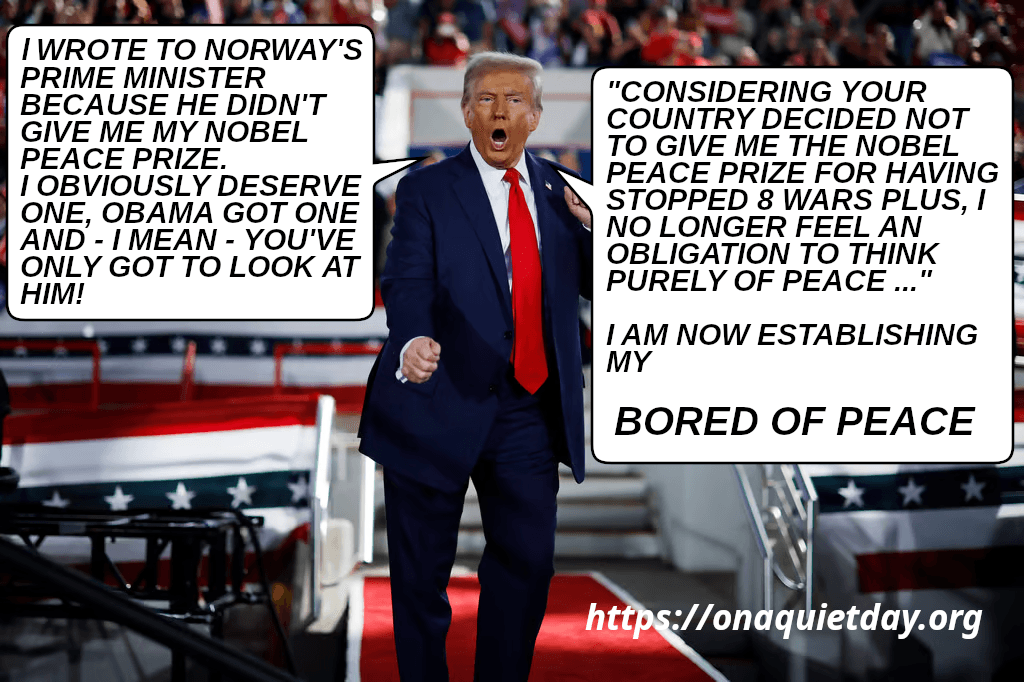
Climate science denier Donald Trump confirms that he knows nothing about democracy and that more liquid gold is being secured according to his policy of global privateering.Orcas discuss Donald Trump and the killer apes’ concept of democracy. Front Orca warns that Trump is crashing his country’s economy and that everything he does he does for the fantastically wealthy.
PSC Cymru co-chairwoman Bethan Sayed [… and what?]
PALESTINIAN campaigners in Wales were celebrating this weekend after 115 Senedd candidates pledged for Palestine — including backing boycott, divestment and sanctions (BDS) against Israel.
Candidates signing the Palestine Solidarity Campaign (PSC) Cymru pledge include 46 Green candidates, 37 from Plaid Cymru, eight from the Liberal Democrats, six from Labour and five independents.
PSC Cymru co-chairwoman Bethan Sayed said: “Reaching over 100 pledges is a milestone and is a clear message that Palestine is on the ballot in this Senedd election.
“Wales has always aspired to be a nation that stands on the right side of history, a globally responsible nation that holds human rights and international law at its heart.
“Support for Palestinian rights stretches across every community and every constituency in Wales. Polls show public backing for this issue.
“Voters will be watching closely to see who has the conviction to stand with them.”
The pledge commits elected candidates to uphold the inalienable rights of the Palestinian people, stand up to Israel for its crimes of genocide and apartheid — and ensure the Welsh government is not complicit in these crimes.
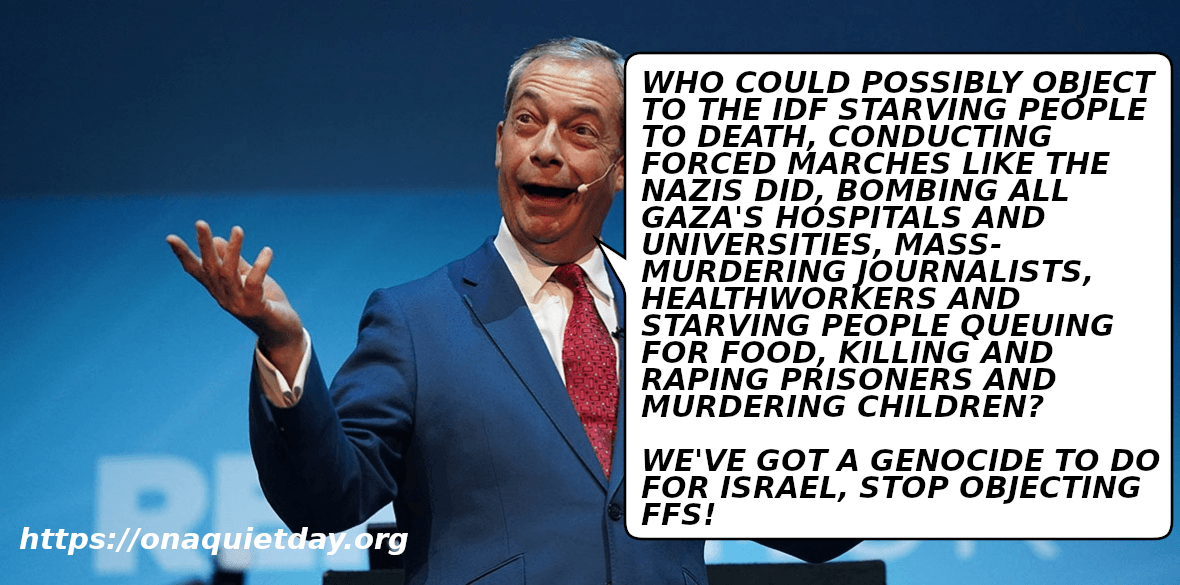
Keir Starmer objects to criticism of the IDF. He asks how could anyone object to them starving people to death, forced marches like the Nazis did, bombing Gaza’s hospitals and universities, mass-murdering journalists, healthworkers and starving people queuing for food, killing and raping prisoners and murdering children. He calls for people to stop obstructing his genocide for Israel.Nigel Farage objects to criticism of the IDF. He asks how could anyone object to them starving people to death, forced marches like the Nazis did, bombing Gaza’s hospitals and universities, mass-murdering journalists, healthworkers and starving people queuing for food, killing and raping prisoners and murdering children. He calls for people to stop obstructing his genocide for Israel.Orcas discuss Genocide-supporting and complicit Zionists. Donald Trump, Keith Starmer, David Lammy, Rachel Reeves, Angela Rayner and Wes Streeting are acknowledged as evil genocide-complicit and supporting cnuts.
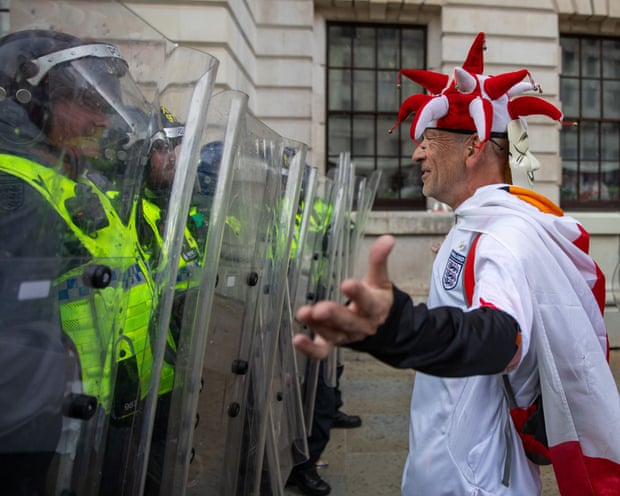
A protester faces off with Met riot police during a previous ‘Unite the Kingdom’ rally in London in September. Photograph: James Willoughby/Sopa Images/Shutterstock
Celebrities including Annie Lennox and Miriam Margolyes sign letter to force after pro-Palestine march route rejected
Annie Lennox and Miriam Margolyes are among artists who have accused the Metropolitan police of giving preferential treatment to a far-right demonstration led by Tommy Robinson over a pro-Palestine protest in London on the same day.
The pro-Palestine movement has had its preferred route through central London for its annual commemoration of Nakba – the mass expulsion of Palestinians – rejected by the Met, while the “Unite the Kingdom” demonstration will take place on the same date in Kingsway, the Strand, Trafalgar Square, Whitehall and Parliament Square. Robinson, whose real name is Stephen Yaxley-Lennon, posted on X: “London is ours on May 16th.”
An open letter saying that the Met “must not favour the far right over Palestine” has also been signed by the actors Samuel West and Khalid Abdalla, the musicians Billy Bragg and Nadine Shah, as well as MPs, academics, lawyers, trade union and civil society leaders. The Met said the decision was based on the relative scale of the demonstrations.
Billy Howle, who starred in the TV shows The Perfect Couple and The Serpent and also signed the letter, said: “The shocking decision of the police to exclusively favour a far-right demonstration and block this important annual commemoration from the political heart of London will send shivers down the spines of every person of good conscience. It must be overturned.”
The letter says that the pro-Palestine movement informed the force on 18 December of its intention to march on the nearest Saturday to Nakba Day, in keeping with a tradition dating back more than a decade, but that the Met has “instead given over the political centre of London to a hate march called by racist thug ‘Tommy Robinson’”. It calls on the force to “immediately reverse this shameful decision”.
Keir Starmer refuses to be outcnuted by Nigel Farage’s chasing the racist bigot vote.Climate science denier Nigel Farage explains that it’s simple to blame asylum-seekers or Muslims for everything.Nigel Farage blames the Muzzies.
This work by Middle East Monitor is licensed under a Creative Commons Attribution-NonCommercial-ShareAlike 4.0 International License.
U.S. Navy warplane takes off from the aircraft carrier USS Abraham Lincoln during Operation Epic Fury targeting Iran in the Gulf of Oman, on March 01, 2026. [U.S. Navy / Handout – Anadolu Agency]
After the 12-day war in May last year, it was clear that both sides would be face-to-face soon. They restarted on 28th February 2026. Israel-US adopted the same pattern of targeting the top brass, including the Grand Leader, Ayatollah Ali Khamenei, on the very first day, thinking that in the absence of these officials, the Iranian administration would be like a rudderless ship. This would create confusion and provide an easy opportunity for regime change.
Thirteen days have passed, yet there are no visible signs of either the fall of the regime or a pause or ceasefire. Despite US-Israel’s anguish, Iran selected Mojtaba Khamenei as the new supreme leader – an act of defiance.
Both sides continue to bombard each other’s vital infrastructure, including civilian and military targets. Energy installations such as oil depots and refineries have become primary targets. Under a tit-for-tat policy, Iran has also declared that financial centers, banks, and offices of major technology companies such as Google, YouTube, and Microsoft could be the next targets. Already 26 US bases have been targeted. Following the assassination of Ayatollah Ali Khamenei, the conflict rapidly expanded from a limited confrontation into a regional war, and with the blockade of the Strait of Hormuz, its effects are now visible in the global economy and in the daily lives of ordinary people. Approximately 130 oil ships are anchored, stopping 20% oil which passes through the narrow strait of 33 km. Already four ships were targeted which tried to bypass the warning.
Among the GCC countries, the UAE faced the highest number of attacks.
Iran’s aggressive response and selection of Mojtaba, a hardliner, as Ayatollah, appear to indicate that Iran is prepared for a prolonged conflict, whereas the United States and Israel seem eager to conclude the war quickly. Meanwhile, President Trump’s plan to send Kurdish Peshmerga into Iran via Iraq seems like another disaster.
Tehran had been closely and patiently observing military buildups in the Indian Ocean, the Gulf of Oman, and the Mediterranean Sea for several weeks. The United States mobilized a substantial part of its defence capabilities, including naval armadas and two aircraft carriers, Abraham Lincoln and Gerald Ford. Hundreds of fifth-generation stealth fighter jets were deployed along with advanced air-defence systems such as THAAD and large stockpiles of interceptors.
In addition, the United States strengthened its military presence across several bases in the Gulf region, including Qatar, Bahrain, Oman, the United Arab Emirates, Kuwait, Saudi Arabia, Jordan, and Iraq.
Israel also appeared determined to launch what it described as a “fight-to-the-finish” war with the Islamic Republic. Prime Minister Benjamin Netanyahu repeatedly stated that he had been waiting for such a war for nearly forty years. Iran, on the other hand, has long maintained that it began preparing for such a scenario after the 2003 US-led invasion of Iraq and the fall of Saddam Hussein.
The earlier conflict in May had already revealed the strengths and weaknesses of both sides. However, the current course of the war suggests that the US–Israel alliance underestimated Iran’s military capabilities, particularly its missile and drone systems, careful planning, and effective use of its military resources.
Compared with the US–Israel alliance, Tehran appears to possess a clearer understanding of its adversaries’ strengths, limitations, and operational constraints.
Iran was also aware of its own limitations. Its air force cannot match the capabilities of US and Israeli fighter jets, and its airspace remains vulnerable to aerial attacks. As the conflict expanded, these vulnerabilities became evident. At the same time, the United States and Israel appeared to have an incomplete assessment of Iran’s capabilities. Although they possessed precise intelligence about the locations of Iranian leaders and senior officials—they killed several commanders and Ayatollah Ali Khamenei-they appeared to lack detailed knowledge of Iran’s missile infrastructure, drone networks, and underground silos developed over several decades.
It also appears that the US–Israel side underestimated the possibility of indirect assistance from Russia and China, relying heavily instead on air superiority and defensive shield systems.
Iran’s war strategy
A detailed military assessment would require expert analysis, but developments in the conflict suggest that Iran followed a three-stage strategy.
First, Iran responded to the US-Israel attacks by deploying large numbers of drones, many reportedly stored since 2011 and 2013. These drones forced US–Israel defence systems to respond with expensive interceptors. In financial terms, this created an asymmetric dynamic: Iranian drones costing between $20,000 and $50,000 were intercepted by missiles costing between $1 million and $2 million. As the wave of drone attacks continued, interceptor stocks began to decline, gradually exposing the airspace of US bases and Israel to greater risk.
Second, once defensive systems were strained, Iran launched more advanced missiles targeting radar installations, communication centres, satellites, and data facilities. Reports indicate damage to communication and data infrastructure at the Al Udeid Air Base in Qatar and at military installations in Bahrain. Such attacks disrupted surveillance and communication systems that coordinate missile defence networks such as THAAD, David’s Sling, Arrow, and Iron Dome. Command and monitoring centres that once gathered and transmitted military data across thousands of kilometres became severely limited in their operations.
Third,
Iran escalated its attacks using hypersonic missiles while adopting a tit-for-tat strategy. These strikes targeted refineries, military bases, and strategic infrastructure in Israel. Some reports suggest the use of the Khorramshahr-1 missile equipped with submunitions capable of dispersing dozens of warheads over a wide area, complicating interception efforts.
Meanwhile, attacks on naval assets reportedly forced aircraft carriers operating in the Gulf of Oman to reposition farther from the Iranian coastline.
After weakening regional defence systems, Iran announced a blockade of the Strait of Hormuz. This strait is one of the world’s most critical energy corridors, through which roughly 20 percent of global crude oil and a similar share of liquefied natural gas passes.
At present, around 130 oil tankers are reportedly anchored in the strait. Iran claims effective control over the Hormuz chokepoint.
It has targeted four vessels, including one linked to India, that attempted to pass through. Iran has reportedly deployed underwater tunnels and small, agile boats to intercept or attack ships that violate the blockade.
At the same time, attacks on energy facilities in Saudi Arabia and the temporary closure of Qatar’s Ras Laffan gas facilities disrupted global energy supplies. As a result, gas prices in Europe rose sharply while crude oil prices increased from about $62 per barrel to more than $100. Some analysts warn that if the conflict continues, oil prices could rise further, potentially reaching $200 per barrel. Such developments could trigger inflation, supply-chain disruptions, and rising unemployment worldwide.
Future of the War
Iran appears determined to pursue its objectives and may not halt operations even if a ceasefire is proposed by the United States or Israel. The selection of Mojtaba Khamenei as the new supreme authority signals continuity of leadership, consolidation of political control, and a claim of legitimacy within the existing system.
Large public gatherings during funeral processions and demonstrations suggest that, at least during wartime, sections of the population have rallied around the leadership.
Reports have also mentioned proposals to deploy Kurdish Peshmerga forces into Iran through Iraq. However, the region’s history suggests that such operations would face significant geographical and logistical difficulties. During the Iran–Iraq War, Saddam Hussein also attempted to advance through the mountainous terrain of the Zagros region but faced serious constraints.
Some Iranian sources have claimed the capture of US special forces personnel and the killing of several Israeli officials during the conflict, although many of these claims remain difficult to verify independently.
Chances of a Ceasefire
Iranian authorities have reportedly outlined three conditions for a ceasefire. First, all military attacks by the United States and Israel must stop immediately. Second, Tehran seeks assurances that such attacks will not be repeated in the future. Third, Iran demands recognition of its sovereignty and compensation for damages caused during the conflict. These conditions are not easy. Who will ensure that the U.S. and Israel would not attack in the future? Second, who will pay the reconstruction cost, etc.? It is true that regional problems can be resolved only when the issue of Palestine is resolved in a fair and just manner. Lebanon and Yemen, Syria also need attention.
Future Trajectory-Palestine solution is the only solution
Even if the present war stops, regional stability will remain uncertain. Long-standing political and security disputes remain unresolved. Israel is unlikely to abandon its strategic objectives, Greater Israel, while tensions involving Hezbollah and Hamas are likely to persist. The United States may also increase pressure on Gulf states to revise their security arrangements so that regional partners become more directly involved in future conflicts.
Implications for India
For India, energy security remains a major concern. Disruptions in the Strait of Hormuz could affect oil supplies and trade routes. Approximately 50% oil passes through the route, while Houthis are there to choke off the Red Sea navigation.
India must also prepare contingency plans for the evacuation of its 9 million workers from the region and strengthen logistical arrangements to safeguard trade and shipping routes in the event of prolonged instability. Chemical fertilizers are another major concern for India. The region provides the bulk of fertilizers and ensures food security. Disruption in supply line has significantly affected the supply of fresh vegetables, perishable items including agriproducts , poultry and meat products
In the long term, India is to sign a long term energy agreement with the US. At the same time, India needs a more coherent West Asia policy and must avoid being drawn into the region’s strategic conflicts. The region is sensitive as well as vital to India’s economy and geostrategy. India needs a careful policy.
The views expressed in this article belong to the author and do not necessarily reflect the editorial policy of Middle East Monitor.
This work by Middle East Monitor is licensed under a Creative Commons Attribution-NonCommercial-ShareAlike 4.0 International License.
Climate science denier Donald Trump says that more liquid gold is being secured according to his policy of global privateeringDonald Trump explains why he established his Bored of PeaceDonald Trump warns against following the https://onaquietday.org blog, says that it’s easy atm, she only needs to report war crimes supporting Israel’s genocidal expansion.


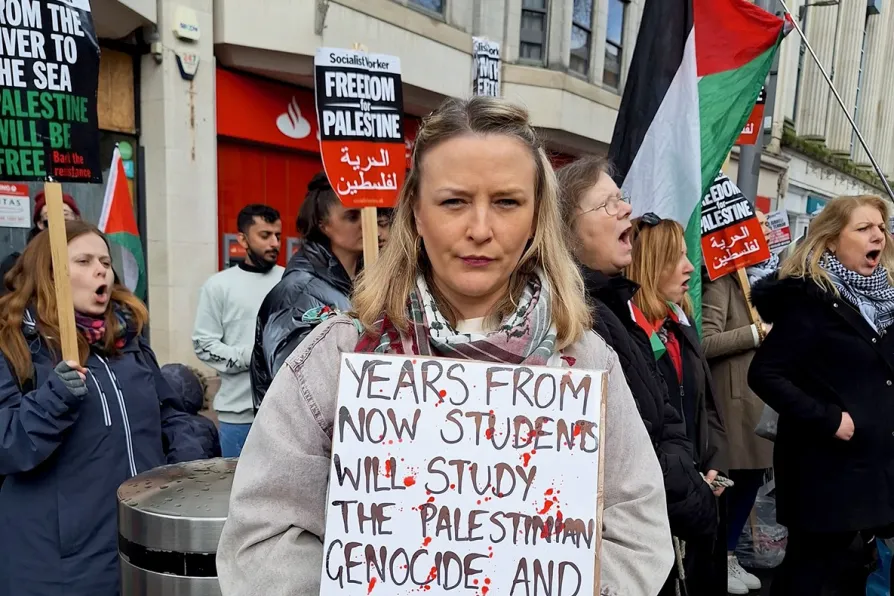
 PSC Cymru co-chairwoman Bethan Sayed [… and what?]