Nearly two-thirds of voters think Starmer doesn’t respect them – new poll

Spread the love
Simon Dawson/Number 10/Flickr, CC BY-NC-ND

Marc Stears, UCL

Exhausted from a long campaign but buoyed by an extraordinary victory, Keir Starmer stood on the steps of Downing Street just over one year ago to deliver his victory speech. “Your government,” the new prime minister said, “should treat every single person in this country with respect.”

This message of respect resonated strongly in the year leading up to the campaign, coming as close as anything to providing a central argument to Labour’s case for government. And, according to polling and focus groups that my team at UCL Policy Lab designed along with polling company More in Common, it seemed to work.

As our research at the time showed, voters felt that “respecting ordinary people” was the most important attribute that any politician could have, more important than having ideas for the future, managing effectively or having real experience. And they thought Starmer was the leader who displayed that respect most.

A year later, the picture looks quite different. In new polling, we asked a representative sample of over 7,000 people to evaluate the government one year on. On respect, the judgement has not been good.


Want more politics coverage from academic experts? Every week, we bring you informed analysis of developments in government and fact check the claims being made.

Sign up for our weekly politics newsletter, delivered every Friday.


During the general election campaign, 41% of the electorate said that they believed that Starmer “respected people like them”. One year on, that stands at only 24%. At the same time, the number who say that he does not respect them has risen from 32% to 63%. Starmer is now outstripped on that question by Nigel Farage – 33% say the Reform UK leader respects people like them.

Losing support

This view has had crucial political consequences. Of those who voted for Labour in the general election, only 60% of our respondents say they would vote for the party in an election held tomorrow.

And that is not because some other political party is suddenly swooping in for their supporters. Labour’s voters are defecting in a host of different directions: 11% say they would vote Reform; 8% would vote Liberal Democrat; 4% would vote Green and 4% would vote Conservative. A further one in ten say they simply don’t know how they would vote.

Labour’s losses have been most dramatic among their first-time voters. Of those who voted for Labour in 2024 but not in any other general election since 2010, barely a third still support the party, while a fifth would vote for Reform UK.

These political failures, our report contends, are directly related to the declining sense of respect. The top reason voters gave for turning away from Labour are the broken promises and U-turns made by Labour in government, followed by the party’s failure to reduce the cost of living and changes to the winter fuel payment.

The idea of “respect” being key to the public’s sense of whether a government is on their side or not has been growing for many years now, both in academia and in politics itself. Since at least the 2007/8 financial crisis there has been a sense that large swathes of the public feel neglected, overlooked and even disdained by those who govern them.

When people talk about wanting to see “change” in Britain, this is often what they mean. It was a theme I touched on recently in two books, Out of the Ordinary and, with my co-author Tom Baldwin, England.
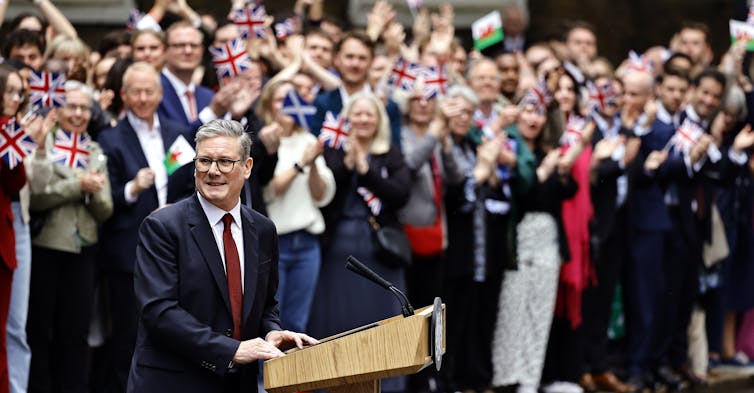
A smiling Keir Starmer delivers his victory speech, with a crowd of supporters behind him
Just over a year ago, a happier Starmer delivers his victory speech. Shutterstock

But respect is not just an abstract idea. People appear to judge whether they are respected by those who govern them or not primarily on the basis of whether the government stands up for them against powerful vested interests.

Our earlier research demonstrated that there is a widespread sense among the British public that certain groups have had it too easy for too long. This is either because they have been able to intimidate the government, or because government ministers and advisers have themselves been recruited from among these groups.

In our new report, therefore, we see that the new government’s most popular act was their willingness to raise the minimum wage by £1,400 in April, against the objections of some in business who suggested that such a move was too burdensome on them.

Changes to the winter fuel allowance and proposed changes to the disability benefits system, on the other hand, registered poorly. They suggest that the interests of ordinary and vulnerable people count for too little in decision-making.

These judgements currently shape the mood of the country and probably top the list of issues that the government now needs to address. There is still time for the government to rebuild its appeal, of course. Indeed, our respondents who said they would vote for Labour said they would do so because the party needs more time to fix the problems they inherited.

But as it seeks to do so, voters will want to know who this government stands for. Whose interests does it put first? What kind of people does it respect?

Much of the electorate thought they knew the answer to these questions one year ago. Now they’re not so sure.

Marc Stears, Director of UCL Policy Lab and Professor of Political Science, UCL

This article is republished from The Conversation under a Creative Commons license. Read the original article.

Keir Starmer says that the Labour Party under his leadership all feel a small part of Scunthorpe.
Keir Starmer objects to criticism of the IDF. He asks how could anyone obect to them starving people to death, forced marches like the Nazis did, bombing Gaza's hospitals and universities,mass-murdering journalists, healthworkers and starving people queuing for food, killing and raping prisoners and murdering children. He calls for people to stop obstructing his genocide for Israel.
Keir Starmer objects to criticism of the IDF. He asks how could anyone obect to them starving people to death, forced marches like the Nazis did, bombing Gaza’s hospitals and universities,mass-murdering journalists, healthworkers and starving people queuing for food, killing and raping prisoners and murdering children. He calls for people to stop obstructing his genocide for Israel.
Keir Starmer chases Nigel Farage's racist bigot vote.
Keir Starmer chases Nigel Farage’s racist bigot vote.

Continue ReadingNearly two-thirds of voters think Starmer doesn’t respect them – new poll

Netanyahu tightens grip on power through Gaza genocide

Spread the love

https://www.middleeastmonitor.com/20241215-israeli-army-deliberately-bombed-site-to-kill-hostages-inside-al-qassam-brigades

Israeli Prime Minister Benjamin Netanyahu in Tel Aviv, Israel on December 10, 2024 [Chaim Goldberg/Flash90/Pool/Anadolu Agency]

Despite overseeing what is widely considered to be a genocide in Gaza and facing an International Criminal Court arrest warrant for war crimes, as well as ongoing corruption charges, Israeli Prime Minister Benjamin Netanyahu has strengthened his political position, according to a new poll which shows that his Likud party would increase its parliamentary representation in an election held today.

Channel 13 News poll published yesterday reveals that Netanyahu’s coalition would win 57 seats in the 120-member Knesset, up from 55 in October, with Likud emerging as the largest party at 26 seats. The results suggest that far from weakening Netanyahu’s position, the devastating military onslaught in Gaza has consolidated his support base.

The polling data, reported by Haaretz, appears to challenge the prevalent Western narrative that Netanyahu is the primary obstacle to peace. Instead, it indicates broad Israeli public support for the military offensive in Gaza, which has killed at least 45,000 Palestinians, mostly women and children, and wounded more than 106,000 others.

The survey shows Netanyahu’s right-wing coalition gaining strength while the opposition would slip to 58 seats, down from 60 in October. Key findings include:

The poll, conducted by the Maagar Mochot research institute in collaboration with Sample Project Panel and Stat-Net, surveyed 676 Israelis with a margin of error of 3.8 per cent. While Netanyahu’s coalition would still fall short of a majority, the strengthening of his position amid international condemnation of the genocide in Gaza suggests deep-rooted support within Israeli society for the current military campaign.

The results indicate that rather than facing political consequences for the unprecedented civilian casualties in Gaza and Israel becoming an international pariah under Likud, Netanyahu has instead seen his position solidify. This raises questions about the broader societal attitudes within Israel towards the ongoing assault on Gaza and the underlying motivations for what is often described as a war of annihilation against the Palestinians.

Amnesty: Israel committing genocide against Palestinians in Gaza

This work by Middle East Monitor is licensed under a Creative Commons Attribution-NonCommercial-ShareAlike 4.0 International License

Continue ReadingNetanyahu tightens grip on power through Gaza genocide

Three quarters of Britons say it’s unacceptable for the Prime Minister to accept gifts from businesses or organisations

Spread the love

https://www.ipsos.com/en-uk/three-quarters-britons-say-its-unacceptable-prime-minister-accept-gifts-businesses-or-organisations

New research from Ipsos assesses whether the public believes that the Prime Minister and MPs earn too much money, and how the public perceives the acceptability of gifts offered to the PM

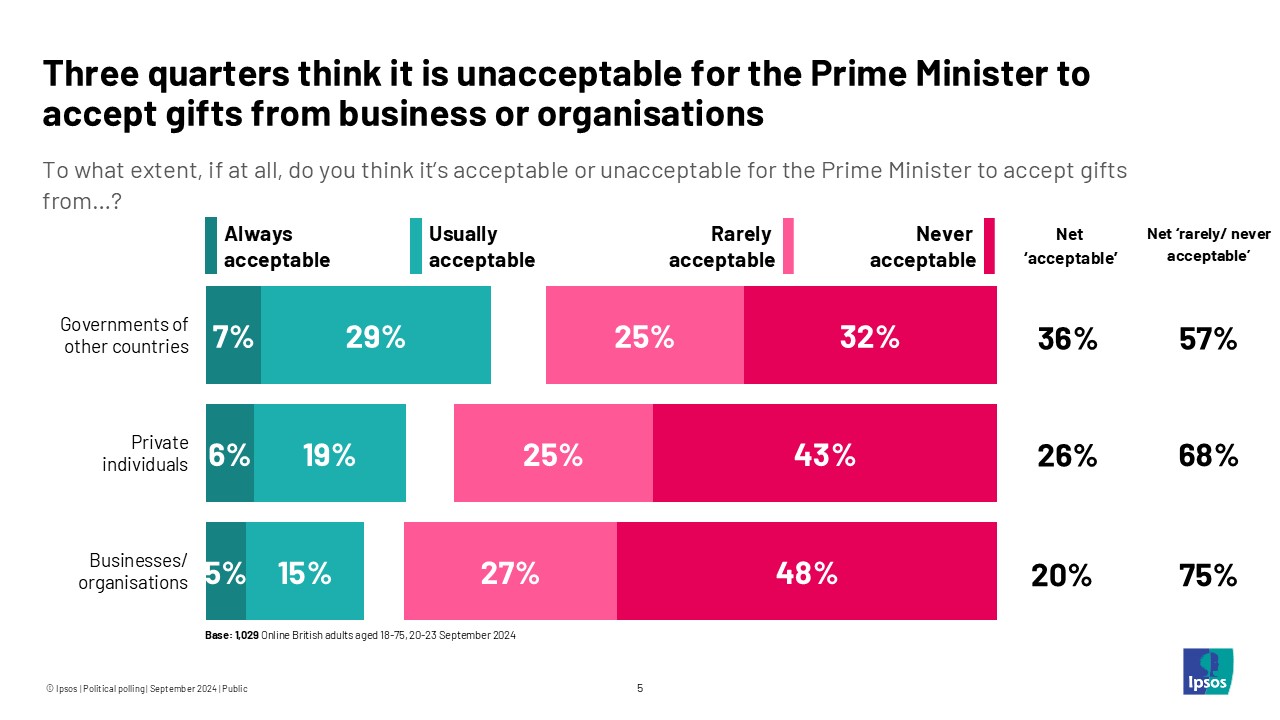
  • Three quarters (75%) of Britons say that it is rarely or never acceptable for the Prime Minister to accept gifts from businesses or organisations.
  • More than two-thirds say the same about accepting gifts from private individuals (68%).

New research from Ipsos, carried out 20-23 September, has assessed whether the public believes that the Prime Minister and Members of Parliament (MPs) earn too much money, and how the public perceives the acceptability of gifts offered to the Prime Minister.  

[R]espondents were asked for their views on whether it is acceptable for the Prime Minister to accept gifts from a range of sources. Three quarters (75%) of Britons say that it is rarely or never acceptable for the Prime Minister to accept a gift from businesses or organisations. 68% say it rarely or never acceptable for the Prime Minister to accept gifts from private individuals, and 57% say the same regarding gifts from the governments of other countries (though 36% say this is usually or always acceptable). If we take out the proportion that say ‘rarely acceptable’ we find that 48% say it is ‘never acceptable’ to accept gifts from businesses / organisations, 43% say it is never acceptable to accept gifts from private individuals and 32% say it is never acceptable to accept gifts from governments of other countries.

https://www.ipsos.com/en-uk/three-quarters-britons-say-its-unacceptable-prime-minister-accept-gifts-businesses-or-organisations

Continue ReadingThree quarters of Britons say it’s unacceptable for the Prime Minister to accept gifts from businesses or organisations

Support for Israel’s War on Gaza Plummeting Among Key Biden Voters: Poll

Spread the love

Original article by JAKE JOHNSON republished from Common Dreams under Creative Commons (CC BY-NC-ND 3.0). 

Hundreds of demonstrators demanding an immediate cease-fire in the Gaza Strip march in Washington D.C. on March 7, 2024. 
(Photo: Celal Gunes/Anadolu via Getty Images)

“Given these numbers,” said one progressive campaigner, “I don’t know how President Biden can reconcile his stalwart support for Israel with the clear preference that his core constituents have for an end to this war.”

A Gallup survey released Wednesday shows that U.S. public support for Israel’s military assault on Gaza has plummeted since November, with the decline particularly sharp among Democratic voters whom President Joe Biden will need to turn out to win reelection against presumptive GOP nominee Donald Trump.

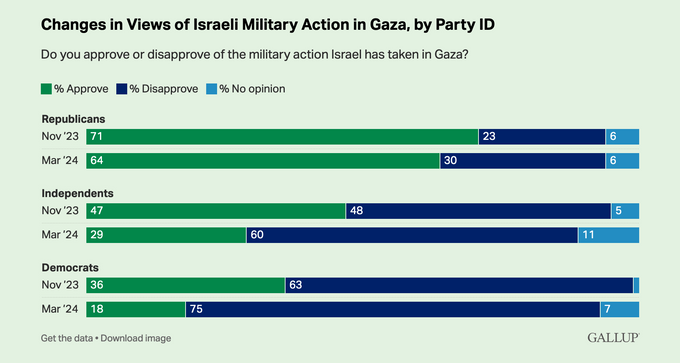
Just 18% of Democratic voters currently approve of “the military action Israel has taken in Gaza” and 75% disapprove, according to the new poll, which was conducted between March 1-20. In November, 36% of Democratic respondents expressed approval of Israel’s war and 63% disapproved.

“The crosstabs are even more striking—nearly two-thirds of people under 54, people of color, and women disapprove of the military action in Gaza,” Sam Rosenthal, political director of the progressive advocacy group RootsAction, told Common Dreams in response to the new poll. “That is effectively the Democratic Party’s base.”

“Given these numbers,” Rosenthal added, “I don’t know how President Biden can reconcile his stalwart support for Israel with the clear preference that his core constituents have for an end to this war.”

Overall, Gallup found that 55% of the American public—including 60% of Independents and 30% of Republicans—disapproves of Israel’s military campaign in the Gaza Strip, up from 45% in November. Just 36% of the U.S. public approves, down from 50% four months ago.

“Biden is risking his second term and our democracy by continuing to support the kind of violence and cruelty that is being perpetrated in Gaza right now.”

Observers noted that Gallup’s new poll was conducted after the Israeli military’s February 29 massacre of Palestinians seeking food aid. Since October, according to one human rights monitor, Israeli forces have killed more than 560 people waiting for humanitarian aid, the delivery of which Israel’s government has intentionally hindered—fueling the spread of famine across the territory.

The Biden administration has backed Israel’s assault from the beginning, providing the Netanyahu government with billions of dollars worth of weapons and diplomatic cover despite widespread and growing protests at home and abroad. Gallup’s survey found that 74% of U.S. adults say they are following developments in Gaza “closely.”

Political analyst Yousef Munayyer wrote on social media that “Biden’s policy of continued support for Israel’s war on Gaza is in line with the views of the right-wing Republicans,” noting that 64% of GOP voters still approve of the Israeli assault—down slightly from 71% in November.

“Just to emphasize how extreme his position is and out of line with his voters,” he added, “more Republicans disapprove of the war than Democrats who approve.”

Growing Democratic opposition to Israel’s military action in Gaza has fueled grassroots campaigns across the country urging voters to mark “uncommitted” on their Democratic primary ballots to pressure Biden to change course ahead of the general election against Trump, who has voiced support for Israel’s devastating assault on Gaza.

“Uncommitted” campaigns won 11 Democratic National Convention (DNC) delegates in Minnesota and two in both Michigan and Washington state.

“Biden is risking his second term and our democracy by continuing to support the kind of violence and cruelty that is being perpetrated in Gaza right now,” Faheem Khan, president of the American Muslim Advancement Council and a lead organizer of Uncommitted WA, said earlier this week.

Rosenthal of RootsAction told Common Dreams on Wednesday that the U.S. decision to abstain and allow the U.N. Security Council to pass a cease-fire resolution earlier this week was “a step in the right direction, and a clear indication that domestic pressure from campaigns like Listen to Michigan and other uncommitted voting efforts is working.”

“However, actual policy towards Israel has changed very little,” said Rosenthal. “Biden is still clamoring for more military aid to be sent, and the U.S. still largely supports Israel’s line, i.e., that military operations in Gaza are solely aimed at rooting out Hamas. What is manifestly obvious to the rest of the world, that Israel is committed to the wanton destruction of the Gaza Strip, is somehow escaping the administration’s notice.”

“President Biden should decide quickly whether he wants to continue to uphold policy that is increasingly associated with the opposition party,” Rosenthal added.

Original article by JAKE JOHNSON republished from Common Dreams under Creative Commons (CC BY-NC-ND 3.0). 

Another State Department Official Resigns Over Biden Gaza Policy

Democratic Insider Rips ‘Shocking’ US Claim That Israel Is Following International Law

US Under Fire for Downplaying Security Council Resolution as ‘Nonbinding’

Continue ReadingSupport for Israel’s War on Gaza Plummeting Among Key Biden Voters: Poll

Bombshell poll suggests Tories could end up with just 36 seats after next election

Spread the love
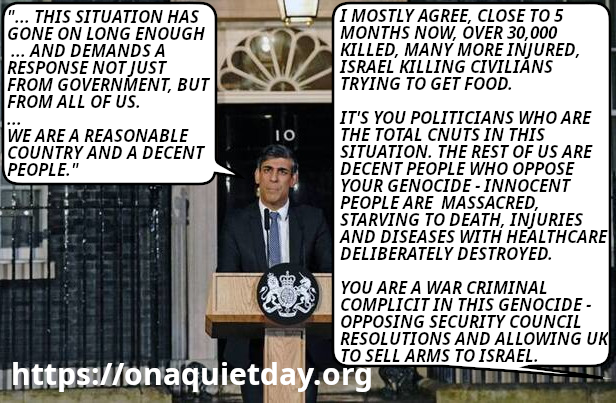
Response to Rishi Sunak's extremism speech at Downing Street 1 March 2024. Second version of this image with text slightly altered.
Response to Rishi Sunak’s extremism speech at Downing Street 1 March 2024. Second version of this image with text slightly altered.

https://leftfootforward.org/2024/03/bombshell-poll-suggests-tories-could-end-up-with-just-36-seats-after-next-election/

The latest poll will do little to calm Tory nerves ahead of the general election, with a number of factions within the party looking at replacing Sunak.

A new poll shows just how much Tory support among the public has collapsed, as the party continues to trail the Labour Party and Tory MPs plot to remove Rishi Sunak.

The poll, carried out by YouGov for the Times, shows that the Tories are set to win just 36 seats at the General Election, handing Labour a comfortable 398 majority in the House of Commons.

It puts the Tories on just 19%, which is the same share the party received at their lowest ebb in the aftermath of Liz Truss’s mini-Budget. Meanwhile, the Labour Party is on 44% of the vote, while Reform UK received their highest ever poll rating at 15%.

https://leftfootforward.org/2024/03/bombshell-poll-suggests-tories-could-end-up-with-just-36-seats-after-next-election/

Continue ReadingBombshell poll suggests Tories could end up with just 36 seats after next election