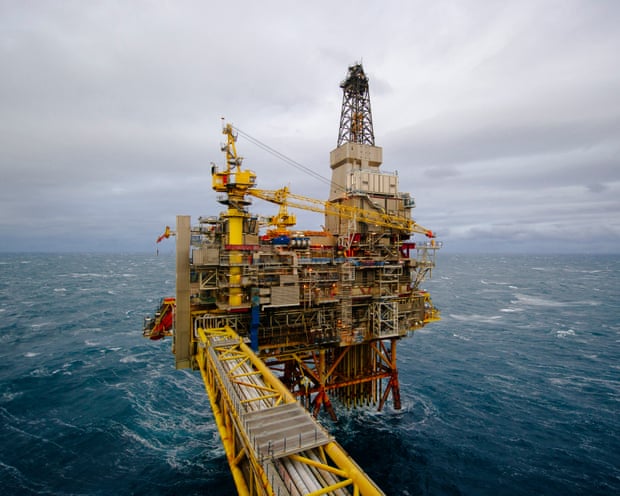
Climate campaigners say the Rosebank oil field will be a ‘defining test’ of the government’s credibility on climate change. (Lucy North/PA)
Equinor, which owns the majority of the oil field, stressed it was committed to advancing the ‘Rosebank project’
Climate campaigners have challenged the UK Government to “do the right thing” and turn down plans for drilling in the Rosebank oil field.
The group Uplift – which wants to see a “rapid and fair transition away from oil and gas production in the UK” – said whether the green light is granted for the development would be the “defining test of this Government’s credibility on climate change”.
It came as it was confirmed Equinor, which owns an 80% majority stake in the oil field, confirmed it has submitted a scope 3 assessment – setting out all associated greenhouse gas emissions for the project, in compliance with new guidelines from UK authorities.
And the company said it is “fully committed” to working with all relevant bodies to “advance the Rosebank project”.
The Rosebank field, which is located some 80 miles west of Shetland, is the UK’s largest untapped oil field and is estimated to contain up to 300 million barrels of oil.
…
Robin Wells, director of Fossil Free London, said: “In the face of this decision on the biggest undeveloped oil field in the North Sea, we must be crystal clear. Rosebank will be the defining test of this Government’s climate promise.”
Nigel Farage urges you to ignore facts and reality and be a climate science denier like him and his Deputy Richard Tice. He says that Reform UK has received £Millions and £Millions from the fossil fuel industry to promote climate denial and destroy the planet.Donald Trump urges you to be a Climate Science denier like him. He says that he makes millions and millions for destroying the planet, Burn, Baby, Burn and Flood, Baby, Flood.Orcas comment on killer apes destroying the planet by continuing to burn fossil fuels.
An oil drilling platform off the coast of Aberdeen. Officials are understood to have looked at a range of proposals in recent weeks. Photograph: Simon Price/Alamy
[Guardian] Exclusive: Energy secretary examining ways to allow oil and gas exploration without breaking manifesto promise
Ed Miliband is planning to encourage drilling in the North Sea despite a manifesto promise not to grant new licences on new parts of the British sea bed.
The energy secretary is looking at ways in which the government can allow companies to look for and produce more oil and gas without breaking Labour’s pre-election pledge not to issue new licences on new fields.
The plans, which will be announced in the coming months as part of a wider strategy for the North Sea, come amid pressure on one side from climate activists to stop all drilling, and on the other from Donald Trump to “drill, baby, drill”.
A government spokesperson said: “The strategy will set out how the government intends to meet its manifesto commitments to ensure no new licenses to explore new fields and maintaining existing fields for their lifetime.” They said the government would meet its manifesto commitments “in full”.
Miliband has been working on proposals for the North Sea for months as the government looks for ways to maximise the lives of existing oil and gas fields without allowing completely new exploration.
Labour promised in its manifesto not to grant any new licences on new fields, and ministers are now looking at how they can implement that while also gaining an economic return from the sizeable industry which already exists. Oil and gas companies employ about 30,000 people from their base in north-east Scotland.
dizzy: It looks like yet more broken promises from the Labour party, seems to be what they’re really good at. Expanding airports is ignoring climate commitments, a huge danger with the North Sea is Rosebank.
Protesters march with an anti-fossil fuel banner during the demonstration in London on January 15, 2023. (Photo: Vuk Valcic/SOPA Images/LightRocket via Getty Images)
“The only sensible thing to do is to pivot the North Sea to something we have an abundance of, and something that will never run out—wind,” argued one climate advocate.
As the United Kingdom on Monday faced the onset of its fourth heatwave of this summer, climate campaigners continued to call out BP for its decision to plow ahead with reopening the Murlach oil field in the North Sea, despite fossil fuels pushing up global temperatures and the U.K. government’s efforts to limit extraction in the region.
“This is climate vandalism, pure and simple,” Kate Blagojevic, Europe team lead at the group 350.org, said in a Monday statement. “BP is putting its profit margins above the survival of communities, ecosystems, and future generations. Every barrel of oil from this project pushes us closer to climate breakdown, more floods, more fires, more heatwaves.”
“The era of fossil fuels is over, and BP’s desperate attempts to wring out the last drops of oil from the North Sea are a reckless betrayal of the public and the planet. They should be winding down, not doubling down,” she declared.
Greenpeace U.K. policy director Doug Parr was similarly critical, saying in a statement that “the North Sea is on death’s door. Reserves are drying up, and what’s left and untapped is barely enough to keep it on life support.”
The Telegraph on Sunday noted recent research from the government’s North Sea Transition Authority that found there were over 3 billion barrels of oil and gas in fields already in production, 6 billion barrels in known potential developments, and 3.5 billion barrels in identified exploration zones.
According to the newspaper, BP said the Murlach field contains 20 million barrels of recoverable oil and 600 million cubic meters of gas, and is “expected to produce around 20,000 barrels of oil and 17 million cubic feet of gas per day,” due to new technologies that weren’t around when it was shut down over two decades ago.
Parr said that “3 billion barrels wouldn’t last more than a few years at current rates of consumption, and even that assumes it is economic to extract. Whatever the political rhetoric, the oil and gas is pretty much gone, and soon, so too will the jobs of thousands of workers.”
“Unless we want to remain dependent on overseas imports and watch an entire industry collapse with no plan for workers,” he added, “the only sensible thing to do is to pivot the North Sea to something we have an abundance of, and something that will never run out—wind.”
Although the U.K’s current Labour Party leaders have pledged to avoid new licensing for fossil fuel projects in the North Sea, “BP won agreement to reopen Murlach, 120 miles east of Aberdeen, under the previous government and has since been installing equipment, with production potentially restarting next month,” The Telegraph explained.
A spokesperson for Ed Miliband, U.K. secretary of state for energy security and net zero, said Sunday that “we are committed to delivering the manifesto commitment to not issue new licences to explore new fields because they will not take a penny off bills, cannot make us energy secure, and will only accelerate the worsening climate crisis.”
“We are delivering a fair and orderly transition in the North Sea, with the biggest ever investment in offshore wind and two first-of-a-kind carbon capture and storage clusters,” the spokesperson added.
Miliband in June announced new guidance for environmental impact assessments of proposed oil and gas projects in licensed fields, which came in response to last year’s landmark U.K. Supreme Court ruling. After that decision, Judge Andrew Stewart of Scotland’s Court of Session ruled in January that Equinor and Shell, which are respectively behind the Rosebank oil and gas field and the Jackdaw gas project, can’t move ahead with extraction.
The June guidance means offshore developers can now submit applications for extractions in fields that are already licensed, including Rosebank and Jackdaw. In response to that development earlier this year, Mel Evans, Greenpeace U.K.’s head of climate, said that “it’s only right for the government to take into account the emissions from burning oil and gas when deciding whether to approve fossil fuel projects currently pending.”
“Since Rosebank and other drilling sites will pump out a lot of carbon while providing little benefit to the economy and no help to bill payers, they should fail the criteria ministers have just set out,” Evans added. “Real energy security and future-proofed jobs for energy workers can only come through homegrown, cheap renewable energy, and that’s what ministers should focus on.”
Experienced climbers scale a rock face near the historic Dumbarton castle in Glasgow, releasing a banner that reads “Climate on a Cliff Edge.” One activist, dressed as a globe, symbolically looms near the edge, while another plays the bagpipes on the shores below. | Photo courtesy of Extinction Rebellion and Mark RichardsDonald Trump urges you to be a Climate Science denier like him. He says that he makes millions and millions for destroying the planet, Burn, Baby, Burn and Flood, Baby, Flood.Nigel Farage urges you to ignore facts and reality and be a climate science denier like him. He says that Reform UK has received millions and millions from the fossil fuel industry to promote climate denial and destroy the planet.
A mobile “Newton Room” classroom operating in Scotland. Credit: Scott O’Hara
Critics fear that Equinor’s latest UK education deal is aimed at quelling opposition to North Sea drilling.
This story was published in partnership with Norway’s E24.
Norwegian oil company Equinor is spending more than £200,000 to sponsor science classrooms in the Shetland Islands, as it seeks approval for plans to develop the vast Rosebank oilfield 80 miles off the coast.
Opponents of Rosebank — the largest new oil and gas field in the North Sea — have accused Equinor of using its deep pockets to dilute concerns over further drilling. Developing the project would result the release of millions of tonnes of planet-heating carbon dioxide (CO2) emissions when the oil it pumps is burned.
Ariane Burgess, a Scottish Green Member of the Scottish Parliament, said Equinor’s backing for the classrooms was “concerning.”
“The timing and location of these investments raise questions about the motives behind them, particularly in light of Equinor’s broader strategy to secure social license to operate in sensitive areas,” said Burgess, one of seven Scottish Green law-makers in the 129-seat assembly in Edinburgh.
The pop-up classroom — known as a “Newton Room” — launched in March and aims to reach 1,000 children aged 10 to 14 across the archipelago of 20,000 people over the next two years, said Highlands and Islands Enterprise, a Scottish agency partnering on the project.
The classroom will be set up in community centres near primary and secondary schools on several of Shetland’s 16 inhabited islands, taking in the Shetland mainland, Unst, Foula, Yell and Fair Isle.
Equinor, which is majority-owned by the Norwegian state, said the project would deliver “pioneering, face-to-face” programmes to develop science, technology, engineering and mathematics skills. The decision to fund the initiative had “no link” to Equinor’s plan to develop Rosebank, and it had declined an opportunity to include its corporate logo, the company said.
“We are proud to support the first Shetland mobile Newton Room and to assist its core operations in the Highlands and Islands,” said Alice Baxter, Equinor’s UK spokesperson. “We look forward to seeing how the mobile Newton Room benefits the wider Shetland community and are delighted to be a key partner in this great programme for the region.”
Credit: Sabrina Bedford
‘Brainwash Children’
Equinor spent a total of $82.7 million on sponsorships between 2020 and 2024, with science, education and research as the main focus, according to a government response to a parliamentary question submitted by Lars Haltbrekken, an MP for the Socialist Left Party, on June 16.
Haltbrekken, a long-time critic of Equinor’s 30-year history of sponsoring education in Norway, had submitted the question in response to reports in Norwegian media detailing the company’s backing for a computer game aimed at UK schoolchildren. The game, called EnergyTown, was developed in partnership with London-based marketing agency We Are Futures and the Association for Science Education, a professional teachers’ body.
Climate campaigners said the game crossed the line between education and promoting fossil fuels because it portrayed renewable energy as “less reliable.”
EnergyTown was part of a two-year-old science education initiative called Wonderverse which has reached over 80,000 schoolchildren in the UK, according to Equinor’s website. Website copy that has since been deleted described Wonderverse as designed to “build future talent pipelines and secure permission to operate at a time of sensitivity around fossil fuels, particularly in light of approval for the Rosebank development.” We Are Futures did not respond to a request for comment.
“[Equinor] is trying to brainwash children into thinking it has the solution to the climate crisis, when in reality, fossil fuels are the reason we are struggling with the climate crisis today,” Haltbrekken told DeSmog.
Equinor, formerly known as Statoil, was the founding partner of the Newton Rooms mobile classroom programme developed by the nonprofit FIRST Scandinavia in Norway in 2003.
“It’s interesting to see how Equinor has developed a playbook for influencing children in Norway and then copy-pasted it to other countries like Scotland,” said Julie Forchhammer, co-founder of Norwegian climate advocacy group Klimakultur.
In Scotland, Equinor’s current education partnerships include a deal with the Aberdeen Science Centre, a museum near the Norwegian company’s UK headquarters in Aberdeen, and another with the city’s TechFest annual science festival.
Equinor committed £208,500 for the Shetland Islands mobile classroom project as part of a total package of £385,000 to support the Science Skills Academy education initiative run by Highlands and Islands Enterprise, said Morven Fancey, the agency’s head of housing, skills and population.
“Our core content and supporting educational materials for Newton Room activities were developed at the beginning of the Highland operation and are branded by [Science Skills Academy] independently of any industry involvement,” Fancey said.
Island Opinion Divided
The sponsorship deal with Highlands and Islands Enterprise was agreed in 2023, Fancey said. That was the same year that Equinor won approval for Rosebank from the UK’s former Conservative government, sparking outcry among climate campaigners.
Equinor is now seeking re-approval for Rosebank after Scotland’s highest court dealt a blow to the project in January by ruling the original decision unlawful because it had failed to consider the environmental impacts of burning the fossil fuels extracted from the oilfield.
Opening any new oil and gas fields in the North Sea is incompatible with achieving 2015 Paris Agreement goals of avoiding catastrophic climate change by limiting global warming to 1.5°C, according to a June report by academics at University College London. Burning Rosebank’s oil and gas would produce up to 200 million tonnes of CO2 over the project’s lifetime, which is more than the combined annual emissions of 28-low income countries, wrote one of the report’s authors in an article for The Conversation.
Opinion over Equinor’s role in sponsoring the classrooms is divided on the Shetland Islands, which have historically benefitted from oil and gas money.
“In Shetland, the fact that our kids have amazing leisure facilities, the roads have no potholes, and the care homes are good is all because of fossil fuels,” said Margaret Goddard, a doctor who lives on the islands of Burra, and who has daughters aged 11 and 14.
But she expressed concerns over the climate crisis, and Equinor’s motives, acknowledging, “These things are very difficult.”
Alex Armitage, a Scottish Green councillor for Shetland Islands Council said he found Equinor’s role “quite dystopian.”
“An oil company that’s making very little effort to reduce carbon emissions and is greenwashing all of its operations is seeking to show that it’s trying to help the next generation,” Armitage said. “Everything it’s doing goes against that.”
Like other oil companies, Equinor has rowed back on its climate commitments in the past year, having announced in February that it would slash planned investment in renewables and low-carbon solutions by around 50 percent between 2024 and 2027. By 2026, Equinor plans to maintain over 95 percent of its energy production from fossil fuels, according to analysis by the environmental law nonprofit ClientEarth.
Equinor holds an 80 percent stake in Rosebank in a joint venture with Ithaca Energy, which is owned by Israel’s Delek Group. In 2023, Delek Group appeared on a UN list of 97 companies whose activities in the West Bank “raised particular human rights concerns.”
‘Extensive Influence’
Oil companies view educational and cultural sponsorships as crucial tools for deflecting pressure from climate activists, influencing legislation, and portraying themselves as gatekeepers to climate solutions, according to a previous DeSmog review of internal industry documents subpoenaed by the U.S Congress as part of an investigation into oil industry disinformation that concluded last year.
Equinor was not a direct target of the investigation, which focused on the U.S. businesses of ExxonMobil , Chevron, Shell USA Inc. and BP America. The Norwegian company is, however, a member of the American Petroleum Institute lobby group, which described sponsored community groups as among the “best and most influential voices with targeted policymakers on industry issues,” according to a subpoenaed document from October 2017.
The findings built on previous research showing how the fossil fuel industry has spent nearly a century using educational sponsorships to shape public opinion about energy and the environment. As early as 1928, Standard Oil of California (which became Chevron) was sponsoring educational radio broadcasts that reached millions of American students over decades. Recent programmes include BP’s Science Explorers, a series of free online resources that now reaches over half of UK secondary schools.
In the latest sign of the oil and gas industry seeking to influence young people, DeSmog reported on June 30 that a group of six Canadian fossil fuel companies known as Pathways Alliance had been sponsoring science fairs for children. The finding followed a report issued by the Canadian Association of Physicians for the Environment earlier this year that documented the sector’s “extensive influence on climate education for elementary and secondary school students.”
‘Cynical Tactic’
Equinor has been a sponsor of the Aberdeen Science Centre since 2019, funding the facility and supporting its partnership with Norway’s Vitenfabrikken (The Science Factory), a children’s science museum in the city of Bergen. The two institutions are linked via an initiative called the North Sea Collaboration Project, which develops science and technology activities aimed at children, focused on “carbon emissions reduction solutions” and climate awareness, according to the Aberdeen Science Centre’s website.
Aberdeen Science Centre did not respond to a request for comment.
The TechFest event, which Equinor sponsors alongside BP and Shell, includes Equinor branding in its 2025 programme directory next to listings for workshops aimed at children as young as four. TechFest did not respond to a request for comment.
Through its Hywind floating wind project, Equinor provided £60,000 to transform a disused classroom at Peterhead Academy into what the school called an “ultra-modern” renewables space, complete with screens, break-out areas and turbine models, which opened in 2018, according to trade publication Energy Voice.
Peterhead is also the site of a planned Equinor carbon capture and storage project, which is facing questions over its likely economic viability and climate impact. DeSmog revealed in June that UK Chancellor Rachel Reeves had told Equinor last year that the industry would receive a “quid pro quo” in return for higher taxes on its windfall profits in the form of carbon capture subsidies.
Such programmes reflect a broader oil industry strategy to preserve its reputation among future generations, said Klimakultur’s Forchhammer. “It’s a cynical tactic, but they wouldn’t do it if it wasn’t working.”
Additional reporting by Daniel Shailer, Shetland Times
The UK government will soon face a momentous decision over whether to approve production in the Rosebank oilfield off the coast of Shetland.
Rosebank is the UK’s biggest undeveloped field. Its proponents – the largest of which is Norwegian state-owned petroleum company, Equinor – estimate that it will produce the equivalent of up to 500 million barrels of oil between 2026 and 2051. When burned, this oil will generate up to 200 million tonnes of carbon dioxide, which is more than the combined annual emissions of 28 low-income countries.
Thanks to recent courtcases, the climate effects of those “combustion emissions” will need to be taken into account by the government when it decides whether to approve production at Rosebank. In a new report, two colleagues and I reviewed the evidence concerning the implications of new oil and gas fields in the UK.
Get your news from actual experts, straight to your inbox.Sign up to our daily newsletter to receive all The Conversation UK’s latest coverage of news and research, from politics and business to the arts and sciences.
There is a rapidly dwindling global carbon budget for holding temperature increases to below 1.5°C of warming (the more conservative end of the Paris agreement’s temperature goal).
Globally, the emissions from burning the fossil fuels in oil and gas fields and coalmines that are already operating or under development far exceed that budget. In this context, Rosebank’s combustion emissions are highly significant, as they add considerably to that excess.
We also found that the projected production from existing fields is sufficient to meet or exceed global oil and gas demand in modelled economic scenarios in which climate warming is restrained to within 1.5°C. This is further evidence that new fields are not consistent with achieving globally agreed temperature goals.
However, it is often asserted by supporters of new fields that keeping UK oil in the ground won’t reduce global emissions, because another producer will supply the demand and reap the benefits. This is a gross and dangerous oversimplification which, according to the United Nations Environment Programme, “defies basic economics of supply and demand”.
Allowing a new field like Rosebank would increase the supply of oil globally, resulting in a fall in its price which, though small, would cause more oil to be consumed. As UK government advisers at the Climate Change Committee have acknowledged, new petroleum projects “support a larger global market overall” for petroleum. Stopping Rosebank would have the opposite effect, and lead to less oil consumed.
Rosebank is found about 80 miles west of Shetland and its puffins. Philippe Clement / shutterstock
The oil industry likes to trumpet the UK’s relatively low upstream emissions – that is, from the process of extracting oil – compared with those of competitors overseas. But this is a distraction from the bigger issue: the additional greenhouse gases emitted from consuming the extra oil that new fields produce.
A recent peer-reviewed study by economists and experts in the emissions-intensity of oil and gas production concluded that limiting oil supply will almost always lead to lower overall emissions, regardless of the intensity of upstream emissions from different fields. It is highly likely that leaving Rosebank’s oil in the ground will result in lower global greenhouse gases than would occur if the field were developed.
However, this focus on Rosebank’s aggregate emissions ignores two further reasons the field’s development consent should be refused on climate grounds.
A litmus test of climate leadership
First, exploiting new sources of oil supply like Rosebank locks in future oil and gas production, ultimately making it economically, politically and legally harder to wind the industry down.
Second, as the Climate Change Committee also stated, decisions by the UK government concerning petroleum production have an important “signalling effect” internationally and at home.
Internationally, the UK government has rightly acknowledged that climate action “must be accelerated drastically” to keep the average global temperature rise “below 1.5°C”.
The UK has a proud reputation for climate leadership. It was the first country to enact a legally binding framework to reduce greenhouse gas emissions, it rapidly phased out coal-fired power generation, and in 2019 it became the first country to adopt a net zero emissions target.
Building on this legacy, the foreign secretary David Lammy has vowed to “push for the ambition needed to keep 1.5 degrees alive”. But approving Rosebank would signal to the world that the UK government is not sincere about keeping the Paris agreement’s 1.5°C goal “alive”, after all.
Some might think that aspirations to climate leadership are futile given the Trump administration’s “drill, baby, drill” approach to fossil fuels. But Trump’s recklessness at a critical time for global climate efforts makes UK climate leadership more important than ever.
The UK already chairs a suite of international energy transition alliances focused on the international phase-out of coal-fired power, the scale-up of renewables, and the financing of these transitions. It could plug a gap in its influence by rejecting Rosebank and joining the Beyond Oil & Gas Alliance, a “club” of (currently) 25 national and sub-national governments that are working to phase-out oil and gas production and persuade other countries to follow suit.
And it could deepen cooperation with the EU to drive down oil and gas demand and scale up clean energy throughout the region, yielding benefits that will outlive the Trump administration.
Domestically, rejecting Rosebank would send a powerful signal to investors about the sincerity of the government’s commitment to achieve economic growth by becoming a “clean energy superpower”, as the governing Labour party pledged to do at the last election.
But the benefits of clean prosperity must extend to the people and communities caught up in the transition, too. The UK’s North Sea oil and gas reserves, along with the jobs their production supports, are in terminal decline.
Oil and gas workers and the communities in which they are based already face a volatile future. New fields like Rosebank would create some additional jobs in this declining industry. But they cannot arrest its long-term decline.
The government recognises that this transition is already taking place and will continue. With targeted regional and industrial investment, support for workers and their families, and careful planning that meaningfully involves affected communities, the UK has an opportunity to demonstrate to the world how to achieve a just transition away from oil and gas.