Analysis Details How Israel’s Gaza Siege ‘Is Driving a Humanitarian Disaster’

Spread the love

Original article by Brett Wilkins republished from Common Dreams under Creative Commons (CC BY-NC-ND 3.0). 
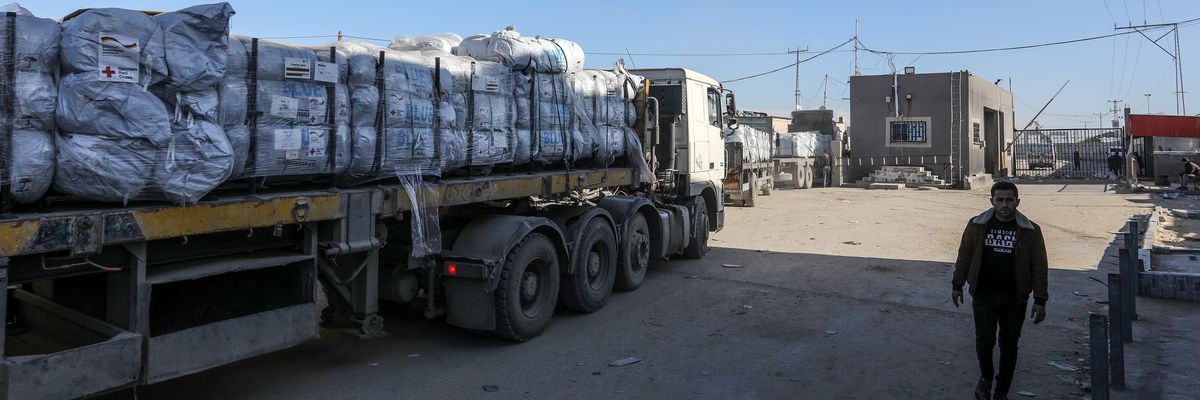
Trucks carrying aid supplies to Gaza are seen at the Karem Abu Salem border crossing on February 17, 2024. (Photo: Abed Rahim Khatib/Anadolu via Getty Images)

“Over 11 months, we have reached shocking levels of conflict, displacement, disease, and hunger,” said one campaigner.

Israel’s “complete siege” of the Gaza Strip “is driving a humanitarian disaster,” with 83% of required food aid failing to enter the embattled enclave, where the entire population is facing hunger and disease and almost half a million Palestinians are at risk of starvation, an analysis published Monday revealed.starvation,

The analysis by 15 international aid organizations noted that a record-low average of just 69 aid trucks are entering the Gaza Strip each day, compared with an already insufficient 500 daily truckloads a year ago. Additionally, the groups said that “only 17 out of Gaza’s 36 hospitals remain partially functional, and “critical infrastructure such as water networks, sanitation facilities, and bread mills” have been destroyed.

“While Israeli military attacks on Gaza intensify, lifesaving food, medicine, medical supplies, fuel, and tents have been systematically blocked from entering for almost a year,” the aid groups—which include ActionAid, American Friends Service Committee, CARE International, Christian Aid, Islamic Aid, Oxfam International, and Save the Children—said in a statement.

The publication highlights numerous ways that “lifesaving aid is systematically obstructed on a daily basis” in Gaza.

“These include the denial of safety, with more than 40,000 Palestinians and nearly 300 aid workers killed since last October; the sharp tightening of a 17-year blockade to a full siege, which prevents aid from entering Gaza; delays and denials which restrict the movement of aid around Gaza; tightly restrictive and unpredictable control of imports; the destruction of public infrastructure such as schools and hospitals; and the displacement of civilians and humanitarian workers,” the analysis’ authors wrote.

Zenab, a 33-year-old Palestinian woman pregnant with her second child, said that her pregnancy “has been the hardest time of my life.”

“It was also hard to get the medication I needed,” she continued. Sometimes I had to walk for hours to different pharmacies, hospitals, and health centers to see if anyone had my medication available. For me as a pregnant woman, there has been hardly any healthcare support, no proper hygiene and sanitation, and no suitable mattress to sleep on.”

“I was suffering from complications during my pregnancy,” Zenab added. “We didn’t have enough water to drink, and had hardly any food. The doctors again told me that my pregnancy was in danger.”

Among the report’s key findings:

  • 83% of required food aid doesn’t make it into Gaza, up from 34% in 2023;
  • An estimated 50,000 children aged between 6-59 months urgently require treatment for malnutrition by the end of the year;
  • 65% of the insulin required and half of the required blood supply are not available in Gaza;
  • Availability of hygiene items has dropped to 15% of the amount available in September 2023, with 1 million women now going without the hygiene supplies they need;
  • Only around 1,500 hospital beds in Gaza remain operational, compared to around 3,500 beds in 2023 which was already well below sufficient to meet the needs of a population of more than 2 million people; and
  • 1.87 million people are in need of shelter with at least 60% of homes destroyed or damaged as of January, yet tents for around just 25,000 people have entered Gaza since May 2024.

“There is a shortage of all humanitarian items. We are overwhelmed [with] these needs and [these] urgent requirements,” said Amjad Al Shawa, director of the Palestinian NGOs Network. “People [are] starving due to the shortage of aid. One hundred percent of the population depends on humanitarian aid.”

The authors of the analysis—which was released ahead of this week’s United Nations General Assembly in New York—are demanding that Israel secure an immediate and lasting cease-fire. They are also calling for an arms embargo on Israel and Israeli compliance with the recent International Court of Justice (ICJ) advisory opinion, which found that the occupation of Palestine is an illegal form of apartheid that must end immediately. Israel is on trial for genocide in a separate ICJ case.

“The situation was intolerable long before last October’s escalation and is beyond catastrophic now.”

“The situation was intolerable long before last October’s escalation and is beyond catastrophic now,” CARE International West Bank and Gaza country director Jolien Veldwijik said in a statement. “Over 11 months, we have reached shocking levels of conflict, displacement, disease, and hunger.”

That includes dozens of children who have died due to malnutrition, dehydration, and lack of adequate medical care.

“Aid is still not getting in, and humanitarian workers are risking their lives to do their jobs while attacks and violations of international law intensify,” Veldwijik added. “Aid, which is urgently required for 2.2 million people at risk of dying in the coming weeks and months, should never be politicized. We demand an immediate and sustained cease-fire, and the free flow of humanitarian aid into and throughout Gaza.”

Original article by Brett Wilkins republished from Common Dreams under Creative Commons (CC BY-NC-ND 3.0). 

Continue ReadingAnalysis Details How Israel’s Gaza Siege ‘Is Driving a Humanitarian Disaster’

Plight of children in Gaza ‘beyond anything I’ve ever seen before’, British nurse says

Spread the love

https://morningstaronline.co.uk/article/plight-of-children-in-gaza-beyond-anything-ive-ever-seen-before-british-nurse-says

Screen grab from PA video of Becky Platt, a British paediatric nurse who provided aid for children with shattered and amputated limbs from airstrikes in Gaza described what she encountered as “beyond anything I’ve ever seen before”, August 2, 2024.

A BRITISH nurse has described the plight of children in Gaza as “beyond anything I’ve ever seen before.”

Becky Platt, 50, treated youngsters with shattered and amputated limbs from Israeli bombing raids at a Gaza hospital in April.

She described the healthcare situation as broken and in dire need for medicine and other aid.

“When I first arrived, I remember seeing small children and toddlers picking through rubbish in the middle of the road, unaccompanied children, picking up things and eating [them],” she said.

“Multiple children had spinal injuries or pelvic injuries, which meant that they were unable to walk, and may always be unable to walk.

“These are children that have had their limbs blown off and what we’ve got to offer them is paracetamol and ibuprofen because all of the supply chains have broken down, and it’s really difficult to get hold of anything stronger than that.

“In addition to that, there are multiple children, thousands affected by all of the problems that are associated with living in poor hygiene conditions and overcrowded areas.”

The advanced clinical practitioner at a London paediatric A&E, who visited the hospital for charity Save the Children, told of how children couldn’t look at their amputated limbs and how one boy “who had his femur shattered when he was near where a bomb landed when he was playing with his friends — he lost his six best friends, and he dreams about those boys every single night.

“When he closes his eyes, they’re there — that kind of psychological distress is something that maybe they’ll never get over.

“They need significant help with that and they need it urgently. There’s an absolute dire need for aid at the moment.”

More than 20,000 children are estimated to be lost, disappeared, detained or buried under rubble, according to recent analysis from Save the Children.

Liz Bradshaw, senior conflict and humanitarian adviser at Save the Children UK, said: “Becky’s experiences in Gaza highlight the critical need for immediate action.

“We urge the international community to support our efforts and provide the necessary resources to help children enduring horrific violence from the ongoing Israeli bombardment.

“The world cannot keep standing by as these children suffer. An immediate and definitive ceasefire is the only way to save lives in Gaza and end grave and serious violations of their rights.”

“In addition to that, there are multiple children, thousands affected by all of the problems that are associated with living in poor hygiene conditions and overcrowded areas.”

https://morningstaronline.co.uk/article/plight-of-children-in-gaza-beyond-anything-ive-ever-seen-before-british-nurse-says

Continue ReadingPlight of children in Gaza ‘beyond anything I’ve ever seen before’, British nurse says

UN Probe Finds ‘Appalling Acts’ of Torture Against Palestinians Detained by Israel

Spread the love

Original article by EDWARD CARVER republished from Common Dreams under Creative Commons (CC BY-NC-ND 3.0).

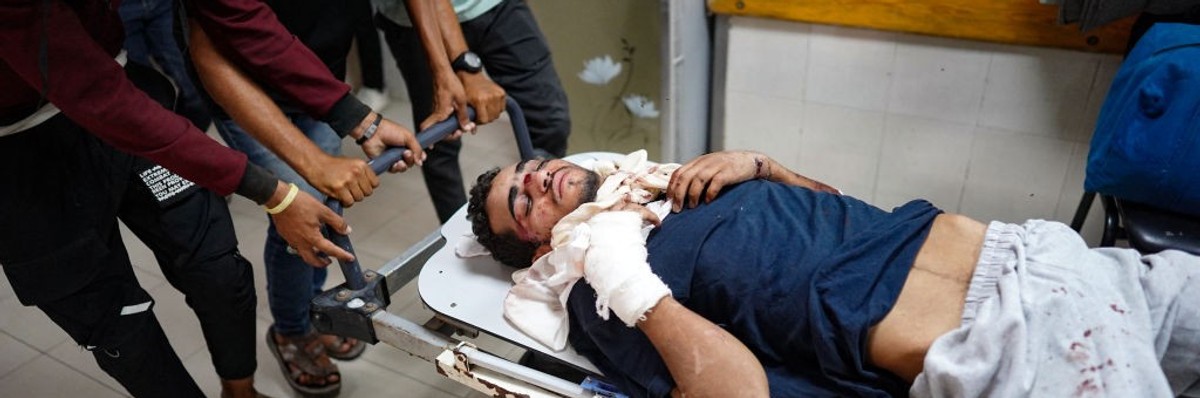
Palestinian Faouzi Abdel Aal, 21, is rushed to Nasser hospital in the southern Gaza Strip to receive treatment for his injuries, after being reportedly released from an Israeli detention center on July 25, 2024. (Photo: Bashar Taleb/AFP via Getty Images)

The U.N. report found evidence of sexual violence, waterboarding, and the use of dogs against detainees, many of whom were deprived of food, water, sleep, and toilet access.

The Office of the United Nations High Commissioner for Human Rights on Wednesday released a report detailing torture and abuse of Palestinians at Israeli detention centers, including sexual violence, waterboarding, and the use of dogs.

Israeli security forces have also used electric shocks, burned detainees with cigarettes, and deprived them of food, water, sleep, and toilet access, according to the 23-page OHCHR report, based largely on interviews with released detainees. Some detainees said they were held with their arms suspended from the ceiling; were forced to be naked for prolonged periods, wearing only diapers; and were blindfolded for extended periods.

Israel security forces have arrested thousands of Palestinians from the West Bank and Gaza since October, many of them arbitrarily; they held more than 9,400 “security detainees” as of the end of June, often in secret and incommunicado, without providing a reason for the detainment, the report says.

“The testimonies gathered by my office and other entities indicate a range of appalling acts, such as waterboarding and the release of dogs on detainees, amongst other acts, in flagrant violation of international human rights law and international humanitarian law,” U.N. Human Rights chief Volker Türk said in a statement accompanying the report.

Most of the detainees have been men and adolescent boys, though some are also women and adolescent girls, and there are many reported instances of sexual and gender-based violence, the report says, including “the forced nudity of both men and women; beatings while naked, including on the genitals; electrocution of the genitals and anus; being forced to undergo repeated humiliating strip searches; widespread sexual slurs and threats of rape; and the inappropriate touching of women by both male and female soldiers.”

OHCHR also said it had video evidence of detainees filmed in “deliberately humiliating positions” while handcuffed and blindfolded, and noted it received “consistent reports” of Israeli security forces “inserting objects into detainees’ anuses.”

Some detainees also reported “cage-like” facilities and overcrowding. The report says that 13 to 20 male detainees were kept in cells designed for five people, forcing many to sleep on the floor. There were “poor living, hygiene, and health conditions, with reports of water running only one hour per day over several weeks” and detainees faced “exposure to cold temperatures due to the confiscation of blankets and removal of windows panes in cold weather.”

At least 53 Palestinian detainees have died in Israeli detention centers since October, according to the report, which suggests that the detention system appears “to constitute a collectively punitive measure against Palestinians,” citing the words of Itamar Ben-Gvir, Israel’s minister of national security, who has said that “terrorists” deserve the most “stringent conditions.” Male detainees reported losing between about 55 and 120 pounds while in custody.

The OHCHR report comes as a highly controversial case involving detention abuse unfolds in Israel. The Israeli military is investigating nine soldiers for alleged “substantial abuse” of a Palestinian detainee who reportedly had to be hospitalized and could not walk after they attacked him. Far-right Israeli groups and political figures have protested the investigation.

Concern about Israeli detentions of Palestinians has been high for many months. In January, a Palestinian watchdog group issued a report condemning the forced disappearance of Gazans, and The New York Times found evidence of detainees being stripped and beaten.

Not all of the alarms about the situation in Israeli detentions centers have come from abroad. In February, Israeli’s public defender’s office issued a report calling for improved prison conditions, including for Palestinians. In April, local human rights groups called for a closure of the Sde Teiman military base detention center, due to its notorious conditions.

The calls were prompted in part by gruesome reports including amputations of detainees’ limbs due to handcuff injuries. The United Nations Relief and Works Agency for Palestine Refugees in the Near East then issued a damning report on detainee treatment, including of its own staff, some of whom had been detained and subjected to harsh interrogation.

Last week, Save the Children called for an end to the Israel’s arbitrary detainment of Palestinian minors, with a regional director saying that “these children are trapped, unable to move or see the sun, forced into crowded cells with appalling, unsanitary conditions, and subject to severe abuse and violence.”

Experts said Wednesday that the OHCHR report served mainly to confirm previous findings on Israeli detention centers. Neil Sammonds, a campaigner at the U.K.-based progressive advocacy group War on Want, said on social media that leaders of the new U.K. government haven’t spoken up about abuses at Israeli detention centers. He also said that the report could be used as evidence by the International Criminal Court, which has sought arrest warrants for both Israeli and Hamas leaders.

The new report also addresses abuses of Israelis held by Hamas and affiliated groups. The Palestinian militants killed roughly 1,200 people in a horrific set of attacks in southern Israel on October 7 and kidnapped about 250 Israelis, more than 100 of whom have since been released. Like Palestinian detainees, the released Israelis reported “appalling” conditions, the report says, including beatings, receiving surgery without anesthetic, and sexual and gender-based violence. The Israeli government has reported that 44 of the remaining hostages in Gaza have died.

Both Israel and Hamas have refused to allow the International Committee of the Red Cross to visit detainees or hostages. The OHCHR called for both sides to allow such independent monitoring.

Original article by EDWARD CARVER republished from Common Dreams under Creative Commons (CC BY-NC-ND 3.0).

Report From Gaza Aid Agencies Shows ‘Catastrophe on an Entirely New Level’

Iranian American Group Says Biden Must Change Course to Avert ‘Bloody Regional War’

Netanyahu Accused of Sabotaging Cease-Fire Talks With Assassination of Hamas Leader

Continue ReadingUN Probe Finds ‘Appalling Acts’ of Torture Against Palestinians Detained by Israel

Over 20,000 Children Missing in Gaza, With ‘Unknown Number’ in Mass Graves: Report

Spread the love

Original article by JAKE JOHNSON republished from Common Dreams under Creative Commons (CC BY-NC-ND 3.0).

A woman stands holding a child surrounded by the rubble of buildings destroyed by Israeli airstrikes in Khan Younis, Gaza on June 23, 2024.
 (Photo: Eyad Baba/AFP via Getty Images)

“No parent should have to dig through rubble or mass graves to try and find their child’s body,” said the Save the Children’s regional director for the Middle East.

The humanitarian group Save the Children estimated Monday that around 21,000 kids are missing in the Gaza Strip as Israel’s military continues its assault on the enclave, reducing much of the Palestinian territory to rubble.

Roughly 4,000 kids are likely buried under that debris, according to Save the Children, while at least 17,000 are unaccompanied, an “unknown number” are in mass graves, and others have been “detained and forcibly transferred out of Gaza, their whereabouts unknown to their families amidst reports of ill-treatment and torture.”

A child protection specialist with Save the Children said that the group finds more unaccompanied children every day in Gaza, where parents and entire families have been wiped out by Israel’s relentless bombing campaign and ground invasion.

“We work through partners to identify separated and unaccompanied children and trace their families, but there are no safe facilities for them—there is no safe place in Gaza,” said the Save the Children specialist. “Besides, reuniting them with family members is difficult when ongoing hostilities restrict our access to communities, and constantly force families to move.”

“Neighbors and extended family members who have taken in lone children are struggling to meet their basic needs, such as shelter, food, and water,” they added. “Many are with strangers—or completely alone—increasing the risk of violence, abuse exploitation, and neglect.”

“We desperately need a cease-fire to find and support the missing children who have survived, and to prevent more families from being destroyed.”

More than 14,000 children have been killed by Israeli forces in the Gaza Strip since October 7, and many others have experienced devastating psychological and physical trauma, including the loss of limbs. Dozens of children have also been starved to death in recent months as Israel’s blockade hinders the flow of lifesaving humanitarian assistance.

Conditions for children have further deteriorated since Israel’s invasion of Rafah, which has forced roughly a million people to flee the city. Last month, Israeli forces used U.S.-made bombs in an attack on a Rafah camp sheltering displaced people, killing dozens—including women and children. The United Nations Human Rights Office said that infants were “torn apart” in the attack and people were “trapped inside burning plastic tents, leading to a horrific casualty toll.”

Save the Children stressed Monday that its count of Gaza’s missing kids is far from conclusive, given the difficulty of collecting accurate information in areas under near-constant attack. The group noted that “confirming identification of a body by the next of kin is almost impossible when whole families have been wiped out and entry restrictions mean the equipment and experts needed cannot get in.”

Jeremy Stoner, Save the Children’s regional director for the Middle East, said that “families are tortured by the uncertainty of the whereabouts of their loved ones.”

“No parent should have to dig through rubble or mass graves to try and find their child’s body. No child should be alone, unprotected in a war zone. No child should be detained or held hostage,” said Stoner. “Children who are missing but living are vulnerable, face grave protection risks, and must be found. They must be protected and reunited with their families. For the children who have been killed, their deaths must be formally marked, their families informed, burial rites respected, and accountability sought.”

“As many have pointed out, Gaza has become a graveyard for children, with thousands of others missing, their fates unknown,” he added. “There must be an independent investigation and those responsible must be held accountable. We desperately need a cease-fire to find and support the missing children who have survived, and to prevent more families from being destroyed.”

Original article by JAKE JOHNSON republished from Common Dreams under Creative Commons (CC BY-NC-ND 3.0).

Zionist Keir Starmes is quoted "I support Zionism without qualification." He's asked whether that means that he supports Zionism under all circumstances, whatever Zionists do.
Zionist Keir Starmes is quoted “I support Zionism without qualification.” He’s asked whether that means that he supports Zionism under all circumstances, whatever Zionists do.

Continue ReadingOver 20,000 Children Missing in Gaza, With ‘Unknown Number’ in Mass Graves: Report

Oxfam Says Israel ‘Actively Hindering’ Aid to Gaza in Violation of ICJ Order

Spread the love

Original article by JAKE JOHNSON republished from Common Dreams under Creative Commons (CC BY-NC-ND 3.0). 

Palestinian children in Rafah, Gaza gather to receive food distributed by aid organizations on March 15, 2024.  (Photo: Jehad Alshrafi/Anadolu via Getty Images)

“There is an indisputable, man-made, intentional deprivation of aid that continues to suck the life out of any and all humanitarian operations, including our own,” said one campaigner.

The Israeli government is intentionally restricting the flow of humanitarian aid to the Gaza Strip by subjecting shipments to a prolonged and dysfunctional inspection process, arbitrarily rejecting items, attacking aid convoys, and limiting the number of crossings through which deliveries can pass, Oxfam International said in a report published late Sunday.

The report, titled Inflicting Unprecedented Suffering and Destruction, argues that Israel’s continued obstruction of humanitarian aid is a direct violation of both international humanitarian law (IHL) and a January order from the International Court of Justice (ICJ), which ruled the Israeli government is “plausibly” committing genocide in Gaza and must ensure that assistance reaches desperate Gazans.

Oxfam said Sunday that “humanitarian access in the Gaza Strip has effectively worsened” since the ICJ handed down its interim order nearly two months ago, and conditions on the ground in the Palestinian territory have deteriorated rapidly. New data from the Integrated Food Security Phase Classification (IPC) shows that Gaza’s “entire population” is facing “high levels of acute food insecurity” and 1.1 million people are experiencing “catastrophic” hunger—a figure that one expert called “unprecedented.”

“The ICJ order should have shocked Israeli leaders to change course, but since then conditions in Gaza have actually worsened,” said Sally Abi Khalil, Oxfam’s Middle East and North Africa director. “The fact that other governments have not challenged Israel hard enough, but instead turned to less effective methods like airdrops and maritime corridors is a huge red flag, signaling that Israel continues to deny the full potential of better ways to deliver more aid.”

“Israeli authorities are not only failing to facilitate the international aid effort but are actively hindering it,” Abi Khalil added. “We believe that Israel is failing to take all measures within its power to prevent genocide.”

In its new report, Oxfam outlines seven ways in which the Israeli government is impeding humanitarian aid shipments and exacerbating one of the worst humanitarian catastrophes in modern history:

In February—the first full month after the ICJ’s order—Israel allowed just 2,874 aid trucks to enter the Gaza Strip, a 44% decline compared to the previous month, according to Oxfam.

The group said Israeli authorities “have rejected a warehouse full of international aid including oxygen, incubators, and Oxfam water and sanitation gear, all of which is now stockpiled at Al Arish just 40 kilometers away from the border of 2.3 million desperate Palestinians in Gaza.”

Israel’s military, which is armed by the U.S. and other major countries that are legally obligated to prevent genocide, has also blocked humanitarian staff from entering Gaza, adding “pressure and workload” to already overwhelmed aid efforts, Oxfam said.

Celine Maayeh, advocacy and research officer at Juzoor for Health and Social Development—an Oxfam partner organization—said Sunday that “there’s been an alarming increase in cases of malnutrition among children in the last month, and yet the only food the team is able to find to feed people living in 45 shelters is some vegetables.”

“There is an indisputable, man-made, intentional deprivation of aid that continues to suck the life out of any and all humanitarian operations, including our own,” said Maayeh.

“If a famine is declared, it will already be too late for too many people—children are famine’s first victims and are already dying in Gaza because of malnutrition.”

Oxfam’s findings are consistent with those of other aid organizations and lawmakers who have visited the region in recent weeks.

In January, U.S. Sens. Jeff Merkley (D-Ore.) and Chris Van Hollen (D-Md.) told reporters that they witnessed “miles of backed-up trucks” stuck at border crossings as Gazans nearby struggled to survive, eating grass and drinking contaminated water.

The senators said they saw one warehouse full of items that Israeli authorities rejected in their inspection process, including oxygen cylinders and medical kits used for delivering babies.

Van Hollen said the warehouse was “a testament to the arbitrariness” of Israel’s inspections.

Oxfam argued Sunday that the “only meaningful solution” to Gaza’s intensifying humanitarian emergency is “an immediate, permanent, and unconditional cease-fire.”

“Even the trickle of aid that a humanitarian response could provide under the current circumstances is being further obstructed by Israel’s policies and practices, inflicting suffering on millions of Palestinians who are living under Israeli bombardment without access to food, clean water, and medical care,” the group said.

Xavier Joubert, country director for Save the Children in the occupied Palestinian territory, echoed Oxfam’s call for a cease-fire and warned in response to the new IPC figures that “we have a clear timeframe to stave off famine, and it demands urgency.”

“If a famine is declared, it will already be too late for too many people—children are famine’s first victims and are already dying in Gaza because of malnutrition,” said Joubert. “Every minute counts for them. It should be on the collective conscience of Israeli authorities and the international community that every day without an immediate, definitive cease-fire and unfettered access for and to humanitarian aid is another catastrophic day of starvation and suffering, another step towards famine, and another death knell for Gaza’s children.”

Original article by JAKE JOHNSON republished from Common Dreams under Creative Commons (CC BY-NC-ND 3.0). 

Continue ReadingOxfam Says Israel ‘Actively Hindering’ Aid to Gaza in Violation of ICJ Order